At Pearson, we have a simple mission: to help people make more of their lives through learning
We combine innovative learning technology with trusted content and educational expertise to provide engaging and effective learning experiences that serve people wherever and whenever they are learning.
From classroom to boardroom, our curriculum materials, digital learning tools and testing programmes help to educate millions of people worldwide – more than any other private enterprise.
Every day our work helps learning flourish, and wherever learning flourishes, so do people.
To learn more please visit us at www.pearson.com/uk
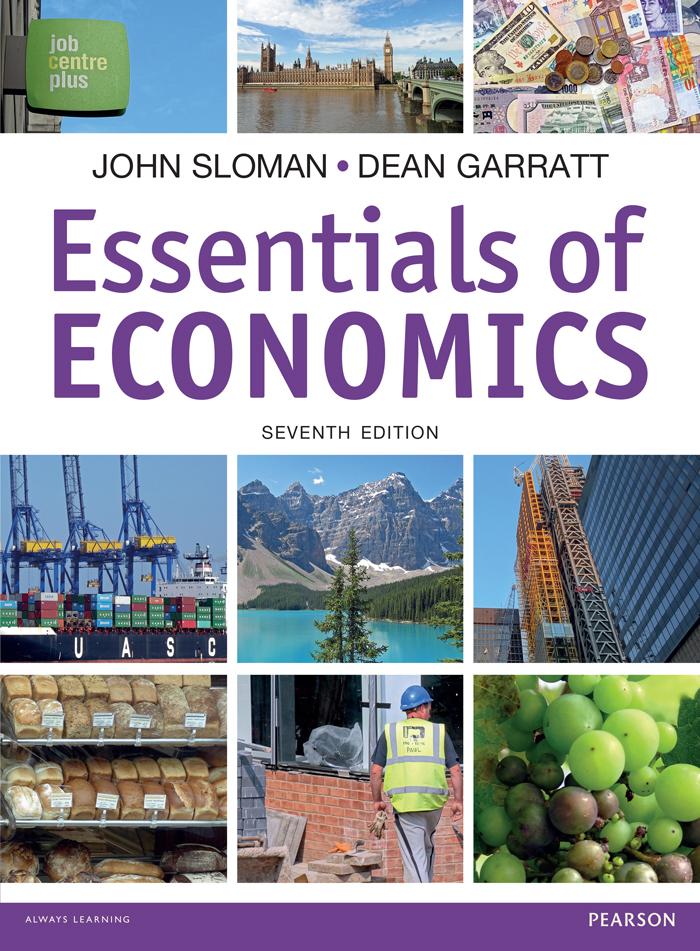
EssEntials of Economics
Seventh edition
John Sloman
The Economics Network, University of Bristol
Visiting Professor, University of the West of England
Dean Garratt
Nottingham Business School
Pearson Education Limited
Edinburgh Gate
Harlow CM20 2JE
United Kingdom
Tel: +44 (0)1279 623623
Web: www.pearson.com/uk
First edition published 1998 (print)
Second edition published 2001 (print)
Third edition published 2004 (print)
Fourth edition published 2007 (print)
Fifth edition published 2010 (print)
Sixth edition published 2013 (print and electronic)
Seventh edition published 2016 (print and electronic)
The rights of John Sloman, and Dean Garratt to be identified as authors of this Work have been asserted by them in accordance with the Copyright, Designs and Patents Act 1988.
The print publication is protected by copyright. Prior to any prohibited reproduction, storage in a retrieval system, distribution or transmission in any form or by any means, electronic, mechanical, recording or otherwise, permission should be obtained from the publisher or, where applicable, a licence permitting restricted copying in the United Kingdom should be obtained from the Copyright Licensing Agency Ltd, Saffron House, 6–10 Kirby Street, London EC1N 8TS.
The ePublication is protected by copyright and must not be copied, reproduced, transferred, distributed, leased, licensed or publicly performed or used in any way except as specifically permitted in writing by the publishers, as allowed under the terms and conditions under which it was purchased, or as strictly permitted by applicable copyright law. Any unauthorised distribution or use of this text may be a direct infringement of the author’s and the publishers’ rights and those responsible may be liable in law accordingly.
All trademarks used therein are the property of their respective owners. The use of any trademark in this text does not vest in the author or publisher any trademark ownership rights in such trademarks, nor does the use of such trademarks imply any affiliation with or endorsement of this book by such owners.
Contains public sector information licensed under the Open Government Licence (OGL) v3.0. http://www. nationalarchives.gov.uk/doc/open-government-licence/version/3/.
Pearson Education is not responsible for the content of third-party internet sites
Typeset in Stone Serif ITC Pro 8/12 by Lumina Datamatics
Printed and bound by L.E.G.O. S.p.A., Italy
NOTE THAT ANY PAGE CROSS REFERENCES REFER TO THE PRINT EDITION
about the authors
John Sloman is Visiting Fellow at the University of Bristol and Associate of the Economics Network (www.economicsnetwork.ac.uk) a UK-wide organisation, where, until his retirement in 2012, he was Director. The Economics Network is based at the University of Bristol and provides a range of services designed to promote and share good practice in learning and teaching economics. The Network is supported by grants from the Royal Economic Society, the Scottish Economic Society and university economic departments and units from across the UK.
John is also visiting professor at the University of the West of England, Bristol, where, from 1992 to 1999, he was Head of School of Economics. He taught at UWE until 2007.
John has taught a range of courses, including economic principles on social science and business studies degrees, development economics, comparative economic systems, intermediate macroeconomics and managerial economics. He has also taught economics on various professional courses.
He is also the co-author with Alison Wride and Dean Garratt of Economics (Pearson Education, 9th edition 2015),
Dean Garratt is a Principal Lecturer in Economics at Nottingham Business School (NBS), Assistant Head of Economics and the course leader for the School’s MSc Economics programme. In 2014/15 Dean worked as a Principal Teaching Fellow in Economics at the University of Warwick having previously been at NBS from 2001, including a period as course leader for the undergraduate economics courses.
Dean teaches economics at a variety of levels to students both on economics courses and non-economics courses. He is passionate about encouraging students to communicate economics more intuitively, to deepen their interest in economics and to apply economics to a range of issues.
Earlier in his career Dean worked as an economic assistant at both HM Treasury and at the Council of Mortgage Lenders. While at these institutions Dean was researching
with Dean Garratt, Jon Guest and Elizabeth Jones of Economics for Business (Pearson Education, 7th edition 2016) and with Elizabeth Jones of Essential Economics for Business (4th edition 2014). Translations or editions of the various books are available for a number of different countries with the help of co-authors around the world.
John is very interested in promoting new methods of teaching economics, including group exercises, experiments, role playing, computer-aided learning and use of audience response systems and podcasting in teaching. He has organised and spoken at conferences for both lecturers and students of economics throughout the UK and in many other countries.
As part of his work with the Economics Network he has contributed to its two sites for students and prospective students of economics: Studying Economics (www. studyingeconomics.ac.uk) and Why Study Economics? (www.whystudyeconomics.ac.uk)
From March to June 1997, John was a visiting lecturer at the University of Western Australia. In July and August 2000, he was again a visiting lecturer at the University of Western Australia and also at Murdoch University in Perth.
In 2007, John received a Lifetime Achievement Award as ‘outstanding teacher and ambassador of economics’ presented jointly by the Higher Education Academy, the Government Economic Service and the Scottish Economic Society.
and briefing on a variety of issues relating to the household sector and to the housing and mortgage markets.
Dean is a Senior Fellow of the Higher Education Academy and an Associate of the Economics Network helping to promote high-quality teaching practice. Dean has been involved in several projects promoting a problem-based approach in the teaching of economics.
In 2006 Dean was awarded the Outstanding Teaching Prize by the Economics Network. The award recognises exemplary teaching practice that deepens and inspires interest in economics. In 2013, Dean won the student-nominated Nottingham Business School teacher of the year award.
Dean is an academic assessor for the Government Economic Service (GES). In this role he helps to assess potential recruits to the GES with particular focus on the ability of candidates to articulate their understanding of economics and its applications.
Outside of work, Dean is an avid watcher of most sports. Having been born in Leicester, he is a season ticket holder at both Leicester City Football Club and Leicestershire County Cricket Club.
This page intentionally left blank
This page intentionally left blank
3.7
3.1
3.3
3.4
3.5
3.6
5.5
5.1 E-commerce: A return of power to the people?
5.2 Breaking sky’s monopoly on live premier league football: The sky is the limit for the English Premier League
5.3 OPEC – the rise and fall and rise again of a cartel: The history of the world’s most famous cartel
5.4 The power of oligopoly: Energising competition in the UK energy sector
5.5 The prisoners’ dilemma
5.6 Profit-maximising prices and output for a third-degree price discriminating firm: Identifying different prices in different markets
chapter
6.1
Part c M A cro E co N o MI c S
8.1 The household sector balance sheets:
8.2 Sentiment and spending: Does sentiment help to forecast spending?
8.3 The distinction between real and nominal values:
8.4 Trying to make sense of economic data:
9 Aggregate supply and growth
9.4
9.1
9.3
9.4
11.6
11.1
11.2
11.3
11.4
12.1
Part D I NTE r NATI o NA l Eco N o MI c
13.3 Do we exploit foreign workers by buying cheap foreign imports?
13.4 The Doha Development Agenda: A new direction for the WTO?
13.5 Features of the single market
13.6 The Chinese ‘economic miracle’: Riding the dragon 392
14.1 The balance of payments account
14.2 Exchange rates
Determination of the rate of exchange in a free market
14.3 Exchange rates and the balance of payments 405
Exchange rates and the balance of payments: no government or central bank intervention 405 Exchange rates and the balance of payments: with government or central bank intervention 406
14.4 Fixed versus floating exchange rates 407
Advantages of fixed exchange rates
Disadvantages of fixed exchange rates 408 Advantages of a free-floating exchange rate
Disadvantages of a free-floating exchange rate
Exchange rates in practice
14.5 The origins of the euro 413 The ErM
The Maastricht Treaty and the road to the single currency
14.6
and monetary union (EMU)
chapter 14 Boxes 14.1 Nominal and real exchange rates: Searching for a real advantage
14.2 Dealing in foreign currencies: A daily juggling act
14.3 The importance of international financial movements: How a current account deficit can coincide with an appreciating exchange rate 409
14.4 The euro/dollar see-saw: Ups and downs in the currency market
14.5 Optimal currency areas: When it pays to pay in the same currency
custom publishing
Custom publishing allows academics to pick and choose content from one or more textbooks for their course and combine it into a definitive course text.
Here are some common examples of custom solutions which have helped over 1000 courses across Europe:
■ different chapters from across our publishing imprints combined into one book;
■ lecturer’s own material combined together with textbook chapters or published in a separate booklet;
■ third-party cases and articles that you are keen for your students to read as part of the course;
■ any combination of the above.
The Pearson Education custom text published for your course is professionally produced and bound – just as you would expect from any Pearson Education text. Since many of our titles have online resources accompanying them we can even build a Custom website that matches your course text.
If you are teaching a first year Economics course you may have a large teaching team with different lecturers teaching the micro and macroeconomics sections. Do you find that it can be difficult to agree on one textbook? If you do, you might find combining the macro and micro halves from different Pearson textbooks a useful solution. You may teach a mixed ability class and would like to be able to provide some advanced material from Sloman’s larger economics text or perhaps you take more of a business focus where chapters from Sloman’s Economics for Business might be useful.
Custom publishing has enabled adopters of this text to employ these different solutions.
If, once you have had time to review this title, you feel Custom publishing might benefit you and your course, please do get in contact. However minor, or major the change – we can help you out.
For more details on how to make your chapter selection for your course please go to www.pearsoned.co.uk/sloman and select the custom publishing link.
You can contact us at: www.pearsoncustom.co.uk or via your local representative at: www.pearsoned.co.uk/replocator.
Student Resources
General Resources (open access)
News Blog site
Current News Articles with Questions
Archive Searchable by Chap or Month
Hotlinks to over 200 sites Animated Models with Audio (demo)
Study Plan (exercises)
Homework Quizzes and Tests
Calendar for Homework and Tests
Results Results Assigned Homework Practice and Assigned Tests
MyEconLab (access using pincode in book)
Glossary Flashcards
Chapter Resources
Animated Models with Audio (iPod)
Case Studies Web Appendices
Multiple-choice Questions and Answers Answers to Questions in Book
Odd-numbered End-of-chapter Questions
Glossary Threshold Concepts and Key Ideas
Other Resources for Book
Ebook to View Any Chapter Online
Grapher to Make Your Own Graphs
MyEconLab Help
Pause for Thought Questions
Animted in full colour for projection Non-animated for OHTs
Figures and Tables Models (animated) Lecture plans Animated in full colour for projection Non-animated for OHTs With questions Without questions
Audience Response System
(for show of hands, etc.)
Workshops (one per chapter)
Answers to Workshops
Student Case Studies Teaching/ learning Case Studies
Case Studies Web Appendices
Answers to Case Study Questions Answers to Web Appendix Questions
Welcome to this introduction to economics. Whether you are planning to study economics beyond this level, or whether this will be your only exposure to this fascinating subject, we hope that you will find the book enjoyable and that it will give you some insight into the economy in which you live and the economic forces that shape all our lives.
Although you have probably never studied the subject before, you will almost certainly know quite a lot of economics already. After all, you make economic decisions virtually every day of your life. Every time you go shopping, you are acting as an ‘economist’: deciding what to buy with your limited amount of money. And it is not just with decisions about buying that we act as economists. How much to work (something that students are increasingly forced to do nowadays), how much to study, even how much time to devote to various activities during the course of the day, are all, in a way, economic choices.
To satisfy us as consumers, goods and services have to be produced. We will therefore study the behaviour of firms and what governs the decisions that they make. How will the decisions of big businesses differ from those of small firms? How will the degree of competition affect the extent to which we gain or lose from the activities of firms?
In analysing economic choices we look at some of the big economic issues that face us all as members of society in the twenty-first century. Despite huge advances in technology, and despite the comfortable lives led by many people in the industrialised world, we continue to suffer from volatile economic growth, industrial change and unemployment and all the insecurity that these bring. We continue to witness poverty and inequality, and in many countries the gap between rich and poor has actually grown wider; our environment is polluted; our growing affluence as consumers is increasingly bought at the expense of longer hours at work and growing levels of stress.
We live in a highly interdependent world where actions have implications elsewhere. The banking crisis of the late 2000s and the subsequent effect on economies and the financial well-being of people, businesses and governments illustrates starkly how individual choices can have not only national but global effects.
So what can be done about these problems? This book seeks not only to analyse these problems but also to examine the sorts of policies that governments might pursue in their attempt to address them.
The book is designed with one overriding aim: to make this exciting and highly relevant subject as clear to understand as possible. To this end, the book has a number of important features:
■ A direct and straightforward written style; short paragraphs to aid rapid comprehension. The aim all the time is to provide maximum clarity.
■ A careful use of colour to guide you through the text and make the structure easy to follow.
■ Key ideas highlighted and explained where they first appear. These ideas are key elements in the economist’s ‘toolkit’. Whenever they recur later in the book, an icon appears in the margin and you are referred back to the page where they are defined and explained. All the key ideas are gathered together at the beginning of the Glossary.
■ Some of the key ideas are particularly important in affecting the way we see the world: they help us think like economists. We call these ‘threshold concepts’ and there are 15 of these.
■ Clear chapter-opening pages, which set the scene for the chapter. They also highlight the issues that will be covered in the chapter and can thus be seen as ‘learning objectives’.
■ Summaries at the end of each section (rather than each chapter). These provide a very useful means of revising and checking your understanding as you progress.
■ Definitions of all technical terms given at the foot of the page where the term is first used. The term itself is highlighted in the text.
■ ‘Pause for thought’ questions integrated in the text. These are designed to help you reflect on what you have just read and to check on your understanding. Answers to all ‘pause for thought’ questions are given in MyEconLab.
■ A comprehensive index, including reference to all defined terms. This enables you to look up a definition as required and to see it used in context.
■ An alphabetical glossary at the end of the book. This gathers together all the defined terms.
■ Plentiful use of up-to-date examples to illustrate the arguments. This helps to bring the subject alive and puts it in context.
■ Review questions at the end of each chapter for either individual or class use.
■ Answers to all odd-numbered questions are given in MyEconLab. These questions will be helpful for selftesting, while the even-numbered ones can be used for class testing.
■ Many boxes (typically four to six per chapter) providing case studies, news items, applications, or elaborations of the text. The boxes are of two types: Case Studies and Applications; and Exploring Economics.
■ A comprehensive set of web references at the end of each of the four parts of the book. Each reference is numbered to match those in the Web Appendix at the end of the book.
You can easily access any of these sites from this book’s own website (at http://www.pearsoned.co.uk/sloman). When you enter the site, click on Hot Links. You will find all the sites from the Web Appendix listed. Click on the one you want and the ‘hot link’ will take you straight to it.
■ Appendices for most chapters appear in MyEconLab. These Web Appendices take the argument further than in the text and look at some more advanced theories. Whilst none of these is necessary for studying this book, and many courses will not refer to them, they provide the necessary additional material for more advanced courses that still require a short textbook.
Good luck with your studies, and have fun. Perhaps this will be just the beginning for you of a lifelong interest in economic issues and the economy.
t o l E ctur E rs an D tutors
This seventh edition of Essentials of Economics is an abridged version of Economics, 9th edition (John Sloman, Alison Wride and Dean Garratt). Some passages have been directly transcribed, while others have been extensively rewritten in order to provide a consistent coverage of the ‘essentials’ of economics. Like Economics, 9th edition, the book attempts to address the concerns expressed by many people since the financial crisis that the economics we teach to our students should reflect the real world and meet the needs of employers.
The book is designed specifically for one-semester courses in introductory economics. There are 14 chapters (1 introductory, 6 micro, 5 macro and 2 international), each providing about a week’s worth of reading. The book is also ideal for year-long courses that are designed for those not going on to specialise in economics, or where economics is only a subsidiary component at level 2.
Naturally, in a one-semester course, or in courses for non-specialists, tutors cannot hope to cover all the principles of economics. Thus some things have had to go. The book does not cover indifference curves or isoquants. The analysis of costs is developed with only an informal reference to production functions. Distribution theory is confined to the determination of wage rates. In macroeconomics, IS/LM analysis has been left out, as have some of the more advanced debates in monetary and exchange rate theory. In addition, many passages have been simplified to reflect the nature of courses on which the book is likely to be used. The result is a book that is approximately half the length of Economics, 9th edition.
suggestions for longer or more advanced courses
If you want to use this book on more rigorous courses, most chapters have one or more Web Appendices. These introduce students to more advanced models, such as indifference
analysis, isoquant analysis, general equilibrium in both a closed and an open economy, IS/LM and IS/MP analysis, the full money multiplier, and trade creation and diversion. You can use any or all of them to fit your course.
The book is also ideal for the new economics A-level syllabuses of the various boards.
The book as also highly suitable for courses, such as HND, where the economic environment component is part of a larger module.
Extensive revision
In bringing economics alive and applying economic ideas and principles to the real word, the seventh edition of Essentials of Economics contains a great deal of applied material. Consequently, there have been considerable revisions from the previous editions to reflect contemporary issues, debates and policy interventions. In particular, this has meant further extensive updating of the macroeconomic chapters. However, the exciting debates around the discipline and the teaching of economics have meant a reworking of the microeconomic chapters too. Specifically, you will find that:
■ Many of the boxes are new or extensively revised.
■ There are many new examples given in the text.
■ All tables and charts have been updated, as have factual references in the text.
■ Economic analysis and debate has been strengthened and revised at various points in the book in light of economic events and developments in economic thinking.
■ There is further discussion around behavioural economics and the insights that it offers across both the micro and macro chapters.
■ We have extended the analysis throughout the book on the significance of financial well-being and balance sheets on economic choices and outcomes.
■ The sections on money and banking, and fiscal and monetary policies have been further strengthened given the continuing issues around financial institutions and the state of governments’ finances.
■ We have significantly extended the analysis on the euro and its future.
■ All policy sections have been thoroughly revised to reflect the changes that have taken place since the last edition allowing us to consider the array of challenges that national and global policy-makers face in the 2010s.
■ Most importantly, every part of the book has been carefully considered, and if necessary redrafted, to ensure both maximum clarity and contemporary relevance.
myEconlab for students
MyEconLab provides a comprehensive set of online resources. If you have purchased this text as part of a pack, then you can gain access to MyEconLab by following the instructions to register the access code included on the enclosed access card. If you’ve purchased this text on its own, then you can purchase access online at www.myeconlab .com. See Getting Started with MyEconLab in the ‘Guided Tour’ area of this text for more details.
MyEconLab provides a variety of tools to enable you to assess your own learning. A personalised Study Plan identifies areas to concentrate on to improve grades, and specific tools are provided to enable you to direct your studies in a more efficient way.
In addition, there are many other resources in MyEconLab to support your learning. These include:
■ Detailed descriptions of each of the fifteen threshold concepts and just why understanding and using each concept helps to transform the way you can approach the analysis of economic issues.
■ Animations of key models with audio explanations. These ‘talk you through’ the models in an attractive way. You can stop, start and replay the animations to make notes and aid your understanding.
■ Sloman Economics News: a news blog with news items added several times each month, with introductions, links to newspaper and other articles and to relevant data, questions for use in class or for private study, and references to chapters in the book. You can search the extensive archive by chapter or keyword.
■ More than 200 case studies with questions for self-study, ordered chapter by chapter and referred to in the text.
■ 25 Web Appendices. As explained above, these take the theoretical arguments further than in the text and are suitable for more advanced courses.
The book also contains 36 ‘key ideas’ and these are highlighted and explained when they first appear. These fundamental concepts provide a ‘toolkit’ for students. Students can see them recurring throughout the book, and an icon appears in the margin to refer back to the page where the idea first appears. Showing how these ideas can be used in a variety of contexts helps students to relate the different parts of the subject to each other. Fifteen of these concepts are given the special status of ‘Threshold Concepts’. Understanding and being able to use these concepts, such as opportunity cost, help students to ‘think like an economist’. Each of these concepts is explained in detail in MyEconLab.
We hope that your students will find this an exciting and interesting text that is relevant to today’s issues.
■ Updated list of over 250 hot links to sites of use for economics, with references at the end of each Part of the book to specific sites.
■ Glossary flashcards. These help you to learn and test your knowledge of all the defined terms in the book.
■ Answers to all in-chapter questions.
■ Answers to odd-numbered, end-of-chapter questions.
■ An ebook, which enables you to access the book anywhere with an internet connection.
Note that Sloman Economics News and hotlinks can also be accessed directly from http://pearsonblog.campaignserver. co.uk/. See the Guided Tour for more details.
myEconlab for lecturers and tutors
MyEconLab can be set up by you as a complete virtual learning environment for your course or embedded into Blackboard, WebCT or Moodle. You can customise its look and feel and its availability to students. You can use it to provide support to your students in the following ways:
■ My EconLab’s gradebook automatically records each student’s time spent and performance on the tests and Study Plan. It also generates reports you can use to monitor your students’ progress.
■ You can use MyEconLab to build your own tests, quizzes and homework assignments from the question base provided.
■ Questions are generated algorithmically so they use different values each time they are used.
■ You can create your own exercises by using the econ exercise builder.
Contact your local Pearson representative to gain access.
additional resources for lecturers and tutors
There are many additional resources for lecturers and tutors that can be downloaded from the lecturer site of MyEconLab. These have been thoroughly revised for the seventh edition. These include:
■ PowerPoint® slide shows in full colour for use with a data projector in lectures and classes. These can also be made available to students by loading them on to a local network. There are several types of slideshows:
– All figures from the book and most of the tables. Each figure is built up in a logical sequence, thereby allowing tutors to show them in lectures in an animated form.
– A range of models. Each one builds up in around 20 to 80 screens.
– Customisable lecture plans. These are a series of bulletpoint lecture plans. There is one for each chapter of the book. Each one can be easily edited, with points added, deleted or moved, so as to suit particular lectures. A consistent use of colour is made to show how the points tie together. They come in various versions:
■ Lecture plans with integrated diagrams. These lecture plans include animated diagrams, charts and tables at the appropriate points.
■ Lecture plans with integrated diagrams and questions. These are like the above but also include multiple-choice questions, allowing lectures to become more interactive. They can be used with or without an audience response system (ARS).
ARS versions are available for InterWrite PRS® and TurningPoint® (in two TurningPoint versions) and are ready to use with appropriate ‘clickers’ or students’ own internet-enabled devices, such as smartphones, laptops or tablets.
■ Lecture plans without the diagrams. These allow you to construct your own on the blackboard or whiteboard, or using a visualiser or OHP.
Note that these lecture plans are organised by chapter for ease of use. It is not intended that the whole PowerPoint is shown in a single lecture.
■ Case studies. These, also available in the student part of MyEconLab, can be reproduced and used for classroom exercises or for student assignments. Answers are also provided (not available on the student site).
■ Workshops. There are 14 of these – one for each chapter. They are in Word® and can be reproduced for use with large groups (up to 200 students) in a lecture theatre or large classroom. In A-level classes, they can be used as worksheets, either for use in class or for homework. Suggestions for use are given in an accompanying file. Answers to all workshops are given in separate Word® files.
■ Teaching/learning case studies. There are 20 of these. They examine various approaches to teaching introductory economics and ways to improve student learning.
■ Answers to all end-of-chapter questions, pause for thought questions, questions in boxes, questions in Web Cases and Web Appendices and to the 14 workshops. As these are in Word files, you can print them off for students or post them on your VLE or intranet.
a cknowl ED g E m E nts
As with previous editions, we owe a debt to various people. A special thanks to Peter Smith from the University of Southampton for authoring the MyEconLab questions and tests. Thanks to the team at Pearson Education, and especially to Kate Brewin, who has been a tremendous help and support at every stage of revising the book. Thanks also to Tim Parker, Louise Hammond and Zoe Smith for all the work they have put in to producing the book and its supplements. Thanks too to the many users of the book who have given us feedback. We always value their comments.
John: I continue to owe a huge debt to my family, and especially my wife and soulmate Alison, whose love and
support have made this and previous editions possible. She is remarkably patient and tolerant of my long hours at the computer. And many thanks once again to Dean, whose ideas and enthusiasm have been fantastic. It’s been great to work together.
Dean: A special thank you must go to Patricia, my very special Warwickshire bear! She is an absolute rock and remains incredibly supportive to this Leicestershire fox. I would like to thank my parents for all their love and support, particularly in supporting me through university. Finally, thanks to John for again inviting me to be involved on this project and sharing with me a desire that we communicate the relevance and applicability of economics.
Publisher’s acknowledgements
We are grateful to the following for permission to reproduce copyright material:
figures
Figure 8.A2 UK GDP: 2013, Annual Abstract of Statistics, 2013 (National Statistics (2014), Office for National Statistics licensed under the Open Government Licence v.3.0, www.ons.gov.uk.
tables
Table on page 45 after IMF Primary Commodity Prices (IMF) and World Economic Outlook Database (IMF), April 2015; Tables 3.1, 3.2 from Intermediate Microeconomics, 11th ed., South Western College Publishing, a division of Cengage Learning (Nicholson, W. and Snyder, C. 2011); Table on page 78 from World Population Prospects: The 2012 Revision (United Nations, Department of Economic and Social Affairs), http://esa.un.org/unpd/wpp/, reprinted with the permission of the United Nations; Tables on pages 152 and 153 from Annual Survey of Hours and Earnings (National Statistics 2014) Office for National Statistics licensed under the Open Government Licence v.3.0, www. ons.gov.uk; Table 6.1 The effects of taxes and benefits on household income, 2014/15 – Reference Tables, Table 26