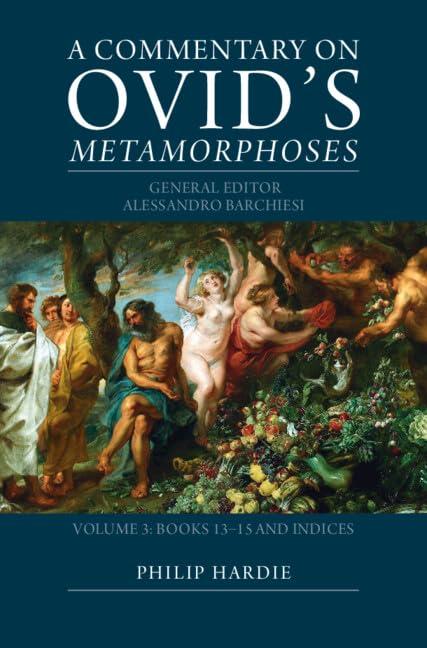
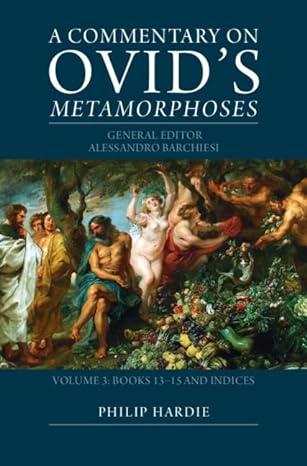
Comprising fifteen books and over two hundred and fifty myths, Ovid’s Metamorphoses is one of the longest extant Latin poems from the ancient world and one of the most influential works in Western culture. It is an epic on desire and transgression that became a gateway to the entire world of pagan mythology and visual imagination. This, the first complete commentary in English, covers all aspects of the text – from textual interpretation to poetics, imagination, and ideology – and will be useful as a teaching aid and an orientation for those who are interested in the text and its reception. Historically, the poem’s audience includes readers interested in opera and ballet, psychology and sexuality, myth and painting, feminism and posthumanism, vegetarianism and metempsychosis (to name just a few outside the area of Classical Studies).
alessandro barchiesi is a professor of Classics at New York University, after teaching at Stanford and the University of Siena. He has been visiting professor at Berkeley and Harvard, and his activity as a lecturer includes the Sather Classical Lectures at Berkeley (2011), the Nellie Wallace Lectures at Oxford (1997), the Gray Lectures at Cambridge (2001), the Jerome Lectures (AAR/ University of Michigan, 2002), the Housman Lecture at UC London (2009), and the Martin Lectures at Oberlin (2012). His work combines close reading of Roman literary texts (poetry and fiction) with interest in contemporary criticism, literary theory, and reception history. He is author of inter alia a commentary on Ovid's Heroides 1–3 (1992) and the Ovidian volumes of essays The Poet and the Prince (1997) and Speaking Volumes (2001), and co-editor with W. Scheidel of the Oxford Handbook of Roman Studies (2nd ed. 2020). His forthcoming work includes The War for Italia and Apuleius the Provincial
philip hardie is a Fellow of Trinity College, Cambridge; Honorary Professor Emeritus of Latin Literature in the University of Cambridge; and Fellow of the British Academy. He has published
extensively on Latin poetry and its reception, and is widely identified as one of the world's leading Latinists. His books include Ovid's Poetics of Illusion (Cambridge 2002); (edited) The Cambridge Companion to Ovid (Cambridge 2002); and Rumour and Renown: Representations of Fama in Western Literature (Cambridge 2012): His 2016 Sather Lectures have been published as Classicism and Christianity in Late Antique Latin Poetry (2019) and his 2016 Warburg Lectures as Celestial Aspirations: Classical Impulses in British Poetry and Art (2022).
A COMMENTARY ON OVID’S METAMORPHOSES
Volume 3
Books 13–15 and Indices
ALESSANDRO BARCHIESI
New York University
PHILIP HARDIE
Trinity College, Cambridge
Shaftesbury Road, Cambridge cb 2 8ea , United Kingdom
One Liberty Plaza, 20th Floor, New York, ny 10006, USA
477 Williamstown Road, Port Melbourne, vic 3207, Australia
314–321, 3rd Floor, Plot 3, Splendor Forum, Jasola District Centre, New Delhi – 110025, India
Cambridge University Press is part of Cambridge University Press & Assessment, a department of the University of Cambridge.
We share the University’s mission to contribute to society through the pursuit of education, learning and research at the highest international levels of excellence.
www.cambridge.org
Information on this title: www.cambridge.org/9780521895811
This publication is in copyright. Subject to statutory exception and to the provisions of relevant collective licensing agreements, no reproduction of any part may take place without the written permission of Cambridge University Press & Assessment.
First published 2024
Printed in the United Kingdom by TJ Books Limited, Padstow Cornwall
A catalogue record for this publication is available from the British Library.
A Cataloging-in-Publication data record for this book is available from the Library of Congress.
Volume 1 isbn 978-0-521-89579-8 Hardback
Volume 2 isbn 978-0-521-89580-4 Hardback
Volume 3 isbn 978-0-521-89581-1 Hardback
Cambridge University Press & Assessment has no responsibility for the persistence or accuracy of URLs for external or third-party internet websites referred to in this publication and does not guarantee that any content on such websites is, or will remain, accurate or appropriate.
Contents
General Editor Alessandro Barchiesi
Volume 1
Books 1–6
Volume 2
Books 7–12
Volume 3
Books 13–15
Index of Proper Names General Index
Preface
Alessandro Barchiesi
This commentary on Ovid’s Metamorphoses is a revised version of the work published in Italian by the Fondazione Lorenzo Valla (5 vols., between 2005 and 2013), with five commentators covering three books each. The original work also included a facing Italian translation by Ludovica Koch and Gioachino Chiarini and a fascinating essay by Charles Segal (‘Il corpo e l’io nelle “Metamorfosi” di Ovidio’). We dedicate this publication to him (he did not live to see the publication of the Italian first volume) and to Ted Kenney, who passed away in December 2019 (the last month before the current plague). They are both, in their own different ways, examples of resilience and true humanism.
The commentaries have been revised and updated, although one of them on a limited scale: I did not dare to alter Kenney’s work after his death, but his notes and introduction on books 7–9 incorporate a number of revisions he made subsequent to the publication of the Italian volume (2011). The other four commentators have engaged in a more extensive rewriting.
The Valla project was based on the important OCT critical edition by Richard Tarrant (2004): the Latin text is not included in this publication since readers may want to use our work as a companion to that widely available critical edition. At times the commentators here diverge from the text printed by Tarrant, and their choices are recorded in a ‘Note on the Text’ introducing every triad of books.
The goal has not changed: we hope to offer guidance on the poem as a literary work to many different readers, keeping in mind the exciting reality that many people today are coming to the Metamorphoses from the most diverse backgrounds and paths. Whether they are interested in the history of Latin poetry or in the lush Caribbean myths of Chris Ofili, in mutations of gender and species or the transmigration of souls, we hope to have provided some orientation.
I thank my companions on this long journey for their patience and inspiration.
Preface Philip Hardie
The last three books of the Metamorphoses move the reader through legendary and historical time towards the poet’s own day, ad mea tempora, to conclude with glances into the future beyond, the prospective apotheosis of Augustus and the poet’s own continuing post-mortem life in an empire-wide and sky-reaching fame: mea tempora in the further sense of the survival of the Metamorphoses in an aetas Ovidiana of indefinite period. This is time as it is charted in the epics of Homer, Virgil and Ennius. The Trojan War marks the beginning of what was regarded in antiquity as historical, as opposed to mythological, time. 1 In Roman tradition, the Trojan War has a further importance, as the fall of Troy is the sine qua non for the eventual foundation of Rome. More particularly, Ovid’s narrating of the Trojan War, the wanderings and toils of Aeneas, and Roman history down to the present day represents his response to Virgil’s scripting of this whole sequence of events in his Aeneid, the epic which, on Virgil’s death in 19 BC, immediately established itself as the central poetic text of Latin literature, and an inescapable challenge to any future long hexameter narrative poem.
This is not to say either that the flow of time in books 13–15 is even and continuous, or that in these books we finally arrive at a more consistently epic mode of narration. As in the previous books, time alternately expands or is concertinaed, internal narrators open out digressions into the past and into different kinds of subject matter, and ingenious transitions take the place of more mundane segues from one episode to the next.
Ovid’s ‘little Iliad’ had begun at the beginning of book 12, with brief summaries of Paris’ rape of Helen and of the gathering of the Greek army
1 See D. Feeney, Caesar’s Calendar: Ancient Time and the Beginnings of History, Berkeley, Los Angeles and London, 2007, pp. 81–4.
Preface
at Aulis.2 The following set-piece ecphrasis of the House of Fama (12.39–63) serves as a kind of frontispiece to the ‘little Iliad’, which stretches down to 13.622. Book 12 contains one of Ovid’s large-scale exercises in epic battle narrative, but this is the hyper-, or Ur-, epic battle of the Lapiths and Centaurs, narrated in a ‘flashback’ analepsis in the mouth of the long-lived Nestor (12.182–535). It is not until book 13 that we are presented with a detailed reworking of the matter of the Iliad itself, but in the form of not one, but two re-narratings, in the mouths of two of the Greek heroes, Ajax and Ulysses. Ajax and Ulysses speak not in the traditional Homeric and Virgilian setting for internal narrators, the heroic banquet, but in the setting of a law court established to judge which hero is the worthier claimant for the arms of the dead Achilles (13.1–383). Self-evidently, neither hero can be taken as a model for the ideal of the objective and impartial epic narrator, an ideal that Ovid also puts under pressure elsewhere.
The remainder of the ‘little Iliad’ moves the spotlight away from macho male characters to grieving women (already a centrally Homeric theme). The account of Hecuba’s intolerable grief at the deaths of her last surviving children, Polyxena and Polydorus, (13.429–575) is Ovid’s closest adaptation in the Metamorphoses of a single surviving tragic model, Euripides’ Hecuba. 3 It is the last major example in the poem of a generically tragic episode – a reason, perhaps, for its unusually faithful dependence on a single tragic source. It is also a literary-historical reminder of the close connection, well recognised already in antiquity, between Iliadic epic and Attic tragedy. Hecuba’s lengthy tragedy is concluded with a brief account of the enraged and grief-stricken mother’s metamorphosis into a rabid dog (13.567–71). The much shorter episode of Aurora’s grief for her son Memnon leads into a more fantastic and complex metamorphosis (13.600–19). A colourful example of the titular phenomenon of the Metamorphoses thus fittingly rounds off the Ovidian ‘Iliad’.
Ovid’s ‘Iliad’ had also begun with a metamorphosis, the petrifaction of the serpent that attacked the nest of sparrows, in the omen at Aulis (Met. 12.22–3), a metamorphosis authorised by the Iliad itself (2.317–20). In the ‘little Aeneid’ (13.623–14.608) that follows the ‘little Iliad’ – as Virgil’s
2 In fact, true to Ovid’s tendency to multiply boundaries and points of division, the passage to the matter of Troy had already been marked in the previous book, 11, by Apollo’s crossing of the geographical boundary of the Hellespont, to view the building of the new city of Troy, 199–201 inde nouae primum moliri moenia Troiae | Laomedonta uidet susceptaque magna labore | crescere difficili nec opes exposcere paruas; see Barchiesi 1997b, p. 183.
3 In general on tragedy in the Metamorphoses, see Curley 2013.
Preface
Aeneid presents itself as the successor to the Homeric epics – Ovid highlights some of the metamorphic moments in the Aeneid, tendentiously redefining Virgil’s epic as already an epic of metamorphosis, comparable to the way in which, in his amatory and exilic poetry, Ovid repeatedly draws attention to the centrality in the Aeneid of the erotic episode of Dido and Aeneas.4 Ovid gives detailed accounts of the maiden Scylla’s transformation into Virgil’s hybrid sea monster ( Aen. 3.424–8; Met. 14.59–67), and of Circe’s transformation of Picus into a woodpecker (Aen. 7.189–91; Met. 14.386–96). Pride of place is given to a retelling of the most striking of Virgil’s metamorphoses, that of the Trojan ships into sea nymphs (Aen. 9.107–22; Met. 14.535–65).
The internal narrator Macareus’ account of Circe’s transformation of Ulysses’ companions into beasts is included within a faithful retelling of a part of the Homeric narrative of the wanderings of Odysseus ( Met. 14.223–307), following on Achaemenides’ retelling of Odyssey 9’s narrative of the encounter with Polyphemus ( Met. 14.165–212). Within Ovid’s ‘little Aeneid’ are thus contained elements of a ‘little Odyssey’. Ovid’s close replications of Odyssean material within his ‘Aeneid’ are licensed by Virgil’s own placing of a retelling of the Homeric Polyphemus episode in the mouth of Achaemenides (Aen. 3.616–38).
Ovid repeatedly derails the teleological thrust of Virgil’s Aeneid with inset narratives of love and metamorphosis, in particular a massive ‘trio of love triangles’, the stories of Acis, Galatea and Polyphemus (13.750–897); Glaucus, Scylla and Circe (13.898–14.74); and Picus, Canens and Circe (14.320–434). Ovid explores genres other than epic, most notably in the polyphony of genres in the story of Acis, Galatea and Polyphemus, which combines pastoral, elegiac and epic elements.5 Yet this generic dialogism can be read as commentary on the encyclopedic nature of the Aeneid itself, an epic in which Virgil confronts the challenge of an ancient view of Homeric epic as the source of all later kinds of literature. But where the Aeneid contains a proliferation of other genres within a constraining epic code, the Metamorphoses allows the plurality of genres to blossom in less controlled ways.
Ovid’s ‘Aeneid’ begins with the briefest of summaries of what is the chronological beginning of Virgil’s main narrative, narrated in flashback
4 Ovid draws attention to what, even from a less biased point of view, might be seen as the importance of mutability as a theme in the Aeneid; see P. Hardie, ‘Augustan Poets on the Mutability of Rome’, in A. Powell (ed.), Roman Poetry and Propaganda in the Age of Augustus, Bristol, 1992, pp. 59–82.
5 See the classic discussion of Farrell 1992.
Preface
xi
by Aeneas in Aeneid 2 (Met. 13.623–7), and reaches down to the death of Turnus, narrated even more briefly in just eight words (14.572–3). The skimpy retelling of key episodes of the Aeneid within Ovid’s ‘little Aeneid’ is compensated for by major reworkings elsewhere in the Metamorphoses. For example, Ovid engages at much greater length with Virgil’s final duel between Aeneas and Turnus in major scenes of fighting and physical struggle, in the battle between Perseus and the supporters of Andromeda’s disappointed suitor, Phineus, at the beginning of book 5 of the Metamorphoses, and in the wrestling match between Hercules and the river god Achelous at the beginning of book 9. Elements of Virgil’s story of Dido and Aeneas, summarised, notoriously, in four lines at Met. 14.78–81, find more expanded reflections in erotic and tragic narratives elsewhere in the poem. These examples of what might be called an Ovidian ‘intertextual displacement’ betoken the fact that the Metamorphoses as a whole, not just the ‘little Aeneid’, engages continuously with the Virgilian epic.
Ovid gives his ‘little Aeneid’ a final metamorphic stamp with two episodes that overstep the chronological limit of the main narrative of Virgil’s Aeneid: firstly, the emergence of a heron from the ashes of Turnus’ city Ardea (14.573–80), one of the numerous bird metamorphoses in the poem; and secondly, the circumstantial narrative of the apotheosis of Aeneas (14.581–608), foreshadowed briefly and proleptically in the Aeneid. Most metamorphoses of humans in the Metamorphoses are downwards in the chain of being, into animal, mineral or vegetable forms. At the end of book 13, lines 916–63, Glaucus narrates his own metamorphosis upwards, from human to divine, albeit a rather bestial form of divinity, a sea god with a fishy tail. The apotheosis of Aeneas conforms to a purifying kind of divinisation, which purges the inferior mortal parts of the human hero, first exemplified in the apotheosis of the archetypal man-god Hercules five books before (9.239–72), and to be followed, in accelerated sequence, in the remaining book and a bit by the apotheoses of Romulus, Julius Caesar and, in prospect, Augustus and the poet himself.
This is one sign that the poem is reaching its conclusion. Another kind of transition that indicates that we are coming home is the geographical passage from east to west, the passage of Aeneas from Troy to Italy, and also the passage of Homeric epic from the Greek east through its naturalisation in Virgil’s Roman Aeneid. At the beginning of book 14, Glaucus travels from Sicily to the house of Circe in Italy, anticipating the Trojans’ own approaches to Italy, thwarted at 14.76–7 when they are driven back
Preface
to Carthage by the storm, and successful in their landing at Cumae at 14.101–5. The poem’s gravitation to Italy continues in book 15 with Myscelos’ journey from Argos to Croton (49–57); Pythagoras’ flight into exile from Samos to Croton (60–2); the Greek tragic hero Hippolytus’ translation to the grove of Aricia as a minor Italian god (541–6); and Aesculapius’ journey from Epidaurus to Rome (695–728). Aesculapius is a god who comes to Rome as an outsider; the subject of the poem’s last narrative, Julius Caesar, becomes a god in his own city (15.745–6).
The cursory catalogue of the Alban king list (14.609–21, 772–4), invented to span the gap in time between Aeneas’ arrival in Italy and the founding of Rome, is interrupted by the story of the Italian divinities Vertumnus and Pomona (14.623–771), moving us into the area of ItalianRoman aetiology. It is also the last erotic story in the poem, in the series that began with Apollo’s attempted rape of Daphne in book 1, and it brings that series to a satisfying conclusion, as the possibility of yet another story of rape or attempted rape is averted through the final success of the lover in achieving the fulfilment of mutual desire, in a reversal of the pattern of the huntress-nymph impervious to male desire. The story’s comfortably familiar setting of an Italian orchard is heightened by the contrast with the admonitory tale told by Vertumnus to Pomona, in his attempt at erotic persuasion, the esoteric Greek story of the suicidal exclusus amator Iphis’ love for the stony-hearted Anaxarete, set in a geographically and culturally distant Cyprus (14.698–761).
In book 15, Greek and Roman meet in the encounter of Rome’s second king, Numa, with the exiled Greek philosopher Pythagoras, whose philosophico-didactic speech takes up almost half of the book (15.75–478). While the Speech of Pythagoras does not provide a philosophical ‘key’ to a principle of change that could be applied to the metamorphoses in the poem as a whole, it does yield another element of closure, in that it forms a ring with the philosophically coloured cosmogony that opens the Metamorphoses. Both passages provide monumental examples of Ovid’s engagement with Graeco-Roman philosophy, in the Metamorphoses and other works, an engagement that is coming to be increasingly recognised.6
The quirky selection of Roman stories that otherwise punctuate the temporal distance between Romulus and Augustus includes female perspectives, in Tarpeia’s attempt to betray the city (14.776–7), and in the
6 See recently the essays in G. Williams and K. Volk (eds.), Philosophy in Ovid, Ovid as Philosopher, Oxford, 2022.
Preface
pious grief of the wives of the first two kings of Rome, rewarded with apotheosis to match that of her husband, in the case of Romulus’ widow Hersilia (14.829–51), and impervious to attempted consolation, in the case of Numa’s widow Egeria (15.487–551). Like Livy, Ovid draws parallels between remoter and more recent Roman history, in the ‘civil war’ between Romans and Sabines (14.798–804); in the reflections on kingship, Republic and principate that glimmer through the story of Cipus (15.565–621); and in the potential of Aesculapius’ salvation of Rome from the plague of 292 BC (15.626–744) to figure Augustus’ salvation of Rome from the ‘plague’ of civil war, a potential also activated by allusions to Virgil and Georgics 3 and 4 in the parallel narrative of salvation from the plague on Aegina at Met. 7.523–657. The plague of 292 BC is the first conclusively datable event in the poem, which then jumps almost 250 years to the Ides of March, 44 BC. That also happens to be the year before the birth of Ovid – ad mea tempora in another sense.
Self-reference to Ovid’s own times has also been detected in the fact that the temple built for Aesculapius, almost the last episode in the Metamorphoses, was dedicated on 1 January, and so naturally appears near the beginning of the Fasti (1.289–94), whose first word is Tempora, my, Ovid’s, ‘Tempora’.7 But Ovid’s times were a-changin’, and the boast in the Epilogue to the Metamorphoses that it is immune to the anger of Jupiter (15.871–2) is often read as post-exilic defiance. And, post-exile, it would be easy enough to see Ovid in the figure of Pythagoras, self-exiled to escape tyranny, yet free to roam the universe in flights of the mind (15.60–4).
This English version of my commentary on Metamorphoses 13–15 is a light revision, with bibliographical updating, of the Italian version in P. Hardie, Ovidio Metamorfosi, Vol. 6: Libri XIII–XV (Fondazione Valla, 2015).
7 See Barchiesi 1997b, p. 188.
Note on the Latin Text Books 13–15
Divergences from Tarrant’s OCT (including punctuation, as was the case in the 2015 list of divergences)
M. Haupt and R. Ehwald (eds.), P. Ovidius Naso, Metamorphosen , rev. M. von Albrecht, 2 vols., Zürich, 1966.
J. Hubaux and M. Leroy, Le Mythe du phénix dans les literatures grecque et latine, Paris, 1939.
A. Degrassi (ed.), Inscriptiones Latinae liberae rei publicae, 2 vols., Göttingen, 1957–63 (vol. 1, 2nd ed. 1965).
H. Dessau (ed.), Inscriptiones Latinae Selectae, 3 vols., 2nd ed., Berlin, 1954–5.
LIMC Lexicon Iconographicum Mythologiae Classicae, Zürich and Munich, 1981–.
LLT-A
LSJ
M–W
NLS
List of Abbreviations
Library of Latin Texts – Series A
H. Liddell, R. Scott and H. Jones (ed.), A Greek–English Lexicon , 9th ed., Oxford, 1940.
R. Merkelbach and M. L. West (eds.), Fragmenta Hesiodea, Oxford, 1967.
E. C. Woodcock, A New Latin Syntax, London, 1959.
PMG Poetae Melici Graeci , ed. D. L. Page, Oxford, 1962.
RE G. Wissowa, W. Kroll, K. Mittelhaus and K. Ziegler (eds.), Real-Encyclopädie der classischen Altertumswissenschaft , Stuttgart, 1893–.
RVV
Religionsgeschichtliche Versuche und Vorarbeiten.
SH H. Lloyd-Jones and P. Parsons (eds.), Supplementum Hellenisticum, Berlin and New York, 1983.
TGF
TLL
Tragicorum Graecorum Fragmenta: I, ed. B. Snell, Göttingen, 1971; II, ed. R. Kannicht and B. Snell, Göttingen, 1981; III (Aeschylus) ed. S. Radt, Göttingen, 1985; IV (Sophocles), ed. S. Radt, Göttingen 1977; V (Euripides, I–II), ed. R. Kannicht, Göttingen, 2004.
Thesaurus linguae Latinae , Leipzig, 1900–.
Commentary on Book 13
Philip Hardie
13.1–398 The Debate over the Arms of Achilles (Armorum Iudicium)
In keeping with the poetics of a perpetuum carmen Ovid continues his reworking of the Iliad into the larger design of an epic cycle (12.1–14.608; on the epic cycle as the structural framework of Ovid’s Trojan material see Ludwig 1965, pp. 62–5; on the strategy of a ‘cyclic’ retelling of the Iliad see Ellsworth 1980). The dispute between Ajax and Ulysses over the arms of Achilles continues the action of the Trojan War after the death of Achilles, but compensates for the elision in book 12 of the material of the Iliad at its proper place in the linear chronology with a twofold retelling of Iliadic material from the different perspectives of two of the major heroes. In book 12 Ovid had caught the creation of an epic tradition at the moment of its formation on the lips of those present in the action, both in the retellings by the Greeks of their previous military adventures at 12.159–67 and in Nestor’s recollection of the Ur - epic encounter between the Lapiths and Centaurs (12.168–535), a garrulous old man’s reminiscences that allow the main narrator no time for a full-length Trojan War narrative. In each case the narration is far from disinterested, whether because of a need to cater to self-esteem or to find a subject suitable for the ears of the greatest model of epic uirtus, Achilles (12.159–63), or because of the wish to avoid opening old wounds (12.536–48: quis enim laudauerit hostem?). In this respect, then, the construction of epic fama in book 12 differs little from the selectivity and misrepresentation of the rhetoric demanded by the agonistic structure of the debate over the arms in the next book.
The Debate is often viewed as one of Ovid’s most brazenly anachronistic exercises, importing the atmosphere of the late first-century BC declamation hall into the world of Homer, and symbolising the victory of the newfangled over the traditional in the defeat of Ajax, the man of action from an older scheme of things, by Ulysses, the type of a
quick-tongued and unprincipled modernity. This is to overlook the sense of literary history built into the episode. It is true that the ability to retell old stories with new colores is as typical of the exercises of the rhetorical schools as it is of Ovid himself, whose whole poetic output might be regarded as a sustained exercise in a verbal remodelling of reality, the imposition of uerba on res (on the slippage between words and deeds in the Debate see Hardie 2007), and it is a legitimate temptation to see in Ulysses a particularly Ovidian manipulator of words. So Stanford 1963, p. 138: ‘a tribute from one skilful rhetorician to another’; Otis 1970, p. 285: ‘Ulysses’ facundia and ingenium are … much like Ovid’s own’; Pavlock 2009, p. 12: ‘Ulysses is an imaginative and deconstructive rhetorician analogous to the poet who thoroughly destabilizes the genre of epic’; Duc 1994 sees the associative structure of Ulysses’ speech as being in the manner of O.’s own practice as a declaimer, according to Sen. Controv. 2.2.9 hanc … controuersiam … declamauit … longe ingeniosius, excepto eo quod sine certo ordine per locos discurrebat. But the Ulyssean-Ovidian skill in referre aliter … idem (Ars am. 2.128) is only a particularly self-conscious manifestation of the basic law of the Graeco-Roman literary tradition, and not least of the oldest and most tenacious of genres, epic. Already in the Odyssey the hero Odysseus appears as a masterful reteller of epic material in ways more or less devious. Retelling is even more deeply embedded in the Aeneid, both through the quality of the epic as a whole as an allusive renarration of the Homeric poems and in the inclusion within the poem of ‘microcosmic recapitulations’, in ecphrasis, internal narratives and songs, or even separate books, of earlier epic poems (the Cycle, Ennius) and of the Aeneid itself. A particularly important model for the Ovidian debate is the Council of Latins at Aeneid 11.225–444, itself probably drawing on versions of the Armorum iudicium in its presentation of a violent verbal debate between a ‘man of action’, Turnus, and a ‘man of words’, Drances, that already explores the impossibility of neatly separating the verbal constructions of rhetoric, facundia, from the supposedly objective narratives of epic, fama (see Hardie 2012, ch. 4; on the parallelism between the tendentious reworkings of fama and facundia see Dippel 1990, p. 93).
As it happens, the Armorum iudicium is subjected to retelling in the Epic Cycle itself, as the contest was narrated in both the Aithiopis and the Ilias Parua, with significant divergences (see conveniently Davies 1989, pp. 60, 63–4; for a full treatment of the traditions see Huyck 1991, pp. 10–68): in the Aithiopis the jury was composed of Trojan prisoners, and Ajax’s suicide was probably a direct consequence of the judgement (as in Ovid);
in the Ilias Parua Nestor sent scouts to eavesdrop on the chatter of Trojan girls in order to reach a decision, and the judgement was followed by the madness of Ajax. Furthermore, the epic episode comes to Ovid filtered through a long tradition of tragic and rhetorical rehandlings. A series of Greek tragedies beginning with Aeschylus’ Ὅπλων Κρίσις ‘Judgement of Arms’, the first play of an Ajax trilogy, was followed by Latin tragedies by Pacuvius and Accius. Ovid also had access to plays on other parts of the legendary material: Sophocles’ Ajax mirrors the earlier debate between Ajax and Odysseus in the agōn between Teucer and Agamemnon, in which Agamemnon counters the charge, found in the Pindaric treatments of the story (Isthm. 4.36–43; Nem. 7.20–30, 8.21–34), that the judgement represented the unfair victory of guile over courage, with the claim that he himself had been just as forward in battle as Ajax, and with the assertion of the superiority of brain over brawn (1250–4). Ovid may also have drawn on Livius Andronicus’ Aiax Mastigophoros and Ennius’ Aiax. The disputants’ argument over Ulysses’ role in the matter of Philoctetes also draws on the Greek and Latin tragedies on that subject (in general see Lafaye 1971, ch. 8 ‘La tragédie et la rhétorique’, with von Albrecht’s bibliographical notes on pp. xiii–xiv).
This part of Ovid’s Cycle is indeed strongly marked by a tragic, and specifically Latin tragic, colouring (and so prepares the reader for the even more tragic material of the following Hecabe episode). Opinions on the exact extent of Ovid’s borrowings from particular Latin plays depend on conflicting reconstructions of those plays; the debate has focused above all on the question of who constituted the jury in the several plays, but even if it were the case that Ovid agrees with Pacuvius in having a jury of Greek chiefs, this would hardly preclude borrowings from other plays. Whether by accident or otherwise, the greater number of visible parallels are with fragments of Accius’ Armorum iudicium (on parallels with the Pacuvian and Accian fragments see D’Anna 1959, pp. 226–32). In general Ovid seems to owe more to Accius than to other Latin tragedians: Accius is paired with Ennius at Am. 1.15.19–20; for a review of the discussion of Ovid’s use of the Latin tragic sources see de Rosalia 1989, pp. 123–4.
In combining within this episode both epic and tragic models, Ovid, himself the author of an acclaimed but lost tragedy, the Medea, places himself in a line of Roman writers who wrote both epics and dramas (Livius Andronicus, Naevius, Ennius). The combination of the tragic and the rhetorical is naturally already present in the agōn of Attic tragedy, but we might also remember the especially close links between early Roman
drama and rhetoric (Jocelyn 1967, p. 42; Argenio 1961). Specifically rhetorical treatments of the debate start with Antisthenes’ pair of speeches by Aias and Odysseus, which shows marked parallelisms with the Ovidian treatment, both in the overall shape of a short speech by Aias followed by a longer one by Odysseus, and in many details, some of which may be the result of shared sources, or mediated to Ovid through fourth-century tragedies on the subject by Carcinus, Theodectes and perhaps Astydamas. Ovid makes no attempt to disguise the affinities of the speeches of his epic heroes with the performances of the rhetorical schools in which he had been trained as a youth. On literary-historical grounds there was nothing wrong in this, since Homer was generally regarded as the inventor of rhetoric, and Odysseus as an exemplar of the elevated style, Nestor with Menelaus being the exemplars of the other two styles (see Radermacher 1951, pp. 6–10); at 12.178 Achilles addresses Nestor as o facunde senex. The Armorum iudicium is indeed attested as a subject in both the Roman and Greek rhetorical schools (e.g. Sen. Controv. 2.2.8; Theon, Progymn. 9 Spengel p. 112), although most of the references provided by Bömer on 12.620–13.398 (p. 197) are to another subject of the controuersia, whether Ulysses, having been found near the body of Ajax, should be judged to have killed him. But Ovid’s Armorum iudicium cannot be classified neatly as either a controuersia or a suasoria; although this is clearly a judicial forum, and not a deliberative council (like the Virgilian debate between Drances and Turnus): ‘the debate cannot be classed as a Controversia, for no general principle is in dispute; it is rather a tragic agōn extended till it resembles a pair of opposing Suasoriae ’ (Wilkinson 1955, p. 230; on the problem of definition see Dippel 1990, p. 74 nn. 14–15. Bonner 1949, p. 151 takes the speeches to be suasoriae, citing Sen. Controv. 2.2.12 declamabat autem Naso raro controuersias et non nisi ethicas; de Sarno 1986 analyses the debate as a controuersia).
The most pointed allusion to the declamation schools comes at the end of the speech not of Ulysses but of Ajax (120–2), reworking a conceit used by Ovid’s favourite rhetorician Porcius Latro in a debate on the subject of the Armorum iudicium (Sen. Controv. 2.2.8). This is a problem for those who see a simple contrast between a doltish Ajax, unskilled in speaking, and the consummate rhetorician Ulysses. Inevitably the debate within the text (which is unequivocally decided in Ulysses’ favour) is projected into a critical debate on the relative skills and moral qualities of the two speakers. Unlike the contest between Beckmesser and Walther in Die Meistersinger, it is not the practice of ancient poets to characterise a defeated performance through obvious incompetence (witness the