Acknowledgements
Increasingly, it is very difficult for academics to write on top of a ‘teaching-only’ contract. I have had no opportunity to present any of this material at conferences, or to apply for any funding, or ever take any research leave. All those on academic ‘scholarship’ contracts must decide either to give up research entirely or to conduct all their research and writing in their annual leave and other spare time. This book is dedicated to all academics on similar contracts.
Luckily, academia is filled with people who help others—including the late (and much missed) Richard Deswarte. I have benefited much from advice from and discussions with Helena Carr, Joel Halcomb, Jayne Gifford (who also read drafts for me), Emma Griffin, Geoff Plank, Milla Schofield, Becky Taylor, Eliza Hartrich, Jacquie Burgess, and Jennifer Wallis. Various anonymous readers for Oxford University Press crafted reports which have been invaluable in shaping my arguments. Thank you also to Leon Jackson for generously supplying me with unpublished material, and to Christopher Hilliard, both for his correspondence and for publishing two exceptionally useful books.
Archivists across the country have been very helpful, especially in the difficult pandemic times, particularly Bristol Archives, Dudley Archives, East Sussex Record Office, Gloucestershire Archives, The National Archive, Northamptonshire Archives, Staffordshire Record Office, Worcestershire Archives, the Shakespeare Birthplace Trust, the British Motor Museum, and the Wellcome Library.
My parents have, as usual, been involved, with my father, David, supplying encouragement and reading the whole draft, and my mother, Yvonne, providing invaluable help with genealogical
researches. My agent, Clare Alexander, yet again provided perfect support, and my editor, Luciana O’Flaherty, suggested wise corrections and alterations. Thank you also Louise Larchbourne, Vasuki Ravichandran, and Tara Werger. Maud Webster created three beautiful diagrams, all done efficiently and with expertise. Especial thanks go to Wendy Roderick for responding to my out-of-the-blue query with candour and kindness.
I am conscious that some families may come across ancestors in these pages, or even people they once knew personally. I am sincerely sorry if telling their stories causes any distress. I have tried my best to trace living relatives, but that is not always possible; some may have been missed. In some cases, I have anonymized or semi-anonymized individuals to protect living relatives.
On my own street neighbours have received nasty letters from a house on a street behind us, complaining about the behaviour of their cats, so thank you to Kevin and Genghis for not being so badly behaved that you have drawn any unwanted attention to yourselves. To George, my writing this book coincided with your brave decision to leave academia and forge a new career—I could not be prouder (or more jealous!) of you. Finally, to Ned and Maud—you know the drill by now, again your mother has written about things she wants you never to do!
Abbreviations
ListofFigures
NoteaboutAnonymity
Introduction:
1. Gossip:
2. Tip-offs:
3. Threats:
4. Obscenity:
5. Libels:
6. Detection:
7. Media:
8. Local reaction:
Conclusion:
Endnotes
Bibliography
Index
Contents
Dear Madam
Major Eliot’s maiden sisters
Undermined coalmasters in Staffordshire
Lord Dorington’s in danger
Peer’s perversion uncovered ’er at number 14 is dirty
Detectives say
Herbert Austin robs men’s brains
And Winifred Simner sows discontent [unsigned]
BA DA
ESRO
GA
OB
OED
PC
PS
SRO
TNA WA
Abbreviations
Bristol Archives
Dudley Archives
East Sussex Record Office
Gloucestershire Archives
Investigations Branch (Post Office)
London Metropolitan Archives
Mass Observation Archive, Mass Observation Online, Adam Matthew, http://www.massobservation.amdigital.co.uk
Northamptonshire Archives
ProceedingsoftheOldBailey
OxfordEnglishDictionary
Police Constable
Police Sergeant
Staffordshire Record Office
The National Archives
Worcestershire Archives
ListofFigures
Anonymous letter to Mary Cokayne, Exeter House, Roehampton, postmarked Sutton 10 November 1894, Northamptonshire Archives Service, C 637
Anonymous letter to Mr Burn 1847, Shakespeare Birthplace Trust ER21/4 recto
Anonymous letter to Mr Burn 1847, Shakespeare Birthplace Trust ER21/4 verso
Hagley murder anonymous letter, Worcestershire Archives, 010:18 BA 14908/3/1/1-2, with permission from West Mercia Police
Major Eliot letter 1829 recto, author’s own item
Major Eliot letter 1829 verso, author’s own item
Copy of a letter sent to Peggy, Countess of Coventry, c.1815, Worcestershire Archives 705:73 BA 14450/289/18(1) recto
Copy of a letter sent to Peggy, Countess of Coventry, c.1815, Worcestershire Archives 705:73 BA 14450/289/18(1) verso
Letter from Peggy, Countess of Coventry, Worcestershire Archives 705:73 BA 14450/289/7 (1)
Anonymous letter [from Thomas Hill] re: Jane Bell, North Shields, 1821, author’s own item
Anonymous letter [from Thomas Hill] re: Jane Bell, North Shields, a second letter from 12 June 1821 recto, author’s own item
Anonymous letter [from Thomas Hill] re: Jane Bell, North Shields, 1821 verso of the second letter from 12 June, author’s own item
Letter to ‘Master Heberard’, 1849, Dudley Archives DRBC/7/8/8, with permission from Mr David Williams-Thomas
Map of the Moor Lane Colliery area, by Maud Webster
Anonymous letter to the Dorington family of Lypiatt Park threatening murder, 1864, Gloucestershire Archives, D5344/1, recto
Anonymous letter to the Dorington family of Lypiatt Park threatening murder, 1864, Gloucestershire Archives, D5344/1, verso
Anonymous letter to the Dorington family of Lypiatt Park threatening murder, 1864, Gloucestershire Archives, D5344/1, envelope
18. 19. 20. 21. 22. 23. 24. 25. 26. 27. 28. 29. 30. 31. 32. 33.
Mock-up of classified advert from Loughborough Echo, 3 November 1916, 1
Anonymous postcard sent to Sanitary Inspector, Hounslow, 1915 recto, author’s own item
Anonymous postcard sent to Sanitary Inspector, Hounslow, 1915 verso, author’s own item
Location of Eliza Woodman’s house in relation to Mary Johnson’s house, Redhill, 1910, by Maud Webster
Numbers 43–49 Western Road, Littlehampton, a plan by Maud Webster
Extract from Charles Chabot and Edward Twisleton, The Handwriting of Junius Professionally Investigated(1871), 37
Anonymous postcard to Herbert Austin, 1935, © British Motor Industry Heritage Trust, recto
Anonymous postcard to Herbert Austin, 1935, © British Motor Industry Heritage Trust, verso
Letter to Marie Stopes, Wellcome Library Collection Creative Commons— Attribution-NonCommercial 4.0 International—CC BY-NC 4.0
Anonymous letter to Charles Hohenrein, 12 May 1915, L DBHR/1/1/13, page 1, recto, Hull History Centre
Anonymous letter to Charles Hohenrein, 12 May 1915, L DBHR/1/1/13, page 2, verso, Hull History Centre
Envelope for anonymous letter to Charles Hohenrein, 12 May 1915, L DBHR/1/1/13, Hull History Centre
Letter from Father O’Halloran, from Mattock Lodge, Ealing, to Father Thomas Jackson, 8 September 1902, author’s own item
Envelope for letter from Father O’Halloran, from Mattock Lodge, Ealing, to Father Thomas Jackson, 8 September 1902, author’s own item
Photograph of Winifred Simner, courtesy of Wendy Roderick
Anonymous letter received in Yately, Daily Mirror, 25 October 1926, p. 24, permission from Mirrorpix
Note about Anonymity
Where cases occurred within the last century, some individuals have been anonymized, especially those who were victims of letter campaigns which revealed private details and those who were either acquitted of writing libellous letters, or dispatched to an asylum immediately after their court appearance, or shortly after any incarceration.
Introduction
Dear Madam
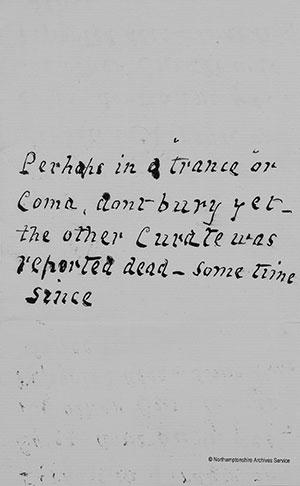
Perhaps in a trance or coma, don’t bury yet the other Curate was reported dead—some time since.1
At the heart of this book is the experience of receiving and first reading a note of this kind. If you have never been sent such a letter, then it is likely the confusion you felt on turning to the one above will be as close as I can bring you to the first moments of that experience. It was received by someone about to bury their son. Mary Dorothea Cokayne, wife of the genealogist George Edward Cokayne in 1894, would have received it about three days after her son, Morton Willoughby, passed away. Morton, an assistant curate at All Saint’s Church in Carshalton, was twenty-eight years old. The letter implies that Mary was about to bury him alive. Why would someone send a note like this to a grieving mother? Her husband George (author of the eight-volume CompletePeerage) kept a diary, but he gives us no clues about his wife’s reaction to it. As was usual for the time, his journal is more of an outline of the day, and we are given but little sense of Cokayne’s emotional state around the time of the illness and death of his son. In the months
before his death, Morton visited his parents, regularly staying over to help out with gardening tasks.2
Morton was struck down by illness on 28 October 1894, while George was working on the ‘R’ section of his Peerage. Morton had been at Carshalton, but made his way to his parents’ residence, Exeter House, in Roehampton, where a doctor diagnosed typhoid fever. Within two weeks Morton was dead. Funeral arrangements were made. Morton’s coffin would need to be screwed down to contain the spread of illness. The funeral took place in Morton’s church at Carshalton, and then the cortege moved to Putney cemetery. George transcribed a copy of Morton’s medical certificate into his diary, which stated that his son had died from exhaustion induced by typhoid fever.3
Figure 1. Anonymous letter to Mary Cokayne, Exeter House, Roehampton, postmarked Sutton 10 November 1894, Northamptonshire Archives Service, C 637
Once the moral shock of the letter has been registered, perhaps the next question is not ‘Who wrote it?’ but instead ‘What other curate?’ Finding that answer is complicated by the split locations: was it a curate in Carshalton, or in Roehampton? However, it is possible that the note was written by someone with a long memory, recalling and alluding to a dark moment in the Cokaynes’ family life. George’s nephew, the Reverend George Hill Adams, absconded in 1877 while on bail for a serious sexual assault involving three very young girls in Cheltenham. One account described Hill Adams as ‘a Ritualistic clergyman’; part of the second generation of the High Church revival of the nineteenth century seeking to reintroduce a
range of Roman Catholic liturgical practice into the Anglican Church.4 Many rumours circulated about him afterwards: was he in Spain? Was he in France? Was he in a foreign mental asylum? Was he dead?5 The truth was unclear, which is perhaps what the anonymous author is alluding to. Then there are even more fundamental questions about the document itself. Why did Mary Dorothea Cokayne retain it? It must have brought her sadness. Was it kept as evidence, in case future letters arrived? The vast majority of such messages, throughout time, were destroyed or hidden. The reason why certain letters appear in the historical record at all is often an important one.
This book is about letters sent anonymously (i.e. unsigned, or signed with initials, a symbol or a pseudonym) with the aim, or apparent aim, of unsettling the person they were sent to. In his Anonymous Letters (1933) Robert Saudek, an influential, Czech-born graphologist, categorized anonymous letters as: those signed with an initial only; letters signed pseudonymously as ‘A citizen’, or ‘An old friend’; letters signed with symbols such as X or a dagger; letters signed with the ‘name of an acquaintance of the addressee, to set the two at variance’.6 This includes a range of letter types, including: obscene or threatening letters; and letters accusing a person, or people, of doing something, sent to someone else, who might use the information to make life harder for the person(s) mentioned. Many letters defy simplistic categorization, including saucy letters which were considered obscene by the person who intercepted them, but were not considered so by the intended recipient. Anonymous Letters also discusses anonymous tip-offs and libellous correspondence. This sometimes includes the decoy letter—penned or typed by someone who then sent it to themselves.
Anonymity and pseudonymity in publishing are very wellresearched fields. By contrast, anonymous letter writers have received little attention.7 This is surprising given the way such
campaigns appear, from our current perspective at least, to prefigure some of the most concerning tendencies of the Internet age. Putting a more positive spin on anonymous letters for London Society in 1886, Frederick Arnold found much to praise in anonymous letterwriting, and that some letters had ‘a very agreeable character’. He suggested that the ‘principle of anonymity is one which has taken deep root in the shy, reserved, island-like British character’. Arnold draws attention to notes which accompanied anonymous donations to charity, and notes sent between lovers which made people’s lives happier and more interesting.8 The intentions behind sending letters anonymously could be positive or negative. The focus here is generally on the latter, but Arnold’s point should never be entirely forgotten.
There is a compelling argument to count malicious, anonymous letters quite separately from other correspondence. The interaction contained in them is very different. Replies to anonymous letters are usually impossible because of the lack of return address. The historian Leon Jackson has contrasted blackmail and threatening letters with the usual ‘polite’ forms of correspondence. He observes that they are hard to interpret, because ‘they do not fit readily into the recent and influential historiography of epistolary practice.’ By not following the same conventions, they did not ‘invite epistolary reciprocity, or create social bonds’.9 One way of categorizing them is as forms of impolite behaviour, giving them more things in common with riot, assault, spoken intimidation, stalking, and verbal haranguing than with other letters. Despite being a one-way form of communication, anonymous letters wereoften written in the hope of getting a response, either in observable behaviour or in a newspaper advertisement. Occasionally, a perpetrator might even entertain semi-realistic hopes of a physical encounter, although (as we will see) on such occasions the police would often be waiting. Although they are often written in the hope of getting a reaction, such messages are not generally written in expectation of a reply. In this they often seem closer to graffiti than to letters. The closest they come to ‘polite’ forms is when they overlap with unsolicited and
unreciprocated love letters. The key difference appears—again—in the lack of specified sender, since unwanted love letters can be unsettling enough.
Back in the late 1980s I anonymously sent a single Rolo (a truncated cone-shaped, chocolate-coated toffee) through the post to a boy I liked. It was my last Rolo: a gesture of my fondness for him. A successful advertising campaign for Rolos had pushed this idea —‘do you love anyone enough to give them your last Rolo?’ We were good friends. In the following days he spoke of many things, but never of receiving this small confectionery gift. This left me hungry for a reaction. Did he get the Rolo? If it had arrived, did he have any suspicions as to the sender? Switch the Rolo for something else and the nature of the situation can shift suddenly or subtly. But the sender in most cases would still hunger for a reaction, an observable response. The anonymous letter is actually an inefficient means of eliciting a reaction, especially if sent to people beyond the immediate neighbourhood or social circle. This is, perhaps, why many senders of anonymous letters have targeted their neighbours, because they might be in a position to observe, or overhear, to fetch out some response. In retrospect, receiving a crushed or melted Rolo anonymously in the post could have been more frightening than charming. Cruel letters circulating in small communities such as villages could create paranoia and suspicion—damaging the social fabric very quickly. For this reason, many people never talked about such incidents.10 The rector of a small village in Essex took to the pulpit in 1962 in an attempt to ferret out the person who had sent letters to several members of the community over a two-year period. He told the Guardianthat nerves were fraying in the village, and that ‘minds are broken, one actually having to go into a mental hospital because of these letters’. After he spoke in church about the matter, two more villagers came forward as victims.11
Receipt of an anonymous letter (and possibly also, anonymous chocolate) has always been more common than people suppose. Exact figures are elusive, however, because people respond in different ways to receiving these missives. It is worth emphasizing
again that many people who received anonymous letters destroyed them. Many recipients would not have wanted to be connected to the letters, either because they didexpose a secret, or because they feared that revealing the content might make people think them guilty of things they had not done; hiding the letters could prevent shame or embarrassment. Shame—most of it hidden—may be the real subject of this book, but as far as the record goes it is practically indistinguishable from prudence. In 1928 the criminologist Harry Ashton-Wolfe declared all anonymous letters to be ‘cowardly, treacherous, vile things’ which ‘should be burned’.12 Citizens were advised to single out any item of mail without a signature, and to ‘consign the communication to the fire unread’.13 The destruction of a majority of the letters renders the full extent of malicious letterwriting unknowable.14 It also means that the source material is relatively scarce and difficult to locate. This is probably why they have been little studied by historians, despite important exceptions such as an essay, ‘The Crime of Anonymity’, by E. P. Thompson in Albion’s FatalTree (1975).15 They are often quite poorly catalogued; there are many hidden cases out there. The words from many letters survive today only because they were included in newspaper accounts (often with foul words and names redacted); actual documentation is scarce.
The wartime diarist Nella Last received an anonymous, ‘pathologically venomous’ and ‘wildly malignant’ letter in May 1940. She found the experience ‘upsetting and unpleasant’. Pragmatic Nella ‘decided to burn it and say nothing to anyone’ (besides writing about it in her diary), explaining that it would ‘upset my husband to no purpose if I had told him’. Nella justified her actions to herself by remembering what her grandma used to say—‘nothing could hurt unless we let it’—although she did vow to take any subsequent letters (if they arrived) to the police.16 Other people also followed Nella’s path. The recipients of letters sent by a mother and daughter to neighbours in Morpeth in 1944 burned them (at least at first), and this was a common response. The matter was only taken to the police when more letters arrived. In recent discussions surrounding
the abuse of anonymity in cyberspace, some commentators have advised a similar response—offensive tweeters, they say, should be blocked, but not necessarily reported. This is, of course, a controversial and important topic in contemporary public discourse.
As I have mentioned this project to my acquaintances, four have voluntarily told me they have received anonymous mail through the post. Only one kept a copy (not the original). One was sent to a university lecturer by a disgruntled student; one was sent to newcomers to a small Yorkshire village; one—a postcard—was dispatched following a house sale; the last was received by the owners of a cat:
Regardless of whether or not we had cat allergies, we should be able to leave a window open without then having to scrub and repaint walls, or change all the bedlinen, and vacuum/mop the house. We do not have time or money to take on this extra work which has come with your cat entering our house.
In each case the person who received a letter was upset, shaken, and confused. The effect was lessened where the writer’s identity could be ascertained. The effect of malicious anonymous letters varies greatly, of course, depending partly on the resilience of the recipient of the letters at the time they were received, but also on an infinity of circumstantial factors. Charles Babbage, the nineteenthcentury polymath, was himself the receiver of anonymous threatening letters, at a period of time when he was already hypersensitized to external threats, in the form of street noises which hindered his study. His reaction to these noises made him the target of abuse, and he ‘received constantly anonymous letters, advising, and even threatening me with all sorts of evils’, including arson and assault.17
Some people were deeply affected and frightened by poison-pen letters, but others (like Nella Last) thought that a letter was impotent unless the receiver dwelt on the contents. Some letters were dismissed as lunatic rantings. Letters that alluded to deep secrets had the potential to terrorize their recipients and could cause mental breakdown and suicide. In 1938 a woman in Streatham Vale,
London, miscarried shortly after receiving a letter which included this passage:
…You are lowering the value of our property by hanging out washing on the Sabbath. Unless you cease we, the neighbours, will inform the borough council or your landlord, and you would not like him to know.18
In close-knit communities, such messages had power. Nella Last described her feelings on receiving the poison-pen letter and detailed some of the contents in her diary. On opening it, Nella felt her heart as it ‘nearly stopped beating’, she felt fearful and unwell. The letter alluded to her son’s cowardice for not enlisting in the army, and for taking a safe job instead. The writer insinuated that she and her son were mad. Most people receiving letters like these will work through memories and try to think who would bear them enough of a grudge to write in this way. Regaining her composure after the initial shock, Nella reread the letter and concluded it was from a woman (because it was ‘calculated to wound’). Nella noted that it was printed to disguise the handwriting, and that some of the details suggested only historic knowledge of the pair, as some of their circumstances had changed. This helped her to settle on a person who knew them ‘between two and four years ago’, and she surmised that it must be from one of Arthur’s former girlfriends—‘a fascinating little thing with soft boneless hands with which she pawed everyone in reach—particularly male things!’ That relationship had foundered after Nella had gently intervened. With typical magnanimity (even empathy), Nella Last reasoned that the writer ‘must feel better to get that filth out of their system!’19
The line between self-expression and criminal malice is not always easy to draw: it is a complicated field in moral and political philosophy. In OnLiberty (1859), printed in the same year that Post Office pillar-boxes became standard nationally, the philosopher J. S. Mill established a ‘harm principle’ as a way of setting a boundary to individual liberty; we can do what we want as long as ‘what we do does not harm’.20 One might think that hate mail came to be treated in terms of harm, but for the period in Britain under discussion this
was largely not the case; it was very rare for such letters to be considered under tort law, for instance. Of course, it was not (and is not) an offence per se to send an anonymous letter: anonymity itself is not illegal. The law instead judged other, no less complicated aspects of such communication—such as whether it was ‘indecent’, ‘obscene’, ‘threatening’, ‘extorting’, or ‘libellous’. The laws used to deal with letters also varied according to how they were delivered. Letters, variously known as ‘hate mail’ or ‘poison-pen letters’, might be left on street furniture, slid under milk bottles, into hedges, or put straight through a letter box. If sent through the Royal Mail, an exposed sender could be tried under legislation empowering the Post Office to interdict socially harmful communications. Until the passing of the Communications Act (1988), poison-pen letters could become the focus of a criminal libel case in a civil court, but some slipped through the net, and in that Act provision was made for ‘the punishment of persons who send or deliver letters or other articles for the purpose of causing distress or anxiety’. Henceforth the sending of a threat; a grossly offensive message; false information; or an article which was ‘indecent or grossly offensive’, was easier to prosecute.21 What is very clear from the record is that anonymous letters slip into grey areas of the law; the law had categories of obscenity, defamation, and blasphemy, but the anonymous authors of some letters committed none of these. Yet their words still caused harm by upsetting or unsettling the people who received them, and despite the different charges brought in court this idea often seems at some level to have impelled the prosecution of such writers. If threats to kill, damage property, or make demands with menaces are made by letter, a person might take them to the police or to their employer (if received at work). Letters with no specific threat were unlikely to have been shown to the police.
The academic investigation of these letters involves a certain degree of nosiness; more than one case caused me ethical discomfort. Although the content of the worst letters is still shocking, those
campaigns which disturbed me most often involved individuals suffering from severe social alienation, neglect, injustice, and disempowerment. The missives sent by Winifred Simner in Wimbledon in the 1930s (Chapter 8) were unexpectedly unsettling in this regard, as I was able to construct some of Simner’s character from her campaign. Many of her targets had indeed been acting in ways which a person of Simner’s background would have found shockingly corrupt. Simner probably felt powerless and that she had no other outlet for the bitterness of a woman thwarted all her life by men like those she wrote to and wrote about. It was Simner who ended up being the person in trouble—but in her mind she was upstanding and moral. I could not fully warm to Simner, especially on reading her will, but I did start to understand her perspective, and how she had created a fiction, a coherent moral universe in her mind, in which what she did appeared completely righteous. By contrast, I was not always able to understand why some men wrote obscene letters to much younger women, or why they wrote bitter and rancorous letters to erstwhile employers. In general, I concluded that such psychological excursions, while sometimes irresistible, were very rarely fruitful.
The aims of my research here were various and not every case or campaign has been treated in the same way. In some cases, I wanted to explore who might have written the letter and how this could be found out. In others, I wanted to establish the context for writing anonymously. Sometimes I was able to ascertain the emotional response to receiving a letter, but (again) it was much more difficult to come by certain knowledge of the emotional motivations for sending letters. Indeed, many authors may not have been entirely sure themselves what motivated them to write anonymously to a particular person at a particular time. Perhaps they felt compelled by circumstances, or triggered by crises, which are now partly or wholly lost to us. All the historian can do is recreate the context and suggest likely scenarios. Still more important is the wider reception of such letters when they were published, as often this casts light on the role of such
communications in British society. The history of detection and forensics supplies a kind of subplot to the book.
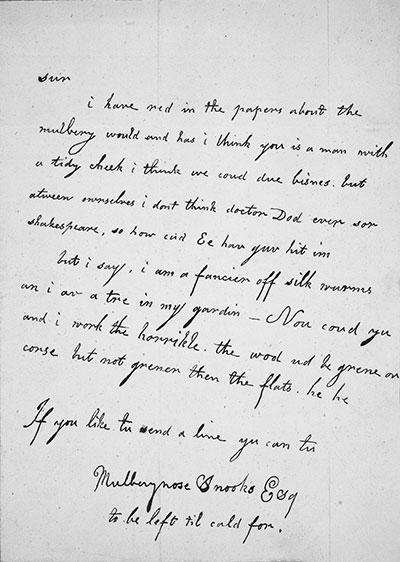
Here is another letter:
Sur
I have re[a]d in the papers about the mulbery would and has I think you is a man with a tidy cheek i think we could due bisnes. but atween ourselves I don’t think doctor Dod ever sor Shakespeare, so how cud Ee hav[e] yur hit imbut i say, i am a fancier off silk wurms an i av a tre[e] in my gardin – Nou coud yu and i work the horrible the wod w[oul]d be grene of corse but not greener than the flats he he. If you like tu send a line you can tu
Mulberynose Snooks Esq
To be left til cal[le]d for.
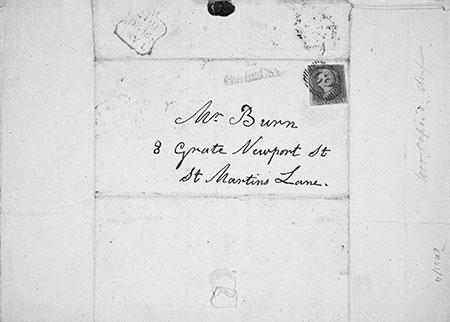
This strange letter was sent on 20 September 1847 to Jacob Henry Burn. Burn lived at 8 Great Newport Street, off St Martin’s Lane in London. He was an essayist, publisher, and numismatist.22 I imagine he had more idea than I do about what ‘Mulberynose Snooks’ is proposing. That is often the case with anonymous letters; they work by tapping into our own private paranoias. There were several newspaper accounts of Shakespeare’s mulberry tree, to which the author could be making reference.23 One paper noted that
Shakespeare planted a mulberry tree with his own hands on his ground, at Stratford-upon-Avon; and Garrick, Macklin, and others, were entertained under this mulberry tree in 1742. Shakespeare’s house was afterwards sold to a clergyman of the name of Gastrel…he pulled it down and sold the materials. He had previously cut down the mulberry tree for fuel; but a silversmith purchased the whole of it, which he manufactured into memorials of the Poet.24
Figure 2. Anonymous letter to Mr Burn 1847, Shakespeare Birthplace Trust ER21/4 recto
Figure 3. Anonymous letter to Mr Burn 1847, Shakespeare Birthplace Trust ER21/4 verso
Items from Shakespeare’s house had been recently auctioned, and there was speculation about the vast number of articles, all apparently made from one tree.25 The implication, perhaps, is that the mulberry tree items—secular relics—symbolized fraudulent or doubtful business. Perhaps ‘Snooks’ is implying that Burn had dirty hands.
Among the most exciting archival materials are those letters for which the envelopes or wrappers have been retained. We have this for the Mulberynose Snooks letter to Burn, because, as was common in 1847, the address was written on the reverse of the letter, which was then folded and sealed. This side (above) supplies various clues. The 62 in a dashed oval shape over the one penny red stamp shows that it went through a London postal district office, where it was stamped with a particular cancellation mark: this one South Tottenham. These marks were added to letters which had been posted at suburban sorting offices, and to letters from other districts on the same route which had not passed through the chief sorting office.26 There is also a stamp in the shape of a compressed square