Studying Sexual Behavior among MSM in New York City 72
Promoting Vaccination Programs in Developing Countries 107
Preventing Wife Abuse in Rural Kentucky 125
Forensic Anthropology for the Maya of Guatemala 147
Advocacy Anthropology and Community Activism in Papua New Guinea 167
Narrating Troubles 176
Aboriginal Women’s Culture and Sacred Site Protection 200
A Strategy on Cultural Heritage for the World Bank 235
Mapping African Pastoralists’ Movements for Risk Assessment and Service Delivery 255
The Saami, Snowmobiles, and Social Impact Analysis 263
Think Like an Anthropologist
Power in the Kitchen 13
The Importance of Dogs 47
Cultural Relativism and Female
Genital Cutting 83
What’s in a Name? 115
Making Friends 134
Yanomami, The “Fierce People”? 165
Should Dying Languages Be Revived? 190
Probing the Categories of Art 219
Haitian Cane Cutters in the Dominican Republic: Structure or Agency? 243
Culturama
San Peoples of Southern Africa 18
The Trobriand Islanders of Papua New Guinea 28
The Kwakwaka’wakw of Canada 63
The Old Order Amish of the United States and Canada 70
The Sherpa of Nepal 105
The Minangkabau of Indonesia 117
The Roma of Eastern Europe 143
The Kurds of the Middle East 169
The Saami of Sápmi, or Lapland 188
Hui Muslims of Xi’an, China 212
The Gullah of South Carolina 232
The Maya of Guatemala 247
Peyizan Yo of Haiti 269
Eye on the Environment
Inuit Place Names and Landscape Knowledge 36
Local Botanical Knowledge and Child Health in the Bolivian Amazon 96
Eagle Protection, National Parks, and the Preservation of Hopi Culture 198
Oil, Environmental Degradation, and Human Rights in the Niger Delta 280
Chapter 1
Map 1.1 Weyéwa Region in Indonesia 11
Map 1.2 Papua New Guinea 14
Map 1.3 Ju/wasi Region in Namibia and Botswana 18
Chapter 2
Map 2.1 Trobriand Islands of Papua New Guinea 28
Map 2.2 Syria 30
Map 2.3 Baffin Island in Northeast Canada 36
Map 2.4 Spain 37
Chapter 3
Map 3.1 Hare Region Is Near Colville Lake in Northwest Canada 47
Map 3.2 Andaman Islands of India 48
Map 3.3 Precolonial Iroquois Region 49
Map 3.4 Yanomami Region in Brazil and Venezuela 49
Map 3.5 Location of the Kuru Epidemic in Papua New Guinea 56
Map 3.6 Use of Mobile Money in Africa 57
Map 3.7 Lese and Efe Region in the Democratic Republic of Congo 62
Map 3.8 The Kwakwaka‘wakw Region in Canada 63
Chapter 4
Map 4.1 Old Order Amish Population of North America 70
Map 4.2 Morocco 73
Map 4.3 Mexico 75
Map 4.4 Maasai Region of Kenya and Tanzania 81
Map 4.5 Sierra Leone 83
Map 4.6 Aka Region of the Central African Republic and the Democratic Republic of Congo 86
Chapter 5
Map 5.1 The Philippines 92
Map 5.2 The Republic of Bolivia 96
Map 5.3 Precolonial Distribution of Indian Tribes in the 48 United States 99
Map 5.4 Designated Reservations in the 48 United States 100
Map 5.5 Nepal 105
Map 5.6 Samoa and American Samoa 106
Chapter 6
Map 6.1 Ireland 112
Map 6.2 Hong Kong 115
Map 6.3 Minangkabau Region in Indonesia 117
Map 6.4 Ghana 118
Map 6.5 Kentucky, United States 125
Chapter 7
Map 7.1
Map 7.2
Bangladesh 133
Caribbean Countries of South America 135
Map 7.3 The Solomon Islands 137
Map 7.4 Guna Region in Panama 139
Map 7.5 South Africa 141
Map 7.6
Chapter 8
Roma Population in Eastern Europe 143
Map 8.1 Melanesia 156
Map 8.2
Central Asian States 163
Map 8.3 Kurdish Region in the Middle East 169
Map 8.4 Puerto Rico 168
Chapter 9
Map 9.1 Pirahã Reservation in Brazil 174
Map 9.2 Bosnia and Herzegovina 176
Map 9.3 Western Apache Reservation in Arizona 178
Map 9.4 Two Sites of Proto-Indo-European Origins 185
Map 9.5 The Bantu Migrations in Africa 185
Map 9.6 The Saami of Sápmi, or Lapland 188
Chapter 10
Map 10.1 Klamath and Modoc Region in Oregon and California 196
Map 10.2 Hopi Reservation in Arizona 198
Map 10.3 England 199
Map 10.4 Hindmarsh Island in Southeast Australia 200
Map 10.5 Mainland Southeast Asia 207
Map 10.6 Sacred Sites in the Old City of Jerusalem, Israel 208
Map 10.7 The City of Xi’an in China 212
Chapter 11
Map 11.1 Costa Rica 231
Map 11.2 The Gullah Region of South Carolina 232
Map 11.3 Turkey 234
Chapter 12
Map 12.1 Tonga 244
Map 12.2 Site of Three Gorges Dam in China 246
Map 12.3 Guatemala 247
Map 12.4 El Salvador 251
Map 12.5 Sahel Region 254
Chapter 13
Map 13.1 Walpole Island Reservation in Southern Ontario, Canada 261
Map 13.2 Kerala, South India 265
Map 13.3 Haiti 269
Map 13.4 Senegal 271
Map 13.5 Nunavut Territory, Canada 274
Map 13.6 Sudan and South Sudan 275
Map 13.7 Nigeria and the Niger Delta 281
Preface
Ihad no idea all those cultures were out there,” said one of my students after taking my introductory cultural anthropology course. Another commented, “I’m a business major, but I am going to keep the books from this course because they will help me in my career. I need to understand people.”
Cultural anthropology opens up whole new worlds. Not just “out there,” but here, there, and everywhere. The subject matter of cultural anthropology may seem distant, exotic, and “other”—jungle drumbeats and painted faces, for example. This book helps students to encounter those faraway cultures and also to realize that their culture has its own versions of jungle drumbeats and painted faces. “Making the strange familiar” is essential learning in a globalizing world where cultural diversity may equal cultural survival for all of us. “Making the familiar strange” is a priceless revelation because it reduces the divide between “us” and the “other.” “We” become “other” through the insights of cultural anthropology.
To achieve this double goal, Cultural Anthropology in a Globalizing World, Fourth Edition, delivers rich and exciting information about the world’s cultures and promotes critical thinking and reflective learning. Students will find many points at which they can interact with the material, view their own culture as a culture, and make connections between anthropology and their everyday life in, for example, hairstyles, food symbolism, sleep deprivation, doctor–patient dialogues, racism and sexism, and the meaning of gestures.
The study of the world’s cultures involves learning new words and analytical categories, but the effort will pay off in terms of bringing the world’s peoples and cultures closer to you. If this book achieves my aspirations, anyone who reads it will live a life that is more culturally aware, enriched, and tolerant.
How This Book Is Organized
The book’s organization and pedagogical features are designed to help ensure student engagement and enhanced learning. The 13 chapters are organized in the following way––but professors will find it easy to assign chapters out of order.
The first chapter describes the discipline of anthropology as a whole and provides the foundation for the rest of the book. The second chapter moves to the subject of how cultural anthropologists define research topics, carry out research, and present their findings.
The next three chapters discuss how people make a living and their patterns of consumption and exchange, how they reproduce and raise children, and how different cultures deal with illness, suffering, and death. While these three chapters address basic questions of how people feed themselves, reproduce, and stay alive and well, the discussion in each case fans out to include a wide array of cultural interpretations and practices that go far beyond sheer basics.
The next three chapters look at people in groups. One chapter addresses kinship and its changing forms. Another looks at social ties that are not based on kinship. The third considers how people organize themselves politically, how they seek to maintain order, and how they deal with conflict.
Although symbolic behavior permeates the entire book, three chapters most directly focus on meaning and symbolism. The chapter on communication pulls much of the book together as it considers the origins and evolution of communication and language, with special attention to contemporary change. The chapter on religion provides cross-cultural categories of religious belief and practice as well as linking “world religions” to specific local transformations. Expressive culture is a wide-ranging subject, and the chapter on it embraces expected topics such as art and music and unexpected topics such as sports, leisure, and travel.
The last two chapters consider two of the most important topics shaping cultural change in our times: migration and international development. These chapters explicitly put culture into motion and show how people are affected by larger structures, such as globalization or violence, and exercise agency in attempting to create meaningful and secure lives.
Features
Several new and continued features make this textbook distinctive and effective.
Learning Objectives
Learning Objectives are listed at the beginning of each chapter and below the three major chapter headings. At the end of the chapter, Learning Objectives Revisited provides a helpful review of the key points related to the three Learning Objectives.
Anthro Connections
Each chapter begins with an attention-getting short piece on an aspect of culture that relates to recent events and connects to the chapter opening photo. This feature helps
students see the relevance of anthropology to contemporary issues around the world.
Culturama
All chapters include a one-page profile of a cultural group with a mini-panorama of two photographs and a map with captions. These brief summaries provide an enticing glimpse into the culture presented.
Anthropology Works
Although students may appreciate the interesting material that cultural anthropology offers, they are still likely to ask, “Does this knowledge have any practical applications?” Every chapter contains a compelling example of how knowledge and methods in cultural anthropology can prevent or solve social problems. Anthropology Works examples include: Paul Farmer’s role in providing health care in Haiti, Laura Tabac’s applied research on men’s risky sexual practices in New York City and Australian Aboriginal women’s collaboration with an anthropologist to document and preserve their cultural heritage.
Think Like an Anthropologist
These examples connect anthropology to everyone’s lives and prompt reflective learning. Others introduce a problem and show how it has been studied or analyzed from different anthropological perspectives, providing links to the major theoretical debates in cultural anthropology presented in Chapter 1, and prompt critical thinking.
Eye on the Environment
This feature highlights the important relationship between culture and environment. Along with many in-text references to how culture and the environment interact, students will recognize culture-environment connections through examples from many cultures.
Map Program
The maps are carefully chosen and designed to provide the right amount of information to complement the text. Detailed captions lead students on to connect the map with other topics such as livelihood, population, and language.
In-Text Glossary
Definitions of the Key Concepts are provided where the concept is first mentioned and defined. A paginated list of the Key Concepts appears at the end of each chapter. The glossary at the end of the book contains a complete list of Key Concepts and their definitions.
Thinking Outside the Box
This feature provides two or three thought-provoking questions in each chapter, displayed at the end of the chapter. These questions prompt readers to relate a topic to their cultural experiences or provide an avenue for further research. They can promote class discussion or serve as a basis for a class project.
What’s New in This Edition?
Each chapter contains updated material including examples from the latest research, current population statistics, and new and revised Key Concepts. Chapters now begin with an Anthro Connections box that relates to contemporary issues around the world.
• Chapter 1: the relevance of cultural anthropology in addressing the Ebola epidemic
• Chapter 2: computational anthropology as a new Key Concept, discussion of “diffraction” in commodity studies; updates in the Culturama on the Trobriand Islands; and sexual discrimination within the discipline
• Chapter 3: discussion of hyperconsumerism; example of effects of global consumer demand driving phosphate mining in a small Pacific island and displacement of the indigenous population; new Key Concepts on division of labor, subjective well-being, and mobile money
• Chapter 4: update on China’s One Child Policy as more flexible; update in the Culturama on the Amish; heteronormativity is a new Key Concept
• Chapter 5: discussion of zoonotic diseases as a subtype of infectious diseases; stigma is a new Key Concept
• Chapter 6: new example of touch as a way of communicating kinship in Central India
• Chapter 7: material on emerging social inequality within “racial” categories in South Africa based on life histories; update in the Culturama on the Roma
• Chapter 8: revised statistics about incarceration; update in the Culturama on the Kurdish people
• Chapter 10: new material about the Ngarrindjeri and their land claims in Australia; revised Key Concept definition of revitalization movements
• Chapter 11: material on the role of art in post-conflict situations
• Chapter 12: updated migration statistics throughout the chapter
• Chapter 13: updated statistics on indigenous peoples; material on careers in international development and how students can best pursue such careers
The Importance of Names
Since the beginning of modern humanity, people have been naming each other, naming their groups and other groups, and naming features of the places they inhabit. People of earlier times often referred to themselves in terms that translate roughly into “The People.” As far as they were concerned, they were The People: the only people on earth.
Things are more complicated now. European colonialism, starting in the fifteenth century, launched centuries of rapid contact between Europeans and thousands of indigenous groups around the world. The Europeans named and described these groups in their European languages. The names were not those that the people used for themselves, or if they were, the transliteration into a European language altered local names into something very different from the original.
The Spanish explorers’ naming of all the indigenous peoples of North America as Indians is a famous example of a misnomer. Beyond being wrong by thinking they had reached India, the Spanish conquerors who renamed thousands of people and claimed their territory simultaneously erased much of the indigenous people’s heritage and identity.
The challenge of using the preferred names for people and places of the world faces us today as people worldwide wrestle with the issue of what they want to be called. Until recently, indigenous peoples of the present-day United States mainland preferred to be called Native Americans, rejecting the pejorative term “Indian.” Now, they are claiming and recasting the term “Indian.” In Alaska, the preferred term is “Alaska Native,” and in Hawai’i it is “Native Hawai’ian.” In Canada, preferred terms are “First Nations,” “Native Peoples,” and “Northern Peoples.”
From small-scale groups to entire countries, people are attempting to revive precolonial group names and place names. Bombay is now Mumbai, and Calcutta is Kolkata. Group names and place names are frequently contested. Is someone Hispanic or Latino? Is it the Persian Gulf or the Arabian Gulf? Is it Greenland or Kalaallit Nunaat? Does it matter? The answer is yes, resoundingly, yes.
This book strives to provide the most currently accepted names for people, places, objects, activities, and ideas. By the time it is printed, however, some names and their English spellings will have changed. It is an ongoing challenge to keep track of such changes, but doing so is part of our job as citizens of a transforming world.
The Cover Image
Mongolia is one of the most sparsely populated countries in the world, with a population of around three million people. It contains very little farmable land, as much of its area is grassy steppe, with mountains to the north and west and the Gobi Desert to the south. Approximately 30 percent of the population depend on herding animals for their livelihoods. Freedom of movement, horse riding, and yert domestic architecture are
central parts of the culture. The majority of its population are Buddhists. Women’s economic and political roles in Mongolian history were often important. Genghis Khan appointed his daughters as combatant generals. Throughout history, many Mongolian women have been skilled horse riders and archers. Since 1999, two women have filled the post of Minister of Foreign Affairs. More than 70 percent of students in higher education are women. We have yet to see how changing gender roles will shape Mongolia’s future.
In Thanks
The breadth, depth, and quality of this edition are the result of many people’s ideas, comments, corrections, and care. For the first edition of Cultural Anthropology , four anthropologists carefully reviewed multiple drafts of the book. I will always be grateful to them for their monumental contribution that helped make this book what it is today: Elliot Fratkin, Smith College; Maxine Margolis, University of Florida; Russell Reid, University of Louisville; and Robert Trotter II, University of Arizona.
The author thanks the following reviewers who provided comments and advice in preparation for this edition: Lisa Beiswenger, The Ohio State University; Lesley Daspit, Purdue University; Alexa Dietrich, Wagner College; Henri Gooren, Oakland University; William Jankowiak, University of Nevada, Las Vegas; Patricia Jolly, University of Northern Colorado; Jing Lei, State University of New York at Oswego; Andrew Nelson, University of North Texas; Simone Poliandri, Framingham State University; and Frank Salamone, Iona College.
The cultural anthropologists who have reviewed previous editions of this textbook and offered their critiques and detailed suggestions have shaped this book from start to finish: Warren D. Anderson, Southeast Missouri State University; Jason Antrosio, Hartwick College; Diane Baxter, University of Oregon; Monica L. Bellas, Cerritos College; Joyce Bishop, California State University, Sacramento; Ronald Bolender, Mount Vernon Nazarene University; Barbara Bonnekessen, University of Missouri–Kansas City; Peter Brown, University of Wisconsin, Oshkosh; Howard Campbell, University of Texas, El Paso; (the late) Charles R. de Burlo, University of Vermont; Elizabeth de la Portilla, University of Texas at San Antonio; William W. Donner, Kutztown University; Lisa Pope Fischer, Santa Monica College; Pamela J. Ford, Mount San Jacinto College; Monica Frolander-Ulf, University of Pittsburgh, Johnstown; Mary Kay Gilliland, Pima Community College; Nancy Gonlin, Bellevue Community College; Jeanne Humble, Bluegrass Community & Technical College; Ann Kingsolver, University of South Carolina; Courtney Kurlanska, University of New Hampshire; Leslie Lischka, Linfield College; William M. Loker, California State University, Chico; Martin F. Manalansan IV, University of Illinois; Roberta Martine, Fort Hays State University; Corey Pressman, Mt. Hood Community College; Ed Robbins, University of Wisconsin; Jacquelyn Robinson, Albany State University;
Harry Sanabria, University of Pittsburgh; Kathleen M. Saunders, Western Washington University; G. Richard Scott, University of Nevada, Reno; Wesley Shumar, Drexel University; David Simmons, University of South Carolina; Kimberly Eison Simmons, University of South Carolina; Lori A. Stanley, Luther College; Margaret Weinberger, Bowling Green State University; Jim Wilce, Northern Arizona University; Peter Wogan, Willamette University; Katrina Worley, Sierra College; Sabrina Adleman, Lansing Community College, Mott Community College; Annalisa Alvrus, Mesa Community College; John Baker, Moorpark College; Suzanne Baldon, University of Texas At Arlington; Sally Billings, College of Southern Nevada; Adriana Bohm, Delaware County Community College; Vicki Bradley, University of Houston; Angela Bratton, Augusta State University; Liam Buckley, James Madison University; Howard Campbell, UTEP; Jenny Chio, University of California Berkeley; Heather Claussen, Cabrillo College; Pearce Creasman, Blinn College; Julie David, Orange Coast College; Phyllisa Eisentraut, Santa Barbara City College; Jack Eller, Metropolitan State College of Denver; Diana Fox, Bridgewater State College; Renee Garcia, Saddleback College; Erik Gooding; Jane Goodman, Indiana University; Kathryn Grant, University of North Florida; William Griffin, St. Charles Community College; Corinna Guenther, Southwestern College; Melissa Hargrove, Miami University of Ohio; Julie Hartley, Brigham Young University; Alanson Hertzberg, Cosumnes River College; Robin Hicks, Ball State University; J. Dwight Hines, Point Park University; Elizabeth Hirsh, Community College of Aurora; Brian Hoey, Marshall University; Barbara Hughes, Metropolitan State College of Denver; Francisca James Hernandez, Pima Community College; William Jankowiak, UNLV; Hannah Jopling, Fordham University; Ronald Kephart, University of North Florida; Andrew Kinkella, Moorpark College; Tracy Kopecky, College of Dupage; Hollie Kopp, Front Range Community College; Elizabeth Lamble, Mott Community College; Alison Lee, UC Riverside; William Leggett, Middle Tennessee State University; Jennifer Malicher, Bergen Community College; Roberta Martine, Fort Hays State University; Chad Morris, George Mason University; Laurie Occhipinti, Clarion University; Carlos Ochoa, University of Arkansas; Pamela Pacheco, Golden West College; James Preston, Sonoma State University; Kathleen Ragsdale, Mississippi State University; Karaleah Reichart, UNC-Chapel Hill And UNCGreensboro; Margaret Sabom Bruchez, Blinn College; Suzanne Scheld, California State University, Northridge; Edward Snajdr, John Jay College of Criminal Justice, CUNY; R. Sophie Statzel, Baruch College; Susan Speigel, College of Dupage; Megan Springate, Monmouth University; Ayse Taskiran, Butte College; Mary Taylor, Hunter College; Shelly Tiley, California State University, Sacramento; Andria Timmer, Texas Christian University; Alan Trevithick, Fordham University; Salena Wakim, Orange Coast College; Margaret Weinberger, Bowling Green State University; and Katrina Worley, Sierra College.
Many anthropologists and others have provided encouragement, suggestions, feedback, references, and photographs: Lila Abu-Lughod, Abigail Adams, Vincanne Adams, Catherine Allen, Joseph Alter, Matthew Amster, Myrdene Anderson, Donald Attwood, Christopher Baker, Isabel Balseiro, Nancy Benco, Marc Bermann, Alexia Bloch, Elson Boles, Lynne Bolles, John Bowen, Don Brenneis, Alison Brooks, Judith K. Brown, D. Glynn Cochrane, Jeffery Cohen, Carole Counihan, Brian Craik, Liza Dalby, Loring Danforth, Patricia Delaney, Alexander Dent, Linus Digim’rina, Timothy Earle, Daniel Everett, Johannes Fabian, Ilana Feldman, Janina Fenigsen, Elliot Fratkin, Martin Fusi, Maris Boyd Gillette, Richard A. Gould, David Gow, Richard Grinker, Daniel Gross, (the late) Marvin Harris, Tobias Hecht, Cornelia Mayer Herzfeld, Michael Herzfeld, Barry Hewlett, Danny Hoffman, Michael Horowitz, (the late) Robert Humphrey, Lanita Jacobs-Huey, Vicki Jensen, Anstice Justin, Barry D. Kass, Patty Kelly, Laurel Kendall, David Kideckel, Diane E. King, Stuart Kirsch, Dorinne Kondo, Conrad Kottak, Jennifer Kramer, Donald B. Kraybill, Ruth Krulfeld, Joel Kuipers, Takie Lebra, David Lempert, Lamont Lindstrom, Susan Orpett Long, Luisa Maffi, Beatriz Manz, Debra Martin, Samuel Martínez, Catherine McCoid, Leroy McDermott, Kimber Haddox McKay, Jerry Milanich, Laura Miller, Madhushree Mukerjee, Kirin Narayan, Sarah Nelson, Gananath Obeyesekere, Ellen Oxfeld, Hanna Papanek, Michael G. Peletz, Deborah Pellow, (the late) Gregory Possehl, David Price, Joanne Rappaport, Jennifer Robertson, Nicole Sault, Joel Savishinsky, David Z. Scheffel, Nancy Scheper-Hughes, Pankaj Sekhsaria, Bob Shepherd, Richard Shweder, Jennie Smith-Pariola, Chunghee Soh, Kate Spilde Contreras, Anthony Stocks, Patricia Tovar, Sita Venkateswar, Martha Ward, James (Woody) Watson, Rubie Watson, Van Yasek, and Kevin Yelvington.
I am grateful to Charlyce Jones-Owen, my editor at Pearson, for her support. I have enjoyed working closely with Ohlinger Publishing Services in Columbus, Ohio, during the revision process, especially Brooke Wilson.
I thank the Millers—my parents, siblings, aunts and uncles, and nieces and nephews—for their interest and support. My father’s two comments about the book were that it has a lot of long words and how do I know so much about sex? “From reading, Dad,” was my truthful reply. I am grateful to the Heatons—my former in-laws, including my ex-husband, (late) ex-parents-in-law, brothers- and sisters-in-law, and nieces and nephews—for their enduring friendship.
I thank, especially, my son, Jack Heaton. He was a superb traveling companion on our trip around the world with the Semester at Sea Program in 1996, when I wrote much of the first edition of Cultural Anthropology. He continues to be excellent company during our time together in DC. This book is dedicated to him.
Barbara Miller Washington, DC
Support for Instructors and Students
This book is accompanied by an extensive learning package to enhance the experience of both instructors and students. The author played a major role in developing and updating the material in the Instructor’s Resource Manual with Tests, MyTest, and the PowerPoint™ slides.
Instructor’s Resource Manual and Test Bank
(0-13-445839-7)
For each chapter, this supplement provides a lecture outline, learning objectives, key concepts, Thinking Outside the Box questions, video suggestions, suggested readings, and a list of REVEL interactives. Test questions in multiple choice, truefalse, and essay formats are available for each chapter. This manual is available for download at www.pearsonhighered. com/irc.
MyTest (0-13-445840-0)
This computerized software allows instructors to create personalized exams, to edit any or all of the existing test questions, and to add new questions. Other features include the random generation of test questions, the creation of alternative versions of the same test, scrambling question sequences, and test previews before printing. This software is available for download at www.pearsonhighered.com/irc.
Powerpoint™ Presentation for Cultural Anthropology in a Globalizing World
(0-13-445841-9)
These PowerPoint slides combine text and graphics for each chapter to help instructors convey anthropological
principles and examples in a clear and engaging way. They are available for download at www.pearsonhighered. com/irc.
REVEL™ Educational Technology Designed for the Way Today’s Students Read, Think, and Learn
When students are engaged deeply, they learn more effectively and perform better in their courses. This simple fact inspired the creation of REVEL: an immersive learning experience designed for the way today’s students read, think, and learn. Built in collaboration with educators and students nationwide, REVEL is the newest, fully digital way to deliver respected Pearson content. REVEL enlivens course content with media interactives and assessments—integrated directly within the authors’ narrative—that provide opportunities for students to read about and practice course material in tandem. This immersive educational technology improves student engagement and understanding of concepts, improving performance throughout the course. Learn more about REVEL at http://www.pearsonhighered.com/revel/
Strategies in Teaching Anthropology, Sixth Edition
(0-205-71123-5)
This book focuses on the “how” of teaching anthropology across all of the discipline’s four fields and provides a wide array of associated learning outcomes and student activities. It is a compendium of strategies and teaching tips from anthropologists, teaching in a variety of settings, who share their pedagogical techniques, knowledge, and observations.
This page intentionally left blank
About the Author
Barbara D. Miller
Barbara Miller is Professor of Anthropology and International Affairs in the Elliott School of International Affairs of the George Washington University in Washington, DC. She is Director of the Elliott School’s Institute for Global and International Studies as well as Director of two of its affiliated research groups, the Culture in Global Affairs Program and the Global Gender Program. Before coming to GW in 1994, she taught at Syracuse University, the University of Rochester, SUNY Cortland, Ithaca College, Cornell University, and the University of Pittsburgh.
For over 30 years, Barbara’s research has focused on gender-based inequalities in India, especially the nutritional and medical neglect of daughters in northern regions of the country, and sex-selective abortion. She has also conducted research on culture and rural development in Bangladesh, on low-income household dynamics in Jamaica, and on Hindu adolescents in Pittsburgh. Her current interests include continued research on gender inequalities in health in South Asia and the role of cultural anthropology in informing policy, especially as related to women, children, and other disadvantaged groups.
She teaches course on introductory cultural anthropology, medical anthropology, development anthropology, culture and population, health and development in
South Asia, migration and mental health, and global gender policy.
Barbara has published many scholarly articles and book chapters and several books including The Endangered Sex: Neglect of Female Children in Rural North India, Second Edition (Oxford University Press 1997), an edited volume, Sex and Gender Hierarchies (Cambridge University Press 1993), and a co-edited volume with Alf Hiltebeitel, Hair: Its Power and Meaning in Asian Cultures (SUNY Press 1998). In addition to Cultural Anthropology, Eighth Edition, she is the author of Cultural Anthropology in a Globalizing World, Fourth Edition (Pearson 2017) and the lead author of a four-field textbook entitled Anthropology, Second Edition (Pearson 2008).
She launched a blog in 2009 called anthropologyworks where she and other contributors present informed opinion pieces about important social issues, a weekly feature covering anthropology in the mainstream media, and other features. Since its beginning, the blog has had 120,000 visits from people in nearly every country of the world. You can follow her, along with over 17,000 people worldwide, via Twitter @ anthroworks and Facebook. In 2010, she launched a second blog called globalgendercurrent, which highlights new research and debates about global women’s issues as informed by grounded research and cutting-edge policy questions. She Tweets and Facebooks about global gender issues.
“Cultural Anthropology is exciting because it connects with everything, from food to art. And it can help prevent or solve world problems related to social inequality and injustice.”
This page intentionally left blank
Chapter 1 Anthropology and the Study of Culture
Outline
Introducing Anthropology’s Four Fields
Anthropology Works: Delivering Health Care in Rural Haiti
Introducing Cultural Anthropology
Think Like an Anthropologist: Power in the Kitchen
Culturama: San Peoples of Southern Africa
Distinctive Features of Cultural Anthropology
Learning Objectives
1.1 Define what is anthropology.
1.2 Recognize what is cultural anthropology.
Anthro Connections
A Zhuang (zhoo-ANG) girl works in the famously beautiful rice terraces of southern China near its border with Vietnam. The Zhuang number about 18 million, making them the largest ethnic minority in China. In addition to growing tourism in the Zhuang region, it is now a favored retirement destination for elderly Chinese. One major attraction is the quality of the drinking water that comes from natural
Cannibalism, Jurassic Park, hidden treasure, Indiana Jones and the Temple of Doom, ancient prehuman fossils, and the Fountain of Youth in China? The popular impression of anthropology is based mainly on movies and television shows that depict anthropologists as adventurers and heroes. Many anthropologists do have adventures and discover treasures such as ancient pottery, medicinal plants, and jade carvings. But most of their research is not glamorous. Some anthropologists spend years in difficult physical conditions, searching for the earliest fossils of our ancestors. Others live among people in Silicon Valley, California, and study how they work and organize family life in a setting permeated by modern technology. Some anthropologists conduct laboratory analyses of tooth enamel to learn where an individual once lived. Others study designs on prehistoric
1.3 Summarize the distinctive features of cultural anthropology.
springs (Lin and Huang 2012). Another is the area’s reputation for having many people who live for a long time, including China’s oldest person who is 127 years old. An elderly resident comments, “My high blood pressure was brought under control after I spent a month here. I would get epileptic attacks about once in two months, but it never strikes now.”
pottery to understand trade relations between cities. And others observe nonhuman primates such as chimpanzees or orangutans in the wild to learn how they live.
Anthropologists study the entire diversity of humanity, past and present. Cultural anthropologists study living people including (left) contemporary Silicon Valley culture in California and (right) the Dani people of West Papua, the Indonesian part of the island of New Guinea, who still value their stone tools in addition to steel tools.
Anthropology is the study of humanity, including prehistoric origins and contemporary human diversity. Compared with other disciplines that study humanity such as history, psychology, economics, political science, and sociology, anthropology is broader in scope. Anthropology covers a much greater span of time than these disciplines, and it encompasses a broader range of topics.
Introducing Anthropology’s Four Fields
1.1 Define what is anthropology.
In North America, anthropology is divided into four fields (Figure 1.1) that focus on separate, but connected, subject matter related to humanity:
• Biological anthropology or physical anthropology— the study of humans as biological organisms, including evolution and contemporary variation.
• Archaeology —the study of past human cultures through their material remains.
• Linguistic anthropology —the study of human communication, including its origins, history, and contemporary variation and change.
• Cultural anthropology —the study of living peoples and their cultures, including variation and change. Culture refers to people’s learned and shared behaviors and beliefs.
Some anthropologists argue that a fifth field, applied anthropology, should be added. Applied anthropology is the use of anthropological knowledge to prevent or solve problems or to shape and achieve policy goals.
Biological or Physical Anthropology
Biological anthropology encompasses three subfields. The first, primatology, is the study of the nonhuman members of the order of mammals called primates, which includes a
anthropology the study of humanity, including its prehistoric origins and contemporary human diversity.
biological anthropology the study of humans as biological organisms, including evolution and contemporary variation.
archaeology the study of past human cultures through their material remains.
linguistic anthropology the study of human communication, including its origins, history, and contemporary variation and change.
cultural anthropology the study of living peoples and their cultures, including variation and change.
culture people’s learned and shared behaviors and beliefs. applied anthropology the use of anthropological knowledge to prevent or solve problems or to shape and achieve policy goals.
wide range of animals from very small, nocturnal creatures to gorillas, the largest members. Primatologists study nonhuman primates in the wild and in captivity. They record and analyze how the animals spend their time, collect and share food, form social groups, rear offspring, develop leadership patterns, and experience and resolve conflicts. Primatologists are alarmed about the decline in numbers, and even the extinction, of nonhuman primate species. Many apply their knowledge to nonhuman primate conservation.
The second subfield is paleoanthropology, the study of human evolution on the basis of the fossil record. Paleoanthropologists search for fossils to increase the amount of evidence related to the way human evolution occurred.
The third subfield is the study of contemporary human biological variation. Anthropologists working in this area seek to explain differences in the biological makeup and behavior of contemporary humans. They study such biological factors as DNA within and across populations, body size and shape, human nutrition and disease, and human growth and development.
Archaeology
Archaeology means, literally, the “study of the old,” but “the old” is limited to human culture. Therefore, the time depth of archaeology goes back only to the beginnings of Homo sapiens, between 300,000 and 160,000 years ago, when they first emerged in Africa. Archaeology encompasses two major areas: prehistoric archaeology, which concerns the human past before written records, and historical archaeology, which deals with the human past in societies that have written documents. Prehistoric archaeologists often identify themselves with broad geographic
Figure 1. 1 The Four Fields of Anthropology
regions, studying, for example, Old World archaeology (Africa, Europe, and Asia) or New World archaeology (North, Central, and South America).
Another set of specialties within archaeology is based on the context in which the archaeology takes place. For example, underwater archaeology is the study of submerged archaeological sites. Underwater archaeological sites may be from either prehistoric or historic times. Some prehistoric sites include early human settlements in parts of Europe, such as household sites discovered in Switzerland that were once near lakes but are now submerged.
The archaeology of the recent past is an important research direction. An example of the archaeology of contemporary life is the “Garbage Project” conducted by archaeologists at the University of Arizona at Tucson (Rathje and Murphy 1992). They have excavated part of the Fresh Kills landfill on Staten Island, near New York City. It is one of the largest human-made structures in North America. The excavation of pop-top can tabs, disposable diapers, cosmetics containers, and newspapers reveals much about recent consumption patterns and how they affect the environment. One surprising finding is that the kinds of garbage people often blame for filling up landfills, such as fast-food packaging and disposable diapers, cause less serious problems than paper. Newspaper is a major culprit because of its sheer quantity. This information can improve recycling efforts worldwide.
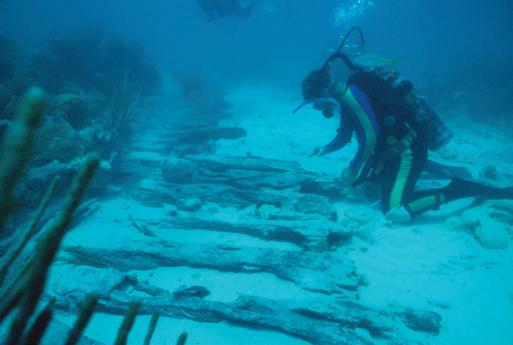
Underwater archaeology is a focus of some archaeologists. Stephen Lubkemann, trained as both a cultural anthropologist and an underwater archaeologist, documents the remains of the hull of DRTO-036, a vessel that wrecked in the Dry Tortugas in the mid-nineteenth century. The vessel lies within Dry Tortugas National Park in the Florida Keys. You can access UNESCO’s Convention on the Protection of Underwater Heritage on the Internet.
Are courses in forensic anthropology offered
Linguistic Anthropology
Linguistic anthropology is devoted to the study of communication, mainly (but not exclusively) among humans (Chapter 9 is devoted to this field). Linguistic anthropology has three subfields: historical linguistics, the study of language change over time and how languages are related; descriptive linguistics or structural linguistics, the study of how contemporary languages differ in terms of their formal structure; and sociolinguistics, the study of the relationships among social variation, social context, and linguistic variation, including nonverbal communication.
Linguistic anthropologists are studying important current issues, as discussed in Chapter 9. First, they study language in everyday use, or discourse, and how it relates to power structures at local, regional, and international levels (Duranti 1997a). Second, they look at the role of information technology in communication, including the Internet, social media such as Facebook, and cell phones. Third is attention to the increasingly rapid extinction of indigenous languages and what can be done about it.
Cultural Anthropology
Cultural anthropology is the study of contemporary people and their cultures. The term culture refers to people’s learned and shared behaviors and beliefs. Cultural anthropology considers variations and similarities across cultures,
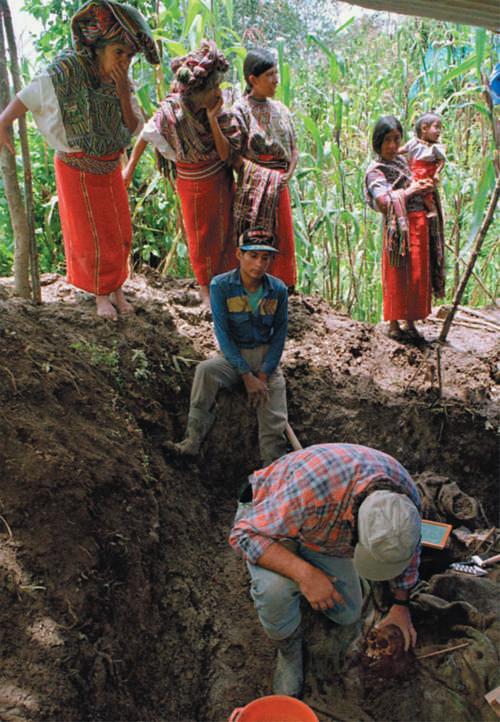
Maya people watch as a forensic anthropologist conducts an exhumation of more than 50 bodies in a highland Guatemalan village in 1997. Such work is ongoing in Guatemala and many other places in the world. It gives closure to the survivors.
at your school?
Anthropology Works
Delivering Health Care in Rural Haiti
Journalist Tracy Kidder’s book, Mountains Beyond Mountains: The Quest of Paul Farmer, a Man Who Would Cure the World (2003), is an inspiring story about an inspiring person: Paul Farmer. Farmer earned a Ph.D. in anthropology and a degree in medicine from Harvard University. His training in cultural anthropology and medicine is a powerful prescription for providing health care to the poor.
In his first book, AIDS and Accusation: Haiti and the Geography of Blame (1992), he wrote about the coming of HIV/AIDS to Haiti and a rural community’s attempt to understand and cope with this devastating new disease. He also describes how the wider world mistakenly blamed Haiti for being the source of the disease. Farmer focuses attention on poverty and social justice as primary causes of health problems worldwide. This position has shaken the very foundations of Western medicine.
In addition to his scholarly publications, Farmer is an influential health practitioner and activist. As one of the cofounders of Partners in Health, he has helped heal thousands of people. In 2009, Farmer was named U.S. deputy special envoy to Haiti. Since the earthquake in January 2010, he has worked tirelessly to alleviate suffering in Haiti.
In my undergraduate cultural anthropology class, when I ask who has heard of Paul Farmer, many hands shoot up. Of these students, most have read Mountains Beyond Mountains. A few have heard him speak. This level of awareness of Farmer’s contributions to health and anthropology prompted me to create a label that captures Farmer’s inspirational role: the Paul Farmer Effect (PFE).
and how cultures change over time. Cultural anthropologists learn about culture by spending a long time, typically a year or more, living with the people they study (see Chapter 2)
Prominent areas of specialization in cultural anthropology include economic anthropology, psychological anthropology, medical anthropology, political anthropology, and international development anthropology.
Applied Anthropology: Separate Field or Cross-Cutting Focus?
In the United States, applied anthropology emerged during and after World War II. Its first concern was with improving the lives of contemporary peoples, so it was more closely associated with cultural anthropology than with the other three fields.
Many anthropologists feel that applied anthropology should be considered a fifth field of anthropology, standing on its own. Many others think that the application of
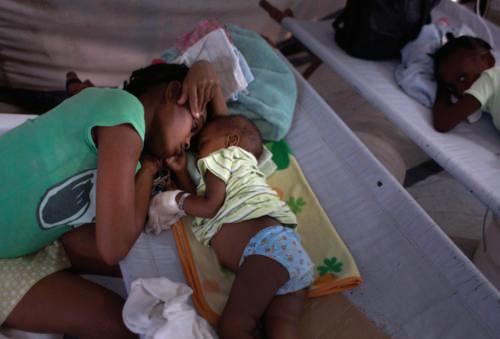
A woman cares for her sick child while he receives treatment for cholera at a clinic in Port-au-Prince, Haiti, in 2011. Cholera has affected more than 450,000 people in this country of 10 million, or nearly five percent of the population, and it has killed more than 6,000. Haiti continues to seek reparations from the United Nations because it was their staff who brought cholera to Haiti.
This label refers to the Pied Piper role he plays for students: They want to follow his lead; they want to be a Paul Farmer. Students are choosing courses and selecting majors and minors to help them achieve that goal.
I began to notice the PFE in 2010, and it is still growing. Because of the PFE, more students each year combine their academic interests in anthropology, global health, and international affairs. These students are beginning to graduate and are going on to pursue humanitarian careers. Thanks to Paul Farmer and the PFE, they are more powerfully informed to make the world a better place.
knowledge to solve problems, just like theory, should be part of each field (see Figure 1.1). The latter is the author’s position, and therefore, many examples of applied anthropology appear throughout this book.
Applied anthropology can be found in all four fields of anthropology:
• Archaeologists are employed in cultural resource management (CRM), assessing the presence of possible archaeological remains before construction projects, such as roads and buildings, can proceed.
• Biological anthropologists are employed as forensic anthropologists, participating in criminal investigations through laboratory work identifying bodily remains. Others work in nonhuman primate conservation, helping to protect their habitats and survival.
• Linguistic anthropologists consult with educational institutions about how to improve standardized tests for bilingual populations and conduct policy research for governments.
• Cultural anthropologists apply their knowledge to poverty reduction, education, health care, international business, and conflict prevention and resolution (see Anthropology Works throughout this book for examples).
Introducing Cultural Anthropology
1.2 Recognize what is cultural anthropology.
Cultural anthropology is devoted to studying human cultures worldwide, both their similarities and differences. Cultural anthropology makes “the strange familiar and the familiar strange” (Spiro 1990). It teaches us to look at ourselves from the “outside” as a somewhat “strange” culture. A compelling example of making the familiar strange is the case of the Nacirema (nah-see-RAY-muh), a culture first described in 1956:
The Nacirema are a North American group living in the territory between the Canadian Cree, the Yaqui and the Tarahumara of Mexico, and the Carib and the Arawak of the Antilles. Little is known of their origin, though tradition states that they came from the east. According to Nacirema mythology, their nation was originated by a culture hero, Notgnihsaw, who is otherwise known for two great feats of strength—the throwing of a piece of wampum across the river Pa-To-Mac and the chopping down of a cherry tree in which the Spirit of Truth resided (Miner 1965 [1956]:415).
The anthropologist goes on to describe the Nacirema’s intense focus on the human body He provides a detailed a ccount o f a d aily r itual p erformed w ithin t he h ome i n a specially constructed shrine area:
The focal point of the shrine is a box or chest which is built into the wall. In this chest are kept the many charms and magical potions without which no native believes he could live. These preparations are secured from a variety of specialized practitioners. The most powerful of these are the medicine men, whose assistance must be rewarded with substantial gifts. Beneath the charm-box is a small font. Each day every member of the family, in succession, enters the shrine room, bows his head before the charm-box, mingles different sorts of holy water in the font, and proceeds with a brief rite of ablution (415–416).
If you do not recognize this tribe, try spelling its name backwards. ( Note: Please forgive Miner for his use of the masculine pr onoun in describing Nacir ema society; he wrote this piece several decades ago.)
Highlights in the History of Cultural Anthropology
The beginning of cultural anthropology goes back to writers such as Herodotus (fifth century bce; note: bce stands for Before the Common Era, a secular transformation of bc, or Before Christ), Marco Polo (thirteenth to fourteenth centuries
ce, or Current Era), and Ibn Khaldun (fourteenth century), who traveled extensively and wrote reports about cultures they encountered. More recent conceptual roots are found in writers of the French Enlightenment, such as the philosopher Montesquieu, who wrote in the first half of the eighteenth century. His book The Spirit of the Laws, published in 1748 [1949], discussed the temperament, appearance, and government of various peoples around the world. He thought that different climates caused cultural variations.
In the second half of the nineteenth century, the discovery of the principles of biological evolution by Charles Darwin and others offered for the first time a scientific explanation for human origins. Biological evolution says that early forms evolve into later forms through the process of natural selection, whereby the most biologically fit organisms survive to reproduce while those that are less fit die out. According to Darwin’s model, continuous progress toward increasing fitness occurs through struggle among competing organisms.
The concept of evolution was important in the thinking of early cultural anthropologists. The most important founding figures of cultural anthropology in the late eighteenth and early nineteenth centuries were Sir Edward Tylor and Sir James Frazer in England and Lewis Henry Morgan in the United States (see Figure 1.2). They developed a model of cultural evolution whereby all cultures evolve from lower to higher forms over time. This view placed non-Western peoples at a “primitive” stage and Euro-American culture as “civilization.” It assumed that non-Western cultures would either catch up to the level of Western civilization or die out.
Bronislaw Malinowski, a major figure in modern cultural anthropology of the first half of the twentieth century, established a theoretical approach called functionalism It says that a culture is similar to a biological organism: T he pa rts wo rk t ogether to s upport th e o peration o f t he whole. Religion and family or ganization, for example, contribute to the functioning of the whole culture. Franz Boas is considered the founder of North American cultural anthropology. Born in Germany and educated in physics and geography, he came to the United States in 1887 (Pat terson 2001:46ff). He brought with hi m a skept icism toward Western science gained from a year ’s study with the Inuit, indigenous people of Baffin Island, Canada (see Map 2.3, page 36). He learned from the Inuit that people in different c ultures m ay h ave d ifferent pe rceptions o f e ven basic physical substances, such as “water.” Boas came to recognize the individuality and validity of different cultures. He introduced the concept of cultural relativism, or
functionalism the theory that a culture is similar to a biological organism, in which parts work to support the operation and maintenance of the whole.
cultural relativism the perspective that each culture must be understood in terms of the values and ideas of that culture and not judged by the standards of another culture.
Figure
1.2 Key Contributors
to Euro-American Cultural Anthropology
Late Nineteenth Century
Sir Edward Tylor First defi nition of culture, armchair anthropology
Sir James Frazer
Comparative study of religion, armchair anthropology
Lewis Henr y Morgan Insider’s view, cultural evolution, compar ative method
Early Twentieth Century
Bronislaw Malinowski
Franz Boas
Functionalism, holism, participant observation
Cultural relativism, historical particularism, ad vocacy
Margaret Mead Personality and culture, cultural constructionism, public anthropology
Ruth Benedict
Personality and culture, national characte r studies
Zora Neale Hurston African Americ an, women’s roles, ethnographic novels
Mid- and Late Twentieth Century and Early Twenty-First Century
Claude Lévi- Strauss
Symbolic analysis, French structuralism
Beatrice Medicine Native Americ an anthropology
Eleanor Leacock
Anthropology of colonialism and indigenous peoples
Marvin Harris Cultural materialism, comparison, theory building
Mary Douglas
Michelle Rosaldo
Clif ford Geer tz
Laura Nader
Symbolic anthropology
Feminist anthropology
Interpretive anthropology, thick description of local culture
Legal anthropology, “studying up”
George Marcus Critique of culture, critique of cultural anthropology
Gilber t Herdt
Gay anthropology
Nancy Scheper- Hughes Critic al medical anthropology
Leith Mullings Anti-racist anthropology
Sally Engle Merr y Globalization and human rights
Lila Abu- Lughod
Gender politics, politics of memory
the view that each culture must be understood in terms of the values and ideas of that culture and not be judged by the standards of another. According to Boas, no culture is “better” than any other, a view that contrasted markedly with that of the nineteenth-century cultural evolutionists.
Margaret Mead, the most famous student of Boas, contributed to understanding how culture, specifically child-rearing, shapes personality and gender roles. Her writings had wide influence on U.S. child-care patterns in the 1950s. Mead was thus an early public anthropologist who took seriously the importance of bringing cultural anthropology knowledge to the general public to create positive social change.
Following World War II, cultural anthropology expanded substantially in terms of the number of trained anthropologists and departments of anthropology in colleges and universities. Along with this growth came increased theoretical diversity. Several anthropologists developed theories of culture based on environmental factors. They suggested that similar environments (for example, deserts or tropical rainforests or mountains) would predictably lead to the emergence of similar cultures.
At this time, French anthropologist Claude LéviStrauss was developing a different theoretical perspective,
known as French structuralism. He maintained that the best way to understand a culture is to collect its myths and stories and analyze the underlying themes in them. French structuralism inspired the development of symbolic anthropology, or the study of culture as a system of meanings, which was especially prominent in the United States in the latter part of the twentieth century.
In the 1960s, Marxist theory emerged in anthropology, stating the importance of people’s access to the means of livelihood. It inspired the emergence of a new theoretical school in the United States called cultural materialism . Cultural materialism is an approach to studying culture by emphasizing the material aspects of life, including people’s environment, how people make a living, and differences in wealth and power. Also arising in the 1960s was the theoretical position referred to as interpretive anthropology, or interpretivism. This perspective developed from both
cultural materialism an approach to studying culture by emphasizing the material aspects of life, including people’s environment, how people make a living, and differences in wealth and power.
interpretive anthropology or a symbolic approach, seeks to understand culture by studying what people think about, their ideas, and the meanings that are important to them.
U.S. symbolic anthropology and French structural anthropology. It says that understanding culture should focus on what people think about, their ideas, and the symbols and meanings that are important to them. These two positions are discussed in more detail later in this section.
Since the 1990s, two other theoretical directions have gained prominence. Both are influenced by postmodernism, an intellectual pursuit that asks whether modernity is truly progress and questions such aspects of modernism as the scientific method, urbanization, technological change, and mass communication. The first theory is termed structurism (the author coined this term), the view that powerful structures such as economics, politics, and media shape cultures, influencing how people behave and think, even when they do not realize it. The second theory emphasizes human agency, or free will, and the power of individuals to create and change culture by acting against structures.
Three Debates
Three debates in anthropology go to the heart of basic questions of why people differ and are similar across cultures, why they behave and think the way they do, and how anthropologists should proceed to understand these questions. The first debate engages biological anthropology with cultural anthropology. The second and third are debates specifically within cultural anthropology.
B I o L og ICAL Dete R m I n I sm Ve R sus Cu Ltu RAL Const R u C t I on I sm Biological determinism seeks to explain people’s behavior and thinking by considering biological factors such as people’s genes and hormones. Thus, biological determinists search for the gene or hormone that contributes to behavior such as homicide, alcoholism, or adolescent stress. They also examine cultural practices in terms of how they contribute to the “reproductive success of the species,” that is, they contribute to the gene pool of subsequent generations by boosting the number of surviving offspring produced. In this view, behaviors and ideas that have reproductive advantages are more likely than others to be passed on to future generations. Biological determinists, for example, explain why human males apparently have “better” spatial skills than females. They say that these differences are the result of evolutionary selection because males with “better” spatial skills would have an advantage in securing both food and mates. Males
structurism a theoretical position concerning human behavior and ideas that says large forces such as the economy, social and political organization, and the media shape what people do and think.
agency the ability of humans to make choices and exercise free will even within dominating structures.
biological determinism a theory that explains human behavior and ideas as shaped mainly by biological features such as genes and hormones.
with “better” spatial skills impregnate more females and have more offspring with “better” spatial skills.
Cultural constructionism, in contrast, maintains that human behavior and ideas are best explained as products of culturally shaped learning. In terms of the example of “better” male spatial skills, cultural constructionists would provide evidence that such skills are passed on culturally through learning, not genes. They would say that parents and teachers socialize boys and girls differently in spatial skills and are more likely to promote learning of certain kinds of spatial skills among boys. Though recognizing the role of biological factors such as genes and hormones, anthropologists who favor cultural construction and learning as an explanation for behaviors such as homicide and alcoholism point to childhood experiences and family roles as being perhaps even more important than genes or hormones. Most cultural anthropologists are cultural constructionists, but some connect biology and culture in their work.
InteRpRetIVe
AnthRopoLogy VeRsus CuLtuRAL
mAteRIALIsm Interpretive anthropology, or interpretivism, focuses on understanding culture by studying what people think about, their explanations of their lives, and the symbols that are important to them. For example, in understanding the dietary habits of Hindus, interpretivists ask why Hindus do not eat beef. Hindus point to their religious beliefs, where cows are sacred and it is a sin to kill and eat them. Interpretivists accept this explanation as sufficient. Cultural materialism attempts to learn about culture by first examining the material aspects of life: the environment and how people make a living within particular environments. Cultural materialists believe that these basic facts of life shape culture, even though people may not realize it. They use a three-level model to explain culture. The bottom level is infrastructure, a term that refers to basic material factors such as natural resources, the economy, and population. According to this model, infrastructure tends to shape the other two domains of culture: structure (social organization, kinship, and political organization) and superstructure (ideas, values, and beliefs). This book’s chapters are organized roughly in terms of these three categories, but with the recognition that the layers are not neat and tidy but have interconnections.
A cultural materialist explanation for the taboo on killing cows and eating beef involves the fact that cattle in India play a more important role alive than dead or carved into steaks (Harris 1974). The many cattle wandering the streets of Indian cities and villages look useless to Westerners. A closer analysis, however, shows that the seemingly useless population of bovines serves many
cultural constructionism a theory that explains human behavior and ideas as shaped mainly by learning.
useful functions. Ambling along, they eat paper trash and other edible refuse. Their excrement is “brown gold,” useful as fertilizer or, when mixed with straw and formed into dried patties, as cooking fuel. Most important, farmers use cattle to plow fields. Cultural materialists take into account Hindu beliefs about the sacred meaning of cattle, but they see its relationship to the material value of cattle, as symbolic protection keeping these extremely useful animals out of the meat factory.
Some cultural anthropologists are strong interpretivists, whereas some are strong cultural materialists. Many combine the best of both views.
In DIVID u AL Agen C y Ve R sus s t R u C tu RI sm This debate concerns the question of how much individual will, or agency, affects the way people behave and think, compared with the power of forces, or structures, that are beyond individual control. Western philosophical thought gives much emphasis to the role of agency, the ability of individuals to make choices and exercise free will. In contrast, structurism emphasizes that free choice is an illusion
because choices are structured by larger forces such as the economy, social and political organization, and media.
A prime example is the study of poverty. Those who emphasize agency focus their research on how individuals attempt to act as agents, even in situations of dire poverty, in order to change their situation as best they can. Structurists, by contrast, would emphasize that the poor are trapped by large and powerful forces. They would describe how the political economy and other forces provide little room for agency for those at the bottom. An increasing number of cultural anthropologists seek to blend a structural perspective with attention to agency.
Changing Perspectives
Cultural anthropology continues to be rethought and refashioned. Several new theoretical perspectives have transformed and enriched the field. Feminist anthropology is a perspective that emphasizes the need to study female roles and gender-based inequality. Early feminist anthropologists, starting in the 1970s, realized that anthropology had
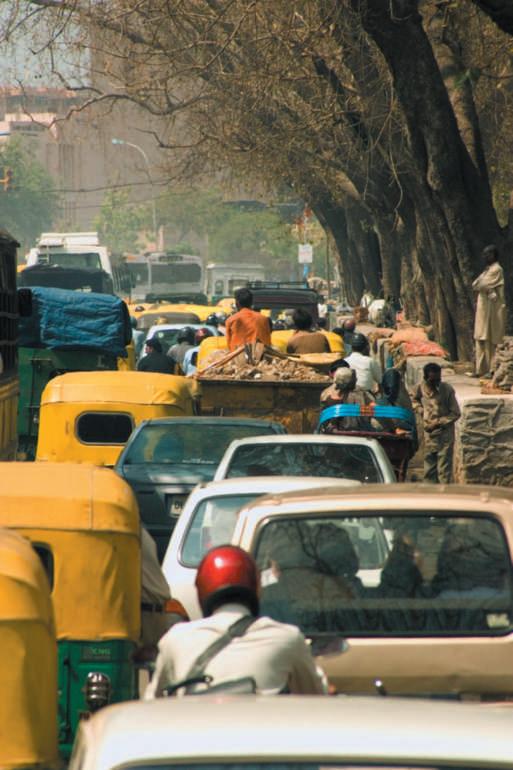
An urban scene in India (left) and in the United States (right) showing two patterns of traffic congestion. With growing aspirations of people worldwide to own a car, what do you think urban planners need to consider in the immediate future and for ten years from now?
overlooked women. To address this gap, feminist anthropologists undertook research that explicitly focused on women and girls, half of the world’s people. A related area is gay and lesbian anthropology, or queer anthropology, a perspective that emphasizes the need to study gay people’s cultures and discrimination based on sexual identity and preferences. This book presents findings from these areas.
In North American anthropology, African American, Latino, and Native American anthropologists are increasing in number and visibility. Yet, anthropology in North America and Europe remains one of the “whitest” professions (Shanklin 2000). Some steps for moving the discipline toward being more inclusive include (Mullings 2005):
• Examine and recognize anthropology’s history of racism.
• Work to increase the diversity of professors, researchers, staff, and students in the discipline.
• Teach about racism in anthropology classes and textbooks.
Worldwide, non-Western anthropologists are questioning the dominance of Euro-American anthropology, and they are offering new perspectives (Kuwayama 2004). Their work provides useful critiques of anthropology as a largely Western-defined discipline and promises to lead it in new directions in the future.
The Concept of Culture
Although cultural anthropologists are united in the study of culture, the question of how to define it has been debated for decades. This section discusses definitions of culture, characteristics of culture, and bases for cultural identity.
Colombian anthropologist Patricia Tovar (center) at an anthropology conference in Colombia. In Central and South America, applied anthropology is an integral part of cultural anthropology.
DeFInItIons oF CuLtuRe Culture is the core concept in cultural anthropology, so it might seem likely that cultural anthropologists would agree about what it is. In the 1950s, an effort to collect definitions of culture produced 164 different ones (Kroeber and Kluckhohn 1952). Since then, no one has tried to count the number of definitions of culture used by anthropologists.
British anthropologist Sir Edward Tylor proposed the first definition in 1871. He stated, “Culture, or civilization. . . is that complex whole which includes knowledge, belief, art, law, morals, custom, and any other capabilities and habits acquired by man as a member of society” (Kroeber and Kluckhohn 1952:81). The phrase “that complex whole” has been the most durable feature of his definition.
In contemporary cultural anthropology, the cultural materialists and the interpretive anthropologists support two different definitions of culture. Cultural materialist Marvin Harris says, “A culture is the total socially acquired life-way or life-style of a group of people. It consists of the patterned repetitive ways of thinking, feeling, and acting that are characteristic of the members of a particular society or segment of society” (1975:144). In contrast, Clifford Geertz, speaking for the interpretivists, believes that culture consists of symbols, motivations, moods, and thoughts and does not include behavior as a part of culture. This book defines culture as learned and shared behavior and beliefs, a definition broader than Geertz’s.
Culture exists among all human beings. Some anthropologists refer to this universal concept of culture as Culture with a capital “C.” Culture also exists in a more specific way. The term microculture , or local culture, refers to
microculture a distinct pattern of learned and shared behavior and thinking found within a larger culture.
distinct patterns of learned and shared behavior and ideas found in local regions and among particular groups. Microcultures are based on ethnicity, gender, age, and more.
ChARACteRIstICs oF CuLtuRe Understanding of the complex concept of culture can be gained by looking at its characteristics.
Culture Is n ot the s ame as n ature The relationship between nature and culture is of great interest to cultural anthropologists in their quest to understand people’s behavior and thinking. This book emphasizes the importance of culture.
A good way to see how culture diverges from, and shapes, nature is to consider basic natural demands of life within different cultural contexts. Universal human functions that everyone must perform to stay alive are eating, drinking, sleeping, and eliminating. Given the primary importance of these four functions in supporting a human being’s life, it seems logical that people would fulfill them in similar ways everywhere. But that is not the case.
e ating Culture shapes what people eat, how they eat, when they eat, and the meanings of food and eating. Culture also defines foods that are acceptable and unacceptable. In China, most people think that cheese is disgusting, but in France, most people love cheese. Throughout
China, pork is a widely favored meat. The religions of Judaism and Islam, in contrast, forbid the consumption of pork. In many cultures where gathering wild plant foods, hunting, and fishing are important, people value the freshness of food. They would consider a package of frozen food on a grocery store shelf as way past its time.
Perceptions of taste vary dramatically. Western researchers have long defined four supposedly universal taste categories: sweet, sour, bitter, and salty. Cross-cultural research disproves these categories as universals. A prominent East Asian flavor, recently added to the Western list, is umami, or savoriness. Providing even more complexity, the Weyéwa (wuh-YAY-wuh) people of the highlands of Sumba, Indonesia (see Map 1.1), define seven categories of taste: sour, sweet, salty, bitter, tart, bland, and pungent (Kuipers 1991).
How to eat is also an important aspect of food behavior. The proper way to eat is one of the first things a person needs to learn when living in a foreign culture. Dining rules in India require using only the right hand. The left hand is considered polluted because it is used for personal cleansing after elimination. A person’s clean right hand is the preferred eating utensil. Silverware that has been touched by others, even if it has been washed, is considered unclean. In some cultures, it is important to eat only from one’s own plate, whereas in others, eating from a shared central platter is considered proper.
Map 1. 1 Weyéwa Region in Indonesia
Sumba, one of Indonesia’s many islands, is 75 miles long. The Weyéwa people number about 85,000 and live in small settlements on grassy plateaus in the western part of the island. They grow rice, maize, and millet, and they raise water buffaloes and pigs.