Exploring the Variety of Random Documents with Different Content
up and maturing in the following spring when the violets begin to grow. Expanse 3 to 4 inches.
This species ranges from Maine to Nebraska and southward to Georgia and Arkansas. It is our commonest species in the Middle States.
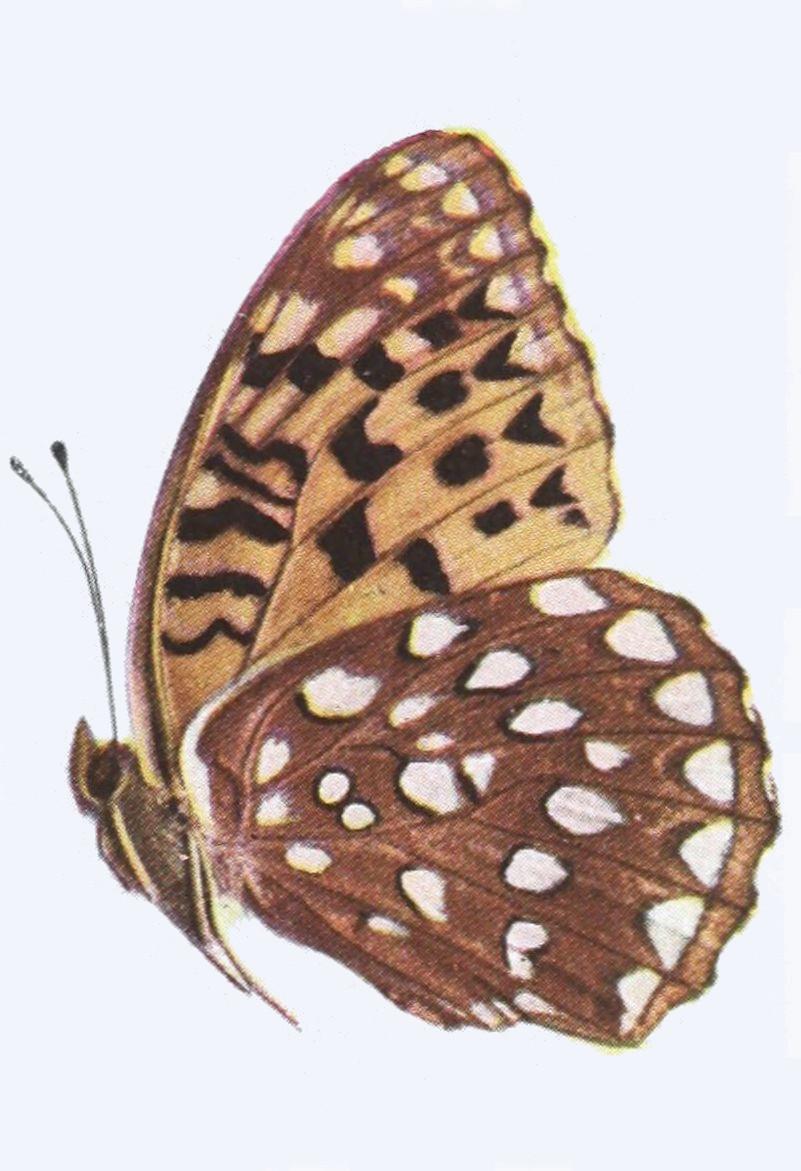
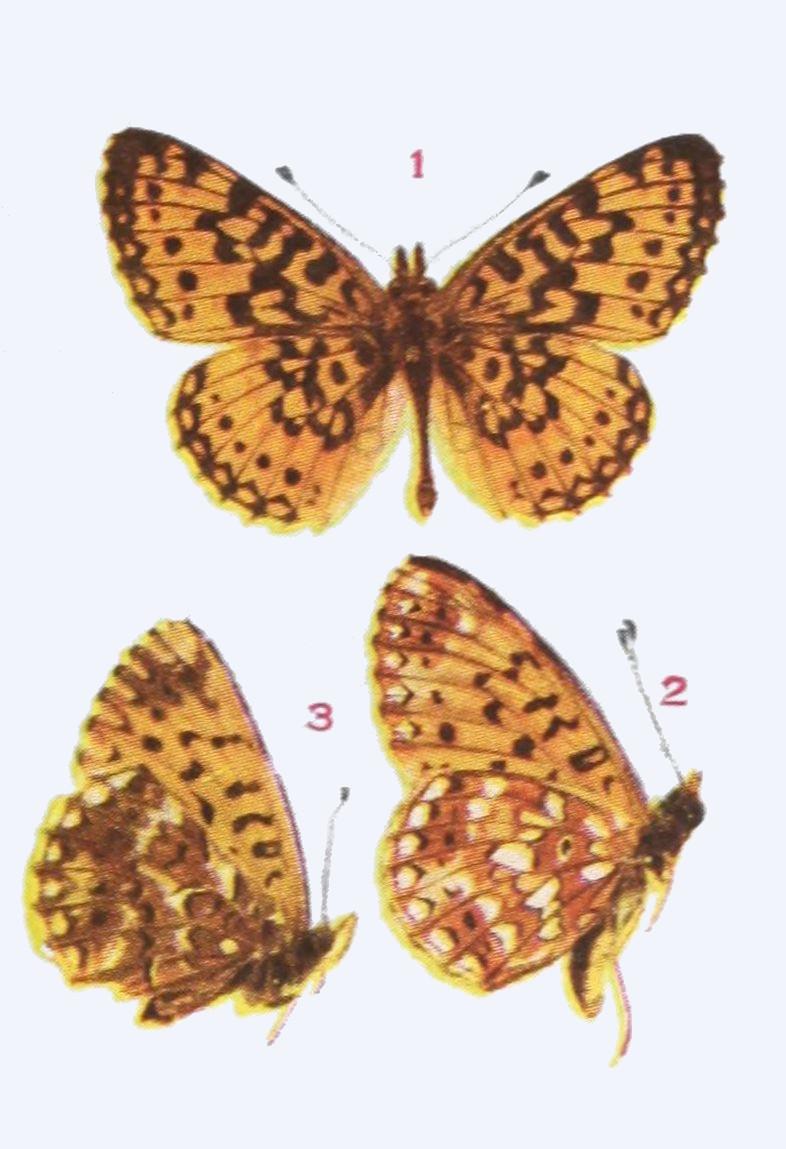
(5) Argynnisaphrodite(Fabricius). Plate XIII, ♀, underside(Aphrodite).
Closely resembling the preceding species, but smaller. The under side of the hind wings has the submarginal band narrower than in A. cybele and often wholly wanting, as shown in the figure. The fore wings on the under side are redder at the base than in A. cybele. Expanse 3 to 3.5 inches.
The range is the same as that of the preceding species.
PL. XIII
The two species A. cybele and A. aphrodite usually are found flying at the same time and in the same places, and when on the wing it is often very difficult to distinguish them from each other. In fact they seem to intergrade into each other, and in a long series of specimens such close resemblances often occur that it is puzzling to decide which is which. The deeper red of the fore wing of A.cybele is the best diacritical character. The paler outer margin of the hind wing of A. aphrodite, which is typically shown in Plate XII, sometimes occurs also in A.cybele, and I have specimens of the latter which very closely approximate the former in this regard. In selecting specimens for illustration I have chosen the two extreme forms in which the pale wing of A. aphrodite is seen to contrast on the under side with the darker wing of A. cybele shown on Plate XIII.
It may be remarked in passing that the genus Argynnis is very difficult, and the writer has been in the habit of comparing it to the genus Salix, the willows, among flowers. Botanists know how the willows seem to run together, and how hard it is to discriminate the species. The same thing is true of this great genus of butterflies with which we are now dealing. It is particularly true of the species which occur in the region of the Rocky Mountains, of which the writer has probably the largest collection in existence, including all of the types of the late William H. Edwards. The test of breeding has not been fully applied as yet to all of these forms, and it is doubtful whether some of them are more than varieties or local races. There is here a field of inquiry which should tempt some young, ardent, and careful student. The day for more thorough work is at hand, and I hope some reader of these pages may be converted to the task. Entomological study should become more intensive, as well as extensive. The fathers of the science have paved the way and laid foundations; it remains for the rising generation to complete the work which the fathers have begun.
PL. XIV
(6) ArgynnisatlantisEdwards. Plate XIV, ♂ (The Mountain Silverspot).
Smaller than A. aphrodite, with narrower wings, darker at the base on both the upper and lower sides. The submarginal band below is pale yellow, narrow, distinct, and always present. Expanse 2.25 to 2.5 inches.
Ranges from Quebec to Alberta and southward, but is confined to the Appalachian mountain ranges in southern Pennsylvania and West Virginia.
The specimen figured on the Plate is the type of the male contained in the collection of the late William H. Edwards.
Although taken long ago, it retains all its original freshness and beauty.
There used to be near Cresson on the summit of the Allegheny Mountains a field surrounded by woodland in which violets grew. When the clover was in bloom myriads of Fritillaries, belonging to the species aphrodite, cybele, and atlantis, congregated there. What captures we made! Many a collection on both sides of the Atlantic contains specimens taken in that field, but no possessor of these specimens can have the happy memories of the days passed in that field by their captor.
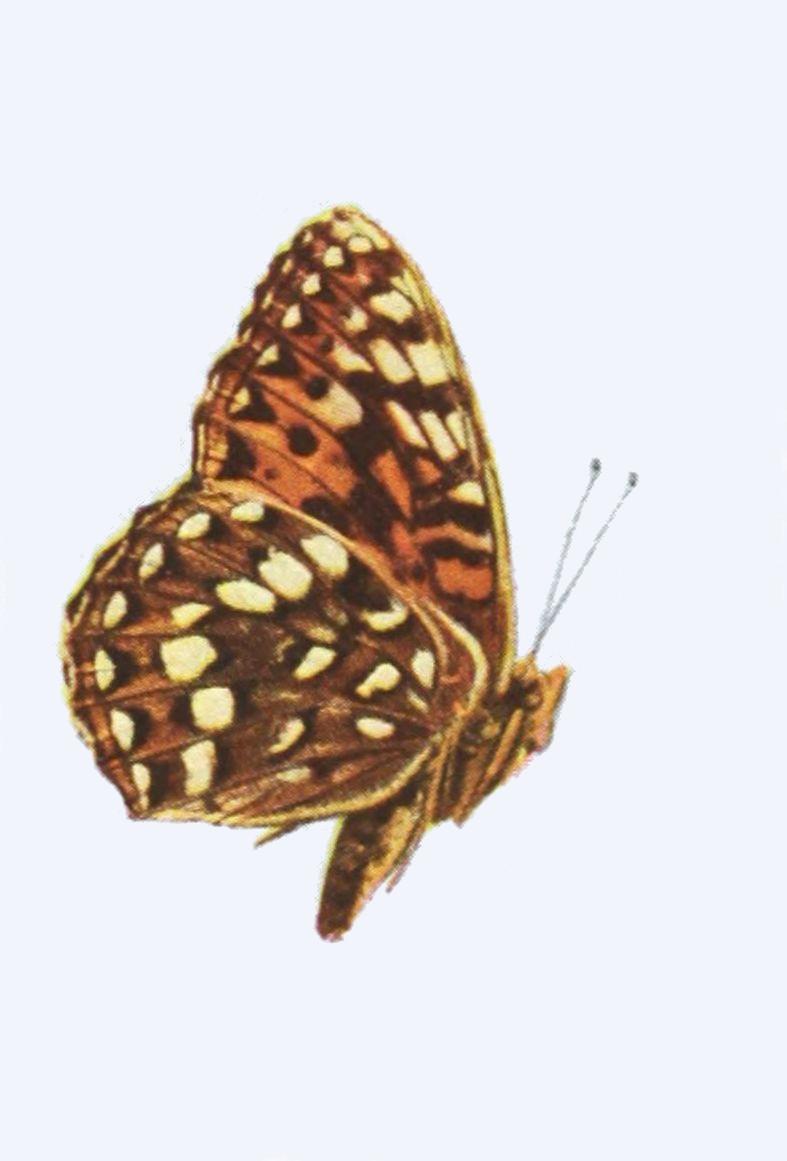
(7) Argynnis callippe Boisduval. Plate XV, ♀, underside(Callippe).
Wings on the upper side obscured with dark brown on which the pale buff spots, margined with black, stand out conspicuously. On the under side the wings are pale buff, with a greenish cast, the spots well silvered. Expanse 2.3 to 3 inches.
Abundant in southern California, according to W. G. Wright, preferring plains, and being confined mainly to the little hot valleys which traverse them. According to the same author the life of the insect as an imago is very brief, “the shortest of any Argynnid that I know of, being only a few days in length.”
Many of the western species do not have the spots on the under side silvered, but are none the less beautiful for that. One of these species, without silvery spots, the spots being creamy white, without metallic lustre, is the beautiful insect figured on Plate XVI, A. rhodope, the under side of the female type of which we show. There
PL. XVI are nearly a dozen species of Argynnis belonging to the same group with A. rhodope, but the latter is the most beautiful of all of them.
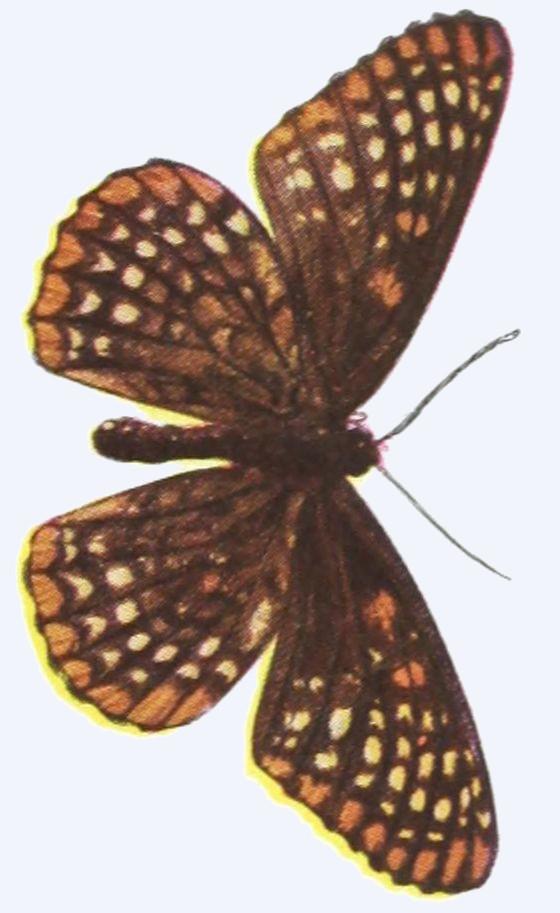
(8) Argynnis rhodope Edwards. Plate XVI, ♀ underside(Type) (Rhodope).
The wings of the two sexes are quite alike on the under side. On the upper side, which we do not figure, the wings are bright fulvous, dark at the base, marked with heavy, black, confluent spots. Expanse 2.2 to 2.4 inches.
Found in Washington and British Columbia.
GENUS BRENTHIS HÜBNER
(THE LITTLE FRITILLARIES).
Small or medium-sized butterflies, closely resembling those of the genus Argynnis. The chief difference is that in Brenthisonly the first subcostal nervule branches off before the end of the cell, while in Argynnis the first and second are thus given off; palpi not so stout as in Argynnis; the basal spur of the median vein of the fore wing, found in Argynnis, is wanting in Brenthis. Eggs subconical, twice as wide as high, truncated, vertically ribbed. Caterpillars like those of Argynnis, but smaller, and often lighter in color, feeding on violets. Chrysalispendant, about 0.6 inch long; two rows of conical tubercles on back.
Sixteen species are found in North America, all of which but two are subarctic or occur on high mountains.
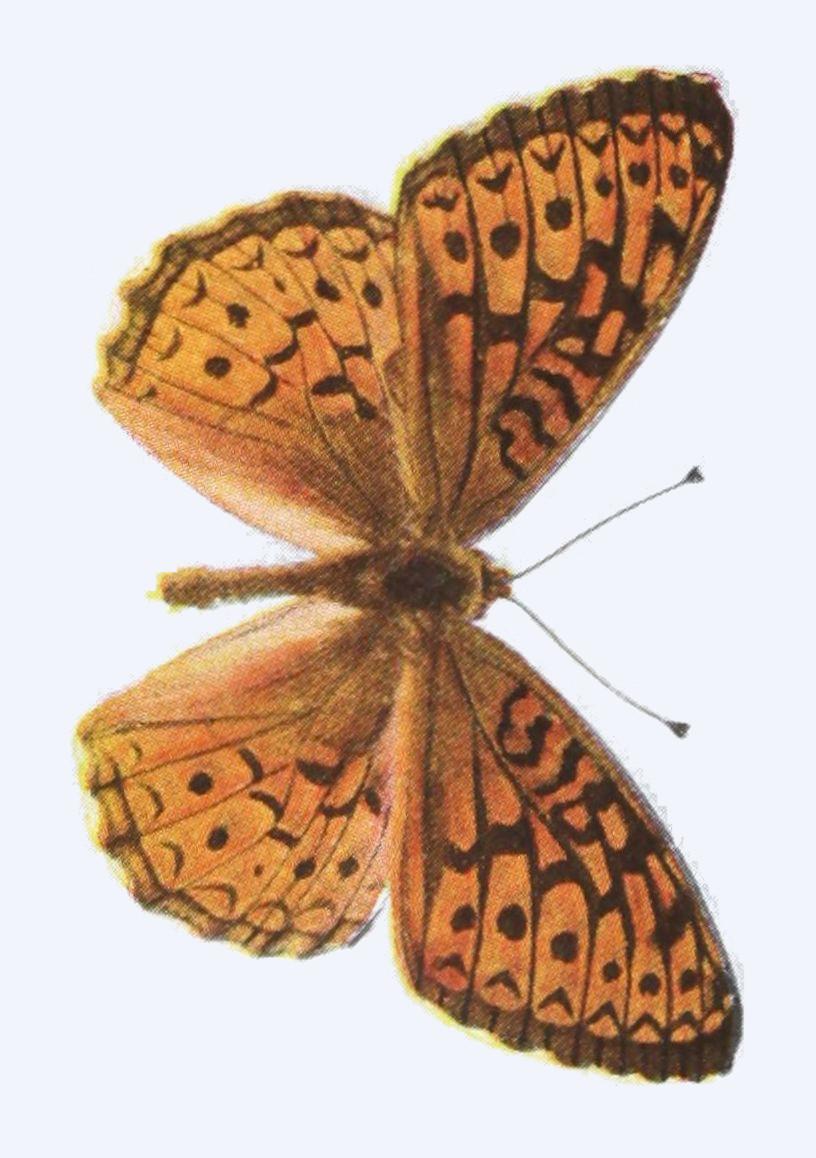
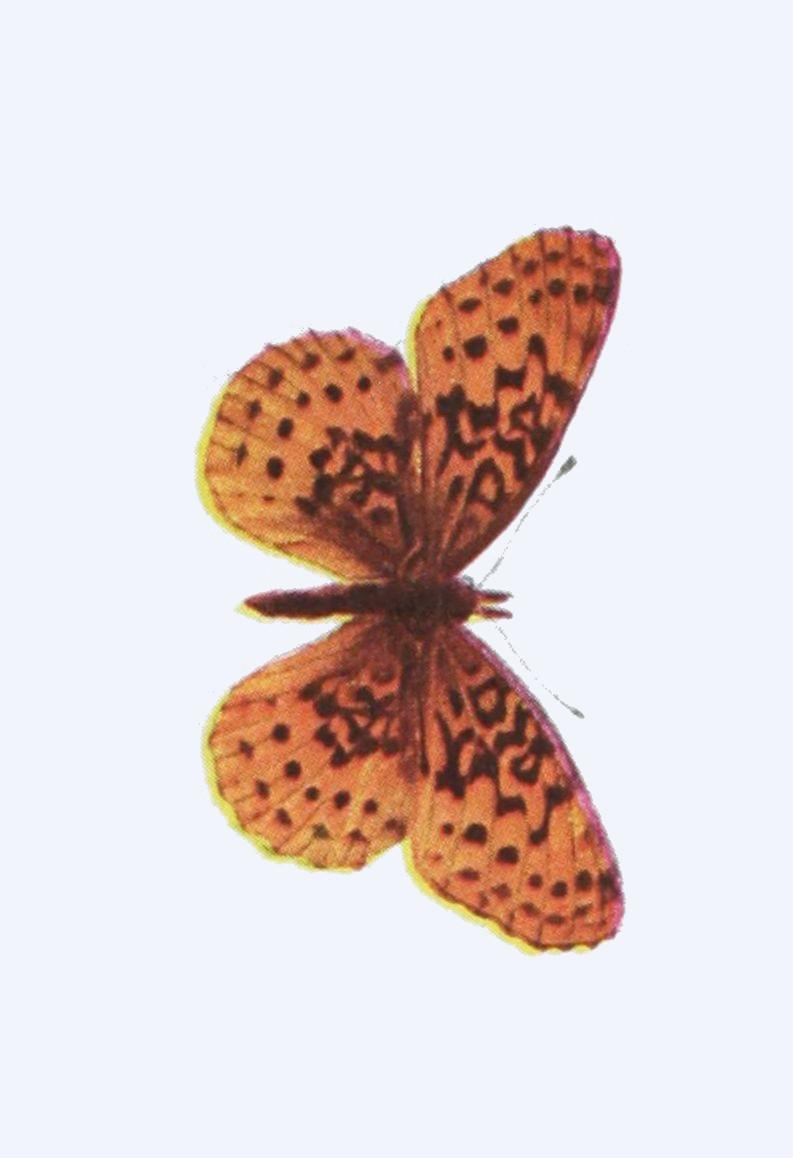
(1) Brenthis myrina (Cramer), Plate XVII, Fig. 1, ♂, upper side; Fig. 2, ♂, underside(The Silver-bordered Fritillary).
Well depicted in the figures we give. Expanse 1.40-1.70 inch. Eggs pale greenish yellow. Caterpillar, when fully grown, about 0.87 inch long, dark olivebrown, marked with lighter green, and covered with spiny, fleshy tubercles. Chrysalis yellowish brown marked with darker brown spots, some having a pearly lustre.
Ranges from Nova Scotia to Alaska and southward as far as the mountains of the Carolinas.
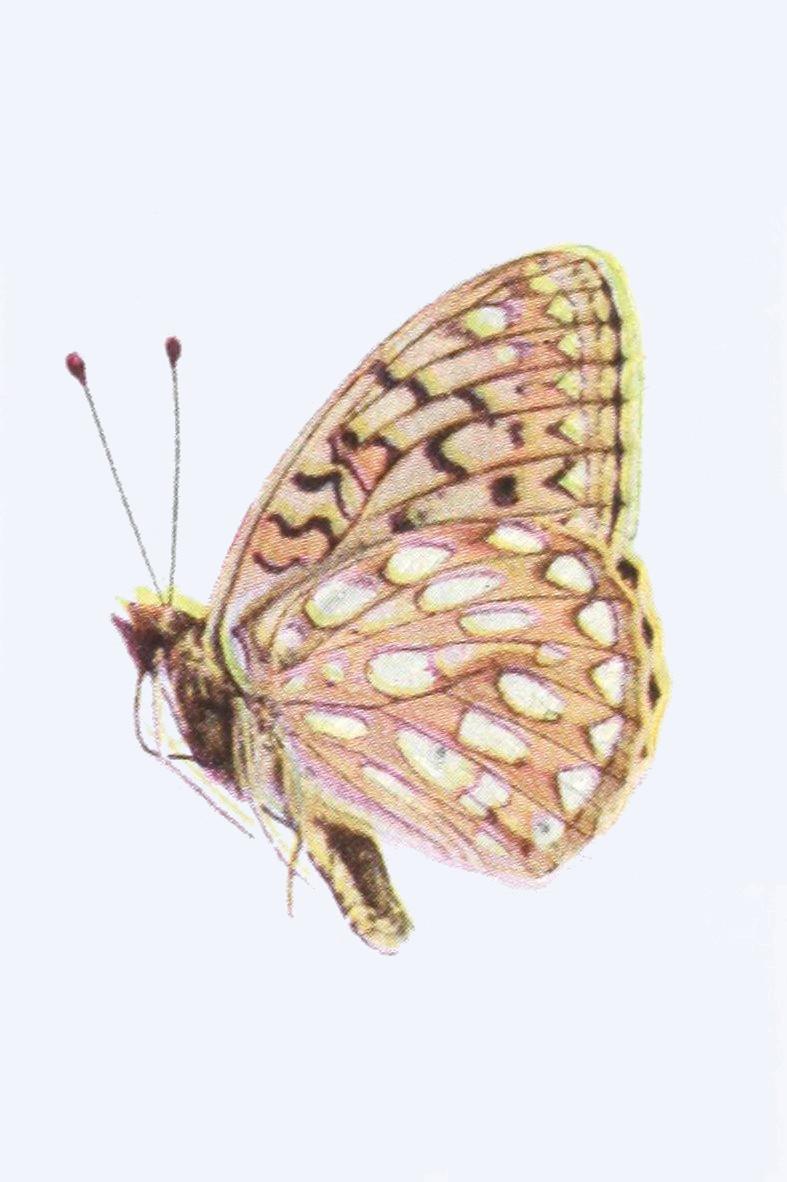
(2) Brenthis montinus Scudder, Plate XVII, Fig. 3, ♀ , under side (The White Mountain Fritillary).
PL. XVII
Upper side fulvous, the wings at base darker than in B. myrina, the black markings heavier. Hind wings below much darker than in B. myrina, the silvery spots being quite differently arranged, the most conspicuous being a bar at the end and a round spot at the base of the cell of the hind wing. Expanse, ♂, 1.50 inch; ♀, 1.75 inch.
A small species living on the summit of Mt. Washington, New Hampshire, where a little colony has survived the glacial epoch, when the northeastern parts of the United States were covered with glaciers, as Greenland is to-day.
(3) Brenthis bellona (Fabricius), Plate XVIII, ♂ (The Meadow Fritillary).
The only species of the genus, except B. myrina, found in the densely settled portions of the continent. Easily distinguished from myrinaby the absence on the under side of the wings of the silvery spots, which make the Silver-bordered Fritillary so attractive. It is generally found upon the wing in the late summer and the fall of the year. In Pennsylvania it may be found when the asters are in bloom.
PL. XVIII
Common throughout Canada and the northern United States as far west as the Rocky Mountains and as far south as the Carolinas. Expanse 1.65-1.80 inch.
GENUS MELITÆA
(THE CHECKER-SPOTS).
Generally small or medium-sized butterflies. Palpi not swollen; the third joint finely pointed; clothed with long hairs. Antennæ about half as long as the costal margin of fore wing, ending with a short, heavy, spoon-shaped knob. The cell in the fore wing is closed, in the hind wing open. The spots and markings are differently arranged from those in Argynnisand Brenthis; the wings are never silvered on the under side. Eggs subconical, flattened on top, fluted on the sides. Caterpillars gregarious when young, then separating; cylindrical, covered with short spines set with diverging hairs; feeding upon the Scrophulariaceæ, Castileja, and allied plants. Chrysalis rounded at the head, with sharply pointed tubercles on back, white or pale gray, adorned with dark markings and orange spots on back.
There are many species in the north temperate zone. Most of the more than thirty species in North America are confined to the
western part of the continent, only two being found east of the Mississippi.
(1) Melitæaphaëton (Drury), Plate XIX, ♂ (The Baltimore).
Easily recognized by the figure. One of the larger species, the male having a width of 1.75-2.00, the female of 2.002.60 inches. Eggs brownish yellow when laid, changing to crimson, and later to black; deposited in clusters on balmony ( Cheloneglabra). Hatching in early fall, the little caterpillars spin a web or tent of silk, where they pass the winter. When spring comes, they scatter, fall to feeding, and after the fifth moult turn into chrysalids, from which the butterflies soon emerge.
Found locally in colonies in swampy places, where balmony grows, from Quebec to west of Lake Superior and south to the Carolina mountains.
PL. XIX
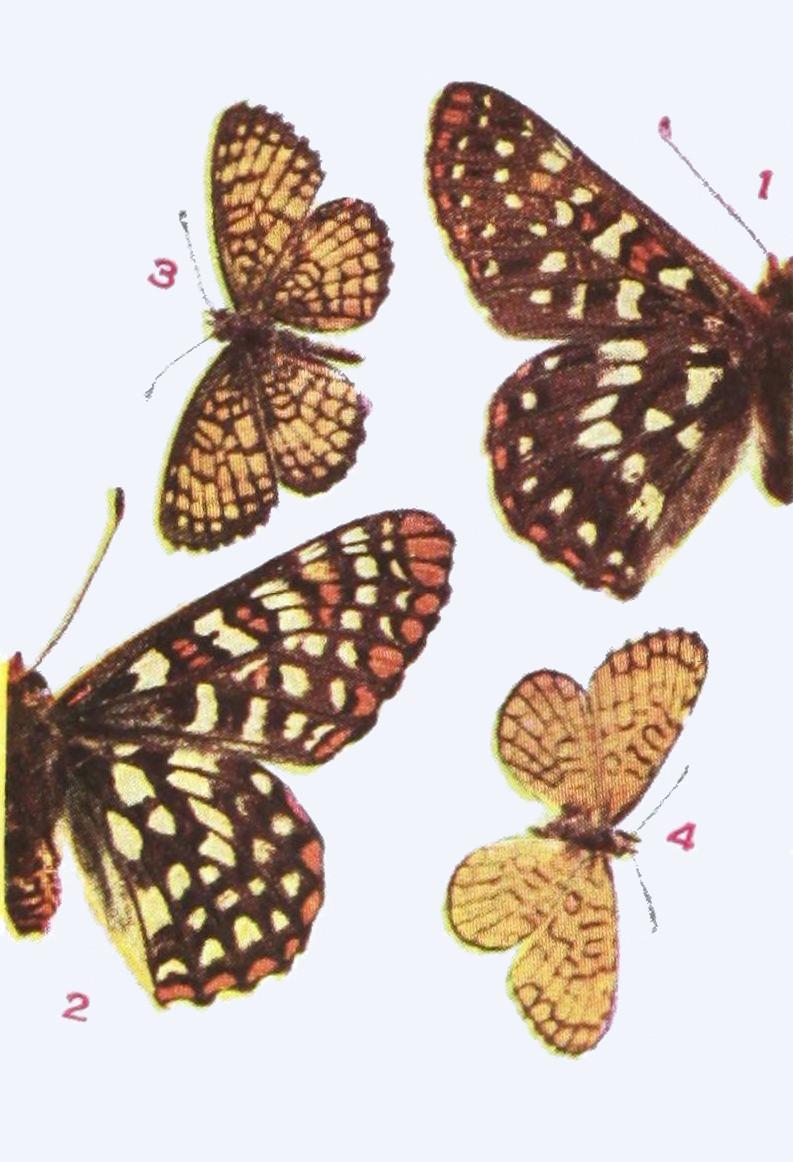
(2) Melitæa chalcedon Doubleday and Hewitson, Plate XX, Fig. 1, ♂ (Chalcedon).
A common species in northern California, ranging eastward as far as Colorado and Wyoming. One of the larger species, expanding 1.75-2.5 inches. The caterpillar feeds on Mimulusand Castileja. The butterfly is variable, the females in particular differing in the size of the light spots on their wings.
(3) MelitæamacglashaniRivers, Plate XX, Fig. 2, ♀ (Macglashan’s Checker-spot).
One of the largest species in the genus, exceeding in size the two foregoing, having a width of from 1.85-3.00 inches; closely resembling M. chalcedon, but the outer marginal red spots always
PL. XX
bigger and the yellow spots paler and larger than in that species. Occurs in Utah, Nevada, and California.
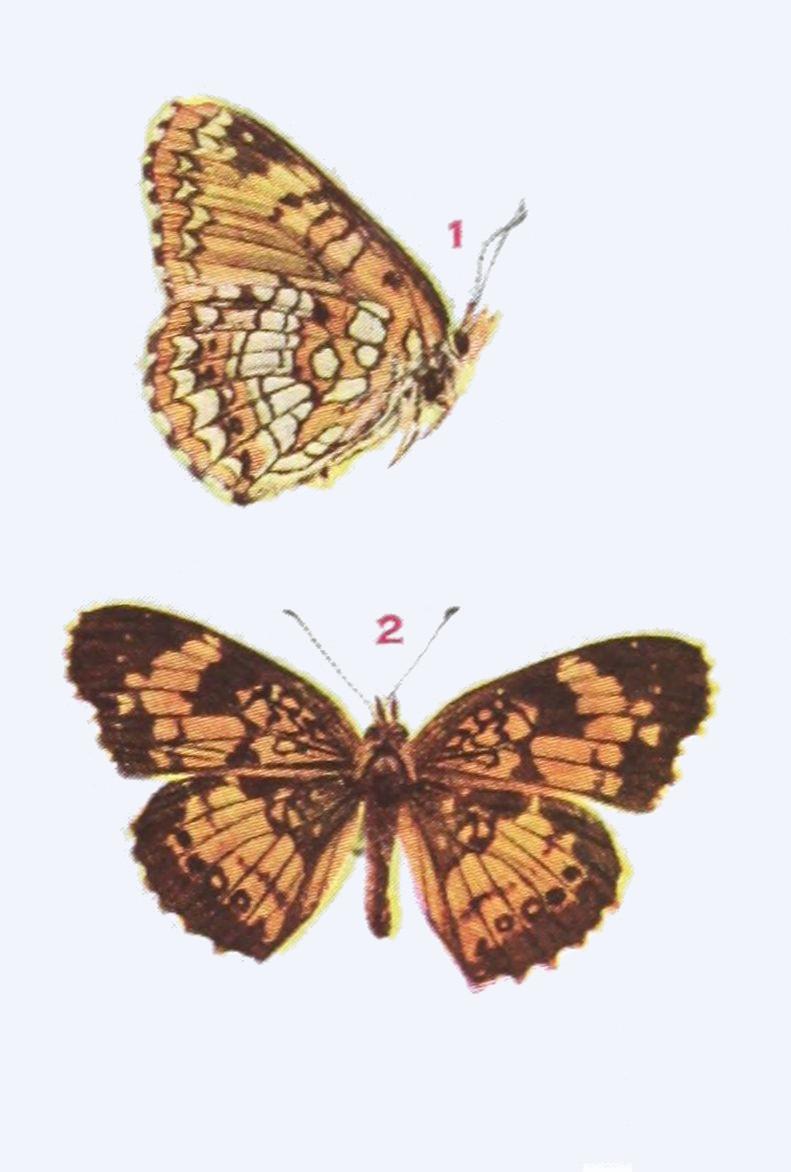
(4) Melitæa harrisi Scudder, Plate XXI, Fig. 1, ♀, underside (Harris’ Checker-spot).
PL. XXI
Fulvous on upper side; base of wings and outer margins black, black margins widest at apex. Five fulvous spots in cell of fore wing, two below it; two white spots on apex. Under side of wings well shown in the figure we give. Expanse 1.5-1.75 inch. Eggslemon-yellow, conoid, flattened at top, ribbed. Adult caterpillarreddish, with a black stripe on middle of back, nine rows of black, branching spines on body. On each segment a black band in front of the spines, and two black-bands behind them. Food-plants Asterand Diplopappus. Chrysalispale gray or white, blotched with dark brown.
Ranges from Nova Scotia to Lake Superior.
(5) MelitæaperseEdwards, Plate XX, Fig. 3, ♂. Type(The Arizona Checker-spot).
One of the very small species of the genus. The specimen we figure is the type, that is to say, the specimen upon which Edwards founded his description of the species. Expanse ♂, 1.00 inch; ♀, 1.10 inch.
HabitatArizona and northern Mexico.
(6) MelitæadymasEdwards, Plate XX, Fig. 4, ♀. Type (The Least Checker-spot).
Even smaller than the preceding, having an expanse of only 0.85 to 1.00 inch. It is much paler on the upper side than M.perse, and the markings are different.
Ranges from southwestern Texas and Arizona to Mexico.
GENUS PHYCIODES DOUBLEDAY
(THE CRESCENT-SPOTS
).
Usually quite small butterflies, the species found in our region being some shade of fulvous or reddish, above with dark markings, which are less distinctly reproduced on the paler under side of the wings. Of the spots on the under side the most characteristic is the crescent between the ends of the second and third median nervules. This, when present, is pearly white or silvery in color. Structurally these insects differ most markedly from the preceding genus in the enlarged second and the fine very sharp third joint of the palpi. Eggs higher than wide, slightly ribbed on top, pitted below, giving them a thimble-like appearance. Caterpillars cylindrical, with rows of short tubercles, much shorter than the spines in Melitæa, dark in color, marked with paler longitudinal stripes. Chrysalis with head slightly bifid, generally pale in color, blotched with brown.
Numerous species occur in Central and South America, but only about a dozen in the United States and Canada, most of them in the Southwestern States.
(1) Phyciodes nycteis Doubleday and Hewitson, Plate XXI, Fig. 2, ♂ (Nycteis).
Easily mistaken on the wing for Melitæa harrisi, which it closely resembles on the upper side, and with which it is often found flying, but an examination of the under side at once reveals the difference. The redder fore wings, paler hind wings, and the crescent on the lower outer border of these are marks which cannot be mistaken. Expanse ♂, 1.25-1.65 inch; ♀, 1.65-2.00 inches.
Ranges from Maine to the Carolinas and westward to the Rocky Mountains.
PL. XXII
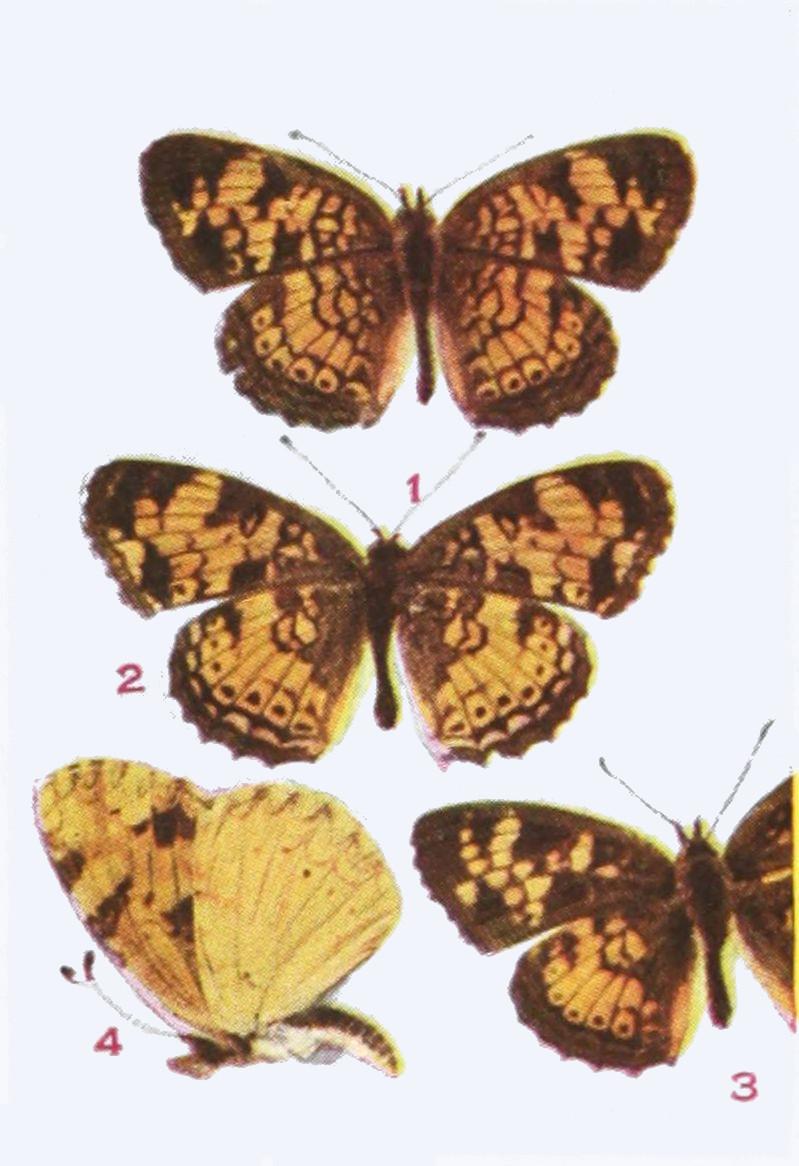
(2) Phyciodes tharos (Drury), Plate XXII, Fig. 1, ♂. Variety marcia Edwards, Plate XXII, Fig. 2, ♂ (The Pearl Crescent).
A very common little butterfly, which everybody must have noticed in late spring or early summer flitting about lawns and gardens, and in fall abounding upon clumps of asters. It may easily be recognized from the figures given. Expanse from 1.25-1.65 inch. The variety marcia comes from larvæ which have hibernated during the winter, and is lighter and brighter in color, especially beneath, than butterflies of the later summer and fall broods.
Eggs laid on asters and related plants; greenish yellow. Matured caterpillardark brown, dotted on the back with yellow; adorned with short, bristly, black spines, yellow at base. Chrysalis pale gray, blotched with spots of brown.
Ranges from southern Labrador to Florida and westward to the Pacific Coast.
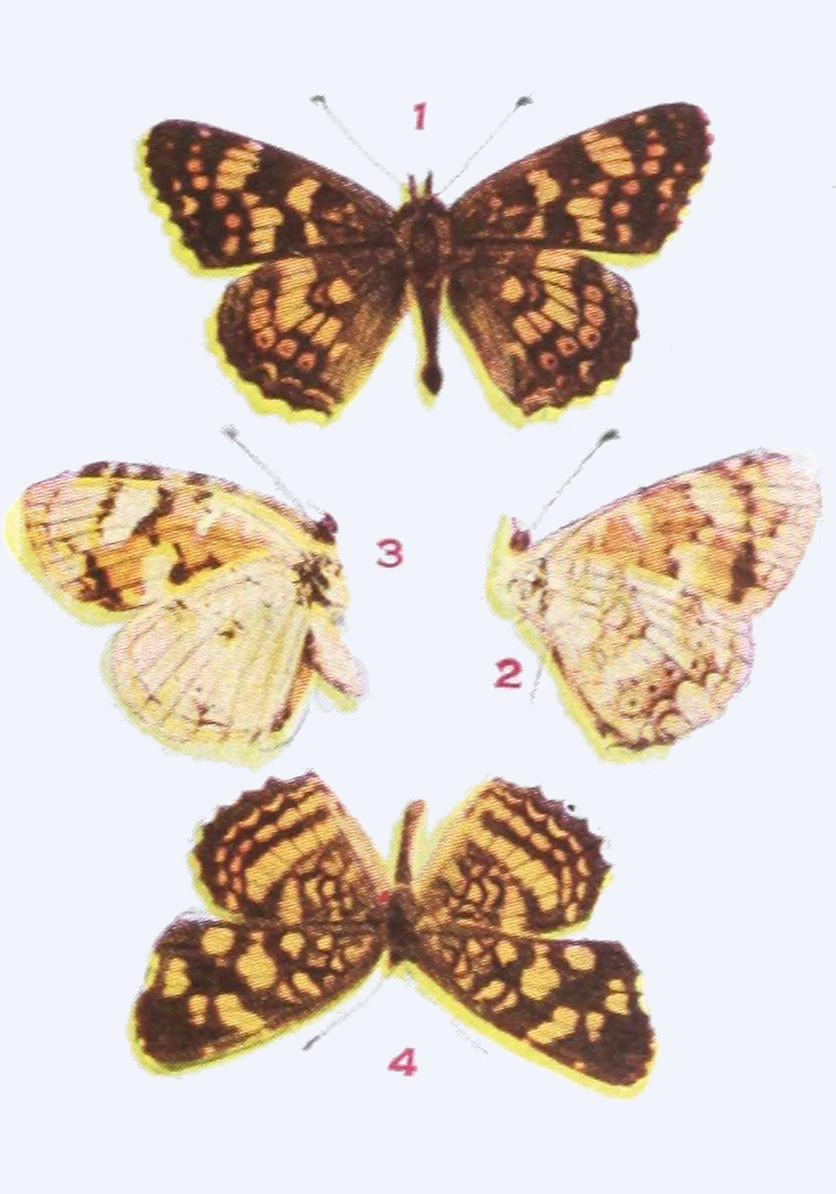
(3) Phyciodes batesi (Reakirt), Plate XXII, Fig. 3, ♂, upper side; Fig. 4, underside, ♀ (Bates’ Crescent-spot).
Above closely resembling P . tharos, but with the dark markings much heavier; below hind wings quite uniformly pale yellowish fulvous, with a row of very pale marginal crescents; ends of veins tipped with brown. Expanse 1.25-1.65 inch.
Ranges from New England to Virginia and westward to the Mississippi.
(4) Phyciodes pratensis (Behr), Plate XXIII, Fig. 1, ♂ (The Meadow Crescent).
Closely resembling the preceding, but fore wings not as curved on the costal margin, and relatively longer and narrower; the pale markings more whitish, not so red, and more clearly defined. On the under side, especially in the female, the markings are heavier than in P . batesi. Expanse 1.15-1.40 inch.
Ranges from Oregon to southern California, Arizona, and northern Mexico.
(5) Phyciodes camillus Edwards, Plate XXIII, Fig. 2, ♂, underside(The Camillus Crescent).
PL. XXIII
Resembling P . pratensis, but the pale spots on fore wings paler, and on hind wings brighter fulvous. Below the dark markings not nearly so pronounced as in P.pratensis. Expanse 1.3-1.6 inch.
Ranges from British Columbia to Colorado and Kansas and south into Texas.
(6) Phyciodes picta Edwards, Plate XXIII, Fig. 3, ♀, under side (The Painted Crescent).
Below fore wings red on median area, with base, costa, apex, and outer margin pale yellow. The dark spots on this wing stand out prominently. Hind wings nearly uniformly bright yellow. Expanse 0.81.25 inch.
Ranges from Nebraska as far as Mexico. The larvæ feed on asters.
GENUS ERESIA DOUBLEDAY
Closely allied to Phyciodes, but distinguished from it by having the fore wing more or less deeply excavated on the outer margin about
its middle, and the light spots on the hind wings arranged in regular bands. There are also differences in the form of the chrysalids and caterpillars. The genus is best represented in Central and South America, where there are many very beautiful species. Only three occur in our region. We have figured two of these.
(1) Eresiafrisia(Poey), Plate XXIII, Fig. 4, ♂ (Poey’s Crescent).
PL. XXIV
Our figure of the upper side will enable any one to recognize it. Below the wings are fulvous, mottled with dark brown and white, and the spots of the upper side reappear as white bands and markings. Expanse 1.4-1.5 inch.
Occurs in the extreme south of Florida about Key West, and is not uncommon in the Antilles, Mexico, and Central America.
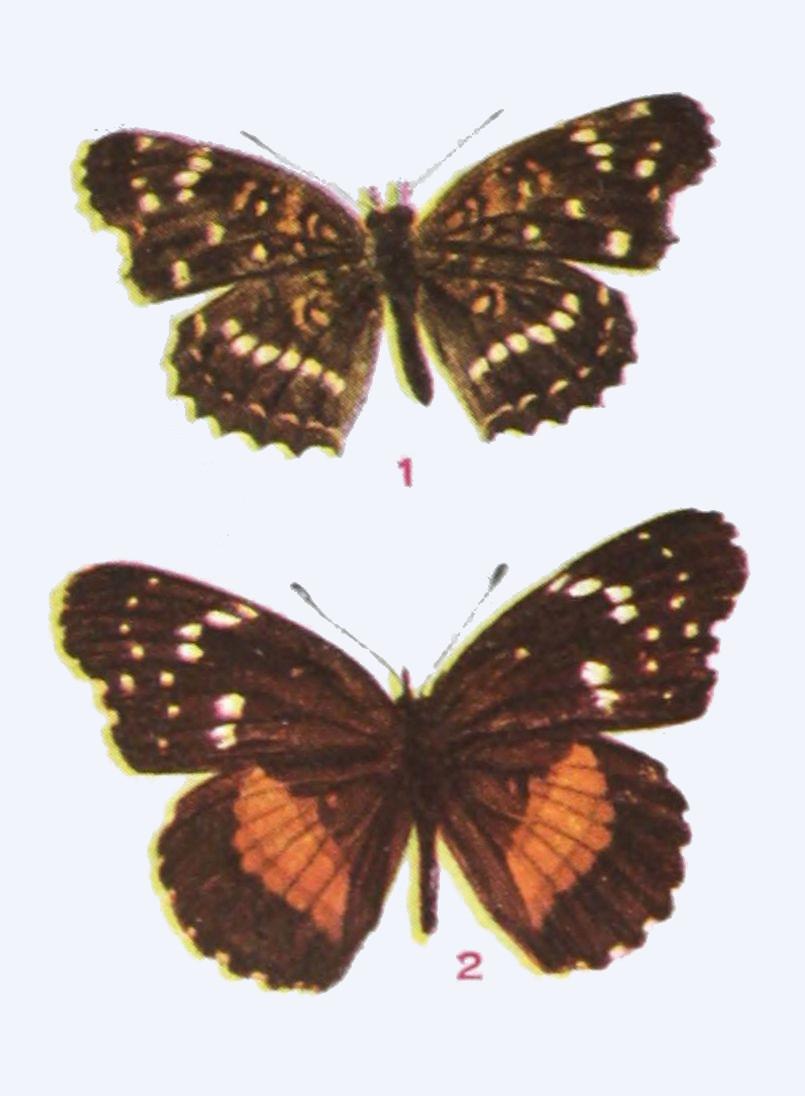
(2) Eresiatexana(Edwards), Plate XXIV, Fig. 1, ♀ (The Texan Crescent).
Well represented in our illustration. Below the fore wings are fulvous at base, and broadly marked with dark brown beyond the middle. Hind wings at base marbled wood-brown, and dark externally like the fore wings. The light spots of upper side reappear on lower side, but not so distinctly. Expanse 1.25-1.75 inch.
Ranges through Texas into Mexico, and South America. The genus Eresia is undoubtedly one of those which originated in the warm neotropical regions and which since the glacial epoch have spread northward. Many of our genera have come to us from the South.
ENUS SYNCHLOE BOISDUVAL (THE PATCH-SPOTS).
G
Medium-sized or small butterflies, often very gayly colored. Wings generally more produced than in the two foregoing genera, more excavated on outer margin of primaries, and third joint of palpus spindle-shaped, not sharp like the point of a needle, as in Phyciodes and Eresia. The lower discocellular vein in the fore wing is straight and not angled, as in the two last-named genera. Eggs, which are laid in clusters upon sunflowers ( Helianthus), like those of Phyciodesin general appearance; the caterpillarsand chrysalidslike those of Melitæa. There are many species of the group found in the American tropics, and among them are many curious mimetic insects, which resemble miniature Heliconians and Ithomiids. Three species occur in our southland, one of which we figure.
(1) Synchloëjanais (Drury), Plate XXIV, Fig. 2, ♂ (The Crimsonpatch).
The upper side of a small male specimen is well shown in our figure. Below the markings of the upper side are reproduced in the fore wings. Hind wings on this side black at base and on outer third. The basal area crossed by a yellow bar, on middle of wing a broad yellow band, washed externally with crimson, in which are numerous black spots. There is a marginal row of yellow, and a limbal row of white spots parallel to the outer border. Expanse 2.50-3.00 inches.
Ranges through southern Texas, Mexico, and Central America.
GENUS GRAPTA KIRBY (THE ANGLE-WINGS).
Medium-sized or small butterflies; fore wing strongly acuminate at end of upper radial, deeply excavated on outer and inner border; hind wing tailed at end of third median nervule; cells on both wings closed; palpi heavily scaled beneath. Upper side of wings tawny, spotted with darker, under side mimicking the color of bark and dead leaves, often with a silvery spot about middle of hind wing. The butterflies hibernate in winter. Eggs taller than broad, tapering toward top, which is flat, adorned with a few longitudinal ribs, increasing in height upward, laid in clusters, or strung together, then
PL. XXV
looking like beads. Larva with squarish head; body cylindrical, adorned with branching spines. Chrysalids with head bifid; prominent tubercle on back of thorax; two rows of dorsal tubercles on abdomen; compressed laterally in thoracic region; color wood-brown or greenish. The caterpillars feed upon plants of the nettle tribe, including the elm and hops, though willows, azalea, and wild currants are affected by different species.
The genus is confined to the northern temperate zone. We have about a dozen species in America, of which five have been selected for illustration.
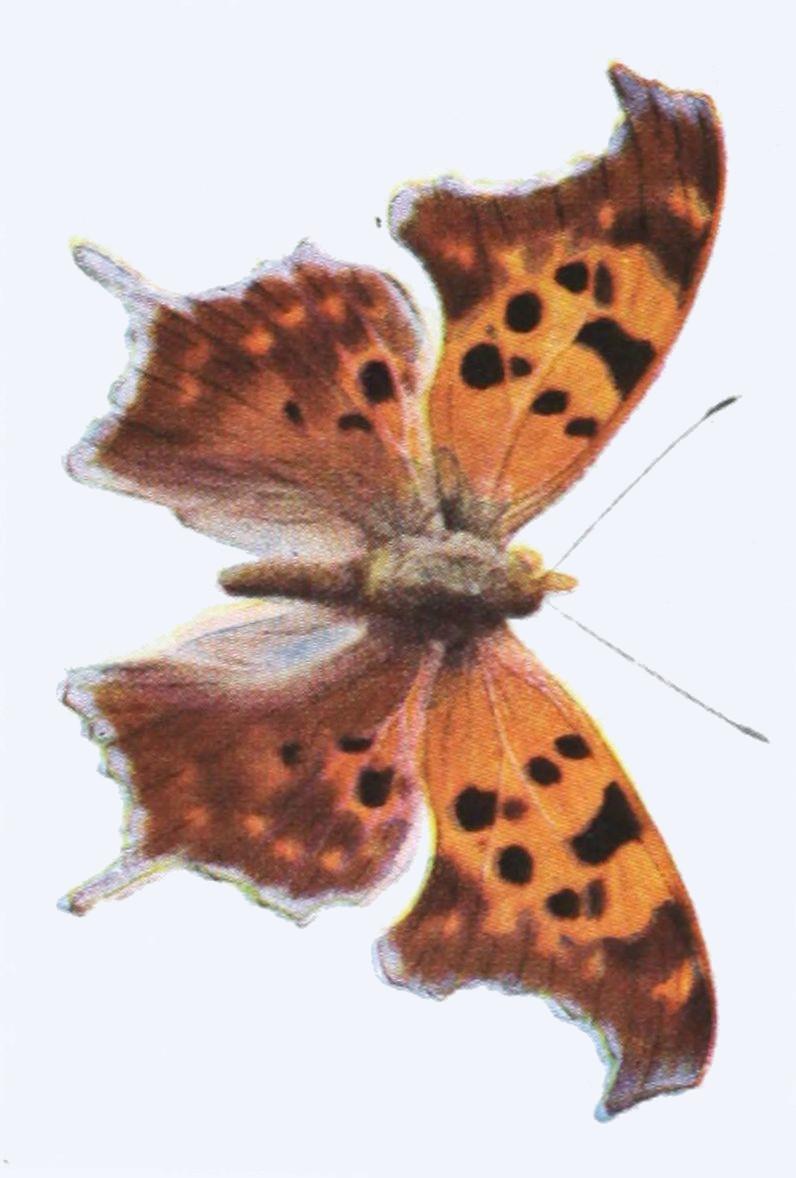
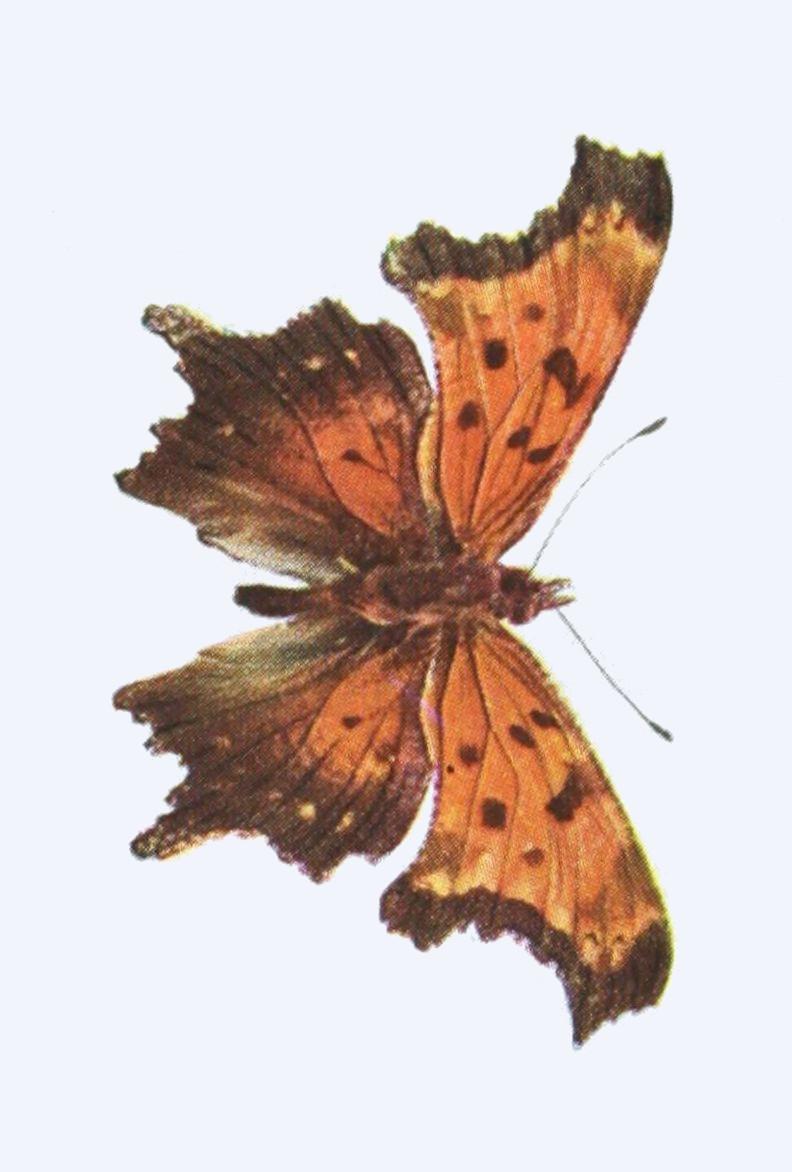
(1) Grapta interrogationis (Fabricius), form fabriciiEdwards, Plate XXV, ♂ (The Question-sign).
The largest species of the genus in our fauna. Dimorphic, the upper sides of the hind wings in the form fabricii being fulvous with dark markings, those of the form umbrosa Lintner being uniformly dark, except at base. In the Middle States double-brooded. The second brood hibernates in the winged form. Expanse 2.50 inches.
Found throughout Canada and the United States, except on the Pacific Coast.
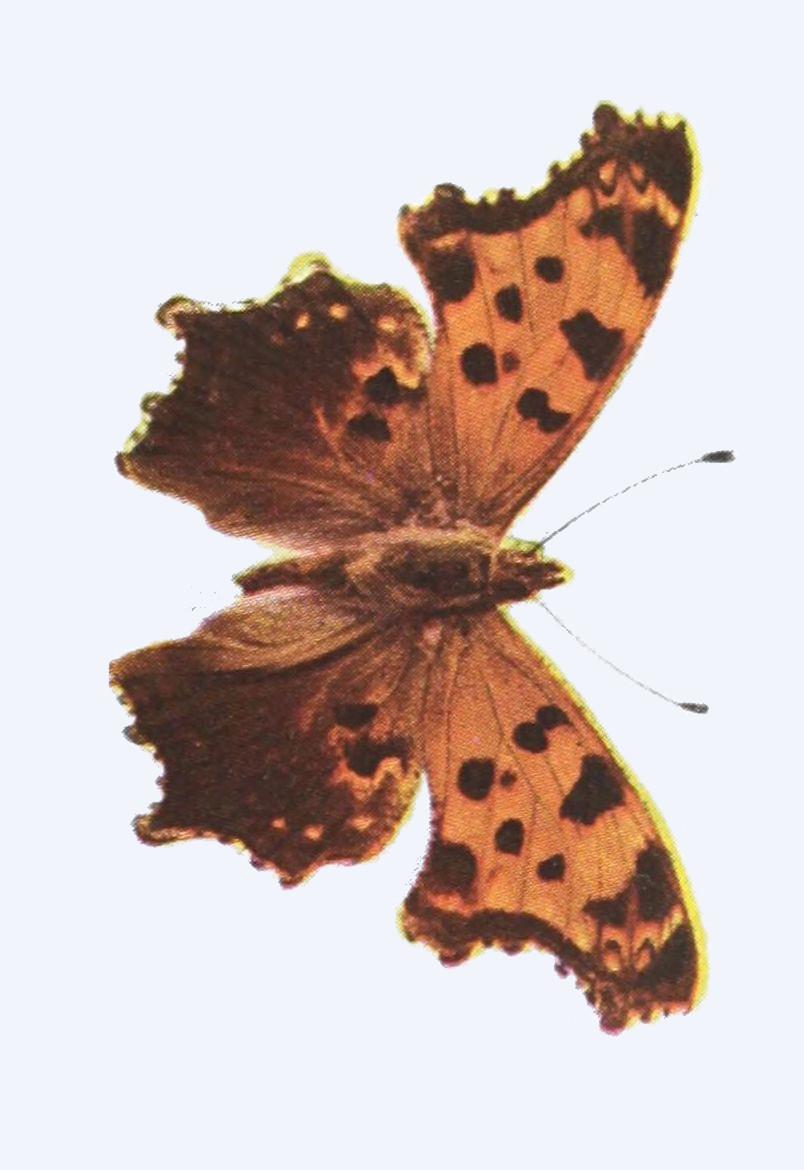
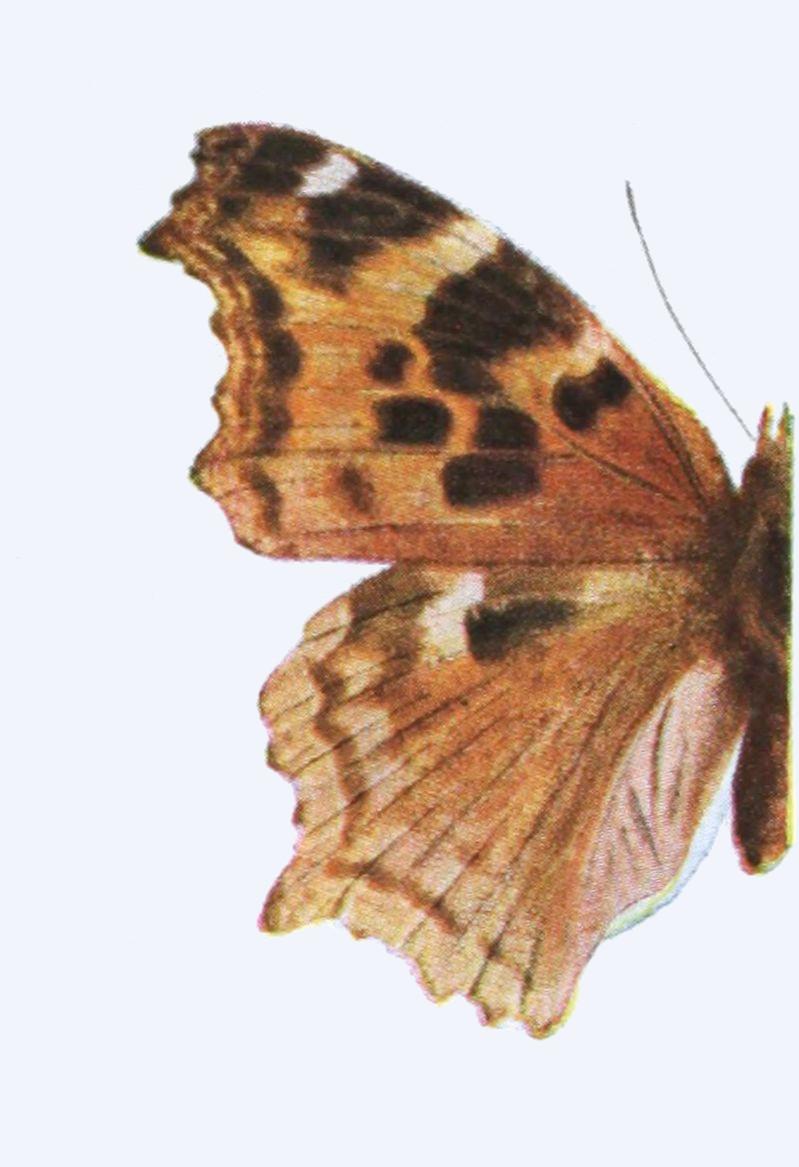
(2) Grapta comma (Harris), form dryas Edwards, Plate XXVI, ♂ (The Comma Butterfly).
PL. XXVI
Larvæ feed on nettles; some are almost snow-white. The species is dimorphic. In the form dryasEdwards the
hind wings are dark above, in the form harrisi Edwards they are lighter in color. Expanse 1.75-2.00 inches.
The range is much the same as that of the Question-mark.
PL. XXVII
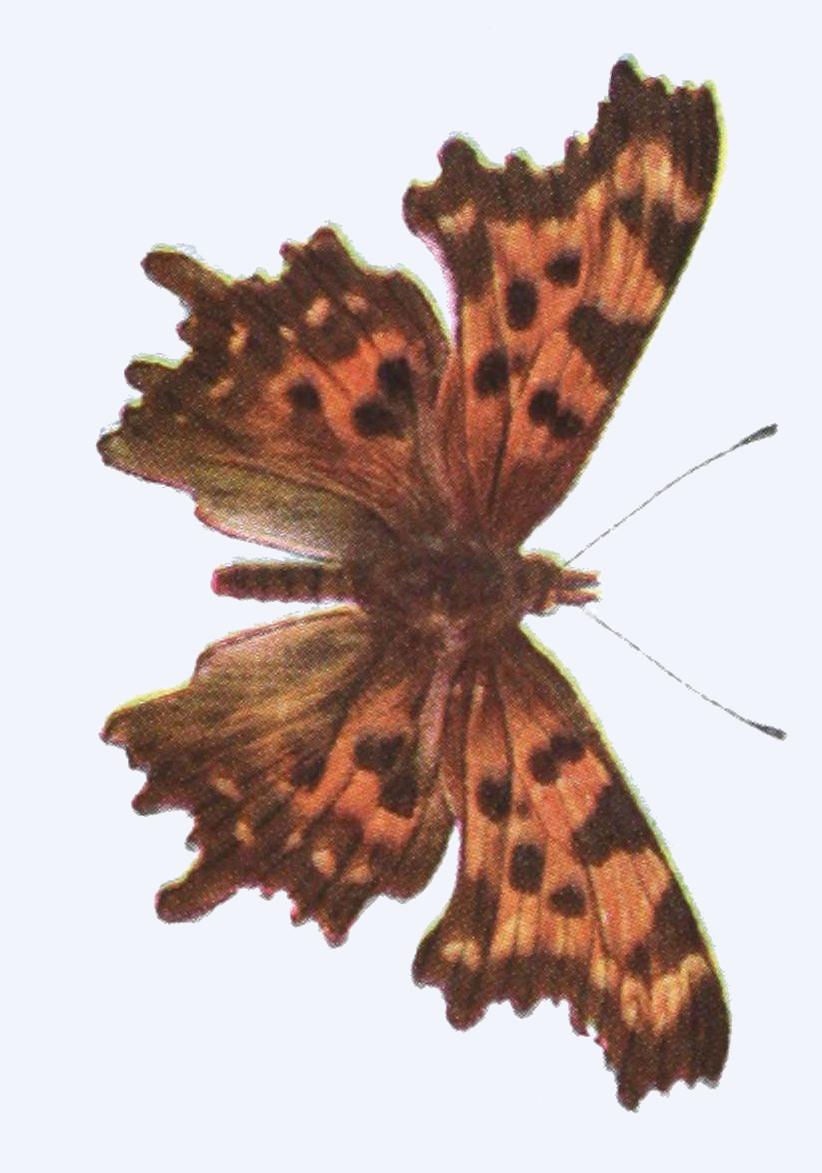
(3) GraptafaunusEdwards, Plate XXVII, ♀ (The Faun).
Readily recognized by the deep indentations of the hind wings, the heavy black border, and the dark tints of the under side mottled conspicuously with paler shades. Expanse 2.00-2.15 inches. The larva feeds on willows.
Ranges from New England and Ontario to the Carolinas, thence westward to the Pacific.
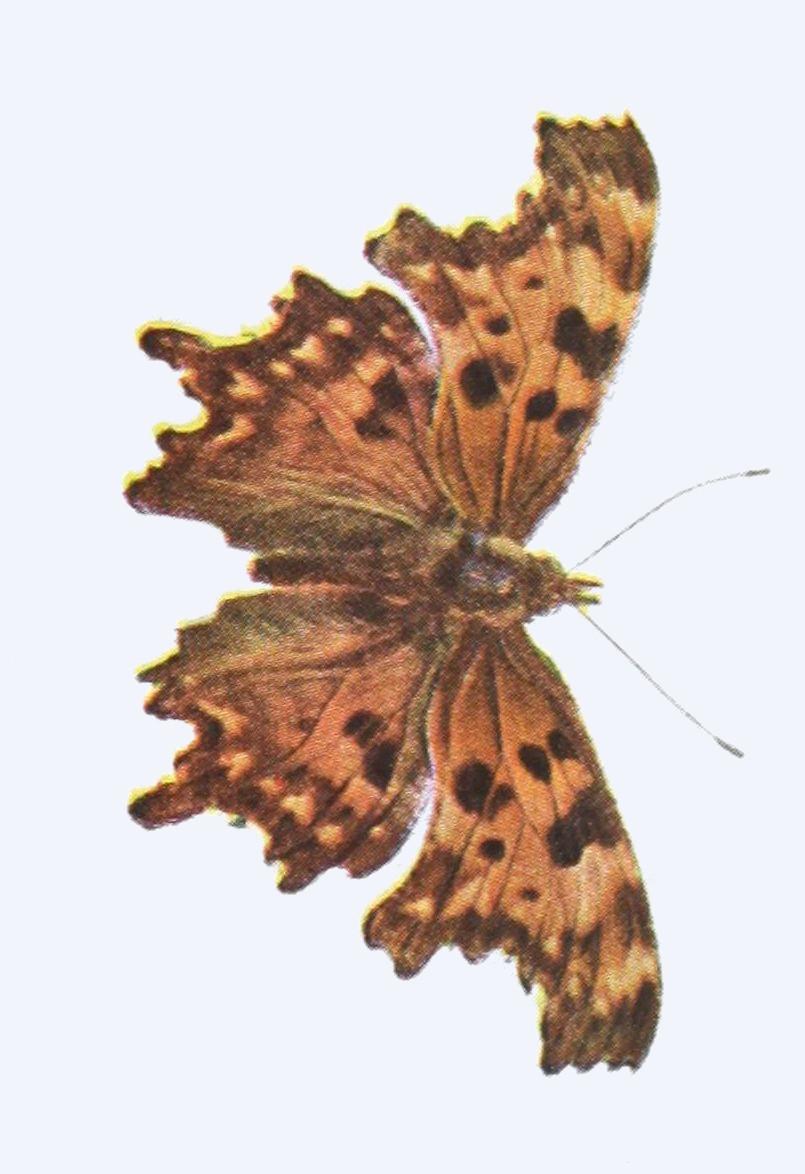
As I have remarked of the genus Argynnis that it is difficult, so also I may say of the genus Grapta that it provokes much discussion among those who have not had the opportunity to study full series of specimens of the various species. The resemblances are very great, and the differences are not accentuated, so that the superficial observer is easily led astray. The differences are, however, valid, even on the upper side of the specimens, which are more nearly alike than the lower side. Take the two species here presented to view on opposite pages. They resemble each other closely, but the student will soon see that there are differences, and these are constant. On the under side they are very great, G.faunus being light in color below, while G.silenusis very dark. In both species at the end of the cell of the hind wing there is on the under side a silvery spot which has the form of an inverted L (⅂), or is rudely comma-shaped.
(4) GraptasilenusEdwards, Plate XXVIII, ♂, Type(The Toper).
Wings in form very much like those of G.faunus, but the fore wing not as strongly produced at the ends of the upper radial, and the
hind wing at the end of the first submedian. The wings are much darker below than in faunus, without large pale spots, at most sprinkled with white scales. Expanse 2.00-2.30 inches.
Occurs in British Columbia, Washington, and Oregon.
PL. XXVIII
The life history of this species is not as yet known. It is highly probable that the insect has the same tastes as the other species of the genus, and lives upon much the same food-plants. The late W. G. Wright, who was a careful observer, states that the butterfly haunts partially wooded places upon hillsides in the region where it is found. It is to be hoped that some bright young person in Oregon or Washington may succeed in breeding the larvæ to maturity, giving us an account of his observations. It is a mistake to suppose that everything which is worth knowing is already known about our lepidoptera. There is much for the students of the future to find out.
(5) Grapta progne (Cramer), Plate XXIX, ♂ (The Currant Anglewing).
Somewhat smaller than any of the foregoing species. Fore wings light fulvous shading into yellow outwardly. The dark markings are smaller than in the other species, but pronounced and clearly defined. Wings below very dark, sprinkled with lighter scales. Expanse 1.85-2.00 inches.
The larva feeds upon all kinds of plants belonging to the currant family.
Ranges from Siberia to Nova Scotia, thence south to the latitude of Pennsylvania.
GENUS VANESSA FABRICIUS
(THE TORTOISE-SHELLS).
Butterflies of medium size. Eyes hairy; palpi somewhat heavily scaled; cell of fore wings may or may not be closed, that of hind wing always open. Fore wings more or less excavated about middle and somewhat produced at ends of upper radial and first median, but not so strongly as in Grapta. Hind wings, with outer margin toothed at ends of veins and strongly produced at end of third median nervule. Eggsshort, ovoid, tapering above, and having a few narrow longitudinal ribs, which increase in depth upward; laid in large clusters. Caterpillarswhen mature, cylindrical, with longitudinal rows of branching spines. Feeding upon elms, willows, and poplars. Chrysalisnot unlike that of Grapta.
The genus is restricted to the north temperate zone and the colder mountain regions of subtropical lands. The butterflies hibernate, and are among the first to be seen in the springtime.
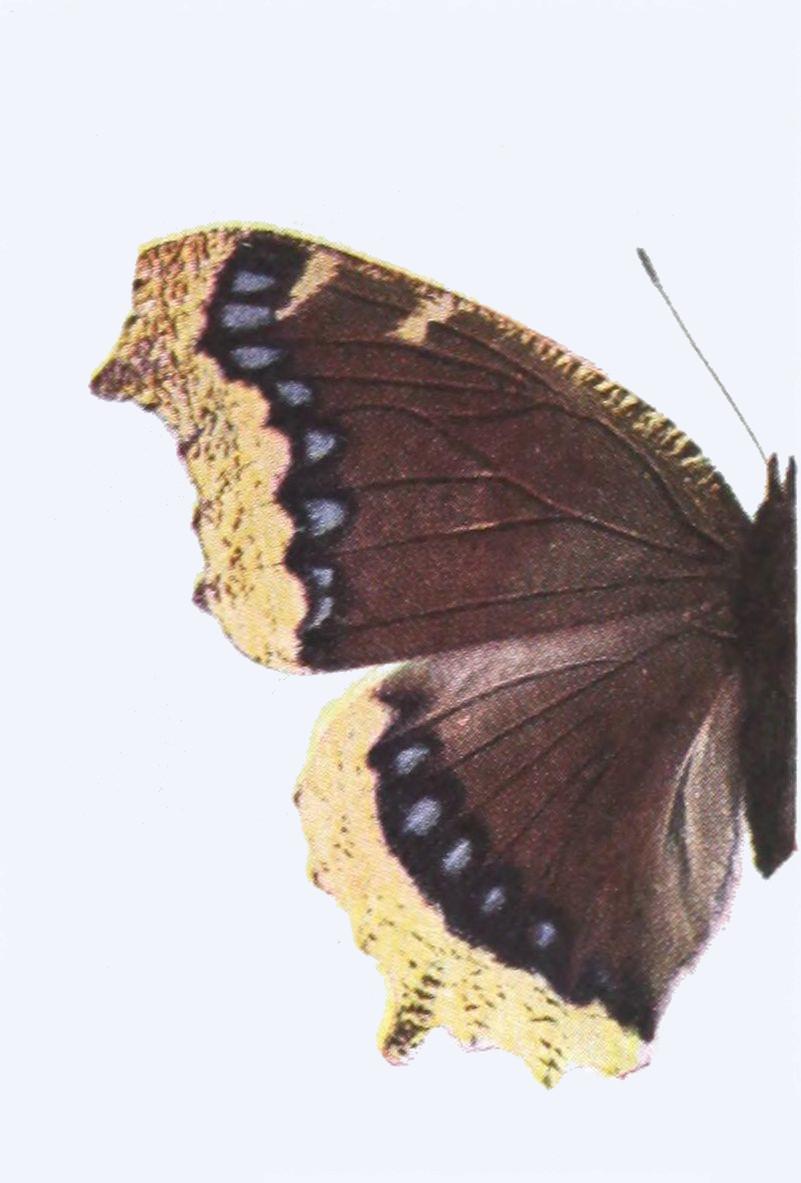
(1) Vanessa antiopa (Linnæus), Plate XXX, ♀ (The Mourning Cloak, The Camberwell Beauty).
This familiar insect needs no description. It occurs everywhere in the north temperate zone. Eggs laid in large masses on willows, poplars, and elms. There are two broods in the Middle States, the second hibernating under eaves and in hollow trees. Expanse 2.75-3.25 inches.
There is a rare variety of this insect in which the yellow border becomes broad, reaching the middle of the wings. Only two or three such “sports” are known, one in the possession of the author. There are some collectors who set great store by such “freaks” or “aberrations,” as they are called.
PL. XXXI
PL. XXX
(2) VanessajalbumBoisduval & Leconte, Plate XXXI, ♂ (The Compton Tortoise).
No description is necessary as our figure will enable it to be immediately recognized. A close ally of the European Vanessa vau-album. Expanse 2.60-2.75 inches.
Larva feeds upon willows. Confined to the northern parts of the country, only occurring in Pennsylvania upon the summits of the higher mountains, and ranging thence to Labrador in the east and to Alaska in the northwest.
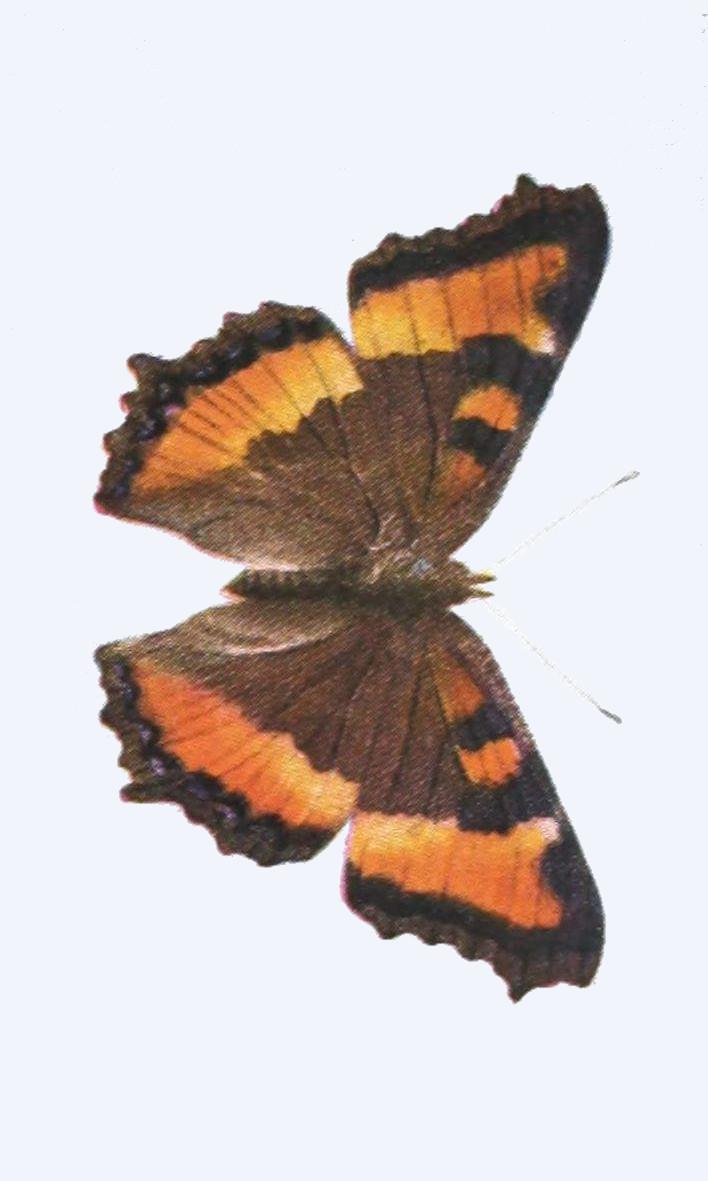
(3) Vanessa milberti Godart, Plate XXXII, ♀ (Milbert’s Tortoise-shell).
Easily distinguished by the broad yellow submarginal band on both wings, shaded outwardly by red. Expanse 1.75 inch. The larva feeds
PL. XXXII upon nettles ( Urtica).
Found at high elevations in the Appalachian highlands, ranging northward to Nova Scotia and Newfoundland, thence westward to the Rocky Mountains and the Pacific Coast, its distribution being determined by temperature and the presence of its food-plant, though its distribution seems to be more dependent upon climate than upon food, as nettles abound in the Southern States, where the insect is never found.
In addition to the three species of Vanessa, which we have figured upon our plates, it should be mentioned that there is a very pretty species, known as Vanessa californica, which occurs upon the Pacific Coast. It somewhat closely resembles the European Vanessa urticæ. In southern California it is only found upon the mountains, but about Vancouver and elsewhere in British Columbia it occurs at sea-level. It is a pugnacious little thing, and fights at sight any other butterfly which comes near. The food-plant of the larva is Ceanothus thyrsiflorus. W. G. Wright informs us that the butterfly in the spring delights to feed upon the gum of Abiesconcolor, when it is still fluid.
GENUS PYRAMEIS DOUBLEDAY
(THE RED ADMIRAL AND PAINTED LADIES).
The butterflies of this are like those of the last genus in the structure of their wings, except that the hind wings are not angulate, and below the hind wings are generally marked with eye-like spots. Egg ovoid, closely resembling that of Vanessa. Larva like that of Vanessa, but spines relatively not so large and not so distinctly branching. Form of chrysalis very like that of Vanessa. The genus includes comparatively few species, but most have a very wide
range, Pyrameiscarduibeing almost cosmopolitan in its distribution, having a wider range than that of any other butterfly.
PL. XXXIII
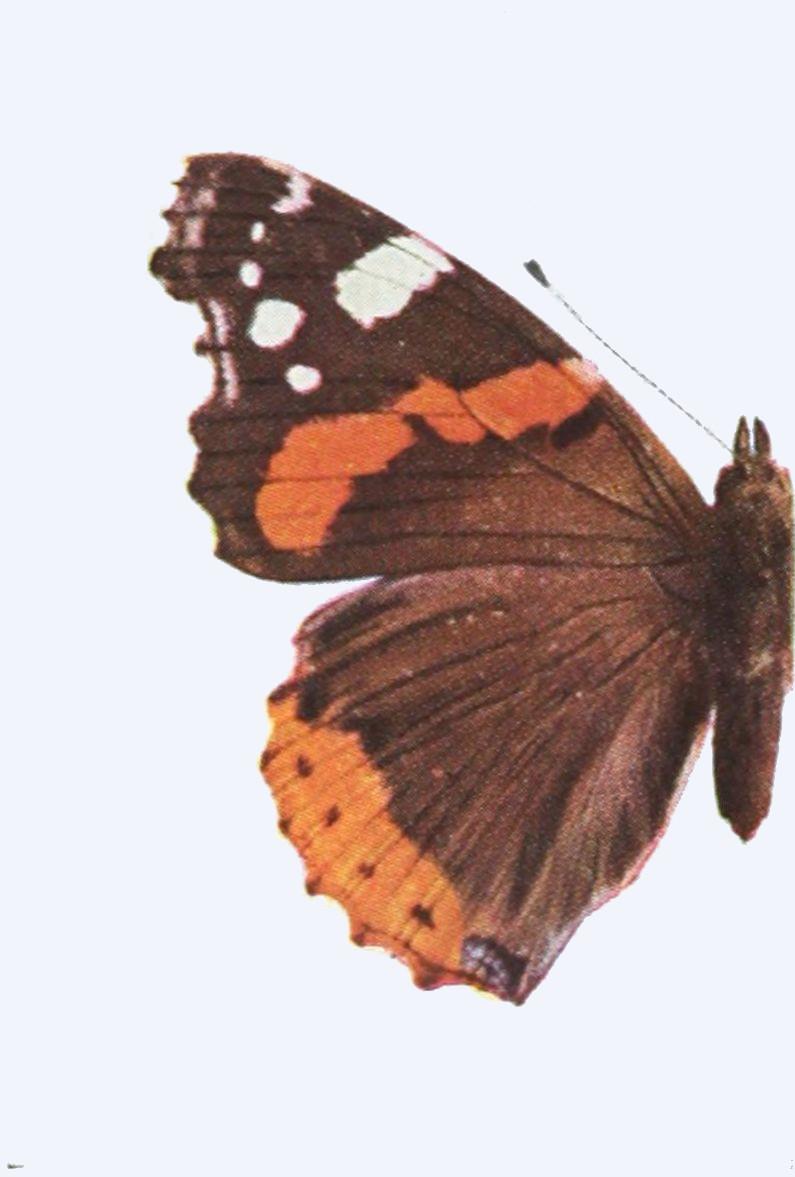
(1) Pyrameis atalanta (Linnæus), Plate XXXIII, ♀ (The Red Admiral).
This familiar butterfly is found throughout temperate North America, Europe, northern Africa, and temperate Asia. Expanse 2.00-2.50 inches.
Larva feeds on the leaves of hop vines, on nettles, and Bœhmeria.
(2) Pyrameis huntera (Fabricius), Plate XXXIV, ♂ (Hunter’s Butterfly).
Marked much like P . cardui, but easily discriminated from it by the two large eye-like spots on the under side of the hind wings. Expanse 2.00 inches.
Caterpillar feeds on cud-weed ( Gnaphalium) and Antennaria. Ranges from Nova Scotia to Mexico and Central America, being comparatively rare in California, but more abundant east of the Sierras.
PL. XXXIV
We all know Hunter’s Butterfly. How many know that its name commemorates that of a most remarkable American, John Dunn Hunter? Captured by the Indians in his infancy, he never knew who his parents were. He was brought up among the savages. Because of his prowess in the chase they called him “The Hunter.” Later in life he took the name of John Dunn, a man who had been kind to him.
He grew up as an Indian, but after he had taken his first scalp he forsook the red men, no longer able to join them in their bloody schemes. He went to Europe, amassed a competence, became the friend of artists, men of letters, and scientists. He was a prime favorite with the English nobility and with the King of England. He interested himself in securing natural history collections from America for certain of his acquaintances, and Fabricius named the beautiful insect shown on our plate in his honor. His Memoirs of Captivity Among the Indians are well worth reading. In that charming book, Coke ofNorfolkandHisFriends, which recently has been published, there are some most interesting reminiscences of this American gentleman, for gentleman he was, although reared by savages. The presumption is established that his unknown progenitors were gentlefolk. “Blood will tell.”
PL. XXXV
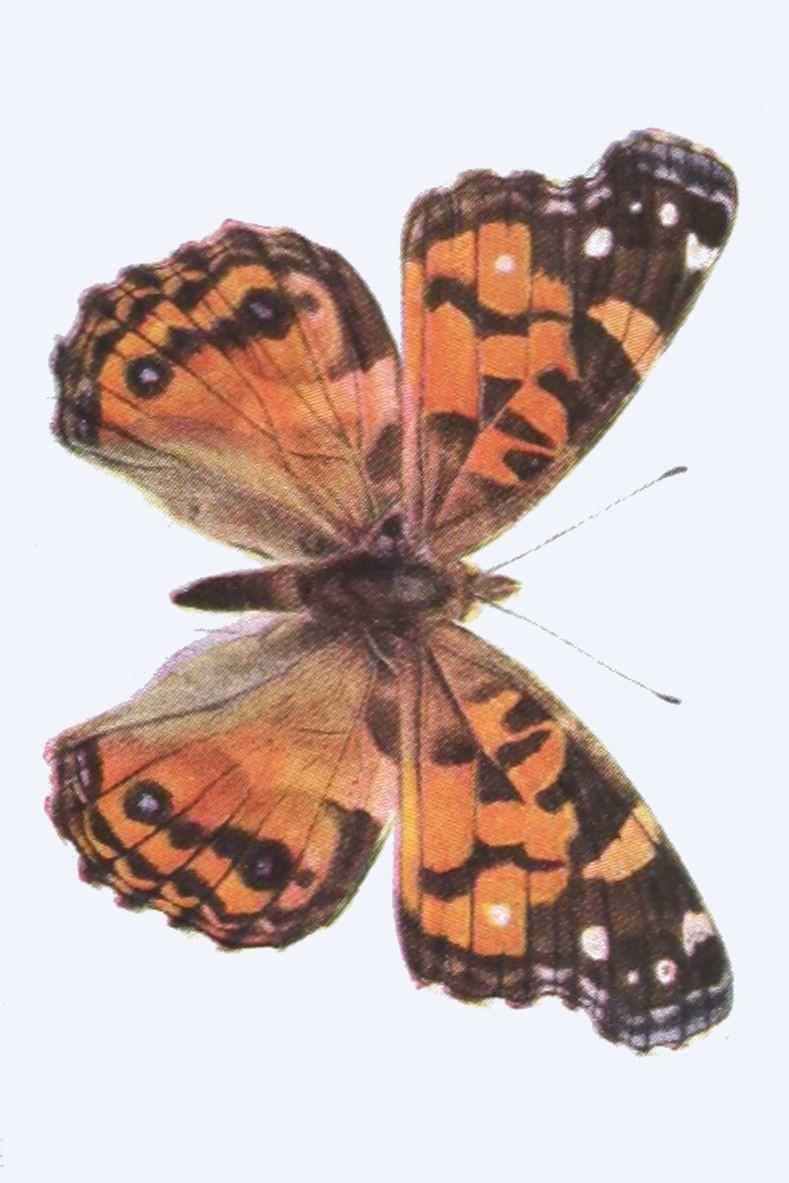
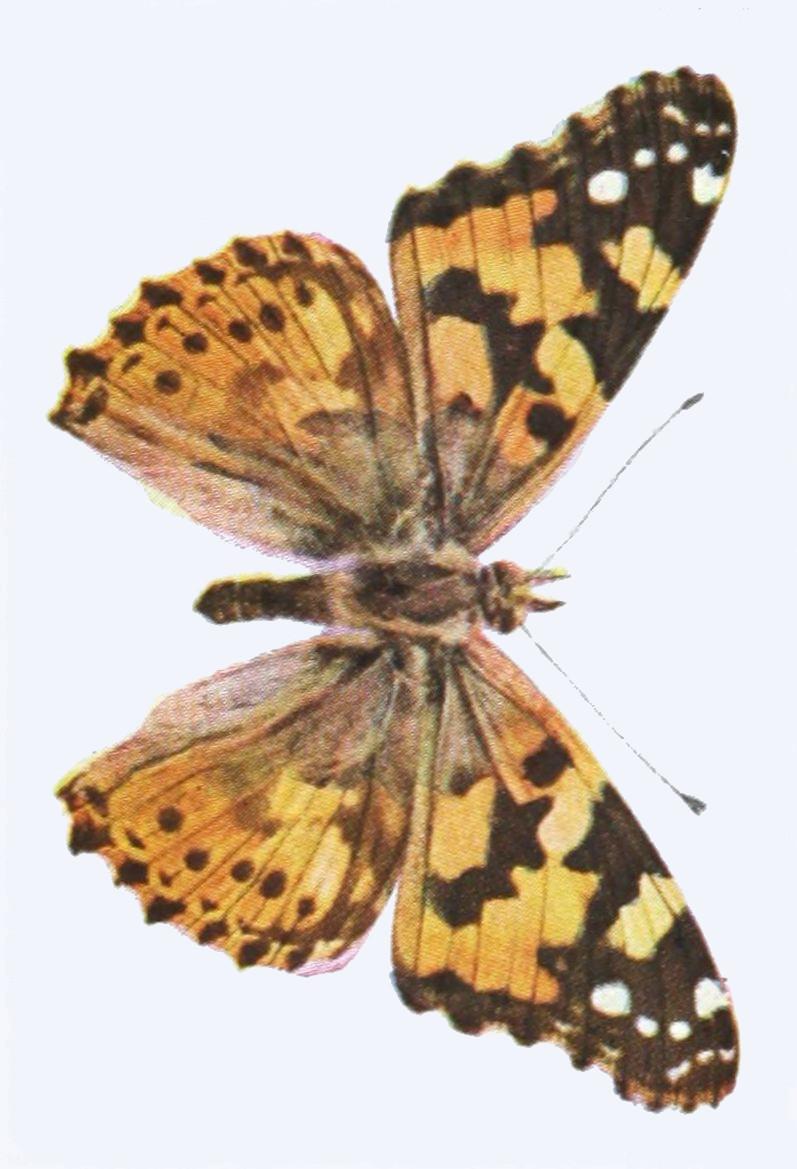
(3) Pyrameis cardui (Linnæus), Plate XXXV, ♀ (The Painted Lady; The Thistle Butterfly).
Easily distinguished from the preceding by the numerous and much smaller eyespots forming a band on the under side of the hind wings. Expanse 2.00-2.25 inches.
Found all over the world, except in the tropical jungles of equatorial lands.
The caterpillars feed on various species of thistles, nettles, and marshmallows.
GENUS JUNONIA HÜBNER (PEACOCK BUTTERFLIES).
Medium-sized butterflies with eye-spots on upper side of wings. Neuration almost exactly like that of the genus Pyrameis, save for
the fact that the cell of the fore wing is usually, and of the hind wing always, open. Eggbroader than high, flattened on top and adorned by ten very narrow and low vertical ribs. Caterpillars cylindrical, longitudinally striped, and with several rows of branching spines. Chrysalisarched on back, curved inwardly in front, and somewhat bifid at head, with the two projections rounded.
There are a score of species, most of which are found in the tropics of the Old World. Three occur in our region, two of which are found in the extreme south. The one which is common we have figured.
PL. XXXVI
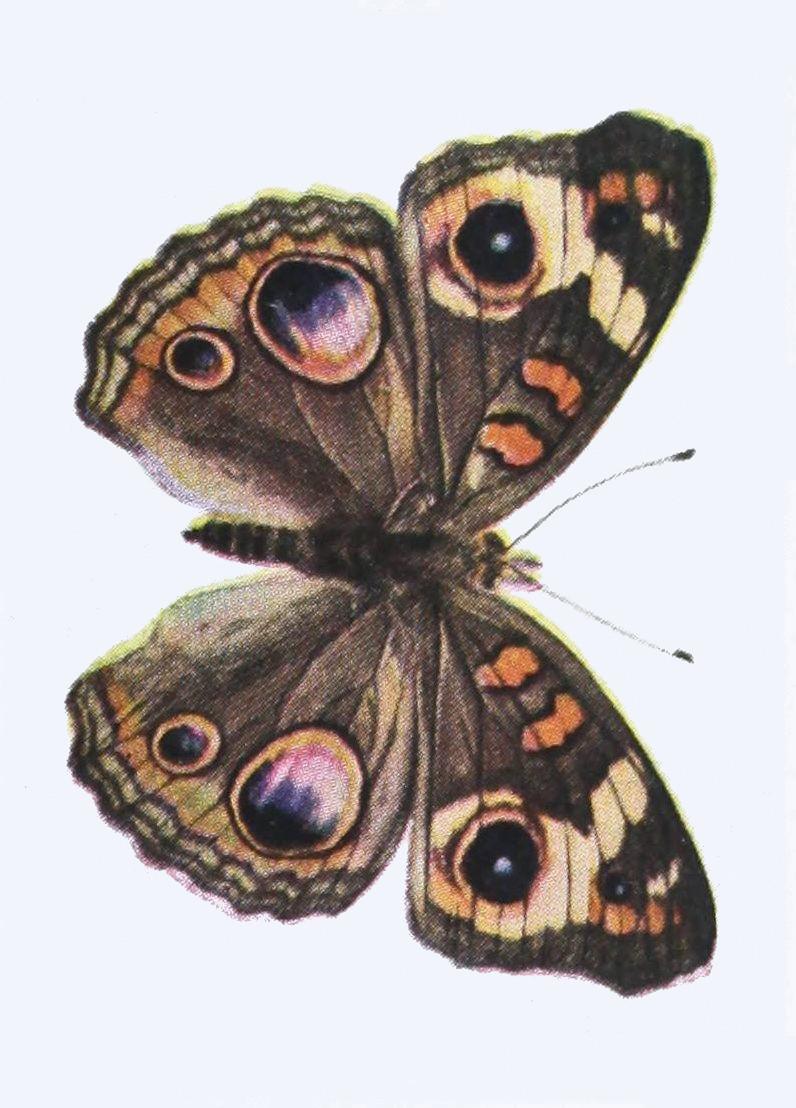
(1) JunoniacœniaHübner, Plate XXXVI, ♂ (The Buckeye).
The spots of the upper side reappear on the lower side, but are much smaller, especially on the hind wings. Expanse 2.00-2.25 inches.
The larva feeds most commonly on plantains ( Plantago), snapdragons ( Antirrhinum), and Gerardia.
Very common in the Southern States, ranging as far north as New England, west to the Pacific, and south into South America.
GENUS ANARTIA DOUBLEDAY.
Medium-sized butterflies, having a weak, hovering flight, and keeping near the ground. Palpi have the second joint thick, the third joint tapering, lightly clothed with scales. Fore wings rounded at apex, the outer and inner margins lightly excavated, cell closed by a feeble lower discocellular, which often is wanting, thus leaving the cell open. Outer margin of hind wings sinuous, produced at end of
PL. XXXVII
third median nervule, cell open. First and second subcostal nervules in fore wing fuse with costal.
There are four species of this genus, one of which occurs in the United States, the rest being found in tropical America.
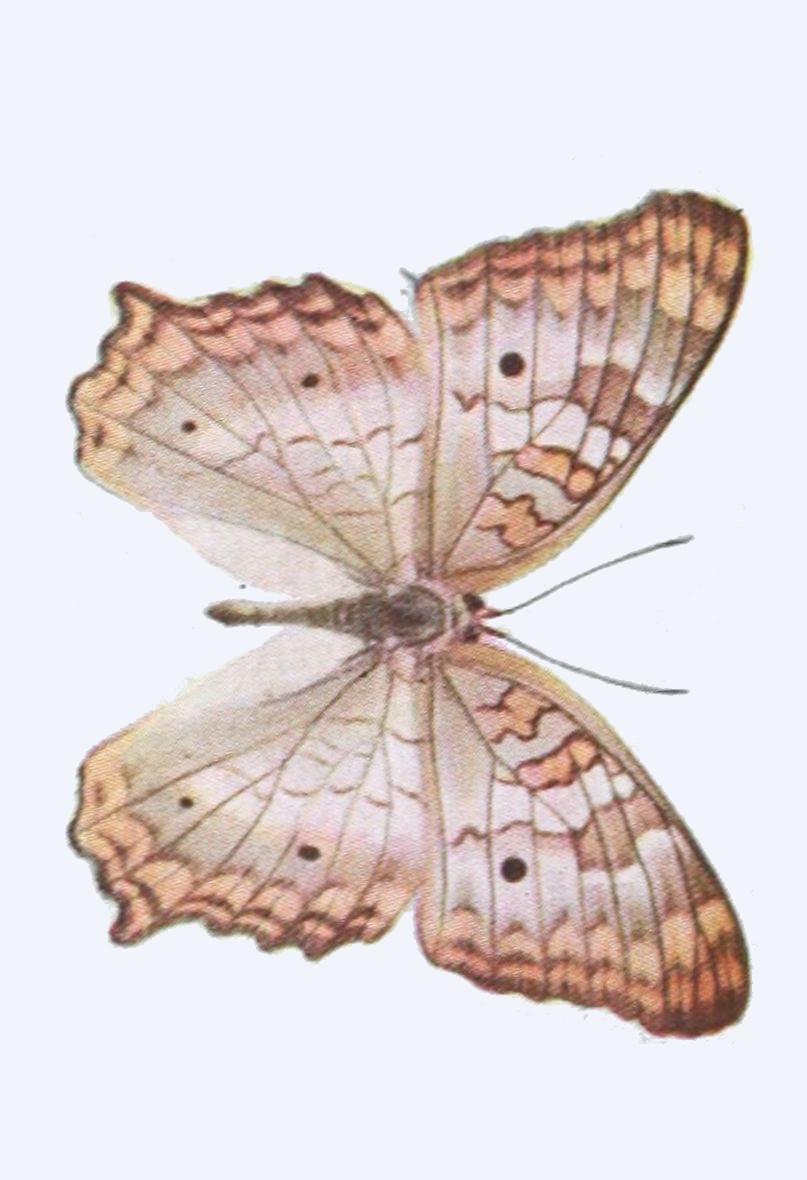
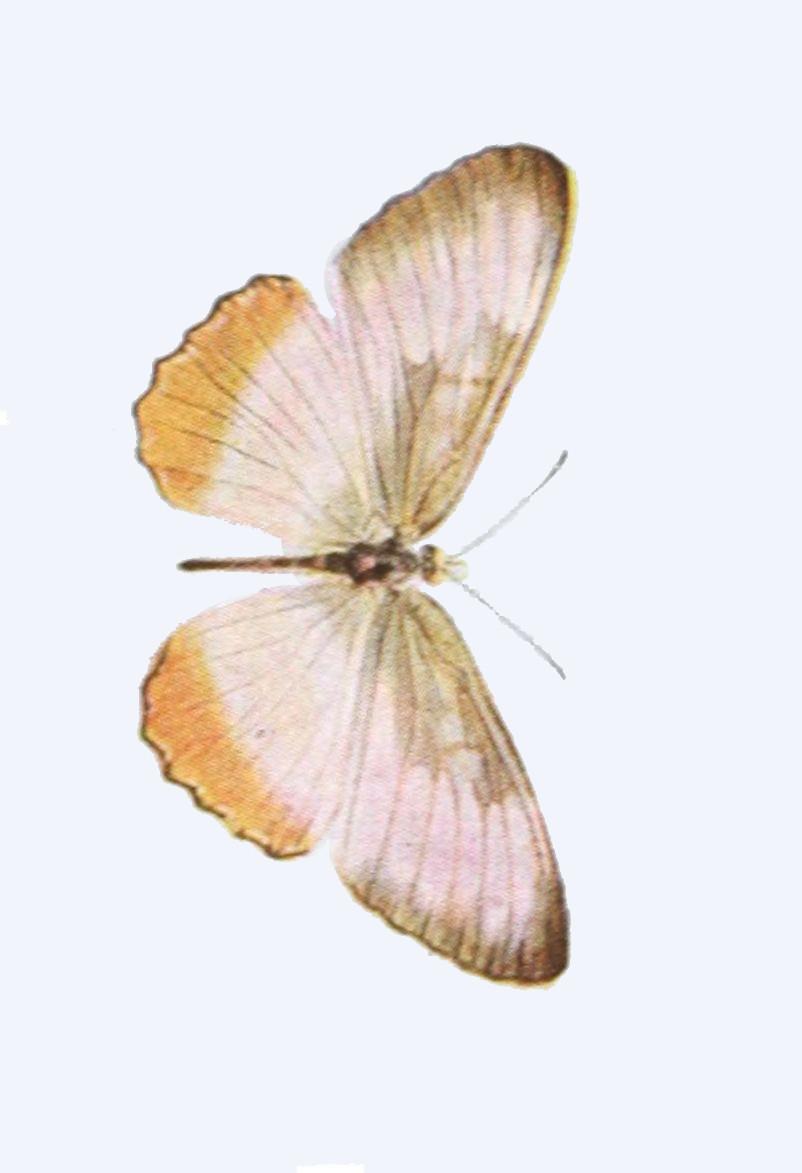
(1) Anartia jatrophæ (Linnæus), Plate XXXVII, ♂ (The White Peacock).
The figure we give will readily serve to identify this insect, which occurs in Florida and Texas, and ranges thence southward to Argentina. Expanse 1.75-2.00 inches.
GENUS EUNICA HÜBNER (THE VIOLET-WINGS).
Rather small butterflies. Antennæ long and slender, with enlarged club, having two grooves. Third joint of palpi of female longer than that of male. The fore wing has the costal and median vein enlarged and swollen at the base. The upper discocellular vein is wanting, the cell is lightly closed. The hind wing is rounded, with its outer margin entire.
The species of the genus have the upper side of the wings dark brown or black glossed with violet, blue, or purple. Below the wings are very beautifully marked. There are about seventy species which have been described, all of them from the American tropics, two of which,
PL. XXXVIII
however, come within our borders, Eunicatatila, occurring in Florida, and the following:
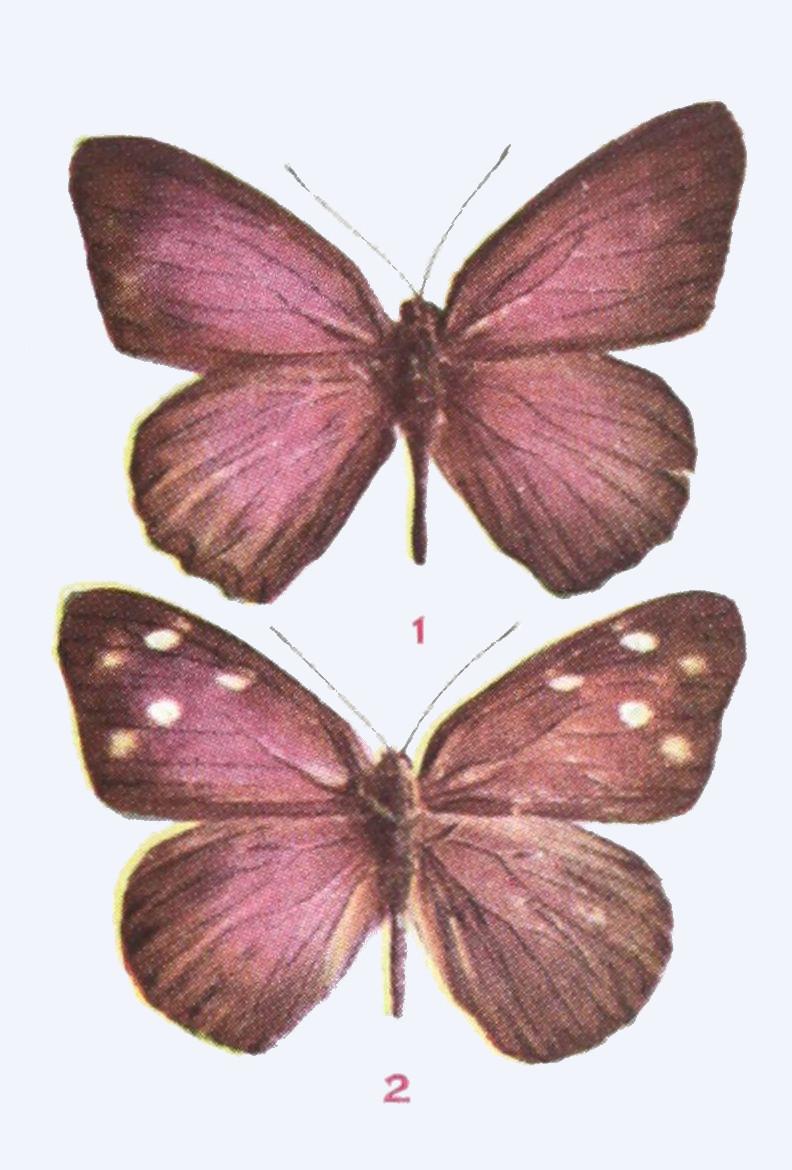
(1) Eunica monima (Cramer), Plate XXXVIII, Fig. 1, ♂; Fig. 2, ♀ (The Dingy Purple-wing).
This obscure little butterfly represents its genus in Texas and Florida, and gives but a faint idea of the beauty of many of its congeners. It ranges southward and is common in Mexico and the Greater Antilles. Expanse 1.35-1.50 inch.
GENUS CYSTINEURA BOISDUVAL
(THE BAG
-VEINS
).
PL. XXXIX
Small, delicate butterflies with elongated fore wings, having the costal vein much swollen near the base, somewhat as in the Satyrinæ. The upper discocellular is lacking in the fore wing, and the cell is feebly closed. Outer margin of the hind wing feebly crenulate; cell open; the two radials spring from a common point.
A number of species and local races have been described.
(1) Cystineura amymone Ménétries, Plate XXXIX, ♂ (The Texas Bag-vein).
On the under side the gray markings of the upper side are replaced by yellow, and on the hind wings there is a transverse white band near the base and an incomplete row of white spots on the limbal area. Expanse 1.50 inch.
Ranges from Kansas southward through Texas into Central America.
GENUS CALLICORE HÜBNER (THE LEOPARD-SPOTS
Small butterflies; the upper side of the wings dark in color marked with bands of metallic blue or silvery green, the lower side more or less brilliantly colored, the fore wings of some shade of crimson or yellow, banded near the apex, the hind wings silvery white or some pale tint, with circular bands of black enclosing round or pear-shaped black spots.
There are about thirty-five species of the genus thus far known, all of which are found south of our limits, except the one we figure.
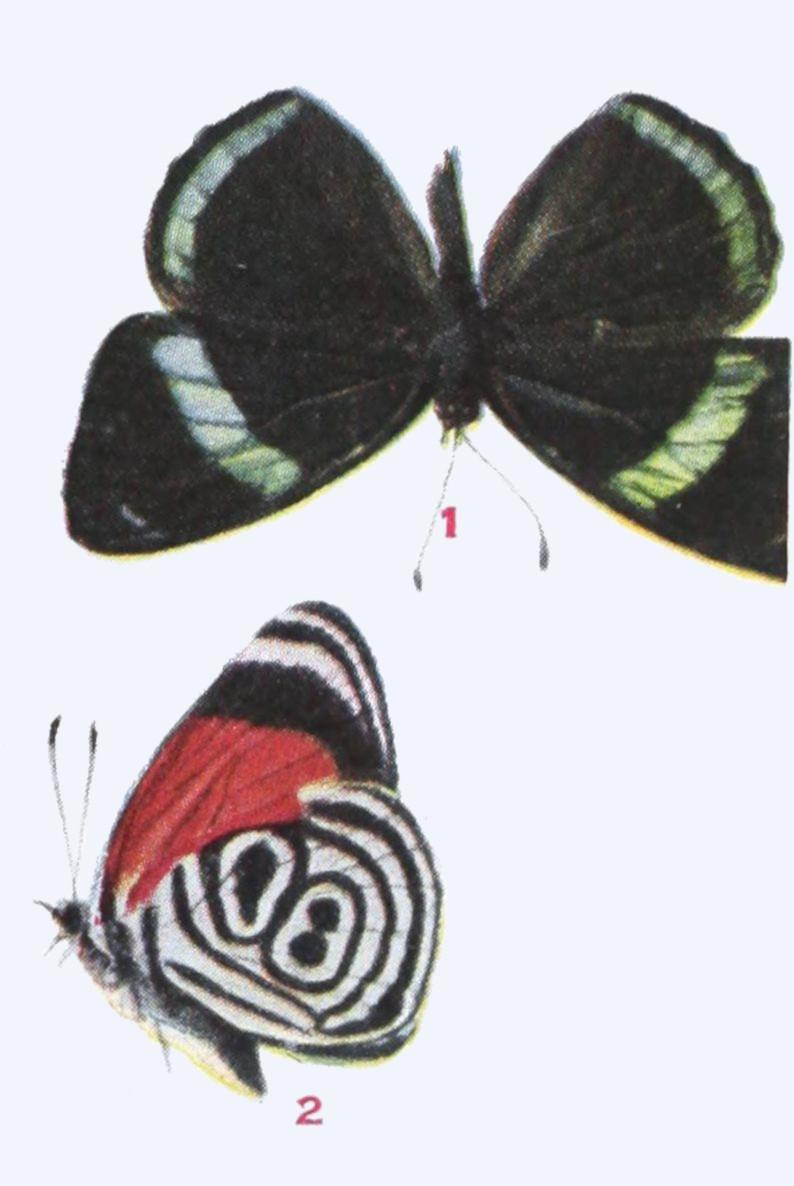
(1) Callicore clymena Hübner, Plate XL, Fig. 1, ♂, upperside; Fig. 2, ♀, underside (The Leopard-spot).
).
Found in Florida, but though quite common farther south, appears to be rather local and rare in the peninsula. Expanse 1.75 inch.
GENUS TIMETES BOISDUVAL (THE DAGGER-WINGS
).
Medium-sized butterflies. Palpi moderately long, thickly clothed with scales, the last joint pointed. Fore wing usually somewhat falcate at apex, deeply excavated on outer margin; hind wing greatly produced at the end of the third median nervule, the wings being tailed in such a way as to make them resemble some species of Papilio. There is also a prolongation of the outer margin of the wing between the extremity of the submedian vein and the first median nervule. On the upper side the wings are generally dark in color, often marked with transverse bands and lines; on the lower side they are light in color, with pronounced darker bands.
PL. XL