Departments of Fisheries and Wildlife and Large Animal Clinical Sciences, Michigan State University, USA
Dana M. Hawley
Department of Biological Sciences, Virginia Tech, USA
Kathryn P. Huyvaert
Department of Fish, Wildlife, and Conservation Biology, Colorado State University, USA
Great Clarendon Street, Oxford, OX2 6DP, United Kingdom
Oxford University Press is a department of the University of Oxford. It furthers the University’s objective of excellence in research, scholarship, and education by publishing worldwide. Oxford is a registered trade mark of Oxford University Press in the UK and in certain other countries
The moral rights of the authors have been asserted
First Edition published in 2021
Impression: 1
All rights reserved. No part of this publication may be reproduced, stored in a retrieval system, or transmitted, in any form or by any means, without the prior permission in writing of Oxford University Press, or as expressly permitted by law, by licence or under terms agreed with the appropriate reprographics rights organization. Enquiries concerning reproduction outside the scope of the above should be sent to the Rights Department, Oxford University Press, at the address above
You must not circulate this work in any other form and you must impose this same condition on any acquirer
Published in the United States of America by Oxford University Press 198 Madison Avenue, New York, NY 10016, United States of America
British Library Cataloguing in Publication Data
Data available
Library of Congress Control Number: 2021931163
ISBN 978–0–19–874624–9 (hbk.)
ISBN 978–0–19–874625–6 (pbk.)
DOI: 10.1093/oso/9780198746249.001.0001
Printed and bound by CPI Group (UK) Ltd, Croydon, CR0 4YY
Links to third party websites are provided by Oxford in good faith and for information only. Oxford disclaims any responsibility for the materials contained in any third party website referenced in this work.
Foreword
In her book The Coming Plague—Newly Emerging Diseases in a World Out of Balance, Laurie Garrett (1994) describes a series of emerging human diseases and makes the point that ‘Preparedness demands understanding. To comprehend the interactions between Homo sapiens and the vast and diverse microbial world, perspectives must be forged that meld many disparate fields.’ She goes on to state that these include not only medicine, parasitology, entomology, and bacteriology, but also disciplines such as basic ecology and evolutionary biology, anticipating the One Health approach. While a fascinating book, the emphasis was on human health. Of course, diseases also emerge among non-human animals and plants. An advantage of studying emerging diseases in non-human systems is that it is easier to test hypotheses experimentally, and it may be possible to follow an epidemic over extended periods without intervention. Some of the most groundbreaking work in disease ecology today (and historically) is done in birds. Birds are both victims and reservoirs. What we learn from studies on birds, however, transcends taxonomic boundaries—hence, while this book may focus on birds, it is meant for any disease ecologist. To really understand how parasites and pathogens emerge, thrive, evolve, and impact hosts, questions have to be asked over extended time periods and at multiple scales: individuals, populations, communities, and ecosystems (as nicely illustrated in the structure of this book), and across broad geographic scales. Here, birds play an important role because some data that need to be collected across large geographic regions can only be obtained in collaboration with community (citizen) scientists who love to watch birds and report their observations to scientists. The House Finch Disease
Survey that we started in 1994, for example, not only allowed us to describe the expansion of an emerging infectious disease in great detail but also made it possible to describe differences in prevalence of conjunctivitis caused by Mycoplasma gallisepticum in wild bird species at a continental scale. As with many other bird studies, our study of mycoplasmal conjunctivitis has become long term, making it possible to detect effects of emerging infectious diseases on host and pathogen dynamics, while also studying evolutionary changes of both host and pathogen. Long-term studies also make it possible to detect effects of climate change on host–pathogen interactions, where bird studies play a big role (e.g., Fuller et al. 2012).
Disease ecology is special in various ways. By its integrative approach it requires collaboration of scientists with very different backgrounds, often from disciplines that ask very different questions and often speak different ‘languages.’ Nevertheless, the scientists involved must be willing to communicate constructively. While working on mycoplasmal conjunctivitis in house finches, for example, we had endless discussions to try to define virulence because veterinarians and mathematical modelers do not use that term in the same way; as is so often the case in ecology, it helps to define terms used up front so as to avoid confusion and to assure that everyone is on the same page, something the authors of the chapters in this volume address head on. Further, designing a project in avian infectious disease ecology requires extended conversations, because what interests a veterinarian may not interest an ecologist, and the data a modeler needs to make predictions may not be a priority for a microbiologist. The best way to understand such complex interactions among disciplines is by approaching
infectious disease ecology from multiple perspectives and scales, as this book exemplifies. This text resource will help to train the next generation of infectious disease ecologists who can speak many languages, use many approaches, and, as a result, solve complex infectious disease ecology problems in avian systems and beyond.
However, to make these transdisciplinary collaborations possible so that work will truly advance our knowledge about infectious disease ecology, major funding is required. Until about 20 years ago, the problem in the US was that it was difficult to find a funding agency willing to support projects that study infectious disease in an ecological context. Over time, it was increasingly recognized that, without a firm foundation in disease ecology, our ability to understand disease dynamics across multiple scales was limited. Fortunately, through the collective vision of two scientists, Samuel Scheiner and Joshua Rosenthal, the National Science Foundation partnered with the National Institutes of Health to develop a program that was ultimately called the Ecology and Evolution of Infectious Diseases (EEID). The mission of the EEID program as it evolved over the subsequent decades was to support interdisciplinary research projects that combined to produce predictive understanding of infectious disease dynamics, with a focus on diseases with an environmental component (Scheiner and Rosenthal 2006). This program was a catalyst for disease ecology funding from more diverse
sources. Collectively, the impact was beyond imagination. Not only do we have a vibrant annual EEID conference that alternates between North America and Europe, but this rapidly growing field has impacted so many young scientists that today we are looking at a book that can easily be used as a textbook to contribute to the training of disease ecologists around the world. It is noteworthy that chapter authors are mostly early- to mid-career scientists, women are prominently featured, and the chapters contribute important and diverse original insights, many of which emerged from interdisciplinary collaborations. Together, this illustrates the incredibly rapid growth and future potential of the exciting discipline that is avian infectious disease ecology.
André A. Dhondt Member of the Academia Europaea, Edwin H. Morgens Professor of Ornithology, Cornell University, USA
References
Fuller, T., Bensch, S., Müller, I., et al. (2012). The ecology of emerging infectious diseases in migratory birds: an assessment of the role of climate change and priorities for future research. Ecohealth, 9, 80–88.
Garrett, L. (1994). The Coming Plague: Newly Emerging Diseases in a World out of Balance. Farrar, Straus and Giroux, New York.
Scheiner, S.M. and Rosenthal, J.P. (2006). Ecology of infectious disease: forging an alliance. Ecohealth, 3, 204–8.
Preface
Disease ecology is a rapidly growing discipline, which will undoubtedly only increase with the COVID-19 pandemic. With this growth comes a need for works that synthesize the core principles and concepts that underlie infectious disease dynamics from ecological and evolutionary perspectives. While there are many excellent disease ecology textbooks already in print, most focus on just one level of ecological hierarchy, such as the population, community, or ecosystem scales. When I was approached about writing a disease ecology book that focused on birds, I had been teaching a wildlife disease ecology course for 8 years. I structured the multiscale course by beginning at the organismal level with the host–parasite interaction and then incrementally scaling up to explore the unique properties that naturally emerge from these interactions within and among populations, communities, and ecosystems. No single textbook aligned with my course structure; rather, I pulled content from many books and papers for each unit. Hence, my motivation with this textbook was to provide a multiscale approach that I found missing in other books, using the lens of a well-studied taxonomic group. Like many ecologists, I am driven not only by scientific questions, which, in my case, are about the role of the environment in host–parasite interactions, but also by my fascination with a particular taxon—birds. Hence, it was such an exciting prospect to write this book; being able to immerse oneself in all facets of avian disease ecology seemed like a luxury, albeit an overwhelming one.
I began this journey solo. But, like many journeys, there were unexpected challenges en route that can force us to change course or adjust our approach. After I experienced a significant setback
in life, it was clear that going solo on this textbook was not going to be possible; yet I wanted to see this project through. With that, I reached out to two amazing fellow disease ecologists and women, Dana Hawley and Kate Huyvaert, to join me as co-editors for this book. We are here today because they said yes. At the heart of scientific discovery and advancement is collaboration, communication, humility, and transparency. It is hard to imagine what this book would be without this collaboration—I know the book is better for it, as am I. And now this becomes our story.
We are proud of this book for many reasons— rather than a collection of independent chapters, each chapter builds upon another, which, in itself, demonstrates the transdisciplinary nature of what this field needs to be and clearly is becoming. Like the editors, each with our unique areas of expertise in disease ecology and avian biology, the authors’ contributions span the breadth of ecological inquiry, taxonomic focus, and research approach. The selection of authors was deliberate—we looked for individuals whose careers were not just about a particular conceptual topic, but we also sought individuals for whom birds are at the heart of their research programs, to truly embrace the depth of understanding emerging at the interface of avian biology and disease ecology.
We are also proud of this book because it highlights a suite of early career and diverse scientists that are transforming the field and culture of disease ecology in much needed ways. Even in 2021, a scientific book with three women editors is notable, as is an author list that is largely female and includes numerous other forms of diversity, such as ethnicity, race, sexual orientation, and ability. But we also recognize that the field of disease ecology—much
like many others in science—suffers from an overall lack of diversity, particularly with respect to race. We use this as a call to do more as educators and mentors to raise up, to encourage, and to empower those that continue to be marginalized and underserved in disease ecology and science more broadly. We are scientists but we are also humans with lives and challenges that we each face—while writing this book we persisted through the loss of a parent, a debilitating car accident, death of beloved pets, a pandemic, Zoom fatigue, parenting/teaching young children with no childcare or school, and more. Hence, we could not have done this alone and we want to acknowledge all those that helped us get here today. Allie Shoffner worked behind the scenes to tackle the huge task of collecting and ensuring that all the many pieces of each chapter
were ready and formatted properly for submission. We are also indebted to Ian Sherman, Charles Bath, and the publishing team at Oxford University Press for their support along this long journey, and our spouses and families (including the furry members) for their unwavering encouragement and support. Through this endeavor, we grew individually and as a team, reminding ourselves that resiliency, personal and ecological, is a hallmark of a healthy, whole system. And, if we learned anything by crafting a book during the COVID-19 pandemic, it is that understanding and appreciating the importance of disease ecology is essential for the resilient world we aspire to live in and contribute to, both for humans and the feathered creatures that bring us and others so much joy.
Jen Owen, Dana Hawley, and Kate Huyvaert
5 Host–Pathogen
Camille Bonneaud
5.1
5.2
5.4
5.5
6 Fitness Effects of Parasite Infection in Birds
Jenny C. Dunn, Dana M. Hawley, Kathryn P. Huyvaert, and Jennifer C. Owen
6.1
6.2
7
Kathryn P. Huyvaert
7.1
7.2
7.3
7.4
8
Karen D. McCoy
8.1
9 Land Use
Maureen H. Murray and Sonia M. Hernandez
9.1
9.2
9.3
9.4
10
Richard J. Hall 10.1
10.3
11 Pathogens from Wild Birds at the Wildlife–Agriculture Interface
11.1
Sarah A. Hamer and Gabriel L. Hamer
12.1
13
12.4
List of Contributors
James S. Adelman Department of Biological Sciences, University of Memphis, USA
Sarah N. Bevins National Wildlife Research Center, United States Department of Agriculture, Wildlife Services, USA
Camille Bonneaud College of Life and Environmental Sciences, University of Exeter, UK
André A. Dhondt Cornell Lab of Ornithology and Department of Ecology and Evolutionary Biology, Cornell University, USA
Jenny C. Dunn School of Life Sciences, University of Lincoln, UK
Alan B. Franklin National Wildlife Research Center, United States Department of Agriculture, Wildlife Services, USA
Richard J. Hall Odum School of Ecology and Department of Infectious Diseases, University of Georgia, USA
Gabriel L. Hamer Department of Entomology, Texas A&M University, USA
Sarah A. Hamer Schubot Center for Avian Health, College of Veterinary Medicine & Biomedical Sciences, Texas A&M University, USA
Dana M. Hawley Department of Biological Sciences, Virginia Tech, USA
Amberleigh E. Henschen Department of Biological Sciences, University of Memphis, USA
Sonia M. Hernandez Warnell School of Forestry and Natural Resources and the Southeastern Cooperative Wildlife Disease Study, Department of Population Health, at the College of Veterinary Medicine, University of Georgia, USA
Kathryn P. Huyvaert Department of Fish, Wildlife, and Conservation Biology, Colorado State University, USA
Karen D. McCoy Centre for Research on the Ecology and Evolution of Diseases, MiVEGEC, CNRS-IRD-University of Montpellier, France
Maureen H. Murray Department of Conservation and Science, Lincoln Park Zoo, USA
Jennifer C. Owen Departments of Fisheries and Wildlife and Large Animal Clinical Sciences, Michigan State University, USA
Susan A. Shriner National Wildlife Research Center, United States Department of Agriculture, Wildlife Services, USA
Andrea K. Townsend Department of Biology, Hamilton College, USA
A Bird’s Eye View of Avian Disease Ecology
Jennifer C. Owen, Dana M. Hawley, and Kathryn P. Huyvaert
‘Birds are not only birds but aviating zoological gardens’ (Shipley 1926).
Wild birds capture enormous human interest and joy—not just for the ornithologists and disease ecologists that study them but for all kinds of people around the globe. Birds function as national emblems, centers of cultural and spiritual rituals, and talisman symbols (Cocker 2014). Humans around the world also go to great lengths to care for and observe wild birds. Wild bird feeding ranks as one of the most popular forms of human–wildlife recreation in many countries (Cox and Gaston 2018; Jones 2018) and bird-based tourism is one of the fastest growing industries, with people making an estimated 3 million trips per year worldwide to watch birds (CREST 2014; CTO 2008). Wild game birds are an important source of subsistence and recreational hunting worldwide, and in the United States (US), revenue generated from the sale of duck stamps and hunting licenses has contributed hundreds of millions of dollars toward wetland conservation (Rubio-Cisneros et al. 2014; Shipley et al. 2019). Birds fascinate people of all ages worldwide; they come in a spectacular array of colors, shapes, and sizes and they possess remarkable adaptations that, more so than any other vertebrate, enable them to live in every habitat of the world. Finally, birds are unmatched in their ability to connect people to nature (Cox and Gaston 2016).
Not all the attention placed on birds is positive, however. Many wild birds are currently threatened by novel pathogens that pose conservation threats
to their populations, some of which are already declining precipitously due to factors such as habitat degradation and loss, pollution, invasive species, and climate change (Rosenberg et al. 2019). Endemic Hawaiian honeycreepers have experienced dramatic population declines, and in some cases extinction, due to the combined impact of invasive bird and mammal species, the introduction of both the avian malaria parasite and its mosquito vector (Warner 1968), and, more recently, the threat of climate change (Paxton et al. 2016). Birds have also been linked to the spread of pathogens infectious to humans and domestic animals. In the last century, there have been significant increases in the numbers of emerging infectious diseases; further, approximately 75% are zoonoses, meaning that they originate in non-human animals but the parasites that cause them are transmissible to humans (Jones et al. 2008). Wild and domestic birds are the natural reservoir for many of these zoonotic pathogens of significant economic and public health importance (Reed et al. 2003). For example, West Nile virus (WNV), for which wild birds are the primary reservoir host, is the most geographically widespread arbovirus globally (Kramer et al. 2007). The virus invaded the US in 1999 and quickly spread across the country and between 1999 and 2018 led to over 50,000 human cases and 2,400 deaths (CDC 2020). The naïve avian population in North America also suffered, with notable mortality events and significant population declines in
the years following the invasion of WNV (LaDeau et al. 2007).
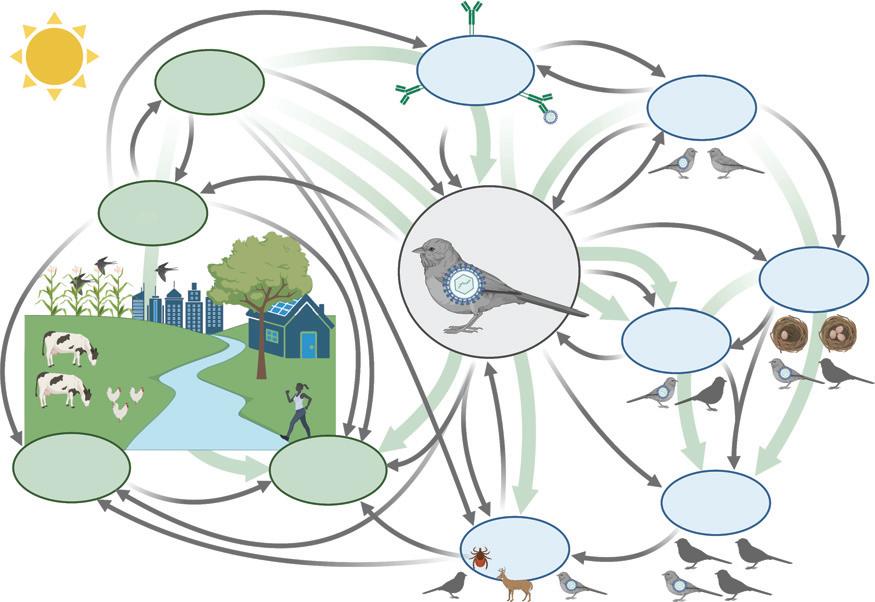
It is not surprising that bird-hosted pathogens continue to pose problems for bird conservation and global health—birds are the most diverse group of extant vertebrates and have evolved to utilize (exploit) every ecological niche on Earth, such that they have the propensity to serve as a host of pathogens in every part of the world. The diversity of birds is outmatched only by the diversity of the parasite fauna infecting them. Given the overwhelming diversity of both avian hosts and their parasites, we have only scratched the surface regarding the role that pathogens play in avian biology and the role that birds play in the maintenance and spread of zoonotic pathogens. For example, wild birds have been documented to harbor a suite of gamma and delta coronaviruses, but the zoonotic potential of avian coronaviruses remains entirely unknown (Wille and Holmes 2020). In addition to this understudied diversity, parasite–bird interactions are increasingly occurring in rapidly changing global environments—thus, their ecology is changing—and this shapes the complex ways by which parasites influence the interconnected health of birds, humans, and shared ecosystems. Parasite–bird interactions are both influenced by and have consequences for every level of ecological hierarchy, from the physiology, behavior, and evolution of individual hosts up to the complex biotic and abiotic interactions occurring within biological communities and ecosystems (Figure 1.1). Understanding these complex and multiscale interactions requires an inherently integrative approach.
Disease ecology is an interdisciplinary field that recognizes that the host–parasite interaction is shaped by the environment and can affect and be affected by the processes that occur across all levels of ecological organization (Hawley and Altizer 2011). The field of disease ecology is closely aligned, yet notably distinct from, the field of epidemiology, which studies the spatial and temporal patterns of disease in human populations and the likely factors that cause those patterns. Disease ecology focuses on understanding the complex ecological and evolutionary underpinnings of the host–parasite interactions of all biological taxa, allowing robust predictions about spatial and
temporal patterns of pathogen transmission and disease risk to host and non-host populations (Kilpatrick and Altizer 2010). In this book, we focus on the dynamics of infectious diseases for wild avian hosts across different scales of biological organization—from within-host processes to landscape-level patterns (Figure 1.1). Because the infectious agents of wild birds can both influence and be affected by processes occurring in other taxa, we consider the role of domestic birds and non-avian hosts, including humans, in the dynamics of infectious diseases of wild birds.
Owen and colleagues begin in Chapter 2 by discussing the basic principles of host–parasite interactions, as they apply more generally and specifically to birds. By introducing terms and providing definitions within the context of the broader field of disease ecology, the authors aim to provide a reference that is a starting point for anyone embarking on the study of infectious disease ecology. To better understand the population and community level dynamics of pathogen transmission, one must understand the timeline by which an individual host progresses through the key steps of infectious pathogen acquisition, clinical signs (where applicable), and spread. In fact, this timeline of infection at the level of the individual is one of the most critical aspects of being able to predict the magnitude of a disease outbreak and develop better control and prevention strategies.
One of the most important factors influencing a bird’s ability to limit an invading pathogen and/or clinical disease expression is the type and effectiveness of the host’s immune system. The field of ecoimmunology, or the study of immune variation, has been rapidly growing in the last two decades and much of the research in this field has been conducted on birds. In Chapter 3, Henschen and Adelman give a broad overview of the avian immune system and use the lens of ecoimmunology to explore some of the key factors that drive immunological variation within and among bird species. They then explore the complex and diverse relationships between immunological variation, host fitness, and infectious disease ecology, which, together, represent an intersection ripe for exciting progress in the coming decades.
Figure 1.1 A conceptual framework for avian infectious disease ecology that is paralleled by the book’s organization (with relevant chapter numbers in each topic oval). Central to this framework are interactions between avian hosts and their parasites (large gray circle in center), which directly connect to (gray arrows) as well as indirectly modify (green arrows) all other interactions. Disease ecology crosses levels of biological hierarchy and temporal and spatial scales (blue ovals), from the processes that occur in cells within an individual host’s immune system, up through aspects of individuals (behavior, fitness), populations, and communities. Anthropogenic activities interact with these various biological processes to drive climate and landscape impacts on birds as well as the degree of overlap among wild birds, humans, domestic animals, and their shared parasites (green ovals). For visual clarity, only key linkages (arrows) are shown, but direct and indirect interactions likely exist between virtually all components of this conceptual framework, illustrating both the complexity and interconnectedness of infectious disease ecology. (Created with Biorender.com.)
A bird’s behavior can act in concert with its immune system, in some cases acting as a first line of defense by preventing exposure and in other cases facilitating pathogen exposure and ongoing spread. In Chapter 4, Townsend and Hawley explore a suite of avian behaviors that have important consequences for infectious disease ecology. Birds are unique in their ability to readily transport pathogens over long distances via both daily foraging movements and annual migrations, with over half of the world’s more than 10,000 species of birds classified as migratory. Townsend and Hawley emphasize the importance of understanding how a
host’s infection status influences behaviors such as social interactions, foraging, and migration in order to understand the implications of many avian behaviors for ongoing disease spread. Because of the importance of traits such as host immunity and behaviors for minimizing the fitness costs of pathogens, infectious agents are expected to exert strong selection on these components of avian biology. In Chapter 5, Bonneaud considers parasitemediated evolution in birds, as well as antagonistic coevolution between birds and their parasites. Because birds are highly visible and well studied, they represent some of the most notable examples
of the ways in which parasites exert strong selection on hosts and vice versa. Using a case study approach, Bonneaud discusses how some of these key avian examples have shed important light on the ability of hosts and pathogens to rapidly evolve in response to one another.
The extent to which avian hosts evolve in response to infectious agents will depend on the way in which parasites and pathogens affect the fitness of individual birds in the wild. While birds represent some of the most notable examples of mortality from pathogens, such as avian malaria causing acute mortality in endemic Hawaiian birds, the fitness effects of parasites on birds can be highly variable, in some cases constituting only subtle effects on survival and reproductive success. In Chapter 6, Dunn and colleagues discuss the ways that these fitness effects are typically measured in birds. They then consider the diverse sources of variation in fitness effects of parasites on hosts, including contributions of host and parasite variation, as well as the role of the environment.
The individual-level fitness effects of parasites on birds are increasingly well studied, but less is known about host population growth in light of parasitism and how and when parasites regulate wild bird populations. That said, the few examples in which a pathogen has been documented to regulate a wild animal population come from studies of wild birds, underscoring the importance of avian systems for our understanding of infectious disease ecology more broadly. In Chapter 7, Huyvaert introduces key concepts, important tools, and mathematical modeling approaches used to describe and deepen our understanding of the effects of parasites on bird population dynamics. At the heart of accurate estimates of the effects of parasites on avian populations are long-term studies—facilitated by bird banding—that employ quantitative approaches such as mark-recapture analyses to account for imperfect detection of individual animals or their infection status. Huyvaert ends by considering the potential for parasites to influence avian population dynamics by affecting population growth, regulation, and, in some cases, the likelihood of extinction.
Bird populations and the parasites they harbor are part of larger, more complex ecological communities. The attributes of these communities—such as
species composition and richness and their structure and trophic networks—can greatly influence the way in which populations within the community interact with each other and their environment. In Chapter 8, McCoy explores community attributes and how the properties that emerge from these interactions influence avian infectious disease dynamics. For instance, an emergent property of the species diversity and composition present in a community is how it either amplifies or dilutes pathogen transmission. McCoy illustrates various community-level processes in disease ecology using long-term studies on polar seabird communities and Lyme disease bacteria. Attention to communitylevel interactions and the influence they have on disease dynamics is gaining warranted attention, particularly considering the ongoing global changes that have key downstream effects on communitylevel characteristics.
Human-led activities have altered landscapes for birds and the communities they reside in around the globe. In Chapter 9, Murray and Hernandez explore how changes in land and water use, including habitat loss, pollution, and supplemental resources, affect infectious disease dynamics in wild birds through several non-mutually exclusive mechanisms. For example, the intensification of agriculture and expansion of urban areas has led to degradation and loss of habitat, affecting abundance and composition of bird and vector populations and communities and, in some cases, the physiology of avian hosts and vectors in ways that alter their susceptibility or competence, respectively. Pollution—including toxicants, light, and noise—can reduce avian or vector population sizes and cause non-lethal effects that influence the capacity to resist infection. Finally, supplemental resources, whether intentional (i.e., bird feeding) or unintentional (e.g., landfills), can cause a suite of effects on disease dynamics by bringing avian hosts into close proximity and influencing their ability to resist infection. Understanding the emergent outcomes of anthropogenic land use for avian disease dynamics is an important area for future study in rapidly changing global landscapes.
One of the key environmental factors that interacts closely with land use and influences the population-level outcomes of disease is climate. In
Chapter 10, Hall discusses the consequences of a warming world on bird–parasite interactions and the diverse, and sometimes conflicting, ways in which climate change can influence avian disease dynamics to either augment or dampen pathogen transmission. Some of the most notable effects of climate change on bird–parasite interactions are the shifting, expanding, and shrinking ranges of many bird species concomitant with the changing distributions of the pathogens themselves and, for many, the vectors that transmit them. The environmental challenges linked to climate change can also affect the behavior and physiology of both hosts and vectors, which has consequences for the likelihood of infection and spread. Hall explores diverse examples of how climactic variables have directly or indirectly influenced the host organism, pathogen, and/or vector, to better predict what may happen in our uncertain future. What we do know for certain is that the effects of climate change on disease dynamics in birds is one of the largest knowledge gaps in avian disease ecology and where future research is sorely needed.
Understanding the role of factors such as land use and climate on avian pathogens has downstream effects for our own health and food security, because wild birds are a major source of pathogens that affect the health of domestic animals and humans. In Chapter 11, Franklin and colleagues discuss how wild birds, particularly granivorous species that frequent domestic farms due to the unintentional supplemental food provided by livestock operations, can affect pathogen transmission between wild birds and domestic livestock. Wild birds pose a risk to global food security by harboring pathogens such as food-borne zoonotic bacteria, including Salmonella enterica and Campylobacter jejuni, and viral pathogens such as virulent Newcastle Disease virus and the zoonotic highly pathogenic avian influenza viruses. Franklin and colleagues consider how the potential for pathogen transmission between wild birds and domestic animals, both avian and non-avian, is increasing with the intensification of agriculture and human encroachment on wildlife habitat. The ecological processes underlying the transmission and disease dynamics at the wild bird–agricultural interface are complex and tackling these problems requires a
multiscale approach and expertise and tools that span disciplines.
Human health is also threatened by the emergence and reemergence of avian pathogens. Humans and birds engage in close contact across multiple interfaces, including interactions with wild birds via game-hunting, backyard bird feeding, or shared vectors; household or veterinary interactions with pet birds; and direct or indirect interactions with agricultural birds. In Chapter 12, Hamer and Hamer explore how these interfaces result in spillover events and ongoing transmission of pathogens between birds and humans. The circumstances of spillover events are often complex and driven by both ecological and evolutionary determinants of cross-species transmission events. Hamer and Hamer explore some of these determinants, as well as the role of migrating birds in the dispersal and establishment of zoonotic pathogens and their vectors in novel areas. Overall, this chapter highlights the increasing interconnectedness of avian health with that of humans and the environment and the need for better surveillance of pathogen transmission across the human–bird interface. Where do we go from here? How do we predict where and when disease outbreaks will occur that negatively impact bird populations and/or where birds play a key role in disease dynamics? In Chapter 13, Hawley and colleagues provide a synthesis of the field of disease ecology in birds and a call for a flight path forward. The discipline of ‘One Health’ is a rapidly growing field that recognizes that the health of all living organisms— including birds and humans—is inherently interconnected and relies heavily on the health of the ecosystem. Hawley and colleagues highlight that the flight path forward for avian infectious disease ecology requires continued work that builds upon the One Health framework by embracing collaboration that crosses and transcends disciplines, harnessing emerging technologies and innovative approaches that leverage the unique characteristics of birds and expanding and merging across spatial and temporal scales of analysis. Approaches like those discussed in this volume are urgently needed because the challenges that face birds, humans, and the Earth we share are critical to a sustainable and healthy future for all living systems, including
wild birds and the many people who value and cherish them.
Literature cited
CDC (2020). Final Cumulative Maps & Data for 1999–2018, https://www.cdc.gov/westnile/statsmaps/cum mapsdata.html, accessed September 2020.
Cocker, M. (2014). Birds and People. Random House, London.
Cox, D.T. and Gaston, K.J. (2016). Urban bird feeding: connecting people with nature. PLoS ONE, 11, e0158717.
Cox, D.T. and Gaston, K.J. (2018). Human–nature interactions and the consequences and drivers of provisioning wildlife. Philosophical Transactions of the Royal Society B: Biological Sciences, 373, 20170092.
CREST (2014). Market analysis of bird-based tourism: a focus on the US market to Latin America and the Caribbean, including fact sheets on the Bahamas, Belize, Guatemala and Paraguay. CREST, Washington, DC.
CTO (2008). Bird Watching. St. Michael, Barbados.
Hawley, D.M. and Altizer, S.M. (2011). Disease ecology meets ecological immunology: understanding the links between organismal immunity and infection dynamics in natural populations. Functional Ecology, 25, 48–60.
Jones, D. (2018). The Birds at my Table: Why we Feed Wild Birds and Why it Matters. Cornell University Press, Ithaca, NY.
Jones, K.E., Patel, N.G., Levy, M.A., et al. (2008). Global trends in emerging infectious diseases. Nature, 451, 990–3. Kilpatrick, A. and Altizer, S. (2010). Disease ecology. Nature Education Knowledge, 1, 408.
Kramer, L.D., Li, J., and Shi, P.Y. (2007). West Nile virus. Lancet Neurology, 6, 171–81.
LaDeau, S.L., Kilpatrick, A.M., and Marra, P.P. (2007). West Nile virus emergence and large-scale declines of North American bird populations. Nature, 447, 710–13.
Paxton, E.H., Camp, R.J., Gorresen, P.M., Crampton, L.H., Leonard, D.L., and VanderWerf, E.A. (2016). Collapsing avian community on a Hawaiian island. Science Advances, 2, e1600029.
Reed, K.D., Meece, J.K., Henkel, J.S., and Shukla, S.K. (2003). Birds, migration and emerging zoonoses: West Nile virus, Lyme disease, influenza A and enteropathogens. Clinical Medicine and Research, 1, 5–12.
Rosenberg, K.V., Dokter, A.M., Blancher, P.J., et al. (2019). Decline of the North American avifauna. Science, 366, 120–4.
Rubio-Cisneros, N.T., Aburto-Oropeza, O., Murray, J., Gonzalez-Abraham, C.E., Jackson, J., and Ezcurra, E. (2014). Transnational ecosystem services: the potential of habitat conservation for waterfowl through recreational hunting activities. Human Dimensions of Wildlife, 19, 1–16.
Shipley, A.E. (1926). Parasitism in evolution. Science Progress in the Twentieth Century (1919–1933), 20, 637–61.
Shipley, N.J., Larson, L.R., Cooper, C.B., Dale, K., LeBaron, G., and Takekawa, J. (2019). Do birdwatchers buy the duck stamp? Human Dimensions of Wildlife, 24, 61–70.
Warner, R.E. (1968). The role of introduced diseases in the extinction of the endemic Hawaiian avifauna. Condor, 70, 101–20.
Wille, M. and Holmes, E.C. (2020). Wild birds as reservoirs for diverse and abundant gamma-and deltacoronaviruses. FEMS Microbiology Reviews, 44, 631–44.
The Nature of Host–Pathogen Interactions
Jennifer C. Owen, James S. Adelman, and Amberleigh E. Henschen
‘The complex effects of infectious disease at the scale of communities and ecosystems are fundamentally driven by the interaction between individual hosts and pathogens’ (Blaustein et al. 2012)
2.1 Introduction
The dynamics of infectious diseases are driven by the fundamental processes that mediate host–pathogen interactions. A basic understanding of the mechanisms underlying these interactions is essential for disease ecologists regardless of the scale of inquiry. In this chapter, we will summarize some of the terms and concepts commonly used in ecological studies of infectious disease across levels of organization and scales of inquiry, from the individual host organism to host populations and multispecies communities. By providing a brief introduction to epidemiological modeling, we will illustrate how the natural history of infection relates to population-level dynamics of infectious disease, a topic covered in more detail in Chapter 7. Further, the between-host processes discussed in the beginning of the chapter arise from the within-host processes between the pathogen and the host’s immune system. Hence, we will finish the chapter with an overview of the pathogenesis of infection and the initial stages of the host immune response (the avian immune system is covered in more detail in Chapter 3). When applicable, we will highlight aspects of avian biology that are unique relative to other taxonomic groups. We do not mean this chapter to be exhaustive but, instead, to provide a common framework for readers approaching this topic
from unique backgrounds. Given the transdisciplinary nature of avian infectious disease ecology, many of the terms used have multiple meanings assigned to them that are taxon- or disciplinespecific; hence, we will try to clarify some terms and provide definitions, many of which will be used throughout this book. In instances when definitions differ between chapters, they will be clarified accordingly.
2.2 Causation of disease
Disease is a condition when an organism’s homeostasis has been disrupted or impaired and ‘harm’ is done. In this book, we focus on infectious diseases, which are disruptions to homeostatis specifically caused by infection with a pathogen or parasite (defined in Section 2.2.2). Importantly, disease is not always the outcome of infection, which we define as the condition when a pathogen or parasite has successfully invaded the host and begins to multiply (see Section 2.3.4). Instead, whether disease results in a given host will be a product of the interactions among a susceptible host, an infectious agent (pathogen or parasite) that has the capacity to cause disease in that host, and the environment that facilitates their interaction. These interactions are commonly illustrated by the epidemiological triangle in which each element (host, pathogen, and
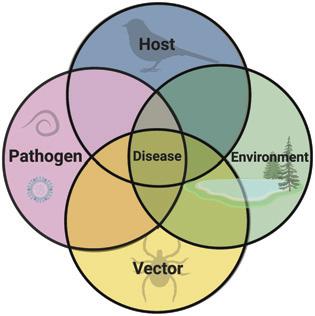
environment) sits at one of the three vertices. Vectors, frequently absent from the classic triangle or incorporated into the environmental node, are an important component given the ubiquity of pathogens that require an arthropod vector (e.g., mosquito, tick) for biological transmission (see Section 2.2.3), and so we have depicted this epidemiological tetrad as a Venn diagram (Figure 2.1). For infectious disease to occur, all elements— host, pathogen, environment, and competent vector (if applicable)—must be present and interacting (Figure 2.1). There are characteristics of each of the four elements that can influence the nature of interactions among them and occurrence of pathogen transmission and the potential for disease. Starting with the host, we will step through each element of the tetrad, defining important terms that will provide the reader with a foundation in ecoepidemiology.
2.2.1 Hosts
A host–parasite interaction requires a ‘susceptible’ host. The term host is used to classify any individual or population that interacts with the pathogen of interest. A susceptible host is an individual that is capable of being infected by a given pathogen at a given time. In many cases, such as for microparasites (see Section 2.2.2), susceptible hosts
Figure 2.1 Epidemiological tetrad depicting the four elements, host, pathogen, environment, and vector, needed for occurrence of pathogen transmission and/or disease for vector-transmitted pathogens. Non-vector transmitted pathogens would be depicted with the host, pathogen, and environment triad. (Created with Biorender.com.)
are those that have never been exposed to a given pathogen in their lifetime; in other cases, susceptible hosts may have had prior exposure to a given pathogen or parasite but have since lost some or all protection conferred from initial infection (see Section 2.3) or otherwise remain susceptible, as is the case for macroparasites.
When pathogens infect multiple species, which describes most agents of infectious disease in birds, the word ‘host’ alone is not very meaningful (Haydon et al. 2002). In multihost–pathogen systems, species in a community have different epidemiological functions relative to their relationship with and potential contribution to the maintenance, amplification, and movement of the pathogen (Caron et al. 2015) within the system.
The host species in which parasites reach maturity and reproduce are called definitive hosts. This distinction is more relevant to macroparasites (see Section 2.2.2.1) that can pass through multiple hosts to complete their life cycle. Intermediate hosts are the obligatory species in which one or more of the parasite’s life stages are completed. In some cases, a host may have a non-obligatory association with a parasite, and these are called mechanical, transport, or paratenic hosts. In the paratenic host, the parasite does not establish itself or undergo development/maturation; it only temporarily resides in (or on) the host until it is released into the environment, without any modification. While birds rarely serve as paratenic hosts, there are some examples in which birds can transport free-living stages of macroparasites or intermediate hosts harboring parasites on their plumage and/or legs (e.g., schistosome parasites; Huffman and Friend 2009). Additionally, hosts can ingest infective life stages and then release them into the environment. For instance, free-living waterbirds can serve as paratenic hosts of Cryptosporidium parvum, a waterborne protozoan pathogen, by ingesting the eggs and then eliminating them with the feces, without the parasite losing its viability and infectiousness (Graczyk et al. 1996). While the protozoa do not invade the bird’s tissues, they can be dispersed during the bird’s short- or long-distance flights within several days of being ingested.
Reservoir (maintenance) host is the most common host definition used in this volume; reservoir
hosts are species within a community whose presence is required for the persistence of the pathogen and are the ultimate source of new infections. The word ‘reservoir’ alone also applies to an environmental source of a pathogen—such as water or food—when applicable. Not all species that can become infected can maintain the pathogen in the absence of a reservoir species; these are frequently called dead-end or incidental hosts. For example, eastern equine encephalitis virus (EEEV) is maintained in nature by an avian reservoir host, particularly passerine birds, and the ornithophilic (i.e., bird-loving) mosquito vector, Culiseta melanura Non-avian vertebrates are dead-end hosts for EEEV because, while they can be fed upon by the vector, the virus does not replicate in these other taxa as it does in birds (Morens et al. 2019).
The inter- and intraspecific variation in host susceptibility to infection and capacity to serve as a reservoir can be substantial (Wilson et al. 2001). Host attributes that may influence their role in the epidemiological tetrad include demographic variables (age, sex; see Chapter 6), genetics, immunity (see Chapter 3), co-infection (see Chapter 12), historical exposure, life history (see Chapters 4, 5, and 6), and nutritional condition.
2.2.2 Pathogens and parasites
The etiological agents of infectious disease in wild birds include viruses, bacteria, fungi, protozoa, helminths, and endoparasitic arthropods, and, collectively, these are called pathogens and/or parasites. Pathogen is strictly defined as an agent that causes disease in the host organism (Casadevall and Pirofski 2002; Pirofski and Casadevall 2012). In an ecological context, a pathogen is one that causes a reduction in host fitness. Parasites are organisms that live in or on a host from which they obtain nourishment (Kennedy 1975). Thus, the term parasite also encompasses ectoparasitic arthropods such as ticks, fleas, and lice. In contrast, this classical definition of parasite would not include viruses, a quintessential pathogen, because they are not considered organisms. That said, how the terms are used and defined varies substantially across disciplines and scales of inquiry and has been the topic of several papers (Casadevall and Pirofski 2002;
Casadevall and Pirofski 2014; Méthot and Alizon 2014; Pirofski and Casadevall 2012). The word itself is less important than the meaning the authors assign to it. In this book, unless specified, the terms ‘pathogen’ and ‘parasite’ are used interchangeably to describe all infectious agents that cause disease, can cause disease, and/or disrupt the physiological state of a susceptible host.
2.2.2.1
Microparasites and macroparasites
In disease ecology it is common to categorize infectious agents, according to their unique biological features and life history, into two functional groups—microparasites and macroparasites—as described by Anderson and May (1991). Note that many pathogens do not fit under these discrete categories but rather can fall anywhere along a continuum between the two. Microparasites are microscopic or small-bodied and not visible to the human eye and include viruses, bacteria, fungi, and most protozoa. Microparasites have short generation times relative to their hosts and typically have direct replication or reproduction in one definitive host. For example, when bacteria invade a definitive host, they can rapidly produce many infectious progeny in the same individual host. Hosts invaded by microparasites typically either exhibit acute mortality from infection or, as occurs in most cases, mount an adaptive immune response that clears the pathogen from the host and protects the host from future reinfections; hence, microparasite infections are typically acute with rapid onset and short duration.
Macroparasites, such as helminths (e.g., trematodes, cestodes, acanthocephala), some protozoa, and ectoparasites such as ticks, biting midges, and mosquitoes (Han and Altizer 2013), have more complex life cycles and may require multiple host species to complete development and reach sexual maturity. While the term infection is used to describe the invasion of a microparasite into the host, for larger endo- and ectoparasites such as helminths and arthropods, colonization of the host is referred to as an infestation. Unlike microparasites, most macroparasites do not replicate and produce infectious progeny that stay in the definitive host. Instead, macroparasite progeny (eggs or larvae) leave the definitive host for further development;
typically, this occurs in another species (intermediate host) but may occur in the environment. The intensity of the macroparasite burden within or on a host, defined as the number of parasites per individual, is often highly variable, with a relatively small subset of hosts harboring large numbers of parasites and the majority of individuals harboring no or few parasites (Wilson et al. 2001; also see Chapter 7). Some macroparasites, such as helminths, elicit host antibody- and cell-mediated immune responses, but, given the large number of antigenic determinants, the generated antibodies are rarely protective. Mounting an immune response to a microparasite—like the protozoa that cause avian malaria—can also be detrimental to the host, in some cases more so than the parasite itself; hence, the host may tolerate chronic, low-level parasitemia (i.e., parasite load in blood) over its lifetime.
2.2.2.2 Routes of transmission
The ability of a pathogen or parasite to infect new susceptible hosts is paramount to its persistence. Transmission of a pathogen from one susceptible host to another can be categorized most broadly as horizontal versus vertical. Horizontal transmission is where the pathogen/parasite is passed between two hosts that are not in a parent–offspring relationship. In contrast, transmission between parents and offspring is called vertical transmission, which typically occurs when the reproductive organs of a female are infected and the pathogen is transferred to the egg and embryo. In birds, evidence of vertical transmission is scarce and primarily associated with domestic poultry (e.g., Cox et al. 2012; Zurfluh et al. 2014). However, there are some viruses that are known to be passed from an infectious female to the egg, including duck plague virus, aviadenoviruses, circoviruses, and retroviruses (Thomas et al. 2008).
Horizontal transmission between hosts can occur directly or indirectly (Wobeser 2013). Direct transmission is when the infection of a susceptible host occurs due to direct contact with an infectious host and exchange of infectious particles (e.g., respiratory droplets or aerosols, mucus, blood, feces, urine, tissue). Contact may arise from a variety of interactions, including predator/prey, scavenging, mating, aggression, or allopreening (see Chapter 4).
Additionally, direct transmission can occur through contact with pathogen-contaminated food, water, or fomites (infectious particles on inanimate objects, such as bird feeders; Dhondt et al. 2007). Fomite transmission is more likely with pathogens that can persist in an infectious state in the environment for long periods, such as Newcastle disease virus (NDV) (Brown and Bevins 2017), Salmonella bacteria (Winfield and Groisman 2003), and avian influenza viruses (AIVs) (Stallknecht et al. 1990), to name a few. Fecal–oral transmission is a fairly common route of infection, in which infected birds can shed pathogen in their feces into the environment (water, soil, nesting material) (Hartup and Kollias 1999) and susceptible birds may then acquire the pathogen from the environment through foraging and drinking (e.g., AIVs, NDV, Pasteurella multocida).
Indirect transmission is when the susceptible host is infected via an intermediate species, such as an intermediate host (see Section 2.2.1) or an arthropod vector (e.g., mosquito, tick, mite) (Wobeser 2013). Birds are commonly infected with arthropodtransmitted pathogens, such as avian poxvirus, Borrelia burgdorferi, and West Nile virus (WNV) among many others that affect birds. Many pathogens are transmitted via multiple routes; for example, avian poxvirus, a primarily vectortransmitted pathogen, can also be transmitted via direct contact with infectious individuals and fomites. Some transmission of WNV in American crows (Corvus brachyrhynchos) has been attributed to a fecal–oral route, presumably because they shed the virus in their feces (Dawson et al. 2007; Wheeler et al. 2014), which is also seen in other bird species and other arboviral pathogens (Nemeth et al. 2010; Owen et al. 2011). Overall, knowledge of transmission mode for a host–pathogen system is critical for developing and implementing strategies to contain or prevent disease outbreaks.
2.2.2.3 Virulence and pathogenicity
In addition to mode of transmission, two key characteristics of pathogens that influence their interaction with a susceptible host or vector are infectivity (i.e., its ability to invade and establish itself in a particular host) and the capacity to cause disease. The latter is frequently referred to as virulence and/or pathogenicity. However, the virulence
and pathogenicity of a pathogen are not attributes of the pathogen alone but the emergent outcome of the host–pathogen interaction (Méthot and Alizon 2014) and the environment in which that interaction occurs. Moreover, the definitions of virulence and pathogenicity are often taxon- and disciplinespecific (Thomas and Elkinton 2004). Nonetheless, virulence is often treated as an inherent pathogen trait by studies that hold host background and environment constant (e.g., Hawley et al. 2013).
Virulence is often defined as the severity of disease exhibited by a susceptible host in response to a particular dose of pathogen or, more broadly, as the degree to which the effects of a given pathogen reduce host fitness. Classically, pathogen virulence is measured under controlled, laboratory conditions using laboratory animal hosts and assumes that a pathogen’s infectivity and host response are constant. Virulence is often quantified as the infectious dose (the number of pathogen units) that kills 50% of infected individuals, called the LD50 (lethal dose). Alternatively, if the pathogen does not directly kill the host in captivity or otherwise, the severity of disease may be scored (Leggett et al. 2012). Pathogen titers (their magnitude and duration) are also used in some cases to quantify virulence based on the idea that, when relevant, the onset of disease is positively correlated with titer. However, experimental quantifications of virulence, while lending important insight into host–pathogen interactions (see Hawley et al. 2013), are not feasible or even applicable for many wild avian systems. A pathogenic microbe is one that can cause disease in the host organism. Pathogenicity describes the ability of a pathogen, of known virulence, to invade and establish itself in a host and to produce disease under natural conditions. In other words, pathogenicity is a product of the pathogen’s virulence and infectivity for a particular host (Thomas and Elkinton 2004). The caveat of ‘known virulence’ limits the use of this term in wildlife studies, where there is likely to be substantial uncertainty in detecting infection or disease in a host population or in identifying the causative agent (see Section 2.4 and Chapter 7). Despite these limitations, these terms are an important way to describe host–parasite interactions, but their meaning in the context they are used must be clearly defined.
2.2.3 Vectors
An arthropod vector can infect a host with a pathogen through both mechanical and biological means. Mechanical transmission is when the vector is contaminated with a pathogen and incidentally transmits the pathogen during close association with a susceptible host. Most notable are avian poxviruses which can be transmitted to susceptible birds through contact with virus-contaminated mouthparts of biting arthropods. Biological transmission is when the pathogen is obligated to pass through the vector for development (Barreto et al. 2006). Some examples of bird-associated arthropod vectors and the pathogens they transmit biologically include biting midges (Culicoides spp.), vectors of many avian hematozoan parasites (Bennett et al. 1993; Svobodová et al. 2017), mosquitoes (primarily from the Culicinae subfamily), the known vectors of a suite of encephalitis viruses (including WNV and EEEV), and Plasmodium species (the protozoan agent of avian malaria).
Like hosts, there are numerous attributes of arthropod vectors that influence their ability to biologically transmit pathogens, many of which are vector-dependent. For pathogens that can be transmitted by multiple arthropod species, the relative competence of the vectors for the pathogen is important. Vectors vary in their susceptibility to infection and ability to support pathogen replication and dissemination, which, collectively, represent vector competence. Dissemination is when the virus is able to successfully invade the vector’s midgut and salivary glands, a requirement for transmission. Additional factors that affect transmission events are the vectors’ biting rates, survivorship, and extrinsic incubation periods, all of which are collectively called vectorial capacity (GarrettJones 1964). Variation in vectorial competence for WNV has received a lot of attention. WNV, which is maintained by avian definitive hosts, has been detected in 62 species of mosquito from 11 genera (Brault 2009), but transmission is primarily attributed to ornithophilic Culex species. However, Culex species are not the most competent vectors for WNV; instead, several species of Aedes mosquitoes (Ae. albopictus, japonicus, and atropalpus) have the highest competence (Turell et al. 2001; Turell et al.