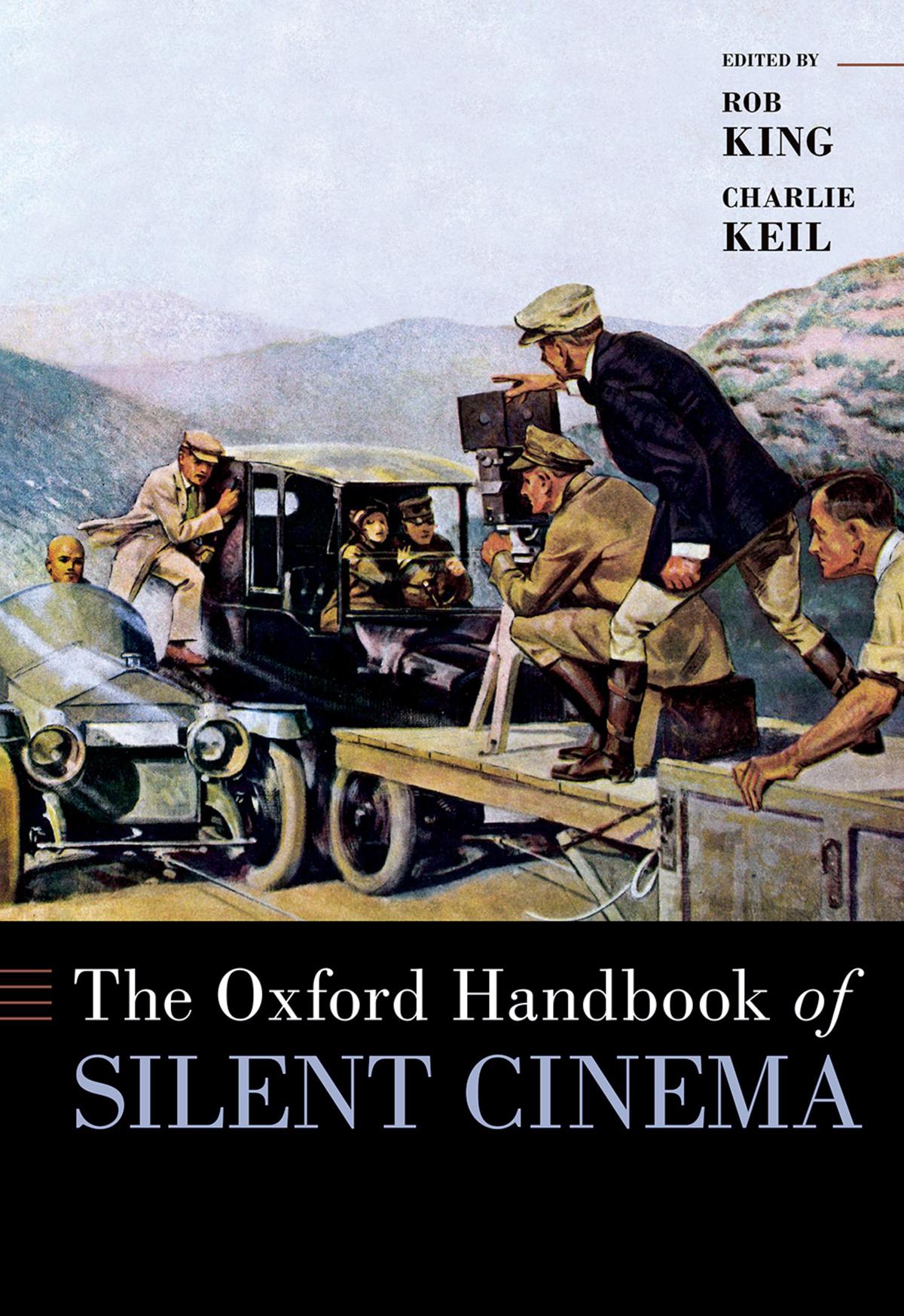
SILENT CINEMA
Editedby ROB KING and CHARLIE KEIL
Oxford University Press is a department of the University of Oxford. It furthers the University’s objective of excellence in research, scholarship, and education by publishing worldwide. Oxford is a registered trade mark of Oxford University Press in the UK and certain other countries.
Published in the United States of America by Oxford University Press 198 Madison Avenue, New York, NY 10016, United States of America.
© Oxford University Press 2024
All rights reserved. No part of this publication may be reproduced, stored in a retrieval system, or transmitted, in any form or by any means, without the prior permission in writing of Oxford University Press, or as expressly permitted by law, by license, or under terms agreed with the appropriate reproduction rights organization. Inquiries concerning reproduction outside the scope of the above should be sent to the Rights Department, Oxford University Press, at the address above.
You must not circulate this work in any other form and you must impose this same condition on any acquirer.
Library of Congress Cataloging-in-Publication Data
Names: King, Rob, 1975– editor. | Keil, Charlie, editor.
Title: The Oxford handbook of silent cinema / [edited by] Rob King and Charlie Keil.
Description: New York, NY: Oxford University Press, [2024] |
Identifiers: LCCN 2023024944 | ISBN 9780190496692 (hardback) | ISBN 9780197630327 (epub) | ISBN 9780190496715
Subjects: LCSH: Silent films—History and criticism.
Classification: LCC PN1995.75.O94 2024 | DDC 791.4309—dc23/eng/20230810 LC record available at https://lccn.loc.gov/2023024944
DOI: 10.1093/oxfordhb/9780190496692.001.0001
CONTENTS
Acknowledgments
ListofContributors
1. Introduction: The History of the History of Silent Film
ROB KING AND CHARLIE KEIL
PART I ORIGINS: FROM INVENTION TO MEDI
2. The Invention of Cinema
TOM GUNNING
3. Early Cinema and the Emergence of Television: An Archaeology of Intertwined Media
DORON GALILI
4. The Right to One’s Own Image: Animism, TheStudentofPragu e, and Legal Doctrine
STEFAN ANDRIOPOULOS
5. Copying Technologies: Two Pirates, Two Centuries
JANE M. GAINES
PART II INTERMEDIALITY: GENRE AND AESTH ETICS IN SILENT FILM
6. The Unfinished Business of History: Defense and Illustration of the Concept “Cultural Series”
ANDRÉ GAUDREAULT AND PHILIPPE MARION
7. Reviewing MapleViewing(Momijigari, 1899)
DAISUKE MIYAO
8. African American Film History Beyond Cinema: William Foster a nd the Legacy of Black Theatrical Comedy
ALLYSON NADIA FIELD
9. Picture, Shadow, Play: Ontology, Archaeology, Ecology
WEIHONG BAO
10. Biograph 1904: The Invention of Chase Comedy
ROB KING
11. Storied Spaces: Staging and Editing in Early American Feature Films
MIRIAM SIEGEL
12. Salon Tango: Hollywood Pictorialism and the Beaux-Arts Traditi on
TOM PAULUS
13. Symbolist Impressions: Modern Theater, Germaine Dulac, and t he Making of an Art Cinema in Belle Époque France (or, the Fals e Ideal of the Cinema against Theater)
TAMI WILLIAMS
PART III PEDAGOGICAL FORMATIONS: NON-T HEATRICAL CINEMA AND THE USES OF FILM
14. PopularScienceMonthlyand the Uses of Moving Pictures
GREGORY A. WALLER
15. Cinema and Science in the Silent Era
SCOTT CURTIS AND OLIVER GAYCKEN
16. Cinema on the Move: Museum-Sponsored Expedition Film in th e Silent Era
ALISON GRIFFITHS
17. Babies and Brochures: Public Service Pamphlet Films of the US Children’s Bureau (1919–1926)
JENNIFER HORNE
18. Curiosity Seekers, Morbid Minds, and Embarrassed Young Ladie s: Female Audiences and Reproductive Politics Onscreen
SHELLEY STAMP
PART IV HOLLYWOOD, INC.: THE INSTITUTIO NS OF MASS CULTURE
19. Unlikely Allies: Crafting Hollywood as Institution and Invention
CHARLIE KEIL AND DENISE MCKENNA
20. A System of Thorough Cooperation: Technology, Service, and t he Film Labs of Hollywood
LUCI MARZOLA
21. A Prologue to Hollywood: Sid Grauman, Film Premieres, and th e (Real-Estate) Development of Hollywood
ROSS MELNICK
22. Franchising as a Strategy of National Feature Distribution in the 1910s: The Case of the Triangle Film Corporation
DEREK LONG
23. Paramount Pictures, National Advertising Agencies, and the Co nspicuous Distribution of First-Run Feature Films in the United S tates
PAUL S. MOORE
PART V NATION, EMPIRE, WORLD: THE SPACE S AND TIMES OF MODERNITY
24. Going Silent on Modernity: Periodization, Geopolitics, and Publi c Opinion
GIORGIO BERTELLINI
25. Empire • State • Media
LEE GRIEVESON
26. Dandyism, Circulation, and Emergent Cinema in Iran: The Pow ers of Asynchrony
KAVEH ASKARI
27. TheCoveredWagon: Location Shooting and Settler Melodrama
JENNIFER LYNN PETERSON
28. Scandinavian Cinema, Location, and the Discourse of Quality in 1920
ANNE BACHMANN
29. Running Late: The Silent Serial, the Cliffhanger, and the Exigen cies of Time, 1914–1920
RUTH MAYER
PART VI CINEMATIC PUBLICS: CRITICS, FANS, COMMUNITIES
30. The Silent Film Criticism of Siegfried Kracauer
JOHANNES VON MOLTKE
31. The Decline of Middlebrow Taste in Celebrity Culture: The First Fan Magazines
SUMIKO HIGASHI
32. The Many Genders and Sexualities of American and European S ilent Cinema
LAURA HORAK
33. Art, Anti-Art, and Poetic Cinema: Revisiting UnChienandalou (Luis Buñuel, 1929)
BREIXO VIEJO
34. Coda: Silent Film after Sound
DONNA KORNHABER
Index
ACKNOWLEDGMENTS
This volume has been in the making for more or less a decade. We are immensely grateful for the patience and commitment shown by all our contributors and by the team at Oxford University Press, including Norm Hirschy, Brendan O’Neill, Madison Zickgraf, Laura Santo, Jayanthi Dineshkumar, and Joellyn Ausanka. All of them saints. We would also like to thank Justin Morris for extremely helpful assistance with citations and images when we were facing one of many crucial deadlines, and Shayla Anderson for lending her photographic expertise to securing a properly reproduced cover image.
Rob King would like to thank Charlie Keil, who came on as coeditor once the project was already under way. He should also apologize to Charlie’s family for editorial chores that spilled over into many family vacations. Sorry, Cathy. But, again, thank you, Charlie: you’ve been the most valuable support I’ve had in my career, not just on this project. Rob would also like to acknowledge, guiltily, all those who tolerated his pestering emails over the years it took to bring this volume to completion. Final thanks, as always, are to his wife, Inie Park, who is currently hard at work on her forthcoming collection, TheOxfordHandbookofSurvivingYourPartner’sBookProjects.
Charlie Keil would like to thank Rob King, who invited me to participate in this project at a relatively early stage; if email records are to be believed, we have been working on this together since 2016. I leapt from the fat of ACompanion to D. W. Griffith directly into the fire of this Handbook. But Rob kept the singeing to a minimum. May everyone have the opportunity to work with a coeditor as discerning, as generous, and as collaborative as Rob King. His only fault is a regrettable tendency to complete every task in about a tenth of the time it takes mere mortals to do the same
thing. His editorial acumen and unassailable work ethic have guaranteed this volume’s success. Charlie would also like to thank all of the contributors, and especially those whom he counts as friends, assuming that they still are his friends now that the editing process is complete. And, of course, the aforementioned Cathy Vine, who has listened to far more nattering about the vagaries of silent cinema research than any non-film specialist should have to tolerate and has always done so with grace and affection.
CONTRIBUTORS
Stefan Andriopoulos is Professor of German and co-founder of the Center for Comparative Media at Columbia University. His book Possessed:HypnoticCrimes,CorporateFiction,andtheInventionof Cinema (2008) analyzes anxieties about the agency of invisible corporate bodies and the power of hypnotism in literature, law, medicine, and silent film. It won the SLSA Michelle Kendrick Award for best academic book on literature, science, and the arts. Andriopoulos has also published Ghostly Apparitions: German Idealism,theGothicNovel,andOpticalMedia(2013), which reveals the constitutive role of spiritualism for the history of philosophy and technology and which was named a book of the year in the Times Literary Supplement. His current book project engages in a short and selective history of the constitutive links between rumor, media, and the credence created by new modes of circulation.
Kaveh Askari is Associate Professor and Director of the Film Studies Program at Michigan State University. He is the author of Relaying Cinema in Midcentury Iran: Material Cultures in Transit (2022). He has also written Making Movies into Art: Picture Craft from the Magic Lantern to Early Hollywood (2014) and co-edited several volumes, including a special issue of FilmHistorytitled South by South/West Asia: Transregional Histories of Middle East–South AsiaCinemas(2021) and PerformingNewMedia,1890–1915(2014). He has collaborated with curators and archives to preserve films made in Iran in the 1950s and 1960s. These preservations have screened at venues including Il Cinema Ritrovato and the Museum of Modern Art.
Anne Bachmann is Assistant Professor of Fashion Studies and Film Studies at Stockholm University and at DIS Study Abroad in Scandinavia. She has published research at the intersection of
Scandinavian studies and film studies, often working on transmedia questions ranging from costume design, print design, and smallscale models to online participatory practices. Her work has appeared in Scandinavica, Early Popular Visual Culture, and Importing Asta Nielsen (2013). She also serves on the editorial board of Journal of Scandinavian Cinema. Her current research interests concern historical visual culture and consumer culture.
Weihong Bao is Associate Professor of Film and Media at UC Berkeley. She is the author of Fiery Films: The Emergence of an Affective Medium in China, 1915–1945 (2015), which received honorable mention for the Best Book Prize by the Modernist Studies Association in 2016. She has co-edited two special issues on Media/Climates (for Representations in 2022) and Medium/Environment (for Critical Inquiry in 2023). She is currently completing a new book, Background Matters: Set Design and The Art of Environment. She is editor-in-chief of The Journal of Chinese Cinemas and co-edits the Film Theory in Media History book series published by Amsterdam University Press.
Giorgio Bertellini is Professor in the Department of Film, Television, and Media at the University of Michigan. He is the author and editor of the award-winning volumes The Divo and the Duce: Promoting Film Stardom and Political Leadership in 1920s America (2019, Italian translation 2022), Italian Silent Cinema: A Reader (2013), and Italy in Early American Cinema: Race, Landscape, and the Picturesque (2010). His other books include a monograph on Sarajevo-born film director Emir Kusturica, published in Italian (1996, 2011), English (2015), and Romanian (2017). With Richard Abel and Matthew Solomon, he is the editor of the book series Cinema Cultures in Contact for the University of California Press. A contributor to Italy’s daily newspapers (CorrieredellaSera,IlFoglio), he was awarded a Guggenheim Fellowship in 2022.
Scott Curtis is Associate Professor in the Department of Radio/Television/Film at Northwestern University and in the Communication Program at Northwestern University in Qatar. The
author of The Shape of Spectatorship: Art, Science, and Early Cinema in Germany (2015) and editor of Animation (2019), Curtis has published extensively on the scientific and medical uses of moving-image technology.
Allyson Nadia Field is Associate Professor of Cinema and Media Studies at the University of Chicago. She is the author of Uplift Cinema:TheEmergence ofAfricanAmericanFilmandthePossibility ofBlackModernity (2015). She is also co-editor with Marsha Gordon of Screening Race in American Nontheatrical Film (2019) and coeditor with Jan-Christopher Horak and Jacqueline Stewart of L.A. Rebellion:Creatinga NewBlackCinema (2015). Field was named a 2019 Academy Film Scholar by the Academy of Motion Picture Arts and Sciences and is a member of the National Film Preservation Board.
Jane M. Gaines is Professor of Film at Columbia University. She has been awarded the Society for Cinema and Media Studies Distinguished Career Award and an Honorary Doctorate from the University of Stockholm. She is author of the award-winning books Contested Culture: The Image, the Voice, and the Law (1991), Fire and Desire: Mixed Race Movies in the Silent Era (2001), and PinkSlipped: What Happened to Women in the Silent Film Industries? (2018).
Doron Galili is Senior Lecturer in Film Studies at the University of Gothenburg and a Research Fellow in the Department of Media Studies at Stockholm University. He is the author of Seeing by Electricity: TheEmergence ofTelevision,1878–1939(2020), as well as co-editor of Corporeality in Early Cinema: Viscera, Skin, and Physical Form (2018), and, most recently, of a special issue on media archaeology for EarlyPopularVisualCulture.
André Gaudreault is Professor in the Department of Art History and Film Studies at the University of Montreal and holds the Canada Research Chair in Film and Media Studies. He is the founder of the Laboratoire CinéMédias, under which he heads/codirects the CINEXMEDIA International Research Partnership, the International
Research Partnership on Cinema Technology (TECHNĖS), and the Groupe de recherche sur l’avénement et la formation des identités médiatiques (GRAFIM). His books include From Plato to Lumière (2009 [1988]), FilmandAttraction:FromKinematographytoCinema (2011 [2008]), and, with Philippe Marion, The End of Cinema? A Medium in Crisis in the Digital Age (2015 [2013]). Gaudreault’s research has earned him several prizes and distinctions, including the Guggenheim Fellowship (2013), the Léon-Gérin Prize (2017), and the Killam Prize in the Humanities (2018). He was named an Officer of the Order of Canada in 2022.
Oliver Gaycken is Associate Professor in the Department of English and a core faculty member of the Cinema and Media Studies and Comparative Literature Programs at the University of Maryland, College Park. He is the author of DevicesofCuriosity:EarlyCinema andPopularScience (2015). His articles have appeared in Historical JournalofFilm,Radio, andTelevision, ScienceinContext, Journalof Visual Culture, Early Popular Visual Culture, Screen, and the collection LearningwiththeLightsOff(2011).
Lee Grieveson is Professor of Media History at University College London. He is the author of the award-winning Cinema and the Wealth of Nations: Media, Capital, and the Liberal World System (2017) and Policing Cinema: Movies and Censorship in EarlyTwentieth-Century America (2004). His other books include seven co-edited volumes, among them The Silent Cinema Reader (2004), co-edited with Peter Kramer; Inventing Film Studies (2008), coedited with Haidee Wasson; and two anthologies devoted to issues of film and empire, co-edited with Colin MacCabe.
Alison Griffiths is Distinguished Professor of Film and Media Studies at Baruch College, The City University of New York, and a member of the doctoral faculty in Theatre at the CUNY Graduate Center. Her research focuses on early cinema, non-traditional spaces of film exhibition, new media, and medieval visual studies. She is the author of the multiple award-winning Wondrous Difference: Cinema, Anthropology, andTurn-of-the-CenturyVisualCulture(2002), Shivers
Down Your Spine: Cinema, Museums, and the Immersive View (2008), and Carceral Fantasies: Cinema and Prison in Early Twentieth-CenturyAmerica(2016), as well as more than fifty journal articles and book chapters. Her research has been supported by a Guggenheim Fellowship, a Fulbright Distinguished Chair, and grants from the NEH, ACLS, The Waterhouse Family Institute, the Institute for Citizens and Fellows, and the Huntington Library in Los Angeles, among others. Her latest book, Nomadic Cinema: A Cultural Geography of the Expedition Film, is forthcoming from Columbia University Press.
Tom Gunning is Professor Emeritus in the Department of Cinema and Media Studies at the University of Chicago. He is the author of D. W. GriffithandtheOriginsofAmericanNarrative Film(1994) and The Films of Fritz Lang: Allegories of Vision and Modernity (2000), as well as more than 150 articles on early cinema, film history and theory, avant-garde film, film genre, and cinema and modernism. In 2009 he was awarded an Andrew A. Mellon Distinguished Achievement Award and in 2010 was elected to the American Academy of Arts and Sciences. With André Gaudreault he originated the influential theory of the “Cinema of Attractions.”
Sumiko Higashi is Professor Emerita in the Department of History at the College at Brockport, SUNY. She is the author of Virgins, Vamps, and Flappers: The American Silent Movie Heroine (1978), CecilB. DeMilleandAmericanCulture: TheSilentEra (1994), Stars, Fans,andConsumptioninthe1950s:ReadingPhotoplay (2014), and essays on women in the media, film as historical representation, and film history as cultural history. She has served on the editorial boards of Cinema Journal and Film History. At the Society for Cinema Studies conference in 1992, she co-founded the Asian Pacific American Caucus in a Pittsburgh coffee shop.
Laura Horak is Associate Professor of Film Studies at Carleton University and director of the Transgender Media Lab and Transgender Media Portal. She investigates the history of transgender and queer film and media in the United States, Canada,
and Sweden. She is co-curator of the ninety-nine-film Blu-ray set Cinema’sFirstNastyWomen(2022), the author of GirlsWillBeBoys: Cross-DressingWomen,Lesbians,andAmericanCinema,1908–1934 (2016), and co-editor of Silent Cinema and the Politics of Space (2014), Unwatchable (2019), an issue of Somatechnics on cinematic/trans*/bodies, and a section of the JournalofCinemaand MediaStudieson “transing cinema and media studies.”
Jennifer Horne is Associate Professor of Film and Digital Media at the University of California Santa Cruz. Her research focuses on American non-theatrical film history, specifically the history of government filmmaking and bureaucracy-based documentary film history. Her publications include chapters in Useful Cinema (2011), Beyond the Screen: Institutions, Networks, and Publics of Early Cinema (2012), and The Documentary Film Reader (2016), and articles in The Moving Image and Historical Journal of Film, Radio, andTelevision.
Charlie Keil is Professor in the Cinema Studies Institute and Department of History at the University of Toronto, where he is also Principal of Innis College and a member of the President’s Teaching Academy. He has published approximately fifty journal articles and book chapters and is the author and/or editor of seven books, the most recent of which are Editing and Special/Visual Effects, coedited with Kristen Whissel (2016), and A Companion to D. W. Griffith (2018). His teaching has been recognized with the SCMS Distinguished Pedagogy Award, as well as the Faculty of Arts & Science Outstanding Teaching Award and the President’s Teaching Award at the University of Toronto.
Rob King is Professor of Film and Media Studies at Columbia University’s School of the Arts. He is the author of Hokum!TheEarly SoundSlapstick Short andDepression-Era Mass Culture (2017) and the award-winning The Fun Factory: The Keystone Film Company and the Emergence of Mass Culture (2009). He has also edited/coedited the volumes Cornell Woolrich and Transmedia Noir (2023), Beyond the Screen: Institutions, Networks, and Publics of Early
Cinema(2012), SlapstickComedy(2011), and EarlyCinemaandthe “National”(2008). King’s latest monograph, ManofTaste:TheErotic Cinema of Radley Metzger, is forthcoming from Columbia University Press.
Donna Kornhaber is Professor of English at the University of Texas at Austin, where she teaches film. She is the author of Charlie Chaplin, Director (2014), Wes Anderson: A Collector’s Cinema (2017), Nightmares intheDreamSanctuary:War andtheAnimated Film (2019), and Silent Film: A Very Short Introduction (2020). In 2016 she was named an Academy Film Scholar by the Academy of Motion Picture Arts and Sciences.
Derek Long is Assistant Professor of Media and Cinema Studies at the University of Illinois Urbana–Champaign, where he teaches courses on cinema history and historiography, media production, film theory, and animation. His work has appeared in Film History, The Moving Image, Velvet Light Trap, Historical Journal of Film, Radio, andTelevision, and [in]Transition, among other journals. His book on the history of film distribution practice in early Hollywood is forthcoming from the University of Texas Press in 2024.
Denise McKenna is Lecturer in the Cinema Program at Palomar College. Her research explores the gender and class politics of the early American film industry’s social and economic integration with Los Angeles and Hollywood’s emergent studio culture. She has published work on film extras, gender, and labor stratification in Hollywood’s formative years and on the class politics of editorial cartoons in film trade and fan magazines and has edited a special issue on labor for Feminist Media Histories. Her current research interests include feminist film historiography, the rhetoric and aesthetics of the film uplift movement in the 1910s, and the relations between cinema and the development of California’s regional identity in the early twentieth century.
Philippe Marion is Professor Emeritus in Information and Communication Sciences at the School of Communication of the Catholic University of Louvain (UCL). Co-founder of l’Observatoire
due récit médiatique (ORM) and the Groupe interdisciplinaire de recherches sur les cultures et les arts en mouvement (GIRCAM), he is also director of the Media Analysis Research Unit at UCL and administrator of the Collectiana Foundation. As a visiting professor at the University of Paris Sorbonne and the University of Neuchâtel, Professor Marion has been principal investigator since 2018 of the EOS (Excellence of Science) research project on The Magic Lantern and Its Cultural Impact as Visual Mass Medium (1830–1940). A specialist in media narratology and visual culture, he is the author of several books, including Schuiten, filiation (2009) and, with André Gaudreault, The End of Cinema? A Medium in Crisis in the Digital Age(2015 [2013]).
Luci Marzola is Lecturer and Program Coordinator in Cinema and Media Studies at University of Southern California’s School of Cinematic Arts. She is the author of Engineering Hollywood: Technology, Technicians, and the Science of Building the Studio System (2021) and co-editor of the forthcoming Hollywood Unions (Rutgers University Press). Her research on technology, infrastructure, craft, and labor in Hollywood has been published in FilmHistory, Historical JournalofFilm, Radio, and Television, Velvet LightTrap,AmericanCinematographer , and IndieWire.
Ruth Mayer is Professor of American Studies at Leibniz University, Hannover, Germany. Her research focuses on modernity, seriality, temporality, and gender. Her work has appeared in the Journal of Cinema and Media Studies, Modernism/modernity, Screen, the Journal of Modern Periodical Studies, and Velvet Light Trap. She is the author of Serial Fu Manchu: The ChineseSuper-Villain and the Spread of Yellow Peril Ideology (2014) and the co-edited volume Modernity andthePeriodicalPress (2022). She is currently directing a research project titled “Multiplication: Modernity, Mass Culture, Gender.”
Ross Melnick is Professor of Film and Media Studies at University of California, Santa Barbara. He is the author of Hollywood’s Embassies: How Movie Theaters Projected American Power Around
the World (2022) and American Showman: Samuel “Roxy” Rothafel and the Birth of the Entertainment Industry (2012); co-editor of Rediscovering U.S. Newsfilm: Cinema, Television, and the Archive (2018); and co-author of CinemaTreasures (2004). His articles have appeared in journals such as CinemaJournal, FilmHistory, Historical JournalofFilm,RadioandTelevision,and TheMovingImage and in numerous edited collections. He was named an Academy Film Scholar and an NEH Fellow for his work on global film exhibition and he is the co-founder of the exhibition history website Cinema Treasures (https://www.cinematreasures.org).
Daisuke Miyao is Professor and Hajime Mori Chair in Japanese Language and Literature at the University of California, San Diego. He is the author of Japonisme and the Birth of Cinema (2020), Cinema Is a Cat: A Cat Lover’s Introduction to Film Studies (2019), The Aesthetics of Shadow: Lighting and Japanese Cinema (2013), and Sessue Hayakawa: Silent Cinema and Transnational Stardom (2007). Miyao is also the editor of the OxfordHandbookofJapanese Cinema (2014) and co-editor of Transnational Cinematography Studies(2017), with Lindsay Coleman and Roberto Schaefer.
Paul S. Moore is Professor of Communication and Culture at Toronto Metropolitan University. His writing on early cinema in North America focuses on the relation between audiences and newspaper publicity, appearing in FilmHistory, CanadianJournalofFilmStudies, and the book MappingMovieMagazines:Digitization,Periodicalsand CinemaHistory (2020). With Sandra Gabriele, his book The Sunday Paper: A MediaHistory (2022) recounts the weekend supplement’s intermedial relations to magazines, cinema, and radio.
Tom Paulus is Professor of Theatre and Film Studies at the University of Antwerp. He is co-founder of the Visual Poetics Research Group. With Rob King he edited the collection Slapstick Comedy (2010) for Routledge/AFI Film Readers. His work has appeared in numerous edited volumes, including Jewish Aspects in Avant-Garde (2017), Ozu International (2015), and The Philosophy ofMichaelMann(2014).
Jennifer Lynn Peterson is Professor and Chair of the Media Studies program at Woodbury University in Los Angeles. She is the author of EducationintheSchoolofDreams: TraveloguesandEarly Nonfiction Film (2013). Her work has been published in journals such as Representations, Journal of Cinema and Media Studies, Feminist MediaHistories, Moving Image, and Camera Obscura. She has published chapters in numerous edited volumes, including Ends of Cinema (2020), Hollywood on Location: An Industry History (2019), NewSilentCinema(2015), and LearningwiththeLightsOff: Educational Film in the United States (2012). She is presently completing a book on US film history and the environment in the 1920s–1940s.
Miriam Siegel is a PhD candidate in the Cinema Studies Institute at the University of Toronto. Her research focuses on the relationship between storytelling, style, and genre in American popular cinema. Her essay on Guy Maddin’s MyWinnipegwas published in Canadian CinemaintheNewMillenium(2022).
Shelley Stamp is Professor of Film and Digital Media at the University of California, Santa Cruz, where she has twice won the Excellence in Teaching Award. She is author of the award-winning books LoisWeberinEarlyHollywood(2015) and Movie-StruckGirls: Women and Motion Picture Culture after the Nickelodeon (2000); curator of the award-winning disc set Pioneers: First Women Filmmakers (2018); and founding editor of the journal Feminist MediaHistories. She is at work on a comprehensive history, Women andtheSilentScreeninAmerica,co-authored with Anne Morey.
Breixo Viejo is an Assistant Professor of Film Studies at Hofstra University, New York. He previously held teaching and research positions at Barnard College, Columbia University, and University College London. He has co-edited with Jo Evans LuisBuñuel:ALife inLetters(2019) and is the author of the books FilmBooks:AVisual History (2016) and Música moderna para un nuevo cine: Eisler , AdornoyelFilmMusicProject(2008).
Johannes von Moltke is Professor of Film, Television, and Media and of German Studies at the University of Michigan. His work on film, media, and critical theory has appeared in the journals New German Critique, Screen, October , Cultural Critique, and Cinema Journal, among others. He is the author of No Place Like Home: Locations of Heimat in German Cinema (2006) and The Curious Humanist: Siegfried Kracauer in America (2016). He has co-edited several books on Kracauer: Siegfried Kracauers Grenzgänge: Zur Rettung des Realen (2019), Culture in the Anteroom: The Legacies of Siegfried Kracauer (2012), and Siegfried Kracauer’s American Writings:EssaysonFilmandPopularCulture(2012). Von Moltke is a past president of the German Studies Association and Vice President of the American Friends of Marbach.
Gregory A. Waller is Provost Professor of Cinema and Media Studies in the Media School at Indiana University. He is the editor of FilmHistory: An International Journal. His recent publications have focused on the institutionalization of education film, the discourse concerning moving pictures in popular magazines and specialized periodicals, and the use of film in the service of advertising and public relations. His books include BeyondtheMovieTheater:Sites, Sponsors,Uses,Audiences(2023).
Tami Williams is Associate Professor of English and Film Studies at the University of Wisconsin–Milwaukee, and President of Domitor, the International Society for the Study of Early Cinema. She is the author, editor, and/or co-editor of several books, most recently, Provenance and Early Cinema (2020), Germaine Dulac: What Is Cinema? (2019, 2020 CNC Prix du livre), Global Cinema Networks (2018), Performing New Media, 1895–1915 (2014), and Germaine Dulac: A Cinema ofSensations (2014), as well as a special issue of TheMoving Image on “Early Cinema and the Archives” (2016). She also serves as a board member of Women Film History International.
INTRODUCTION
The History ofthe History ofSilent Fi lm
ROB KING AND CHARLIE KEIL
Revisionist scholarly interest in silent cinema has now lasted longer than the silent era itself. This introduction to The Oxford Handbook of Silent Cinema explores the various stages and development of that scholarship the better to see how silent film research positions itself today. Some forty-plus years after the revisionist turn, what has the history of the history of silent cinema been?
For a field of inquiry so suspicious of origin myths, it is no small irony that silent film history has one of its own. The legendary thirtyfourth congress of the International Federation of Film Archives (FIAF), held in Brighton, England, in May 1978, is the oft-cited ground zero for what came to be called the “New Film History,” which initially focused on the medium’s very earliest years. At Brighton, participants systematically viewed nearly two hundred films produced prior to 1906, in the process renouncing longingrained assumptions of cinema’s first decade as a supposedly “primitive” stage awaiting the maturity subsequently bestowed by the innovations of D. W. Griffith and the development of the feature film. On this telling, Brighton stood as a turning point that sparked repudiation of an older tradition of “informed connoisseurship” (in the words of Brighton participant Jan-Christopher Horak): the next generation of film historians would take their cue from archival
holdings, using paper documents and preserved prints as the basis for their claims.1
But the question immediately arises: What was the “old” film history against which the “new” defined itself? What was this stupefying tradition, the dead weight of which was finally being sloughed off? Was it Terry Ramsaye’s A Million and One Nights (1926)? Benjamin Hampton’s AHistoryoftheMovies(1931)? Maybe Georges Sadoul’s multi-volume Histoire générale du cinema (1946–1950)? But these are survey histories that, by the time of Brighton, were in the earliest cases already more than fifty years old and could hardly have constituted a meaningful tradition or opponent to be vanquished.
One is tempted to propose that the old film history never really existed, as least not as a meaningful disciplinary formation; that is, that within the academy there has never been anything butthe New Film History. Nor, moreover, should we presume that the battle cry of “revisionism” was first shouted from the seats of the Brighton Theatre during the springtime of ’78. Even if we look only to the pioneering figures of that moment—archivists Eileen Bowser (Museum of Modern Art), David Francis (British Film Institute), and Paul Spehr (Library of Congress), and historians André Gaudreault, Tom Gunning, and Charlie Musser we find that Gaudreault was already independently in contact with Bowser and Musser the previous year, just starting his research on Edwin S. Porter’s Life of anAmericanFireman(1903). We also need to extend our horizon to consider other important conferences that pre-date the events in Brighton: the thirtieth FIAF congress of 1974, titled “Film Archives and Audiovisual Techniques/The Methodology of Film History”; the thirty-first Edinburgh International Film Festival of 1977, which included a colloquium on “History/Production/Memory”; and the Second Annual Purdue Film Conference in 1977 at Purdue University all of which featured scholarly presentations expressing discontent with traditional models of film historical writing.2
But if all this is the case, we will need to look for the Brighton “break” elsewhere, less, perhaps, as a break within an academic
tradition of filmhistoryspecifically than as a collective sense of fresh scholarly vistas within the then still-nascent trajectory of academic film studies in general. Here, the evidence is somewhat clearer, as Tom Gunning would himself recall a decade after the fact, speaking of Brighton at the 1989 FIAF Congress in Lisbon. “The main direction in American film study during that period had been towards theory, and away from history,” Gunning remembered. “I thought theory was important, but films were more important. So to be able to look at films, using theory, but reaffirming the importance of the films themselves was very, very important to me. Brighton gave me that opportunity.”3 We would do well to remember, for example, that Gunning’s “Cinema of Attraction” essay—one of the New Film History’s founding documents—was, from the outset, a critique of some of the assumptions underwriting theory’s dominance within film studies of the 1970s. “What precisely is the cinema of attraction?” Gunning asked there. “First, it is a cinema that bases itself on […] its ability to show something. Contrasted to the voyeuristic aspect of narrative cinema analyzed by Christian Metz, this is an exhibitionist cinema.”4 Theoretical claims about spectatorship informed by psychoanalysis now found themselves vying with new models derived from historical study. Viewed thus, the New Film History was a first turn away from the perceived overreach of Marxist, psychoanalytic, and structuralist models that defined what has since come to be called the “apparatus theory” of post-1968 film studies.
One can push too hard on this point, as though the break in question was simply driven by the will to wriggle free from the “dogma” of theory and into the liberating pastures of empiricism. Not that such accusations haven’t been leveled: in 2001, no less a figure than Slavoj Žižek traced what he perceived as the political failure of present-day film studies through the career of Ben Brewster, once a hardline Althusserian, subsequently a “pure” film historian working on cinema before 1917, or, as Žižek put it, “significantly, prior to the October Revolution.”5 A similar note was sounded by Patrice Petro, who, in 2002, read the “revisionist” turn in
film history symptomatically as a retreat from the polemical analysis of 1970s feminist theory.6 Such characterizations presume ungenerously that empiricism equates with political retreat as though, for example, the formidable research into the class and ethnic background of nickelodeon audiences in these years did not touch on fundamental questions of the politics of mass culture.7 But these critiques also miss how the energies flowing out of Brighton ultimately resulted less in a retreat from theory than in a new way of thinking about history and theory in tandem. Nowhere was this more evident than in a subsequent body of scholarship, first coalescing in the early 1990s, that began to theorize cinema’s development in its first decades via the historical optic of modernity.
An admission: both of the editors of the current volume have, over the years, challenged various particulars of what its critics have labeled the “modernity thesis”—the position that seeks to comprehend cinema’s development against the social, cultural, and sensory context of late-nineteenth/early-twentieth-century modernity.8 But we both also acknowledge the extraordinary reach of the modernity thesis as a catalyst for theoretical and historiographic insight. Scholarly engagement with modernity has constituted one of the few “schools” of thought within film studies— in this case, the “Chicago School,” that extraordinary cadre of silent film scholars, headed by Tom Gunning and Miriam Hansen, that came together at the University of Chicago in the 1990s.9 It switched out 1970s-era film theory’s stringent investment in avantgarde “counter-cinema” for a renewed sensitivity to the utopian dimensions of the popular arts. It also represents, to date, the most productive path for thinking beyond the false binary of theoretical obtuseness and apolitical historicism so often mobilized in reductive accounts of film studies’ post-Brighton development. As Ben Singer memorably put it in his spirited defense of the approach, in Melodra ma and Modernity (2001): “The appeal of this concept [i.e., the
modernity thesis] derives partly from the hope that, after the exhaustion of Screen-style film theory and the pendulum’s swing to hard-nosed empirical film history, it seems to offer the possibility of a commodious middleground of theoretically informed history and/or historically informed theory.”10
How might we characterize this approach? Its basic premise is on first sight a modest and, as Singer notes, appealing one; namely, that we can explain the distinctive formal and spectatorial properties of early cinema in relation to the sensory environment of turn-ofthe-century metropolitan experience. As Gunning argued in 1989:
Attractions trace out the visual topology of modernity: a visual environment which is fragmented and atomized; a gaze which, rather than resting on a landscape in contemplation, seems to be pushed and pulled in conflicting orientations, hurried and intensified, and therefore less coherent and anchored. [ ] The attraction in film consists of a specific relation between viewer andfilm that reveals aspects ofthe experience ofmodernity.11
This is an elegant and potent formulation, whose richness was such that even its detractors seemed only to strengthen modernity’s hold on the field. One critique, for instance, concerned the issue of film’s stylistic development during the early period. Even if we allow that the cinema of attractions takes its shape from the culture of modernity, the argument went, how then to explain the brute fact of stylistic change in the years that followed, when cinema moved away from an attractions-based aesthetic toward greater narrative integration? Did modernity’s influence somehow cease following the attraction era? Did modernity itself come to an end?
The only sensible answer to the last question is: ofcoursenot. But that answer had the effect of unlocking the silent era more broadly to the explanatory force of modernity, so that a hypothesis first formed in relation to the cinema of attractions quickly began to bleed beyond its initial temporal framework. Modernity’s salience as the explicansof early film was now extended forward into the 1910s and 1920s, with modernity construed in diverse ways that vastly exceeded its founding explicandum. One could now read D. W. Griffith’s Biograph films (1908–1912) in relation to the “systematic