https://ebookmass.com/product/the-decline-and-fall-ofrepublican-afghanistan-ahmad-shuja-jamal/
Instant digital products (PDF, ePub, MOBI) ready for you
Download now and discover formats that fit your needs...
The Decline and Fall of the Chatty Empire John Emil Vincent
https://ebookmass.com/product/the-decline-and-fall-of-the-chattyempire-john-emil-vincent/
ebookmass.com
The Eternal Decline and Fall of Rome: The History of a Dangerous Idea Edward J. Watts
https://ebookmass.com/product/the-eternal-decline-and-fall-of-romethe-history-of-a-dangerous-idea-edward-j-watts/
ebookmass.com
Advanced Applications of Ionic Liquids Jamal Akhter Siddique
https://ebookmass.com/product/advanced-applications-of-ionic-liquidsjamal-akhter-siddique/
ebookmass.com
Media and the Government of Populations: Communication, Technology, Power 1st ed. Edition Philip Dearman
https://ebookmass.com/product/media-and-the-government-of-populationscommunication-technology-power-1st-ed-edition-philip-dearman/
ebookmass.com
ISE Chemistry: The Molecular Nature of Matter and Change
9th Edition Martin Silberberg
https://ebookmass.com/product/ise-chemistry-the-molecular-nature-ofmatter-and-change-9th-edition-martin-silberberg/
ebookmass.com
The Practice of Generalist Social Work 4th Edition, (Ebook PDF)
https://ebookmass.com/product/the-practice-of-generalist-socialwork-4th-edition-ebook-pdf/
ebookmass.com
If We Were Kin: Race, Identification, and Intimate Political Appeals Lisa Beard
https://ebookmass.com/product/if-we-were-kin-race-identification-andintimate-political-appeals-lisa-beard/
ebookmass.com
High-Entropy Alloys(Second Edition) B.S. Murty
https://ebookmass.com/product/high-entropy-alloyssecond-edition-b-smurty/
ebookmass.com
Sociology: A Brief Introduction Richard T. Schaefer
https://ebookmass.com/product/sociology-a-brief-introduction-richardt-schaefer/
ebookmass.com
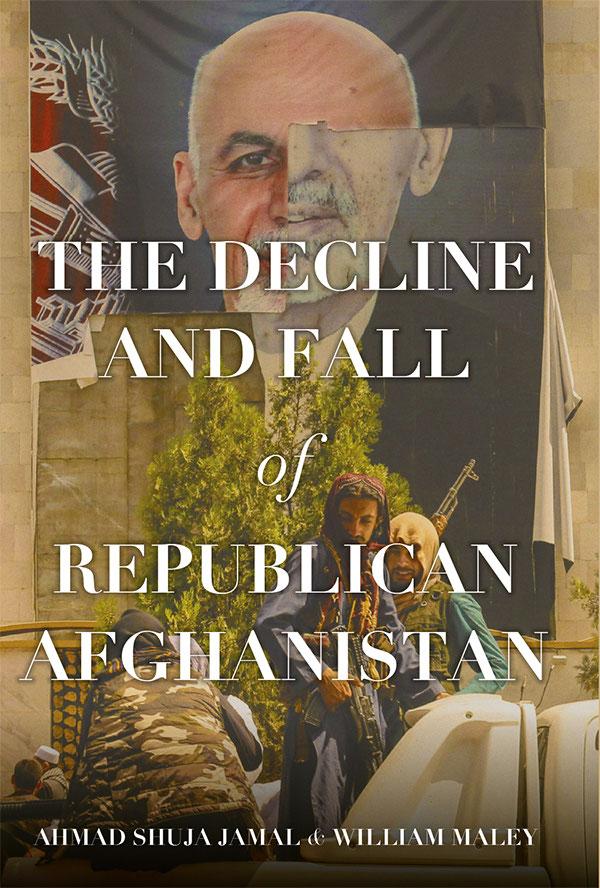
AHMAD SHUJA JAMAL
WILLIAM MALEY
The Decline and Fall of Republican Afghanistan
HURST & COMPANY, LONDON
First published in the United Kingdom in 2023 by C. Hurst & Co. (Publishers) Ltd.,
New Wing, Somerset House, Strand, London, WC2R 1LA
© Ahmad Shuja Jamal and William Maley, 2023
All rights reserved.
The right of Ahmad Shuja Jamal and William Maley to be identified as the authors of this publication is asserted by them in accordance with the Copyright, Designs and Patents Act, 1988.
A Cataloguing-in-Publication data record for this book is available from the British Library.
ISBN: 9781787388017
www.hurstpublishers.com
Dedicated to those courageous and steadfast members of the Afghan National Defence and Security Forces, and their families, who in the face of tremendous odds gave so much to Afghanistan and received so little in return.
Dedicated to the Afghans and their friends who shared the dream of a republican and democratic Afghanistan and worked towards it in their own ways.
Dedicated to the Afghans for whom hope died on 15 August 2021. And dedicated to the Afghans resisting the Taliban’s tyranny and keeping the nation’s aspirations for a more just country alive.
Acknowledgements
Map
Preface
1. Introduction
2. The Problem of Political Legitimacy
3. Pathologies of Aid and Development
4. Problems of Insurgency
5. Political Leadership
6. Diplomatic Disaster
7. Cascade Effects and the Unravelling of Military Power
8. The Final Days of Kabul
9. Conclusion
Afterword: On Betrayal
Notes Index
ACKNOWLEDGEMENTS
The authors would like to express their deep appreciation to Michael Dwyer and his colleagues at Hurst Publishers for supporting the writing of this book. For literally decades, no publisher has done more to foster serious analysis of Afghanistan and its travails.
Ahmad Shuja Jamal would like to thank the individuals who spoke to us in the research for this book and offered other assistance. He would also like to thank his co-author, William Maley, for the valuable opportunity to work together. And, of course, he offers special thanks to Homa for her constant love and companionship that sustained him in difficult times.
William Maley owes a special debt to his co-author Ahmad Shuja Jamal, not just for the intellectual engagement that led to this book, but for a decade of convivial friendship. He would also like to make special mention of several networks of researchers and officials studying Afghanistan that came together after 15 August 2021, both face-to-face and online, to canvass the complexities surrounding the decline and fall of Republican Afghanistan: these included Ali Yawar Adili, Waheed Ahmad, Shaharzad Akbar, Farkhonda Akbari, Muzafar Ali, Nasir Andisha, Michael Barry, Nematullah Bizhan, Srinjoy Bose, Wolfgang Danspeckgruber, Abbas Farasoo, Robert P. Finn, Niamatullah Ibrahimi, Haroro J. Ingram, Namatullah Kadrie, Joseph Mohr, Kobra Moradi, Nishank Motwani, Dipali Mukhopadhyay, Rani Mullen, Arif Saba, Mahmoud Saikal, David Savage, Susanne Schmeidl, Timor Sharan, Fred Smith, Barbara Stapleton, Safiullah Taye and Wahidullah Waissi, as well as others who would prefer not
to be named. The diverse views expressed by these observers have been very helpful in shaping the arguments in this book.
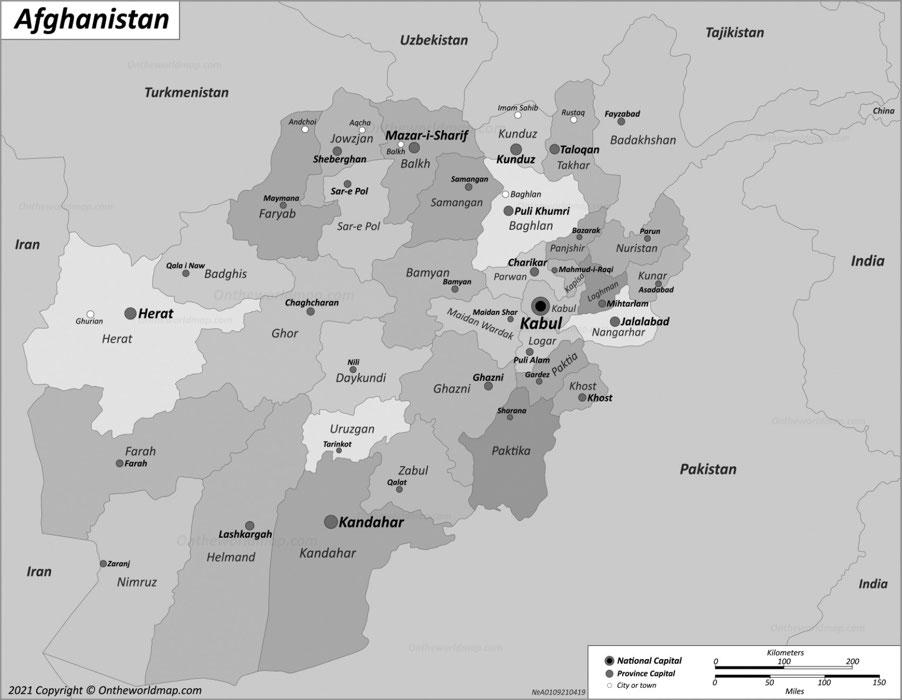
The map in this book is one freely supplied by ontheworldmap.com: see https://ontheworldmap.com/afghanistan/map-ofafghanistan.jpg.
Ahmad Shuja Jamal and William Maley
Brisbane and Canberra, November 2022
PREFACE
On 28 June 1919, statesmen gathered in the Hall of Mirrors at the Palace of Versailles for the signing of a momentous treaty, the product of months of discussion between the victorious powers of the First World War.¹ Article 231 of the Treaty of Versailles affirmed Germany’s responsibility for the war, and under threat of invasion, Germany, which had not been part of the negotiations, was forced to sign. Some observers, such as the economist John Maynard Keynes, excoriated the treaty for its lack of magnanimity.² Others saw it as too lenient to Germany. French Marshal Ferdinand Foch ominously warned: ‘This is not Peace. It is an Armistice for twenty years’.³
Just over twenty years later, on 10 May 1940, forces of Nazi Germany smashed their way into Germany’s western neighbours— the Netherlands, Belgium and Luxembourg—putting an end to the ‘phony war’ that had persisted uneasily since the outbreak of the Second World War following the German invasion of Poland on 1 September 1939. Three days later, German forces crossed the river Meuse, and on 15 May, they broke through the French lines at Sedan. As an eminent historian put it, ‘Nothing stood between the German armies and the French capital’.⁴ The following day, the newly appointed British Prime Minister, Winston Churchill, flew with a small team to Paris for consultations with their French counterparts. Churchill asked the French commander, General Gamelin, ‘Where is the strategic reserve?’ ‘Aucune’—‘there is none’—Gamelin replied. Churchill later wrote ‘I admit this was one of the greatest surprises I have had in my life’.⁵ Six days into the war in the west, the end for the French was in sight. A remarkable operation from 27 May to 4 June evacuated 338,226 soldiers from Dunkirk in northern France and transported them to England; most were from the British
Expeditionary Force (BEF), but roughly 110,000 of them were French.⁶ But as Churchill himself remarked, wars are not won by evacuations,⁷ and on 10 June, the French government left Paris, paving the way for German troops to enter the capital on 14 June. Four dark years were to pass before the liberation of Paris in August 1944.⁸ And debate persists to this day as to exactly what factors— military failure, poor leadership, weak institutions, social decay under the Third Republic, sheer complacency—led to the collapse.
Eighty years later, something eerily similar happened in another part of the world, in Afghanistan. In 1937, the French diplomat René Dollot had written ‘L’Afghanistan est la Suisse de l’Asie’—‘Afghanistan is the Switzerland of Asia’.⁹ No one seemed disposed to make such a claim in 2020 or 2021. In 2001, following the 11 September 2001 attacks by Al-Qaeda on the World Trade Centre and the Pentagon, and the overthrow by the United States of the radical Taliban regime in Afghanistan that had hosted Al-Qaeda, another conference of victors was held, this time in Germany, in the city of Bonn. The Taliban, scorned and scattered, were not invited to participate. The Bonn Conference culminated in an agreement signed on 5 December 2001 between non-Taliban Afghan political actors that set out a pathway towards a new political system.¹⁰ The process was not perfect, but it offered some hope for Afghans after decades of conflict and misery.
Nearly twenty years later, everything unravelled. After years of insurgent attacks by Taliban fighters given sanctuary in neighbouring Pakistan, Afghanistan’s long-time backer the United States, under the leadership of the most erratic and unpredictable president in its history, Donald Trump, struck an agreement with the Taliban on 29 February 2020 entitled ‘Agreement for Bringing Peace to Afghanistan’ (Mowafeqatnamah-e awardan-e solh ba Afghanistan).¹¹ Negotiated and signed by Dr Zalmay Khalilzad, who in September 2018 had
been appointed as ‘Special Representative for Afghanistan Reconciliation’, the fine print revealed it to be an exit agreement for the United States. The Afghan government had been excluded from the negotiations that led to it, and as US forces were drawn down, Taliban attacks on Afghan targets escalated sharply. Peace was nowhere in sight. The end came in July–August 2021. The Taliban, after seizing customs posts at Afghanistan’s borders, surged unexpectedly into the north of the country, taking over key cities such as Herat and Mazar-e Sharif. Resistance to the Taliban began to crumble, and at an accelerating pace. With the capital Kabul wide open to attack, President Ashraf Ghani fled the country on 15 August with a few members of his intimate circle, his reputation in ruins.¹² The government of the Islamic Republic of Afghanistan collapsed, and the Taliban occupied Kabul. Scenes of horror emerged as desperate Afghans sought to leave the country by air before the United States terminated its evacuation flights at the end of the month. For Afghans who had been inspired by the vision of a modern, pluralistic and globalised society, life had become dark indeed.
Just as debate has swirled in France and beyond over what factors led to the collapse of Republican France in 1940, a multiplicity of explanations might be offered to shed light on the collapse of Republican Afghanistan in 2021.¹³ This book sets out our account of what happened and why.