HOUSEHOLDS IN CONTEXT
DWELLING IN PTOLEMAIC AND ROMAN EGYPT
EDITED BY
Caitlín Eilís Barrett and Jennifer Carrington
CORNELL UNIVERSITY PRESS Ithaca and London
In fond memory of our friend and colleague Ross Iain Thomas
Contents
Preface andAcknowledgments
List ofContributors
Note on Abbreviations
Introduction: Houses, Households, and Homes: Toward an Archaeology of Dwelling
Caitlín Eilís Barrett
Part I Households in Spatial Context: Settlements, Neighborhoods, and Urbanism
1. Egyptian Houses in Their Urban and Environmental Contexts: Some Case Studies of the Roman and Late Roman Periods
Paola Davoli
2. Neighborhood Networks: The Civic and Social Organization of Accessways in Ancient Karanis
Bethany Simpson
3. The Tower Houses of the Hellenistic Period: A Solution to the Urban Pressure within Egyptian Towns and Villages
Gregory Marouard
Part II Households in Social Context: Families, Individuals, and Communities
4. The Papyrus Trail: Houses and Households in Ptolemaic and Roman Egypt
DorothyJ. Thompson
5. Habitatio: Transfer of Houses and Rights of Residence in Roman Egypt
Sabine R. Huebner
6. Unsafe Houses in Greco-Roman Egypt: Forms and Locations of Violence
YoussriAbdelwahed
Part III Households in Practice: Production, Consumption, and Discard
7. Modes of Production and Reproduction in Roman-Era Egyptian Villages
RichardAlston
8. Domestic Discard: The Making and Unmaking of RomanoEgyptian Houses
Anna Lucille Boozer
Part IV Households in Cosmic Context: Religion and Ritual
9. Figurines and the Material Culture of Domestic Religion
Ross I. Thomas
10. The Supernatural Vulnerabilities of Domestic Space in Late Antique Egypt: Perspectives from the “Magical” Corpus DavidFrankfurter
Part V Expanding the Household: Dwelling Practices in Monastic and Military Contexts
11. Three Monks and a House: The Archaeology of Monastic Houses in Byzantine Egypt
Darlene L. Brooks Hedstrom
12. Domestic Activities in Alternative Settings: The Ptolemaic Fort at Bi’r Samut, Egypt
Jennifer Gates-Foster, Bérangère Redon, andMelanie Godsey
Afterwords: Perspectives from Pharaonic Egypt and the Greco-Roman World
1. Greco-Roman Households in Pharaonic Perspective
Miriam Müller
2. Contextualizing Houses, Households, and Homes in the Classical World and Beyond
Lisa Nevett
Index
Preface and Acknowledgments
This volume publishes the proceedings of a two-day international conference at Cornell University, “Better to Dwell in Your Own Small House”: Households of Ptolemaic and Roman Egypt in Context (April 27–April 28, 2018), organized jointly by the coeditors of this book, Caitlín Barrett and Jennifer Carrington. Dorothy J. Thompson delivered the keynote presentation (published here as chapter 4). The current volume includes edited and revised versions of all of the papers presented at the conference, as well as two additional papers kindly contributed by Paola Davoli and David Frankfurter. The preparation of all of these papers for publication coincided with the onset of the COVID-19 pandemic, and we are immensely grateful to all of our contributing authors for their dedication, resilience, and patience under the resulting challenging circumstances, which unavoidably lengthened the time between conference and publication. This conference, and the present volume, could not have taken place without the help of many individuals and institutions. The Department of Classics at Cornell University was the primary institutional sponsor for the conference and provided essential funding. We also received generous grants from a number of cosponsors at Cornell: the Cornell Institute of Archaeology and Material Studies (CIAMS); the Departments of Anthropology and Near Eastern Studies; the Religious Studies Program; the Archaeological Institute of America, Finger Lakes Chapter; the Cornell Society for the Humanities; and the Mario Einaudi Center for International Studies. By enabling us to subsidize the travel expenses of our participants, this funding made it possible for the conference
(and resulting volume) to bring together an international group of scholars. We are immensely grateful for this generous support.
We are equally grateful for the help of many individual colleagues. Four colleagues at Cornell agreed to serve as discussants for the panels: Adam Smith (responding to Panel 1, “Households in Spatial Context”), Jonathan Boyarin (responding to Panel 2, “Households in Social Context”), Dana Bardolph (responding to Panel 3, “Households in Practice”), and Astrid Van Oyen (responding to Panel 4, “Expanding the Household”). These four discussants offered thoughtful feedback and insightful observations that, we believe, have materially improved the resulting publication.
The Cornell Classics Department accounts coordinators first Philip Rusher, then Jessica Smith—coordinated the travel plans and hotel arrangements for all of our speakers. Jessica also went above and beyond in negotiating with hotels, restaurants, and caterers all across Ithaca to ensure that the event would be successful. We thank Classics Department manager Keeley Boerman for overseeing the finances for the event, and undergraduate coordinator Linda Brown for helping with logistics. We are also very grateful to the graduate student volunteers, Salpi Bocchieriyan, Katie Guttman, and Elizabeth Proctor, who helped with registration, setup, and cleanup and generally kept everything running smoothly during the conference.
At Cornell University Press, we are very grateful to Bethany Wasik, the acquisitions editor, for her support of this project and her helpful feedback; to Karen Laun, the assistant managing editor, for shepherding this project to completion; to Jack Rummel, the copy editor, for the keen eye that he brought to the text; to Joyce Goldenstern, for preparing the index; and to Kristen Gregg and the marketing team, for helping put this volume out into the world. We are also immensely thankful to Bradley Ault and to the anonymous reviewers of this volume, both external and on the Cornell University Press editorial board and faculty board, for numerous constructive, thoughtful, and helpful comments on the manuscript.
Financial support for this publication came from grants generously awarded by the Hull Memorial Publication Fund of Cornell University and the von Bothmer Publication Fund of the Archaeological Institute
of America. This funding has been put toward lowering the purchase price of the volume, and we are grateful for the opportunity to make this volume more widely accessible to those who wish to read it.
We would like to express our most sincere thanks to all of the authors in this volume for their varied and exciting contributions, which bring new perspectives to bear on households, dwelling, and daily experience in Ptolemaic and Roman Egypt.
As is only fitting—for all publications, really, but especially one on the subject of households and families—we send our warmest thanks and love to our own families, who have supported us in this project as in everything.
Finally, we are deeply saddened to note that Ross Thomas passed away while this volume was in preparation. We thank his wife, Elisabeth O’Connell, for helping to review the text of his chapter and ensure that it is faithful to Ross’s wishes. We are honored to be able to include Ross’s work in this book, which we dedicate to his memory as a small tribute to a brilliant scholar, generous colleague, and kind friend.
Contributors
Youssri Abdelwahed, Faculty of Tourism and Hotels, Minia University
Richard Alston, Professor of Classics, Royal Holloway, University of London
Caitlín Eilís Barrett, Associate Professor of Classics, Cornell University
Anna Lucille Boozer, Professor of Archaeology and Ancient History, Baruch College and the Graduate Center, City University of New York
Jennifer Carrington, PhD alumna, Department of Classics, Cornell University
Paola Davoli, Professor of Egyptology, University of Salento (Lecce)
David Frankfurter, William Goodwin Aurelio Chair of the Appreciation of Scripture, Department of Religion, Boston University
Jennifer Gates-Foster, Associate Professor of Classical Archaeology, University of North Carolina at Chapel Hill
Melanie Godsey, Visiting Assistant Professor of Classical Archaeology, Texas Tech University
Darlene L. Brooks Hedstrom, Myra and Robert Kraft and Jacob Hiatt Associate Professor of Christian Studies, Department of Near Eastern and Judaic Studies, Brandeis University
Sabine R. Huebner, Professor of Ancient History, University of Basel
Gregory Marouard, Senior Research Scholar and Lecturer, Department of Near Eastern Languages and Civilizations, Yale University
Miriam Müller, University Lecturer in Egyptian Archaeology, Art, and Material Culture, Leiden University
Lisa Nevett, Professor of Classical Archaeology, University of Michigan
Bérangère Redon, Researcher, CNRS (Centre National de la Recherche Scientifique), Laboratoire HiSoMA (Histoire et Sources des Mondes Antiques)
Bethany Simpson, Assistant Professor of Art History, Virginia Commonwealth University
Ross I. Thomas, Curator, Department of Greece and Rome, The British Museum
Dorothy J. Thompson, Newton Trust Lecturer (emerita), Faculty of Classics, University of Cambridge
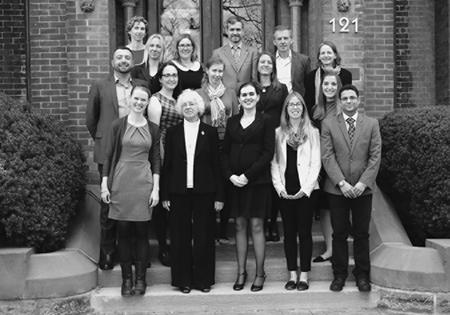
Figure 0.1. Participants in the 2018 conference “Better to Dwell in Your Own Small House”: Households of Ptolemaic and Roman Egypt in Context (Cornell University, April 27–April 28, 2018). Bottom row (from left): Jennifer Carrington, Dorothy J. Thompson, Caitlín Eilís Barrett, Liam Benjamin Zarzycki Barrett (in utero), Dana Bardolph, Youssri Abdelwahed. Second row (from left): Gregory Marouard, Bethany Simpson, Anna Lucille Boozer, Lillian Rose Boozer-Velasco (in utero), Miriam Müller, Melanie Godsey. Third row (from left): Sabine Huebner, Darlene L. Brooks Hedstrom, Lisa Nevett. Top row (from left): Jennifer Gates-Foster, Ross I. Thomas, Richard Alston. Not pictured: Paola Davoli, David Frankfurter, and Bérangère Redon, who did not participate in the conference, and Jonathan Boyarin, Adam Smith, and Astrid Van Oyen, who participated as discussants. (Photograph by Elizabeth Proctor.)
Introduction
Houses, Households, and Homes: Toward an Archaeology of Dwelling
CAITLÍN EILÍS BARRETT
One of the major achievements of late twentieth- through twenty-firstcentury archaeology has been the growth of theoretically engaged, multidisciplinary research on houses and households.1 The study of ancient domestic life provides crucial insights into everyday dwelling practices, lived experiences, and the interactions of families and individuals with larger social and cultural structures.2 Historically, scholars working in Egypt and the ancient Greco-Roman world have often focused more on monumental temples, tombs, and elite material and visual culture. However, an explosion of new research on houses and households is transforming the way that we think about life in ancient Egypt3 and throughout the Mediterranean.4 As the first synthetic book-length study of houses and households in Ptolemaic and Roman Egypt, this volume aims to bring together archaeologists, papyrologists, historians, and art historians to offer new perspectives on dwelling and daily practice.
Egypt during the Ptolemaic and Roman Periods provides especially rich material for household studies. Thanks to the extraordinary preservation of both material and textual remains, these eras of Egyptian history offer abundant evidence for ancient households: indeed, in some ways, even more than has survived from Pharaonic Egypt.5 Egypt at this time also offers an important test case for “big questions” of cross-cultural importance, concerning, for example, the domestic impact of imperialism and colonialism.6 The Macedonian
king Alexander’s conquest in 332 BCE initiated a turbulent new period of Egyptian history. After about three centuries as an independent kingdom under a dynasty of Greco-Macedonian origin, the Ptolemies (305–31 BCE), Egypt fell to the Roman warlord Octavian in 31 BCE and became a province of the Roman Empire. These two periods are sometimes categorized together as the “GrecoRoman Period,” although as many scholars have pointed out, there were actually major social, political, and economic differences between the Ptolemaic and Roman administrations.7 Nonetheless, both periods do share some distinctive cultural features, including the existence of a substantial, and in certain ways privileged, element of the population that identified as Hellenes (i.e., Greeks).8 During the Ptolemaic Period and continuing into Roman rule, Egypt became a multiethnic, multicultural, and multilinguistic society, with multiple (and indeed frequently overlapping) population groups that included not only Egyptians and Greeks, but also Jews, Arabs, Thracians, and many others besides.9 As a result, Egypt in these periods provides an important case study for investigating cultural entanglement, empire, globalization, and the negotiation of power relations and identities in the household.
Yet, while research on houses and households in Ptolemaic and Roman Egypt has substantially increased over the past two decades,10 no major synthetic study of household archaeology has yet been published for these complex periods of Egyptian history—a gap that we hope this volume will help address. Some recent contributions provide synthetic analyses of settlements and household architecture in Roman Egypt.11 However, the only comprehensive monograph on Ptolemaic-period houses is now over fifty years old, and there is a great need for newer synthetic studies of Ptolemaic housing that take account of recent research.12 A better knowledge of Ptolemaic houses and households would also enrich the study of the Roman-period evidence. By facilitating deeper understanding of the ways in which Ptolemaic and Roman-period practices overlapped and diverged,13 a diachronic perspective can address ongoing scholarly interest in
questions of change and continuity between these two periods of foreign rule in Egypt.14
Through a multidisciplinary exploration of households in Ptolemaic and Roman Egypt, we intend this volume to promote further discussion about the interrelationships between domestic material culture and larger social, political, and cultural phenomena. In so doing, we seek to place the study of Greco-Roman Egypt in dialogue with recent theoretical and comparative research on households, dwelling, and daily practice.15 A Ptolemaic-period text of wisdom literature in demotic Egyptian, The Instruction of Ankhsheshonq, advises ancient readers that “it is better to dwell in your own small house than to dwell in the great house of another.”16 While this passage’s valorization of autonomy and exhortation to satisfaction with one’s lot furnish intriguing evidence for ancient cultural values and social expectations, the emphasis on “dwelling” (Demotic ḥms) also provides a link to much more recent intellectual developments. Tim Ingold’s so-called dwelling perspective treats buildings not as fixed and immovable containers for human activity, but as dynamic and socially embedded structures whose form and meaning are constituted through daily practice.17 Viewed in this light, Ankhsheshonq’s “small house” may be small in scale, but enormous in its potential to shape the daily experiences and practices of its occupants.
Approaching the Household
So what is it, exactly, that we are purporting to investigate? The modern English word household evokes a rather daunting array of meanings and connotations.18 According to the Oxford English Dictionary, “household” can mean “a group of people (esp. a family) living together as a unit”; a “domestic establishment”; or even “the contents or appurtenances of a house considered collectively; household goods or furniture.”19 In other words, depending on context, “household” can evoke everything from people, to
institutions, to places and structures, to things themselves: the physical “stuff” of domestic life. Nor are we on much firmer ground with “house,” even if that term might initially seem to offer a reassuring solidity.20 Architectural definitions of the “house” are challenging, because not all dwelling sites involve formal architecture,21 and even when they do, there is not always a one-to-one relationship between a structure and a dwelling; some homes consist of massive multibuilding estates, while others are single apartments or rented rooms within buildings that are mostly occupied by other people.22
One of the most influential efforts to create operational definitions of “household” (and assorted related concepts) is that of the historian Peter Laslett. For Laslett and those who follow him, a household is about both people and place: it consists of individuals who both share a residence and act together as a meaningful socioeconomic unit.23 These individuals may consist of a single family (that is, people who are genealogically related through kinship, however kinship may be defined in their society),24 but this is not always the case. Besides family members, a household can also include dependents, such as enslaved laborers or live-in servants. In this volume, Dorothy Thompson (chapter 4) discusses a Ptolemaic-period demotic Egyptian property contract that refers to two types of servants (bꜢk.w, šms.w) as well as enslaved people (ḫl.w) as potential members of households. Laslett further distinguishes between household and houseful, which is a more comprehensive term for people who share a residence: whereas the members of a household are socially united in some capacity as members of a shared economic and legal unit, a houseful could also incorporate more distantly connected individuals, such as lodgers.25
We frequently read that the “household” is a socioeconomic entity, whereas the “house” is a physical entity. Yet if that is the case, the relationship between these two very different sorts of things is by no means straightforward. As Bruce Routledge puts it in a review of several recent publications on household archaeology:
On reading these books in succession, I was immediately struck by the impression that (1) most scholars begin from the assumption that the
household is a fundamental social group; (2) most scholars accept that this group bears some significant relationship to houses as built structures encountered in the archaeological record; and (3) no one presents a clear and coherent argument to explain this relationship; indeed, a number of authors seem to hold rather different views. So, from the beginning, we have a problem with the link between archaeological houses and households.26
And Routledge is not wrong to identify a serious issue here. Let’s say we dig up a structure that we identify as a “house.” If we assume an a priori one-to-one correspondence between this structure and the activities of a single social group that we call a “household,” we risk eliding both the predepositional and postdepositional history of the structure. By the time we encounter the physical remains of houses in the archaeological record, they may have been inhabited by not just one household, but a whole series of households over generations.27 Additionally, their current condition has been shaped not just by their ancient inhabitants, but by all manner of subsequent formation processes.28 In this volume, Anna Boozer highlights the reuse of abandoned houses as garbage dumps (chapter 8).
Most recently, the “material turn” in the humanities and social sciences has prodded some scholars to problematize the apparent Cartesian dualism of “household” (as social construct) versus “house” (as actual, physical thing). As Julia Hendon expresses the situation:
[A] certain unease has pervaded household archaeology, precisely because of the assumption that the true focus of interest is a social institution which must be an abstraction or an idea in people’s heads, not a material form. Thus, houses become a stand-in that must always be qualified as less than ideal.29
Yet is the household really just an abstraction, a ghost in the house’s machine?30 If “household” refers, as per Laslett, to a group of people who live and work together in intimate proximity, then the household is not so much an abstractionas it is a setofrelations. It describes the relationships between real people, whose bodies were just as material as anything else in the house, and whose interactions with each other would have been enacted through, and even constructed by, domestic
material culture.31 In other words, the household is a tiny network, whose participants—if we follow actor-network theory or a range of other “new materialist” approaches—could indeed be said to include objects as well as people.32 Ultimately, the supposed dichotomy between the household and the house is a red herring. Instead of imagining the house as separate from the household, we may do better to conceive of it as a memberof the household.
In which case: just as the human members of a household vary widely in their identities and personalities, so too do the material forms that share (and constitute) their living space. And in many cases, that living space may not confine itself neatly within the bounds of a single built architectural structure. As Lynn Rainville asks:
Is domestic limited to the archaeologically discovered “home” or “house”? If so, would a communal bread oven (visited by neighbors each morning) constitute a “domestic activity area” or is the domestic space only the locale where family members consume the bread? On the other hand, would a local market where shoppers collect ingredients for baking the daily bread (or other meals) be considered part of a domestic activity area? … . [Are] the sherds recovered from a men’s teahouse part of a domestic assemblage? … To pose the question another way, do people have to sleep in a structure for it to be domestic? And, if so, are inns, caravanserai, hotels, and so forth considered domestic residences? Or does sleeping have to co-occur with other domestic activities such as eating, child rearing, and bathing? With [sic] the cooccurrence of these two activities, a cemetery could be defined as domestic because it provides eternal rest.33
To rephrase Rainville’s series of questions: of all the various activities that we associate with “dwelling,” which ones are the most essential, why, and to whom? Here we also need to consider the possibility of differences between emic and etic conceptions of “house” and “home.” Ancient people’s understanding of what made a place into a home, or what made a group of people into a family or household, may often have been different from our own. To this end, the chapters in this volume address a wide range of perspectives on the
relationships that connect and separate the English “household,” Egyptian per, Greek oikos, and Coptic manshōpe.
In fact, let’s go back to Rainville’s comment about cemeteries as possible domestic spaces. In context, this statement appears to be intended as a rhetorical flourish—a sort of mic drop to prove her point about blurry definitions. Yet there are in fact societies where people speak of tombs as the houses of the ancestors34 or preserve the bodies of the dead within the houses of the living,35 and there are places, like the “City of the Dead” in modern Cairo, where living people repurpose tombs as dwellings.36 The necropolis and the polis are not always categorically separate.
More broadly, many of the activities that take place in houses also take place in other residential or quasi-residential settings. Take, for example, inns, taverns, and brothels, all of which Glazebrook and Tsakirgis call “places of temporary habitation and dining.”37 Such sites are indeed “places of temporary habitation” from the perspective of their customers, but they may well be permanent habitations for the people working there. In the ancient Mediterranean, the proprietors of many small businesses—inns, shops, restaurants, bars, and other places—lived on the premises with their families.38
Brothels too were often long-term residences for the individuals who worked there,39 raising the prospect of a household that is not centered on a family. Discussing one apparent brothel in Building Z of the Athenian Kerameikos, Bradley Ault proposes that the women who lived here should be considered “homeless,” because even though they had a roof over their head, they did not have the sort of domestic community that Greeks would have understood as an oikos.40 Yet the Greek oikos, or household, was (much like the English word) not defined in terms of kinship relations alone.41 The people who lived and worked in this building may have remained there for a long time, and it is hard to imagine that they did not form any meaningful interpersonal relationships among themselves. Can we be certain that they did not understand themselves to constitute a sort of oikos?42 We have ancient texts that inform us about how some Classical-period Greeks thought about the oikos, but these are almost entirely written
by elite men,43 whose perspectives might be very different from those of the women in Building Z.44 When we ask how ancient people conceptualized “house,” “home,” and “family,” it is important to consider differences between emic and etic perceptions—but we can also go farther. Rather than searching for one single homogeneous emic view, we should recall that many different opinions, worldviews, and perceptions can coexist within the same society.
So what actually are the limits of the “domestic”? Yanagisako notes that we typically do not consider as households “institutions like orphanages, boarding schools, men’s houses, and army barracks” because their inhabitants do not share what we usually consider domestic activities, by which she means food production, food consumption, sexual reproduction, and childcare.45 Yet most of these groups do in fact share food together, an activity widely recognized as a powerful generator of fellow-feeling and communal identity.46 And while “child-bearing and child-rearing” are certainly important activities for many households, they are not necessary ones.47 In antiquity as today, not all couples had children, and as Dorothy Thompson shows in her analysis of Ptolemaic tax registers (chapter 4), some people lived alone.48
By this point, readers would be forgiven for thinking (probably with some dread) that I want to reinterpret essentially every imaginable archaeological site, from tombs to shops to schools, as a sort of “domestic context.” I hope it will come as some relief to read that this is not, in fact, my goal! Rather, I want to highlight the extent to which “dwelling” is a spectrum rather than an on/off condition, involving a wide range of possible activities and conditions that do not lend themselves well to a simple checklist.
I am skeptical about our ability to generate a universal list of conditions that must always be met before we declare a context to be “domestic.” More to the point, even if it were possible to create such a list, I doubt we would learn very much from the exercise. The category of the “domestic” is what cognitive psychologists call a “fuzzy set”: that is, a set whose borders are inherently blurry, and within which gradations of membership are possible. Psychologists
have demonstrated that many, if not most, of the concepts expressible in human natural languages are fuzzy sets.49 In other words, the slipperiness of terms like house, household, or domestic is not evidence that we need to work harder to define these categories more perfectly; it is an inevitable result of the way that natural languages work.
As editors of this volume, we choose to foreground the fuzziness of the set(s) that it explores, rather than trying to force the gloriously messy reality of life into artificially neat categories.50 To that end, we have intentionally taken a hands-off approach to definitional issues, encouraging our contributors to define (or question, or reject, or redefine) “houses and households” as they see fit. The blurry boundaries of the household are perhaps most obvious in part V, “Expanding the Household: Dwelling Practices in Monastic and Military Contexts.” These chapters investigate places of residence that are organized around groups other than the family: namely, monastic communities (Brooks Hedstrom, chapter 11) and military fortresses (Gates-Foster, Redon, and Godsey, chapter 12).
Yet in the earlier chapters too, houses, households, and families prove more slippery than one might expect. As Richard Alston shows (chapter 7), families might maintain dense ties across multiple households—and indeed even multiple communities—as well as houses. Household and family organization and composition varied widely (Thompson, chapter 4; Alston, chapter 7). Sabine Huebner’s discussion of habitatio (chapter 5) explores one of the legal arrangements that might structure an individual’s or family’s relationship to a dwelling, underlining (among other things) that the resident of a house might not be its legal owner. A Ptolemaic tax register demonstrates that individuals might live not only in architecturally identifiable houses, but also in everything from shrines to gatehouses to bathhouses to shops (Thompson, chapter 4). Many domestic tasks took place outside houses, often in courtyard spaces or streets that might be shared between multiple households (Simpson, chapter 2; Alston, chapter 7). Activities essential to household maintenance might also be conducted farther afield. These could range
from practical errands, like the grocery shopping that Rainville mentions above, to making offerings in temples to secure the wellbeing of family members.
Going further, the status of a given space as “private” or “public” often shifted over time and might be bitterly contested, with people appropriating public streets as personal property (Davoli, chapter 1; Simpson, chapter 2; Marouard, chapter 3) or, on the other hand, allowing neighbors to access routes on their property (Simpson, chapter 2) or converting abandoned houses into neighborhood waste disposal sites (Boozer, chapter 8). Concepts of the “family” were also up for renegotiation and might reach far beyond the common understanding of the family as “a group of people related by descent or marriage.”51 The Coptic monks studied by Darlene Brooks Hedstrom (chapter 11) were not biologically related to each other, but they used kinship terms, like father and son, to assert both hierarchy and intimacy within their community. Such language suggests a model of family that centers socially constructed relationships rather than biological descent.
Household Studies: From the Rearview Mirror to the Road Ahead
In a themed volume such as this, one of the introduction’s traditional functions is surveying the history of research on that theme, so that readers can better appreciate where this intervention has come from and what it aims to do. A comprehensive survey of all previous household studies would be impossibly vast: we would need to cover the disciplinary histories of, at a minimum (and in alphabetical order), anthropology, archaeology, architecture, art history, classics, Egyptology, history, Near Eastern studies, philosophy, sociology, and urban planning.52 Given the reality of space constraints, this will not be such a behemoth of a treatise. Instead, I will focus primarily on the history of household studies within one of the multiple disciplines represented in this volume: archaeology. Developments in other fields
and interpreting human behavior in terms of ecological adaptation.57 The emphasis on culture as what Lewis Binford called an “extrasomatic means of adaptation for the human organism”58 led many processualists to treat ideology, ontology, religion, emotion, arts, and essentially everything else classifiable under the heading of “humanities” as epiphenomenal. Skeptical of the possibility of even studying such dubious business, the New Archaeology charge leader Binford scoffed that he was not a “paleo-psychologist.”59
Processualist archaeology placed more emphasis on the (supposedly) “hard” drivers of history, which in practice meant mostly technological, economic, and sociopolitical factors.60 And to that end, Wilk and Rathje inform us: “Looking at households cross-culturally, we find that the many activities they perform can be classified into four categories of function: production, distribution, transmission, and reproduction.”61 They go on to clarify these categories as follows: “Production is human activity that procures resources or increases their value,”62 distribution is “moving resources from producers to consumers,”63 transmission is “a special form of distribution that involves transferring rights, roles, land, and property between generations,”64 and reproduction “consists of the rearing and socializing of children… . Child care demands constant time and effort, and households can be organized to provide this constant care in different ways. Pooling of labor is a frequent solution to the problem.”65
In other words, households, as Wilk and Rathje portray them, are fundamentally economic institutions. They are about producing resources, moving them around, and transmitting them over generations. Even “reproduction,” a category that we might expect to have slightly more emotive charge, turns out to be all about labor management.66 Archaeologists are not to be concerned here with intimate relationships or family dynamics, but with the organization of child care duties and the question of whether or not “women’s labor” is deployable to “play a major productive role” outside of child care.67