MASTER PLANNING AND SCHEDULING a practical guide to challenges in the current and future... competitive manufacturing world. 4th Edition John F Deutsch Eric Proud
Freddie Williams is the author of MyHVAClab and the program chair of the Air Conditioning Technology Department at Lanier Technical College, with over twenty-three years of professional experience. Mr. Williams has been a faculty member at Lanier Tech since 2002, teaching air conditioning and industrial systems. He was awarded Instructor of the
Year at Lanier Tech in 2010 and the Master Teacher award in Hall County, Georgia, in 2010. Mr. Williams is a member of ASHRAE and RSES and holds degrees in management and technical studies. He has extensive experience with electrical and mechanical systems in industrial, commercial, and military environments.
LAB CONTRIBUTORS
Gary Reecher
Current member of Refrigeration Service Engineers Society (RSES)
Tom Owen Sullivan College of Technology & Design
Jason Rouvel Western Technical College
Michael Garrity
Branford Hall Career Institute
Elwin Hunt
San Joaquin Valley College
Glen Martin
Branford Hall Career Institute
Patrick Monahan
Branford Hall Career Institute
Bryan DeNardis
Everest Institute
Robert Yeomans
Robert Polchinski
New York City College of Technology
Donald Steeby* Grand Rapids Community College
ASSESSMENT CONTRIBUTORS
Tom Owen
Sullivan College of Technology & Design
Michael Patton*
Branford Hall Career Institute
Edward Rosenberg Branford Hall Career Institute
POWERPOINT SLIDES AND LECTURE NOTES CONTRIBUTORS
Bruce Bowman
Davidson County College
Jerry Britt
Horry Georgetown Technical College
Michael Brock Florida State College
James Chadwick
Kaplan University
Gabriel Cioffi
LA Trade Tech
Clint Cooper
Chattahoochee Technical College
Mike Falvey
Copiah-Lincoln Community College
Rick Marks
Cisco College
Joe Owens*
Antelope Valley College
Kevin Pulley
Career Institute of Technology
Roger Raffaelo Daytona State College, Main
Doug Sallade
Cypress College
Donald Steeby Grand Rapids Community College
Monty Timm
Ivy Tech Community College
S. Shane Todd
Ogeechee Technical College
PICTORIAL SUPPORT
We would also like to acknowledge the following individuals, companies, and colleges for allowing photographs to be taken of their equipment and facilities for use in this text.
Jerry Markley and Lynn Darnell
Maine Maritime Academy
Charlie Veilleux, Rick Gomm, and Jim Peary
Eastern Maine Community College
Tom Kissell
Terra Community College
Glenn Carlson
Hannaford Bros. Co.
David Kuchta
The Jackson Laboratory
Jeff Vose
Allen’s Blueberry Freezer, Inc.
Robin Tannenbaum LEED AP and Phil Kaplan AIA, LEED AP
Kaplan Thompson Architects
Keith Collins, M.D.
BrightBuilt Barn
Bob Morse and Mike Hudson
Getchell Bros. Inc.
About the Authors
Carter Stanfield is program director of the Air Conditioning Technology Department at Athens Technical College, where he has taught since 1976. His industry credentials include both an RSES CM and NATE certification and a State of Georgia Unrestricted Conditioned Air Contracting license. He graduated from the University of Georgia magna cum laude in 1995 with a bachelor of science degree in education. Mr. Stanfield believes that successful educational programs are focused on what the students do. Students start with a strong background in fundamental concepts and theory and then actively apply them to solve real problems. Practice and active application are the keys to students building both confidence and competence. For teaching tips and more, see his HVACR blog at http://hvacrfundamentals.blogspot.com/.
David Skaves, P.E., has been a faculty member at the Maine Maritime Academy since 1986 and received the Teaching Excellence award at the college in 2006. His career background includes employment as a marine engineer on supertankers in the merchant marine, a production planner at Maine’s Bath Iron Works Shipbuilding, and an engineering consultant for combined cycle power plant performance testing throughout the United States as well as in Mexico and South America. In addition to his MBA from the University of Maine at Orono, Professor Skaves is a registered professional engineer, licensed first-class stationary engineer, and licensed marine chief engineer. He is currently a member of ASHRAE and AFE.
SECTION 1
Fundamentals
unit 1 Introduction to Heating, Ventilation, Air Conditioning, and Refrigeration 1 unit 2 Being a Professional HVACR Technician 10 unit 3 Safety 18
unit 4 Hand and Power Tools 31 unit 5 Fasteners 56 unit 6 Measurements 67
SECTION 2 HVACR Science
unit 7 Properties of Matter 78 unit 8 Types of Energy and Their Properties 87 unit 9 Temperature and Thermodynamics 100 unit 10 Pressure and Vacuum 115
SECTION 3
Refrigeration Systems and Components
unit 11 Types of Refrigeration Systems 126 unit 12 The Refrigeration Cycle 135 unit 13 Compressors 150 unit 14 Condensers 177 unit 15 Metering Devices 197 unit 16 Evaporators 222
unit 17 Refrigerants and Their Properties 246 unit 18 Special Refrigeration Components 267 unit 19 Plotting the Refrigeration Cycle 280
SECTION 4
Refrigeration Practices
unit 20 Refrigerant Safety 295 unit 21 Refrigerant System Servicing and Testing Equipment 311 unit 22 Piping and Tubing 332 unit 23 Soldering and Brazing 353 unit 24 Refrigerant System Piping 380 unit 25 Accessing Sealed Refrigeration Systems 399 unit 26 Refrigerant Management and the EPA 413 unit 27 Refrigerant Leak Testing 438 unit 28 Refrigerant System Evacuation 448 unit 29 Refrigerant System Charging 466
SECTION 5
HVACR electrical Systems and Components
unit 30 Electrical Safety 486 unit 31 Basic Electricity 499 unit 32 Alternating Current Fundamentals 518
unit 33 Electrical Measuring and Test Instruments 533
unit 34 Electrical Components 550
unit 35 Electric Motors 570
unit 36 Motor Controls 585
unit 37 Motor Application and Troubleshooting 598
unit 38 Electrical Diagrams 622
unit 39 Control Systems 647
unit 40 Communicating Control Systems 673
unit 41 Electrical Troubleshooting 687
SECTION 6
Air-Conditioning Systems
unit 42 Fundamentals of Psychrometrics and Airflow 698
unit 43 Air Filters 717
unit 44 Ventilation and Dehumidification 730
unit 45 Residential Air Conditioning 742
unit 46 Mini-Split, Multisplit, and Variable Refrigerant Flow Systems 756
unit 47 Residential Split-System Air-Conditioning Installations 772
unit 48 Duct Installation 790
unit 49 Troubleshooting Air-Conditioning Systems 813
SECTION 7
Heating Systems
unit 50 Principles of Combustion and Safety 833
unit 51 Gas Furnaces 847
unit 52 Gas Furnace Controls 864
unit 53 Gas Furnace Installation 885
unit 54 Troubleshooting Gas Furnaces 904
unit 55 Oil-Fired Heating Systems 919
unit 56 Oil Furnace and Boiler Service 934
unit 57 Residential Oil Heating Installation 952
unit
58 Troubleshooting Oil Heating Systems 964
unit 59 Space Heaters 975
unit 60 Humidifiers 983
SECTION 8 Heat Pump Systems
unit 61 Electric Heat 990
unit 62 Electric Heat Installation 1001
unit 63 Troubleshooting Electric Heat 1008
unit 64 Heat Pump System Fundamentals 1018
unit 65 Air-Source Heat Pump Applications 1030
unit 66 Geothermal Heat Pumps 1048
unit 67 Heat Pump Installation 1062
unit 68 Troubleshooting Heat Pump Systems 1077
SECTION 9
System design, Sizing, and layout
unit 69 Basic Building Construction 1091
unit 70 Green Buildings and Systems 1106
unit 71 Indoor Air Quality 1117
unit 72 Residential Load Calculations 1132
unit 73 Duct Design 1161
unit 74 Zone Control Systems 1175
unit 75 Testing and Balancing Air Systems 1187
SECTION 10
Commercial environmental Systems
unit 76 Commercial Air-Conditioning Systems 1200
unit 77 Fans and Air-Handling Units 1214
unit 78 Single-Zone Rooftop Unit Installation 1233
unit 79 Commercial Zoned Systems 1241
unit 80 Commercial Control Systems 1254 unit 81 Chilled-Water Systems 1269
unit 82 Hydronic Heating Systems 1283
unit 83 Boilers and Related Equipment 1301
unit 84 Cooling Towers 1314
SECTION 11
Commercial Refrigeration Systems
unit 85 Commercial Refrigeration Systems 1327
unit 86 Supermarket Equipment 1346
unit 87 Ice Machines 1370
unit 88 Troubleshooting Refrigeration Systems 1390
SECTION 12
installation, Maintenance, Service, and troubleshooting
unit 89 Installation Techniques 1407
unit 90 Planned Maintenance 1428
unit 91 Refrigeration System Cleanup 1453
unit 92 Troubleshooting 1466
Glossary 1481 index 1513
Unit 1 Introduction to Heating, Ventilation, Air Conditioning, and Refrigeration
After completing this unit, you will be able to:
1. give a brief history of HVACR.
2. define environmental heating and air conditioning.
3. give the advantages of freezing foods quickly. objectives
1.1 introdUction
The abbreviation HVACR is certainly a mouthful, and so it is not unusual to ask the question, “What does this mean, and how does it impact me?” However, the answer is not so simple, and a standard definition may not explain very much. This is because the HVACR industry is a complex network that our entire society relies on more today than ever before. Just think how your world would change without refrigeration for your food or drinks and without air conditioning in your car or classroom. Try to visualize how this would affect the greater population, from food distribution networks, to hospital care, to housing for the elderly. As a trained and skilled HVACR technician, you can make a positive impact on society. You can contribute to this growing industry to ensure that systems work efficiently and safely and are environmentally friendly (Figure 1-1).
4. explain the importance of having a clean background.
5. list the various types of HVACR jobs and explain what they might do.
6. list the HVACR professional organizations.
1.2 History and overview of Hvacr
Heating
In an attempt to better understand HVACR, let’s break it down component by component. The H for heating seems easy. The history of heating a space by burning wood starts in our earliest times and continues to the present. Elaborate systems using firewood heated Roman buildings. Channels were built underneath the floors to draw heat from a fire, thus warming the building and creating the first central heating systems (Figure 1-2).
Wood, peat, and coal remained the primary heating fuels for centuries. Many early buildings had open fireplaces. But fireplaces are an inefficient way of heating because too much of the heat produced is drawn up the chimney. Although early seventeenth-century European masonry-type stoves burned wood safely at high efficiency,
figure 1-1 Think green! New innovative technologies will allow some HVACR systems to operate on power supplied by wind turbines.
figure 1-2 Romans used fires channeled below floors as early heating systems.
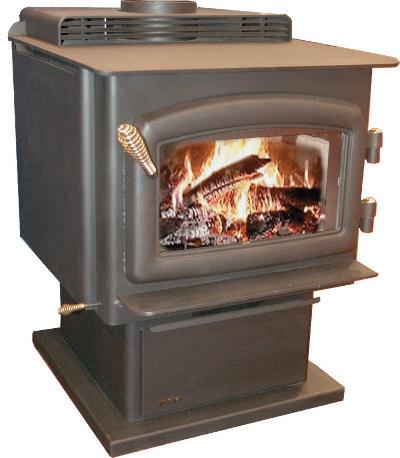
the next major step in heating technology in America was the metal stove. Benjamin Franklin is credited with inventing a cast-iron stove that was several times more efficient than any other stove at that time. Many people still use decorative, efficient stoves to provide much, if not all, of their heating needs (Figure 1-3).
However, wood heat is only one alternative, because today there are many more choices for heating. Gas heat, oil heat, electric heat, and solar heating systems are common. Heat pumps that use a refrigeration system for heating can be very efficient. Geothermal heating systems that utilize the heat from within the earth are becoming more popular. New, environment-friendly ideas and efficient designs are continually being developed, tested, operated, and maintained by people just like you entering the industry. So you can see that just the H alone is a large and important sector.
ventilation
Next comes the V for ventilation. Before the invention of chimneys, fires were burned in the center of a room with smoke having to escape through holes in the roof. When early homes were heated by wood fires, the smoke would permeate the entire building. Although people were warm, the health hazards from this smoke exposure were harmful. As an improvement, early Norman fireplaces in England were designed to allow the smoke to escape through two holes in the side of the building. It was obvious that something needed to be done to improve the air quality.
A properly ventilated building allows for the air to flow and exchange so that harmful particulates such as those in smoke are not allowed to accumulate. Fresh air also brings oxygen into the space, but it becomes depleted over time. A simple ventilation system can consist of only a fan and some minor ductwork for transporting the air. More complex systems circulate air throughout entire buildings through a vast network of ducts and blowers.
WATER
HEAT IN VAPOR
LIQUID TO VAPOR
air conditioning
LIQUID EVAPORATION
The AC stands for air conditioning. Generally this is considered by most people to be a way to cool a space, but as you will learn, this term encompasses much more. Artificially cooling the air in a living space dates back to the earliest centuries. In ancient Greece, large wet woven tapestries were hung in natural drafts so that the air flowing through and around the tapestries was cooled by the evaporating water. As the water evaporated, it would remove heat, just like when you perspire to remain cool (Figure 1-4). Some manufacturers sprayed water in factories for cooling as early as the 1720s. Evaporative cooling is still used extensively in residences and businesses throughout the southwestern United States, where typical summer conditions are very hot and dry.
Ice was the primary means of cooling air for many years. The Romans packed ice and snow between double walls in the emperor’s palaces. John Gorrie patented the first mechanical air-conditioning system in 1844. His system was used to cool sick rooms in hospitals in Florida. The United States capitol building in Washington, DC, was first air conditioned using ice in 1909. Rumor has it that when the legislators got really involved in controversial debates, more ice was required to keep the building cool. The phrase “tons of air conditioning” we use today came from this era in history, when tons of ice were used for cooling (Figure 1-5).
figure 1-4 When water evaporates, heat is absorbed. This change of state is also referred to as a phase change. LIQ UID
HEAT IN
figure 1-5
When ice melts, heat is absorbed.
figure 1-3 Woodstove.
tecH tip
Refrigerant capacity is measured in tons. One ton of capacity is equivalent to the amount of heat that 2,000 lb of ice can absorb in one day. The amount of latent heat required to change 1 ton of ice into 1 ton of water is 288,000 BTU. If this amount is divided by 24 hr per day, the equivalent is 12,000 BTU/hr.
refrigeration
Finally, the R stands for refrigeration, which is a necessary component for most air-conditioning systems; however, refrigeration systems are more commonly considered to be used for keeping food cold. That is why very often you may see the abbreviation HVAC, which implies air conditioning only. The broader term HVACR includes both air conditioning and refrigeration systems.
The first use of refrigeration was for the preservation of food. Ice was harvested from frozen lakes and stored for later use. Sometimes it could be kept all summer long in ice houses. Ice harvesting remained a flourishing industry well into the twentieth century.
Archeologists have discovered that the first evidence of man making ice appeared more than 3,000 years ago, about 1,000 bc Peoples living in northern Egypt, the Middle East, Pakistan, and India made ice using evaporation. Archeological excavations in these regions have discovered ice-producing fields that covered several acres. The ice was produced in shallow clay plates, about the size of a saucer. The water in these clay plates wept through the clay. This water dampened the small straw mats holding the clay plates in racks a few feet above the ground (Figure 1-6). The straw aided evaporative cooling of the water. Under the right conditions of temperature and humidity, a thin film of ice would form overnight on each clay plate.
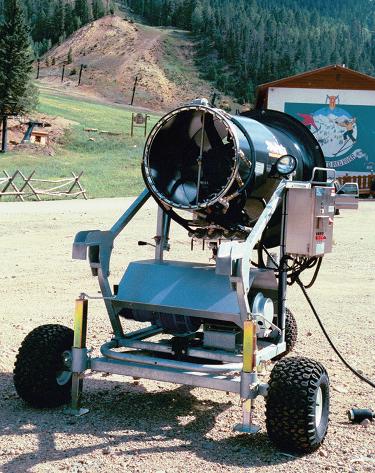
Producing ice in this way is also the principle behind modern snow-making equipment. A snow-producing machine like the one in Figure 1-7 can make snow by
evaporative cooling even when the temperatures on the ski slopes are above freezing.
Today, a majority of refrigeration systems use what is referred to as mechanical vapor compression. The mechanical process of compressing a gas to produce cooling can be traced back to coal mines in England. Large steamdriven or water-powered compressors were used to force air into the deepest mines so miners could work in a safe atmosphere. Over long hours of operation, miners observed the formation of ice around the air nozzles (Figure 1-8). This ice was collected and used for food preservation. The construction of steam-powered compressed-air plants that produced ice soon followed. The first maritime refrigeration units were made by putting steam-powered compressors on sailing ships to make it possible for beef to be shipped from Australia to England, starting in 1876.
Hvacr and the refrigeration cycle Now that you have a better understanding of what HVACR means, it is easy to see that it encompasses a broad spectrum of needs and applications. Although the methods for heating can vary considerably, the majority of cooling applications are based on the refrigeration cycle. When ice changes to water, heat
figure 1-6 Ice was first artificially produced to be used for food preservation more than 3,000 years ago.
figure 1-7 Snowblowers can produce artificial snow by evaporative cooling. (Courtesy of Red River Ski Area)
PIPE VALVE ICE AIR
figure 1-8 Ice forming around an air nozzle.
is absorbed, which makes ice a viable refrigerant. But ice is hard to store and takes up a lot of space. Water is easier to use because it can be pumped and doesn’t need the insulation that ice requires. When water evaporates to vapor it also absorbs heat, but then the water needs to be replaced, and this uses up a lot of water over time.
If the vapor can be recovered and turned back into water, then this cycle reduces the total amount of water needed (Figure 1-9). Even so, the major disadvantage with this type of evaporative cooling is that the lowest temperature that can be reached is dependent on the properties of water.
Notice that with both ice and water, it is their change of state that allows for heat to be absorbed. It is this important principle that serves as the basis for most refrigeration
systems today, but instead of using water, other fluids with different properties and lower boiling points, called refrigerants, are now used. This allows for much colder temperatures, far below freezing. The “refrigeration cycle” therefore continually evaporates and condenses refrigerants to absorb and then throw away the heat.
A compressor is used like a pump to raise the pressure and circulate the refrigerant through the system (Figure 1-10). A condenser is used to remove heat from the refrigerant as it turns into a liquid. An expansion device drops the pressure to allow the refrigerant to change back from liquid to vapor in the evaporator. Heat is absorbed in the evaporator and then thrown away in the condenser. The refrigerant does not wear out and circulates around and around during operation. Most refrigeration systems in use today operate using this type of cycle.
HEAT OUT
CONDENSATION
figure 1-9
HEAT IN
EVAPORATION
1.3 today’s Heating, air conditioning, and refrigeration
VAPOR TO LIQUIDLIQUID TO VAPOR
Water evaporates to vapor and absorbs heat, and then the vapor is condensed back to water to release its heat.
figure 1-10 The basic refrigeration cycle consists of four major components: compressor, condenser, expansion device, and evaporator.
LOW PRESSURE VAPOR
“Environmental heating and air conditioning” refers to the control of a space’s air temperature, humidity, circulation, cleanliness, and freshness, and it is used to promote the comfort, health, and/or productivity of the inhabitants. Homes, offices, schools, colleges, factories, sporting arenas, hotels, cars, trucks, and other vehicles such as aircraft and spacecraft are heated and cooled. The main purpose of environmental heating or cooling is to help maintain the body temperature within its normal range. Generally, the term air conditioning is used when the space temperature is above 60°F (15°C), and refrigeration is the term used when the space temperature is below 60°F (15°C).
Without our ability to control the environment, it would be impossible for us to explore space or the bottom of the ocean, or even to enjoy the comfort of a transcontinental jet ride at 35,000 ft. So, our ability to control our environment has served both to improve the quality of life and to enhance our scientific endeavors.
Process heating and cooling are used to aid in manufacturing or to keep equipment at a desired temperature. An area used to process meat or vegetables may be cooled to help preserve the product. Computer rooms are cooled so the equipment lasts longer and is able to stay online due to the heat being removed from the space. Computers would not operate properly if heat was not absorbed from the space. Remote pumping stations may be heated to prevent pipes from freezing. The main purpose of process heating or cooling is to maintain the temperature of things or processes within their required range.
tecH tip
An operating room is cooled to aid with the surgery as well as for the comfort of the patient or surgeon. Therefore, an operating room is an example of process cooling even though it may be within the normal air-conditioning temperature range.
Modern Heating
Central heating of homes and businesses dates back to ancient times, but the first commercial warm-air fan-driven system was marketed in the 1860s. By the 1900s a number of different central warm-air systems were available for residential and commercial applications, and in 1908, the essential elements for heating, cooling, humidifying, dehumidifying, and filtering air were defined.
Today central heating systems can use warm air, hot water, steam, electric resistance, or a reverse refrigeration cycle (heat pump). The basic theory for the heat pump dates back to 1852.
Modern air conditioning
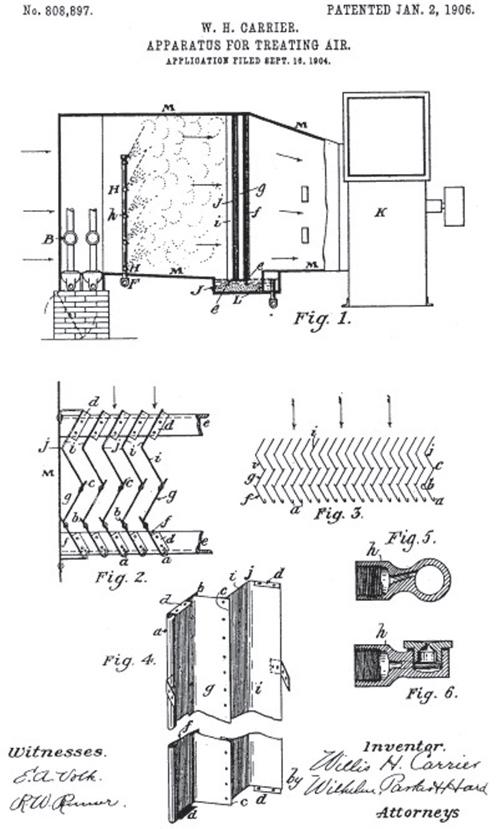
The development of modern air conditioning is often credited to Dr. Willis Carrier. Dr. Carrier, an engineer, was confronted with a problem facing printers. As paper was printed with one color, the dampness in the ink caused the paper to stretch slightly, and it was nearly impossible for the second color to be printed without being misaligned. Dr. Carrier determined that a means for controlling the humidity was necessary and developed the first airconditioning system for the printing industry. His invention, called an “Apparatus for Treating Air,” was patented in 1906 (Figure 1-11). His invention quickly found favor not only for dehumidifying but also for cooling. Through the 1940s and 1950s, businesses would proudly display signs reading “Air
Source: Patent Drawing for W. H. Carrier’s Apparatus
Conditioned.” Dr. Carrier designed the psychrometric chart as we know it today. (This chart displays the properties of air, such as temperature, humidity, and volume, and is commonly used for many HVAC applications.)
Mass air conditioning of homes began in the late 1950s with window air conditioners. Central residential air conditioning started to become popular in the mid-1960s. Today most of us cannot imagine living in a home anywhere in the country that does not have air conditioning.
Modern refrigeration
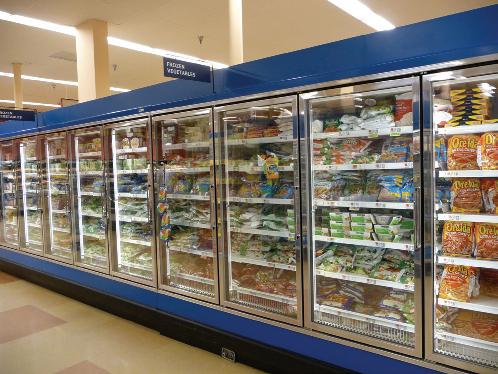
Clarence Birdseye made another major contribution to the industry. He developed the process of freezing foods in 1922. Today, supermarket freezer displays provide us with a variety of food products that would not be possible to preserve any other way (Figure 1-12). In 2006, a new era in eating occurred when the American public purchased more heat-to-eat and thaw-to-eat foods than any other type of food.
figure 1-11 The patent for the first apparatus for cooling air, invented by Willis Carrier.
for Treating Air, The National Archives Catalog
frozen foods Before Clarence Birdseye began commercially freezing food, people had allowed food to freeze naturally during the winter months as a way of preserving it for later use. Food frozen this way did not always taste that good, so the trick was to come up with a way of freezing food and having it still taste good when it was thawed.
Quick freezing The process of rapidly freezing food using air blast, contact, and/or immersion freezing was the key to improving the quality and taste of thawed frozen foods. The problem with freezing food slowly is that when ice crystals form over time, they become much larger. These large, sharp ice crystals grow through the cell walls of the food, and when the food thaws, all of the nutrients in the food are allowed to drain away. Quick freezing causes the ice crystals to be very small and less likely to penetrate cell walls, so the food retains nutrients and flavor when it is thawed.
1.4 eMployMent opportUnities
The HVACR industry represents one of the largest employment occupations in the country. Our industry, for example, is one of the largest consumers of electric and gas utilities in the nation. More electricity and natural gas is consumed producing heating and cooling than for any other single use. The size of the industry has been growing steadily since the late 1960s, when residential central systems became popular. The installation and servicing of HVACR systems will always be an expanding occupation. No one builds a home or business without some type of heating and/or cooling system, which requires designing, installing, and servicing by skilled and trained technicians.
residential air conditioning and Heating
Most residential heating systems have a heating capacity of 50,000 to 150,000 BTU/hr. The majority of residential air-conditioning systems are 5 tons or less. Both of these
To protect the public from potentially dangerous individuals, some businesses and/or local and state governments require criminal background checks on anyone involved with in-home service work. These checks may go back 25 years or more into an individual’s past. Check with your local or state governmental department that regulates inhome service work if you feel there is something in your past that might affect your ability to work in residential service. In most states these checks are only required for in-home service work, so you may still be able to work in new construction or in the commercial or industrial areas. sizes will obviously vary greatly, depending on the region of the country you are working in. In addition, there are many very large homes being built, requiring systems that could easily be classified as light commercial because of their size and/or complexity.
tecH tip
commercial air conditioning and Heating
The term commercial is used to refer to any system that is used in commercial buildings (for business) that provides cooling or heating. These systems may be as small as a fraction of a ton in size to several thousand tons in cooling capacity and/or from 1,000 BTU/hr to hundreds of thousands of BTU/hr.
Commercial systems may be operated independent of any other system or be integrated with a building automation system. Because of the vast differences in the types of equipment and system complexity, commercial technicians often specialize in a single type of system or group of systems.
commercial and industrial refrigeration
The terms commercial refrigeration and industrial refrigeration are applied to retail food and cold-storage equipment and facilities. Examples of commercial equipment and systems include refrigeration equipment found in supermarkets, convenience stores, restaurants, and other food service establishments. Industrial refrigeration can include long-term storage either as cold storage or medium or low-temperature refrigeration systems that are generally larger-scale operations.
types of jobs
There are a variety of occupational specialties offered within the HVACR industry. These occupations range from the basic entry-level helper to the systems designer. Although the work involved with heating, air conditioning, or refrigeration equipment and systems is similar in theory, there is a significant difference between the work done in the areas of residential, light commercial, commercial, and industrial. These areas of heating, air conditioning, and refrigeration generally relate to the size (capacity) and complexity of the system. However, technicians may find the exact same equipment used in one home being used in a commercial shop or factory. In these cases the distinguishing factor is whether you are working in someone’s home or in a business.
figure 1-12 Modern refrigeration display cases provide us with a variety of food products that would not be available without refrigeration.
entry-level helper The entry-level helper (firstyear apprentice) provides the senior technician with assistance installing and servicing equipment. Most medium and large mechanical contracting companies use a number of helpers to assist with the installation and service of residential and commercial systems. A helper may be expected to assist in lifting, carrying, or placing equipment or components. He or she may also run errands to pick up parts and clean up the area following installation or service. Helpers receive basic safety training, and if they will be driving, they must have good driving records.
rough-in installer The initial installation process is referred to as rough-in. In this process the technician (first- through third-year apprentice) will install the refrigerant lines, electrical lines, thermostat and control lines, duct boots, and duct run and set the indoor and outdoor units. The rough-in technician must have an understanding of duct layout, blueprint reading, and basic hand tools and good brazing skills.
start-up technician Once the system has been installed and all of the components are ready for operation, a start-up technician (fourth- and fifthyear apprentice) will go through the manufacturer’s recommended procedures to initially start a system. Because much of the HVAC system has been field installed, this checkout procedure is essential to ensure safe and efficient operation. The start-up technician records all of the information requested by the manufacturer’s warranty. Start-up technicians must be skilled with electrical troubleshooting and refrigerant charging and have good reading comprehension and writing skills.
service technician The service technician (fourthyear apprentice to journeyman) is the individual who provides the system owner with repair and maintenance. Service technicians are the people who must be able to diagnose system problems and make the necessary repairs. Service technicians must be skilled in diagnosing electrical problems, refrigerant problems, and air-distribution problems.
tecH tip
Technology has enabled the field tech to stay in close contact with his service manager. This allows the highly experienced service managers to provide assistance to technicians as they come upon new problems. The technician can also call upon the office to research unique problems to determine the best, most efficient way of making the repair.
sales HVACR sales are divided into two major categories: inside sales and outside sales. Inside sales deal primarily with system sales to other air-conditioning contractors. Outside sales may be to both contractors and end users. Working in outside sales or consumer sales requires the technician to have a good understanding of cost and value of equipment so that the owner can make an informed choice.
equipment operator Equipment operators are required by local ordinance and state law to be present anytime large central heating and air-conditioning plants are in operation. Their primary responsibility is to ensure the safe and efficient operation of these large systems. They must have a good working knowledge of the system’s mechanical, electrical, and computer control systems to carry out their job. They sometimes need to hold a city or state license to become an operator. Equipment operators generally work by themselves or as part of a small crew. They often are required to have good computer skills when buildings have computerized building-management systems. facilities maintenance personnel Facilitiesmaintenance personnel are responsible for planned maintenance and routine service on systems. They may work at a single location or have responsibilities for multiple locations, such as school systems. Facilities-maintenance personnel typically maintain systems and provide planned maintenance. They may work alone or as part of a crew, depending on the size of the facility. Maintenance personnel may from time to time have duties and responsibilities outside of the HVACR trades, such as doing minor electrical plumbing and carpentry projects for the upkeep of the building. service manager A service manager is typically a skilled HVACR technician with several years of experience. This individual oversees the operation of a company or maintenance department. He or she must have good management skills, communication skills, and technical expertise. Service managers typically assign jobs to other technicians and employees. They must then oversee these individuals’ jobs. systems designer For small buildings, contractors normally size and select HVAC systems and equipment. There are many industry-standard sizing and design guides available from trade associations such as the ACCA (Air Conditioning Contractors of America). For larger buildings, mechanical, architectural, or building services engineers may be required by law to design and specify the HVAC systems. Specialty mechanical contractors will work with the design plans to build and commission these systems.
1.5 trade associations
With the rapid growth and variety of interests, trade associations naturally evolved to represent specific groups. The list includes manufacturers, wholesalers, contractors, sheet metal workers, and service organizations. Each is important and makes a valuable contribution to the field. Space does not permit a detailed examination of all of these organizations, or all of their activities, but throughout the book many of these associations will be acknowledged as specific subjects are covered.
certifications
Many trade associations offer training programs and competency examinations for the industry to help ensure a workforce of qualified technicians. In addition, the 1990 Clean
Air Act passed by the United States Congress requires that anyone who performs maintenance, service, repair, or disposal that could be reasonably expected to release refrigerants must be certified. To become certified, technicians are required to pass an Environmental Protection Agency (EPA)–approved test given by an EPA-approved certifying organization. Four different types of certifications have been developed to address different types of equipment. A person meeting the requirements for all four types is issued a universal certification. This is certification process is further described in Unit 26, Refrigerant Management.
air-conditioning, Heating, and refrigeration institute (aHri)
The Air-Conditioning, Heating, and Refrigeration Institute (AHRI) is a national trade association representing manufacturers of over 90 percent of U.S.-produced central airconditioning, gas appliances, and commercial refrigeration equipment. AHRI was formed in 2007/2008 when ARI (Air Conditioning and Refrigeration Institute) merged with GAMA (Gas Appliance Manufacturers Association). ARI, now AHRI, was originally formed in 1954 through a merger of two related trade associations and traces its history back to 1903 when it started as the Ice Machine Builders Association of the United States. Today AHRI has over 180 companies as members. Many services are provided by AHRI to assist HVACR technicians. Some of these services, which would supplement this text, are as follows:
ICE is an industry competency exam. This test is made available to students of educational institutions to test their knowledge of fundamental and basic skills necessary for entry-level HVACR technician positions. The information in this text covers the topics in the AHRI curriculum guide and would assist the student in taking this examination. A directory of those who pass the examination is published nationally to assist prospective employers in identifying job candidates. Equipment donations to schools participating in the ICE competency exam. AHRI contacts industry sources having no-cost or low-cost equipment available to supply a school’s laboratory needs.
Technician certification program. In accordance with EPA’s enforcement of the Clean Air Act, the sale of refrigerants is made only to those technicians who have been certified. AHRI is among the many approved by EPA to administer the test for certification. In addition, AHRI provides study material to prepare for the test. Reclaimer certification program. EPA also requires certification of any processor of recovered refrigerant for resale. AHRI is among those assigned by EPA to carry out a certification program for companies that seek to reclaim refrigerants. Technicians handling reclaimed refrigerant should become familiar with the Directory of Certified Reclaimed Refrigerants, published every March and September by AHRI.
Certification program for equipment used to recover and recycle refrigerant. AHRI is one of the companies approved by EPA to certify equipment used to recover and recycle refrigerants. Technicians should become
familiar with the Directory of Certified Refrigerant Recovery/Recycling Equipment, published every March and September by AHRI.
HVACR equipment certification program. AHRI maintains a certification service, which tests a wide variety of equipment and products to verify the performance described by the manufacturer. Certified directories for various products are published semiannually and annually.
AHRI has a full program of educational activities geared toward helping the nation’s vocational and technical schools improve and expand their education and training programs. Under the direction of AHRI’s education director and its Education and Training Committee, AHRI serves as a resource for manufacturers, school instructors, department heads, and guidance counselors. In addition to this textbook and its companion materials, AHRI produces the Bibliography of Training Aids, a career brochure, and a promotional video for schools to use to recruit students into HVACR programs. Many schools around the country have adopted the ICE competency exams as final exams for their programs. AHRI’s most recent efforts involve participation in developing national HVACR competency standards. Having students pass the ICE competency exams and training toward national competency standards will improve the quality of installation and service. New HVACR technicians will be better prepared, resulting in three basic advantages:
Limited training required for contractors
Limited rework or repeat calls due to error
Limited warranty/replacement for manufacturers
The cost of repeat service calls, which is borne by contractors, may be reduced substantially by employing properly trained technicians. Every new technician receives training and serves as an apprentice for a period of time. That is essentially a period where contractors pay two people to do one job. A properly trained technician will generally require less training time and function sooner than a poorly trained technician.
In co-sponsorship with AHRI, ASHRAE holds an annual international Air Conditioning Heating Refrigeration Exposition, which may draw 30,000 to 50,000 people in the field. Product exhibits, technical displays, and business seminars highlight the event.
american society of Heating, refrigeration, and air-conditioning engineers (asHrae)
The American Society of Heating, Refrigeration, and AirConditioning Engineers (ASHRAE) is an organization started in 1904 as the American Society of Refrigeration Engineers (ASRE) with seventy members. Today its membership is composed of thousands of professional engineers and technicians from all phases of the HVACR industry. ASHRAE also creates equipment standards for the industry. Its most important contribution probably has been a series of four books that have become the reference books of the industry: HVAC Applications, Refrigeration, Fundamentals, and HVAC Systems and Equipment
tecH tip
Becoming an active participating member in a professional trade association will provide you with an opportunity to continue your HVACR education. The HVACR field is such a dynamic and evolving industry that to stay competitive you must continually attend seminars and take classes. This is a field where your success will depend on your continued education.
american society of Mechanical engineers (asMe)
The American Society of Mechanical Engineers is an organization composed of engineers in a wide variety of industries. Among other functions, ASME writes standards related to safety aspects of pressure vessels.
air conditioning contractors of america (acca)
The Air Conditioning Contractors of America is a service contractor’s association concerned with the education of technicians and service managers with business-improvement techniques. ACCA provides technician EPA certification.
refrigeration service engineers society (rses)
The Refrigeration Service Engineers Society is the international professional association for all HVACR workers and is dedicated to education and certification of technicians in the HVACR industry. RSES offers Specialist Certification for senior technicians in eight HVACR areas and has a technician EPA certification program. RSES chapters conduct classroom training in technical areas and are a source for educational printed material and books.
Hvac excellence
HVAC Excellence is a not-for-profit organization that has been serving the HVACR industry since 1994. The organization’s goal is to improve competency through validation of the technical education process by offering progressive levels of technician certification through its HVAC Excellence programs.
service tip
The AHRI list of certified equipment is available to anyone through the Internet. This material is very helpful when trying to make a determination of the best equipment to recommend for customers and their specific application needs. On the Web, very often all of the various pieces of equipment are available.
Unit 1—sUMMary
Since the beginning of time, people have had a desire to control their environment to live and work more comfortably. That trend will not stop, and that is the good news for anyone entering this ever-growing, financially rewarding, and personally satisfying field. HVACR technicians are required to understand the theories behind designing, installing, and servicing a wide range of systems. This diversity ensures that each day on the job will be new and unique, ever changing, and challenging.
Unit 1—review QUestions
1. List some of the different ways that homes and buildings may be heated.
2. What were some of the primary heating fuels that early civilizations used?
3. When is it believed that ice was first artificially made for food storage?
4. How did early man make ice?
5. Why did some manufacturers spray water in factories in the early 1700s?
6. How did early Romans cool palaces?
7. What do the terms environmental heating and air conditioning refer to?
8. What does the term process heating and cooling refer to?
9. When did central warm-air systems for residential and commercial applications become well defined?
10. Who developed what is referred to as modern air conditioning?
11. When did mass air conditioning of homes with window units begin?
12. Why is it important to freeze foods quickly?
13. Why do some businesses and/or local and state governments require criminal background checks for HVACR workers?
14. What size range might a commercial air conditioner fit into?
15. Give an example of some of the types of equipment that a commercial refrigeration technician might work on.
16. What type of things might an entry-level helper do?
17. Whose job is it to do the initial installation process, such as install the refrigerant lines, electrical lines, thermostat and control lines, duct boots, and duct run, as well as setting the indoor and outdoor units?
18. What skills must a service technician have?
19. What are some of the things that a service manager must be able to do?
20. What is the ICE exam, and who might take it?
21. What are some of the RSES’s activities?
Unit 2 Being a Professional HVACR Technician
Objectives
After completing this unit, you will be able to:
1. list some of the most popular HVACR publications.
2. explain the importance of professional certifications.
3. list the eleven specialty areas of NATE specialty certification.
2.1 intrOdUctiOn
The air-conditioning and refrigeration industry has more professional organizations, trade associations, publications, and other related organizations when compared to many other technical fields. As a student, you should consider becoming involved with a student organization such as the student clubs of ACCA, RSES, or ASHRAE. These will give you an opportunity to begin developing extremely important business and technical contacts in the local HVACR industry, and these contacts will serve you very well as you enter the profession.
As a professional in the trade, it is to your advantage to maintain a close relationship with one or more of these professional organizations. Each group provides its members with the latest trends and most current technical information. This gives members a significant edge. Most of the organizations provide ongoing technical and business training classes. Many of the classes cover the latest trends in equipment, regulations, codes and standards, local building regulations, and business practices. Being able as a member to participate in these ongoing educational opportunities will keep you at the leading edge of your new profession.
Each of these professional organizations has publications, and many provide the industry with codes and standards. These publications would be an excellent addition to your technical library. Having an up-to-date library will help you provide your employer and customers with the best possible service while making you significantly more valuable as an employee. HVACR is an ongoing learning process for even the most skilled technician.
Figure 2-1 lists a number of these professional associations. Most have Web sites, and many have local, regional, and state chapters that you can become affiliated with.
Many of the HVACR professional organizations have industrial trade shows. These shows provide excellent opportunities for you to see the various manufacturers’ latest equipment, tools, supplies, and services. Some of the trade shows are local, others may be regional, some are national, and a few are international (Figure 2-2).
4. explain the value of taking the Industry Competency Exam (ICE).
5. list the items that help make for a professional appearance while on the job.
6. describe how to develop good communication with the customer.
tech tiP
Once you enter the profession as an HVACR technician, all costs associated with taking additional classes, purchasing books, and membership dues may be tax deductible.
2.2 PUblicatiOns
Another excellent way of keeping up with the latest information in the HVACR field is by subscribing to one or more of the HVACR publications (Figure 2-3). Some of these publications are weekly, while others are monthly. They all contain well-written articles specifically addressing HVACR industry concerns. Many of them are written to teach their readers troubleshooting skills. Their articles are very valuable even to the skilled technician.
Some of the professional organizations have their own newsletters that are published and provided to their members. Some local and state chapters of these organizations have additional newsletters that are provided to their members.
2.3 PrOfessiOnal certificatiOn
Every HVACR technician must become certified under the EPA Section 608 regulations. Compliance with these regulations regarding the management of refrigerants is mandatory for everyone in the trade. Following your successful completion of any and all of the appropriate levels, it remains your responsibility to comply with any changes in these regulations. As unfair as it may seem, you can be fined significantly for violating an EPA regulation pertaining to refrigerants even if that regulation took effect after your successful completion of the certification. In addition, it is your sole responsibility to remember and follow all of the EPA regulations pertaining to refrigerant management. For
ACCA—Air Conditioning Contractors of America
AFEAS—Alternative Fluorocarbons Environmental Acceptability Study
AGA—American Gas Association
AHAM—Association of Home Appliance Manufacturers
AMCA—Air Movement & Control Association
ANSI—American National Standards Institute
AHRI—Air-Conditioning, Heating, and Refrigeration Institute
ARWI—Air-Conditioning & Refrigeration Wholesalers International
ASAE—American Society of Association Executives
ASHRAE—American Society of Heating, Refrigerating, and Air-Conditioning Engineers
ABC—Associated Builders & Contractors
BOMA International—Building Owners and Managers Association
COBRA—The Association of Cogeneration
CDA—Copper Development Association
COSA—Carbon Monoxide Safety Association
EEI—Edison Electric Institute
EPRI—Electrical Power Research Institute
EHCC—Eastern Heating & Cooling Council
Envirosense Consortium Inc.
EPEE—European Partnership for Energy and the Environment
FMI—The Food Marketing Institute
GEO—Geothermal Exchange Organization
GMA—Grocery Manufacturers of America
Green Mechanical Council
HARDI—Heating, Airconditioning, and Refrigeration Distributors International
HPBA—Hearth, Patio and Barbeque Association
HI—Hydraulic Institute
HRAI—Heating, Refrigerating, & Air-Conditioning Institute of Canada
HVAC Excellence
IDDBA—International Dairy, Deli, Bakery Association
IFPA—International Fresh-Cut Produce Association
IGSHPA—International Ground Source Heat Pump Association
IIAR—International Institute of Ammonia Refrigeration
IHACI—Institute of Heating and Air Conditioning Industries
ISA—The Instrumentation, Systems, and Automation Society
MCAA—Mechanical Contractors Association of America
MSCA—Mechanical Service Contractors of America
NACS—National Association of Convenience Stores
NADCA—National Air Duct Cleaners Association
NAHB—National Association of Home Builders
NAFEM—National Association of Food Equipment Manufacturers
NAM—National Association of Manufacturers
NATE—North American Technician Excellence Program
NRA—National Restaurant Association
NEMA—National Electrical Manufacturers Association
NFFS—Non-Ferrous Founders' Society
NIPC—National Inhalant Prevention Coalition
PHCC—Plumbing Heating Cooling Contractors Association
PIMA—Polyisocyanurate Insulation Manufacturers Association
PMA—Produce Marketing Association
RACCA—Refrigeration & Air Conditioning Contractors Association
RSES—Refrigeration Service Engineers Society
SMACNA—Sheet Metal and Air Conditioning Contractors' National Association
SMWIA—Sheet Metal Workers International Association
UL—Underwriters Laboratories Inc.
UA—United Association
CANMET—Canadian Centre for Mineral and Energy Technology
EPEE—European Partnership for Energy and the Environment
EUROVENT—European Committee of Air Handling & Refrigerating Equipment
ICARMA—International Council of Air-Conditioning and Refrigeration Manufacturers' Association
globalEDGE
IEA—International Energy Agency
IIAR—International Institute of Ammonia Refrigeration
IIR—International Institute of Refrigeration
JRAIA—Japan Refrigeration and Air-Conditioning Industry Association
LATCO's Tools of the Trade(Latin American international trade sites) Trade Compass
UNEP—United Nations Environment Programme
USA*Engage
World Bank
WTPF—World Trade Point Federation
figure 2-2 International Organizations.
The Air-Conditioning, Heating & Refrigeration (ACHR) News
American School & University (AS&U)
APPLIANCE magazine
Appliance Manufacturer
ASHRAE Journal
Buildings
Building Design and Construction
Consulting-Specifying Engineer
Contracting Business
Contractor magazine
Energy User News
Engineered Systems
Facilities Net
Heating/Piping/AirConditioning (HPAC)
Japan Air Conditioning, Heating & Refrigeration News (JARN)
Plant Engineering
RSES Journal
SchoolDesigns.com
Skylines
Supply House Times
Western HVACR News
figure 2-3 Publications.
that reason, it would be a good business practice to occasionally take a refresher course in EPA rules and regulations.
2.4 indUstry cOmPetency exam (ice)
The Air-Conditioning, Heating, and Refrigeration Institute (AHRI); the Air Conditioning Contractors of America (ACCA); Heating, Airconditioning, and Refrigeration Distributors International (HARDI); the Plumbing, Heating, Cooling Contractors Association (PHCC); North American Technician Excellence (NATE); the Partnership for Air-Conditioning, Heating, Refrigeration Accreditation (PAHRA); and the Refrigeration Service Engineers Society (RSES) have established a competency examination that is designed for students who have
completed or nearly completed a technical training program. This examination is voluntary, but it does provide students leaving a training program, whether from high school, trade school, or community college, with an opportunity to evaluate their knowledge with an industry standardized test.
The ICE has been developed over the years with input from manufacturers, trade associations, instructors, and other industry experts. This exam can also provide your institution with an overall evaluation of its training program. Upon your successful completion of the ICE, your name, along with your school’s name, is published and made available to area contractors who might be looking for new skilled employees. In short, the successful completion of the ICE can put you well ahead of other graduates from programs not participating in the ICE. The ICE is in three parts—Residential Heating and Air Conditioning, Light Commercial Heating and Air Conditioning, and Commercial Refrigeration. A good student will make testing and certification achievement a challenge for him- or herself, always setting goals high.
AHRI and its affiliates provide training institutions with incentives as encouragement to participate in the ICE by directing many of its manufacturing members’ equipment donation programs toward the schools, institutes, and colleges that participate in the ICE program. These equipment donations can become an excellent source of the latest equipment you will be seeing in the field.
2.5 skills Usa
Skills USA is a vocational industrial club for students in high schools, trade schools, and community colleges. Skills USA clubs are open to students in all areas of specialty, including HVACR. The national organization provides local chapters and students with many opportunities to develop leadership, citizenship, and interpersonal skills that are invaluable to the success of individuals in any profession. The Skills USA logo is shown in Figure 2-4a.
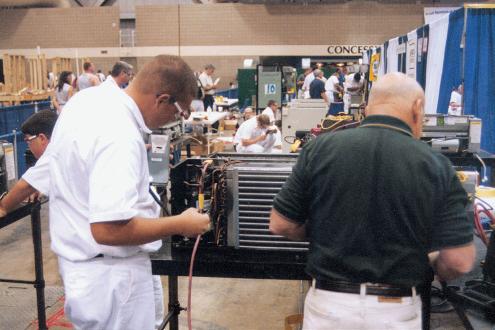
In addition to the opportunities for individual professional growth, Skills USA sponsors regional, state, national, and international skills competitions. The contestants for the HVACR competitions will be tested in the following areas: written exam, brazing skills, refrigerant component
different country each year. At the international competition, the best and brightest students from around the world compete to see who has the greatest knowledge and expertise in each of the technical areas, including HVACR. Every student who participates in these skills Olympics at any level receives recognition. Students involved in this program are shown in Figure 2-4b, c. This recognition is invaluable to the students because prospective employers value such recognition.
2.6 cOUncil Of air cOnditiOning and refrigeratiOn edUcatOrs (care)
The Council of Air Conditioning and Refrigeration Educators (CARE) is an organization that was founded in the late 1990s by a group of air-conditioning educators, counselors, and administrators responsible for the various aspects of HVACR training. This group is made up of individuals from secondary schools, post-secondary schools, and colleges, representing institutions from various regions of the country. The purpose of CARE is to educate to meet or exceed the needs of the industry.
CARE membership is open to instructors, counselors, and administrators who are involved in some aspect of HVACR training. Through this organization, individuals can come together to learn and share experiences for the betterment of the HVACR students and program.
2.7 nOrth american technical excellence (nate)
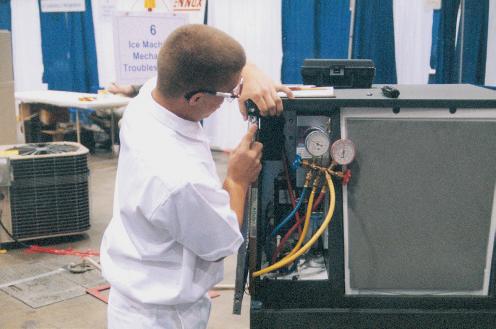
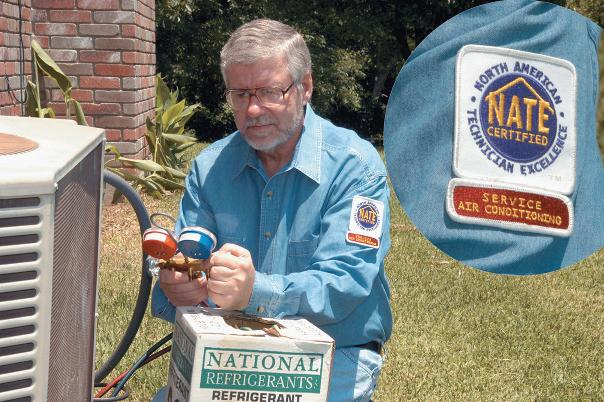
NATE is an independent, third-party certification body formed in 1997 as a result of a concern expressed by many in the industry that there was not a way of distinguishing quality, highly skilled HVACR technicians from every other person working in the field. NATE is supported by all of the major equipment manufacturers, major component manufacturers, professional and trade associations, and the National Skills Standard Board. Figure 2-5 shows a technician with a patch showing NATE certification working on a system. You can earn installation, service or senior certification in one or more of the following specialty areas:
1. Air conditioning
2. Air distribution
3. Air-to-air heat pumps
4. Gas furnaces
5. Oil furnaces
6. Hydronics gas
7. Hydronics oil
service, air measurement and troubleshooting, refrigerant recovery, and electrical troubleshooting. Various industry equipment used may include ice machines, refrigerated display cases, small package HVAC units, furnaces, and split-system air-conditioning units. These skills competitions are available on the secondary and post-secondary levels. By participating in the competition, students are given the opportunity to demonstrate their troubleshooting skills in diagnosing real-world problems under the supervision of highly skilled individuals serving as judges.
The winners of local, state, and national competitions move on to the international skills competition held in a
8. Light commercial refrigeration
9. Commercial refrigeration
10. Ground source heat pump loop installer
11. HVAC efficiency analyst (Senior Level)
Installation certification is primarily designed for the technician who is involved with the installation or removal of HVAC equipment. Installers assemble the system and fabricate the necessary connections to complete an efficient system. They also set up the operational controls under the supervision of a service technician. After the system is started, the installation technician records the readings for
(a)
(c)
(b)
figure 2-4 (a) Skills USA logo; (b,c) Students competing in the National Skills Olympics.
figure 2-5 NATE-certified airconditioning technician checking the refrigerant charge in a residential system.
temperature, pressure, voltage, current, and any other measurements required by the manufacturer or service company for the completion of the warranty paperwork.
The service technician must have all of the skills of the installation technician plus be able to work independently. Service technicians must be able to perform field diagnostics to determine the cause of system failures and to make the needed repairs.
In addition to having the technical skills required to pass the various areas of specialization, each technician must take a core exam as part of the exam process. The core test covers basic math, customer relations, comfort, heat transfer, and the fundamentals of electricity. A welltrained, experienced technician should be able to take and pass both the core and area specialty exams. A number of organizations provide NATE pretest tutorial classes to bring technicians’ skill levels up to pass the exam. The exam passing score is 70 percent or better. Certification lasts for five years, after which time a technician must recertify. There are many classes that qualify for credits that can be used toward recertification. If a technician receives 60 hours of credit, the technician does not have to take a test at five years. If the technician obtains 30 credit hours, he or she will only be required to take a fifty-question specialty test instead of a hundred questions.
NATE recommends that you have at least one year of field experience before taking an installation series test and at least two years of experience before taking a service series test. It is further recommended that you have some instruction from an educational institution or trade association.
NATE has provided technicians with Knowledge Areas of Technician Expertise (KATEs), which give detailed
outlines of all of the material that a technician can expect to be questioned about on an exam. These KATEs represent all of the knowledge and skills that a quality HVACR technician should have. The KATEs also help the prospective test candidate to focus on those areas that the industry feels are most important.
2.8 hvac excellence
HVAC Excellence established the national standards for HVACR programs in the summer of 1999, becoming the industry’s first accrediting body. Programmatic accreditation is an independent third-party review of an educational program. This begins with experienced auditors conducting an on-site visit at each school applying for accreditation. The process validates that established standards of excellence for HVACR educational programs are met. Standards require a thorough examination of mission of the program, administrative responsibilities, finances and funds, curriculum, plan of instructions, facilities, equipment and tools, cooperative training, and instructor’s qualifications.
2.9 cOdes and standards
There are many organizations and agencies that provide codes that are used throughout the HVACR industry, and Figure 2-6 lists many of them. In addition to codes, these groups provide standards. The difference between a code and a standard is that codes often carry with them the force of law, and standards do not. Organizations providing standards to the HVACR industry are listed in Figure 2-7.
International Association of Plumbing and Mechanical Officials (IAMPO)
International Code Council (ICC)
International Fire Code Institute (IFCI)
National Conference of States on Building Codes and Standards (NCS/BCS)
National Fire Protection Association (NFPA)
figure 2-6 Code groups.
AFNOR—Association Francaise de Normalisation
ANSI—American National Standards Institute
BSI—British Standards Institution
CSA International—Canadian Standards Association
DIN—Deutches Institut für Normunge. V.
CEN—The European Committee for Standardization
CENELEC—The European Committee for Electrotechnical Standardization
EU—European Union
IEC—International Electrotechnical Commission
ISO—International Organization for Standardization
JIS—Japanese Industrial Standards
NSSN—National Standards Systems Network
SASO—Saudi Arabian Standards Organization
SES—Standards Engineering Society
DOE-EERE—Department of Energy, Energy Efficiency and Renewable Energy
FCIC—Federal Citizen Information Center
NATE—North American Technician Excellence Program
CEE—Consortium for Energy Efficiency
Many consumer groups over the years have worked with HVACR industry leaders to help the industry provide consumers with the most efficient and effective service. Some of these consumer information groups are listed in Figure 2-8.
2.10 the PrOfessiOnal technician’s aPPearance
As a service technician you are seen by the customer as a representative of your company. Customers often assume the appearance and professionalism of the technician is a reflection on the technician and company’s technical skills. It is therefore important that you present yourself professionally, in a very clean and neat manner, to the customer. In some cases you might find during the course of the day that your uniform becomes soiled. It is therefore a good idea to carry at least an extra clean shirt in the service van so that you can change if necessary.
If your company does not provide uniforms, you should dress appropriately. In some cases, blue jeans and a jersey or denim shirt are acceptable. In other cases, where you might be working in an office building, slacks and a shirt would be appropriate. Check with your employer to see what the company dress code is. In addition to your clothing, you must have a clean and neat personal appearance. That means clean, well-kept hair and either being clean shaven or having a well-kept beard for men, and clean hands for everyone.
You must keep your service vehicle clean and neat. It is a rolling billboard for your company, and it is important that it look sharp. A clean service van provides a better, more efficient work area, making it easier to find tools and supplies, and it also makes a better impression on the customer. Unless you have permission from residential customers, you should not park your service vehicle in their driveway. Always make it a habit to park your vehicle on the street. You do not want to be responsible for cleaning up an oil spill, and your vehicle can obstruct their access, which to some customers is very aggravating.
figure 2-7 Standards associations.
figure 2-8 Consumer information.
When you present yourself to a customer’s door, you should have your hands in plain sight either at your side or holding your tools and clipboard. When the customer opens the door, if you take one step back, it will give the customer a greater sense of comfort. Many companies provide photo ID badges, and you must have yours clearly displayed. If it is necessary for you to enter a dwelling for service, ask permission from the homeowner before entering.
2.11 WOrking neat
Some companies provide technicians with paper shoe covers to prevent tracking dirt into residences. If you suspect your shoes are dirty, either remove them or use the covers. You and your company can be responsible for cleaning the carpet if it becomes soiled. When working on an indoor furnace, place a drop cloth on the floor in front of the furnace so that any debris will be contained. When you are finished working in the furnace area, a small battery-powered vacuum cleaner can be used to pick up loose dirt and debris in the area. Use a damp rag to wipe down any fingerprints that are on the equipment or that may be on the door or woodwork.
Cleaning up the equipment area in a residence is an excellent PR move. You should vacuum up all of the debris in the area. Many customers judge your work by appearance, and all they may understand is neat and clean. When changing out a unit, electricians or plumbers may also be involved. You should clean up any mess even if you did not make it. Leaving behind a mess will reflect on you, since the final repair is still your responsibility.
In many residences, the air handler is located in an attic. If access to the unit is through a pulldown staircase, make certain that any dirt or debris that falls from the
stairs when it is pulled down is cleaned up. If you are going to be going in and out of the attic a number of times during the service, place a drop cloth on the floor below the stairs to catch any insulation or other debris that might fall on the floor. Do not attempt to carry a large number of tools up and down the stairs. This can cause you to be caught off balance and possibly drop your toolbox. In addition, most attic stairs have a weight limit that could be exceeded by you and a large toolbox. Attic stair treads, like any ladder, are strongest next to the side rail. For that reason, when you ascend and descend the stairs, place your foot as close as possible to the side next to the side rail to reduce the possibility of breaking the stairs. Always be careful in an attic so that you do not step through the homeowner’s ceiling.
Many customers have extensively landscaped their homes, including the area around an outdoor condensing unit. Even though their landscaping may encroach within the manufacturer’s recommended free air space around the unit, do not remove this landscaping. Notify the homeowner as to how it should be trimmed so that they or their landscaper can remove the vegetation. When working around vegetation, it is important that you be as careful as possible so as not to damage any plants. On very soft, wet ground your repeated trips to the service van can wear a path. To avoid this, each time you have to cross soft, wet ground, take a slightly different route when possible. It is considered bad practice to leave packaging and boxes left over from the installation of new equipment in the customer’s trash receptacles. This material should be taken with you so as not to overload their receptacle.
tech tiP
Working in air conditioning and refrigeration is often a very hot job. From time to time customers may offer you a glass of water, tea, or cold drink. Use your discretion on accepting these offers. However, it is never appropriate for you to accept a beer or other alcoholic beverage from a customer. Even if you do not open the drink but take it with you, you have significantly damaged your credibility with the customer and your boss. If you take a beer, even though you do not drink it, and there is a problem with the service you provided the customer, the first thing the customer is going to tell your boss and everyone else is that you were drinking on the job, in spite of the fact that they gave you the beer. Do not take any alcoholic beverages that are offered by customers.
2.12 technician and cUstOmer cOmmUnicatiOn
A large part of the technician’s job is to educate the customer as to the problem that was found and the available options for its repair. Tell the customer what failed, why it failed, and the options to fix the problem. Do not simply tell the customer that they need a part and that you are going to replace it.
Many customers would like an estimate of the job’s cost. In some municipalities you are obligated under consumer protection laws to provide customers with such a quote. In some cases the quote must be in writing. If, however, as part of your service you uncover a situation that could not have been foreseen or was not visible in your initial evaluation that will require additional work, immediately stop and inform the customer of the new problem. Do not simply make the repairs and expect the customer to accept the higher charge at the conclusion of the job.
tech tiP
If you locate an additional problem or pending problem with a customer’s system and, after notifying the customer of your concerns, they choose not to have you provide that repair, you should note that on the customer’s invoice as part of your service call recordkeeping and get them to sign the acknowledgment.
Under no circumstance should you tell a customer that the previous technician messed up their system when they did the last service. All that will result from such statements is the loss of faith the customer may have in you and your professionalism; but, more important, you might find out that one of your colleagues who works for your company did the last service job.
tech tiP
Good professional technicians never knock the competition. Their skill and knowledge will set them apart from everyone else without the need to brag.
One of the primary complaints customers have on any service call is punctuality. It is not always possible to be at a job exactly when you anticipated being there, as earlier service calls may take more time than you initially estimated. However, as soon as you realize you are not going to make the schedule, and as early as possible, let the customer know and give them an opportunity, if they so choose, to reschedule. If you do reschedule, you must be at the next scheduled appointment on time.
It is also extremely important that you provide a very clear, clean, and legible invoice or bill to the customer. If it is necessary for you to get prices, look up information, or check your spelling, you should do all of that in your service vehicle and not in front of the customer. Even though you may not be a literary expert, customers do expect you to provide them with clear, concise, well-written statements. If you have a problem writing clear and concise statements, you may want to invest in a PDA (personal digital assistant) device. There are many of these devices on the market, and many can have spell-check and writing programs installed.
Some air-conditioning and refrigeration work in the summer requires that the technician work in relatively hot environments such as attics or buildings without working air-conditioning systems. To prevent heat stress injury, it is important that you guard against dehydration by drinking large quantities of water or sports drinks. You must drink enough so that you have to use the restroom at least once every couple of hours throughout the day. In addition to dehydration, you may also develop kidney and bladder problems if you do not drink enough fluids while working in hot environments.
Carbonated beverages, milk, fruit juice, beer, and many other beverages do not replace the body’s electrolytes. Without replacing the electrolytes, you can feel fatigue and may experience cramps. For that reason, only sports drinks with the essential electrolytes and water are recommended as your primary drinks when working in the heat.
Unit 2—sUmmary
You should become familiar with the various professional organizations and trade associations that support the air-conditioning and refrigeration industry and consider joining those that are suitable to your career goals. Read the many available publications so that you may keep upto-date with the latest changes in industry practices and standards.
As a refrigerant technician, you must become certified under EPA Section 608 regulations. To further demonstrate your ability as a service technician, you may also consider taking an industry standardized test such as the Industry Competency Exam (ICE). There are also certification programs such as North American Technical Excellence (NATE) that allow you to focus on specialty areas.
Always remember to present yourself to the customer as a neat and clean professional. Carry an extra set of clothes in the event you need to change because your uniform becomes soiled. Think of using paper shoe covers rather than tracking dirt across the customer’s carpet. Finally, always be polite to the customer and make sure
that you communicate clearly. A large part of your job is to provide guidance for the customer by explaining the nature of the equipment-related problem. Be prepared to tell the customer what failed, why it failed, and the options to fix the problem.
Unit 2—revieW QUestiOns
1. List three student organization clubs.
2. What does RSES stand for?
3. What does ACCA stand for?
4. What does AHRI stand for?
5. What does ASHRAE stand for?
6. What does NATE stand for?
7. What section of the EPA regulations requires technician certification?
8. The ________ has been developed over the years with input from manufacturers, trade associations, instructors, and other industry experts.
9. What is the name of the vocational industrial club for students in high schools, trade schools, and community colleges?
10. What organization was founded in the late 1990s by a group of air-conditioning educators, counselors, and administrators responsible for the various aspects of HVACR training?
11. List the eleven specialty areas for the NATE service technician certification program.
12. The core exam for the NATE certification program covers what topics?
13. What is the difference between a code and a standard?
14. What precaution should be taken if you find that during the course of the day your uniform becomes soiled?
15. When might it be necessary for you to use a drop cloth?
16. When making a repair, what information should you relay to the customer?
17. If you locate an additional problem or pending problem with a customer’s system and they choose not to have you provide that repair, what should you do?
18. What is one of the primary complaints that customers have regarding service calls?
19. Why are many common drinks, such as sodas, not adequate for your protection against heat stress injury?
20. When would it be appropriate to tell the customer that the previous technician messed up their system when performing the last service call?
Unit 3 Safety
Objectives
After completing this unit, you will be able to:
1. explain how to work safely to avoid accidents.
2. discuss the material that appears on all Safety Data Sheets (SDSs).
3. discuss how to safely use hand and power tools.
4. discuss how to practice safety in the shop.
5. describe four types of fire extinguishers.
6. demonstrate a safe method of lifting heavy objects.
7. discuss safe welding and cutting practices.
3.1 intrOdUctiOn
In every trade, safety is a major concern, and safety is everyone’s first job responsibility. Accidents, no matter how minor, can cost the technician, the company, and the customer unnecessary losses of time and money. There is no reason to feel that accidents are inevitable and something you must just accept. Good working habits, good tools, and being vigilant to potential hazards can virtually eliminate accidents. Never do anything you feel is unsafe. When working with new equipment or tools, read all the safety instructions and follow them.
Most companies require some type of safety training for all their employees. In addition, some of the businesses where you may be asked to do HVACR work at may have their own safety program that you must pass before beginning work at their site.
Most accidents are caused by carelessness, as well as lack of awareness of proper safety procedures. This unit deals with some of the basic safety tips and procedures the installer and service technician should follow—whether on the job site or at related locations where hazards could exist; additional specific safety facts are covered in each unit. Read and follow all safety rules.
3.2 PersOnal PrOtective eqUiPment
Personal protection equipment (PPE) is designed to reduce your exposure to hazards that cannot be eliminated or controlled. PPE may include equipment or devices to protect your head, face, eyes, ears, respiratory system, hands, and feet. Some devices, such as safety glasses, are commonly used, while others, such as respiratory protection, may be less frequently used.
If PPE is required for any job, OSHA (Occupational Safety and Health Administration) recommends that all
8. discuss electrical safety rules.
9. discuss the safe use of refrigerants, their storage, and proper disposal.
10. tell how to safely handle refrigerant cylinders.
11. discuss refrigerant system safety.
12. name three major hazards of pressure vessels.
13. discuss how a technician’s driving record can affect employability.
14. tell what steps should be followed in case of an accident.
employees be trained. This training may be as short as a few minutes or as long as several hours or more. The length of the training time depends on the level of hazard and the complexity of the PPE to be used.
Keeping all PPE clean and in good working condition is essential to ensure that, when needed, it will work properly.
Head Protection
An approved hard hat (Figure 3-1) should be worn whenever there is a danger of things dropping on the head or where the head may be bumped. On a construction site, proper safety head gear is a must.
eye and Face Protection
The majority of eye injuries are the result of flying or falling objects. Most of these objects are smaller than the head of a pin but can cause serious injury. Approved eye or face protectors (Figure 3-2) must be worn whenever there is
Figure 3-1 Hard hats are required to be worn on many job sites.
Figure 3-2 Eye protection equipment: (a) these safety goggles can be worn over glasses; (b) safety glasses with side protection.
a danger of objects striking the eyes or face. Side shields must be part of any safety glasses worn, even if they are prescription eyeglasses. Safety glasses or goggles must be worn over prescription eyeglasses if they do not have side shields. Eye and face protectors come in various shapes and sizes, and some of them are very specialized.
Special eye protectors must be worn when arc welding, spot welding, and burning to cut out harmful light radiation. These special face visors come with various shades of viewing eyepieces that filter out the harmful emissions. Take time to identify the right one for the job. For example, never wear oxyacetylene welding goggles when an arc welding face shield is needed.
Confine long hair and loose clothing before operating rotating equipment.
tecH tiP
To control insurance costs, many air-conditioning companies have adopted very stringent policies on personal protection equipment. Unlike your shop teacher, who may have reminded you each day about safety glasses, ear protection, and so on, many employers may terminate you with a single safety infraction. Others may warn you once or twice about wearing proper safety equipment while working. But no HVACR companies are going to give you unlimited warnings before your employment with them is terminated. These policies are good for you and the company, because they reduce the likelihood of your being injured on the job.
ear Protection
Hearing protection devices (Figure 3-3) must be worn whenever there is exposure to high noise levels of any duration. These devices are of two types: (1) ear plugs, which are inserted in the ear, and (2) headphones, which cover the ear. Either one must be properly selected on the basis of how much protection is required.
respiratory Protection
There are two main types of respirators, as shown in Figure 3-4: (1) air-purifying respirators are ones that purify the air by filtering out harmful dust, mist, metal, fumes, gas, and vapor; and (2) atmosphere-supplying respirators are ones that supply clean breathing air from a compressed
Figure 3-3 Ear protection equipment: (a) disposable earplugs on a lanyard (that fits around the neck) allow for easy removal and reuse; (b) headphones protect both ears and hearing; (c, d) disposable, one-time-use earplugs.