Toward Behavioral Transaction Cost Economics: Theoretical Extensions and an Application to the Study of MNC Subsidiary Ownership 1st ed. Edition George Z. Peng
No part of this book may be reproduced or transmitted in any form or by any means, electronic or mechanical, including photocopying and recording, or in any information storage or retrieval system, without the prior written permission of Stanford University Press.
Studies of the Harriman Institute
Publication of this book is supported in part by the Harriman Institute at Columbia University.
Printed in the United States of America on acid-free, archival- quality paper
Library of Congress Cataloging-in-Publication Data
Names: Hamed-Troyansky, Vladimir, author.
Title: Empire of refugees : North Caucasian Muslims and the late Ottoman state / Vladimir Hamed-Troyansky.
Description: Stanford, California : Stanford University Press, 2024. | Includes bibliographical references and index.
Identifiers: LCCN 2023018074 (print) | LCCN 2023018075 (ebook) | ISBN 9781503636965 (hardcover) | ISBN 9781503637740 (paperback) | ISBN 9781503637757 (epub)
LC record available at https://lccn.loc.gov/2023018074
LC ebook record available at https://lccn.loc.gov/2023018075
Cover design: Gabriele Wilson
Cover art: Zaina F. El- Said, Family Tree, 2022, collage, 42 x 60 cm A2, Amman, Jordan
For Ronny
This page intentionally left blank
ILLUSTRATIONS AND TABLES
MAPS
1 Ottoman Empire and the Caucasus, 1864 xx
2 Ethnic groups in the Caucasus, c. 1850 13
3 North Caucasian villages in Anatolia, the Levant, and Iraq 73
4 Danube Province, 1867 92
5 Ottoman Transjordan, 1914 123
6 Ottoman Uzunyayla, 1914 160
7 Khutats’ correspondence, 1890–1905
8 Caucasus Viceroyalty, 1878
FIGURES
1 Circassians in Istanbul
2 Circassian displacement in Russian art
3 Ottoman Amman
4 Şerife, Hanife, and Cevat Khutat
5 Fuat Khutat
6 Ottoman Aziziye
7 Şerife, Fuat, and Şefika Khutat
8 Cevat Khutat
9 Blueprint of a mosque for refugees
1 North Caucasian refugees, 1858–1914
2 Taxes in Babadağ District, 1873– 77
3 Property in the town of Babadağ, 1877
4 Household economy in Berkofça District, 1873
5 Shops purchased in Amman, 1891–1912
6 Houses purchased in Amman, 1889–1912
7 Inventory of Hajj Islam’s inheritance, 1901
8 Land prices in Circassian villages in Transjordan, 1891–1912
9 Chechen returnees to Russia, 1867– 71
10
11 Returnees to the Caucasus, 1860–1914
NOTES FOR THE READER
TRANSLITERATIONS
This book relies on many sources in Ottoman Turkish, Arabic, Russian, and Bulgarian. I transliterate Ottoman Turkish using Modern Turkish orthography, without diacritics. For Arabic, I adopt the transliteration system of the International Journal of Middle East Studies, marking ʿ ayn as ʿ and hamza as ʾ. For Russian and Bulgarian, I use the Library of Congress transliteration systems. Transliterations from Circassian (both Adyghe and Kabardian) are based on the romanization system adopted by the United States Board on Geographic Names and the (British) Permanent Committee on Geographical Names.
The names of less-known geographic localities are transliterated according to the rules outlined for modern Turkish, Arabic, and Russian: respectively, Pınarbaşı, Naʿur, and Temir-Khan-Shura. For the names of well-known locations, I use standard English spellings: for example, Istanbul not İstanbul, Amman not ʿAmman, Nalchik not Nal’chik.
Mohydeen Quandour; Mohammad Kheir and Nart Pshegubj; Janset Berkok Shami; Dasi Amin Shamseddin; Nawriz Shapsough; Akram Qursha; and the Asendar, Janbek, Khurma, Mufti, and Qursha families.
In Turkey, Murat Papşu and Zeynel Abidin Besleney shared their vast knowledge of the Circassian diaspora’s history and politics. For their friendship and guidance, I thank Elbruz Aksoy in Istanbul, Bislan Jalouqa in Ankara, Neslihan Kaplan in Kayseri, and Abidin İnci and his family, who hosted me in the magnificent mountain valley of Uzunyayla. Muhittin Ünal, Tsey Rengin Yurdakul, and Ebubekir Kızık facilitated my research in, respectively, Kafkas Araştırma Kültür ve Dayanışma Vakfı, Şamil Eğitim ve Kültür Vakfı, and Kafkas Vakfı. I also learned from Sevda Alankuş, Nihat Berzeg, Sefer Berzeg, Jade Cemre Erciyes, Erol Karayel, Kuban Kural, Ömer Aytek Kurmel, Ergün Özgür, Nefin Şakarcan, Metin Sönmez, and Rahmi Tuna.
In Russia, Vladimir Bobrovnikov warmly welcomed me at the Institute of Oriental Studies in Moscow. I also thank Alikber Alikberov, Yuri Anchabadze, Fasikh Baderkhan, Anastasia Ganich, Zaira Ibragimova, Madina Pashtova, Jamal Rakhaev, Mikhail Roshchin, Aleksandr Vasil’ev, and Ilya Zaytsev. In the North Caucasus, I had the good fortune of receiving advice from Anzor Kushkhabiev, Adam Gutov, and Murat Tabishev in Nalchik; Georgy Chochiev in Vladikavkaz; and Makhach Musaev, Shamil Shikhaliev, Amir Navruzov, Madina Abdulaeva, Amirkhan Magomeddadaev, and Magomedkhan Magomedkhanov in Makhachkala.
In Bulgaria, Margarita Dobreva patiently helped me to find my way through the largest Ottoman archive in the Balkans. Grigor Boykov, Petar Dobrev, Gergana Georgieva, Rossitsa Gradeva, Stoyanka Kenderova, and Ventsislav Muchinov generously gave their advice and expertise. I further extend my gratitude to every archivist and librarian, in every location during my research, who endured my queries, shared their knowledge, and brought out unending piles of documents. Without your work, this one would never exist.
For over a decade, Joel Beinin has been a wonderful friend and source of inspiration. He read many drafts and struck a beautiful balance between providing steady guidance and total freedom to explore, think, and craft. I now get to do daily what I love the most, and this is possible thanks to you, Joel. Ali Yaycıoğlu expanded my vision of the Ottoman world and its
awe-inspiring mobility. He enthusiastically encouraged every archival adventure. Robert Crews reintroduced me to the Russian Empire, an empire that seemed equally familiar and foreign when looking at its southern borderlands. Norman Naimark made me think harder about how we write and what is at stake. Shahzad Bashir, Paula Findlen, Burcu Karahan, Nancy Kollmann, Martin Lewis, Khalid Obeid, Aron Rodrigue, Kären Wigen, and many others at Stanford University enriched this book in various ways.
Beautiful places and brilliant people helped to shape this work. This book was conceived in three magnificent cities: Istanbul, Amman, and Tbilisi. I first put the stories of remarkable individuals of this book on paper while living in northern California and doing regular Amtrak commutes between the Bay Area and the Sacramento Valley. Suad Joseph welcomed me to a vibrant community of Middle East scholars at the University of California, Davis, which I will always cherish. Baki Tezcan, Keith Watenpaugh, and Heghnar Zeitlian Watenpaugh provided great camaraderie. While on a research fellowship at Columbia University’s Harriman Institute, I embarked on writing a transimperial history of migration, bridging scholarship on the Middle East, the Balkans, the Caucasus, and Russia, further buoyed by sparkling conversations with Catherine Evtuhov, Jane Burbank, Rashid Khalidi, Zachary Lockman, Mark Mazower, Elidor Mëhilli, and Larry Wolff. Writing continued in the Deep South, as I moved to Furman University in Greenville, South Carolina. There, in the stunning foothills of the Blue Ridge Mountains, I realized that my book captures the making of the Ottoman refugee regime. The manuscript took its final shape at the University of California, Santa Barbara. I am grateful for Sherene Seikaly, Adrienne Edgar, Anshu Malhotra, Bishnupriya Ghosh, Paul Amar, Charmaine Chua, Stephan Miescher, Dwight Reynolds, Shiva Balaghi, and other colleagues, with whom we are building vibrant Middle Eastern, migration, and global studies communities in an idyllic place between the Santa Ynez Mountains and the Pacific Ocean.
At UC Santa Barbara, with support from the UC Humanities Research Institute, I hosted a manuscript workshop. I am deeply grateful to Adrienne Edgar, Stacy Fahrenthold, Reşat Kasaba, and Michael Provence for their insightful feedback and for pushing me to redraft, deepen, and clarify. Sherene Seikaly provided invaluable suggestions and continues to model what intel-
lectual generosity looks like. I benefited from feedback by Kristen Alff, Catherine Baylin Duryea, Basma Fahoum, and Rebecca Gruskin, my brilliant and beloved academic siblings, who witnessed every stage of this project; Rhiannon Dowling and Nana Osei- Opare, my daily writing partners through the pandemic; and Jacob Daniels, Jennifer Derr, Samuel Dolbee, Koji Hirata, and Michelle Lynn Kahn.
I thank Stanford University Press for turning this manuscript into a beautiful book. It has been a privilege working with Kate Wahl, Gigi Mark, Cat Ng Pavel, Athena Lakri, and the rest of the team. I owe a debt of gratitude to the peer reviewers. Bill Nelson produced beautiful maps. Zaina ElSaid, whose art is inspired by Circassian heritage and whose family I met in Amman, kindly allowed her breathtaking work to be featured on the book cover.
Many scholars shared their advice, feedback, and friendship over the years. I thank Myriam Ababsa, Raouf Saʿ d Abujaber, Patrick Adamiak, James Altman, Leyla Amzi-Erdoğdular, Alexander Balistreri, Nora Barakat, Timothy Blauvelt, Olga Borovaya, Fırat Bozçalı, Lâle Can, Dawn Chatty, John Colarusso, Camille Cole, Nazan Çiçek, Markian Dobczansky, Julia Elyachar, Tolga Esmer, Heather Ferguson, Sarah Fischer, Ella Fratantuono, Ryan Gingeras, Krista Goff, Chris Gratien, James Grehan, Zoe Griffith, David Gutman, Marwan Hanania, Peter Hill, Peter Holquist, Yasemin İpek, Aaron Jakes, Toby Jones, Eileen Kane, Cynthia Kaplan, Ceyda Karamürsel, Kemal Karpat, K. Mehmet Kentel, Akram Khater, Ilham Khuri-Makdisi, Masha Kirasirova, Hakan Kırımlı, Abdulhamit Kırmızı, Sandrine Kott, Selim Kuru, Jean-Michel Landry, Margaret Litvin, Anaïs Massot, Adam Mestyan, James Meyer, Eiji Miyazawa, Leslie Page Moch, Oktay Özel, Ramazan Hakkı Öztan, Uğur Zekeriya Peçe, Eda Pepi, Victor Petrov, Michael Reynolds, Laura Robson, Eugene Rogan, Sergey Salushchev, Cyrus Schayegh, Nir Shafir, Seteney Shami, Hind Abu al-Shaʿr, Lewis Siegelbaum, Will Smiley, Ulaş Sunata, Ronald Grigor Suny, Şölen Şanlı Vasquez, Tunç Şen, Philipp Ther, Ehud Toledano, Alexandre Toumarkine, Max Weiss, Amanda Wetsel, Benjamin Thomas White, Anna Whittington, and Sufian Zhemukhov.
The research and writing of this book were supported by the Social Science Research Council International Dissertation Research Fellowship, the American Council of Learned Societies and the Mellon Foundation Disser-
This page intentionally left blank
Empire of Refugees
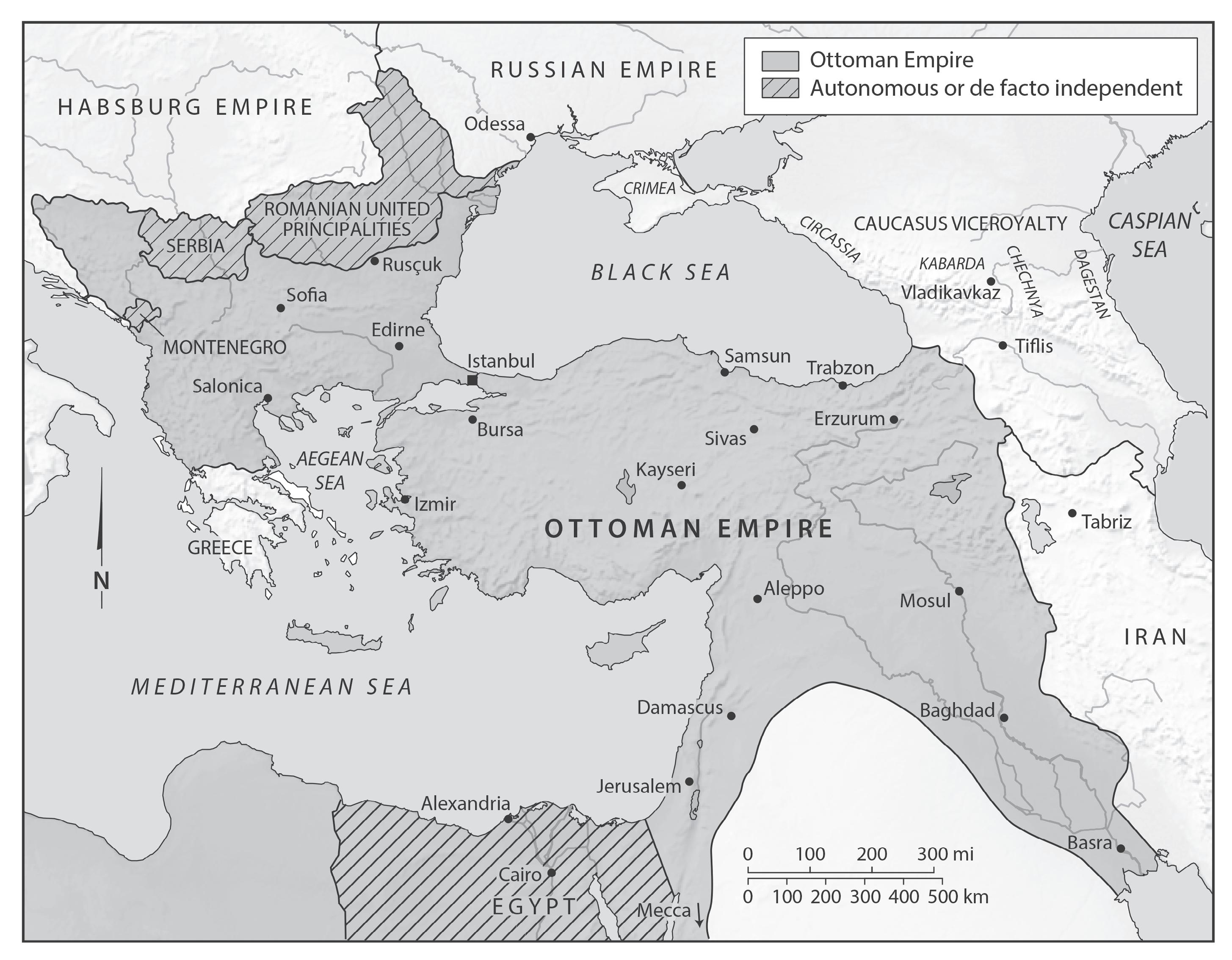
Map 1. Ottoman Empire and the Caucasus, 1864.
INTRODUCTION
On a scorching day in the late summer of 1863, fishermen in the Ottoman port of Trabzon, in the southeastern corner of the Black Sea, noticed several boats on the horizon. The boats carried Muslim refugees fleeing the Russian conquest of their lands in the Caucasus. Dehydrated and disoriented, Circassian families disembarked in the port. The next day, more boats sailed into the harbor. Dozens of boats kept arriving daily not only in Trabzon but also in Samsun and Sinop. By the end of autumn, Circassian refugees exceeded the resident population in Ottoman port cities on the Black Sea. Inns, schools, and mosques were filled to the brink, and refugees slept in covered bazaars, stables, and the streets. Deadly epidemics of typhus and smallpox broke out, devastating refugee communities. The ports in northern Anatolia started redirecting boats with refugees to Istanbul, Burgas and Varna (in Bulgaria), and Köstence (in Romania). The onset of winter did not stop the arrival of refugees, and the following year even more refugees disembarked on Ottoman shores. Between 1863 and 1865, up to half a million Circassians fled the Caucasus for the Ottoman Empire.1 It was the largest refugee crisis that the Ottomans had experienced by then.
Migration from the Caucasus continued for the next half century. Abkhazians, Chechens, Ingush, Balkars, Karachays, Ossetians, Avars, Lezgins, and other Muslim communities left their native mountains. One constant in late Ottoman history was the continuous arrival of Muslim refugees from Russia.
While the earlier groups of refugees had fled an ethnic cleansing perpetrated by the Russian military in the North Caucasus, the latter parties were pushed out by Russia’s new civil reforms and settler colonial policies. Between the 1850s and World War I, approximately a million North Caucasian Muslims had left the tsardom in what was one of the greatest displacements in Russian imperial history.
The Ottoman government maintained an open-door policy for North Caucasian refugees. They arrived when the Ottoman Empire was steadily losing territory and population in the Balkans and North Africa. Muslim refugees fit neatly into the Ottoman government’s agenda to stem demographic decline, revitalize the economy, and solidify the imperial hold on far-flung provinces. Within two generations, North Caucasian refugees were resettled throughout the Ottoman Empire in the following fourteen countries today: Turkey, Syria, Jordan, Lebanon, Israel, Iraq, Georgia, Bulgaria, Romania, Serbia, Kosovo, Greece, Cyprus, and North Macedonia. The Ottomans considered settling Circassian refugees also in Albania, Bosnia, Montenegro, and Libya.2 Temporary refugee camps existed in Palestine, and some North Caucasians moved, without Ottoman support, to Egypt.
The successive Muslim migrations turned the Ottoman state into an empire of refugees. In addition to North Caucasians, hundreds of thousands of Muslims from Crimea, the Balkans, the South Caucasus, and Crete, as well as smaller groups from North Africa, Central Asia, and Afghanistan, arrived in the Ottoman Empire as refugees. Many parts of the empire became a refugee country, where one was more likely to hear Circassian or Abkhazian than Turkish, Arabic, or Greek. The Ottoman Empire fashioned itself as a refuge for Muslims displaced in the age of European imperial conquest and colonialism. Meanwhile, the resettlement of Muslim refugees changed the empire from within and was a harbinger of population transfers and forced homogenization that befell the Middle East and the Balkans in the twentieth century.
EMPIRE AND REFUGEE RESETTLEMENT
Empire of Refugees is a history of migration that examines how North Caucasian refugees transformed the late Ottoman Empire and how the Ottomans managed Muslim refugee resettlement. This book advances several argu-
ments. First, between 1860 and World War I, the Ottoman government had constructed a refugee regime, which coexisted with, but was distinct from, the Ottoman immigration system. The Ottoman Refugee Commission (Ott. Tur., Muhacirin Komisyonu), founded in 1860, implemented the refugee regime. The Commission was responsible for settling Muslim refugees from Russia, arriving in the aftermath of the Crimean War of 1853– 56 and the Caucasus War of 1817– 64, and Ottoman Muslims displaced during the RussoOttoman War of 1877– 78, the Balkan Wars of 1912–13, and World War I. Having settled between three and five million Muslim refugees in total, the Commission presided over the demographic, economic, and social transformation of the remaining Ottoman territories, especially Anatolia. The Ottoman refugee regime built on the Ottoman Immigration Law of 1857, which had set the terms for immigration into the empire for anyone, irrespective of their faith, and the Land Code of 1858, governing land ownership and tenure. After the 1860s, the vast majority of immigrants in the Ottoman Empire were Muslim refugees. The Commission developed a set of additional policies and subsidies specific to refugee needs, inaugurating a regime of expectations— of protection and settlement by Muslim refugees and of obligations and loyalty by the Ottoman government.
The Ottoman refugee regime preceded and has a distinct genealogy from the contemporary international refugee regime. The modern refugee regime is a product of the United Nations and is anchored by the Convention Relating to the Status of Refugees, better known as the Refugee Convention of 1951. It has roots in the interwar era, when the League of Nations implemented ad hoc procedures to resolve refugee crises, arising out of the collapse of the Ottoman and Russian empires.3 The legal status of a modern refugee is derived from one’s citizenship in a nation-state. In recent years, historians demonstrated that the ideology of modern humanitarianism and such practices as population exchange, refugee transfer, and territorial partition, which were central to the interwar refugee regime, had roots in the Middle East.4 Humanitarian crises in the post- Ottoman world defined global conversations about protecting refugees. This book suggests a further historiographical corrective. The nineteenth-century Ottoman Empire, struggling mightily with European annexations, created its own nonwestern and nonsecular system of categorizing, sheltering, and resettling refugees. The status of refugee, or
muhajir, was based not on one’s subjecthood or citizenship but on facing religious persecution and seeking refuge in the sultan-caliph’s domains. A refugee being Muslim, while not a codified requirement, was an expectation and raison d’être of the Ottoman refugee regime.
Second, refugee resettlement accelerated the collapse of the empire in the Balkans and fortified Ottoman rule in the outlying regions of the Levant and Anatolia. Historians explain the disintegration of the Ottoman Empire by geopolitics, including European annexations throughout the nineteenth century and the empire’s defeat in the Balkan Wars of 1912–13 and World War I, and by cultural forces, especially the sectarianism and nationalism that tore through the empire’s social fabric.5 By revisiting late Ottoman history through the prism of migration and political economy, I show that Muslim refugee resettlement had a profound impact on both the survival and the demise of the Ottoman Empire. Ottoman refugee resettlement was an ambitious project of the Azizian (1861– 76) and Hamidian (1876–1908/9) governments. The Ottoman government expected Muslim refugees to become productive farmers. It happened for some but not all. The economic well-being of refugee communities depended on Ottoman support. That support could come in different forms: favorable legislation, free land, financial aid, roadway construction, and military backing. How much help the government provided and whether refugees could use it explain why refugee resettlement had vastly different outcomes throughout the empire.
This book examines refugee resettlement in three core parts of the Ottoman Empire: the Balkans, Anatolia, and the Levant. In the northern Balkans, the Ottoman government’s settlement of Muslim refugees from Russia stoked anti- Ottoman sentiments among Balkan Christians. The lack of state funding for refugee households undermined the efficacy of the resettlement program and pushed some refugees toward banditry. The ensuing violence of Circassian gangs, especially against Christians, inflamed social tensions, leading up to the Bulgarian uprising of 1876 and the Russo- Ottoman War of 1877– 78. The war ejected the Ottomans from half of their European territories, which they had held for over five centuries. Meanwhile in central Anatolia, Ottoman financial support for refugees was equally limited, but the government backed North Caucasians in their conflict over land with Turkic nomads. Refugee villages survived, well hidden among the mountains, yet
their economies stagnated because of a lack of Ottoman infrastructure. In contrast, North Caucasian refugees in the Levant took advantage of Ottoman land reforms and the state-sponsored Hejaz Railway and built thriving villages on the edge of the desert. North Caucasian refugees founded three of the four largest cities in modern Jordan, including its capital city of Amman. The Ottoman government favored refugee farmers, and, through their settlements in the Levant and central Anatolia, it expanded authority into the sparsely settled parts of the empire.
The resettlement of Muslim refugees was key to the disintegration of the Ottoman Empire in several ways. Resettling Muslims from Russia strained Ottoman imperial and provincial budgets at a time of fiscal emergency. The Ottomans took out their first international loans during the Crimean War of 1853– 56 and kept borrowing from European banks, in part to pay for the settlement of Muslim refugees. In 1875, the Ottoman state defaulted on its debts, which ushered in the European- controlled Ottoman Public Debt Administration, shrinking Ottoman sovereignty and fiscal control. Yet borrowing for refugee resettlement continued. Furthermore, the resettlement of Muslim refugees intensified intercommunal strife. In almost every place of settlement, refugees came into conflict with local populations over land. Those conflicts soured relations between North Caucasians and their settled and nomadic neighbors, whether Christian, Muslim, or Druze, while helping the Ottoman government to entrench a new land regime in its reformist drive to centralize the empire. Finally, after 1878, the resettlement of Muslim refugees went hand in hand with displacing and dispossessing Ottoman Christians. The Hamidian government altered demographic ratios on the margins of the empire to forestall further loss of territory. While the policies were not consistent and varied from region to region, the general message was clear. The government welcomed foreign Muslims and trusted them to become loyal subjects of the sultan at a time when it viewed its Christian subjects with suspicion. The resettlement of Muslim refugees lay at the heart of the Ottoman government’s ambition to preserve the imperial project.
Third, Russia attempted to control Muslim migration to consolidate its authority over the Caucasus. Russia’s migration policies in the Caucasus helped to manage its “Muslim empire,” which stretched from Crimea and the Caucasus to the Volga region, through the Ural Mountains and into the