List of Abbreviations
BHE Bund der Heimatvertriebenen und Entrechteten [League of German Expellees and Those Deprived of Their Rights]
CLNAI Committee of National Liberation for Northern Italy
EW Elizabeth Wiskemann
FO Foreign Office
FRG Federal Republic of Germany
GDR German Democratic Republic
IfZ Institut für Zeitgeschichte, Munich
IR International Relations
LSE London School of Economics
MI5 Military Intelligence, security service responsible for British territories
MI6 Military Intelligence, security service responsible for non-British territories
MI9 Military Intelligence responsible for assisting escape of British POWS and servicemen stranded behind enemy lines
MOI Ministry of Information
NA National Archives, Kew, London
NAAFI Navy, Army and Air Force recreational institutes in the war years and later
NAWA National Archives Washington
NATO North Atlantic Treaty Organization
OSS Office of Strategic Services
PCO Passport Control Officer
PID Political Intelligence Department, Foreign Office
PPE Politics, Philosophy, and Economics (Oxford University degree course)
PWE Political Warfare Executive
RAF Royal Air Force
RIIA Royal Institute of International Affairs (Chatham House)
SA Sturmabteilung
SD Sicherheitsdienst (SS Intelligence Service)
SIS Secret Intelligence Service (i.e. MI6, gathering foreign intelligence)
SOE Special Operations Executive
SS Schutzstaffel
T4 Tiergartenstrasse 4 [abbrev. for the Nazi euthanasia program]
TLS Times Literary Supplement
UNRRA United Nations Relief and Rehabilitation Administration
WCC World Council of Churches, Geneva
Captions for Photographs/Illustrations
Chapter 1
1.1. “Elizabeth Wiskemann c. 1905, about six years old.” 12
1.2. “F.A. Voigt in 1935,” by Lucia Moholy. Permission of Artimage. 28
1.3. “Elizabeth Wiskemann in February 1932,” by Ramsey & Muspratt. Permission of Peter Lofts. 48
Chapter 2
2.1. “Shiela Grant Duff in 1939,” by Howard Coster. National Portrait Gallery Co. Ltd. 64
Chapter 3
3.1. “Elizabeth Wiskemann in the war years” c. 1940. 89
3.2. “Elizabeth Scott-Montagu in 1928,” by Bassano Ltd. National Portrait Gallery Co. Ltd. 104
Chapter 4
4.1. “Allen Dulles,” Getty Images. 116
Chapter 5
5.1. “Elizabeth Wiskemann in the 1950s.”
Chapter 6
6.1. “Elizabeth Wiskemann’s home at 41 Moore Street, London, S.W.3.”
Introduction
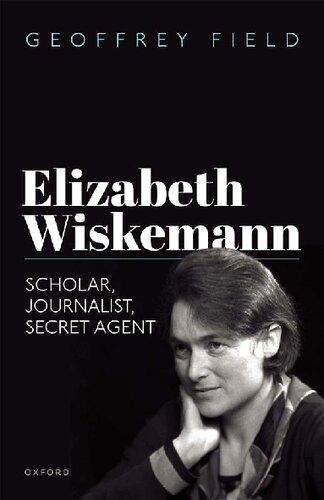
On July 6, 1971, British newspapers announced the suicide of Elizabeth Meta Wiskemann from a drug overdose. She had taken a lethal dose of pills washed down by alcohol. Letters to the Times soon appeared praising her as an “outstanding scholar, a sensitive and loyal friend and a brave woman who risked her life for her country.”1 She was well known as a commentator on European politics and her books and articles were once fixtures on the reading lists of students of international affairs and Eastern Europe, as well as undergraduates in the 1960s studying twentieth-century European history. Today she is largely forgotten and—except for a few specialists—her name mostly draws blank looks from those whose intellectual formation came later. The author of ten books, including several of lasting significance, scores of essays and press articles, translations, and innumerable reviews, she was both prolific and remarkable for her breadth of expertise, writing with equal mastery about Germany, France, Italy, Switzerland, and Eastern Europe. Also, few could match her personal acquaintance with so many of the politicians, intellectuals, and officials about whom she wrote. As Leonard Woolf once put it: “You know more people than anyone else in Europe.”2 She liked to describe herself as a scholar-journalist and as a woman was among the very few who achieved distinction in both these male-dominated spheres. She also spent the Second World War as a British intelligence agent in Switzerland, running agents and gathering information about Axis-occupied Europe.
A ‘Victorian’ born in 1899 a few months before the Boer War, Wiskemann’s life spans two World Wars, depression, the reconstruction of post-1945 Europe, and the Sixties—roughly speaking what many historians later dubbed “the short twentieth century.” She was a schoolgirl during the First World War, somewhat burdened with her father’s German surname. Then came Cambridge where—as a student, researcher, and part-time teacher—she flourished in the microenvironment of Bloomsbury’s younger generation. She was not uncritical of Bloomsbury: its insular view of foreign countries precluded real understanding of their cultures and populations, and the arrogant, unpolitical sensibility of some of its members was out of step with the 1930s. But for her generation, growing up in the shadow of the First World War, they were liberators, and Bloomsbury’s revolt against Victorian attitudes and sexual morality, its aesthetic vision, openness to modernism in literature and art, and its devotion to friendship had a lasting impact on her.
Elizabeth Wiskemann: Scholar, Journalist, Secret Agent. Geoffrey Field, Oxford University Press. © Geoffrey Field 2023. DOI: 10.1093/oso/9780192870629.003.0001
Hoping for an academic career, Wiskemann embarked upon a doctorate, but found her ambition thwarted, not least by an unsympathetic male supervisor. Rare exceptions aside—like medievalist Eileen Power, the epitome of a stylish and successful “new woman” academic—prejudice against women in universities was pervasive and very few positions were open to them. Wiskemann’s career prospects in Cambridge seemingly blocked, she was especially drawn to Paris and Berlin, fascinated by their avant-garde cultural scene and political turbulence; they seemed more open, freer, less constrained by rules and conventions than British society—places where a self-reliant young woman could test her mettle and “learn about life.” She loved travel, which in the interwar years was inherently ‘modern’ and a little ‘daring’ for a lone female: “Fairly early I found myself wanting to get inside a country, wanting to stay in its homes, to live with its citizens and if possible speak its language.”3 From 1930 she began spending long periods in Berlin where in the space of a few years she reinvented herself as a successful foreign correspondent for the New Statesman and other journals—a remarkable achievement given that most female journalists were confined to the women’s pages of papers and very few covered political news, domestic or foreign. Her turn to journalism in Berlin in the early 1930s was propitious in place and time, but it took talent, unrelenting drive to find sources and research stories, and no little courage amid mounting lawlessness and Nazi terror. Her reports were detailed, cogent, and shrewd, capturing brilliantly the frantic pace of political events, even on those occasions when her expectations were mistaken.4 Like Timothy Garton Ash today, she viewed the crafts of history and journalism as closely related, at their best sharing similar virtues: “exhaustive, scrupulous research, a sophisticated, critical approach to the sources, a strong sense of time and place, imaginative sympathy with all sides, logical argument, clear and vivid prose.”5
The Thirties was in the eyes of many a golden age of the foreign correspondent, satirized by Evelyn Waugh and celebrated by Hitchcock. Central Europe especially was the arena of an outstanding collection of British and American journalists who chronicled the Weimar Republic’s disintegration and the growing danger of Hitler. Among the British contingent were experienced men like Norman Ebbutt, F.A. Voigt, G.R. Gedye, and Marcel Fodor—men who had spent many years in Central Europe, were proficient in local languages, and were knowledgeable about the culture, history, and customs of the lands they covered. The American correspondents included several—James Vincent Sheean, Dorothy Thompson, Edgar Mowrer, William Shirer and John Gunther—who became international celebrities. There were differences between the two groups. In the US, newspapers and broadcasting were booming and it was relatively easy for adventurous, untrained reporters to land jobs and assignments. Their readers were generally less knowledgeable about Europe and their writing was more personal, interpreting events as eyewitnesses. The British press was harder to break into, almost impossible without connections; money was tighter; readers were
mostly better informed; and articles tended to be drier, more factual, with less insertion of the reporter’s self. The contrast between Martha Gellhorn’s brilliant and personal report on Czechoslovakia in 1938, “Obituary of a Democracy,” and Wiskemann’s more academic dissection of the Sudeten German problem with its complex cultural and historical origin is a striking illustration of this.6
Always skillful in networking and acquiring influential contacts, Wiskemann found friends in both groups, but most important in her journalistic training were Ebbutt and Voigt, experienced journalist-activists who were intent on shaping opinion and influencing national policy. She listened carefully, learned quickly, and through shared contacts interviewed many of the key political figures of the day. In addition to the consolidation of the Nazi regime in Germany, Wiskemann also reported in detail on the 12 million Germans living outside the Reich’s post-Versailles borders whom Hitler fashioned into a potent foreign policy weapon, and she developed a lasting interest in contested borderlands such as the Saar, the Sudetenland, Switzerland, and the Tyrol. Her sympathies lay with small states, often the victims of international and inter-ethnic conflicts; she studied demographic changes and pondered the problem of how multilingual, multiethnic, and multi-confessional populations might construct stable and united polities. By 1939, remarkably for a freelance reporter, she had achieved an international reputation for her articles and two highly praised books on Czechoslovakia and Nazi economic and political penetration of south-east Europe. Convinced already by 1935 that Hitler was intent on provoking another war, Wiskemann became one of the earliest voices admonishing Britain and France to rearm in preparation and a crusader against Chamberlain’s policy of Appeasement. As Julie Gottlieb has shown, the “male-centrism” of standard accounts of British debate about Nazism and Appeasement has marginalized or excluded altogether the vociferous and effective role played by numerous women activists, including Wiskemann.7
When war broke out, Wiskemann looked for a job in research, propaganda, or some facet of intelligence. The links between the British secret service and foreign correspondents were already considerable in the 1930s and her first-hand knowledge of much of Europe and the skills she had honed gathering information made her an ideal recruit. And yet her war service was also somewhat serendipitous. After German forces occupied much of Western Europe and Mussolini entered the war, what began as a brief and vague semi-official assignment in neutral Switzerland turned into five years working at one of the key “listening posts” for intelligence about Axis Europe. Several sources attest to Wiskemann’s success as an intelligence agent. Her experiences, which can be pieced together in some detail, illustrate the day-to-day work of an agent in the field, the contacts and sources she relied upon, her close collaboration with Allen Dulles and the OSS, and, equally interesting, the difficulties she encountered in her own embassy, reflective of both the internecine infighting between Whitehall’s covert agencies
and prejudice against an assertive female outsider whose position seemed anomalous. Most accounts of Britain’s female agents focus on the exploits of those like Violette Szabo, Nora Inayat Khan, and Christine Glanville who were infiltrated into occupied France by SOE; far less recognized are those like Wiskemann in Bern, Elisabeth Pares in Stockholm, and Nancy Lambton in Teheran who were posted to neutral countries and fed intelligence back to London.
The Allied victory in 1945 signaled the end of Wiskemann’s personal campaign to defeat Hitler and Nazism; this had been her continual focus for more than a dozen years. She knew that starting over in her mid-forties would be difficult, notwithstanding the reputation she had achieved in the 1930s as an author and foreign correspondent. Initially she moved to Rome where, as a correspondent for the Economist and the Spectator, she analyzed the birth of the Italian Republic, while also writing the first major study of the Axis alliance between Hitler and Mussolini. Her stay in Italy coincided with a particularly rich and innovative period in cultural life and she got to know not only most of the leading politicians but also writers like Croce, Moravia, and Carlo Levi. For Wiskemann and activists like her friend Ada Gobetti, the Italian partisans’ struggle against the German occupation 1943–45 was a “finest hour,” a morally transformative movement of purification and rebirth after decades of Fascism. And, while historians have become more divided over its legacy, viewing it as contradictory and ambiguous, Wiskemann never forgot the courage and possibility manifested in the Resistenza and she was bitterly disappointed, like most of her circle, at the early Republic’s failure to translate its social and political values into a concrete and viable program for postwar reconstruction.
Postwar Wiskemann also remained very much engaged with Eastern Europe but, as Communist regimes took power, the kind of regular journeys she had made earlier became impossible, especially for a freelance reporter; perforce her journalism turned more and more to developments in Germany, Austria, Switzerland, and Italy while employment as a regular book reviewer, especially for the Times Literary Supplement and the Spectator, and work for Chatham House both paid her bills and burnished her reputation as a contemporary historian, in particular as an expert on the Second World War and Nazi Germany. Her scholarly productivity was prodigious: including four books (effectively five if one counts her contributions to Chatham House’s Survey of International Affairs) in the dozen years after the war, one of them—Germany’s Eastern Neighbours the first English-language account of the postwar expulsion of 12 million ethnic Germans from Eastern Europe. No stranger to controversy, her insistence that West Germany should accept the expulsions and the Oder–Neisse frontier with Poland as irreversible provoked a storm of criticism in West Germany. Famously opinionated and forever marked by the 1930s, she was highly suspicious of Germany and Germans, alert—arguably, overly sensitive—to the possibility of neo-Fascist and neo-Nazi revival; but in this too she shared the mindset of large
numbers of British contemporaries, particularly in their antipathy towards Adenauer’s Germany, something forgotten or downplayed in later years.
Wiskemann’s reputation as a commentator on foreign policy and a scholar of European history was achieved largely outside, or rather on the fringes of, academia. Approaching sixty, she didn’t expect to return to university teaching after a gap of more than twenty years. But life took an unexpected turn and she was appointed to a Chair of International Relations at Edinburgh (the first woman to receive a Chair there in any discipline) and later moved to the newly founded University of Sussex. British university life was changing in the early 1960s with the creation of several new universities, a doubling of the numbers of students, and—more slowly—an increase in women faculty. It was also in this period that International Relations and Contemporary History began to gain institutional presence in university curricula. Wiskemann’s writing in these years illustrates these changes, including four non-specialist books of contemporary history largely written for undergraduates, while her presence at Edinburgh and Sussex also reflects the importance of journalists in these two fledgling disciplines.
As a journalist, historian, and political commentator, Wiskemann focused on international affairs, and her opinions about British politics occupy little space in this book. Not that she didn’t have strong views, but detailed information about them has not survived. Early on she favored the Liberal party, but in the course of the Second World War her politics moved sharply left: the ravages of war and people’s sacrifices, she argued, necessitated sweeping social reform and a redistribution of wealth, most of all in countries like Italy where disparities were most extreme. She also supported closer European integration and favored Britain playing a prominent role in this. Above all, her focus on European politics was defined by “the German question” and the threat of German power. Already by the time she went off to Cambridge, the Europe Wiskemann had studied in high school barely existed: the Habsburg, Hohenzollern, and Romanov emperors had been overthrown and the map of Eastern Europe was about to be re-drawn. Much of her later research and writing focused on the consequences of this geopolitical earthquake for the populations of Mitteleuropa and the German borderlands. She had strong political opinions and the issues she focused upon were highly contentious. Examining this epicenter, whether in the 1930s or after the Second World War, “placed her,” in Mark Cornwall’s words, “in a no-man’s land where she was bound to be a target from many quarters.”8 The region, she felt, could or should have acted as an “essential hinge” or a bridge drawing together East and West Europe, facilitating economic and cultural exchange between them. At her death, however, the bipartite division between the West and a Soviet-dominated East seemed greater, more immutable than ever. With the implosion of the Soviet Union two decades later, debate about Mitteleuropa’s future was rekindled.9 Wiskemann would have been suspicious of German conservatives in the 1990s who spoke of ‘the lost East’ and advanced a thinly veiled revisionist project,
and she would have embraced warmly Czech, Hungarian, and Polish liberal intellectuals (Havel, Kundera, Konrád, Milosz) who proclaimed a unifying common cultural heritage. Ultimately, however, she would have been disappointed by NATO and European Union enlargement and the failure of Europe’s new center to realize her image of an “essential hinge.” And, one might add, many of the disturbing features of today’s Europe—rising nationalism, the descent of East European states into illiberalism and authoritarianism, democracy under pressure, and the international free trade regime under attack—would have alarmed her by their familiarity. * * *
This biography focuses primarily upon Wiskemann’s individual experiences as journalist, spy, and scholar, but aside from the intrinsic interest of her life and writings, her story should also be viewed as illustrative of a whole cohort of women, born between the late 1890s and the First World War, who graduated from university in the 1920s and early 1930s. They came from upper-middle-class or aristocratic families, belonged to the first large group of women to gain a university education, and—whether or not they identified as feminists—were the legatees of the recent women’s struggle for the franchise.10 Better educated than their mothers, influenced by debate about the “new woman” and the suffrage campaign, they sought greater freedom in many areas of their lives. They wanted careers and were in no rush to marry and have children. They were ambitious and challenged conventional expectations about women’s roles. The First World War shaped their early years, and they were attracted by the liberal internationalism of men like Arnold Toynbee, Gilbert Murray, and Alfred Zimmern and shared their enthusiasm for the League of Nations and the prospect of international cooperation. With few opportunities open in universities and the Foreign Service still closed to women, they looked to journalism, the BBC, pressure group organizations, and the agencies of the League to pursue their interests in international politics.
Several accounts in recent years have examined women’s engagement in international affairs in the interwar period. As the hopes of the 1920s faded and economic depression and renewed international conflict darkened their horizons in the 1930s, this cohort became active participants in debates about how to prevent another war and in the anti-fascist and anti-Appeasement movements.11 Some, like the Quaker cousins Jean and Tessa Rowntree, were active in international relief efforts and worked to get socialists and Jews out of Czechoslovakia in 1938–39. The remarkable career of Francesca Wilson has also attracted attention; she took part in relief efforts in two World Wars, famine relief in Soviet Russia, the rescue of Basque children from Civil War Spain, and UNRRA’s massive relief efforts in postwar Yugoslavia.12 Doreen Warriner seemed to be on a fast track towards an academic career; her research focused on peasant societies in Central
and Eastern Europe. But in 1938, deeply troubled by the Munich Agreement, she gave up a Rockefeller fellowship, flew to Prague, and, through the British Committee for Refugees, began organizing the emigration of socialists and Jews whose lives were increasingly imperiled.13 The political activism of others like Elizabeth Monroe, Hester Pinney (later Hester Marsden-Smedley), Shiela Grant Duff, and Wiskemann herself was channeled through their writings as foreign correspondents publicizing the Nazi and Fascist danger.
The careers of a number of these women intersected with Wiskemann’s life and activities, although because of a paucity of personal records it is sometimes unclear how well they were acquainted. Aside from their shared political activism in the 1930s, their career trajectories evince several common features. First, the continuing importance of journalism. They wished both to enlighten readers and to influence public policy. Several, like Wiskemann, got their start as foreign correspondents and many remained active as journalists and broadcasters for most of their lives. Indeed, a strong female network of alumnae from Cambridge and Oxford operated within the BBC.14 Another important formative influence was the Royal Institute for International Affairs or Chatham House, so named because of its location in the London mansion once owned by William Pitt, earl of Chatham. It was founded in 1920 as an independent institute to foster research in international relations and to promote public understanding of global affairs. The Institute was more hospitable to women than many university faculties, playing an important role as a source of research grants and publishing opportunities as well as a forum for meeting scholars and policymakers in their fields. All these women wrote for Chatham House journals, and Wiskemann’s early reputation owed much to a book that it commissioned.15 The same is true of Elizabeth Monroe, who became a leading expert on Middle East affairs, and both Warriner and Monroe seem to have gained considerable influence on its committees.
An equally important (and often neglected) shared experience was government service in the Second World War. The significance of the war for men’s careers, including many academics, is well-documented, less so for professional women. The expansion of the wartime state offered unprecedented opportunities for those, like Wiskemann, with expertise in foreign affairs, especially in the propaganda, information, and intelligence agencies. For example, Shiela Grant Duff, author of a bestselling Penguin special, Europe and the Czechs, became head of the Czech section of the BBC’s European Service; Elisabeth Barker, daughter of the political theorist Sir Ernest Barker and a close friend of Wiskemann, moved from the BBC to Foreign Office Intelligence, eventually becoming head of PWE’s South-east Europe Directorate. Margaret Lambert worked for the BBC Austrian Service and then the intelligence service interrogating German prisoners of war, while Ann Lambton occupied a similar post to Wiskemann as press attaché to the British Embassy in Teheran where she was involved in propaganda and SOE activities.16 Recruited by the Ministry of information, Elizabeth Monroe’s
organizational talents led to her appointment as head of its Middle East Division, while Warriner moved from the Ministry of Economic Warfare to PWE’s Cairo offices, helping to administer shipping and supplies for British forces in the Middle East, and then in 1944 joined UNRRA’s mission to supply relief to Yugoslav war victims.17
War service played a critical role for this group of women in forging important personal networks and shaping the future direction of their scholarly research. Wiskemann’s later writing was largely devoted to the era of the dictators, the consequences of the Second World War, and the contested borderlands resulting from it. Margaret Lambert was editor-in-chief of the British series of Documents on German Foreign Policy, 1918–45. As a distinguished correspondent for Reuters and the BBC, Elisabeth Barker wrote two books on Balkan affairs; then, after her retirement in 1970, she published six more, returning to topics she once covered as a journalist now supplemented by recently released files from the national archives.18 Monroe worked as a foreign correspondent in the Middle East, covering every major story from Britain’s withdrawal from Palestine, Suez, the Iraqi and Jordanian revolutions, to the landing of American marines in Beirut in 1982. Her book, Britain’s Moment in the Middle East 1914–1956 (1963) remains a classic. Warriner became Britain’s leading expert on peasant societies, under-development, and land reform, publishing a steady stream of books, journalism, and reports for the United Nations and other international agencies.19 In the postwar years many of these women obtained academic positions, although—as in Wiskemann’s case— their contribution to International Relations and Contemporary History often originated from outside or on the margins of the academy.20 None of these women is well known today. Warriner has recently received more attention but mostly for her heroic rescue work in Prague in 1939 and the fact that she alerted Nicholas Winton, the chief organizer of the Kindertransport, to the desperate plight of Jewish children in Czechoslovakia.21 As scholars begin to recover and re-examine these largely forgotten pioneers, their careers (including Wiskemann’s) provide a reminder that they were always there, hidden in plain sight.22
A collective biography of these women would be a fascinating project but impossible, I fear, because of the paucity of sources; they were mostly reticent about themselves, and none left much in the way of archival papers. Wiskemann also presents difficulties for a biographer.23 Her published writings are voluminous, but she left no diaries or formal archive and while she had many friends and acquaintances, she either didn’t keep their letters or destroyed them before her death. Also, the memoir she wrote focused on only twenty years of her professional life and is largely silent about her emotions, personal relations, ambition, and self-awareness. It described the Europe she saw as a participant observer, but one who wished to limit the participant’s self-exposure. Even photographs of her were hard to find at first. Had I embarked on the task earlier, it would certainly have been easier to fill some of the gaps or silences through interviewing her
friends and colleagues. But most had died by the time I began this project, depriving me of valuable first-hand recollections. Fortunately, many of Wiskemann’s acquaintances were sufficiently interesting or eminent to have left papers of their own which contain a good deal of her correspondence, now spread across numerous libraries and archives.24 In addition, files in the archives of newspapers, publishers, private institutions like Chatham House, and official state agencies with which she was involved were also invaluable in piecing together a fuller picture of her travels and activities.
Writing this book has involved a good deal of detective work, searching for documents and unearthing biographical details. Wiskemann was, as her friends made clear, a very private person, “dauntingly discreet,” and reticent—about as far from today’s confessional mode as can be imagined—and so, unavoidably, gaps remain. I have mostly chosen to acknowledge them rather than substitute speculation. But none of these lacunae, I think, would seriously alter the analysis presented here. As biography widens its scope, focusing less upon high politics, power, and celebrities, and especially as it attempts to recover ‘unrecorded lives,’ especially of women who were not particularly famous, so these problems of sources and documentation are inevitable.25 Almost nothing is known, for example, about Wiskemann’s brother and sister, while, despite many inquiries, I have been able to find little information about Marchese Francesco Antinori, the Italian diplomat whom she contemplated marrying in 1944. Few subjects attract more curiosity than sex, and the fact that Wiskemann remained unmarried invites speculation. Mark Cornwall has suggested that “her attitude to her gender was . . . ambiguous” and refers to her “unresolved sexuality,”26 but he provides no evidence and I found no lesbian relationships, only heterosexual affairs. Her friendships with women were mutually supportive at a time when and in careers where professional women were rare and prejudice and innuendo about spinsters, unmarried “new women”, and “business women” was rife. In 1966 when her old friend Martin Wight joked that she was a puritan (he was referring to her unrelenting insistence upon factual accuracy) Wiskemann disagreed: “I’m too fond of pleasure to be called puritan, and, although my lovers admired my purity (isn’t that different?) I did have them and felt no shame – nor do.” The memoir she had just begun, she assured him, concerned her views about Europe, not her private life: “In my old-fashioned way I abhor the way people now display what should be private.”27 Inevitably, then, my book is both less and more than a conventional biography. I have focused mostly on the public persona in an effort to show how her successes and disappointments, her political engagement, and her experiences as foreign correspondent, secret agent, author, and academic scholar illuminate larger historical issues as well as more individual themes such as this woman’s struggle to earn a living, define herself, and protect her independence.