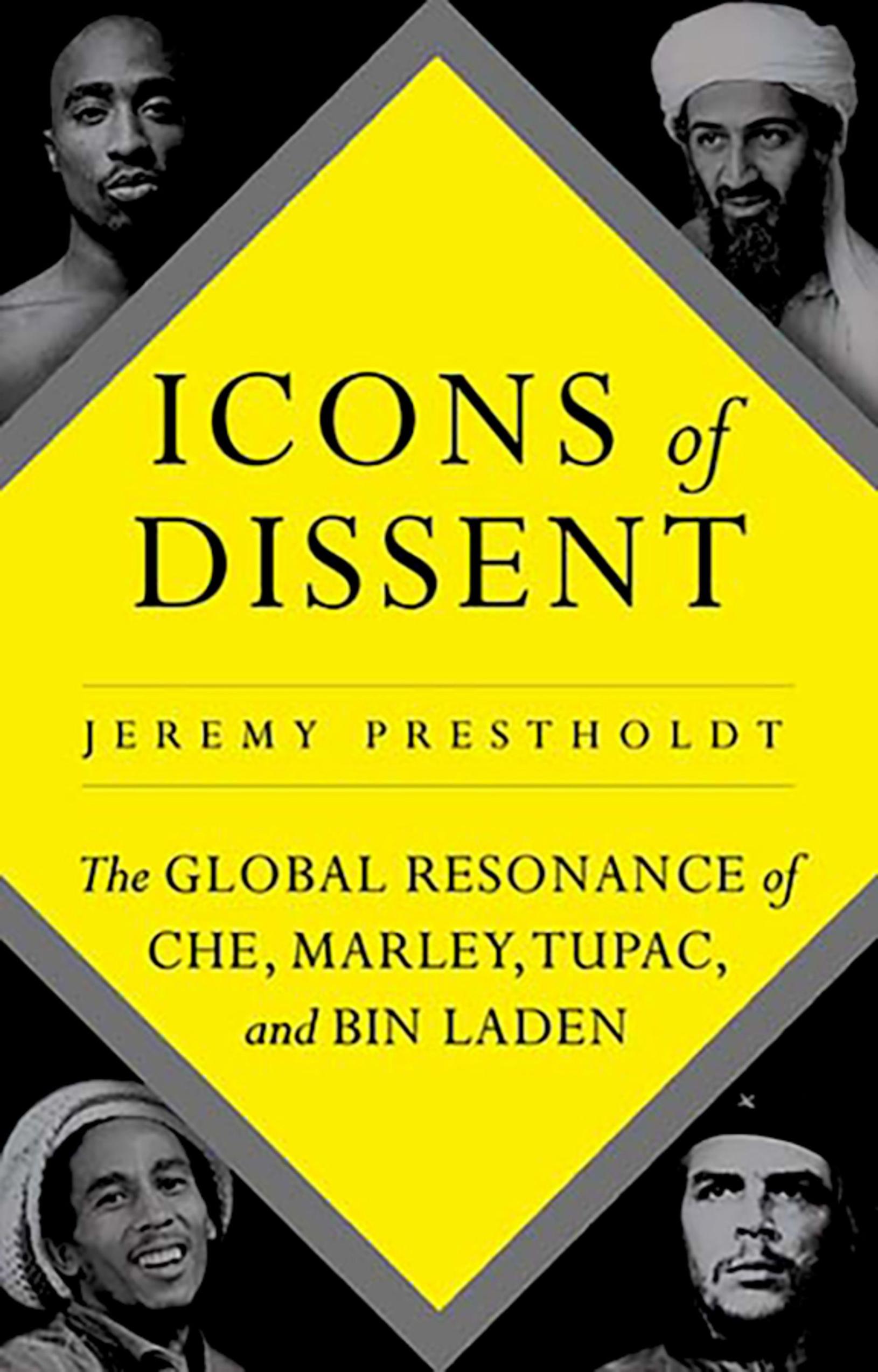
JEREMY PRESTHOLDT
Icons of Dissent
The Global Resonance of Che, Marley, Tupac, and Bin Laden
3
Oxford University Press is a department of the University of Oxford. It furthers the University’s objective of excellence in research, scholarship, and education by publishing worldwide. Oxford is a registered trade mark of Oxford University Press in the UK and in certain other countries.
Published in the United States of America by Oxford University Press 198 Madison Avenue, New York, NY 10016, United States of America
© Jeremy Prestholdt, 2019
First published in the United Kingdom in 2019 by C. Hurst & Co. (Publishers) Ltd
All rights reserved. No part ofPublication may be reproduced, stored in a retrieval system, or transmitted, in any form or by any means, without the prior permission in writing of Oxford University Press, or as expressly permitted by law, by license, or under terms agreed with the appropriate reproduction rights organization. Inquiries concerning reproduction outside the scope of the above should be sent to the Rights Department, Oxford University Press, at the address above.
You must not circulate this work in any other form and you must impose this same condition on any acquirer
A copy of this book’s Cataloging-in-Publication Data is on file with the Library of Congress.
ISBN 978-0-1906-3214-4
Chapter 1 previously appeared as: “Resurrecting Che: Radicalism, the Transnational Imagination and the Politics of Heroes,” Journal of Global History 7, 3 (2012): 506–526.
Chapter 3 previously appeared as: “The Afterlives of 2Pac: Imagery and Alienation in Sierra Leone and Beyond,” Journal of African Cultural Studies 21, 2 (2009), 197–218.
Chapter 4 previously appeared as: “Superpower Osama: Thoughts on Symbolic Discourse in the Indian Ocean after the Cold War,” in Christopher J. Lee, ed., Tensions of Postcoloniality:The Bandung Moment and Its Political Afterlives (Athens, OH: Ohio University Press, 2010), 315–50.
For my parents
LIST OF IMAGES
1. Che Guevara banner, Washington, DC, USA, 1967. © Marc Riboud/ Magnum Photos 36
2. Che Guevara, Ho Chi Minh, and Karl Marx placards, Munich, West Germany, 1972. © ullstein bild / Getty Images 47
3. Jim Fitzpatrick’s “Viva Che!”, 1968. © Jim Fitzpatrick, 2010 49
4. Che Guevara banner, Mexico City, Mexico, 1968. © A. Abbas / Magnum Photos 56
5. Bob Marley performing at the Roskilde Festival, Denmark, 1978. © Jorgen Angel / Getty Images 76
6. Tupac Shakur mural, Cape Town, South Africa, 2002. © Per-Anders Pettersson / Getty Images 109
7. Tupac Shakur mural, Freetown, Sierra Leone, 2000. © Teun Voeten 121
8. Tupac Shakur framed picture, Freetown, Sierra Leone, 2004, author’s own 127
9. Osama bin Laden poster, Rawalpindi, Pakistan, 1999. © B. K. Bangash / AP Images 138
10. Osama bin Laden T-shirt, Dhaka, Bangladesh, 2004. © Farjana K. Godhuly / Getty Images 142
11. Osama bin Laden T-shirt, Pate Island, Kenya, 2005, author’s own 145
12. Bob Marley street art, San Cristóbal de las Casas, Mexico, 2007, author’s own 165
13. Bob Marley flag, Lamu, Kenya, 2008, author’s own 176
14. Che Guevara street art, Bergen, Norway, 2006, author’s own 189
15. Che Guevara mural, EZLN autonomous zone Oventic, Chiapas, Mexico, 2007, author’s own 194
16. Che Guevara flag, New York, USA, 2011. © Ramin Talaie / Corbis via Getty Images 204
17. Che Guevara advertisement, Mombasa, Kenya, 2005, author’s own 211
18. Guy Fawkes mask, 2016, author’s own 219
PREFACE
Icons are well-known figures that represent sentiments, ideals, political positions, or something else recognizable to a wide audience. They are powerful symbols that audiences collectively reinterpret over time. This book asks why certain public figures resonate with diverse audiences to become global icons and how perceptions of them change in response to social, cultural, and political currents. To answer these questions I explore popular interpretations of four evocative figures over several decades: Che Guevara, Bob Marley, Tupac Shakur, and Osama bin Laden. These figures differed in ideology, message, and audience, yet each became a highly politicized symbol of dissent that resonated widely and more profoundly than most other global icons. To understand the phenomenon of the icon of dissent, and through it the icon generally, I examine both the commonalities and significant variations in how audiences have interpreted these four figures across differing social environments and historical moments. In this way, Icons of Dissent traces a global history of the modern icon. This book began to take shape after I completed dissertation research in Kenya and Tanzania in 2000. My dissertation and subsequent book, Domesticating the World: African Consumerism and the Genealogies of Globalization, shed light on Africa’s multifaceted global interface through a survey of nineteenth-century East African demands for imported manufactured goods. I was particularly interested in how East Africans gave locally relevant meanings to imports and how these in turn impacted economic relationships with other world regions and production abroad. This research on consumer demand also piqued my interest
in the circulation and reception of less material things such as images, music, and ideas. I was curious, for example, about the extraordinary popularity and strong political resonance of Bob Marley in many African countries, Kenya and Tanzania included. Similarly, I was keen to understand Tupac Shakur’s prominence as a symbol for political frustration and hope in East Africa, and indeed around the world.
Events in the wake of the 2001 terrorist attacks in New York and Washington, DC also shaped my research. 9/11 made Osama bin Laden an instantly recognizable figure, both the international face of terrorism and a focus of outrage. At the same time, people around the world began to use posters, banners, and T-shirts bearing bin Laden’s image to protest domestic circumstances and international events, including the 2001 invasion of Afghanistan. More surprisingly, bin Laden’s face appeared on a great range of mundane consumer goods such as mobile phone cases and cologne bottles. He became a symbol used to represent sentiments, political positions, and even consumer tastes. This astonishing spectrum of bin Laden iconography brought into sharper focus the overlapping spheres of consumer culture and political sentiment that, as I would discover, defined each of the icons in this study. It also highlighted the question of timing: why was Osama bin Laden such an appealing symbol to people in diverse locales at that historical juncture? With this question in mind, I began to focus more intently on the particular historical circumstances of iconic resonance.
After researching Osama bin Laden iconography, it became clear to me that looking at any figure in isolation risked missing dimensions of the larger phenomenon of the icon. To develop a more complete picture of how icons have functioned in global popular culture, I concentrated on several otherwise unrelated figures that gained similar political relevance to international audiences at different moments in time.
A sensible place to begin was the most recognizable Cold War-era icon of dissent: Ernesto “Che” Guevara. Guevara became a popular international symbol in the 1960s, a time when the convergence of new modes of communication, patterns of consumption, and shifting political imaginations created new conditions for the creation and circulation of icons. Starting with Guevara and moving forward chronologically to consider the global resonance of Bob Marley since the 1970s, Tupac Shakur since the 1990s, and Osama bin Laden in the early 2000s
provided a frame for interpreting global icons over five decades. However, triangulating the histories of these figures, including postCold War reinterpretations of Guevara and Marley, proved more challenging than I had initially expected. The research necessarily spanned several continents and took many years to complete. Nevertheless, studying popular perceptions of Guevara, Marley, Shakur, and bin Laden allowed me to consider multiple dimensions of iconic resonance over time and so develop a new perspective on both the global variegation and historical contingencies of the icon.
Researc hing and writing this book has been an intellectual journey assisted by many scholars, friends, and family members. I owe a great debt to all of those who offered their reflections and suggestions on chapters and manuscript drafts, including Gopalan Balachadran, Timothy Brown, Mona Domosh, Todd Henry, Jeffrey O. Green Ogbar, Ilham Makdisi, Dillon Mahoney, Dilip Menon, Miki Sugiura, and Dixon Wong. Many others have offered their thoughts on the project and thereby assisted in refining the ideas of the book, including Andrew Apter, Jeffrey Babin, Erica Baffelli, Felicitas Becker, Roger Begrich, Ann Biersteker, Dimitri Bogazianos, James R. Brennan, Martin Bunzl, Jeffrey Burds, Thomas Burgess, Rainer Buschmann, Judith A. Byfield, Shane Carter, Conerly Casey, Sohail Daulatzai, Rachel Dwyer, Andrew Eisenberg, Ivan Evans, Laura Fair, Duana Fullwiley, Karl Gerth, Adam Green, Joseph D. Hankins, Patrick Harries, Ariana HernándezReguant, Deborah Hertz, William Hitchcock, Shamil Jeppie, Bennetta Jules-Rosette, Hassan Kassim, Hasan Kayali, Nancy Kwak, Peter Limb, Ghislaine Lydon, Zethu Matebeni, Everard Meade, Bettina Ng’weno, Farish A. Noor, Patrick Patterson, David Pedersen, Kristin Peterson, Deborah Posel, Doug Pray, Michael Provence, Zeke Rabkin, Allen F. Roberts, Susan Rosenfeld, Nayan Shah, Eric Tagliacozzo, Julie Weed, Edward Watts, Daniel Widener, and Peter Zinoman.
I g reatly appreciate the reflections of many other colleagues at the University of California, San Diego as well as graduate and undergraduate students at UCSD and Northeastern University, notably Naomi Greckol-Herlich, Greg Kosc, Mychal Odom, Reuben Silverman, and Caine Jordan, who acted as research assistant and always approached the work with great enthusiasm. Sarah Bly, Sam Hitz, Robert Strand, Charles Weed, and my sister, Jennifer Prestholdt, offered valuable
observations and encouraged this project for more than a decade. I am likewise very grateful to mentors Edward A. Alpers, Mary Jo Arnoldi, Robert Edelman, Jonathon Glassman, and David Schoenbrun, who have given so generously of their time and advice over many years. My department chair, Pamela Radcliff, offered both guidance and support, which I greatly appreciate. Sincere thanks go to Matthew S. Hopper, for his friendship and valuable feedback on many aspects of this project since its inception. Similarly, I cannot thank Jacob S. Dorman enough for his friendship, enduring enthusiasm for this project, and his ideas for improving the manuscript. Jake has always been a primary sounding board for the book and the final product is much stronger as a result of his insights, keen eye, and suggestions.
This book has benefited immensely from comments received at workshops, conferences, and lectures, including events at Cornell University, Dartmouth College, Northeastern University, Stanford University, the University of California, Berkeley, the University of California, San Diego, the University of Kansas, Centro Incontri Umani, the Centre for Indian Studies in Africa at the University of Witwatersrand, Copenhagen Business School, the Graduate Institute of International and Development Studies-Geneva, the Institute for Humanities in Africa at the University of Cape Town, and the University of Hong Kong. I owe an additional debt to Anne K. Bang for inviting me to the University of Bergen, facilitating an ideal environment in which to work, and for her valuable reflections on this and other research. Similarly, Madeleine Herren-Oesch and the Institute for European Global Studies (Europainstitut) generously hosted me at the University of Basel, and I benefited immensely from this experience. Research for this book was facilitated by grants from the Harry Frank Guggenheim Foundation and the University of California, San Diego Division of Arts and Humanities as well as the Academic Senate. I greatly appreciate all of the efforts of Karen Colvard at the Harry Frank Guggenheim Foundation. Additionally, I appreciate the important work and assistance of archivists at the National Archives of the United Kingdom, the National Archives of South Africa, Cape Town Archives Repository, and Dag Hendrichsen and Anna Vögeli at Basler Afrika Bibliographien.
My sincere thanks go to the anonymous reviewers of this manuscript whose comments and suggestions made for a more cogent final itera-
PREFACE
tion. I am similarly grateful to editors William Gervase Clarence-Smith, Christopher J. Lee, and Lutz Marten as well as anonymous reviewers for earlier versions of chapters that appeared in the Journal of Global History, Making a World After Empire:The Bandung Moment and its Political Afterlives, and the Journal of African Cultural Studies. I am especially appreciative of the teams at Hurst Publishers, including Daisy Leitch, Kathleen May, and Jon de Peyer, and Oxford University Press. Lara Weisweiller-Wu at Hurst was an expert editor and worked tirelessly to guide this book to publication. A heartfelt thanks to Michael Dwyer for seeing the potential of this project while it was still in its infancy. I have always valued his commitment to the book, his input, and his friendship.
My deepest thanks go to my wife, Nicole, who has enriched both my life and this book in countless ways. She encouraged and supported me over many years of research and writing, and I am extremely grateful for her reflections on this project as well as her myriad other contributions to the realization of this book. I cannot imagine a more ideal partner with whom to have shared this intellectual journey or with whom to share my life. I am also incredibly thankful for our daughter, Sofia Liv, who came into our lives as this book reached completion and who has given her parents so much joy. Finally, I thank my parents, Cynthia and Perry, who, as with all I have undertaken, enthusiastically encouraged this project from its earliest stages. They have given me everything in life and made me who I am. As a small token of my gratitude, I dedicate this book to them.
INTRODUCTION
Since the 1960s the world has seen a significant increase in the number and diversity of globally recognizable figures, including those who personify dissent. The images, music, and ideas of iconic figures such as Che Guevara, Bob Marley, Tupac Shakur, and Osama bin Laden have circulated with ever-greater rapidity and found a wide audience. In an epoch defined by connectivity and audiovisual technologies, these and other icons have condensed the anxieties, frustrations, and dreams of people across the planet. As a means to articulate individual and collective sentiment, global icons of dissent have affected political culture, social movements, national conflicts, consumerism, and other modes of interface.
For example, in 1967 the Argentine hero of the Cuban Revolution, Ernesto “Che” Guevara, became a martyr for socialist internationalism. Over the following decade his dramatic visage was so frequently reproduced that it became one of the most widely circulated images in world history. More remarkably, after the end of the Cold War Guevara regained political allure but his image was largely emptied of its socialist content, and in this guise it was transformed into a brand-like logo for the fashion industry. Despite this unbridled commercialization, in the twenty first century Guevara’s iconic image once again became a ubiquitous symbol of dissent. Similarly, Robert Nesta “Bob” Marley, a Jamaican convert to Rastafari who was born into extreme poverty, emerged as an international symbol for emancipatory social justice in the 1970s. By the end of the 1990s, long after his death from cancer in 1981, Marley was one of the most recognizable artists in the world.
Yet, this meteoric rise was facilitated to a great degree by the reconceptualization of him as a spiritual figure and popular emphasis on his refrain “One Love”. Tupac Amaru Shakur, an American hip-hop artist murdered in 1996, released only a handful of albums during his short life, yet he became an omnipresent voice of post-Cold War disillusionment. As his renown grew, young people in many parts of the world embraced him as an icon of both antiestablishment defiance and masculinity. More surprisingly, in the wake of the 9/11 attacks, the world’s most notorious terrorist, the Saudi-born Osama bin Laden, became a transnational icon of anti-imperial sentiment and his face became a popular T-shirt logo in many parts of the world. Though most people saw bin Laden as little more than a mass murderer, some interpreted him differently. Across the global South, in Africa, Latin America, the Middle East, South Asia, and Southeast Asia, many imagined bin Laden to represent diverse social and political grievances, even though few shared his worldview.
How do we explain the remarkable trajectories of such iconic figures? More precisely, why do certain individuals become martyrs, heroes, villains, and commercialized symbols at specific historical junctures? What meanings do transnational icons have for diverse audiences? And what can the popular attraction to these figures tell us about both the global past and contemporary cultural politics? This book seeks to answer these questions by studying the history of popular attraction to iconic figures over the past fifty years, a period of significant global integration. It explores the transformation of individuals into idealized symbols and the circulation of those larger-than-life icons in mass culture. In the first instance this is a story of symbolic communication in a media age. I explore how flesh and blood has become a foundation for modern mythology and an object of consumer culture. In the second instance this is a book about the larger contexts of iconic resonance and the people that embrace icons, young people in particular. It is an inquiry into why so many people are drawn to iconic figures, how such figures condense larger ideals and desires, mirror and affect popular sentiments, and gain or lose meaning. By considering the resonances of four very different figures across the globe over several decades, Icons of Dissent seeks to shed new light on the transnational factors and historical contingencies that define icons.
In the process it reveals both their dynamism and volatility, and it offers a perspective on global cultural politics that highlights the convergence of consumer culture and political sentiment since the 1960s.
Che Guevara, Bob Marley, Tupac Shakur, and Osama bin Laden are more than recognizable personas. They have each become emblems of popular dissent, social identity, and political community. However, they are very different historical figures and it is not my intention to equate them. Beyond the fact that they are men (a point to which I will return), they are an unusual set because they had little in common. They ascribed to different worldviews, represented different subject positions, advocated divergent political strategies, and attracted different audiences. This raises the question: why study these four icons together? The comparative study of four contrasting figures offers insight into the phenomenon of the icon across social and ideological divides. It reveals dimensions of iconic resonance that considering either a single figure or closely related figures would not. For instance, while Guevara, Marley, Shakur, and bin Laden have appealed to different audiences, they have done so in remarkably similar ways. Each acted as a focal point for the popular imagination and so came to represent collective sentiments, even though such sentiments did not necessarily align with their personal philosophies. By giving form to collective sentiment, their images focused communal energies, shaped actions, and provided symbols of transnational solidarity. Guevara, Marley, Shakur, and bin Laden were each heavily commoditized as well. As a result, each personified the intersection of politics, consumerism, and transnational connectivity. Additionally, while many politically oriented icons have gained global popularity, few have resonated as widely or to the same degree as these four. Indeed, Guevara, Marley, Shakur, and bin Laden are among the most galvanizing and omnipresent icons to emerge in the past fifty years.
Guevara, Marley, Shakur, and bin Laden are also worthy of study together, despite their ideological differences and contrasting audiences, because they belong to a poorly understood category of figures: the global icon of dissent, or figures that challenge the socioeconomic norms of their times and so attract audiences beyond their nations of origin. They are not only antiestablishment but also “antisystemic”.1 They represent the rejection of, or resistance to, global structures of power and
hegemonic systems such as colonialism, imperialism, and capitalist exploitation. Their stance against systemic forms of domination and inequality has encouraged audiences to invest them with inherently political meaning. This in turn distinguishes icons of dissent from other popular personalities. Icons of dissent are not new, but a great many have risen to global prominence since the end of the Second World War. Political figures such as Mao Zedong, Mahatma Gandhi, Gamal Abdel Nasser, Angela Davis, and Nelson Mandela have appealed to wide audiences, as have prominent artists including Miriam Makeba, John Lennon, and Peter Tosh. Other celebrities have also transcended their particular fields to become icons of dissent. Notably, Olympic gold medal winner and heavyweight champion of the world Muhammad Ali used this platform to speak out against racism and the US war in Vietnam. As a result of his political stance, he was both celebrated and vilified.2
Icons of dissent are dynamic products of the communal imagination whose meanings are constantly changing. In image form they relay more than words, while their actual words are at times superseded by popular projections. Icons of dissent also represent less conscious phenomena. As symbolic figures of resistance they act as proxies for traumas and unspoken desires.3 They become mediums through which individuals and groups simultaneous broadcast and claim shared sentiments and emotions. In this sense, they function as communal reservoirs from which diverse audiences draw and contest meaning. They also function as romanticized folk heroes, reflecting particular virtues, transcendent values, and revolutionary sentiment, which in turn makes them inherently controversial. In appealing across conscious and unconscious planes, icons of dissent fortify social identity and focus communal energies. They can also demonstrate solidarity, spark the imagination, reflect dreams of possibility, and offer a sense of empowerment. As a result, studying icons of dissent allows for a greater appreciation of agency and imagination, of marginalized and young people in particular, in the overlapping spheres of political thought and popular culture. Just as important, icons of dissent offer a lens through which to view linkages among seemingly disconnected social actors, events, and historical moments. In sum, icons of dissent grant us a valuable window on collective interests and the popular imagination. In this way, they help us to understand how diverse audiences make sense of the world and attempt to shape it.
Icons and Iconic History
Iconic figures are often studied in biographical form and within relatively narrow time frames.4 This approach has yielded great insight into the lives and motivations of figures such as Che Guevara, Bob Marley, Tupac Shakur, and Osama bin Laden. But this tack often reveals little about their iconic histories, or how and why they attracted international audiences. As a result, the critical questions of iconology, including the global context of their appeal, the social impact of their images, and how these resonated differently across time and space, have received insufficient attention.5 Tracing the iconic histories of Guevara, Marley, Shakur, and bin Laden can address these questions and significantly augment biographical approaches to well-known figures.
Emphasis on the histor ical and transnational dimensions of iconography reveals several critical points. First and foremost, icons are to a significant degree composite products of the popular imagination. Audiences and marketers collectively transform famous individuals into powerful, myth-like figures who represent ideals, emotions, and aspirations. More precisely, the iconic imagery of each of the four figures surveyed in this book reflects individual and collective interpretations of them.6 This imagery recalls elements of the four figures’ lives, but it also reduces their actions to abstract concepts, amplifies limited elements of their messages, and obfuscates their individual complexities. Iconic representations of historical figures are thus more than images of well-known individuals. They are the building blocks of popular myths based on the lives of individuals, but which substantially reduce, reimagine, or otherwise distort those lives.
For example, the most common image associated with Che Guevara, a two-dimensional rendering of him with long hair, beard, and beret, is not simply a photograph of Che. As we will see in Chapters One and Six, it is an image that has been interpreted and strategically modified by graphic artists, manufacturers, and diverse audiences to serve numerous social, cultural, political, and economic ends. It has acted as an attractive symbol for rebelliousness, antiestablishment sentiment, and revolutionary action. The image became iconic in part because it so neatly represented the kind of heroic figure that artists and audiences longed for. It has remained iconic because multiple generations have found it similarly evocative. This transformation of the human into a
meaningful symbol defines the phenomenon of the icon in global culture. To understand this transformation, my focus in this book will not be Guevara, Marley, Shakur, or bin Laden per se. Rather, the overarching emphasis will be on their resonance—how they have been interpreted and reimagined by artists and audiences to address particular sociocultural concerns.
The iconic histories of Guevara, Marley, Shakur, and bin Laden highlight several additional points. As products of the popular imagination, their meanings have exhibited significant dynamism across space and time. Such variegated interpretations, or the malleability of iconic figures, has often increased their appeal. At the same time, the iconic histories I sketch in this book suggest that shifting collective interpretations determine whether an icon’s significance will be resilient or fleeting. Thus, understanding how icons work in mass culture necessitates an emphasis on revisionist interpretations. In other words, to appreciate the appeal of iconic figures, we must understand not only the variegated local meanings of global icons but also the temporal dimensions of iconic resonance, or how and why perceptions of icons change over time.
The histor ical and transnational analysis of icons also reveals that while transcultural iconography has seen a historical shift from a field dominated by the sacred to one dominated by the secular, the modern secular icon has retained core elements of the sacred. Much like religious relics, secular icons act as screens—audiences not only draw meaning from them but also project meaning onto them. Individuals develop emotional, even quasi-spiritual relationships with iconic figures, including icons of dissent, and thus they often function as totemic identity markers. Audiences even blur the distinction between sacred and secular by representing modern iconic figures as saint-like or superhuman, as we will see throughout this book.7 Finally, the history of global icons offers a window on a broad phenomenon that deserves greater attention: the desire for transnational connection. I will return to this point in the next section.
This sur vey of Guevara, Marley, Shakur, and bin Laden as iconic figures relies on evidence from both the West and the global South, Africa in particular. I look beyond the national spaces of each icon’s genesis to highlight the ways in which they circulate across national
boundaries, how like rhizomes they appear, disappear, appeal to, and connect social actors beyond the control of the state.8 In short, this book is interested in how icons have been created in transnational dialog and domesticated by diverse audiences. Accordingly, it highlights the social actors who raised these figures to global iconic status and why they did so. It also pays close attention to cultural products, such as murals, graffiti, T-shirts, posters, and other renderings, as these provide important evidence of how audiences transform popular figures into symbols. However, I do not trace the resonance of Guevara, Marley, Shakur, and bin Laden everywhere in the world. Rather, I focus on those social and national environs where strong empirical evidence of each figure’s popularity is available.
Icons gain popular ity because they resonate with contemporaneous sociopolitical contexts, ways of thinking, and emergent trends. Therefore, the meanings of icons are linked to a number of social and historical circumstances. Drawing on insights from theories of the image and cultural translation, I suggest that icons have two degrees of connotation: general and particular.9 The general connotations of icons are often consistent across social space and only change gradually. Particular connotations, on the other hand, vary significantly across space and can change rapidly over time. For example, since the Cuban Revolution, the image of Che Guevara has connoted rebellion and rebelliousness.10 In the 1960s and 1970s, however, the particular meaning of rebellion associated with him varied, from general anti-Vietnam War sentiment to revolutionary internationalism. We can see greater variance in popular interpretations of Che in the post-Cold War era. Guevara remained a metonym for rebelliousness, and he was once again associated with anti-war sentiment. But he was less frequently associated with militancy or socialism. Instead, antipolitical and even apolitical connotations influenced popular perceptions of Che, both of which were affected by the commercialization of his image.
Che Guevara’s iconic history highlights the malleability of icons on the one hand, and their ability to maintain general symbolic value on the other. This combination of malleability and endurance, or the capacity to act as vessels of both shared and divergent meaning, gives iconic figures their broad appeal. It can also contribute to their remarkable longevity. One of the most important conclusions we can draw
from the study of icons of dissent is that while their ideological positions may contribute to their initial popularity, most obtain their greatest notoriety once they are abstracted from those particular positions. Reduction to a finite number of attributes, stereotypical gender roles, and even a single mantra, as I will address below, invariably does violence to the complexity of the individual.11 Detractors frequently engage in this form of reduction as a means to critique iconic figures, as we will see. On the other hand, the selective interpretation of historical figures ensures their appeal to audiences well beyond those who share their convictions. Guevara, Marley, Shakur, and bin Laden resonated most widely when their messages were stripped of nuance and their images assigned less complicated, broader connotations. In sum, iconic figures tend to gain larger audiences as they are distilled into essences of general sentiment or common values.
Icons have also been made and remade by consumer culture and marketing. Since their attractiveness is contingent on how they are popularly perceived, they function much like, and are often made into consumer goods.12 For example, the images of icons of dissent have been reproduced as popular commodities that reflect political or social identity. But even though iconic resonance is affected by marketing, it is by no means determined by it. Just as consumers reinterpret and transform cultural products to serve their interests, diverse audiences reimagine icons.13 And while the marketing of icons of dissent has certainly led to recuperation, or cooptation and banalization by the cultural forces of global capital, this banalization is not the inevitable outcome of marketing icons of dissent.14 The presumption that consumer culture necessarily militates against the subversive uses of symbols assigns too narrow a role to the commodity. For example, the resurgence of Malcolm X as a global icon of dissent in the 1990s (see Chapter Four) was in part a consequence of director Spike Lee’s 1992 biopic Malcolm X 15 The transnational political import of Bob Marley provides another case in point. As we will see in Chapter Two, Marley’s mainstream record label marketed his group as a “black rock band”, but his music was bootlegged around the world and many embraced him as an indefatigable advocate for national liberation, racial equality, freedom, and social justice. As a result, Marley’s tracks were radically decommercialized as a soundtrack for political struggle and human
rights. Thus, the popularity of icons of dissent can develop in spite of or in tandem with significant commercialization.
Icons and Iconic Resonance
The term “icon” is used to refer to such a great range of people, things, and phenomena that it has been rendered almost meaningless. It is now frequently used as a synonym for little more than being well-known. Common references to iconic figures rarely note what, precisely, such figures represent in the popular imagination. However, the etymology of the word evidences two overarching senses, both of which are useful for our purposes. The first sense is archaic: that of an image or totem. This usage is close to its Greek derivation, eikon (likeness, image), and has been applied to representations of sacred figures since the Byzantine era.16 The second sense of the term is more contemporary and broad, exhibiting only traces of its ancient origins. Since the nineteenth century, the term “icon” has referenced a personality, thing, or phenomenon that occupies a prominent place in the popular imagination and is often, as W.J.T. Mitchell noted, “provocative of powerful emotions.”17 This book unites these two senses, the image and the celebrity. Thus, I use the term icon in a precise sense: a person who becomes a totem or brand-like symbol and occupies an important place in the public imagination because he or she represents something acclaimed, loathed, or otherwise recognizable.18 The iconic figure is thus a synthesis of person, image, and mythos, with evocative connotation and recognizable form.
A g reat range of historical figures, from athletes to actors, musicians, intellectuals, political figures, and many other people of note fall within this definition of icons. Some only attained this status within national or other circumscribed spaces, while others gained transnational prominence.19 Regardless of their reach, popular icons connote specific traits such as courage or strength. More precisely, audiences transform them into Jungian archetypes: seemingly superhuman figures of the collective unconscious that condense virtues and values into human form.20 These recall a range of mythic figures and speak to a transhistorical yearning for “exemplars”. Specifically, icons such as those in this study are often perceived as “moral agents”.21 As with religious figures, audiences rework and embellish the life stories of icons of dissent until they