1 Invitation to Personal Learning and Growth 3 Where Am I Now? 3
and Change 4
for Personal Growth 10 Are You an Active Learner? 28 Multiple Intelligences and Multiple Learning Styles 30 Fixed Versus Growth Mindsets 34 Getting the Most from this Book: Suggestions for Personal Learning 36
38 Where Can I Go From Here? 38
2 Reviewing Your Childhood and Adolescence 43 Where Am I Now? 43 Stages of Personality Development: A Preview 44 Infancy 49
3 Adulthood and Autonomy 77
Where Am I Now? 77
The Path Toward Autonomy and Interdependence 78 Stages of Adulthood 93
Early Adulthood 95
Middle Adulthood 99
Late Middle Age 102
Late Adulthood 104
Summary 110 Where Can I Go From Here? 111 Online Resources 112
4 Your Body and Wellness 115
Where Am I Now? 115
Wellness and Life Choices 116
Maintaining Sound Health Practices 122 Your Bodily Identity 129 Summary 136
Where Can I Go From Here? 137 Online Resources 137
5 Managing Stress 141 Where Am I Now? 141 Sources of Stress 142 Effects of Stress 146
Ineffective Reactions to Stress 150
Posttraumatic Stress Disorder 155 Sexual Exploitation 157
Vicarious Traumatization 163 Constructive Responses to Stress 164 Time Management 168 Deep Relaxation 170 Meditation 171 Mindfulness 172
Yoga 174
Pilates 176
T’ai Chi 177
Acupuncture 177
Therapeutic Massage 178
Summary 180
Where Can I Go From Here? 181
Online Resources 182
6
Love 185
Where Am I Now? 185
Love Makes a Difference 186
Learning to Love and Appreciate Ourselves 188
Authentic and Inauthentic Love 189
The Link Between Love and Attachment 194
Barriers to Loving and Being Loved 195
Is It Worth It to Love? 202
The Power of Love 203
Summary 203
Where Can I Go From Here? 204
Online Resources 204
7 Relationships 207
Where Am I Now? 207
Types of Intimacy 208
Meaningful Relationships: A Personal View 211
Anger and Conflict in Relationships 215
Dealing With Communication Barriers 221
Relationships in a Changing World 225
Gay and Lesbian Relationships 230
Separation and Divorce 236
Summary 240
Where Can I Go From Here? 240
Online Resources 241
8
Becoming the Woman or Man You Want to Be 245
Where Am I Now? 245
Reflecting on Gender Roles 247
Male Roles 248
Female Roles 257
Alternatives to Rigid Gender-Role Expectations 265 Summary 268 Where Can I Go From Here? 268 Online Resources 269
9 Sexuality 271
Where Am I Now? 271
Learning to Talk Openly About Sexual Issues 272
Developing Your Sexual Values 275 Guilt and Misconceptions About Sex 279
Learning to Enjoy Sensuality and Sexuality 282
The Healthy Dimensions of Sexuality 284 Sex and Intimacy 285 The Controversy Over Sexual Addiction 289 The Hazards of Unprotected Sex 290 Summary 293 Where Can I Go From Here? 293
Online Resources 294
10 Work and Recreation 297
Where Am I Now? 297 Higher Education as Your Work 299
Choosing an Occupation or Career 300 The Process of Deciding on a Career 308 Choices at Work 314 The Changing Workplace 318 Changing Careers in Midlife 319
Retirement 320
The Place of Recreation in Your Life 323
Summary 327
Where Can I Go From Here? 328
Online Resources 329
11
Loneliness and Solitude 331
Where Am I Now? 331
The Value of Solitude 332
The Experience of Loneliness 334
Loneliness in the Age of Connectivity 335
Learning to Confront the Fear of Loneliness 336
Creating Our Own Loneliness Through Shyness 338
Loneliness and Our Life Stages 344
Time Alone as a Source of Strength 351
Summary 352
Where Can I Go From Here? 352
Online Resources 353
12
Death and Loss 355
Where Am I Now? 355
Our Fears of Death 357
Death and the Meaning of Life 358
Suicide: Ultimate Choice, Ultimate Surrender, or Ultimate Tragedy? 363
Freedom in Dying 368
The Hospice Movement 370
The Stages of Death And Loss 371
Grieving Over Death, Separation, and Other Losses 376
Summary 381
Where Can I Go From Here? 382
Online Resources 383
13 Meaning and Values 385
Where Am I Now? 385
Our Quest for Identity 386
Our Search for Meaning and Purpose 388
People Who Live with Passion and Purpose 392
When Good People do Bad Things: The Lucifer Effect 394
When Ordinary People do Extraordinary Things 395
Religion/Spirituality and Meaning in Life 396
Our Values in Action 399
Embracing Diversity 402
Making a Difference 410
Finding Meaning Through Growth: Pathways for Self-Exploration 413
Counseling as a Path to Self-Understanding 415
Summary 418
Concluding Comments 418
Where Can I Go From Here? 420
Online Resources 421
References and Suggested Readings 423
Index 435
Preface
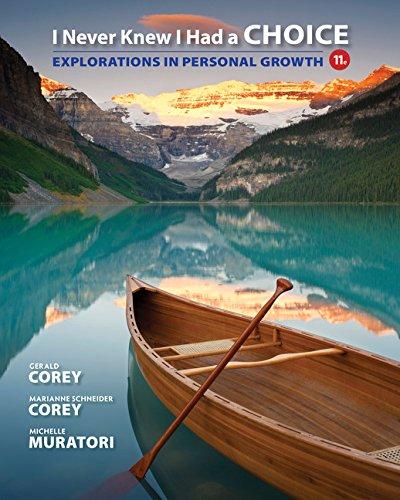
I Never Knew I Had a Choice is intended for college students of any age and for all others who wish to expand their self-awareness and explore the choices available to them in significant areas of their lives. Some of the topics discussed include choosing a personal style of learning; reviewing childhood and adolescence and the effects of these experiences on current behavior and choices; meeting the challenges of adulthood and autonomy; maintaining a healthy body and wellness; managing stress; appreciating the significance of love, intimate relationships, gender roles, and sexuality; work and recreation; dealing creatively with loneliness and solitude; understanding and accepting death and loss; choosing one’s values and meaning in life; embracing diversity; and pathways to personal growth.
This is a personal book in which we describe our own experiences and values with regard to many of the issues we raise. In addition, we encourage readers to examine the choices they have made and how these choices affect their present level of satisfaction. Each chapter begins with a self-inventory—Where Am I Now?—that gives readers the opportunity to focus on their present beliefs and attitudes. Within the chapters, Take Time to Reflect exercises encourage readers to pause and reflect on the issues raised. Additional activities and exercises (Where Can I Go From Here?) are suggested at the end of each chapter for use in the classroom or outside of class. We want to stress that this is an unfinished book; readers are encouraged to become coauthors by writing about their own reactions in their journals.
Throughout the book we have updated material to reflect current thinking, but the underlying themes we focus on are timeless. The introductory chapter addresses the importance of self-exploration and invites students to consider the value in learning about themselves, others, and personal growth. Social concerns must balance self-interests, however, and we maintain that self-fulfillment can occur only when individuals have a sense of social consciousness.
What’s New in the Eleventh Edition?
A new coauthor, Michelle Muratori, has brought her own unique voice and perspective into this 11th edition. This edition provides the most up-to-date developments in the field, and we have added new topics, expanded and revised existing topics, abbreviated the discussion of some topics, and updated the References and Suggested Readings at the end of the book. General features that have been revised throughout include personal stories illustrating key themes, current research findings relevant to original and new topics for each chapter, updated Take Time to Reflect exercises, and new Where Can I Go From Here? activities at the end of each chapter. The chapter-by-chapter overview that follows highlights the changes in this 11th edition.
CH apter 1 (Invitation to Personal Learning and Growth) presents several models of personal growth. The chapter includes some revision of the choices leading to change and updated material on what constitutes happiness. Increased coverage is devoted to positive psychology and attaining a sense of well-being. Considerable new material illuminates factors
associated with happiness. The section on how we change and difficulties in making changes has been expanded. We present a new discussion on the topic of fixed versus growth mindsets, address the advantages of a growth mindset, and clarify how our mindsets are shaped by messages we receive about success and failure.
CH apter 2 (Reviewing Your Childhood and Adolescence) contains an expanded discussion of the role of early childhood experiences on later personality development. This chapter continues to feature Erikson’s psychosocial model and the self-in-context theories as they deal with development throughout the life span. The discussion of attachment theory has been significantly expanded, demonstrating how human connection in early development is central to understanding later stages of life. More emphasis has been placed on how cultural factors influence attachments as well as on the impact of parenting style on a person’s development, with special attention paid to the role of culture. We have expanded the treatment on social networking as a way of connecting with peers in adolescence, the impact of cyberbullying on adolescents, and the benefits and drawbacks of social networking.
CH apter 3 (Adulthood and Autonomy) continues the discussion of the life-span perspective, focusing on the psychosocial theory and the self-in-context perspective. This chapter has been streamlined to highlight choices we can make at each of the phases of life and the unique challenges facing the individual at each stage. Increased coverage on common cognitive distortions and learning how to critically evaluate our self-defeating thinking have been added to this chapter.
CH apter 4 (Your Body and Wellness) has a revised discussion of wellness and life choices. There is some updating and expansion of these topics: sleep, exercise, eating, and spirituality. Increased coverage is given to applying technology to health care, initiatives aimed at helping people to lead healthier lives, and the impact of social media on body image. We continue to invite readers to examine their lifestyle choices and how these decisions can enhance their health.
CH apter 5 (Managing Stress) examines the impact of stress on the body, causes of stress, ineffective and constructive reactions to stress, and stress and the healthy personality. Revisions have been made to the role of culture in our perception of stress, environmental sources of stress (including the destructive impact of oppression and discrimination), the power of resilience in coping with stress, and a range of constructive practices for managing stress. The sections on posttraumatic stress disorder and vicarious traumatization have been significantly updated and expanded. Recent research has been included on meditation, mindfulness, yoga, and massage, and several additional approaches to stress management—t’ai chi, Pilates, and acupuncture—are discussed.
CH apter 6 (Love) deals with the many facets of love, the meaning of love, our fears of loving and being loved, the link between attachment and love, and even the effects of social media on how people demonstrate their love for one another. A research-based perspective on love and intimate relationships and a new section on the power of love have been added.
CH apter 7 (Relationships) contains guidelines for meaningful interpersonal relationships, including friendships, couple relationships, and family relationships. Information on the importance of self- and other-forgiveness has been expanded in this edition. The section on gay and lesbian relationships has also been updated, and we have revised our discussion regarding hate crimes against LGBT youth and sexual orientation. Sections on intimate partner violence and abuse and on relationships in a changing world address how technological advances are affecting relationships. We discuss social networking, online dating, and infidelity in cyberspace and look at both the advantages and disadvantages of social networking with respect to relationships.
CH apter 8 (Becoming the Woman or Man You Want to Be) has been extensively revised to reflect recent literature on gender-role socialization. The chapter contains numerous new resources to update the discussion of male roles, female roles, gender-role conflict, gender-role socialization, women and work choices, and challenging traditional gender roles. In addition, the gender similarities hypothesis and recent research on third genders are introduced.
CH apter 9 (Sexuality) has been substantially revised to emphasize communication about sexual issues. This discussion addresses programs on college campuses that focus on sexual communication, a cross-cultural perspective on sexual communication, and how cyberculture is expanding the boundaries of communication about sexuality. New material addresses the impact of the hook-up culture. This chapter also highlights the positive, healthy aspects of sexuality and the development of sexual values. We look more in-depth at the messages we receive about sexuality from the media and from society. The topics of enjoying sexual intimacy in later life, the controversy over sexual addiction, and the importance of personal choices in preventing sexually transmitted illnesses have been updated in this edition.
CH apter 10 (Work and Recreation) contains a revised section on occupational fields associated with various personality types. New material has been added on the dynamics of discontent at work, workplace bullying, the relationship between self-esteem and work, and forced retirement. Reflecting the realities of today, we include a discussion of choices in the context of difficult economic times and employment cutbacks. We also include a new section on the changing workplace, in which we address the impact of technology on the way we work and interact with colleagues.
CH apter 11 (Loneliness and Solitude) discusses the creative dimensions of solitude, along with increased coverage on the different kinds of loneliness we face. Once again, we discuss the impact of technology on our lives in a new section on loneliness in the age of connectivity. We explore the following question: “Does Facebook make you lonely?” The section on creating loneliness through shyness has been updated and expanded considerably. We describe the social fitness model as a way to deal with shyness.
CH apter 12 (Death and Loss) contains a revised discussion of the models for understanding the process of death and dying. The section on suicide has been updated and expanded. Coverage on the importance of grieving our losses and cultural variations in the mourning process has also been revised.
CH apter 13 (Meaning and Values) addresses the meaning of life, and we have provided many more examples of people who live with passion and purpose in their quest for a meaningful existence. We highlight Professor Philip Zimbardo’s research on why good people do bad things as well as what makes ordinary people perform exceptional heroic acts. We examine the link between spirituality/religion and meaning in life and address ways we can embrace diversity and make a difference beyond ourselves. We conclude by asking, “Do you like the person you are today?” Readers are reminded that their journey toward personal growth is only beginning. The importance of self-assessment as a key to personal growth is highlighted, and readers are guided in reviewing salient topics throughout the book. A variety of avenues for growth are suggested that readers may wish to pursue now and in the future in making changes in the way they are living.
Fundamentally, our approach in I Never Knew I Had a Choice is humanistic and personal; that is, we stress the healthy and effective personality and the common struggles most
of us experience in becoming mature adults. We especially emphasize accepting personal responsibility for the choices we make and consciously deciding whether and how we want to change our lives. There are multiple approaches to the study of personal adjustment and growth. We emphasize the existential and humanistic approach because to us it best sheds light on the role of choice and responsibility in creating a meaningful life for ourselves. We also include other theoretical perspectives in many of the chapters, a few of which are choice theory and reality therapy, transactional analysis, cognitive behavior therapy, feminist theory, self-in-relation theory, and the psychosocial approach to development.
Although our own approach can be broadly characterized as humanistic and existential, our aim has been to challenge readers to recognize and assess their own choices, beliefs, and values rather than to accept our particular point of view. Our basic premise is that a commitment to self-exploration creates new potentials for choice. Many of the college students and counseling clients with whom we work are relatively well-functioning people who desire more from life and who want to recognize and remove barriers to their personal creativity and freedom.
The experiences of those who have read and used earlier editions of I Never Knew I Had a Choice reveal that the themes explored have application for people of a diversity of ages and backgrounds. This book was developed for a variety of self-exploration courses, including Introduction to Counseling, Therapeutic Group, Psychology of Personal Growth, Personal Development, Personal Growth in Human Relationships, Personality and Adjustment, Interpersonal Relations, Human Potential Seminar, and Psychology of Personal Well-Being. Choice has also been adopted in courses ranging from the psychology of personal growth on the undergraduate level to graduate courses for training teachers and counselors. Courses that make use of an interactive approach will find Choice a useful tool for discussion.
We have written this book to facilitate interaction—between student and instructor, among the students within a class, between students and significant people in their lives, between the reader and us as authors—but most important of all, our aim is to provide the reader with an avenue for thoughtful reflection.
An updated Instructor’s Resource Manual accompanies this textbook. It includes test items, both multiple-choice and essay, for each chapter; a student study guide covering all chapters; suggested reading; questions for thought and discussion; numerous activities and exercises for classroom participation; guidelines for using the book and teaching the course; examples of various formats of personal-growth classes; guidelines for maximizing personal learning and for reviewing and integrating the course; PowerPoint presentations; and a student evaluation instrument to assess the impact of the course on readers.
I Never Knew I Had a Choice comes with MindTap, an online learning solution created to harness the power of technology to drive student success. This cloud-based platform integrates a number of learning applications (“apps”) into an easy to use and easy to access tool that supports a personalized learning experience. MindTap combines student learning tools—readings, multimedia, activities, and assessments—into a singular Learning Path that guides students through the course. This MindTap includes:
● Interactive versions of many of the self-assessments and reflection exercises from the text, including “Where Am I Now?” and “Take Time to Reflect”
● Video activities exploring many of the book’s themes in greater depth
● Discussion questions and activities that allow students to collaborate with their peers to develop solutions and responses in an online environment
● Chapter quizzes at the end of each chapter
● A glossary and flashcards of key terms and concepts
Acknowledgments
We would like to express our appreciation for the insightful suggestions given to us by friends, associates, reviewers, students, and readers.
The reviewers of the entire manuscript of this 11th edition of Choice provided us with many useful ideas for the refinement of this book, and many of their suggestions have been incorporated in the present edition. They are:
Jude Austin II, Old Dominion University
Julius Austin, Nicholls State University
Tammy McClain, West Liberty University
Beverly Palmer, California State University, Dominguez Hills
Lauren Verlaque, Georgia Regents University
Jude Austin and Julius Austin also played a key role in creating videos and writing and revising assessment content and interactive activities for use in the MindTap online program for Choice.
We especially want to acknowledge Julie Pearce, psychology instructor at Irvine Valley College, California, who has used this book for 17 years in her classes. She served as an expert reviewer who provided an in-depth critique of each chapter and gave us extensive feedback based on student responses to the topics in this book.
Katherine Helm and Pat Love, both of whom have written books on sexuality and teach courses on sexuality, did an in-depth review of Chapter 9 (Sexuality) and added some new material to the chapter.
In addition to the general reviewers listed above, 36 faculty members completed a prerevision survey and provided feedback on ways the book is being used.
Finally, as is true of all our books, I Never Knew I Had a Choice continues to develop as a result of a team effort, which includes the combined efforts of the following people at Cengage Learning: Jon Goodspeed, Product Director; Julie Martinez, Product Manager, Counseling, Social Work, & Human Services; Alexander Hancock, Associate Content Developer, Sociology, Counseling, and Social Work; Vernon Boes, Art Director; Lisa Henry, for her work on the interior design and cover of this book; and Rita Jaramillo, Content Project Manager. Thanks to Ben Kolstad, of Cenveo Publisher Services, who coordinated the production of this book. Special recognition goes to Kay Mikel, the manuscript editor of this edition, whose exceptional editorial talents continue to keep this book reader friendly. We appreciate Susan Cunningham’s work creating and revising test items to accompany this text, preparing the index, updating the Instructor’s Resource Manual, and assisting in development of other supplements to this book. The efforts and dedication of all of these people have contributed to the high quality of this edition.
Gerald Corey
Marianne Schneider Corey
Michelle Muratori
I Never Knew I Had a CHoICe
Explorations in pE rsonal Growth
Choice not chance determines your destiny.
—Aristotle
Phillip & Karen Smith/Getty Images
Invitation to Personal Learning and Growth
● Where Am I Now?
● Choice and Change
● Models for Personal Growth
● Are You an Active Learner?
● Multiple Intelligences and Multiple Learning Styles
Where Am I Now?
● Fixed Versus Growth Mindsets
● Getting the Most From This Book: Suggestions for Personal Learning
● Summary
● Where Can I Go From Here?
● Online Resources
Each chapter begins with a self-inventory designed to assess your attitudes and beliefs regarding a particular topic. Think about each question. By answering these questions as honestly as you can, you will increase your awareness and clarify your personal views on a range of subjects. Use this scale to respond to these statements:
4 = I strongly agree with this statement.
3 = I agree with this statement.
2 = I disagree with this statement.
1 = I strongly disagree with this statement.
●
1. I believe I influence the course of my life through my choices.
● 2. I have a good sense of the areas in my life that I can change and those aspects that I cannot change.
● 3. Generally, I have been willing to pay the price for taking the personal risks involved in choosing for myself.
● 4. I believe it is within my power to change even if others around me do not change.
● 5. I think happiness and success are largely related to a sense of belonging and to social connectedness.
● 6. I try to strike a balance between meeting my own needs and meeting the needs of others.
● 7. At their deepest core, I think people are good and can be trusted to move forward in a positive way.
● 8. I am an active learner.
● 9. I feel ready to make changes in my life that will result in personal growth even if the process is painful at times.
● 10. I am willing to challenge myself to examine my life in an honest way.
Here are a few suggestions for using this self-inventory:
● Retake the inventory after reading the chapter and again at the end of the course. Compare your answers to see if your attitudes have changed.
● Have someone who knows you well take the inventory for you, giving the responses he or she thinks actually describe you. Discuss any discrepancies between your sets of responses.
● Compare your responses with those of other class members and discuss the similarities and differences between your attitudes and theirs.
Personal growth involves a commitment to change. Whether you change your beliefs, your attitudes, or your behaviors, the process through which change occurs can be intimidating, if not overwhelming. It is natural to wonder whether the changes involved in personal growth are worth the effort they require. Whether you choose it or not, change is an inevitable part of life, and it is just one of the many compelling reasons to embark on this journey of personal learning and growth. When contemplating changes in your life, you first need to assess where you are now. Is your life satisfying? Are you getting what you want out of life? Do you sense a need to make changes in your daily life? Do you have an understanding of how your actions affect others? Perhaps even more fundamental is whether you believe you have the capacity to change. As you read this book, it is our hope that you will increase your awareness about who you are, how you relate to the world, and the choices open to you about ways to experience personal growth. We hope you will feel inspired to make the changes that are likely to result in a more fulfilling life.
Choice and Change
We Do Have Choices!
It is exciting for us when we see students and clients discover that they can be more in charge of their own lives than they ever dreamed possible. As one counseling client put it: “One thing I can see now that I didn’t see before is that I can change my life if I want to. I never knew I had a choice!” This remark captures the central message of this book: we can make choices, and we do have the power to re-create ourselves through our choices. Although you may wonder whether doing what it takes to bring about change is worth the effort, we hope you do not stop at this point. Reflect on the quality of your life and consider whether you want to change, and if so in which ways. Realize that the process of changing your attitudes and behaviors can be unsettling. Challenge your fears rather than being stopped by them. Socrates, in his wisdom, said, “The unexamined life is not worth living.” Examine your values and your behavior. What crises have you faced? How did these crises affect your life? Did they represent a significant turning point for you? What are the most important situations and events in your life? As you
engage yourself in this book, consider ways to use any challenging life situations as opportunities for discovering choices and making changes.
A Student’s Poem
At a recent reunion of graduates in the human services program at California State University, Fullerton, I (Jerry) met a former student of mine who shared this poem he had written when taking a self-exploration group course with me in the 1980s. In many ways, John Everett’s poem captures the spirit of this book.
I Never Knew I Had A Choice
I never knew I had a choice.
I thought I had to be what others saw in me.
I never knew I had a voice.
I felt I had to hide the things I held inside. Tears and years rolled slowly past. Somehow I knew it wouldn’t last.
Now freedom calls my name. My life won’t be the same.
I’m not afraid to change.
And as I leave the past behind, it’s good to realize the choice is mine.
I never knew I had inside the strength to carry on no matter what went wrong.
I never knew I had the pride to search for something new to change my point of view. But it appears that I was wrong. I had it in me all along.
Now freedom calls my name. My life won’t be the same. I’m not afraid to change.
And as I leave the past behind, it’s good to realize the choice is mine.
Copyright by John Everett September 14, 1980
What Brings Us Happiness?
Making choices for yourself and having self-control are important ingredients in happiness. However, Buddhists teach us that trying to control what cannot be controlled will not lead to fulfillment. Identify changes that are within your power to make and those that are not within your power. In considering what leads to happiness, remember that many of your decisions will be influenced by your relationships with significant people in your life; we are all social beings. Making a commitment to examine your life does not mean becoming wrapped up in yourself to the exclusion of everyone else. Knowing and caring about yourself can help you connect with others in a meaningful way. A relative of mine (Jerry) recently was diagnosed with the beginning stages of Alzheimer’s disease, and the physician emphasized the importance of mental activity, physical exercise, and especially social connections. We never outgrow our need for connection to others it seems, no matter what lies ahead.
Philip Hwang (2000) asserts that happiness entails possessing a healthy balance of both self-esteem and other-esteem. Rather than searching for ways to enhance self-esteem, Hwang makes a strong case for promoting personal and social responsibility. Other-esteem involves respect, acceptance, caring, valuing, and promoting others, without reservation. We need to strive to understand others who may think, feel, and act differently from us. American culture stresses the self, independence, and self-sufficiency, but a meaningful life includes connections to others in love, work, and community. Hwang suggests that our challenge is to learn to see the world anew by reexamining our attitudes, values, and beliefs and developing a balance between caring for self and showing high esteem for others. It is not a matter of self-interests versus interest in others, for we can care for both ourselves and others. Caring for others can be rewarding in itself; in addition, others are likely to reciprocate in positive ways when we demonstrate concern for them. Schueller and Parks (2014) conveyed a similar sentiment, suggesting that a reliable way to feel happier is to be kind to others. They add that “increasing the amount of social contact a person has and improving the quality of one’s interpersonal relationships are both strong pathways to promoting happiness” (p. 149). Passmore and Oades (2015) claim that psychological research overwhelmingly supports random acts of kindness as being beneficial to the individual giver both mentally and physically.
Weiten, Dunn, and Hammer (2018) examined empirical studies on what constitutes happiness and found that happiness is more a subjective matter than an objective state. How we feel about our experiences and how we perceive what we have in life are crucial in bringing us happiness. A number of factors contribute to determining our subjective well-being, or happiness. The following factors are relatively unimportant in determining our general happiness: money, age, gender, parenthood, intelligence, and physical attractiveness. Factors that are somewhat important in determining our subjective well-being include health, social relations, leisure activity, culture, and religion. These are moderately good predictors of happiness. Researchers indicate that a few factors are very important ingredients for overall happiness: love and relationship satisfaction, work, genetics, and personality.
Key factors associated with happiness vary in different cultures. For example, Joshanloo and Weijers (2014) state that interpersonal relationships bring about happiness in some Asian cultures. Ugwuanyi (2014) notes that in African philosophical thought attempting to promote the value of another’s life and having an optimistic outlook toward life brings
about happiness. As Mohanty (2014) discovered in a study of longitudinal U.S. data, a positive attitude is more clearly related to happiness than any other factor, including income. Watson and Tharp (2014) believe happiness is the result of striving toward goals and devoting time to meaningful activities. They identify meaningful life work, spirituality, close relationships, and transcending self-interest as categories of behavior that lead to life satisfaction and happiness.
Kottler (2014) takes the position that happiness is as much a state of mind as it is life circumstances. Having a positive, optimistic attitude predisposes us to a range of benefits that accumulating possessions, striving for great wealth, and seeking status ado not provide. We fully agree with his contention that “once you have enough to live on comfortably, having more things or making more money does not significantly improve anything—except the levels of stress associated with holding onto what you’ve amassed” (p. 41). Research supports the notion that “the happiest people are those who are most willing to adjust their visions and change their objectives in light of experience and feedback regarding what is working and what is not” (p. 244). If you want to live a happy life, Kottler suggests that you do the following:
● Focus on positive aspects of life.
● Maintain an optimistic perspective.
● Live in the present.
● Spend quality time with those you love.
● Forgive those who hurt you.
● Figure out what you love, and then do this as often as possible.
Much of this book is devoted to addressing factors that relate to your general level of happiness and subjective well-being. You will be invited to explore your choices in key areas of life such as personality, health, managing stress, love, intimate relationships, gender, sexuality, work, recreation, solitude, spirituality/religion, and meaning in life. Happiness is not simply something that automatically comes our way; we believe happiness is largely a function of the choices we make in each of these areas of living. The Dalai Lama, the spiritual leader of the Tibetan people, has said that “the purpose of our lives is to be happy.” The route to happiness involves making choices and taking action, which is captured by his words: “Happiness is not something ready made. It comes from your own actions.”
Are You Ready to Change?
Deciding to change is not a simple matter. It is common to have doubts and fears about making changes. In fact, it is a mark of courage to acknowledge your ambivalence about changing and your anxiety over accepting greater responsibility for your life.
It is no easy matter to take an honest look at your life. Those who are close to you may not approve of or like your changes. They may put up barriers to your efforts. Your cultural background may be in conflict with the cultural values of the society in which you live. These factors can increase your anxiety as you contemplate making your own choices rather than allowing others to choose for you.
I (Michelle) embarked on my own personal growth journey while taking a personal growth course as an undergraduate. I was not prepared for the reactions of some of the
people in my life at that time. My significant other, who was wrestling with his own insecurities, seemed to resent my commitment to this work and perhaps feared that we would eventually grow apart. Looking back on this time, I suspect he felt threatened by the changes I was making. As I was becoming more assertive and emotionally healthy, our relationship was becoming increasingly rocky. The more I changed, the more difficult it was for us to stay together. We eventually parted ways, which was very painful, but it was in my best interests, and perhaps in his too, to move on rather than to remain in a relationship that made us both unhappy.
What is the best way to bring about change? The process of change begins when you are able to recognize and accept certain facets of yourself, even though you may not want to acknowledge some personal characteristic. Sometimes it is not possible to make a desired change, but even in these cases you have power over your attitude. You can choose how you perceive, interpret, and react to your situation. The Serenity Prayer* outlines the sphere of our responsibility:
God, grant me the serenity to accept the things I cannot change, courage to change the things I can, and wisdom to know the difference.
The paradoxical theory of change holds that personal change tends to occur when we become aware of what we are as opposed to trying to become what we are not (Beisser, 1970). The more we attempt to deny some aspect of our being, the more we remain the same. If you live in denial, it is difficult to make changes. Thus, if you desire change in some area of your life, you first need to accept who and what you are. You may wish you were different, but to move forward you must be willing to accept the person you are right now. Recognizing who you are at the present time is the starting point for making changes.
Change is not facilitated by being critical of yourself; treat yourself kindly and respectfully. Learning the art of self-compassion and being accepting of yourself is essential in making life changes. Once you are able to identify and acknowledge those aspects of yourself that you tend to deny, you increase your choices and open yourself to possibilities for changing. Start with small steps in the direction you want to move. It helps to remember that perfection is a direction, not a goal that you arrive at once and for all. Wanting to be different is a key first step. Your personal journey can be enriched by reflecting on these words of Aristotle: “Choice not chance determines your destiny.”
The Stages of Change
Change is rarely easy, and most of the time we are ambivalent about making significant changes. Reluctance to change is a normal and expected part of the growth process. It is so common, in fact, that Prochaska and Norcross (2014) developed a framework for a change model that describes five identifiable stages. In the precontemplation stage, the individual has no intention of changing a behavior pattern in the near future. In the contemplation stage, the person is aware of a problem and is considering overcoming it, but the individual has not yet made a commitment to take action to bring about the change. In the preparation stage, the person intends to take action immediately and reports some small behavioral changes. In the action stage, the individual is taking steps to modify his or her behavior to solve a problem. During the maintenance stage, the individual works to consolidate the gains made and to prevent relapse.
*Attributed to Friedrich Oetinger (1702–1782) and Reinhold Niebuhr, “The Serenity Prayer” (1934).
It is worth noting that Prochaska and Norcross’s (2014) stages of change endorse the Western idea of change, which is confirmed by making progress toward a particular goal. In some cultures, people believe there are no end goals of change. In other cultures, change may be seen as acceptance of one’s circumstances or as being in greater harmony with one’s environment. We encourage you to explore what change means to you from your cultural perspective.
People do not pass neatly through these five stages in a linear fashion, and an individual’s readiness can fluctuate throughout the change process. If change is initially unsuccessful, individuals may return to an earlier stage. You may want to change certain patterns because they are no longer serving you, yet you cling to these familiar patterns either because you are afraid to leave what is known or because the costs of changing are too high. Although you may see advantages to making life changes, you may have many concerns and fears about changing. It is important to find an inner source of motivation that will enable you to challenge your fear and make life-affirming choices.
Self-exploration —being honest with yourself and others, thinking for yourself, deciding to acquire new ways of being, and making a commitment to live by your choices—requires concerted effort. Kottler (2014) reminds us that significant change takes place as a result of our chosen attitudes, beliefs, and perspectives. He claims that there are good reasons for people to avoid change. Every change we make involves surrendering something familiar and comfortable. Thus, a degree of discomfort and even fear may be associated with discovering more about yourself. When you are considering making life changes or acting in new ways,
ask yourself this question: “What is the cost, and is it worth the price?” Change is a proactive process, and only you can decide what you want to change and how much change is right for you.
Models for Personal Growth
Changing your life exposes you to new experiences. But just what does personal growth entail? In this section we contrast the idea of growth with that of adjustment and offer a humanistic model of what ideal growth can be.
Adjustment or Growth?
Although this book deals with topics in what is often called “the psychology of adjustment,” we prefer the phrase “personal growth.” The term adjustment is frequently taken to mean that some ideal norm exists by which people should be measured. This notion raises many questions:
● What is the desired norm of adjustment?
● Who determines the standards of “good” adjustment?
● Is it possible that the same person could be considered well adjusted in one culture and poorly adjusted in some other culture?
● Do we expect people who live in chaotic and destructive environments to adjust to their life situations?
This notion of adjustment suggests a single standard of measurement that identifies universal qualities of the well-adjusted or psychologically healthy person, and we do not believe such a standard exists.
Within the limits imposed by genetic and environmental factors, we see the possibilities for creating our own vision of who we want to become rather than conforming to a single standard. In forming this vision, cultural values and norms play a crucial role. For example, if you are in your 20s and live with your parents, some would view this as dependent behavior on your part and think you should be living apart from your family of origin. From another cultural perspective, this might well be an expected or desired living arrangement. Instead of talking about adjustment, we talk about personal growth , in which the individual defines and assesses his or her own growth in a lifelong process while dealing with numerous crises at various stages of life. These crises can be seen as challenges to change, giving life new meaning. Growth also encompasses a relationship with significant others, the community, and the world. You do not grow in a vacuum but through your engagement with other people. To continue to grow, you have to be willing to let go of some old ways of thinking and acting so new dimensions can develop. When reading and studying, think about the ways you may have restricted your choices and the degree to which you are willing to exercise new choices and take action to bring about change. Ask yourself these questions:
● What do I want for myself, for others, and from others?
● What do I like about my life?
● What am I having difficulty with in my life?
● How would I like to be different?
● What are possible consequences if I do or do not change?
● How will my changes affect others in my life?
● What choices are open to me at this time in my life?
● How does my culture influence the choices I make?
● Do my cultural values enhance or inhibit my ability to make changes?
Our perspective on personal growth undoubtedly has been influenced by our clinical experiences over the years, but the topic of personal growth has captured the attention and interest of researchers as well (e.g., Robitschek et al., 2012; Weigold, Porfeli, & Weigold, 2013). Robitschek et al. (2012) describe the personal growth initiative (PGI) as an antecedent to optimal functioning and well-being. It is multidimensional and includes these cognitive and behavioral components: readiness for change, the ability to plan specific changes, using resources throughout the growth process, and engaging in intentional behavior that will assist in the process of personal growth.
Creating Your Vision: Allowing Yourself to Dream
At age 8, when I (Marianne) decided to come to America, I did not fully realize what an unrealistic dream this was. I was challenged many times to give up my dream, yet I did not let obstacles stop me. The choice I made when I was 8 has greatly influenced my life and the lives of many others as well.
Although I (Michelle) didn’t formulate a vision for my life until I was in my 20s, the pursuit of my dream to become a counselor and counselor educator has required me to face my fears and to take some risks. Moving first to the Midwest for my graduate studies and later to the east coast for my career entailed leaving friends and family members behind. As difficult as that was to do, the path I have taken has enriched my life.
My (Jerry) fear of failing and feelings of inadequacy have been my best teachers. I believe that the greatest hindrance to growth may be allowing the fear of failing to stop you from doing what you most want to do. I have learned that failure isn’t fatal and that much can be gained from reflecting on my mistakes. Having a personal vision is essential to growth and change. Allow yourself to formulate your vision so you can pursue your dreams. If you follow your dreams, a range of choices will unfold for you.
Many of our students have said that they did not envision the turns their life would take and that they continue to be surprised by what has come into their lives. At one time they would not have imagined such possibilities—even in their wildest dreams—but their dreams have become reality. Dare to dream what may seem like an impossible dream, believe in yourself despite self-doubts, have the courage to follow your passions, and then work hard to turn your dreams into your reality.
Overcoming Barriers, Opening Doors
Sometimes we limit our potential for personal growth by letting obstacles stop us from realizing our dreams and pursuing our goals. External and internal barriers may seem to block us from the choices that can lead to success. Joseph’s story illustrates how our beliefs can guide us around the barriers and to the open doors that lead to life’s richest rewards.