PRAISE FOR HUMAN FLOURISHING:
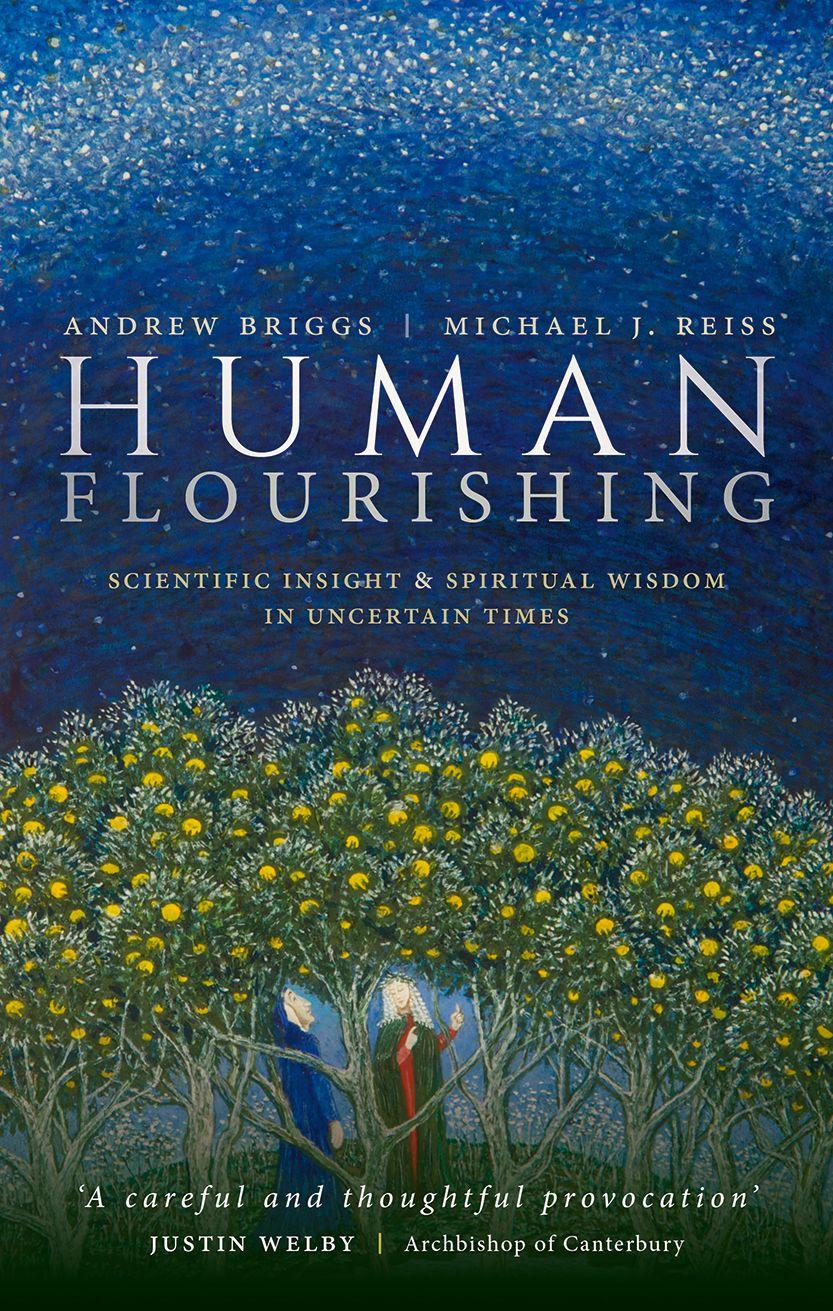
SCIENTIFIC INSIGHT AND SPIRITUAL WISDOM IN UNCERTAIN TIMES
‘The struggle for human beings to integrate a thoughtful understanding of the world as described by science and an ambitious hope of human flourishing as described by philosophy or faith is one at which humans have largely failed over the last three hundred years. This book is a major step in the right direction. It is very serious about science and very serious about human beings and their hopes and fears. I warmly commend it for a careful and thoughtful provocation towards a deeper commitment to the flourishing of human beings and of the creation.’
Justin Welby, Archbishop of Canterbury
‘The theme of this highly readable and enlightening book is broad and ambitious. It’s the product of the authors’ deep engagement with science, ethics and religion, and analyses the requisites for a fulfilled life, highlighting those that too often elude politicians and economists. The text is enlivened with historical allusions and quotations. It offers a wise perspective that’s much needed as individuals and societies contend with the anxieties of the present era.’
Lord Martin Rees, Astronomer Royal, former President of the Royal Society
‘In this magisterial book, Andrew Briggs and Michael Reiss address one of the most fundamental issues confronting humanity—human flourishing. Drawing on science and religion, they examine it from the perspective of the material, relational and spiritual. What emerges are profound insights into meaning, purpose, truth, and the reason for being. This book should be read by anyone interested in what it is to be human.’
Colin Mayer, Peter Moores Professor of Management Studies, University of Oxford
‘What enables the good life? Material goods? Supportive relationships? Transcendent purpose? In this state-of-the-art synopsis, scientist Andrew Briggs and bioethicist Michael Reiss weave these and other threads into the fabric of human thriving. With a breath-taking sweep of scholarship that draws insights from multiple disciplines, they illuminate a path toward meaningful well-being and sustainable joy.’
David Myers, Professor of Psychology, Hope College, author of The Pursuit of Happiness
‘A sophisticated and much-needed and insightful integration of science and humanity. As an economist I am embarrassed by my profession’s stunted characterization of humanity as “Homo economicus”, which shrivels us to hedonistic consumers. In reality, as Professors Briggs and Reiss demonstrate, we thrive from morally guided agency that transcends ourselves and our time on Earth. In this time of uncertainty and pessimism, it is a hopeful guide to meaningful lives.’
Sir Paul Collier, Blavatnik School of Government, author of The Future of Capitalism
‘In a world where human flourishing seems somewhat more elusive and abstract than ever, Professors Briggs and Reiss capture the many dimensions of human flourishing in the 21st century. In doing so, they give us reason to hope and to work toward a world where all people flourish. This is a delightful and uplifting treatise on what it means to be human.’
Heather Templeton Dill, President, John Templeton Foundation
In Human Flourishing: Scientific Insight and Spiritual Wisdom in Uncertain Times, acclaimed scholars Andrew Briggs and Michael Reiss provide insight for navigating a world of uncertainty and complexity to find more meaning, purpose, and happiness all around us. Using a combination of science and ancient wisdom, they demonstrate why love is essential for human flourishing.
Arthur C. Brooks, Professor, Harvard Kennedy School and Harvard Business School, and The New York Times bestselling author
‘For those of my generation, who grew up with post-war austerity and the threat of nuclear annihilation, the twenty-first century promised an era of unparalleled human flourishing. But it was a mirage. Material wealth has led to problems of disparity, overconsumption, and climate catastrophe; social media has produced alienation and a retreat from shared values. Democracy and common decency look increasingly fragile. We have entered a strange new era in which extraordinary promise is coupled with a burgeoning sense of insecurity and uncertainty. Science, the powerful facilitator of progress, also threatens our undoing. In this lucid and comprehensive analysis, Andrew Briggs and Michael Reiss carefully examine the rich tapestry of religious, cultural, and scientific factors that define our current predicament, and offer a message of hope, a way ahead founded on that familiar, yet too-often elusive, human quality—love.’
Paul Davies, Director of the Beyond Center for Fundamental Concepts in Science, Arizona State University
‘This book by Briggs and Reiss covers questions that are of critical importance to everyone everywhere: How do we understand human life? What is human flourishing? How do we flourish? The book’s rich insights and comprehensive scope will be of benefit to all readers. It provides a roadmap to flourishing in this life, and beyond.’
Tyler J. VanderWeele, Loeb Professor of Epidemiology and Director of the Human Flourishing Program, Harvard University
‘In the midst of a great pandemic, unprecedented poverty, and natural disasters alongside never-before-seen development of new technologies and great wealth, nothing could be more important than wrestling with what it really means for humans to flourish. Here, Briggs and Reiss provide a comprehensive, synthetic, and highly readable book that addresses this topic head on. It is the kind of book that should be read and re-read.’
Elaine Howard Ecklund, Herbert S. Autrey Chair in Social Sciences, Rice University
‘As I read this book, Modest Mussorgsky’s wonderful Pictures at an Exhibition started playing in my mind. The same sense of multiple perspective, overt spaciousness with periodic attention to intense detail, yet a persistent crescendo in continuity of purpose emerges in this elegant and comprehensive tour of a rich and pan-disciplinary subject. Briggs and Reiss have given a compelling introduction to human flourishing, and show us why, though discussed since the ancient world, it has become ever more pressing in our own times.’
Tom McLeish, Professor of Natural Philosophy, University of York
1 Dimensions and Pillars of Human Flourishing
Angela Ricker was born in 2004 in the living room of her parents’ home, surrounded by her immediate family. No sooner had she arrived in the world than it was apparent that all was not well. Her uncle remembers receiving a distressed phone call from her grandfather, ‘There’s something wrong with the baby.’ Babies with Down syndrome have an extra copy of their twenty first chromosome—a condition called trisomy 21. Angela had three copies of her thirteenth chromosome— this is called trisomy 13 or Patau syndrome. Angela’s trisomy 13 affected almost every part of her body, from curled-in toes to unfused plates in her skull. It was this that immediately alerted the midwife to the need for urgent medical attention.
Angela never learned to see or hear normally, to walk or talk, or to feed or wash herself. Her family would never know what she understood or appreciated about her mother and father, her brothers and sisters, or her wider family. Although early on she responded to voice and touch, as she grew she seemed to recede further into an already distant and unknowable world. Was Angela flourishing?
Her uncle reckoned that you could not answer that question in isolation. If a test of a human community is how it cares for the most vulnerable like Angela, then the question is not whether Angela was flourishing on her own (she could not), but whether her presence led to the family and others flourishing together. That in turn suggests other questions, such as ‘Who is helping Angela to flourish?’ and ‘Who is flourishing because of Angela?’ Maybe even, ‘How can those around her become the kind of people among whom Angela flourishes and who flourish with Angela in their midst?’
When Angela was ten years old, her grandparents celebrated their fiftieth wedding anniversary. Angela’s siblings and cousins played music and games around her. Without belittling the huge emotional and
Human Flourishing: Scientific insight and spiritual wisdom in uncertain times. Andrew Briggs and Michael J. Reiss, Oxford University Press. © Andrew Briggs and Michael J. Reiss 2021. DOI: 10.1093/oso/9780198850267.003.0001
financial costs of caring for Angela, her family found that her inescapable vulnerability in an astonishing way concentrated their attention and their love. Her uncle described it thus, ‘In a centrifugal world where everything and everyone flees the demands of love, Angela was a centre of gravity, drawing us back to one another and to true life—the life that really is life, the life that money cannot buy, the life of making flourishing possible, at great cost and with great tears.’1
For Angela and those around her to flourish required the best of scientific insight—the medical science that enabled her condition to be diagnosed and underpinned all the equipment and treatment needed to keep her alive—and the best of spiritual wisdom—the wisdom that affirms that Angela is of value and inspires those around her to keep on loving her even when there is no evident response. Those resources needed to be applied in three connected dimensions: the material, her bodily needs; the relational, the caring by her parents and others; and what we shall call the transcendent, to describe what enabled her family to attribute dignity and value to Angela.
Angela died a year later. While she was still alive, her uncle posed two further questions about flourishing: ‘What are we meant to be?’, and ‘Why are we so far from what we’re meant to be?’2 Answering such questions requires rich resources of scientific insight and of spiritual wisdom.
What do we mean by ‘human flourishing’?
The notion of ‘flourishing’ may appear rather antiquated to some. In the Western tradition the term is most closely associated with Aristotle, who lived in the fourth century before the Common Era. But interest in human flourishing has been growing in recent years in academic, policy, and popular circles. In part, this is a reaction against measures such as ‘average human lifespan’ or ‘per capita Gross Domestic Product (GDP)’. While such measures clearly tell us something about a nation’s or a community’s state of affairs, we all know that a long life is not necessarily a good life and the same is true of a life that is rich if measured only in monetary terms. What then is it that makes a human life a flourishing life? We start from the premise that each person is of equal dignity—a premise shared by many religious and non-religious traditions. As this book is about to go to press, the refrain ‘Black Lives Matter’ has revived an awareness of the inherent dignity and worth of every human.
Possibly since humans were first capable of asking the question, certainly since the dawn of history, humans have asked why we are here and what a good life entails. At different times, different answers have held sway. Nowadays, there are perhaps more answers proposed than ever. Much of humanity still finds the ultimate answers to meaning and purpose in religion. But in countries across the globe, secular views are widely held. In any event, whether religious or secular, individuals, communities, and governments still have to make decisions about what people want and need from life.
The notion of human flourishing is a useful concept within which to consider such questions—few would maintain that we want people not to flourish. The concept is sufficiently flexible that it can contain common-sense answers as well as ones that date back to the births of the world’s major religions and the origins of philosophy, whether in the East or the West. In this book we therefore explore what is meant by human flourishing and see what it has to offer for those seeking after truth, meaning, and purpose. We hope that this book will enable readers to clarify what they want for their lives, for themselves, for their families and more widely. In our more optimistic moments, we hope that what we write will help some to lead more flourishing lives. We are not so naïve as to imagine that our writing will help those who, for example, are clinically depressed—and we are not attempting to write a self-help guide. But we do believe that at a time when most of us are bombarded with messages about what we should or should not do to live healthily, attain a work–life balance and find meaning, a careful consideration of the contributions of both scientific insights and spiritual wisdom to human flourishing can provide a new angle that many will find helpful.
We realize that not everyone is convinced that science (both the natural sciences and the social sciences) has much of value when considering questions of human flourishing, such as purpose and meaning. Equally, many hold that, important as such questions are, religions have nothing of value to contribute to them. We disagree with both these views. In different places within the book the extent to which we rely on scientific insights—including such social sciences as psychology and sociology within the scope of science—and spiritual wisdom varies. In some chapters one takes precedence, in other chapters the other. Across the book as a whole, both make major contributions and our hope is that someone sceptical of the utility of
one or the other will, if not converted to our position, at least appreciate why we have included both and understand the contribution that each makes to our argument.
To anticipate the argument that we will develop, we maintain that the concept of human flourishing provides a valuable framework within which to consider the importance of satisfying people’s yearnings for material goods, successful relationships and the hope that we can achieve and experience things that give us a sense of something greater than ourselves—the transcendent. We maintain that the transcendent is not discerned only within religions; for many, the arts, nature, wilderness, and a consideration of our place in the Universe are all instances of routes towards an appreciation of something beyond. At the same time, transcendence plays a particular role within religions and we will discuss aspects of transcendence that are opened up by a religious or spiritual outlook on life.
The material dimension of human flourishing
Words matter. The word ‘material’ can be understood in a number of ways. In philosophy the term ‘materialism’ refers to the view that nothing matters except for matter and such physical concepts as energy and waves. One of us is based in the Oxford Department of Materials. A scientist who works in physics is a physicist, but to describe a scientist who works in materials as a materialist might be seriously misleading! By the ‘material dimension to human flourishing’, we mean those aspects of human flourishing that are to do with such things as having enough to eat, access to clean water, enough sleep, reasonably good health, somewhere that one considers to be one’s home and in which one feels safe, and enough money not to be endlessly worried by financial matters.
It might immediately be objected that we are beginning rather to stretch the everyday understanding of ‘material’—for example, in our inclusion of ‘somewhere that one considers to be one’s home and in which one feels safe’. Our reason for having a broad conception of the material dimension to human flourishing is that we don’t want simply to erect a ‘straw man’ definition of the term which allows it almost effortlessly to be knocked down, leading to the conclusion that the material dimension on its own is insufficient. We do think that even our rather broad understanding of the material dimension to human
flourishing provides an inadequate conceptualization of human flourishing. One of the rather sad, in our view, features of much of modern life, including too many education systems, is that one can arrive at adulthood thinking that the material is all there is to life.
However, this is to get ahead of ourselves. Before we critique the notion that the material dimension is enough for human flourishing, we need to acknowledge that for many people the way we have characterized it—such things as having enough to eat, access to clean water, enough sleep, reasonably good health, somewhere that one considers to be one’s home and in which one feels safe, and enough money not to be endlessly worried by financial matters—sounds like a utopian dream. Even in peace time there are many hundreds of millions of people across the globe who do not enjoy such basic comforts. And when we add in the effects of wars and other conflicts, we are talking of many more.
So the material dimension does matter. Indeed, if we just think of having enough sleep and enjoying reasonably good health, things may be getting worse in many countries. Modern life for many of us, as we live in an increasingly 24/7 wired world, means that it’s all too easy to deprive oneself of sleep, striving to keep connected to our social networks for just another half hour. And then, while almost all countries have seen startling improvements over the past century in life expectancy, this does not seamlessly translate into greater human flourishing for all. People may be living some 30 years longer on average than they did a century ago but around ten of those additional years are often ones of poor health. The average person nowadays spends longer, especially towards the end of life, in poor health than their ancestors did.
The relational dimension of human flourishing
Most of us enjoy the company of others, even if there are times when we may prefer to be on our own. We value family and friendship, even though we all know that family relations can be painful and we may fall out with our friends. But even these apparent objections to the value of relationships show how significant they are—they can go wrong and damage us as well as go well and help us to flourish.
For all of us, our initial closest relationship is with the woman in whose womb we begin our post-conception life. Throughout our lives
we carry genetic material from two individuals (setting aside biotechnological interventions such as treating mitochondrial disease using gene therapy) but for some nine months or so we rely on the biological environment that one of them provides. This first relationship is an important one. If all goes well the baby emerges at birth having developed from a single fertilized cell into a newborn, typically weighing several kilograms, able to breathe on its own and begin its post-partum development through to adulthood.
Sometimes, though, matters don’t go as well before birth as they should, and not only for genetic reasons. For example, if a pregnant woman’s diet is low in folate (vitamin B9) in the first few months of pregnancy, the newborn may have neural tube defects, which can have adverse lifetime consequences. Moving from shortage to excess, if a pregnant woman has too high an intake of alcohol or smokes cigarettes (or pretty much anything else), then there can be damage to her developing child. Fetal alcohol syndrome can result in permanent brain damage, with consequent harms to educational attainment and general intelligence as well as other problems including motor coordination. While mental impairment should not be equated with a life that is less worth living, no parent wants a child to have fetal alcohol syndrome.
The relationship a mother has with her unborn child illustrates how the distinction between the material and relational dimensions of human flourishing may not always be clear. In one sense, all the adverse consequences in the preceding paragraph could be said to provide evidence for the material dimension—too little folate, too much alcohol or cigarette smoke. It is because the unborn child sits within his or her mother that we can also consider the effects as illustrating the relational dimension.
After the baby is born, the primary benefit of feeding, whether by breast or bottle, comes from the nutritional, which is clearly material. But feeding for many of us—especially for a mother (or father, though perhaps typically to a lesser extent) with her newborn child—is also about relationships. This is a lesson from the great 1987 Danish film Babettes gæstebud (Babette’s Feast), based on a story by Isak Dinesen (aka Karen Blixen). Spoiler alert: Babette is a refugee who uses lottery winnings and her extraordinary culinary expertise to create a meal that heals a damaged community.
For a mother and baby, feeding plays an important part in their relationship. New mothers are bombarded with feeding advice from all
corners. The consensus nowadays seems to be that whilst breastfeeding can have various health benefits over bottle feeding (it is still not really possible to replicate in formula milk all the constituents of breastmilk, which also plays a role in the development of the immune system and lowers the likelihood of Sudden Infant Death Syndrome (cot death)), a mother can establish a good relationship with her baby whether she breastfeeds or not.3 We would like to think that this observation can be extrapolated to bottle-feeding by fathers.4 It is because of the importance of this bonding that some nursing parents choose to put away their phones while feeding.
The psychoanalyst Wilfred Bion introduced the term ‘reverie’ (from the French for ‘dream’) to describe what can happen between mother and baby when feeding is going well—which, of course, it doesn’t always, for a range of reasons, sometimes to do with the baby, sometimes to do with the mother and often to do with their relationship, even if only their relationship at a particular point in time. When feeding goes well, the baby, with its immature mental structures, somehow senses that its mother can contain any anxieties it has. The baby can therefore relax and concentrate on feeding and on its relationship with it mother. At the same time, the mother too may enter a state of reverie. This experience, for all that it is a natural and not uncommon experience, may suggest to the mother an aspect of the transcendent. There can be a depth to the experience that is beyond the everyday, much as some poets talk of the capacity of nature to take us out of ourselves. We have more to say about transcendence in the next section.
Beyond the mother–baby relationship, most of us would affirm the importance of good relationships between people. This applies to dyadic relationships—as in a marriage or between a parent and a particular child or between two friends of any age—and also to relationships within a community, whether one is thinking of the relationships within a family, a team, a congregation, a neighbourhood, or any other group that is not so large as to be anonymous.
Just how important relationships between people are for human flourishing we will examine in Chapter 3. For some people, relationships with non-human animals can play a major role in helping to maintain their quality of life. Distinctions can be made between pets, companion animals, and service animals. Pets are usually domesticated animals (cats, dogs, horses, certain bird species, etc.) that by virtue of their domestication are easy to keep and generally get on well with most
people. Individuals with some sort of disability may have a companion animal, which has no particular training for its role, or a service animal, which does. A companion animal, like a pet, can provide company, enjoyment, and psychological support (Figure 1.1). A service animal, such as a guide dog for someone who is blind or visually impaired, does more than this—and is usually trained to pay as little attention as possible to members of the general public, so that it can focus on its job.
The transcendent dimension of human flourishing
For most of us, there are times when aspects of life seem to go beyond, to transcend, the quotidian or the mundane. Nature, music, poetry, and the other arts can transport us beyond ourselves. Many creative people, whatever their discipline, may feel as if at least part of what they are creating comes from outside themselves, is given to them. An awareness of the transcendent can happen when we are alone or in group situations, whether in singing, in dancing, in certain sporting activities, or in worship.
Figure 1.1 Companion animals can make an important contribution to people’s flourishing.
But what do such highfalutin statements mean? Feelings like these, which in groups can be at least partly triggered by endorphin release, may serve some evolutionary function, perhaps in terms of binding people together; there is a growing scientific literature on this. Is that the whole story? Or does the way we react to great works of music, stunning scenes in nature or the birth of our own children require a deeper explanation?
We do not want to advocate some sort of cheap argument here from such experiences to belief in a transcendent being. Neither of us thinks that that sort of argument works. At the same time, while we fully recognize that there can be rich secular interpretations of such phenomena, we are also entirely comfortable with the suggestion that some experiences can be more than this, that they can link us to an awareness of the divine.
At this point it seems sensible to say a bit more about each of us. We were both educated in the natural sciences and one of us, Andrew Briggs, has remained in them to this day while the other of us, Michael Reiss, soon migrated to the social sciences. Each of us has a Christian faith that is important to us and shapes how we try to live our lives. For us, therefore, the transcendent dimension of human flourishing is as significant as the material and the relational. For most of our professional lives each of us has sought to elucidate how our occupation fits within our religious convictions.
Since Christianity is the tradition which we know best, when we consider religion we focus on Christianity. At the same time, we have tried not to be too parochial, indicating when our observations apply to religions in general and, in places, drawing on religious traditions other than Christianity. We hope that readers will be able to apply the principles which we set out to wherever they are coming from.
The Methodist theologian Frances Young has spent most of her adult life struggling with the practical and theological issues arising from the birth, in 1967, of her son Arthur. Arthur has severe physical and mental disabilities, is unable to speak and has always required a great deal of care. In her book about Arthur,5 she concludes with a chapter titled ‘Arthur’s vocation’, which provides insights about both the relational and transcendent dimensions of human flourishing.
Arthur, and others like Arthur, including Angela Ricker with whom we started this chapter, enable a shift from individualism and competitiveness to community and mutuality. As Young puts it:
What really makes us human is the capacity to ask for help, and that challenges modern claims to autonomy, as well as our individualism and success-values. The spirituality of the L’Arche communities has much to teach us about the presence of God in the everyday experience of living with persons who have learning disabilities. It’s important to highlight the mutuality of this relationship. It’s not a matter of doing good, or patronizing charity, but of receiving as well as giving, according dignity to the other person by receiving from them. The fruits of the Spirit, according to St Paul, are love, joy, peace, patience, kindness, generosity, faithfulness, gentleness and self-control (Gal. 5.22). It is in community with persons who are limited in their competence and capacity, at least compared with most of us, that we often best discover these deeper values.6
Young concludes her book with the thought that her son functions as a religious minister, who reveals to us something about who we are and reminds us that in worship believers enter the wordless praise along with all of creation.7
Different people are likely to react to the suggestion that there is a transcendental dimension to human flourishing in different ways. We hope that many readers find the notion intriguing, possibly attractive, even if it is not one to which they may have previously given a great deal of thought. The transcendent dimension of human flourishing, like the relational and material dimensions, is not without support. We identify three robust pillars: truth, purpose, and meaning.
The pillar of truth
We take it as axiomatic that a flourishing life will be built on truth. Pilate asked ‘What is truth?’ and, whatever he meant by this,8 the question remains an important one. In the context of a post-positivist hangover,9 it is easy to assume that the only truth that matters is empirical truth of the sort that can be used to establish whether a statement such as ‘Gold is a metal that does not tarnish’ is true or not. An assertion like this about the physical world falls within the domain of the natural sciences. How would a scientist go about establishing whether it is true or false? First, it would be necessary to be precise about the various terms. ‘Gold’ causes no problems—the word clearly refers to the chemical element with an atomic number of 79—and ‘metal’ is reasonably clear-cut (though non-scientists may be surprised to be told
that mercury is a metal as there is no requirement for a metal to be solid at room temperature) but ‘tarnish’ is a bit more problematic. It is an everyday word and everyday words often lack the precision that scientists attach to words—for example, to a physicist, the words ‘energy’, ‘work’, and ‘force’ each have precise and distinct meanings, which they lack in day-to-day conversation. In the case of ‘tarnish’, the word principally refers to the product of a chemical reaction between a metal and either oxygen or sulphur dioxide. Then, having clarified precisely what is meant by ‘Gold is a metal that does not tarnish’ it would be necessary, either through experimentation or some other objective method, to establish whether gold does indeed tarnish, or whether this is only the case for a substance that contains gold in a mixture (as gold in jewellery almost always is—even 22 carat gold has 8.3 per cent non-gold metals like silver, zinc, and nickel), rather than when it is pure.
But there are other ways of establishing truth, in addition to those used in the natural sciences. Mathematicians establish truth by ensuring that assertions that fall within the domain of mathematics are consistent. Many of us may remember from our school days the threefold classification of mathematics into arithmetic, geometry, and algebra, but there is more to mathematics than this. Mathematicians are fascinated by patterns and while there is no universally agreed definition of the subject, mathematics is widely agreed to include such things as the theory of knots and game theory. Mathematicians arrive at their conclusions through the use of proofs—all it takes for a purported proof to be invalidated is for it to be shown to have one inconsistency or a missing step that cannot be filled in. Something of what it is like to be a world-class mathematician is captured in Simon Singh’s account of how Andrew Wiles proved Fermat’s Last Theorem, a mathematical problem that had baffled mathematicians for over 350 years.10
Truth can be found in other domains of knowledge—in history, in aesthetics and in moral philosophy, for instance. There is a joke that goes ‘If Henry VIII had six wives, how many wives did Henry IV have?’ The humour relies on the appreciation that anyone (perhaps a young child) who seriously answers ‘three’ has failed to understand how both mathematics and history work.
But there are deeper questions about truth that the sciences, mathematics, history, aesthetics, and moral philosophy cannot answer.
In The Republic, Plato presents his allegory of the cave. Plato has Socrates describe the lives of people (perhaps us!) who live their lives in a cave where their perceived reality consists only of shadows projected onto a wall from a fire behind them. From within a system it can be difficult to imagine what the system looks like from the outside. It’s a bit like the story of two embryos debating whether there is life after birth. One asserts that there is; the other maintains that there isn’t and that stories of life after birth—of embryos entering though a tunnel into the light of a new world—are wish fulfilments. After all, what embryo has every come back from birth to convince other embryos of this second life?
The pillar of purpose
When Charles Darwin was considering whether to propose to his cousin Emma, he listed the advantages of not marrying, including:
Freedom to go where one liked—choice of Society & little of it.— Conversation of clever men at clubs—Not forced to visit relatives, & to bend in every trifle.—to have the expense & anxiety of children— perhaps quarelling—Loss of time.—cannot read in the Evenings— fatness & idleness—Anxiety & responsibility—less money for books &c11 and also the advantages of marrying:
Children—(if it Please God)—Constant companion, (& friend in old age) who will feel interested in one,—object to be beloved & played with.——better than a dog anyhow.—Home, & someone to take care of house—Charms of music & female chit-chat.—These things good for one’s health.—but terrible loss of time.—
My God, it is intolerable to think of spending ones whole life, like a neuter bee, working, working, & nothing after all.—No, no won’t do.—Imagine living all one’s day solitarily in smoky dirty London House.—Only picture to yourself a nice soft wife on a sofa with good fire, & books & music perhaps—Compare this vision with the dingy reality of Grt. Marlbro’ St.
Marry—Mary—Marry Q.E.D.12
More generally, we can say that the purposes of a marriage include companionship for the couple, a stable basis within which to bring up children and a socially sanctioned mechanism by which two people can begin a new life together. As an Anglican statement of purpose of
marriage expresses it: ‘Marriage is given, that husband and wife may comfort and help each other, living faithfully together in need and in plenty, in sorrow and in joy. It is given, that with delight and tenderness they may know each other in love, and, through the joy of their bodily union, may strengthen the union of their hearts and lives. It is given as the foundation of family life in which children may be born and nurtured in accordance with God’s will, to his praise and glory.’13
To a reductionist evolutionist, the purpose of life is to produce more life, life that is as closely related as possible. The past forty years have seen an enormous growth in the disciplines of behavioural ecology and evolutionary biology, with a particular focus on cases where organisms appear to engage in behaviours that contradict this simple dictum. A classic case is altruism—cases where organisms help one another in ways that go beyond what might be regarded as unproblematic instances of parents assisting offspring. Darwin himself wondered about the evolution of sterility in the social insects. In many species of ants, bees, termites, and wasps, many individuals—indeed, typically the large majority of them—never attempt to reproduce, instead serving the colony as a whole. Darwin realized that what such individuals are, in a sense, doing is to reproduce vicariously via others in their colony.
Nowadays we realize that the story is a bit more complicated—there are evolutionary battles within a colony as the various individuals do not all share identical interests—but the fundamental insight of Darwin holds good. This type of activity is nowadays named ‘kin selection’ as individuals are, effectively, reproducing via their kin (e.g. their siblings) rather than directly. Another mechanism by which altruism can evolve is through reciprocal altruism when one individual helps another individual (who may not even be in the same species) with the expectation (though this is not to imply any conscious awareness) that the time will come when such behaviour will be reciprocated and the altruist thus paid back.
When most of us wonder at a deeper level what we should do with our lives, consideration of how natural selection of random mutations of genes might best advance our interests is not generally uppermost in our minds. Part of being human is that we are able to go beyond the forces of evolution in a way that may be unique to our species. It is hard for people to flourish if they feel that their lives, indeed the Universe more generally, lack purpose. A key issue here is what is involved in finding a purpose. At one pole is the view that the Universe has no