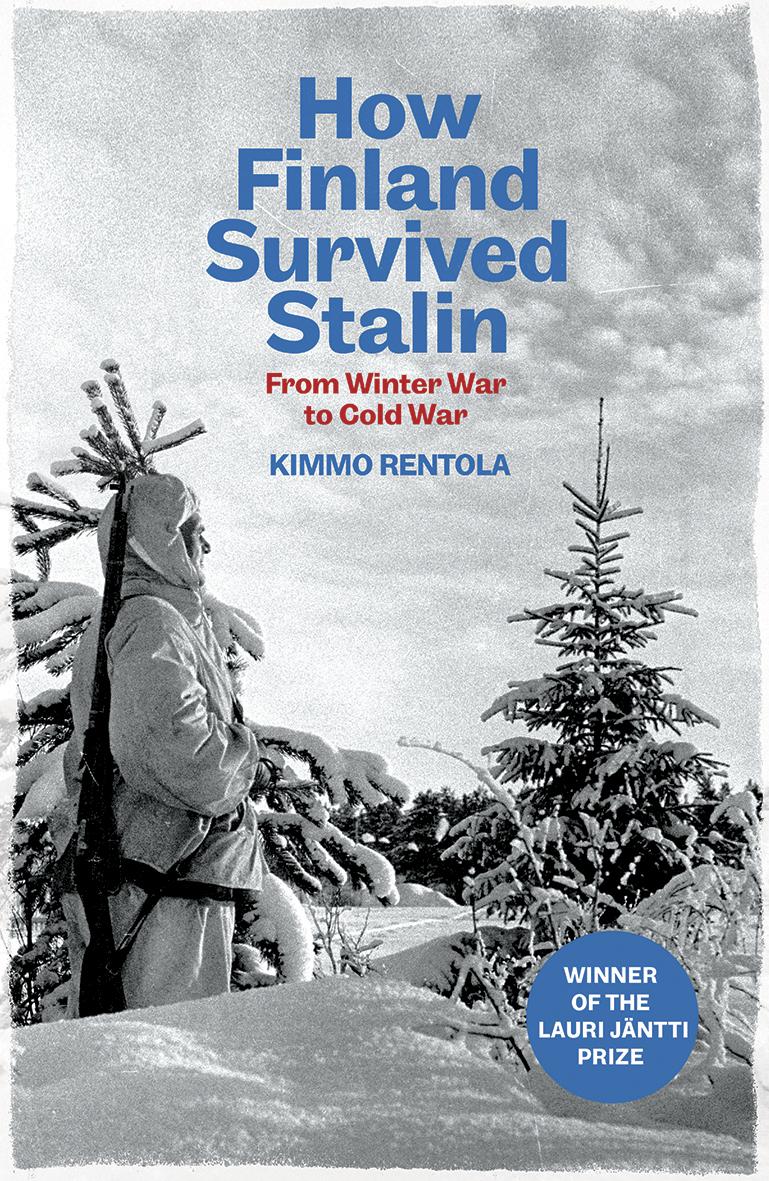
HOW FINLAND SURVIVED STALIN
Originally published as Stalinja Suomen kohtalo, Otava, 2016. English language edition published by agreement with Kimmo Rentola and Elina Ahlbäck Literary Agency, Helsinki, Finland.
Copyright © 2023 Kimmo Rentola
All rights reserved. This book may not be reproduced in whole or in part, in any form (beyond that copying permitted by Sections 107 and 108 of the U.S.
Copyright Law and except by reviewers for the public press) without written permission from the publishers.
All reasonable efforts have been made to provide accurate sources for all images that appear in this book. Any discrepancies or omissions will be rectified in future editions.
For information about this and other Yale University Press publications, please contact:
U.S. Office: sales.press@yale.edu yalebooks.com
Europe Office: sales@yaleup.co.uk yalebooks.co.uk
Set in Adobe Caslon Pro by IDSUK (DataConnection) Ltd
Printed in Great Britain by TJ Books, Padstow, Cornwall
Library of Congress Control Number: 2023946539
eISBN: 9780300274875
A catalogue record for this book is available from the British Library.
10 9 8 7 6 5 4 3 2 1
Contents
ListofIllustrations
ListofAbbreviations Acknowledgments
Introduction
I The Winter War (1939–40)
TheSovietDecisionforWar TheWar TheSovietDecisionforPeace Consequences
II The Way to Peace (1944) Contact IsThisAll? Capitulation? InterimPeace Reflections
III The Coup Threat (1948) SettingtheStage GoingontheOffensive TheMilitaryTreaty WhentoStop? WhatWasIt?
IV Pendulum Motions (1950–51)
ToGetRidofPaasikivi
KoreaandKekkonen
ThirdWorldWar?
Finland’sThirdWay
Notes
Bibliography
Index
Illustrations
1. Soviet intelligence officer Elisei Sinitsyn (“Eliseyev”), 1939. SAkuva.
2. Elisei Sinitsyn (“Eliseyev”), 1941. SA-kuva.
3. Signing of the Treaty of Mutual Assistance and Friendship between the Union of Soviet Socialist Republics and Finnish Democratic Republic, 2 December 1939. Historic Collection / Alamy.
4. Finnish soldiers heading to the front line at Summa, December 1939. SA-kuva.
5. “Would it be very un-nootral if we made just a small snowball for him?,” British Winter War cartoon. Military Collection / Alamy.
6. “Finland defends itself valiantly against the Soviet invasion,” French Winter War poster. Chronicle / Alamy.
7. The results of Stalin’s idea to cut Finland into two: dead soldiers and destroyed vehicles on the distant Raate road December 1939. SA-kuva.
8. Vyborg cathedral destroyed in an air attack, February 1940. SAkuva.
9. “Finland’s cause is ours!,” Swedish Winter War recruitment poster, 1940.
10. Swedish volunteers talking with Finnish canteen workers, Kemijärvi, February 1940. SA-kuva.
11. Swedish volunteer soldier, Lapland, February 1940. Associated Press / Alamy.
12. Finnish officers posing with a statue of Stalin, Soviet Karelia, September 1941. SA-kuva.
13. The Soviet Legation aflame during a Soviet bombing raid, Helsinki, February 1944. SA-kuva.
14. Eero A. Wuori at a lunch to celebrate Marshal Mannerheim’s seventy-fifth birthday, June 1942. SA-kuva.
15. Marshal Mannerheim visiting the front, August 1941. SA-kuva.
16. Soviet and Finnish soldiers meet on armistice day, Saimaa Canal, September 1944. SA-kuva.
17. Heavy mortar being packed away on armistice day, Ihantala, September 1944. SA-kuva.
18. Finnish soldiers enjoy a sauna, Vuosalmi, September 1944. SAkuva.
19. First officers of the Allied (Soviet) Control Commission arriving at Helsinki airport, September 1944. SA-kuva.
20. President J.K. Paasikivi and Voroshilov at the Finnish Embassy, Moscow, September 1955. Sputnik / Alamy.
21. Annual anniversary celebrations of the signing of the 1948 security treaty, April 1949. Kansan Arkisto.
22. Children celebrating Stalin’s seventieth birthday, December 1949. Kansan Arkisto.
23. Finnish delegation leaves Moscow, June 1950. Kansan Arkisto.
24. Pass allowing Kekkonen to participate in Stalin’s funeral. Urho Kekkonen Arkisto.
Maps
1. Northern Europe during the Winter War: November 1939–March 1940.
2. Finland: territorial changes in 1944.
3. The Soviet military base in Porkkala, 1944–56.
Abbreviations
Archival and publication abbreviations can be found in the Bibliography
AK Armia krajowa, Polish Home Army (1942–45)
Cominform Information Office of the Communist Parties (1947–56)
Comintern Communist International (1919–43)
EK Etsivä keskuspoliisi, Detective Central Police (Finland, 1919–38)
GRU Glavnoe razvedyvatel’noe upravlenie, Soviet military intelligence
GUGB Glavnoe upravlenie gosudarstvennoi bezopasnosti, Soviet main administration for state security 1934–41
LVO Leningrad Military District
MGB Soviet Ministry of State Security 1946–53
MI6 British Intelligence Service (=SIS)
MVT Soviet Ministry of Foreign Trade
NKGB People’s Commissariat for State Security 1943–46
NKID People’s Commissariat for Foreign Affairs
NKO People’s Commissariat for Defense
NKVD People’s Commissariat for Internal Affairs
OSS Office of Strategic Services, US 1942–45
PCI Partito comunista italiano, Italian Communist Party
RKKA Red Army of Workers and Peasants
SAK Central Trade Union of Finland (1930–69)
SDP Social Democratic Party of Finland
SIS British Secret Intelligence Service (MI6)
SKDL Finnish People’s Democratic Union (1944–89)
SKP Communist Party of Finland
Smersh Smert’ shpionam, Soviet Military Counterintelligence 1943–46
SOE Special Operations Executive, UK
UD Foreign Ministry of Sweden
UM Foreign Ministry of Finland
UN United Nations
USSR Union of Soviet Socialist Republics
Valpo Valtiollinen poliisi, State Police (Finland, 1938–48)
VKP(b) Soviet Communist Party (Bolsheviks)
Acknowledgments
In addition to those mentioned in the Finnish original, the author wishes to thank the following people, whose generous understanding and support have helped to bring about the book in English.
Professor Stephen Kotkin (now in Stanford) and Ambassador Sir Paul Lever (former chair of UK Joint Intelligence Committee) wrote supportive statements, which certainly helped in finding a publisher.
Ambassadors Mikko Hautala (now in Washington) and René Nyberg (formerly in Moscow) have actively promoted the book and instigated to publish it in English. My friend and colleague Dr Mikko Majander never refused to help.
Professor Geoffrey Roberts (Cork) has offered valuable advice, as have Patrick Salmon (Foreign and Commonwealth Office historian), the late Krister Wahlbäck (Stockholm) and Professor Peter Ruggenthaler (Graz). Dr Sergey Zhuravlyov (Russian Academy of Sciences) was seminal in obtaining Stalin’s materials from the Russian Presidential Archives. Now this kind of cooperation is no longer possible. I miss in particular Dr Natalia Lebedeva, who found the Katyn massacre documents.
The Jenny and Antti Wihuri Foundation financed the translation. Dr Richard Robinson did the work skillfully, translating even our national poet better than earlier published attempts.
Yale University Press accepted the book in their program, and Julian Loose negotiated and made the deal. This book has mainly
been taken care of by Frazer Martin and Lucy Buchan. The professional level in the publishing house seems astonishing.
My agent Elina Ahlbäck and her staff have efficiently and swiftly taken care of everything necessary.
My Finnish publisher Otava and in particular Dr Jarkko Vesikansa have helped in every way possible. Directors Marita Jalkanen of Kansan Arkisto (including the former Communist Party documents) and Pekka Lähteenkorva of President Kekkonen’s archive gave generous permissions for the publication of photographs.
Luckily, there is family. Healthy advice is always abundantly available, as is the joy of following my grandchildren.
Kimmo Rentola, 31 August 2023
Introduction
In 2001 the former President of Finland, Mauno Koivisto, published a small book on the idea of Russia, a theme he had been pondering for decades. He had been a young front-line soldier in the war against the Soviet Union, then after the war a Social Democratic activist fighting hard against the Communists. From the early 1960s, he was among those Social Democratic leaders who saw the necessity to adapt his party to the conditions of growing Soviet influence, at the same time preserving the country’s integrity and independence. Lastly, as the President of the Republic, he guided Finland through the collapse of the Soviet Union—at first very carefully, but when the time was ripe, he acted swiftly.
When his book was published in Russian, a Moscow journalist asked Koivisto, “Mr President, what, then, is the idea of Finland?” The answer was one word only, “Vyzhit’.” To survive.
This book explores the basis of the survival of Finland, both during the Second World War and immediately after.
Following Russia’s invasion of Ukraine, many analysts turned to the past to find historical precedents. The fate of Finland in the Second World War has loomed large in this regard. Indeed, while it is futile to expect history to neatly repeat itself, it cannot be denied that the Winter War, in particular, offers many similarities and plenty of food for thought. In the short but ferocious conflict between Finland and the Soviet Union in 1939–40, Moscow surely underestimated its neighbor’s defensive capacity and will to survive.
It is an extraordinary fact that, among the capitals of the European nations participating in the Second World War, only three avoided foreign occupation: London, Moscow, and Helsinki. If the latter sticks out, it is for good reason: Finland was not only on the losing side of the Second World War, it was a small nation of 4 million, situated in the immediate vicinity of the Soviet Union, against which she had to wage two wars in five years. In spite of all this, once the fighting had ceased, Finland was able to hold on to its democratic government and capitalist economy. It developed “friendly” relations—at least on the surface—with Moscow. It did not turn into a “people’s democracy,” nor was it incorporated into the Soviet Union.
How was this possible? In order to answer the question, I seek to analyze events from the perspective of the Soviet leadership, that is to say, Stalin. My aim is to scrutinize in depth those occasions when Stalin was clearly the main decision maker and when the stakes for Finland were at their highest: when the fate of its social and economic system, its state sovereignty and the lives of its citizens all hung in the balance. The first of these occasions was the Winter War in 1939–40, when Stalin decided to attack and then, in an abrupt volte-face, to make peace. The second was the long journey to a separate peace treaty with Finland in 1944, marking the end of the Continuation War, 1941–44, when Finland allied with Nazi Germany to fight against the Soviets. The third occasion was the spring of 1948, when Stalin pondered whether or not Finland should be made a “people’s democracy.” Each of these three episodes ultimately concluded with Stalin settling for far less than he had originally intended to get. This book will examine what caused him to back down each time.
Despite the welcome rise of diverse research approaches to military history, the relevance of the field’s traditional core area— power politics and international relations—remains undimmed. High politics is not reducible to the social. And it would be a mistake to be blinded by the immorality of the actors or the unpleasantness of their deeds. The historian needs to be guided by reason and to
strive for analysis. “A successful revolution can be a tragedy. But tragedies can still be grand geopolitical projects.”1
Finland: Background
A non-Finnish reader might need an overview of developments before and between the short periods examined in this book.
For six hundred years, beginning sometime in the thirteenth century, Finland was the eastern part of the Kingdom of Sweden. Fundamental Western institutions took hold in the region, such as the Roman Catholic (and later Lutheran) Church. In 1808–09, however, Sweden lost a war with Imperial Russia, and was forced to give up its eastern provinces. Finland became a Grand Duchy of the Russian Empire from 1809 to 1917. It was a separate state where Swedish laws still applied, and had an administration and later also a currency of its own. During the first decades, Swedish remained the official language, until 1863 when Finnish was also granted official status. Russian never became an official language, despite the empire’s Russification efforts from the 1890s on. Finland established a unicameral parliamentary system in 1906, and the next year held its first democratic elections, in which both men and women had the right to vote and to get elected. It was the first country in Europe to introduce female suffrage.
Amidst the collapse of the Russian Empire, Finland declared independence on 6 December 1917. Three weeks later this was recognized by the new Bolshevik government in Petrograd. However, escalating tensions between “Reds” and “Whites” culminated in the Finnish Civil War from January to May 1918.2 With the help of Germany, the White army emerged victorious, and most leaders and many supporters of the defeated Reds sought refuge in Soviet Russia. The collapse of Germany in November 1918 helped create the conditions for a democracy, and in the elections of 1919 the Social Democrats again became the biggest party. The Communist Party, founded in Moscow by Finnish Reds, remained illegal in
Finland until 1944. Official relations between Finland and Bolshevik Russia remained cool.
In 1930, Finland avoided becoming a right-wing authoritarian dictatorship, which was the typical outcome for the new states that had sprung up between Germany and Soviet Russia after the First World War. The kidnapping of the first President of the Republic as well as a failed coup attempt resulted in a loss of prestige and political support for the far-right Lapua movement. From 1937, the country was ruled by a center-left government consisting of Social Democrats and Agrarians. This government enjoyed the support of 75 percent of the electorate. At the same time, Finnish Red refugee communities were destroyed in the Stalinist terror.
These developments created the basic conditions for political actors during the first stage of the Second World War. For Finland, the most decisive issue was the secret division of spheres of interest in the non-aggression pact between Germany and the Soviet Union in August 1939. Finland was given to the Soviet sphere. This period is analyzed in detail in the first part of my book, which focuses on the Winter War.
After the Winter War, Finland’s position was precarious. Germany’s occupation of Denmark and Norway, and then the defeat of France, put paid to any hope of help from the West, which had seemed a real option during the Winter War. In summer 1940, three small Baltic republics, which had agreed to cede bases to the Red Army and Navy in 1939, were incorporated in the Soviet Union. It seemed fully possible that this would also be the fate of Finland. In fact, secret preparations for this course of action had already begun in Moscow. When Foreign Minister Molotov visited Berlin in November 1940, Stalin instructed him to ask, first and foremost, whether the non-aggression pact between Germany and the Soviet Union was still in force as far as Finland was concerned. Areas had been divided as agreed, except for Finland. Hitler finally answered that “of course” the pact was in force, but Germany did not want any military disturbances in the Baltic Sea region. This response was enough to dissuade Stalin from taking care of Finland there and then.
At that time, Berlin was already considering and making preparations for an attack on the Soviet Union. Finland did not require much persuasion to participate in the offensive, at least to reclaim the territory that had been lost in the Winter War. No formal treaty or deal was signed, but practical cooperation was established through mostly verbal mutual understanding between the countries’ militaries. Politically, Nazism was not particularly popular in Finland: the Social Democrats and many in the Swedish People’s Party were opposed to it. Key leaders, like President Ryti and Marshal Mannerheim, remained essentially pro-Western. But Germany was, at this point, Finland’s sole practical option.
Germany launched its offensive on 22 June 1941, and Finland followed suit a few days later. The Finnish Army was quickly able to conquer the areas lost in 1940, and much more besides, in Soviet Karelia. After these gains, the front was relatively quiet. But with Germany’s defeat at Stalingrad in early 1943, it became clear that Finland was again on the losing side. The peace process between the Soviet Union began after the Tehran Conference of the Allies in late 1943. From the Finnish perspective, the main problem was timing: the peace had to be made while the Germans were too weak to enact any effective countermeasures, but the Soviets not yet strong enough to crush the Finnish defenses. How this exact set of circumstances came to pass is described in the second part of this book.
After the interim peace agreement was signed in September 1944, the Allied Control Commission arrived in Finland, directed by Andrei Zhdanov, one of Stalin’s closest subordinates. The Communist Party became legal and even entered the government. In the elections of March 1945 the Communist-led bloc got a quarter of the seats and a coalition government of the “big three”—Communists, Social Democrats and Agrarians—was formed. For a time, it appeared inevitable that developments in Finland would proceed along the same lines as in Eastern Europe. It seems that the Soviets believed this, although they were aware that their power was more restricted, because Finland was not occupied, and the introduction of
full control and the opening of a path to “people’s democracy” was always too early for the Soviets, until it was too late.
With the onset of the Cold War, Stalin finally decided to take care of the Finnish question. His attempts to resolve it in spring 1948 form the theme of the third part of this book. In short, Finland—led by President J.K. Paasikivi—agreed to sign a restricted military treaty with the Soviet Union, which led to the Soviets dropping their offensive plans to facilitate the Communists’ road to power. Indeed, the Finnish Communists were subsequently ousted from government after their severe election defeat. A Social Democratic government was formed, which was met by a hostile reception from the Soviets. To some extent, the atmosphere changed in 1950, after Stalin had given the go-ahead for the Korean War and a new Agrarian government had taken power in Finland. The underlying situation remained volatile, and the contrasting scenarios that the Soviets envisaged for Finland are outlined in brief in the book’s fourth and final part.
Stalin made big decisions, but of course he was unable to determine their outcomes. History is full of unintended consequences: time and again, the best-laid plans have turned out very differently in practice. Often the result is something that no one involved had sought or wanted to achieve, and occasionally something that no one could even have imagined. As we will see, Soviet policies need to be analyzed in connection with the wider international situation and, in particular, with Britain, since it was a country that was constantly taken seriously by Moscow. Stalin was able to keep abreast of British thinking with the help of the Cambridge Five and other intelligence operations.
Stalin: Background
In Finland, it has been a tradition ever since the Second World War to believe—or at least to say—that our country was somehow a special case for Stalin. Having the opportunity to talk with Stalin on 13 June 1950, Prime Minister Urho Kekkonen claimed that the Finns
had found out that “Mr Generalissimus Stalin has a recess in his heart of goodwill towards the Finns.” Stalin’s reply was courteous, but nowhere near as lofty. Faithful to his habits, he talked about concrete interests. According to him, the Finns were honest men, who accurately fulfilled their obligations. If this continued, everything would proceed smoothly.3 In Stalin’s eyes, the most important obligations to fulfill were the war reparations the country had been paying since 1944 and the military obligations agreed in 1948 to fight against any attack through Finnish territory against the Soviet Union.
Of course, Kekkonen “the Rascal”—to quote the appellation given by Communist leader Hertta Kuusinen—was aware that the Kremlin was not the place to speak the plain truth. The heart of the generalissimus consisted of darker chambers and was ravaged by hidden demons. But it does seem possible that the Soviet leader had come to crave compliments of the sort expressed by the polite Prime Minister. Take the letter Stalin received from the Finnish Communist Party: he had marked sentences where he was thanked for his valuable advice. The better the Communists adhered to his words, the greater their forthcoming electoral success.4
Finland was certainly not a special case for Stalin before the Winter War, but not totally unknown either. He had visited the country twice when it was still a part of the Russian Empire. The first trip to a Bolshevik congress in Tampere in December 1905 later became seminal for the construction of the Stalin myth, because it was there that he met Lenin for the first time. As for Finland, he saw that it was a separate half-foreign state, with passports examined at the border with Russia, and with a separate currency. If anything was visible through train windows (it was the darkest month of the year), he would have seen forests and marshes in terrible weather and wondered how it was ever possible to build a state in these distant parts. In November 1917, Stalin visited the Social Democratic Party congress to encourage his Finnish comrades to take power just as the Bolsheviks had done. Afterwards, he offered harsh criticism of the Finns’ hesitation and inconceivable timidity—ignoring any
objective factors, such as the impact of a different political system. If experience in Baku in 1910 influenced Stalin’s policy in Iran in 1946, as has been claimed,5 it would be believable that the 1905 and 1917 Finnish experiences also left their imprint on him.
In power, Stalin continuously made decisions concerning Finland, but this neighbor was not in any way unique. It was one of the limitrofy, in the western border-country group with Estonia, Latvia, Lithuania, Poland and even Romania.6 It was less common to see Finland in the Nordic (Scandinavian) group. However, there was one occasion when Finland did stick in Stalin’s mind. In 1930, the Soviet Union’s trade representative Suren Erzinkian defected in Helsinki, and tried to claim 5.2 million marks in bills of exchange from the bank accounts of the Soviet trade delegation. At that time, similar incidents frequently took place across Europe, and as a rule the court cases about money were won by the defector. Except in Finland, where the Helsinki Magistrates’ Court ruled the money to be the property of the Soviet Union and found Erzinkian guilty of fraud. (It should be noted that there was no ‘Finlandization’ at that time, Finland being as staunchly anti-Soviet as any of the limitrofy.) This strengthened the Russian stereotypical view that the Finns were so stubbornly law-abiding and honest that it verged on stupidity. The case was surely remembered by Stalin, since his close ally Anastas Mikoian submitted his resignation, because the Armenian defector had been his protégé and probably knew even Stalin himself. (The discharge was not granted, but for a period Mikoian did lose his responsibility for foreign trade.)7
The most significant decision concerning Finland by Stalin before the war was the repression of Finnish-related populations and, in particular, the almost total destruction of the Finnish Red refugees. This was called the Great Hate8 by the survivors. Finnish institutions —military units, educational establishments and publications—were suppressed and, finally, any use of the Finnish language was prohibited. The specific details did not become known in Finland, but rumors abounded, as some refugees managed to return across the border. The overall picture could certainly be sensed in Finland, and
it had an effect on the national mood, particularly impacting the leftwing mindset before and during the Winter War. There was nothing particularly anti-Finnish in these purges; the fate of minority nations was more or less similar, in particular close to the border areas. The repression was led and closely watched by Stalin. When a commission in 1935 proposed the removal of 5,000 families—Finns, Karelians, Ingrian Finns—away from the northwestern border areas, Stalin approved of the idea, but marked in the margin: “Why not more?”9
Sources
Extensive Soviet archival sources have been used, even a sizeable amount of intelligence materials. Because of the war in Ukraine, further archival research is now impossible. Extensive use of documents from Finnish, Swedish and British archives complement the picture.
This English translation is not fully identical to the Finnish original that was published in 2016. It has been updated to include source materials that have only recently become available, in particular documents from Stalin’s files on Finland obtained from the Presidential Archives of Russia when cooperation was still possible.10 New books and articles on the topic have also been taken into account.
The Winter War
1939–40
Early in the second week of the Winter War, on 8 December 1939, the Soviet torpedo boat Razvedchik (“Scout”) struck a rock in Lake Ladoga under Finnish artillery fire.1 If this was a portent of the calamity that would befall the invasion, then Stalin and his razvedchiki (intelligence officers) did not yet realize it. At first Moscow thought that the difficulties were technical in nature. A perplexed Marshal Voroshilov could only order the 9th Army “to speed up its advance” on Oulu to sever Finland’s land connections to the west.2
At the front the Red Army’s soldiers already knew that this was not a border incident or occupation, but a war.3 The Finns were putting up a fierce resistance, not deceived by the puppet government ostensibly formed in the border town of Terijoki on 1 December 1939. This had been cobbled together from the few Red Finns in the Soviet Union to survive the purges, and was headed by the Communist International Secretary Otto Ville Kuusinen. When the seriousness of the difficulties, the scale of the losses and the problem of deserters dawned on Stalin,4 he prescribed his usual first aid: new NKVD regiments. Seven of them were set up to control the rear, then he started to change the attacking forces’ commanders.5
From the outbreak of war it was clear that the strategic intelligence of both sides had failed. The Finns knew about their opponent’s preparations, but not their extent. They concluded that their eastern neighbor was trying to apply pressure: the Soviets had not issued any ultimatum, and they would hardly launch an attack in the dead of winter. Finnish leaders tended to rely on the support of the West and Sweden acting as a deterrent. Few believed the rumors that the secret part of the Molotov–Ribbentrop Pact, the mutual non-aggression agreement concluded between Germany and the Soviet Union on 23 August 1939, left Finland at the Soviets’ mercy.6
On the Soviet side there was a failure to grasp that this conflict would not follow the precedent set by their occupation of eastern Poland in September. Then they had entered the country, which had already been invaded by Hitler from the west, with a great show of force: with tanks, airplanes and a million men. They encountered little resistance, however, so less would have sufficed. This was fresh in the memory when the Soviets were making plans to march on Finland in November. One sign of their complacency was the appointment of the greenhorn as the new NKVD intelligence rezident in Helsinki. Elisei Sinitsyn had only begun his foreign service earlier that year in Lwów.7 Another was the strict order given to the Red Army’s troops not to cross the Swedish border: they should salute the Swedes at the Tornio River, but they should not communicate further.8 Only when Stalin’s official 60th birthday—on 21 December 1939—came and went without a gift from the front did he inform the front-line commanders that “the war in Finland is a serious war, sharply different from our autumn raid [pokhod] on Poland.”9 Such an observation had certainly already been made at the front.
In Finland there prevailed the assumption that, upon the outbreak of war, the Communist refugees in Moscow would convince Stalin that the Finnish working class would side with the Red Army and rise up against their White oppressors. This was proved false on two counts. First, it was shown that a puppet government was a regular feature
of the Red Army’s invasions, as it provided ideological justification for the military action. The Terijoki government, therefore, was formed regardless of whether or not the Finns would be politically inclined to support it.10 Second, it became clear that the terrorstricken Comintern Finns were distant from Stalin and devoid of political influence: their leader, O.V. Kuusinen, was invited only to receive orders, not to help make them.11
Moscow’s ideological authorities were in the dark about how things really stood in Finland. As Lev Mekhlis, chief of the Red Army’s Political Directorate and one of Stalin’s inner circle, confessed, it was imagined that “the workers and the peasants would greet us with flowers.”12 Yet it was not just ideological myopia that caused the Soviets to seriously misjudge the situation. Other explanations can now be found by examining the intelligence and security reports sent to Stalin by the NKVD (the People’s Commissariat for Internal Affairs). This ministry was responsible for the majority of foreign intelligence and domestic surveillance, and its head, Lavrenti Beria, diligently ensured that the Khozyain(the Boss, that is to say Stalin) was kept up to date with its actions. In addition to these reports from the Lubyanka Building in Moscow, documents from both the Leningrad NKVD and the GRU military intelligence have now been published in Russia.13 Together, these materials offer an opportunity to more accurately assess the information upon which Stalin made his decisions.
The Soviet Decision for War
On 28 September 1939, following the rapid collapse and partition of Poland, the Soviet Union and Germany agreed a new treaty of friendship. This modified the two powers’ spheres of influence, and allowed Stalin to turn his attention to the northern countries that fell within the Soviet Union’s delineated area.14 The Western Powers, Britain and France, were still at war with Germany, but during the so-called Phoney War, instead of military action there was only
anticipation of it. In the West it was believed that Germany could be demoralized by economic warfare, as in the First World War. Some hoped that the nations could then unite to direct their combined might against Bolshevism; it was precisely this scenario that Moscow feared.15
The three Baltic States and Finland did not constitute much of a security threat to the Soviet Union as long as the treaties with Germany held fast, but Stalin exploited his free rein over the border countries to shore them up for the future. He knew that circumstances would change, and Germany’s surprisingly easy victory over Poland hardly reassured him otherwise. The Baltic States quickly agreed to cede military bases, but Finland, invited last to the negotiating table on 5 October, proved a harder nut to crack. Increasing the pressure, Stalin had to consider three major intelligence questions: what would Germany do, how would the Western Powers react, and what was the Finns’ own capacity for defense?
As to the first, would Hitler keep his word and leave Finland’s fate in the hands of the Soviets? In so doing, the Führer would betray the military ties established with Finland during the First World War, when over one thousand Finnish volunteers had fought for Germany. Known as the Jägers, they helped lead the White Army to victory over the Reds in the Finnish Civil War in 1918, and went on to form the backbone of independent Finland’s military. Soviet intelligence had kept a mistrustful eye on these connections right up until August 1939 when Moscow made its pact with Germany.16
After obtaining Foreign Minister Ribbentrop’s signature on the amended treaty in September, the Soviets saw in trade negotiations how the Germans were seeking close economic cooperation. Moscow always valued “deeds” like these more highly than “words,” even if the Germans were unwilling to sell their best cannon.17 Amongst those sent to Germany for procurement purposes was the young Dmitry Ustinov; decades later, during Leonid Brezhnev’s rule, he would visit Finland as Marshal and the Soviet Minister of Defense, trying (without success) to promote military cooperation between
the two neighbors. The Brezhnev generation was first acquainted with Finland when they were tasked with organizing support for the regime’s official stance before and during the Winter War. Their careers had only recently been rapidly advanced by Stalin’s purges, which had left many high-ranking posts vacant. These fast-rising young men did not quite have blood on their hands, but plenty of it at their feet.
Stalin was comforted also by the intelligence reports about Germany. From secretly obtained British intelligence cables, the Soviets saw that Finland’s head of military intelligence had been left “very disappointed” by Berlin’s unwillingness to offer assistance.18 In Helsinki, Soviet intelligence learned about a secret trip to Berlin by the former head of the secret police (Etsivä keskuspoliisi), Esko Riekki, and a couple of other Germanophile Finns. Riekki had never before heard his colleague Heinrich Himmler be so blunt, with the German commenting: “Stand firm if you want, but we will not help you.”19 Germany’s frosty attitude was confirmed by the Japanese military attaché in Moscow, Colonel Doi, who was overheard by Soviet surveillance complaining to his Swedish colleague that he could not comprehend how the Germans could have given the Russians carte blanche in Finland.20
With the Germans keeping their side of the bargain, the more pressing question was what the Western Powers and Norway and Sweden would do. Monitoring the British secret cables from Helsinki, Soviet intelligence realized that neither Great Britain nor America had any advice to offer the troubled Finns. All Sweden had to offer was moral support.21 Nonetheless, there was one cause for concern: notwithstanding the Phoney War against Germany, British intelligence circles seemed to believe that there was “a serious chance” of an Anglo-Soviet war breaking out within the next six months. This was despite the fact that the Foreign Office had instructed all embassies to refrain from anti-Soviet actions and to promote friendly relations.22 That they were publicly fostering concord but privately forecasting war caught Stalin’s paranoid eye. To at least assuage Sweden, his intelligence let leak that the Soviet