Hobbes’s Political Philosophy
Interpretation and Interpretations
A. P. MARTINICH
Roy Allison Vaughan Centennial Professor Emeritus in Philosophy University of Texas at Austin
Oxford University Press is a department of the University of Oxford. It furthers the University’s objective of excellence in research, scholarship, and education by publishing worldwide. Oxford is a registered trade mark of Oxford University Press in the UK and certain other countries.
Published in the United States of America by Oxford University Press 198 Madison Avenue, New York, NY 10016, United States of America.
© Oxford University Press 2021
All rights reserved. No part of this publication may be reproduced, stored in a retrieval system, or transmitted, in any form or by any means, without the prior permission in writing of Oxford University Press, or as expressly permitted by law, by license, or under terms agreed with the appropriate reproduction rights organization. Inquiries concerning reproduction outside the scope of the above should be sent to the Rights Department, Oxford University Press, at the address above.
You must not circulate this work in any other form and you must impose this same condition on any acquirer.
Library of Congress Control Number: 2021933670
ISBN 978–0–19–753171–6
DOI: 10.1093/oso/9780197531716.001.0001
Printed by Integrated Books International, United States of America
To some of my favorite editors and co-authors, whom I esteem and thank: Jeff Dean, Marissa Koors, S. A. Lloyd, Roger Louis, Peter Ohlin, Tom Palaima
1. Hobbes’s Political-Philosophical Project: Science and Subversion
2. Interpretation and Hobbes’s Political Philosophy
3. On the Proper Interpretation of Hobbes’s Philosophy
4. The Interpretation of Covenants in Leviathan
5. Four Senses of “Meaning” in the History of Ideas: Quentin Skinner’s Theory of Historical Interpretation
6. Law and Self-Preservation in Leviathan: On Misunderstanding Hobbes’s Philosophy, 1650–1700
7. The Laws of Nature Are the Laws of God in Leviathan
8. Leo Strauss’s Olympian Interpretation: Right, Self-Preservation, and Law in The Political Philosophy of Thomas Hobbes
9. Hobbes on Sovereignty by Acquisition in Leviathan
10. Natural Sovereignty and Omnipotence in Hobbes’s Leviathan
11. The Author of Sin and Demoniacs: Two Calvinist Issues in Thomas Hobbes and Some Contemporaries
12. Hobbes’s Erastianism and Interpretation
13. Sovereign-Making and Biblical Covenants in On the Citizen
Preface
Almost all of the chapters of this book were published in various books and journals over twenty-five years. The philosophical content of the chapters is the same as in their first publication. Typographical errors have been corrected; some mystifying phrases have been demystified; and some mental slips, such as writing “John Knox” for John Foxe, have been silently corrected. Because the editorial formats of the chapters in their original publication varied greatly from chapter to chapter, some uniformity has been imposed on the chapters—for example, changing all endnotes to footnotes. Two chapters appear here for the first time: “The Author of Sin and Demoniacs: Two Calvinist Issues in Thomas Hobbes and Some Contemporaries” was originally published in French; and “Hobbes on Sovereignty by Acquisition in Leviathan” was written expressly for this volume. The chapters are ordered according to overlapping themes, not chronologically. The chronological order is given in the List of Permissions.
Some points are made in more than one chapter because they were part of the immediate background of my position and could not be reasonably assumed to be part of the readers’ beliefs, or because they were the best way to advance or defend my position. Almost fifty years ago, a mathematician told me that a new theorem is not proved until it is published at least three times.
Acknowledgments
I want to thank my editor Peter Ohlin of Oxford University Press and his colleagues, Emily Bang and Madeleine Freeman, for their extraordinary work. I am also grateful to the project manager, Preetham Raj, and his colleagues, Peter Jaskowiak and Munusamy V., at Newgen Knowledge Works for their labor on the production process. And Leslie Martinich, as always.
Introduction
The central concepts of Thomas Hobbes’s political philosophy, especially as they appear in Leviathan, are explained in this book: the state of nature, the laws of nature; covenants; authorization and representation; sovereignty by institution, by acquisition, and by nature. The chapters are self-contained and should be intelligible to readers with only rudimentary knowledge of Hobbes’s political philosophy. Hence the title, Hobbes’s Political Philosophy Many of the chapters took form as I responded to criticisms of my book, The Two Gods of Leviathan (1992), by theorists with competing interpretations. Reflecting on their competing interpretations moved me to think about the nature of interpretation itself. Hence the subtitle, Interpretations and Interpretation.
My interpretation of Hobbes’s “science” of political philosophy is that he tried to show that absolute sovereignty was the only genuine kind of government by using Euclidean geometry as his mode (cf. Stauffer 2018: 66–72). He would deduce theorems about politics from carefully formulated definitions. Political philosophy was to result from reason alone, not empirical experience. When he mentioned empirical facts in his exposition, it was for the sake of illustrating a point, not proving it.
The idea that Hobbes was either an early liberal theorist or a proto-liberal is a mistake. His premises that all persons are equal and are absolutely free in the natural condition of human beings, the state of nature, are imposters of liberal premises, because for him, equality is equal ability to kill any other person and freedom is the right to do whatever one wants, no matter the harm that comes to others. With these premises, plus the proposition that the dominant or strongest desire of human beings is self-preservation, he argued that human beings ought to create their sovereign and commit to obeying it, no matter what it does.1 This is the heart of his “timeless” political philosophy.
1 I will typically refer to sovereigns with neuter pronouns to emphasize that the sovereign is an artificial person, which has no gender.
Hobbes’s Political Philosophy. A. P. Martinich, Oxford University Press. © Oxford University Press 2021. DOI: 10.1093/oso/9780197531716.003.0001
In addition to his formidable, timelessly true political philosophy, I argue that he had two time-bound projects. The first was to prove that authentic Christianity is not politically destabilizing, contrary to what the opponents of King Charles I maintained during the years prior to and during the English Civil War. This project should have been crystal clear, given the number of sermons preached and published against the king’s policies by the English and Scots. In his history of the Civil War, he wrote that “the interpretation of a verse in the Hebrew, Greek, or Latin Bible, is oftentimes the cause of a civil war and the deposing and assassinating of God’s anointed.” He was alluding to the execution of Charles (Hobbes 1679: 202). The second project was to show that Christian doctrine, properly conceived, is compatible with the new science of Copernicus and Galileo. Several of Hobbes’s friends had the same project, but they carried it out in different ways. Pierre Gassendi Christianized Epicurean atomism; Kenelm Digby and Thomas White Christianized atomism and Aristotelianism; and Marin Mersenne, the leader of a circle of intellectuals that included those just mentioned, “was indubitably an heir to the Thomistic view of a necessary synthesis between Christian faith and philosophy, . . . the tacit assumption being that ‘true philosophy never contradicts the teachings of the Church’ ” (Hamou 2018).2
That is, Hobbes’s time-bound projects were not unique to him. To distinguish Hobbes from his philosophical friends, we can appeal to three facts: he was an English Calvinist; he was better informed about the Bible than they were; and he was a better philosopher. In short, Hobbes was both a powerful political philosopher and a person of his age.
That Hobbes’s historical projects were closely connected to his philosophy is a fact that even atheist interpreters—that is, those who think that Hobbes was an atheist—admit. For example, Leo Strauss wrote that Hobbes made “use of the authority of the Scriptures for his own theory,” but he also wanted to “shake the authority of the Scriptures themselves” (Strauss 1952: 71). Recently, Devin Stauffer gave a more sophisticated defense of the same basic position. As one reviewer described it: “Hobbes’s reinterpretation of Scripture is designed to bring the Bible into alignment with his political philosophy” and to “dispel the reigning darkness, chasten religion, and bring a new dawn of enlightenment” (Franco 2020: 127). One problem with the Straussian interpretation is that it attributes to Hobbes the incoherent intentions of
2 Rene Descartes also wanted his philosophy to be consistent with Christianity, but it was less central to his aspirations than it was for Hobbes and others, and Descartes was not a friend (Martinich 1999: 163–79).
wanting to use Christianity and to subvert it at the same time.3 Hobbes may have been a blockhead, but Strauss or Stauffer have not discovered how (cf. Hobbes 1682a: 7). The more palpable interpretation is that Hobbes’s project was the one that made perfect sense in the middle of the seventeenth century. If it is impossible to reconcile science and Christian doctrine and impossible to show that Christianity is a religion of peace, most intellectuals only came to know that a century or more later, and many intellectuals today still do not know it.
Hobbes’s characterization of the different realms of faith and reason is straightforward and neat. Reason generates science from definitions by proving universal and necessary propositions about the natural world. Faith generates religion by revealing individual, contingent events that show the road to salvation. Because they reign in different areas of cognitive life, they cannot contradict each other. Of course, if the tenets of a religion are nonsensical or superstitious, then the distinction would be futile. So Hobbes’s description of biblical Christianity needs to be sensible and not superstitious; and it is. But equally important is that Hobbes’s account is one that most mainstream, biblical scholars today accept. His penchant for absolute sovereignty worked well with familiar Christian adages such as “No man can serve two masters”; “Servants, obey your earthly masters with fear and trembling”; and “Let every person be subject to the governing authorities, for there is not authority except from God” (Matthew 6:24, Ephesians 6:5, and Romans 13:1, respectively).
I hope that what I have already said explains why I think understanding Hobbes’s time-bound projects is important. However, to be explicit, at least three values motivate me: respect for the philosopher, truth, and the belief that studying the philosopher’s actual beliefs repays the effort. These values are consistent with judging the adequacy of the philosophy and improving it when viable.
Chapter 1 discusses the place of Hobbes’s political philosophy within his general scheme of philosophy. In logical order, his philosophy has three parts: De corpore (1655) (On Body) or physics; De homine (1658) (On Man) or human beings; and De cive (1642, 1647) (On the Citizen). Hobbes’s titles have to be taken with a grain of salt. The first of his three parts is about
3 Another criticism is that what Stauffer wants to prove does not entail that no version of Christianity is true: “thoroughgoing critic of traditional Christianity, . . . [and the desire] of overthrowing a ‘Kingdom of Darkness’ . . . [and] offering . . . a rational and secular ‘Kingdom of Light’ ” (Stauffer 2018: 7).
bodies; but it begins with chapters about the nature of language and concepts of logic. His second part, about human beings, is as much about optics as it is about any other aspect of human beings. (My guess is that he had worked so long and hard on optics that he wanted his final version published.) Oddly, his treatment of human beings does not discuss families. The reason is that for him, human beings are no more familial animals than they are political ones. When Hobbes begins the third and last part of his philosophy, De cive (On the Citizen), human beings are mature individuals with no history and no emotional attachments. They are, as Hobbes suggests, like mushrooms, fully developed creatures when they first appear. Parental authority appears in the middle of De cive. It is treated as a special case of sovereignty as dominion; and dominion has the connotation of things such as household property belonging to an owner (dominus). The default condition of authority over children, in the original condition, belongs to the mother who is the first to have power over a child. In Leviathan, his comments about families or social relations are limited and ill fitting (cf. Hirschmann 2016).
Another oddity of De cive is that it says little about citizens and a great deal about sovereignty and government. The problem with Hobbes’s political philosophy (mentioned at least once by Quentin Skinner) is that he has no theory of society. Hobbes’s political philosophy provides no space for social relations among one’s fellows. His occasional comments about “social” behavior are unflattering.
A second theme of chapter 1 is the importance of historical context. No interpretation of the actions performed by using sentences can be reliable or complete without information about the context of its utterance and at least the intentions of the speaker. Donald Davidson’s T-sentences illustrate one feature of language, namely, that a satisfactory semantics has to appeal to no more than finite intellectual resources. But his semantic theory is not supposed to be a theory of interpretation, as he himself says (Davidson 2005: 89–107). Take the method of disquotation, for example:
“This board is strong enough” is true if and only if this board is strong enough
gives the lexical meaning of a sentence but not an interpretation in the sense relevant to theories of textual interpretation. For Davidson interpretation is not a rule-governed activity. The interpreter has to use various contextual resources to arrive at an interpretation. Suppose the context indicates that the
speaker is talking about a wooden board. More is required. Does the author mean that the board is strong enough for battering down a door, prying up a tree trunk, or supporting the weight of a human being, or something else? Is the speaker asserting, recommending, hypothesizing, or something else? (See chapters 2 and 3.)
The third theme of chapter 1 concerns Hobbes’s subversive motives. He was quite open about wanting to subvert long and deeply held false political and religious beliefs (e.g., Hobbes 1651: A2v). And it should not be surprising that his criticisms would apply to all but a narrow conception of religion— Erastian, episcopal, high liturgy, orthodox, and Calvinism as the English understood it. This is was the religion of King James I, Hobbes’s sovereign from the formative years of seventeen to thirty-seven. He was generally not religiously tolerant because the English were not tolerant; and almost every denomination in England denounced every other in harsh terms. Until recently, each Christian denomination professed itself to be the one true religion. For Christians, the great variety of false religions is a consequence of human perversity. Hobbes wrote that it was “almost impossible for men without the special assistance of God to avoid both Rocks of Atheism and of Superstition” (Hobbes 1647: 16.1, spelling modernized).
Scholarly disagreement about the proper interpretation of Hobbes’s philosophy is almost as deep and fierce as religious disputes in the seventeenth century. Not long after the publication of Two Gods, I began to think about the nature of interpretation and the reason that interpreters are intransigent. Chapter 2 explains that a deep source of disagreement is the fact that each person comes to a text with a complex network of beliefs acquired over decades of experience, partially shaped by the person’s dispositions. And this has the consequence that different people will understand complex texts differently. Although relatively few beliefs in a network are held tenaciously, often they are the ones that are crucial to interpretation. These beliefs are largely impervious to contrary evidence, even in learned, brilliant scholars. These differences do not make discussions impossible, but they do reduce the likelihood of rational persuasion.
The extent of differences in networks should not be exaggerated. The networks of beliefs of people in the same culture at the same time greatly overlap. Although networks of beliefs of people living at different times and places have less overlap, education enables them to embed subnetworks roughly of the form, “People in place p and time t, believed . . . ,” by which people of the present can understand people of the past.
Chapter 2 also describes the main properties of beliefs and the network, such as unity, generality, and tenacity and how they relate to interpretation. Good interpretations have defeasible virtues such as simplicity, generality, consistency, and coherence (see also chapter 4). Usually a simpler interpretation that uses general principles to explain the text and is also coherent and consistent in doctrine is better than a more complex one. However, sometimes a simpler interpretation is incorrect. The serpent of Genesis is not identical with the Satan of the book of Job, because they had different origins and the author of Job did not intend it to be the serpent. Sometimes texts do not hang together as neatly as they should. And some texts, especially philosophical ones, are not consistent. For example, Hobbes contradicts himself because he asserts both that the sovereign is never a party to a sovereign-making covenant and sometimes, it seems, that he is a party to the covenant (see chapter 9, “Hobbes on Sovereignty by Acquisition in Leviathan”). So sometimes an interpretation that reports incoherencies and inconsistencies in a text is the better and the correct one. Some of the ideas in chapter 2 are continued in chapter 4, which relates the role of networks of belief to Hobbes’s understanding of covenants.
Chapter 3, “On the Proper Interpretation of Hobbes’s Philosophy,” is a response to criticisms of Two Gods by Edwin Curley (1996a). Much of his disagreement with my interpretation turns on the applicability of a conversational device that Curley calls “assertion by denial,” a type of irony or sarcasm (“I would never think that your approval of Pol Pot’s domestic behavior was morally insensitive”). Assuming that interpretations require networks of beliefs and acknowledging that differences in those networks account for much scholarly disagreement, I discuss the conditions under which a conversational context is ripe for sarcasm and when it is not. The standard or default way to understand an author’s words is in their literal meaning. If doing so would result in a falsehood that the speaker would expect the hearer to recognize, then an interpreter thinks about alternative ways of taking the words, for example, as a figure of speech or as sarcasm when appropriate.
Where Curley can find no plausible, literal interpretation of many of Hobbes’s sentences, I identify aspects of the seventeenth century that make the sentences literally reasonable. The major context is Jacobean, the complex of beliefs promoted by King James VI and I, namely, support for absolute sovereignty, Erastianism episcopacy, a high liturgy, orthodoxy in doctrine,
and English Calvinism in theology. Unfortunately for Hobbes, this culture began to wane in the 1620s and was largely nonexistent by 1651.
Sometimes Hobbes’s failure to develop a satisfactory theory for some religious doctrine is mistakenly interpreted as a sign of irreligion. While his attempt to explain the doctrine of the Trinity as one god and three persons who represent that one god fails, as he later admitted, no other scholar produced a logically and religiously sound theory. The doctrine is arguably inconsistent; and no scholar to my knowledge has identified a logically satisfactory doctrine of the seventeenth century or earlier. The distinguished Roman Catholic theologian Bernard Lonergan quipped, “The doctrine of the Trinity has four relations, three persons, two generations, one substance, and no explanations.” Scholars who are hard on Hobbes for his Trinitarian theory should compare it to John Wallis’s view. Wallis wrote that each person of the Trinity is
wont to be called Personality. By which word, we mean, that Distinction (what ever it be) whereby they are distinguished each from other, and thence called Three Persons.
If the word Person do not please, we need not be fond of Words, so the Thing be agreed: . . . And we have no reason to wave the Word, since we know no better to put in the Place of it.
If it be asked, what these Personalities or Characteristicks are, whereby each Person is distinguished from other; I think we have little more thereof in Scripture, than that the Father is said to Beget; the Son, to be Begotten; and the Holy-Ghost, to Proceed.
If it be further asked, what is the full import of these Words (which are but Metaphorical), and what is the adequate Meaning of them, I think we need not trouble our selves about it: . . . we may be content to be ignorant.
In brief, “person” does not mean person; and Christians do not know what it means as regards the Trinity. Any other word would work as well, as long as it makes sense to say that one begets, one is begotten, and one proceeds. Then Wallis says,
And we who know so little of the Essence of any thing . . . need not think it strange that we are not able to comprehend all the Particularities of what concerns that of God, and the Blessed Trinity. (Wallis 1690: 3–4; cf. Hobbes 1651: 31.33/191)
Hobbes’s views about Christian doctrines look less objectionable when they are considered against the background of numerous theological efforts. Almost all of them eventually break down. But Christian intellectuals continue to deal with the same problems. Recent efforts to escape the conundrum of reconciling God’s universal causality with the causality of free will continue to come up short, I think (see Tracy 1994: 96n20, and Vicens 2018). Curley and others claim that Hobbes advanced so many implausible or impossible religious views that he must have been doing so deliberately. But many of Hobbes’s views about political philosophy, geometry, and natural science are similarly implausible or impossible.4
In “The Interpretation of Covenants in Leviathan,” Curley again criticized my interpretation (Curley 2004). He argued that Hobbes’s discussion of covenants is suspiciously ambiguous and that his appeal to mediators in covenants with God is intended to show that it is impossible for human beings to enter into a covenant with God. Chapter 4, “The Interpretation of Covenants in Leviathan,” is my reply. Putting our debate into a larger context of interpretation in order to explain why it is difficult for scholars to resolve their disagreements, I say more about the role of networks of belief in interpretation and more about the properties of networks. However, the networks of contemporaries are similar, and a community of scholars can evaluate competing interpretations against principles or marks of good interpretations, some of which have been mentioned above. Scholarly arguments about interpretations do not need to end in disagreement to be fruitful. They may help the scholars to clarify their positions or to shore up their evidence. Curley argues that the best explanation for the contradictory opinions that Lord Clarendon and Robert Filmer had concerning Hobbes’s treatment of biblical covenants is that Hobbes was willfully ambiguous (Curley 2004: 199). But that is implausible, since Hobbes’s treatment of non-religious
4 Also, Hobbes is sometimes criticized for espousing standard Christian views. One of the most egregious examples is his assertion that God is incomprehensible and no creature knows his nature (Stauffer 2018: 92). But probably hundreds of examples of this doctrine could be assembled. I give just one from the document currently at hand: “We firmly believe and confess that there is only one true God . . . incomprehensible and ineffable” (“Fourth Lateran Council: Constitutions,” https:// www.ewtn.com/catholicism/library/history-and-text-1465, accessed June 19, 2020). When Hobbes says that human beings “cannot have any idea of him in their mind answerable to his nature,” he means that God, subtle body, does not affect the senses. Thomas Aquinas also denies that human beings know God’s nature. Stauffer then seems to commit a non sequitur via a rhetorical question. Hobbes’s definition of a true religion as one in which “the power imagined is truly such as we imagine” moves him to ask whether any religion could fit this description. Obviously, it could. And one could have faith in and believe that religion. But one may not know that it is the true religion: “Blessed are those who have not seen and yet have come to believe” (John 20:29).
concepts was equally ambiguous and has generated contradictory interpretations. I discuss nine absurdities in parts of Hobbes’s philosophy that do not concern religion and allude to others. No scholar holds that Hobbes was intentionally ambiguous about these topics.
Curley thinks Hobbes’s position that “there is no covenant with God but by mediation of somebody that representeth God’s person” (Hobbes 1651: 18.3/ 89) is a good example of Hobbes’s surreptitious project. Curley thinks that because he can prove that there could not be such a covenant, Hobbes must have thought the same. But Curley is projecting his own belief onto Hobbes. All Christians believe that Jesus is the mediator of the new covenant between God and human beings, just as Moses was the mediator between God and the Israelites. To assume that Hobbes did not believe that Jesus could be the mediator is to beg the question. It also renders absurd Hobbes’s long discussions of divine covenants in chapter 35 and elsewhere in Parts III and IV. Curley’s interpretation is an exercise of reading between the lines, when understanding the lines themselves is satisfactory.
In chapter 5, “Four Senses of ‘Meaning’ in the History of Ideas,” I discuss four different senses of that key term for interpretation. These four senses can be identified by their syntactic and semantic features. Briefly, “mean” in the sense of intend takes an infinitive complement and intentions are often not fulfilled; “mean” in the sense of try to communicate takes a “that”-clause as its complement and the sentence asserting meaning does not entail its complement; “mean” in the way that logical and causal relations mean also takes a “that-clause as its complement and is entailed by the sentence that expresses the meaning. Finally, “mean” in the sense of significance or importance has to be relativized to a person or group, “for x” or “to x,” and entails its that-clause. Historians are most concerned with meaning as significance and search for meaning in the other senses as clues to the relevant significance. Using a classic article by Quentin Skinner, I show how a confusion of these various senses produced a confused theory of interpretation.
A central principle of Skinner’s theory of interpretation is considered in chapter 6, “Law and Self-Preservation: On Misinterpreting Hobbes’s Philosophy, 1650–1700.” Skinner espoused the principle that a philosopher’s contemporaries have a privileged position for understanding what the philosopher meant. I think the principle is falsified by the facts. Ironically, Skinner expresses his perplexity after reading articles about his theory by distinguished scholars: “Reading my critics, I . . . learn that I am at once an idealist, a materialist, a positivist, a relativist, an antiquarian, an historicist, and
a mere methodologist with nothing to say” (Skinner 1988: 231). The explanation for these facts, in my opinion, is that the contemporaries of a first-rate philosopher are generally not reliable interpreters because the originality of such philosophers usually consists of creating new concepts or reconfiguring familiar concepts in unfamiliar ways that second- and third-rate readers cannot appropriately fit into their networks of belief. Taking Hobbes’s views about law and self-preservation as my central example, I explain the misinterpretations of his views by his contemporaries. They thought that self-preservation was one of Hobbes’s laws. But that could not be true. Selfpreservation is a desire, the dominant or strongest one that humans have; and because desires are physiological conditions, they cannot be laws. Rather, the concept of self-preservation is part of the definition of “law of nature.” But the definition of a law of nature is no more a law of nature than the definition of an elephant is an elephant. What then are laws of nature? Chapter 7, “The Laws of Nature Are the Laws of God in Leviathan,” answers this question. Against the standard interpretation that the laws of nature in Leviathan are not laws because Hobbes calls them “theorems,” I argue that the theorems or “dictates of reason” constitute the content of the laws of nature, but not the laws themselves. To be laws, the dictates of reason need to have the force of a command, as Hobbes says. He uses reason to prove theorems; and reason is the “undoubted word of God” and one of the three ways that God communicates with human beings, according to Hobbes. So the laws of nature are “properly called Lawes.” John Deigh’s ingenious defense of the standard view is that terms that have a certain sense outside of a technical term such as “law” may not retain that sense inside the technical term such as “law of nature.” The technical term “law of nature” should be taken as if it were a fused expression such as “law-ofnature” or “lawofnature” (Deigh 2016a). If that is true, then “civil laws” and “natural liberty” may not be laws or liberty, respectively. Also, if the laws of nature are not laws, then Hobbes’s division of two kinds of law, civil and natural, would be analogous to the division of two kinds of horses into equine animals and hobbyhorses.
I criticize the interpretation of another distinguished philosopher in chapter 8, “Leo Strauss’s Olympian Interpretation.” I argue that Strauss is mistaken about three foundational concepts in Hobbes’s De cive: (a) Concerning rights, I argue that in the state of nature they are not normative, contrary to Strauss’s view. For Hobbes, rights exist simply where no law excludes them. They contribute to conflict; but no one violates another person’s right in that
state. (b) As for self-preservation, it is a desire and is not necessarily guided by reason. (c) Finally, Strauss is mistaken in thinking that Hobbes was an innovator in understanding law in terms of will. God’s laws in the Bible are laws because God wills them. Also, Hobbes’s laws of nature depend on reason.
Chapter 9, “Hobbes on Sovereignty by Acquisition in Leviathan,” shows that Hobbes’s philosophy had better resources to explain the nature of sovereignty when it arises from conquest than Hobbes actually used. When he first explains sovereignty, he says that the two kinds of sovereignty differ only in the incidental way in which they come to exist. But he says that sovereignty by institution consists of a covenant among all and only the future subjects of a sovereign; and he seems to say that sovereignty by acquisition does not. The conquering sovereign seems to be a party to a covenant and the newly acquired subjects seem not to covenant at all. They consent. These differences are not incidental, because if they exist, then several unfortunate consequences follow: (1) Commonwealths could contain two kinds of sovereigns governing the same territory, with two corresponding kinds of subjects, with different obligations to their sovereign. (2) The kind of commonwealth that occurs most frequently in history would have a less prominent place in Hobbes’s philosophy and it would be less clearly and more briefly described. And (3) sovereignty by acquisition would lack the two most innovative aspects of sovereign-making in Leviathan, authorization and representation. The alternative interpretation of sovereignty by acquisition offered here contains the essential features as sovereignty by institution; and the unfortunate consequences are eliminated or mitigated. The application of Hobbes’s theory to several historical or nearly historical examples of new sovereigns arising for a population shows that the phenomena to be explained is much more varied than Hobbes seems to appreciate.
Chapter 10, “Natural Sovereignty and Omnipotence in Hobbes’s Leviathan,” completes the treatment of Hobbes’s views about sovereignty. Because his discussion of natural sovereignty—that is, the sovereignty that God has in virtue of his omnipotence—occurs in the last chapter of Part II, “Of the Commonwealth,” it is properly part of his political philosophy. Two significant differences between human and divine sovereignty are that the power and authority of God depends neither on a transfer of rights from subjects to the sovereign nor on a covenant. These two differences are grounded in the same fact, namely, God’s “irresistible power.” He does not need his subjects for his power and his authority does not depend on a covenant they make among themselves. Hobbes’s views allow for a special
covenant to be made between God and his subjects. This special covenant does not fit his other models of sovereignty; but he has to accept it since it is biblical.
Seventeenth-century divines and philosophers used their conception of divine sovereignty to explain the sovereignty of absolute monarchs. In Psalm 82, God calls kings “gods.” So human monarchs are analogs of the divine sovereign. They have a monopoly on power; their judgments resolve contested facts and statements; they administer justice, and they save people (usually) from enemies and criminals. Sometimes the model of the human sovereign is used to explain properties of God. The question “Should human beings obey God or their sovereign if there is a conflict?” has an easy answer in Hobbes’s philosophy. There can be no conflict because God commands people to obey their human sovereign. Locating the source of God’s sovereignty in his power contrasts with standard seventeenth-century views, which located the source in his goodness or creation.
In chapter 11, my interpretation of Hobbes extends to one of the principal controversies between English Calvinists and Arminians, whether God is the author of sin or evil, and to another issue, the nature of demoniacs in the New Testament. Concerning God and sin, Arminians claimed that Calvinists were committed to the following inconsistent set of propositions:
1. God is the cause of everything.
2. God is the cause of Adam and Eve’s sin of disobedience.
3. Whoever is the cause of sin is culpable of the sin.
4. Whoever is caused to perform a sinful action is not guilty of the sin.
5. God is culpable for Adam and Eve’s sin; and Adam and Eve are not guilty of the sin. (From 1–4)
The creation story in Genesis is the evidence for (1) and accepted by both Arminians and Calvinists. Calvinists claim that (1) entails (2); Arminians say either that God is the cause only of good things or that he only permits evil actions like disobedience. Propositions (3) and (4) are supposedly obviously true; and (1)–(4) entail (5). Thus, God is the author of sin or evil. Calvinists less insightful than Hobbes often simply denied (3) and (4) without giving a good explanation, and occasionally denied (2). Hobbes’s resolution is ingenious. He accepted (2) and denied (3) on the ground that not everyone who causes a sin is culpable for the sin. Concerning (4), he pointed out that in order to commit a sin, one has to be subject to a law and God is subject to
none; and Adam and Eve were subject to God’s law or command not to eat the fruit of the tree of the knowledge of good and evil and broke it.
Hobbes’s debate with John Bramhall on these issues was only one of at least two other extensive debates at roughly the same time. The debates between the English Calvinists William Twisse and William Barlee and the Arminians Thomas Jackson and Thomas Pierce are similar in structure and argumentation to the Hobbes-Bramhall debate. The same lines of reasoning were pursued by other Calvinists too. I will mention only one more here, that of Thomas Whitfield, whose view is expressed in the title of one of his books, A Treatise Tending to Shew that the Just and Holy God, may have a Hand in the Unjust Actions of Sinfull Men: and that in such a Way as shall be without any Impeachment of his Justnesse and Holinesse, or Diminution of his Power and Providence (1653).
The second topic of chapter 11 concerns Hobbes’s position that the people possessed by demons (daemons) in the Gospels were madmen. Although John Bramhall attacked him for this view, it was accepted by Twisse and originated with the respected and renowned Joseph Mede (aka Meade), one of the great New Testament scholars of the seventeenth century. Bramhall criticizes the view either because it was new or because Hobbes accepted it. Hobbes ably defends his position (Hobbes 1682a: 58).
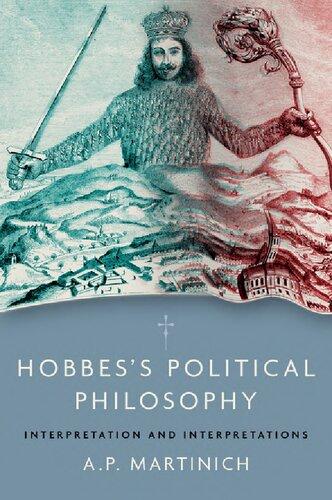
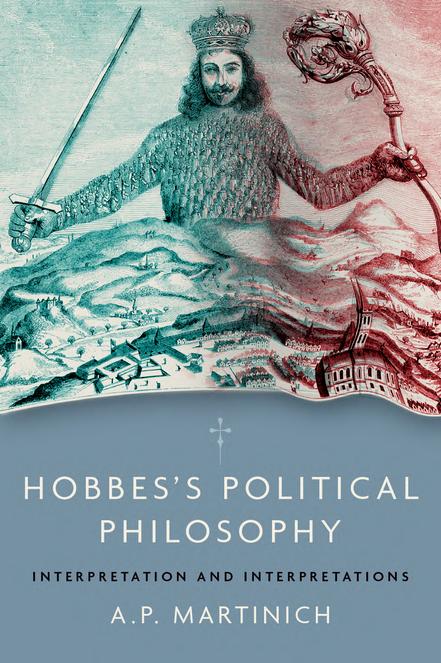
The Act of Supremacy (1534 and 1559) was of great consequence. When Hobbes scholars mention this act, they usually say that the Church was subordinate to the monarch. That is at best misleading. State and religion are united; neither is subordinate to the other (cf. Evrigenis 2020: 131). In chapter 12, “Hobbes’s Erastianism and Interpretation,” I explain how the illustrated title page of Leviathan illustrates the unity of church and state (see also Martinich 1992: 362–7). The sovereign is pictured with a sword in one hand and a bishop’s crozier in the other. Down the left side of the page are images proper to secular government, such as a castle; and down the right side of the page are images proper to the Church, such as a cathedral. If Erastianism is defined as the view that the Church is governed by the monarch, then England was Erastian and Hobbes was a good Englishman. If it is defined as the view that the Church is subordinate to the monarch, it is less clear whether England or Hobbes was Erastian.
The focus of my criticisms is the scholarship of Jeffrey Collins, who argued that Hobbes was Erastian, a proponent of Independency, and irreligious. While I agree that Hobbes was Erastian, Hobbes’s support for Independency was hedged at best; and he was not irreligious. Collins sometimes omits