Hegel’s Value
Justice as the Living Good
DEAN MOYAR
Oxford University Press is a department of the University of Oxford. It furthers the University’s objective of excellence in research, scholarship, and education by publishing worldwide. Oxford is a registered trade mark of Oxford University Press in the UK and certain other countries.
Published in the United States of America by Oxford University Press 198 Madison Avenue, New York, NY 10016, United States of America.
© Oxford University Press 2021
All rights reserved. No part of this publication may be reproduced, stored in a retrieval system, or transmitted, in any form or by any means, without the prior permission in writing of Oxford University Press, or as expressly permitted by law, by license, or under terms agreed with the appropriate reproduction rights organization. Inquiries concerning reproduction outside the scope of the above should be sent to the Rights Department, Oxford University Press, at the address above.
You must not circulate this work in any other form and you must impose this same condition on any acquirer.
CIP data is on file at the Library of Congress
ISBN 978–0–19–753253–9
DOI: 10.1093/oso/9780197532539.001.0001 1 3 5 7 9 8 6 4 2
Printed by Integrated Books International, United States of America
To my parents
It was a humorously perilous business for both of us. For, before we proceed further, it must be said that the monkey-rope was fast at both ends; fast to Queequeg’s broad canvas belt, and fast to my narrow leather one. So that for better or for worse, we two, for the time, were wedded; and should poor Queequeg sink to rise no more, then both usage and honor demanded, that instead of cutting the cord, it should drag me down in his wake. So, then, an elongated Siamese ligature united us. Queequeg was my own inseparable twin brother; nor could I any way get rid of the dangerous liabilities which the hempen bond entailed.
So strongly and metaphysically did I conceive of my situation then, that while earnestly watching his motions, I seemed distinctly to perceive that my own individuality was now merged in a joint stock company of two: that my free will had received a mortal wound; and that another’s mistake or misfortune might plunge innocent me into unmerited disaster and death. Therefore, I saw that here was a sort of interregnum in Providence; for its even-handed equity never could have sanctioned so gross an injustice. And yet still further pondering—while I jerked him now and then from between the whale and the ship, which would threaten to jam him— still further pondering, I say, I saw that this situation of mine was the precise situation of every mortal that breathes; only, in most cases, he, one way or other, has this Siamese connexion with a plurality of other mortals. If your banker breaks, you snap; if your apothecary by mistake sends you poison in your pills, you die.
Herman Melville, Moby-Dick
The love which brings the right answer is an exercise of justice and realism and really looking. The difficulty is to keep the attention fixed upon the real situation and to prevent it from returning surreptitiously to the self with consolations of self-pity, resentment, fantasy and despair. The refusal to attend may even induce a fictitious sense of freedom: I may as well toss a coin. Of course virtue is good habit and dutiful action. But the background condition of such habit and such action, in human beings, is a just mode of vision and a good quality of consciousness. It is a task to come to see the world as it is. A philosophy which leaves duty without a context and exalts the idea of freedom as a separate top level value ignores this task and obscures the relation between virtue and reality. We act rightly “when the time comes” not out of strength of will but out of the quality of our usual attachments and with the kind of energy and discernment which we have available.
Iris Murdoch, “The Sovereignty of Good over Other Concepts”
4.2.
4.5.
5. The Living Good
5.1.
5.2. The System of Practical
5.3. Ethical Mutuality and the Equivalence of
5.4.
5.5.
6. The Circulation of Value in Civil Society and the State
6.1. Completing the Inference of
6.2. The Value of Work and the Division into
6.3. The Return of the Good in “The
6.4.
6.5. The Final Value of
6.6. The Living State as a Totality
6.7.
7. Law and Public Reason
7.1.
7.2.
7.3.
7.4.
7.5.
7.6.
8. The Sovereignty of the Good
8.1.
8.2.
8.3.
8.4.
8.5.
Acknowledgments
At every step in this book’s research and composition I have been helped along by a host of individuals and institutions. First thanks go to my institutional home of the past eighteen years, the Department of Philosophy at Johns Hopkins University. The Krieger School of Arts and Sciences generously supported sabbaticals near the beginning and end of the project. To my colleagues I am grateful for a congenial working environment. Special thanks go to Hilary Bok for co-teaching a class on Rawls, to Michael Williams for his discussions of Sellars and for carrying the torch of Rortyan ecumenicalism, and to Yitzhak Melamed for making Hopkins a lively center of discussion of early modern philosophy. Eckart Förster has been a wonderful mentor, coteacher, and general source of inspiration.
My research leaves were supported by the Wilhelm von Humboldt Foundation, by the American Academy in Berlin, where I was the Dirk Ippen Fellow, by the Westfälische-Wilhelms Universität Münster, and by Freie Universität Berlin. For helpful feedback I would like to thank audiences at KU Leuven, University of Milan, Ruhr-Universität Bochum, WestfälischeWilhelms Universität Münster, Northwestern University, Goethe-Universität Frankfurt, the Hegel-Vereinigung meeting in Stuttgart, and Uppsala University.
For discussions of the texts and issues in this book, thanks go to Arash Abazari, Mark Alznauer, Stefano Bacin, Thom Brooks, Dina Emundts, Alexander Englert, Kristin Gjesdal, Espen Hammer, RolfPeter Horstmann, Stephen Houlgate, David James, Jim Kreines, B é atrice Longuenesse, Itai Marom, Jake McNulty, Patricia Mindus, Lydia Moland, Michael Nance, Andreja Novakovic, Julia Peters, Michael Quante, Andrew Reisner, Paul Redding, Robert Stern, Nandi Theunissen, and Marcus Willaschek.
Special thanks go to Terry Pinkard and Chris Yeomans for detailed criticisms on a late draft that saved me from many blunders and forced me to clarify many of my arguments. I would also like to thank my teachers Ludwig Siep and Robert Pippin, whose deep and pervasive influence is in no way adequately reflected in my citations of their work.
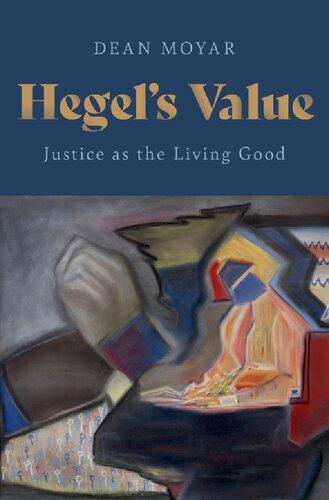
I have dedicated this book to Marjorie and Bert Moyar, loving parents and true members of ethical life. I thank my children, Lois and Dylan, who surprise me every day with their curiosity and wonder. My final thanks go to Sharlyn Rhee, the oracle of the Absolute in the family. I thank her for allowing me to use “Unterwegs” for the cover of this book, and for all that she does to bring our love to life.
Introduction
Value and the Rationality of Justice
There is a puzzle at the heart of modern justice. The core of the modern conception—the rights of the individual person—makes the rest of the conception impossible to achieve. The more that we uphold the individual’s rights to life, liberty, and property, the less we can justify measures to guarantee that each individual is in a position to put their rights to good use in the living of a fulfilling life. We guarantee the right to keep the property one already has, but we do little to guarantee that each individual will have any property to keep. The modern liberal project did not give up on the idea of individual human flourishing, or on the common good and social welfare as essential to justice. But the problem of meeting the demands of the more expansive conception of justice goes very deep. The concept of personhood at the heart of modern law is so thin that it is hard to see how personhood can be the basis for any claims of justice beyond the basic rights to life, (negative) liberty, and property. “As long as I’ve got mine” comes very naturally to the subject of a liberal polity. We enforce contracts and lock up criminals, we sanctify free speech and assembly, but the rest of justice eludes us.
This self-defeating tendency of modern theories of right spurred G.W.F. Hegel to develop his philosophy of right as a system of just institutions. This system found its fullest expression in the 1820 Elements of the Philosophy of Right (Philosophy of Right or PR), in which Hegel argues that the modern rights of the person need to be integrated with the demands of moral subjectivity in a “living” system oriented by the thicker identities of family member, worker, and citizen. Hegel was writing in the wake of the idealist conceptions of morality and natural right developed by Immanuel Kant and J.G. Fichte in the 1790s. Both Kant and Fichte argued for a sharp separation of individual right, or the external freedom of the person, from the domain of universal morality conceived as the internal freedom to determine the will in accordance with the moral law. To overcome this
Hegel’s Value. Dean Moyar, Oxford University Press (2021). © Oxford University Press. DOI: 10.1093/oso/9780197532539.003.0001
dichotomy Hegel had to rethink the nature of human agency and the whole framework for theorizing human freedom. He bases his account on an expressive conception of action as the realization of the inner through the outer. He argues for the realization of morality through right, and thus for an account of right as the expression of morality. The account remains squarely in the modern tradition of basing political legitimacy on the free will, but his fuller account of action enables him to develop a more systematic account of justice.
The theory of justice I set out in this study will strike many liberal readers as both deeply strange and exceedingly familiar. The strangeness of the account—especially the dialectical method and the functional teleology of life—makes Hegel a continuing source of disruption and innovation for the modern rights-based project of justice. The familiarity of the account largely stems from the fact that the dominant theory of justice for the past fifty years—John Rawls’ A Theory of Justice is in large part a work in Hegelian political theory.1 Rawls was attracted to many of the same elements in Rousseau and Kant that drove Hegel’s thought, and the institutionalism of A Theory of Justice is deeply Hegelian. Much of the difference between their accounts lies in Rawls’ greater attachment to elements of Kant’s moral theory—the generic rational agent and the form of principles—that Hegel thought were of limited use.
Hegel’s distinctive mode of normative theory is bound up with his appropriation of the concept of life as the form of rationality. The first chapter of this study unpacks the role of life in Hegel’s critique of social contract theory and in the revolutionary theory of self-consciousness in the Phenomenology of Spirit. The rest of this work is a reading of the Philosophy of Right, the primary source for Hegel’s systematic account of justice. There has been an abundance of fruitful research on the PR over the last thirty years, yet Hegel’s own conception of justice has remained elusive. This is no doubt largely due to the sheer complexity of the architectonic in which the political philosophy is set, but it is also due to Hegel’s apparent ambivalence toward ideal theory. In this Introduction I take up the ideal-real contrast in political philosophy and then lay out some of the central interpretive elements that distinguish my reading from others.
1 I thus very much disagree with the assessment of Honneth (2010) that Hegel’s Philosophy of Right has not impacted contemporary political philosophy.
1. Political Moralism and Critical Realism
There is a well-known strategy for thinking about justice as the realization of morality within the political domain. The first step is to give an account of basic goods or basic capabilities to which everyone is entitled simply by virtue of being human. The second step is to treat the political domain as the collective effort to ensure the proper distribution of those goods, or the realization of those basic capabilities. Typically such an account is laid out in the mode of ideal theory, which means that many idealizing assumptions are made about human psychology (e.g., no envy), compliance (full), etc. The basic thought, promoted by Rawls and many of his followers, is that we need to have a picture of the ideal on hand before we start thinking about ways of tackling non-ideal situations. Such theories are often fairly minimal in the kinds of goods that they would like to see realized, for they acknowledge that any liberal polity needs to leave space for individuals to craft their own conceptions of the good life. Nonetheless, for this kind of view a sharp dichotomy of right and morality is simply misplaced, for there is no need to think of the moral as disconnected from the right when the very purpose of a system of justice is to ensure that certain moral requirements are met for all citizens.
Yet against such views, many authors have lately invoked a distinction of morality and politics to say that the political needs to be viewed as an independent branch of practical activity and practical philosophy. In his influential “Realism and Moralism in Political Theory,” Bernard Williams attacks theories that espouse “the priority of the moral over the political” and the idea that “political theory is something like applied morality.”2 He singles out Rawls (both early and late) for criticism, claiming that Rawls gives undue priority to morality in so far as his theory of justice “lays down moral conditions of co-existence under power” and certain “ends of political action” prior to any discussions of actual political relations.3 Williams’ contrasting “realist” view takes its inspiration from theorists such as Hobbes who define the political first and foremost as the struggle to achieve basic order and authority. According to Williams, it is only by foregrounding the initial problem or basic question of authority that the subject matter is specifically political. The kind of ideal theory that constructs a political system based on unquestionable
2 Williams (2005), 2.
3 Williams (2005), 1.
moral premises simply misses what is distinctive about the political domain.4 Williams thinks that we should orient our account from a minimal normative starting point that he calls the Basic Legitimation Demand (BLD). This is the idea that the answer to the question of political order needs to be justified to each person who is subject to the law. He insists that modern liberalism does not take its authority from a theoretical acceptance of the moral conception of the person, but rather from BLD plus specific historical conditions. Williams’ attack on political moralism is shared by thinkers who identify with the “critical theory” branch of political philosophy. Williams himself endorses a “critical theory principle,” so it makes sense to classify the parties in opposition to political moralism as critical realists 5 From the likes of Raymond Geuss and his virulent dismissal of ideal theory, to advocates of Hannah Arendt’s vision of “the political,” there is a broad swath of theorizing (or anti-theorizing in some cases) that takes Rawlsian political philosophy and its offshoots to be counterproductive. One could also align critical race theory with this realism, including Charles Mills’ influential attack on ideal theory (although Mills has recently defended a revised version of the Rawlsian framework).6
Political moralism holds that philosophy is in a position to dictate to politics what is permissible, whereas critical realism holds that political thinkers can hope to achieve justice only if they foreground political action and processes. Moralists argue for rational standards on which there ought to be a consensus, whereas realists take conflict to be essential and ineliminable in politics. To the realist, the political moralist lacks the ability (or the courage) to confront historically conditioned power imbalances, to see clearly the exploitation conducted under the banner of individual rights and market principles, and in general to account for the rough and tumble of political and social strife. To the moralist, the realist suffers from a lowering of expectations about what is philosophically and politically possible, settling for perennial conflict rather than aiming to realize a more just society. The realist likes to turn this charge around and claim that political moralism, precisely because it claims to be able to answer questions theoretically, does not engage with the real world and thus does not actually make a difference with
4 As Charles Larmore has reformulated the charge, Williams is in essence saying that “political philosophy has lost touch with the very nature of its subject matter.” Larmore (2018), 27.
5 Williams’ critical theory principle runs: “that the acceptance of a justification does not count if the acceptance itself is produced by the coercive power which is supposedly being justified.” Williams (2005), 6.
6 See especially Mills (2004) on ideal theory, and the more recent Rawlsian position in Mills (2017).
its principles. There might be ideal norms with the force of rational necessity, but a rationality that lives only within a theoretical edifice, however imposing, will find no purchase in the contests of the moment. Power relations and affective responses determine the necessity of events, and a genuine political philosophy is one that tracks those processes rather than constructing ideals of justice.
Hegel’s political philosophy does not fit neatly in either of these camps. He is famous for opposing all merely ideal, non-actual approaches to political questions, and he thus clearly has sympathies with political realism. He strongly opposes the idea of philosophical theorizing about political matters in abstraction from the actual conditions on the ground. If the philosopher’s theory “builds itself a world as it ought to be, then it certainly has an existence, but only within his opinions—a pliant medium in which the imagination can construct anything it pleases” (PR, 14, 1.15; Wood/Nisbet, 22). Hegel thus seems to subordinate the moral to the political, so that there really is no normativity apart from the development of laws and institutions in actual states. Furthermore, the element of contestation and struggle that is so important to critical realism goes very deep in Hegel’s philosophy. In locating the struggle to the death and the master-servant relationship at the basic level of normativity, Hegel seems to be a hard-headed realist who thinks that political norms are worked out within the political struggle itself. In his most famous dialectical moments, such as in the conflict of Antigone and Creon in the Phenomenology, the nature of justice is up for grabs, and the normative order is essentially a result of the conflict rather than a moral postulate.7
On the other hand, it is not hard to find signs of political moralism in Hegel’s work, especially in the PR. He strongly criticizes theories of right (such as Fichte’s) that focus on a basic question of order under conditions of mistrust. Hegel also makes the political the main domain in which morality is realized, so the political is oriented as much by the moral domain as by the domain of abstract individual right. While he includes the principle of conflict in his theory of “Civil Society,” he is quite clear that in the State such unrestrained conflict is out of place. In the economic domain there is certainly an unceasing struggle for honor and income, but politics proper in Hegel’s theory is not the open-ended conflictual affair that realists cherish.
7 See Novakovic (2017) for an excellent recent attempt to come to terms with Hegel’s position on normative critique.
Moreover, Hegel seems to presuppose that there must be ethical bonds between citizens if a just political entity is going to thrive.
The apparent ambivalence in Hegel’s position can be traced to his goal of uniting moral theory with political theory. In the PR this unification is accomplished through a section on “Morality” between the basic rights of personhood of “Abstract Right” and the institutional order of Sittlichkeit (standardly translated as “Ethical Life”). Hegel aims to break down the sharp dichotomy of right and morality in Kant and Fichte, and he also demotes morality from the highest space of reasons to an intermediate position subordinate to politics. This unifying move can be read in two ways: either (1) as circumscribing the place of morality in favor of a public political domain of realist contestation, or (2) as giving morality a guiding, idealizing function for the entire social and political domain. The former would see the system of justice as a site of political action and a struggle for liberation through social processes, while the latter would see the system of justice as the realization of the Good in well-organized interlocking social spheres.
In my view Hegel does not think we should have to choose between realism and moralism. He has systematic reasons for giving realist conflict a leading part in the Phenomenology of Spirit and a more idealized account in the PR, but the same conception of justice is at work in both texts. In the PR he defines the Good prior to instituting the full-blown political order of ethical life, and his treatment of Sittlichkeit does tend to assume that individuals will be fully compliant with institutional norms. Yet even in the PR there is a process of development from basic abstract property rights to welfare rights and the rights of an institutional system. At the very heart of PR is a set of conflicts, most notably the collision between welfare and property in the “right of necessity.” My account will highlight the moralist side of Hegel in emphasizing the realization of the Good in relations of right, but in stressing the process of development and the idea of a living institution, I aim to show that the realist and moralist strands are thoroughly intertwined. The moralism makes sense only as the result of processes, and the processes can be identified as meaningful only from the standpoint of the good they have achieved.
Hegel does side with those theorists (including most critical realists) who take the morality of the de-institutionalized individual to be a relatively minor factor in the overall ethical and political picture. The real action for Hegel is indeed at the level of family, work, courts, and the social policy enacted by the political entities. The idea that all those public functions are
one thing, and living a life of duty is something different and higher, struck the young Hegel as bizarre. Even in the mature philosophy there is no moral theory in the full sense of the term, for there is no account of a formal decision procedure to identify what is permissible, there is no list of virtues, and no casuistical considerations (even though he admits that conflicts of normative considerations are a common feature of modern life). One lives a universal life precisely through participation in the institutional order. This deflates our moral self-regard while drastically raising the stakes for achieving a just social system.
Hegel thought that most of us would engage in ethical purposes primarily in the form of family and work obligations. Contrary to some recent interpretations, Hegel did not see participation in political processes (voting, mobilizing public support for important issues, etc.) as a major activity for those not officially occupied with State business. This view stems not only from a traditional philosopher’s skepticism about democracy (though Hegel does share that skepticism), but also from Hegel’s belief that one’s overall interests, one’s welfare or happiness, will not be well-served unless one is represented in politics through one’s membership in the lower institutional spheres of estate and corporation. When it comes to propounding a science of right, Hegel thought that philosophers should keep their attention on the big picture, on relations such as the subordination of property claims to the public good, rather than on the details of specific applications. Hegel thought of philosophy’s job as that of providing a coherent vision of the whole, emphasizing the rationality that has proven itself over time and bending the present toward a more just order.
2. An Overlooked Theory of Value
One of the central concepts in our ordinary ethical discourse is often modified with subjective, objective, and absolute. The concept of value is often linked closely to basic human desire (x is valuable because we desire it), yet it also has been considered the key to the ultimate questions of metaphysics (Plato’s form of the Good). As a central economic concept, value is both the fluid medium of all activity and the virtual measure that lacks any substance of its own. Looking at Hegel’s division of spirit into subjective, objective, and absolute spirit, one is tempted to ask, what concept could be more Hegelian than value? Considering further the centrality of desire and the Good to
Hegel’s idealism, and his appropriation of modern political economy in the PR, why has there been so little discussion of Hegel’s conception of value?
While Kantian moral theory has embraced the language of value as a correlate to the themes of universality and autonomy, attention to Hegelian moral theory has focused mainly on his empty formalism critique of Kant and on the idea of a “social” understanding of practical reason. On the economic side Hegel’s thinking seems derivative, taken largely from the Scottish political economists. While it is widely accepted that Hegel’s philosophy provides the logical backbone of Marx’s philosophy, the prominent role of value in Marx is not thought to have much to do at all with Hegel’s theory of value (though Marx’s identification of Capital with Spirit is certainly suggestive). But the main reason that Hegel’s theory of value has not been thematized recently is that commentators have focused instead on the fundamental form of value in Hegel’s system: freedom. Nearly all the major English-language works on Hegel’s practical philosophy in the last two decades have taken freedom as their focus.8 Freedom is indeed everywhere in the PR, and I will not be disputing the centrality of freedom to Hegel’s account. My point is that the realization of freedom leads directly to the issue of value and its role in adjudicating rights and duties. Hegel’s formula for the Good, “realized freedom” (§129), suggests that value just is freedom in its realization in living subjects and an objective world. Free action is action that realizes value, and just institutions are ones in which value circulates rationally, each person receiving their due.
One of my two main claims to originality in this study is my reading of value as the unifying thread in Hegel’s practical philosophy.9 I began work on this project focused on the unification of abstract right and morality, and my assumption (shared with most commentators on this theme) was that these two domains are different modes of deontology, so that the key to finding
8 Any list of such works would include Wood (1990), Patten (1999), Franco (1999), Neuhouser (2000), Pippin (2008), Pinkard (1994), Peperzak (2001), Honneth (2012), Alznauer (2015), Lewis (2012), Yeomans (2015). The best introductory commentary on the PR is Knowles (2002).
9 The three studies that engage most with the theme of value are Neuhouser (2000), Pinkard (2012), and Yeomans (2015). None of them takes the concept of value to be as central to Hegel’s account as I do, yet they do freely use the language of value to fill out Hegel’s picture of freedom. Neuhouser devotes a major section of his text to the question of whether the value of the social whole can be reduced to what is valuable to individuals. I discuss Neuhouser’s views on this point in 4.5 and 6.4. Pinkard’s stress on “the final ends of life” leads him to consider in depth questions of the good, both how it originates in the struggle for recognition and how it is realized in Sittlichkeit. Yeomans’ book concludes with a section on “The Concreteness of the Good” that spells out key aspects of Hegel’s institutional rendering of value.
their unity is to locate a new kind of approach to the deontological notions of obligation and entitlement in Sittlichkeit. But the more I looked into the issue, the more I became convinced that the deontological aspect is inseparable from the value realization or teleological aspect. I came to think that Hegel’s unification of right and morality depends on a unification of value, and that the rationality of the institutions of Sittlichkeit can be understood, and Hegel’s conception of justice comprehended, only through a thorough re-conceptualization of value.
In this study I show that Hegel appeals to value at nearly every stage of his account in the PR. The Good is of course the ultimate value term, and its central place in the Philosophy of Right is not hard to discern. The challenge is to connect that overall conception of value to the various forms of value that lead up to it—forms that Hegel describes with the thinner notion of value (Wert)—and then to decipher how both conceptions function in the overall ethical system of justice. Making those connections, understanding them as rational connections, and showing how the social and political agencies operationalize that value, are the burdens of this study.
Hegel does not make it easy to locate a unified theory of value in his writings. As an initial step, let me list seven main types of value in the PR. 10 These fall roughly into two groups (1–3 and 4–7).
1. Value as the potential use of things for serving human needs. The first real treatment of value in the PR comes in the discussion of property, where, after discussing possession and immediate use, Hegel thematizes the value of property as a universal version of use. Hegel’s thinking about this basic conception changes in the later lectures, where he clarifies the difference between use and value and gives value a much greater systematic role.
2. Value as the medium of equivalence between two disparate individual items. This conception is especially prominent in his discussions of contract and punishment. Value plays this role as a virtual universal, a way of translating a particular thing or action into a universal measure that can then be retranslated back into other concrete terms. This
10 I say very little in this book about aesthetic value or the value of religion and philosophy. Though my account bears on those domains, it would take another book to spell out his theory of value in what he calls “Absolute Spirit.”
measure is a generalized form of use that I identify as inferential equivalence (for reasons that will become clear later).
3. Subjective value as the interest of the individual in their actions. Value in this sense serves to translate our natural desires and needs into articulate purposes that Hegel generally classifies as interests and identifies with the subjective value of action. This conception aligns well with what we call agent-relative value, and it is the basis of Hegel’s conception of welfare.
4. Universal value. This conception of value is the closest Hegel comes to a distinctively moral value. He thematizes it in the pivotal sections on the Good in the PR, where he contrasts subjective value to universal value. It is impersonal or agent-neutral, the conception of value that indicates a measure that is identical for everyone.
5. Infinite and absolute value. Hegel tends to use these terms interchangeably to indicate the value of individual agents and of their capacities for free activity. This is the paradigmatic final value, that which cannot be turned into a means or alienated. In his uses of infinite value I find a nuance that goes beyond intrinsic value to indicate a productivity of value, such as when he writes that education is infinitely valuable (see §20 and §187).
6. The goodness of functional unities. His examples of judgments of value are of a good house and a good action, but he is primarily interested in the unity of living organisms. These entities are good through their proper functioning, and in particular through a proper relation of the whole to its parts.
7. Living value. The living Good is Hegel’s term for the inclusive, holistic system of value that incorporates all of the other types of value within it. The just system of social institutions in Hegel’s view takes the form of a living system oriented by the Good as a holistic conception of “realized freedom” (§129).11 For Hegel justice is the Good in the form of living social institutions.
A list is of course not an argument, and one is entitled to ask, what does this all amount to? What really is value for Hegel?
If there is a single concept at the heart of Hegel’s theory of value that binds together these seven different types, it is the concept of purpose. In the case of use
11 When I capitalize “Good” I am referring to the Good as “Idea” that he announces in PR §129.
in the service of needs (1), value is determined by the potential of something to serve my essential purposes, for needs just are those purposes that I cannot do without. In the case of equivalence (2), value serves the purpose of completing an equal property exchange or locating an appropriate punishment for a crime. Value has the functional inferential role of equating two things that are otherwise quite disparate (e.g., theft and jail time) by thinking of them both in terms of an abstract measure. Subjective value (3) just is the identification of what is valuable with the individual’s freely adopted purpose. While subjective value is akin to agent-relative value, the demands of justice are demands of agent-neutral or universal value (4), which he captures in abstract holistic terms when he claims that the Good is “the final purpose [Endzweck] of the world” (§129).12 The basis for thinking of the subject’s purpose as both particularly and universally valuable, and thus as secured by right, is that the subject herself has infinite value (5). Hegel’s conception of “free spirit” as infinitely valuable comes close to the Kantian idea of the human being as one who posits purposes (“sets ends”) and directs her life according to them. The value of a functional unity (6) consists in both the value of the purpose and the goodness of the relations of the overall purpose to the functional subsystems (the parts or “members”). The Good is the basis of an overall abstract functional unity once it is joined with the particular subject who wills it in their particular purposes. The conception of the Good is thus transformed into the final conception of value (7) through its elevation to the form of life, as the living Good in which subjective and objective value are generated and circulate as a system of purposes reliant on the State as the overall purposive agency.
Viewed in terms of the purpose, the varieties of value in (1) to (7) reflect an ancient line of thought about function, form, and value. The distinctive good or value of something is what it is for. The general goodness or value of a knife consists in its use for cutting. The specific goodness of this knife consists in how well it cuts, which in turn depends on how well formed it is for the purpose of cutting (its shape, sharpness, etc.). Value is thus the goodness of form in relation to a certain purpose. The value of artifacts is a functional unity (6) in one sense, but it is also merely of instrumental or use value (1). The knife is good for serving our purposes (e.g., cutting to prepare food). But what of our purposes themselves?
12 Parenthetical citations of the main text of the Philosophy of Right simply give the section number (§#). For the indented “Remarks” I add an “R” (§#R), and the handwritten notes I add “HW” (§#HW). For the text of the “Preface” I give the GW 14, 1 page numbers followed by the page number of the Wood/Nisbet translation (GW 14, 1.#; Wood/Nisbet, #). For the “Additions [Zusätze]” I add an “A” and then give the volume and page number from the GW editions of Hegel’s lectures (§#A; GW #.#).