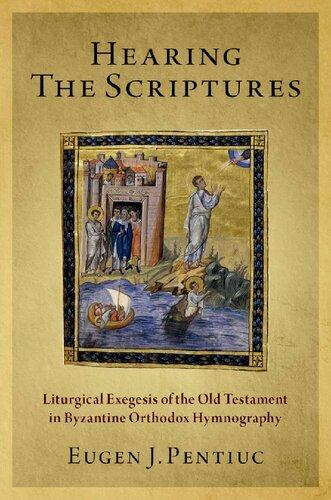
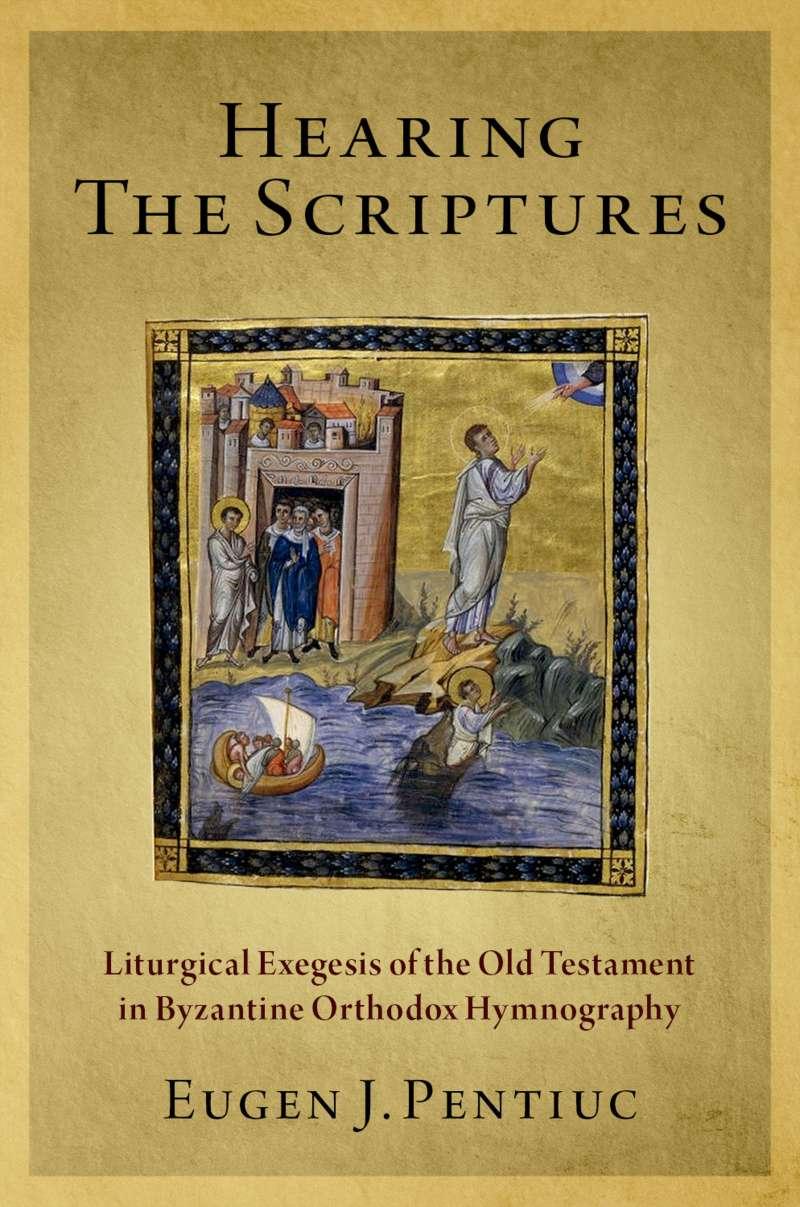
Liturgical Exegesis of the Old Testament in Byzantine Orthodox Hymnography
EUGEN J. PENTIUC
3
Oxford University Press is a department of the University of Oxford. It furthers the University’s objective of excellence in research, scholarship, and education by publishing worldwide. Oxford is a registered trade mark of Oxford University Press in the UK and certain other countries.
Published in the United States of America by Oxford University Press 198 Madison Avenue, New York, NY 10016, United States of America.
All rights reserved. No part of this publication may be reproduced, stored in a retrieval system, or transmitted, in any form or by any means, without the prior permission in writing of Oxford University Press, or as expressly permitted by law, by license, or under terms agreed with the appropriate reproduction rights organization. Inquiries concerning reproduction outside the scope of the above should be sent to the Rights Department, Oxford University Press, at the address above.
You must not circulate this work in any other form and you must impose this same condition on any acquirer.
Library of Congress Control Number: 2021912232
ISBN 978–0–19–023964–0 (pbk.)
ISBN 978–0–19–023963–3 (hbk.)
DOI: 10.1093/oso/9780190239633.001.0001
1 3 5 7 9 8 6 4 2
Paperback printed by Marquis, Canada
Hardback printed by Bridgeport National Bindery, Inc., United States of America
To Flora, Daniel, and Cristina, with love.
Preface ix
Acknowledgments xiii
Abbreviations xv
Notes on Editions and Translations xix
Introduction: Brief Overview of Byzantine Orthodox Holy Week 1
PART I. HEARING THE SCRIPTURES THROUGH HOLY WEEK HYMNS
1. Chastity: Joseph and the Midnight Bridegroom—Holy Monday 37
2. Loyalty: Three Youths in a Fiery Furnace—Holy Tuesday 62
3. Bravery: A Daring Woman and a Hiding Eve—Holy Wednesday 94
5. Suffering: The Slaughtered Lamb and the Distraught Ewe—Good Friday 177
6. Overcoming: Jonah and the Never-Setting Light—Holy Saturday 227
PART II. LITURGICAL EXEGESIS
7. Key Features and Hermeneutical Procedures 285
Preface
This is a book on the use and interpretation of Scriptures in Byzantine Orthodox hymnography. The idea of writing such a book emerged with the publication of my The Old Testament in Eastern Orthodox Tradition (Oxford University Press, 2014). In the last two chapters of that work, I dealt with two media through which liturgists have interpreted the Scriptures, namely, the “aural” (e.g., hymnography, lectionaries, homilies, etc.) and “visual” (e.g., portable icons, mosaics, frescoes, liturgical acts, etc.) modes of interpretation, which I coined “liturgical exegesis.”
In that work, I made a general remark about liturgical exegesis: “The condensed liturgical exegesis is again a challenge to hearers and readers to locate the texts, events, images, and figures woven into the hymnography.”1 I took on that challenge myself, having researched and written the present book, which seeks to identify Scriptures in Byzantine hymnography, a challenge as difficult as finding the proverbial needle in a haystack. Through a comprehensive and minute analysis of selected hymns, I have strived to make sure that no scriptural needle, as tiny and unobservable as it might be (i.e., scriptural hapax legomena [Gr., forms “occurring once” in the Bible] or rare words), remains hidden in the depths of the hymnic tapestry.
Therefore, the first goal of my research was to find Scriptures, primarily Old Testament, in Byzantine Orthodox hymnography. The selection criteria for which hymns to consider rested fundamentally upon the presence of references and hints of the Old Testament in the targeted hymns. However, due to the resilient “hiddenness” of scriptural material within the poetic fabric of the hymns, it took me quite some time to decide which hymns should be selected and then thoroughly analyzed.
The second goal of my research was to identify key features and hermeneutical procedures characteristic of “liturgical exegesis” in comparison to “discursive exegesis” (i.e., the interpretive method of ancient biblical commentaries).
Another important factor that encouraged me to pursue this project was the very scarcity of studies on the subject matter of Scriptures and Byzantine hymnography. Moreover, those few studies dealing with this topic were
carried out by experts in Byzantine and liturgical studies, from a historical perspective, and focused not so much on Scriptures as on matters concerning Byzantine liturgy, society, and culture.2
A noteworthy exception is Bogdan G. Bucur’s contribution to the study of early Christian biblical interpretation (i.e., patristic commentaries and Byzantine hymnography) in its theological-hermeneutical framework.3 Seeking to reconstruct the theological presuppositions of the early interpreters, Bucur’s view is that Christophanies (Christ’s appearances in the Old Testament) are epiphanic, denoting not a simple hermeneutical procedure but a “real presence” of the Logos. Nevertheless, Bucur’s treatment of Scriptures and hymnography is more from a patristic-theological point of view than from a biblical scholarly perspective.
Jack Custer rightly notices, “Oddly, philologists, liturgists and theologians alike have largely ignored this rich corpus of poetry and, until recently, modern biblical scholarship took scant interest in patristic prose, much less in poetry. Nevertheless, it may be safely asserted that Byzantine liturgical hymns are as much products of biblical interpretation as they are of poetic inspiration and therefore stand as important documents of Greek patristic exegesis.”4
Since there are no comprehensive studies on this topic from a biblical scholarly point of view, I embarked as a biblical scholar (with primary focus on the Old Testament) and philologist (interested in Septuagint Greek and Semitic languages) on a research journey to identify Scriptures in Byzantine hymnography as well as to reconstruct the hermeneutics beyond the liturgical exegesis.
The methodology followed in this volume can be briefly described as a critical lexical-biblical analysis of the hymnic material with special emphasis on Scriptures and the ways in which they are recontextualized in a liturgical setting and what influenced hymnographers in their choice of favorite scriptural texts or terms as they interwove these with poetry and theology.
Given the vast corpus of Byzantine hymnography, I have narrowed the scope of my research to selected Holy Week hymns. Why did I expressly choose the hymns of the Holy Week cycle as a case study? First, much of the Old Testament is found in the Triodion and Holy Week liturgical services if one considers both the lectionary and hymnography. Second, Holy Week is replete with gospel material concerning Jesus’s last week in Jerusalem, hence my curiosity to see how the interplay between texts belonging to the Old and New Testaments unfolds at the level of Byzantine hymnography.
I titled the volume Hearing the Scriptures: Liturgical Exegesis of the Old Testament in Byzantine Orthodox Hymnography to indicate that my research was done on “aural” interpretations as attested by hymnography, leaving the analysis of “visual” interpretations as found primarily in iconography for a future endeavor. The phrase Byzantine Orthodox in the title underlines the continuity between Byzantine hymnography and what is chanted today in Orthodox churches.5 This continuity, in spite of all modifications and screenings, may be seen in present-day Orthodox Holy Week hymns that represent essentially and illustratively what we call “Byzantine hymnography.”
The book is divided into two parts, with an introduction. In the introduction, “Brief Overview of Byzantine Orthodox Holy Week,” the reader is introduced to Byzantine Holy Week functioning as a bridge between Great Lent and Pascha or the Easter vigil.
Part I, “Hearing the Scriptures through Holy Week Hymns,” contains six chapters, each of which corresponds to a specific day of Holy Week (Monday through Saturday) and follows a similar structure: a brief overview of the day’s theological themes(s) followed by a lexical-biblical-theological analysis of selected hymns prescribed for that day, occasionally supplemented with hymnic material from outside the Holy Week cycle, in order to underline an idea or theme primarily found in an analyzed Holy Week hymn. Additionally, each of the six chapters opens with the brief synaxarion notice for the day taken from the Triodion which identifies the specific themes liturgically commemorated for each day of Holy Week.
The single chapter in Part II, “Liturgical Exegesis,” is a compilation of key features of liturgical analysis and hermeneutical procedures employed by hymnographers in using and interpreting the Scriptures.
While writing this book, I have had in mind a twofold readership: biblical scholars and liturgiologists interested in the history of biblical interpretation on the one hand and, on the other, common readers, belonging or not belonging to a faith community, who want to acquire a deeper understanding of these mini masterpieces of poetical beauty, biblical reflection, and theological inquiry that are the Byzantine hymns.
Acknowledgments
The six years of research and writing materialized in the present volume require a proper recognition of those who have assisted me to complete this project.
First and foremost is my own home institution, Holy Cross Greek Orthodox School of Theology, with its president, George Cantonis, and interim dean, Maximos Constas, which granted me a sabbatical so necessary to conclude this volume and submit it for publication.
Second, is the Archbishop Demetrios Chair for Biblical Studies and Christian Origins along with its generous donor, the Jaharis Family Foundation, which supported me financially during summer sabbaticals at École Biblique et Archéologique Française (EBAF) in Jerusalem, where I did most of the research.
Third, EBAF in Jerusalem and the Dominican friars, especially director Jean-Jacques Pérennès, who welcomed me into their famous biblical school and library. The EBAF extended me the invitation to teach, as a visiting professor, a course on “Byzantine Orthodox Modes of Interpretation” (spring semester 2021), based on the research I did for the present volume.
Fourth, I thank St. Joseph’s Catholic Seminary in Yonkers, New York, its former rector Peter Vaccari and current rector Bishop James Massa and vice rector William Cleary, and the entire faculty, who invited me as “scholarin-residence” for the academic year 2020–2021, where I completed the final touches for the book.
I am in debt to the following colleagues and friends who read drafts of my work, sending me their helpful suggestions and comments at various moments of this journey. Here they are in alphabetical order: Stefanos Alexopoulos, Matthew Baker (in memoriam), John Behr, Harald Buchinger, Maximos Constas, Michael Coogan, Kevin DiCamillo, Stamatia Dova (special assistance on ancient Greek), Allan Emery, Mary Funchion, Alexander Lingas, James C. Skedros, Gregory Tucker, Olivier-Thomas Venard, Philip Zymaris.
My special thanks go to my good and reliable friend and colleague whom I have known for almost twenty-five years, James C. Skedros, who constantly encouraged me to pursue this project until its completion.
I am indebted to Seraphim Dedes and Michael Colburn for their assistance with the Greek text of the hymns, digitally stored with search capabilities by AGESInitiatives (www.agesinitiatives.org).
Cynthia Read, Executive Editor at Oxford University Press has my special thanks for her professionalism and great patience. I would be remiss if I did not mention other people involved in the publication of my book: Drew Anderla, team leader, Narayanan Srinivasan, project manager, and Wendy Keebler, copy editor.
In addition, I would like to thank Elias (Bogue) Stevens and Malbis Foundation for their financial support.
Mea culpa in case I have left someone off this list.
My heartfelt thanks go to my family—my wife, Flora, and our children, Daniel and Cristina—who had to cope with my unpardonable absences during the writing of this book. To them I dedicate the book with love.
I would be remiss if I did not mention here the most reliable companion I have had during the research and writing journey, through shadowy valleys and shining mountain peaks, namely, the Lord of Passion (Kyrios tōn Pathōn), who inspired, encouraged, and protected me with his humble, selfoffering, and “mighty love” (agapēsin krataian, Hab 3:4 [LXX]), nailed on a cross two millennia ago, as an unshakable testimony. To him and his unique saving Passion, I reverently and gratefully dedicate this volume.
Abbreviations
General
Akk. Akkadian
ANE Ancient Near East
Byz. Byzantine text-type (New Testament)
En Enoch (book)
Gk. Greek
Heb. Hebrew
kativ See qere below. The terms kativ and qere, found on the margins of Hebrew Bible manuscripts, indicate what is written (kativ) and what is read (qere), as preserved by scribal tradition.
Lat. Latin
LXX Septuagint (the Greek Old Testament)
MT Masoretic Text
NT New Testament
OT Old Testament
Q Qumran (scroll)
qere See kativ above.
S Peshitta (the Syriac Old Testament)
Tg(s). Targum(s)
Theod. Theodotion
V Vulgate (the Latin Old Testament)
Primary Sources
Hebrew Bible/Old Testament
Gen Genesis
Exod Exodus
Lev Leviticus
Num Numbers
Deut Deuteronomy
Josh Joshua
Judg Judges
Ruth Ruth
1–2 Sam 1–2 Samuel
xvi Abbreviations
1–2 Kgdms 1–2 Kingdoms (LXX)
1–2 Kgs 1–2 Kings
3–4 Kgdms 3–4 Kingdoms (LXX)
1–2 Chr 1–2 Chronicles
Ezra Ezra
Neh Nehemiah
Esth Esther Job Job
Ps/Pss Psalms
Prov Proverbs
Eccl Ecclesiastes
Song Song of Songs
Isa Isaiah
Jer Jeremiah
Lam Lamentations
Ezek Ezekiel
Dan Daniel
Hos Hosea
Joel Joel
Amos Amos
Obad Obadiah
Jonah Jonah
Mic Micah
Nah Nahum
Hab Habakkuk
Zeph Zephaniah
Hag Haggai
Zech Zechariah
Mal Malachi
New Testament
Matt Matthew
Mark Mark
Luke Luke
John John Acts Acts
Rom Romans
1–2 Cor 1–2 Corinthians
Gal Galatians
Eph Ephesians
Phil Philippians
Col Colossians
1–2 Thess 1–2 Thessalonians
Abbreviations
1–2 Tim 1–2 Timothy
Titus Titus
Phlm Philemon
Heb Hebrews
Jas James
1–2 Pet 1–2 Peter
1–2–3 John 1–2–3 John
Jude Jude
Rev Revelation
Septuagint Additions
Bar Baruch
Pr Azar Prayer of Azariah
Sus Susanna
1–2 Esd 1–2 Esdras
Ep Jer Epistle of Jeremiah
Jdt Judith
1–2 Macc 1–2 Maccabees
3–4 Macc 3–4 Maccabees
Pr Man Prayer of Manasseh
Sir Sirach/Ecclesiasticus
Tob Tobit
Wis Wisdom of Solomon
Mishnah and Talmud
b. Talmud Bavli (Babylonian Talmud)
m. Mishnah (Mishnah)
Sanh. Sanhedrin
Secondary Sources
ABD Anchor Bible Dictionary, edited by D. N. Freedman, 6 vols. (New York: Doubleday, 1992)
ACCS Ancient Christian Commentary on Scripture
ANF Ante-Nicene Fathers
BAR Biblical Archaeology Review
BHS Biblia Hebraica Stuttgartensia
CBQ Catholic Biblical Quarterly
GOTR Greek Orthodox Theological Review
HTR Harvard Theological Review
JBL Journal of Biblical Literature
JECS Journal of Early Christian Studies
JETS Journal of the Evangelical Theological Society
Abbreviations
JPS Jewish Publication Society
JSOT(Sup) (Supplements to) Journal for the Study of the Old Testament
JTS Journal of Theological Studies
KJV King James Version
NETS A New English Translation of the Septuagint, edited by Albert Pietersma and Benjamin G. Wright (New York: Oxford University Press, 2007)
NPNF2 The Nicene and Post-Nicene Fathers, Series 2
NRSV New Revised Standard Version
NTSup Novum Testamentum Supplements
ODB The Oxford Dictionary of Byzantium, edited by Alexander P. Kazdhan (New York: Oxford University Press, 1991)
PG Patrologia graeca [= Patrologiae cursus completus: Series graeca], edited by J.-P. Migne, 162 vols. (Paris, 1857–1886)
PL Patrologia latina [= Patrologiae cursus completus: Series latina], edited by J.-P. Migne, 217 vols. (Paris, 1844–1864)
RB Revue biblique
RQ Revue de Qumran
RSR Revue des Sciences Religieuses
SBL Society of Biblical Literature
SC Sources chrétiennes (Paris: Cerf, 1943–)
SVTQ St. Vladimir’s Theological Quarterly
TDNT Theological Dictionary of the New Testament, edited by Gerhard Kittel and Gerhard Friedrich, translated by Geoffrey W. Bromiley, 10 vols. (Grand Rapids, MI: Eerdmans, 1964–1976)
TDOT Theological Dictionary of the Old Testament, edited by G. J. Botterweck and H. Ringgren, translated by J. T. Willis, G. W. Bromiley, and D. E. Green, 15 vols. (Grand Rapids, MI: Eerdmans, 1974–2006)
TLG Thesaurus Linguae Graecae, Digital Library, edited by Maria C. Pantelia, University of California, Irvine, http://www.tlg.uci.edu
TNK Tanakh, Jewish Publication Society
VT Vetus Testamentum
VTSup Supplements to Vetus Testamentum
Notes on Editions and Translations
Bible
For practical purposes, biblical citations follow the NRSV in terms of book name and numbering; e.g., 1 Sam (NRSV) corresponds to 1 Kgdms (LXX).
Specifically, the first number indicates the NRSV, and the second number (placed in parentheses) denotes the LXX. For instance, Ps 22:16 (21:17) means Ps 22, v. 16, according to the NRSV numbering, or Ps 21, v. 17, following the LXX numbering. With respect to Dan 3, beginning with v. 24, the citations will read: Pr Azar 1:1–68 (NRSV) = Dan 3:24–90 (LXX/Theod./NETS).
For uniformity, the spelling of biblical proper names follows the NRSV, even in those portions translated from the LXX.
The transliteration of Hebrew forms follows Thomas O. Lambdin, Introduction to Biblical Hebrew (New York: Charles Scribner’s Sons, 1971), with slight alterations. The transliteration of Greek and Syriac forms is according to The SBL Handbook of Style: For Biblical Studies and Related Disciplines, directed by Billie Jean Collins, Bob Buller, and John F. Kutsko (Atlanta: SBL Press, 2016).
Bible translations belong to the author, unless otherwise indicated.
Hymnography
Hymnographic citations are taken from the following editions: Lenten Triodion (in Greek Triōdion Katanyktikon), edited by the Church of Greece. 2nd ed. Athens: Apostoliki Diakonia, 2003.
Papagiannis, K. Corrections and Observations on the Triodion (in Greek Diorthōseis kai Paratērēseis eis to Triōdion). 2nd ed. Thessaloniki: University Studio Press, 2008.
Translations of hymns used in this volume belong to the author, unless otherwise indicated. For lexical-analysis purposes, these renditions are occasionally more literal than literary. During the translation process, the author consulted closely the following available renditions, listed here in
xx Notes on Editions and Translations
alphabetical order. Of great use and inspiration were Dedes’s and Lash’s translations.
Dedes, Seraphim. “Ecclesiastical Translations, Texts, and Music.” https:// www.agesinitiatives.com/dcs/public/dcs/dcs.html
Holy Week, translated from Greek by the Holy Transfiguration Monastery. Brookline, MA: Holy Transfiguration Monastery Press, 2016. Lash, Ephraim. “Holy Week Translations.” http://web.archive.org/web/20060911201927/http://anastasis.org.uk/
The Lenten Triodion, translated from the original Greek by Mother Mary and Archimandrite Kallistos Ware. Service Books of the Orthodox Church. London: Faber and Faber, 1978.
The Services for Holy Week and Easter, translated by Leonidas C. Contos and edited by Spencer T. Kezios. San Francisco: Narthex Press, 1994.
Introduction
Brief Overview of Byzantine Orthodox Holy Week
Given that Holy Week is the case study of the first and longest part of this volume, which consists of lexical-biblical- theological analyses aimed at identifying Scriptures in the “great ocean” of Byzantine Orthodox hymnography— before gathering a number of hermeneutical procedures the hymnographers used in interpreting the Scriptures in the book’s second part— a brief introduction to the Orthodox Holy Week is well warranted.
As the title of this introduction states, this is solely a “brief overview” for readers who have little or no knowledge of the history and structure of Holy Week as it is celebrated today in Eastern Orthodox communities. For this reason, the information here is general and relies heavily on the works of some contemporary liturgiologists.
This introduction covers the history of Pascha and Holy Week from its earliest attestations to the Byzantine synthesis, the structure of today’s Orthodox Holy Week along with the liturgical services held on each day (Monday through Saturday), and ends with a cursory exposition of Byzantine hymnography and some of its main genres.
From the outset, one needs to keep in mind Robert Taft’s caveat: as ancient as it might look, the Byzantine Orthodox rite is not a museum of unchanged content and practices.1 The following historical overview of the Orthodox Holy Week will show that what one experiences today with respect to this important liturgical period is astonishingly the result of a lengthy and intricate process of borrowing, adaptation, synthesis, renewal, and symbiosis.
There is no evidence in the New Testament of any commandment of Jesus directed to his disciples to commemorate his crucifixion, death, and resurrection with a synaxis (“gathering”).
Nonetheless, there is a single occasion when Jesus asks his disciples to share bread and wine in his remembrance (Luke 22:17–20: “Do this in my remembrance [anamnēsin]” [v. 19]; cf. Matt 26:26–29; Mark 14:22–25)— which later became the Eucharist, held primarily on Sunday, as the “day of the Lord” (kyriakē hēmera, lit. “lordly day,” Rev 1:10) or the “eighth day,” that is, the day of his resurrection.
Paul, following Luke 22:19 (anamnēsin), explains to the Christians in Corinth that having bread and wine when they gather together fulfills an anamnetic (“commemorative”) function, namely, reminding Jesus’s followers of the “Lord’s death” until his coming again (parousia): “For as often you eat this bread [arton], and drink this cup [potērion], you herald [katangellete] the death of the Lord [thanaton tou kyriou] until he comes [achri hou an elthē]” (1 Cor 11:26).
Both names used for Sunday, “Lord’s day” (Rev 1:10) and “eighth day”2 (Epistle of Barnabas 15.8–9), are helpful in reconstructing the early Christians’ view of Sunday as a liturgical synaxis (Gk., “gathering, assembly”). The first Christians saw Sunday as the beginning of a New Creation (i.e., a proleptic experience or an eschatological understanding) or as the day when Jesus rose from a tomb belonging to one of his secret disciples, Joseph of Arimathea (i.e., a historical understanding of Sunday, a commemoration of a past, historical event in a concrete historical-geographical context).
The two meanings of Sunday coalesce neatly especially in the current Eastern Orthodox understanding of the Eucharistic service held on Sunday aiming at a twofold goal: to enter into communion with the suffering and risen Lord throughout this earthly life’s journey while looking forward with a deep sense of eschatological expectancy to meeting the Lord upon his Parousia at the end of time. History and eschatology in Eastern Orthodox liturgical life are tightly interwoven. The dichotomy between past and future attested in the post-Reformation West is absent in Eastern Orthodoxy, where the anamnesis and prolepsis, historical commemoration and anticipatory celebration, do coexist.
Summing up, Sunday was the only commemoration of Jesus’s resurrection before the introduction of an annual celebration of Pascha in the second century. The primitive Church was more interested in the week than in the year as a liturgical cycle. So Sunday from the very beginning was associated with the Paschal events. Sunday became a commemoration of Jesus’s resurrection.3
The Christian Pascha: Quartodeciman and Dominical Traditions
The Christian Pascha derived, as name and theology, from the Jewish Passover held on the fourteenth day of the month Nisan. The name Pascha is the Greek transliteration of the Aramaic word pasḥaɔ going back to the Hebrew pesaḥ, “passing over,” with reference to God who “passed over” (pāsaḥ), saved, the Hebrew houses during the last plague over Egypt (Exod 12:27).4 With respect to its theological meaning, if the Jewish Passover commemorates the liberation of ancient Hebrews from Egyptian slavery through Moses’s agency, the Christian Pascha celebrates humans’ liberation from Satan’s slavery through Jesus’s salvific work culminating with his Passion, death, and resurrection.
Christian Pascha, with Jewish Passover as its model, was a “nocturnal festival”—a vigil was held from Saturday evening until Sunday at dawn. The vigil began after lighting lamps and consisted essentially of a series of lections interwoven with chants.
From Melito of Sardis’s poetical homily Peri Pascha (“On Pascha,” ca. 190), one may surmise that Asia Minor’s practice and Rome’s practice had something in common: the readings from Exod 12. The presence of this lection in both rites (Asia Minor and Rome) testifies to a common earlier origin of Paschal practices going back to a Jewish prototype, the Passover. Another lection was from the gospel of John (from the trial in front of Pilate [chap. 18] to the end of John’s account of resurrection [chap. 21]). According to Harald Buchinger, the antiquity of this custom is difficult to prove. The gospel resurrection narratives as liturgical readings for Pascha (Easter) are not attested prior to the late fourth century.5 After the readings, there was a homily delivered by a bishop, followed by the baptism of catechumens and confirmation of the neophytes joining the faithful in prayers and in the Paschal Eucharist.6
The Armenian Lectionary (fifth century, based on fourth-century sources) prescribes as readings for the Pascha vigil the following themes (among others): creation (Gen 1:1–3:24), the binding of Isaac (Gen 22:1–18), and the Passover narrative (Exod 12:1–24). According to Thomas J. Talley, these three readings correspond to three of the four themes (the fourth being the
coming of the Messiah) associated with Passover in a “Poem of the Four Nights” found in the Palestinian Targum on Exodus.7 These readings indicate continuity between the Christian Paschal vigil and the Passover tradition.
The practice of Quartodecimanism (i.e., celebrating the Pascha on Nisan 14) was observed by Asia Minor churches as well as those churches consisting of relocated Asia Minor Christians in Italy and other western areas. Pope Victor I, Bishop of Rome (189–199) sought to excommunicate those Asia Minor Christians who celebrated the Pascha on the evening of Nisan 14 in alignment with the Jewish Passover meal. These Christians were called Quartodecimans, “Fourteeners.” Pascha could have fallen on any weekday, and Quartodecimans needed to wait for the rabbis in Jerusalem to set the day for the beginning of Passover (the afternoon Nisan 14 when the lamb was sacrificed) and the vigil with the Passover meal beginning after sunset. A lamb was chosen out of the flock on Nisan 10 to be slain on the afternoon of Nisan 14 (Exod 12:6). The Passover meal was to be eaten on Nisan 15 (Exod 12:8).
One may add that the Quartodecimans were not intentionally seeking to imitate the Jewish Passover but rather following the Johannine view that Jesus died on the “day of preparation” (Gk. paraskeuē), Friday in the afternoon (John 19:14–31), when the Paschal lambs were slaughtered; they wanted to make sure that they keep the vigil on Nisan 14 when Jesus, the “Lamb of God” (John 1:36), was crucified and died.8
According to the gospel of John, Jesus died on a Friday afternoon almost at the time when the Paschal lambs were slain and prior to the beginning of the Passover feast (at sunset); the Last Supper in John was an ordinary supper. Unlike John, the synoptic gospels set Jesus’s death on the cross on the very first day of Passover, and the Last Supper was the Passover meal. John is probably the correct one: Jesus died on a Friday, around three p.m., a few hours before the Passover meal held at sunset in anticipation of Nisan 15, the first day of Passover and Sabbath at the same time.
Here is Eusebius’s (d. 339) account of Quartodecimans in Asia Minor:
A question of no small importance arose at that time. For the parishes of all Asia, as from an older tradition, held that the fourteenth day of the moon, on which day the Jews were commanded to sacrifice the lamb, should be observed as the feast of the Savior’s Passover. It was therefore necessary to end their fast on that day, whatever day of the week it should happen to be. But it was not the custom of the churches in the rest of the world to end it at
this time, as they observed the practice which, from apostolic tradition, has prevailed to the present time, of terminating the fast on no other day than on that of the resurrection of our Savior. Synods and assemblies of bishops were held on this account, and all, with one consent, through mutual correspondence drew up an ecclesiastical decree, that the mystery of the resurrection of the Lord should be celebrated on no other but the Lord’s day, and that we should observe the close of the paschal fast on this day only.
(Ecclesiastical History 5.23.1–2)9
The Epistula Apostolorum composed in Asia Minor in the second century introduces the risen Lord who urges his disciples: “Therefore, you should celebrate the remembrance of my death, i.e., the Passover.”10
The Asia Minor Quartodeciman bishops led by Polycrates of Ephesus wrote to Pope Victor, arguing to keep their old Paschal practice that dated back to the apostle John (cf. Eusebius, Ecclesiastical History 5.24). Melito of Sardis was one of the first well-known Quartodecimans, and his Peri Pascha, “On Pascha,” is a midrash on Jesus’s Passion, suffering, and death. Pope Victor, disturbed by the Ephesians’ claim on apostolic authority (John and the “great lights” of Ephesus such as Polycarp and Papirius) with respect to their Paschal practice, acted hurriedly by excommunicating the churches in Asia Minor, while asking the other bishops to do the same. Nonetheless, one of them, Irenaeus of Lyon (115–202), did not follow his direction and criticized Victor for his harsh attitude toward the Quartodecimans. Irenaeus reminded the pope that some of his liberal predecessors of the see of Rome allowed a variety of Paschal practices.11
The Quartodecimans overlooked Victor’s excommunication and continued their practice until 325, when the Council of Nicaea decreed Sunday as the day of annual celebration of Pascha—and the vast majority of Quartodecimans complied with the council’s decision. The Council of Nicaea condemned Christian views that bridged Pascha with the beginning of Jewish Passover. The council also noted that Christians in the West (primarily at Rome) traditionally commemorated Pascha on the first Sunday following the Jewish Passover. The Council of Nicaea decided that Easter12 should be celebrated on the first Sunday after the first full moon following the spring equinox, i.e., March 21. It is noteworthy that the Quartodeciman controversy and its follow-up (i.e., the adoption of a Sunday as the date of Pascha) reflect a change in emphasis from “Passion” (Nisan 14) to “Resurrection” (Sunday).13