Sustainable Development Politics in the Brazilian Amazon
EVE Z. BRATMAN
Oxford University Press is a department of the University of Oxford. It furthers the University’s objective of excellence in research, scholarship, and education by publishing worldwide. Oxford is a registered trade mark of Oxford University Press in the UK and certain other countries.
Published in the United States of America by Oxford University Press 198 Madison Avenue, New York, NY 10016, United States of America.
All rights reserved. No part of this publication may be reproduced, stored in a retrieval system, or transmitted, in any form or by any means, without the prior permission in writing of Oxford University Press, or as expressly permitted by law, by license, or under terms agreed with the appropriate reproduction rights organization. Inquiries concerning reproduction outside the scope of the above should be sent to the Rights Department, Oxford University Press, at the address above.
You must not circulate this work in any other form and you must impose this same condition on any acquirer.
CIP data is of file at the Library of Congress
ISBN 978–0–19–094938–9
1 3 5 7 9 8 6 4 2
Printed by Integrated Books International, United States of America
For Lior
1. Introduction: The
3.
4. The Roads through the Forest: Modernizing Amazonia
5. The Land in the Middle: Conservation from
6. The River: Contesting
7.
4.1 Population of Municipalities near the Transamazon and BR-163 Highways
4.2 Deforestation in Major Municipalities Bordering Transamazon and BR 163 Highways 130
4.3 The Amazonian State and Federal Road Network 136
5.1 Population Change in the Terra do Meio 184
6.1 Belo Monte and Belo Sun Overview
6.2 World Bank and BNDES Lending for Major Renewable Energy Sectors, 2003–2012
Preface
When I first traveled to Brazil in my early twenties, I was seeking inspiration. I visited Curitiba, the capital city in the state of Paraná, located about a sixhour drive south of São Paulo. Curitiba was heralded by many urban sustainability advocates as one of the “ecological capitals” of the world. While many other cities in the Global South, turned into sprawling, smog-ridden industrial centers in the 1970s, Curitiba had taken a different path. The city developed a bus rapid transit system, created a pedestrian mall in the downtown, retrofitted old quarries and turned them into public parks, built libraries, and had adopted a number of other ecologically oriented innovations. To my relatively novice eye, Curitiba lived up to the sustainability hype. To say I was inspired after my visit is an understatement. I was smitten. After this first trip, I presented some lessons learned from Curitiba to my local city council in Oberlin, Ohio, where I was studying as an undergraduate student. After that first trip, I began learning Portuguese, I trained capoeira, and helped a Brazilian rock and roll band go on tour in the United States. Two subsequent return trips to Brazil were similarly inspiring. I visited eco-villages, attended the World Social Forum, interviewed human rights defenders, and met campesino farmers and city planners alike, all of whom sparked in me a sense that something hopeful and important was taking place in Brazil, along the lines of what I imagined to be strong examples of sustainable development activism and policies. I was eager to find ways to reproduce sustainable development as I saw it taking shape there. I wanted to encourage people to reach the goal of attaining a perfect triangulation between social, economic, and environmental concerns, all while creating thriving communities that were rich in artistic expression, active political engagements, and cultural vibrancy.
Four trips later, I was headed to distant Altamira, in the Amazon. The more I learned about Brazil, the more I realized the depths of inequality, corruption, and contradictions in policymaking there. I am sure that at times I envisioned myself in a starry-eyed vision of Edenic wilderness, filled with potential plant cures for cancer, blue morph butterflies, and, occasionally, some wise indigenous people sharing pieces of their sacred cultures with a privileged few insiders. At the same time, most of the news I encountered about the region was about worrisome rates of deforestation and biodiversity loss. It was concerning. A saying about how the fate of the Amazon was intertwined with the fate of the world gnawed at me and rattled my conscience about the events taking place in the
region. I approached working in the Amazon with trepidation. After all, what can a North American tell the world about the Brazilian Amazon that hasn’t already been said by Amazonians themselves?
Soon, I turned away from trying to gauge whether sustainable development was working in Brazil and what could be reproduced elsewhere, in lieu of a more ethnographic set of questions. I wanted to understand, instead, how conservation, social movements, and development issues were intersecting in Brazilian politics. At best, as an outsider I could do the important work of ethnographic inquiry. I could endeavor to explain how and why practices emerging from policies described as sustainable development took shape as they did. Why did some groups come to be viewed by the Brazilian government and international nongovernmental organizations as supportive of Amazonian environmental concerns, while others were positioned as culprits in its destruction? How did people at local levels respond as they simultaneously encountered plans to pave Amazonian highways, learned of projects to dam Amazonian rivers, and participated in an economic-ecological zoning effort for their region? How did discourses and practices involving the green economy and sustainable development in the Amazon take shape on an everyday basis, as co-constituents of grand plans which sought to make the world’s largest rainforest economically profitable yet at the same time a place that was environmentally protected and that also respected the needs of the diverse groups of people living there?
In the course of my field research I was based in the city of Altamira. In the Xingu prelature, Bishop Erwin Krautler was rumored to wear bulletproof vests to mass because he had been receiving death threats fairly consistently since the early 1980s for being outspoken against deforestation, the Belo Monte hydroelectric project, and the creation of conservation areas in the more remote parts of the prelature. I traveled by boat along the Xingu River, by car (and often in the back of trucks) along the Transamazon highway, and took buses down the BR163 highway. I visited artisanal gold mining towns, where stories of shootouts and characters nicknamed “Pit Bull,” “Rambo,” and “White Jaguar” are locally famous. Influential local power brokers are present as the dominant elite in nearly every small Amazonian town, and these individuals, in collaboration with the police, often rule more by intimidation and violent force than by law. I interviewed some of them, including a few illegal land claimers, as much as my own concerns for safety and security would allow. I spoke with dozens of people who were non-indigenous settlers to the region, hearing their stories of the long migration from other parts of Brazil and learning of the hardships they experienced upon first arriving to the region. Rubber tappers showed me how they traditionally tapped trees for latex and toasted and prepared manioc flour to make the ubiquitous staple of farinha. They shared with me stories of giant river snakes, their history of conflicts with land claimers, and we spoke about their
hopes and dreams for their children. I met some of the most resilient and kindhearted people imaginable in these remote parts of the world. Consistently, the people I met believed deeply in the potential of the Amazon region to become a better place for all its citizens, and they were often working to make that vision be possible. At times this was in high-profile career paths and risky public activism; at other times, doing so meant simply engaging in land stewardship and farming in a way that fit within a more personal set of aspirations. During my research, I was reminded by the notion expressed by Paulo Freire that humble dialogue, embodied through theoretical work and practical action, was a worldchanging process of transformation. I still cling to this idea in the hope that through dialoguing with words, theory, and action, we might better come closer to certain truths and, in that process, to our own humanity. I am immensely privileged to have been so welcomed into Amazonia through the hospitality and generosity of countless Brazilians, and I am filled with appreciation and thanks for the chances they gave me to join in their lives. Countless individuals encouraged, inspired, and supported me along the way. Inescapably, my gratitude will inadequately suffice to acknowledge all those people.
A few remarkable individuals and organizations do stand out as my bastions for security, advice, and assistance. For support with visa issues and providing me with important supplementary opportunities for scholarly engagement, Louis Goodman at American University, Alexandre Barros of UniEuro in Brasilia, and Reinaldo Corrêa Costa of the Instituto Nacional de Pesquisas da Amazônia (INPA) have my deep thanks. My field research was especially supported by an American University dissertation fellowship and by a Fulbright Scholarship. Incredible generosity of time, office space, and spirit was a gift to receive from the office and staff of the Comissão Pastoral da Terra (CPT) in Altamira and Anapu, and the Fundação Viver, Produzir, e Preservar (FVPP). Tarcísio Feitosa opened up his home and family life to me in important ways, especially in the early months of my field research. Gracinda Magalhães and her family also took me in as one of their own and offered insights—both political and personal— during my research at several important junctures. I additionally am grateful to the following people for their assistance through conversations and insights that left their mark in the development of this book manuscript: Ane Alencar, Brenda Baletti, Robin Broad, Binka Le Breton, Jeremy Campbell, Miguel Carter, Janet Chernela, Christiane Dias, Adam Henne, Kathryn Hochstetler, Nabil Kamel, Craig Kauffman, Vânia Lemos, Renzo Mártires, Marlon Menezes, Andrew Miller, Simon Nicholson, Noemi Porro, Sérgio Praça, Matthew Taylor, Linda Rabben, Malini Ranganathan, Marcelo Salazar, Ana Paula Souza dos Santos, Cristina Velasquez, and Hilary Zarin. Fabiano Toni’s comments and suggestions especially helped to strengthen this manuscript, as did comments from one anonymous reviewer. You all have my heartfelt thanks. Special thanks also go to
my brilliant academic colleagues and friends who offered important comments and support for this work as it developed: Scott Freeman and Annie Claus, thank you. For their decade-plus of assistance and mentoring, Ken Conca, Paul Wapner, Julie Mertus, and Steve Schwartzman all have my deep gratitude. My graduate research assistants from American University’s School of International Service also are owed a huge round of appreciation: Amanda Harris, Mukhaye Muchimuti, and Attiya Sayyed. Additional thanks for their comments on several chapters presented here are due to Laura Shelton, Stephanie McNulty, and Alexandria Poole. I am profoundly indebted to Felipe Storch, a remarkable Acreano and graduate of Franklin and Marshall College, who helped to transform this manuscript with his rigorous attention to detail and keen historical research as a Hackman Scholar. Also from Franklin and Marshall College, Stephanie Schick and Coleman Klein helped steward the manuscript through its final revision with their respective skills in editing and map-making, respectively. For early-stage manuscript comments, thank you to Leo Schlosberg, and for final-stage manuscript preparation help, thank you, Derek Meyer, Adam “Fuzzy” Konner, and the team at Oxford University Press, most notably Alexcee Bechtold, and Angela Chnapko. All my family members, by birth and by choice, and especially my partner Joel Rothschild and my sister Dara Hoppe have my profound gratitude. They spurred me on, nourished and cultivated my love of learning, engaged in innumerable conversations, encouraged and joined in my research and travels, and held me up with meals, hugs, patience, generosity, and humor. Annalee Letchinger was a remarkably thorough editor and offered constant encouragement, well beyond the call of motherly obligation. Thank you, mom. None of this work would be possible had it not been for the support of so many people who informed and inspired this work. It is stronger because of all of them. All remaining inaccuracies and weaknesses in the manuscript are entirely my own and my full responsibility.
Abbreviations
APA (Área Protegida Ambiental): Environmental Protection Area
BNDE (Banco de Desenvolvimento Econômico): Brazilian Economic Development Bank
BNDES (Banco Nacional de Desenvolvimento Econômico e Social): National Bank for Economic and Social Development
CCBM (Consórcio Construtor Belo Monte): Belo Monte Construction Consortium
CEB (Comunidades Eclesiásticas de Base): Grassroots Evangelical Communities
CIMI (Conselho Indigenista Missionário): Indigenous Missionary Council
CNPT (Centro Nacional para Populações Tradicionais): National Center for Traditional Populations
CNS (Conselho Nacional de Seringueiros): National Council of Rubber Tappers
CONTAG (Confederação Nacional dos Trabalhadores na Agricultura): National
Confederation of Agricultural Workers
CPT (Comissão Pastoral da Terra): Pastoral Land Commission
CUT (Central Única dos Trabalhadores): Unified Workers’ Central
CVRD: (Companhia Vale do Rio Doce): Rio Doce Mining Company (later re-named Vale)
EIA: Environmental Impact Assessment
ESEC (Estação Ecológica): Ecological Station
FLONA (Floresta Nacional): National Forest
FUNASA (Fundação Nacional de Saúde): National Health Foundation
FUNAI (Fundação Nacional do Índio): National Indian Foundation
FVPP (Fundação Viver, Produzir, e Preservar): Foundation for Life, Production, and Preservation
GMO: Genetically modified organism
IACHR: Inter-American Commission on Human Rights
IBAMA (Instituto Brasileiro de Meio Ambiente e dos Recursos Naturais Renováveis): Brazilian Institution for the Environment and Renewable Natural Resources
ICMBio (Instituto Chico Mendes de Conservação da Biodiversidade): Chico Mendes Institute for Conservation of Biodiversity)
IIRSA: Initiative for the Integration of the Regional Infrastructure of South America
IMF: International Monetary Fund
INCRA (Instituto Nacional de Colonização e Reforma Agrária): National Institute for Colonization and Land Reform
IPAM (Instituto de Pesquisas Ambientais da Amazônia): Institute for Amazonian Environmental Research
ISA (Instituto SocioAmbiental): SocialEnvironmental Institute
Abbreviations
ISI: Import-substitution industrialization
IUCN: International Union on the Conservation of Nature
MAB: (Movimento dos Atingidos por Barragens): Movement of People Affected by Dams
MMA (Ministério do Meio Ambiente): Ministry of the Environment
MME (Ministério de Minas e Energia): Ministry of Mines and Energy
MDTX (Movimento pela Desinvolvimento da Transamazonica e Xingu): Movement for the Development of the Tranamazon and Xingu
MPF (Ministério Público Federal): Federal Public Ministry
MPST (Movimento pela Sobrevivência na Transamazônica): Movement for Survival on the Transamazon
MST (Movimento dos Trabalhadores Rurais Sem Terra): Landless Workers’ Movement
NGO: Non-governmental organization
OECD: Organization for Economic Cooperation and Development
PAC (Plano Anual de Crescimento): Plan for Annual Growth
PAS (Plano Amazônia Sustentável): Plan for a Sustainable Amazon
PIN (Plano de Integração Nacional): Plan for National Integration
PDS (Projeto de Desenvolvimento Sustentável): Project for Sustainable Development
PRODIAT (Projeto de Desenvolvimento Integrado da Bacia do Araguaia-Tocantins): Integrated Development Program for the Araguaia-Tocantins Basin
PROTERRA (Programa de Redistribuição de Terras e de Estímulo à Agro-indústria do Norte e do Nordeste) Program for Land Redistribution and Stimulation of Agroindustry in the North and Northeast
PT (Partido dos Trabalhadores): Worker’s PartyRESEX (Reserva Extrativista): Extractive Reserve
SNUC (Sistema Nacional de Unidades de Conservação): The National System of Conservation Areas
SUDAM (Superintendência de Desenvolvimento da Amazônia): Superintendency for the Development of Amazonia
TI (Terra Indígena): Indigenous Land
TIPNIS: Isiboro Sécure National Park and Indigenous Territory
UNCED: United Nations Conference on Environment and Development, also known as the Rio Earth Summit and Eco ’92
WWF: World Wildlife Fund for Nature
1 Introduction
The Sustainable Development Conundrum
An elderly, gaunt woman wearing a brightly colored feather headdress sits upon a retaining wall overlooking the Xingu River. Her wan gaze focuses away, looking upon the quietly flowing water. A dense jungle island is the backdrop for the broad blue waters. The woman picks up a can of Coca-Cola and takes a long drink. “Bye bye Brasil,” she says, flatly. The late afternoon sun casts a long shadow as the woman remains still, maintaining her contemplative pose. An eerie silence follows, but for a few chirps of crickets.
This is the scene that gives the title to Bye Bye Brazil, a 1979 film by Brazilian director Carlos Diegues. The vignette captures a moment within the changing life in the Amazon. Brazil’s entry into the global economy and drive to establish new cities in the jungle is wrapped in melancholy. As indigenous people speak English and drink Coca-Cola in a distant city located along a tributary to the Amazon River, the wilderness meets modernity, and ancient cultures meet global capitalism.
The city in which this scene is set is Altamira, Pará. For the band of traveling circus performers who are the main characters of the film, Altamira represents a place where dreams are made. Filled with the mystique of being deep in the jungle, and rich with cosmopolitan opportunity, Altamira embodies the hopes of a modern Brazil. But in Altamira, the protagonists’ relationships experience fissures; big bets are lost, romantic relationships go sour, and instead of fortunes made, the place is full of hard knocks. Along their journey, the travelers meet indigenous tribes fleeing their lands because whites have brought disease and death to their villages. As the travelers drive through recently cut roads through the forest, the landscape is one of skeletal tree trunks and roadkill.1 Viewers are left with the impression of a gradual and lethal process occurring in the rainforest. It is one that is filled with what environmental writer Rob Nixon calls “slow violence” (2011), in which ecosystem decline; vulnerable, disempowered, and displaced people; and erosions of life-sustaining conditions play out in the everyday experiences of the ecosystems and people living in the region.
This story of cultural losses and ecosystem transformation is relatively ubiquitous in contemporary Amazonia. Similar representations are regularly presented in radio broadcasts, magazines, and newspaper stories around the world, though
often these realities are less of a news spectacle than the crisis-driven and “hot” conflict focus that often features in the media and in public activism. The portrayal of a dying rainforest is not only resonant because it captures so much of the reality of rapid environmental change and societal transformations. It also involves some of the most fundamental struggles concerning how humans— both in the Amazon and among concerned citizens across the world—relate to nature. One of the most central debates in the environmental field involves interrogating what an authentic “nature” entails. Second, and more pragmatically, debates rage over how best to protect nature. On this count, arguments are fierce over what the right balances and compromises should entail while ensuring a thriving nonhuman Nature (capital N) along with meeting human needs, such as economic growth and poverty alleviation. The framework of sustainable development is the most common policy and discursive tool for addressing these debates. This notion, in its most basic form, posits that balancing social equity, economic growth, and environmental concerns is possible. As such, sustainable development perennially offers a promise of positive potential, wherein conservationist and development aims might amicably unite.
This book is about development and conservation politics in the Brazilian Amazon. Centrally, it explores how the Amazon region’s lands and peoples are shaped by sustainable development plans. The sustainable development framework offers a central (though often inexplicit) set of discourses, values, and policies through which Amazonian social dynamics, politics, economic plans, and natural resources are governed. The drive to transform land and natural resources into economically productive assets holds appeal for national economic planners and corporate interests alike. In contrast, environmentalists argue for the need to protect rainforest biodiversity and emphasize the importance of the Amazon as an essential climate-balancing ecosystem, with intrinsic value for protection and stewardship. The complexity and diversity of indigenous cultures pulls mightily within the struggle over the Amazon’s present and future as well, given the long historical context of genocidal conquests and the interlinking of human livelihoods with losses of land. For everyday Amazonians, especially for those who settled in the region when it was made more accessible through the governmental colonization and development efforts in the 1970s, moving into the Amazon was simply about making a decent life. Like the travelers in Bye Bye Brazil, Amazonia represented to many Brazilians a bountiful setting to make a fresh start away from the highly unequal and poverty-stricken Brazil they knew, where adventure awaited and where a bold national vision for progress might be achieved.
While often oversimplified in narrations as a vast wilderness of ecological bounty, the realities, values, histories, and experiences that are entangled within the developmental and environmental politics of the Amazon are enormously
complex. One of the central aims of this book is to portray those complexities with a richness of historical depth and nuanced attention to the social dynamics that are involved as various governance decisions are made about how to live with and manage tropical rainforest ecosystems.
The main argument advanced in this book is that sustainable development politics in the Amazon yields highly uneven results among different members of society and between different geographies. Despite offering a positive vision for change, the framework instead tends to reproduce and reinforce existing inequalities. The research presented in this book shows how land use and infrastructure plans conducted in the name of sustainable development often perpetuate and reinforce economic and political inequalities. While environmental concerns do play a catalyst role in the Amazon, sustainable development plans at work there tend to give social equity concerns short shrift while prioritizing economic growth and only marginally and occasionally leading to any environmental benefits. The granular examination of sustainable development plans presented in this book illustrate some significant mismatches between the ideas people hold about sustainable development’s promise and the actual practice of sustainable development. For the people living in the areas that are geographically the closest to where those plans are being implemented on the ground, the experiences of sustainable development are especially fraught with tension.
The analytical focus in this work is on governing, that is, the ongoing processes through which people, institutions, political regimes, and NGOs are involved in policymaking and management of outcomes within a specific geographic area. Environmental governance takes shape in the Amazon through strategic planning and public discussions, and more subtly; under the banner of sustainable development discourses, numerous land organizing and rural livelihood projects are conducted in the region. The outcomes of governing the rainforest are uneven, with ironies, contradictions, and inequalities frequently marking both social and environmental dynamics. By focusing on the recent conflicts and development polices in the region, paying attention to how various actors use the sustainable development framework, we can see more clearly what sustainable development offers for different actors and what it does not. Rather than attempt to solve the riddle or show how closely (or remotely) we have hit the sustainable development mark in the Amazon, this book turns the very idea of sustainable development into the object of study, inquiring into how and why it has continued to hold such power and influence and with what impacts. This focus allows for an examination of how different political processes and relationships orient the lived experiences of sustainable development as a manifestation of political practice.
Nearly twenty-five years after Bye Bye Brazil was made, in 2005 I too sat along the banks of the Xingu River. The irony was not lost on me that thanks to the
privileges of being an American researcher working in the age of globalization, I was a gringa tracing the footsteps of the indigenous woman drinking the CocaCola. And, somewhat like the traveling circus performers, I too was drawn to Altamira because of my hopefulness. The Brazilian government had recently created one of the world’s largest conservation areas upstream of Altamira, in the Xingu River basin. Despite the fact that the new conservation areas were created in the aftermath of a high-profile assassination, it seemed that things were looking up for many of the people living in the region. The ribeirinhos, or river-based peasants, were no longer experiencing armed conflicts with illegal land claimers. A new civil–society managed pool of funds was established from a massive crackdown on illegal mahogany logging, and the monies were being directed toward environmental protection, social projects, and indigenous tribes in the region.2 Still, the Xingu River was slated to receive a mega-dam within a few years’ time. The city of Altamira was abuzz with speculation about when the Transamazon highway would finally become paved. Most people said they wanted “development” in Altamira, meaning that they supported the dam and the highway paving because those infrastructures would bring more jobs and urban growth.
How did these visions of development come to represent a transformative reality for the people in the region? What was their relationship to the Brazilian state as they alternately contested, supported, and acquiesced to plans conducted in the name of achieving sustainable development? This work uncovers how sustainable development is articulated by different actors, ranging from the grassroots level to international agencies, and explores the tensions between their approaches. The primary geographical site for this investigation is not the entire Brazilian Amazon, but rather a specific stretch of the Lower Xingu River basin, located in the state of Pará. The region is one of the world’s most symbolically laden and high-profile locations for exploring sustainable development as a concept and in physical forms.
A scholarly focus on sustainable development makes sense because it is something that appears both banal and ubiquitous. Anthropological tradition suggests that by finding something to be strange—whether a discourse, concept, or culture—a better understanding about that “thing” can be gained. It is important to study sustainable development precisely because it is so taken for granted. Examining how the discourse can serve to legitimate and privilege certain interests above others, and how it orients particular visions articulated by state and civil society actors while making other discourses and sets of values more marginal, is ripe for critical examination. How are sustainable development plans embraced, resisted, and represented by local communities? How are NGOs and social movements involved in the design, promotion, and implementation of those plans? What is the role of governmental officials and planning
authorities as they shape policies aimed at achieving other versions of sustainable development? As plans for sustainable development come into adoption, how are different ideological visions contested?
A political ecology lens is useful for shedding light on how environmental governance in the Brazilian Amazon affects lives and landscapes. Political ecology is an approach that emphasizes geographical and historical materialist analysis of the political interplay between discourses, material struggles, and social relations, with attention to how society and environmental resources are interrelated.3 The field examines the narratives, institutions, and political-economic structures that underpin how physical environments (land and water resources, for example) are co-produced with society. Its interdisciplinary basis is concerned with understanding how actors contribute to certain environmental practices while also being situated within ecologies themselves, involving relationships that are shaped by political and economic factors as much as cultural and physical connections. This work aligns with the political ecology scholarship that engages in a more critical approach that seeks to portray the complexity of interrelated political, economic, ecological, cultural, and social dynamics as part of a larger environmental epistemology of political analysis (Forsyth 2008, Peet and Watts 1996, Robbins and Monroe Bishop 2008, Robbins 2004, Zimmerer and Bassett 2003, West 2006).4 A political ecology approach allows for complexity, insofar as its focus on interrelationships and co-constitutions between humans and nature runs against the essentialist and mechanistic tendencies to explain how actors influence governance and underpin social and ecological change.
This book’s analysis begins by taking sustainable development at face value. It is used as a strategy, a name given to different policies, and an orienting worldview, through which the insertion of state power, economic priorities, and conservation-oriented values become enacted in lives and on landscapes. For the sake of present discussion, it is important to remember that sustainable development is often thought of as a product—it is in this sense a noun, a thing that can be achieved through a project or built into a place. The notion thus implies a fixed end-point or set of interventions that suggest we can “get there”—to an imagined sweet spot where three major dimensions of economic, ecological, and social equity goals find balance. When understood as a noun, the implication is that sustainable development is an object or outcome that can be built. It stays relatively fixed. Instead, sustainable development is more usefully conceptualized as an ongoing process. Just as ecosystems are dynamic, so too are the social systems that are the object of sustainable development. Change is the constant of our world, and rather than a harmonious balance, sustainable development is generally full of friction. Even reaching agreement among key constituencies on what the specific targets of the three major axes of sustainable development should involve in specific circumstances is difficult, let alone triangulating
effectively between often-competing aims in dynamic economic, social, and ecological environments. Furthermore, while ubiquitous, sustainable development is also commonly recognized as inadequate. It is difficult to imagine not wanting to have sustainable development; few would venture to argue that we should not strive for such a laudable objective. But simultaneously, societies and governmental leaders do not fully understand what it means to live within sustainable development as a feature of contemporary times.
Approaching Rainforest Politics
Scholars have long acknowledged that there are power differentials and new subject positions created as neoliberalism and environmental governance mobilize different—and often competing or ambiguous—desires to change the world (Gibson-Graham 1996, 2006, Agrawal 2005). As a discourse and a mechanism of environmental governance, diverse visions are captured within the plans that take shape as sustainable development is enacted. These function to open certain spaces of possibilities for new social, political, and environmental relations, and to delineate the bounds of resistance as well. Inescapably, however, the framework of sustainable development falls short of what it attempts, because its role is one of a relatively incomplete and conservative utopia (Hedrén and Linnér 2009).
A utopia, it is worth remembering, ultimately means no place, coming from the Greek word ou-topos. Yet even since Thomas More coined the word in 1512, utopia has had a second meaning. Utopia, More wrote, was intended as a pun, because it sounded identical to the Greek word eu-topos, or “good place,” which also described his perfect but imaginary world (British Library 2017). Places and spaces, then, become centrally implicated in understanding how sustainable development is imagined. These imaginings, moreover, inform how nature itself is produced, becoming co-constituted through levels of ideas, social relations, and actions, and re-productions of our nature imaginaries through scales of culture, politics, and economics (Lefebvre 1991 [1974], West 2006).
Critically engaging how sustainable development orients different plans for Amazonian landscapes and developmental possibilities, and how certain expectations are established concerning what could and should be done in the region helps inform scholarship on two counts. First, it reveals a nuanced portrayal of how contemporary approaches involving sustainable development are manifested in the present, through building on a deep historical and politicaleconomic analysis of the past. Second, a critical engagement of this sort with the sustainable development concept opens up new possibilities for research about the future of the Amazon and the future of sustainable development itself. Interrogating sustainable development’s history and its on-the-ground
manifestations offers us the possibility of escaping the problem-solving approach that all too often has offered incremental and inadequate solutions that are ill-matched for the urgent and monumental problems of climate change, biodiversity losses, and gross social and economic inequalities. Instead, it moves toward transformational, structural analysis of our problems, in hopes of finding meaningful routes out of them.5
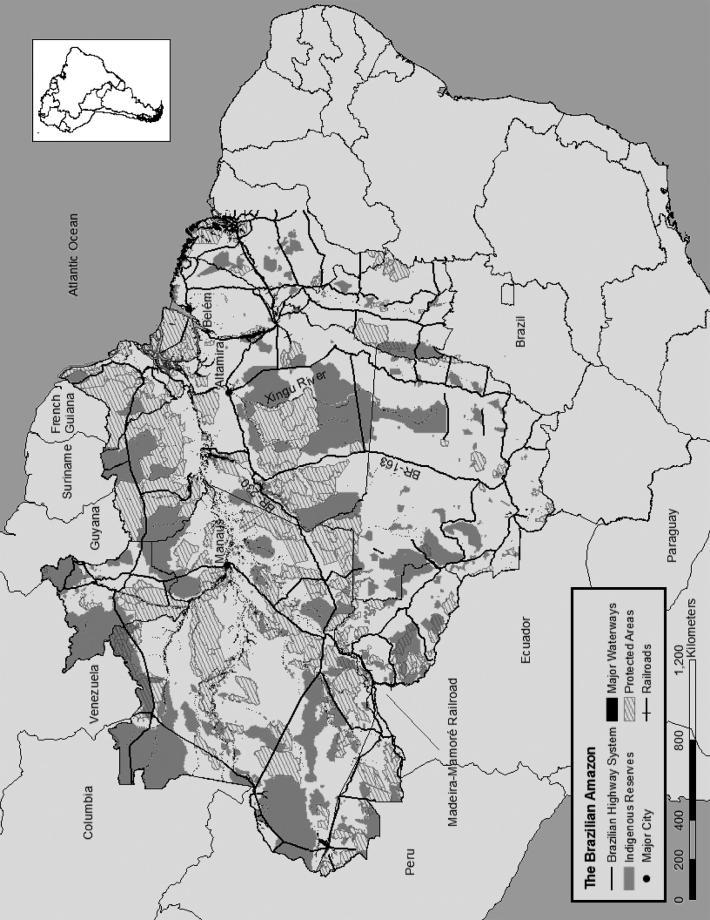
The specific geographic location within the Brazilian Amazon that is discussed in this work are the central and southwestern lands of the state of Pará, in the vicinity of the Transamazon highway and the BR-163 highway. Pará is in the North region of Brazil, and its capital city, Belém, is located near the eastern mouth of the Amazon River delta, about 100 km from the Atlantic Ocean (see Figure 1.1).
In the region, we are witness to sustainable development planning which, upon a surface-level examination, seems to embody significant contradictions: highways that run across the rainforest are paved, the world’s third-largest hydroelectric dam is proposed to be built, and at the same time new conservation areas and forestry regulations are established, all within the same geographic space. Operating in concert with one another, these new physical infrastructures are intended to be harmonized with ecological conservation, and together they become the basis of environmental governance interventions in the region.
Governing for Sustainable Development
The approach taken here focuses on how the ongoing process of governing society takes shape. I understand governing as involving a purposeful effort to steer, guide, control, and manage (sectors or facets of) society, both through singular acts and as constellations of political interventions (Kooiman 1993, Kemp, Parto, and Gibson 2005). Governing happens as new environmental norms are shaped, as certain institutional forms become entrenched, and as actors, who often have divergent interests, find places of convergence with ascertainable coherence and legitimacy (Baletti 2014). Focusing on governing helps inform the question of how governance is playing out in practice, at various levels of actors and discourses. Through centering our interrogation around how particular policy interventions transform lives and land into spaces of spatial, cultural, and economic production, we may gain greater insight into how power is exerted, how it shapes social and ecological realities, and how those realities are navigated by different actors (Lefebvre 1991 [1974], Brosius 1999, Bunker 1985, Bunker and Ciccantell 2005).
This book’s theoretical focus is informed by the seminal urban geographer Henri Lefebvre, insofar as it attempts to excavate these dynamics within the
Figure 1.1 Th e Brazilian Amazon with major infrastructure, environmentally protected areas, and indigenous reserves depicted.
particular spaces in which sustainable development operates. Understood as mental, social, and physical spaces, Lefebvre encourages an understanding of a trialectic between lived space, produced through co-constitutions of objective spatial practices; conceptualizations of space; and lived experiences (1991 [1974]). In Lefebvre’s view, “ideologies of space” form a bridge between subjects’ perceptions and their lived spaces of activity. In everyday life, ideologies articulate with science, make coherence of spatial practices, and are the forces through which everyday life is practiced in all its contradictions.
Socio-political contradictions are realized spatially. The contradictions of space thus make the contradictions of social relations operative. In other words, spatial contradictions ‘express’ conflicts between socio-political interests and forces; it is only in space that such conflicts come effectively into play, and in so doing they become contradictions of space. (Lefebvre 1991 [1974], 365)
Using Lefebvre as a foundation for understanding how space is co-constituted in the modern world, this book endeavors to unpack how sustainable development is imagined, negotiated, and physically enacted. As an element of modern state practice, sustainable development is manifested in specific spatial cultures through social, physical, economic, and cultural expressions.
A good part of the theoretical foundation for answering the question of how sustainable development is manifested in lives and landscapes also derives from the concept of the production of nature. As Neil Smith (1996) argues, the urge for capital accumulation shapes nature both discursively and materially. Understanding nature as a co-constituted element of social relations (which are simultaneously constituted by economic and political forces), or a socio-nature, establishes capitalism within contingent and contested historicalgeographical processes that position society and nature as inseparable.6 New natures are produced across space and time in these ongoing processes, and because of this, the idea of a pristine nature, untouched by humans, is increasingly problematic. Lefebvre’s call to capture socio-nature requires tracing through a complex maze of power relations and natural processes. The production of socio-nature is understood through moments of relation between representational visions, symbolic-level expressions, and material practices. These elements may each embody characteristics that tend to internalize dialectical relations, but none of these are reducible to or determined by the other (Lefebvre 1991 [1974]). For Lefebvre, process and fluctuation “becomes interiorized in moments (lived, perceived, conceived) of the production process, but always in a fleeting, dynamic, and transgressive manner” (Swyngedouw 2015, 21). In this epistemological perspective, there is no fixity; flows of social relations, language, discursive constructions, material and cultural practices, biochemical