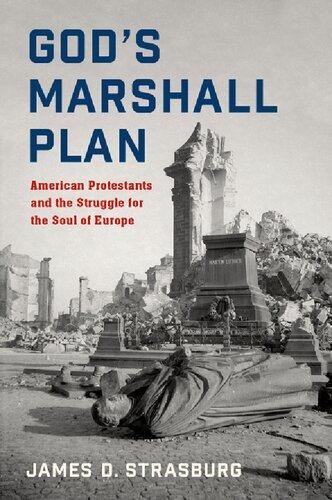
God’s Marshall Plan
American Protestants and the Struggle for the Soul of Europe
JAMES
D. STRASBURG
Oxford University Press is a department of the University of Oxford. It furthers the University’s objective of excellence in research, scholarship, and education by publishing worldwide. Oxford is a registered trade mark of Oxford University Press in the UK and certain other countries.
Published in the United States of America by Oxford University Press 198 Madison Avenue, New York, NY 10016, United States of America.
© Oxford University Press 2021
All rights reserved. No part of this publication may be reproduced, stored in a retrieval system, or transmitted, in any form or by any means, without the prior permission in writing of Oxford University Press, or as expressly permitted by law, by license, or under terms agreed with the appropriate reproduction rights organization. Inquiries concerning reproduction outside the scope of the above should be sent to the Rights Department, Oxford University Press, at the address above.
You must not circulate this work in any other form and you must impose this same condition on any acquirer.
CIP data is on file at the Library of Congress
ISBN 978–0–19–751644–7
DOI: 10.1093/oso/9780197516447.001.0001
Printed by Integrated Books International, United States of America
Acknowledgments
I am deeply grateful to the community of scholars, family, and friends who supported and cheered me on as I researched and wrote this book. In particular, a long line of teachers and scholars have shaped my work as a historian. At Duke Divinity School, both Grant Wacker and Kate Bowler were excellent teachers who invited me to ponder the global engagement of American Protestants in the twentieth century. Their teaching helped inspire the earliest stages of the research that would appear in this book. At the University of Notre Dame, Mark Noll proved to be a tremendously gracious, generous, and kind mentor. His perceptive insights and thoughtful questions about this research project greatly sharpened it. He has been a tireless advocate ever since, and I am deeply grateful for his guidance and support. I can only hope to emulate his example of scholarly rigor, humility, and kindness. John McGreevy, Wilson Miscamble, Gerald McKenny, and Darren Dochuk likewise gave early drafts of this work a close read. Their thoughtful comments and suggestions for revision improved it immensely. Finally, the Colloquium on Religion and History at Notre Dame provided a lively intellectual community and a hospitable environment to test out early drafts of chapters as well. Beyond these scholars, I would also like to thank Jan Stievermann, the Heidelberg Center for American Studies, and the Ecumenical Institute at the University of Heidelberg. They provided numerous opportunities to present my research in Germany and offered a productive environment to revise drafts of the manuscript. At the University of Leipzig, Peter Zimmerling helped open up to me the depth and richness of Dietrich Bonhoeffer’s theology. Matthew Avery Sutton also offered his perceptive critiques on drafts of this manuscript and helped save me from several embarrassing mistakes. I am exceedingly grateful for his help and insight. Mark Ruff likewise gave helpful feedback at a crucial point in the drafting process, while Ansley Quiros provided her insightful wisdom and helpful edits on several chapters. Finally, the peer reviewers at Oxford University Press sharpened this book in myriad ways and opened up new avenues of inquiry that I could not have seen without their input. At Oxford, Theo Calderara and his editorial team went above and beyond in helping get this book to the finish line. They
proved incredibly patient through several snafus. It has been a privilege and an honor to work with them, and I would like to thank them for their patience and graciousness, as well as for taking a chance on a first-time author like myself. A special thanks goes to Prabhu Chinnasamy and Dorothy Bauhoff as well for shepherding this book through its final stages. Tucker Adkins also came through with terrific work on the index. All told, I am sincerely grateful to all of these scholars for their support. The strengths of this work are theirs, the weaknesses wholly mine.
Researching and writing this book would also not have been possible without the support and tireless work of archivists in the United States, Germany, and Switzerland. Dirk Ullmann at the Archiv für Diakonie und Entwicklung in Berlin proved a most kind and gracious guide to their extensive resources. Anne-Emmanuelle Tankam-Tene at the World Council of Churches pointed me toward helpful collections, facilitated some exciting archival discoveries, and helped me navigate copyright permissions. Katherine Graber at the Billy Graham Center and Wheaton College Archives generously gave her time in helping me track down collections and figure out image permissions. Omee Thao at Denver Seminary was remarkably kind in granting me access to hard-to-find fundamentalist journals. The librarians at Michigan State University Special Collections and Wichita State University Special Collections also went above and beyond in helping with the final stages of research. Finally, Brenna Wade and Pam Ryan at Hillsdale College tolerated my numerous requests for obscure fundamentalist articles and journals and never failed to acquire them.
In writing this book, I also incurred a great debt to institutions that generously supported my research, including the Fulbright Program, Duke Divinity School, the History Department at the University of Notre Dame, the Institute for Study of the Liberal Arts at the University of Notre Dame, the Nanovic Institute for European Studies at the University of Notre Dame, the Andrew Mellon Foundation, and Hillsdale College. I am grateful to these institutions for giving me a chance and believing in this project.
Finally, I could not have reached the finish line without the loving support of friends and family along the way. Jonathan Riddle, Karie Cross, and Alex Wimberley have been especially dear friends and supporters since we navigated the highs and lows of doctoral work. It has also been a joy to now support one another in our respective vocations. Heath Carter has always been amazingly generous with his time, a tremendous mentor, and an inspiring friend. Nathan has been a faithful friend who always cheered me on
as I spent my life’s “prime meridians” in dusty archives. Last but not least, I would like to thank my family, to whom I dedicate this book: my parents for their constant presence, encouragement, and steadfast example of love; my grandparents for pouring so much of their time, energy, and love into my life and inspiring my interest in history with their stories; and my brother and sister, for always being there. I love you all very much.
Introduction
On August 7, 1945, American Protestant pastor Stewart Winfield Herman, Jr., arrived in Berlin, Germany, unable to recognize the city he had once known so well. Following countless bombing raids and a final Soviet assault, the Nazi capital lay in ruins. Although months had passed since the guns of the Second World War had fallen silent, little progress in reconstruction had been made. Navigating between piles of rubble and debris, Herman set out to make sense of the city’s new landscape.
The young minister first visited the burned-out remains of his old church, the American Church in Berlin, where from 1936 to 1941 he had served as pastor in the throes of Adolf Hitler’s dictatorship. The church had succumbed to Allied bombing in the heat of war, leaving behind only the skeleton of its once grand Gothic exterior. Once inside, Herman sifted through the ashes of charred hymnals, burned Bibles, and scorched pews. He left the church having managed to salvage only a few personal belongings that he had stashed in the church’s safe before the Nazis had interned him in 1941.
Pressing onward, Herman passed by the badly damaged Reichstag—the German parliamentary building—and made his way to the Brandenburg Gate. As he pulled up to that historic monument, he could not help but notice that a large portrait of Soviet premier Joseph Stalin stood at the center of Unter den Linden, Berlin’s main boulevard. Soviet flags had flown just months before over the parliament, announcing the Soviet triumph over Berlin. In response, Herman’s concern grew that secularism and Soviet communism would spread among Germany’s spiritual and civic ruins. If Germany fell, he feared, all of “Christian Europe,” and even “Christian America,” would be at risk. Germany’s so-called stunde null the “zero hour”—thus symbolized something much more alarming to Herman: the survival of “Christian civilization” itself was now at stake.1
Herman left Berlin with these concerns about Germany’s postwar fate burning in his mind. He was not alone. Since the outbreak of the First World War, American Protestants had been discussing what they called “the German problem.” They had found Germany to be both a conundrum and a paradox.
God’s Marshall Plan. James D. Strasburg, Oxford University Press (2021). © Oxford University Press.
DOI: 10.1093/oso/9780197516447.003.0001
While they lauded Germany as the historic birthplace of their Protestant faith, they also puzzled over its path to authoritarian government, its hypernationalism and militarism, and its theological liberalism. With the rise of Nazi fascism, American Protestants had come to believe that the same nation that had ignited the Protestant Reformation had also paradoxically threatened to destroy the “Christian West” altogether. Although Allied powers had triumphed over Axis armies and had prevented such a fate, the difficult tasks of reforming Germany, reconstructing Europe, and forging a new Christian world order remained. As the burned-out sanctuary and destroyed parliament lingered in his mind, Herman thus pondered how Americans could restore Germany and the European continent to full spiritual and political health. With fascism defeated and communism on the move, the American pastor summoned his nation into action. He called on the American government and American Protestant churches to make good on the war they had just won. In particular, he and other leading American Protestants identified Germany as the prime territory for creating a new Christian and democratic world order in the heart of Europe, one that could dispel any new totalitarian threat, whether spiritual or political.2
Herman’s mission activated in particular the energies of a group of American Protestants that described themselves as “ecumenists.” From the turn of the twentieth century onward, these “ecumenical” Protestants had worked to overcome doctrinal differences through commitments to a modern and progressive faith. They also had pursued interdenominational unity through creating a powerful national church organization they called the Federal Council of Churches (FCC). They believed their ecumenical cooperation enhanced their efforts to “Christianize” their nation, and to spread the Protestant faith and democracy across the globe. They accordingly envisioned themselves at the center of what they called “World Christianity,” an imagined global community that was ecumenically Protestant in its spirituality and democratically oriented in its politics. Through the trials of war, they worked to unify the world’s Protestant churches in the World Council of Churches (WCC), a global church body which they thought of as a spiritual complement to the League of Nations and then the United Nations. In sum, they tended to be proponents of progressive governance, ecumenical religion, and spiritual values such as responsible citizenship, democratic equality, and multilateral organization.3
When Herman and other American ecumenists joined army platoons in occupying Germany, they did so reflecting these particular beliefs about their
faith and their nation’s purpose in the world. Their sense of global mission naturally led them now to intervene in Europe and to seek to spiritually rebuild the continent in the American image. This course of action flowed out of their steadfast conviction that their faith and their nation possessed the spiritual and civic acumen needed to advance the cause of world peace and to create a new Christian world order rooted in democracy and Protestant ecumenism. They marshalled their spiritual and political energies to oppose any perceived “totalitarian” threat to such an order—including communism and secularism, as well as Catholicism and Protestant fundamentalism—both at home and across the European continent.
These Protestant ecumenists indeed sensed they were not the only ones interested in spiritually reconstructing Europe. They were especially eager to not cede spiritual ground to the Vatican in the heartland of their faith. Believing that Protestant Christianity alone provided the proper spiritual foundation for political democracy, they rushed to match and outdo the Vatican’s relief and reconstruction efforts. American Protestant “evangelicals” also raised their alarm by sending squadrons of preachers and revivalists to Germany and the continent. Shortly after Herman arrived in Berlin, rising evangelical preacher Billy Graham embarked on his first preaching tour through Europe, where he would perfect his pitch before taking the United States by storm. Graham and his evangelical partners wanted to spread a different set of American spiritual and political values abroad. In contrast to Herman, they promoted biblical fundamentals and conversionary mission as the proper theological expression of Protestant Christianity. They also identified individual liberty, limited government, free market capitalism, and an America-first foreign policy as their nation’s proper political values. Led by Graham, these evangelical Protestants worked to resurrect Europe and establish their own countervailing evangelical order abroad. Together, these ecumenists and evangelicals began a struggle for the soul of Europe that would remake politics and theology on both sides of the Atlantic.4
This book narrates the origins and history of these competing American Protestant missions to Germany and Europe. In particular, it examines how ecumenical and evangelical American Protestants used the onset of two world wars and an era of reconstruction as rationale to spiritually and politically intervene in Europe. As they did so, Germany and Europe became proving grounds for the respective world orders these American ecumenists and evangelicals desired to create in the early to mid-twentieth century. This volume also documents how this spiritual struggle for Europe
activated and advanced American Protestantism’s long-standing Christian nationalism—the belief that the United States was a Christian nation with an exceptional role to play in the world. In pursuit of Europe’s spiritual reconstruction, both groups lived out tenets of what Francis B. Sayre, a prominent 1930s American diplomat, called his nation’s “conquering faith”—its spiritual impulse to shape, lead, and transform the globe through the spread of Protestant Christianity and American democracy. In pursuit of such a cause, ecumenical and evangelical Protestants alike mobilized for world war and pursued strategic partnerships with federal officials, foreign policymakers, and the American military. Through these efforts, they hoped to spread democratic values and Protestant Christianity to Europe, and as such, to remake the continent in the American image.5
As they pressed abroad, however, America’s ecumenical and evangelical Protestants also came to see that they had developed dramatically different plans for rebuilding their world out of the ruins of war. Germany and the European continent therefore became an early battleground between them for the spiritual leadership of their nation and the so-called “Christian West.” While their respective missions to Germany provided a spiritual rationale for a new cold war against communism, they also refined competing spiritual agendas that would begin to fracture American politics, diplomacy, and religion in the decades that followed.
Their spiritual advance would also not go uncontested abroad: European Protestants firmly challenged aspects of these American Protestant missions to their continent as well. As the Cold War intensified, leading European theologians forged a “third way” theology of their own that mediated between Moscow and Washington and called for peace and reconciliation across the world. Faced by this counter-response, a growing number of American Protestants were challenged to rethink the contours of their global mission and their relationship to the American nation-state in the Cold War. They examined anew how their loyalties to their nation aligned with their commitments to the global church. They questioned more fully whether God’s global kingdom could be advanced through America’s global primacy. They reconsidered where their true citizenship lay.
While American Protestants had thus pressed abroad to remake Europe, Europe had instead begun to remake them. Forsaking their wartime Christian nationalism, a growing number of American Protestants embraced an emerging Christian globalism that placed commitments to Christ over the nation and challenged the imperial contours of their global activism. A fresh
wave of Protestant spiritual warriors ensured, however, that the Christian nationalist cause and struggle for Europe’s soul would continue deeper into the Cold War. The spiritual struggle for Europe thus left American Protestants deeply divided and at odds over their global mission. It ultimately forged competing theologies of global engagement—Christian nationalism and Christian globalism—that transformed the United States, diplomacy, and religion in an era of world war and beyond.6
At heart, God’s Marshall Plan explores how American Protestants have come to see their place and role in the world in such differing and competing ways. Although most American Protestants today accept that their nation is a global superpower, they often disagree sharply on the promise and perils of that particular identity. While some celebrate the United States as God’s chosen nation, others ponder how to live faithfully in the world’s new Babylon. The American Protestant mission to spiritually reconstruct Europe reveals that these contemporary tensions are not new. In fact, American Protestants have long wrestled with how their faith relates to the particulars of their nation’s identity and its international engagement.
To examine the roots of these tensions, this book begins its storyline at the turn of the twentieth century, when American Protestants were just beginning to make sense of their nation’s rise as a world power. The three global wars that ensued—the Great War, the Second World War, and the Cold War— offered American Protestants an extraordinary opportunity to redefine their nation’s role in the world. Many American Protestants began to broadly agree that their nation had a divine commission to solve the trials of their age. Their isolationist and pacifist tendencies began to fade as they supported new global interventions and launched missions to remake the world in their image. By 1945, their nation’s ascent seemed near complete. Following the Second World War, America’s military spanned the globe and its economy dwarfed all others. In the view of many American Protestants, the United States also possessed the clearest claim to moral and spiritual leadership of the world. Yet despite that preponderance of power, American Protestants had come to sharply disagree over how exactly the United States should use its newfound standing in the world and to what ends. The spiritual fight for Europe exposed this growing divergence between American Protestants over the proper political and diplomatic expressions of their faith.
This book explores the origins of these sharp disagreements through considering how American and European Protestants responded to the outbreak of world war and the rise of totalitarian regimes in the early to mid-twentieth century. To do so, it recovers a lost transatlantic world that reshaped Protestant political thought and international engagement on both sides of the Atlantic. Zooming in further, it focuses its narrative especially on the German-American Protestant relationship from the turn of the twentieth century into the early Cold War. It explores how the German-American exchange in this era was arguably much richer, more complex, and more transformative to international religion and politics than previously recognized.7
At the turn of the twentieth century, Protestants across the North Atlantic world were beginning to make sense of the rise of the United States and Germany as new global powers. Following respective wars of national unification in the 1860s and 1870s, both the United States and the German Reich endeavored to become powerful nation-states and internationally respected empires. The American government emerged from the American Civil War (1861–1865) eager to consolidate its control over the North American interior, as well as to unify its northern and southern sections under the banner of a shared Protestant culture. In the Spanish-American War, the United States proceeded to stretch its “frontier” thousands of miles from home into the Pacific and the Caribbean, in the process becoming a new empire. Meanwhile, following the Franco-Prussian War in Europe (1870–1871), Otto von Bismarck, the militant “blood-and-iron” minister of Prussia who had unified the German states through war, worked to strengthen Prussian and Protestant hegemony through a domestic culture war on Catholicism and socialism. He also sought to win the new German empire continental respect and to establish German colonies through “carving up” the African continent. By the turn of the century, both nation-states had become imperial powers and had developed commanding positions in their era’s industrializing international economy. Both had also sought to forge Protestant national cultures at home and were pursuing Protestant foreign missions abroad that aimed to “civilize” and “Christianize” the world.8
Against this backdrop, religion proved to both connect and divide American and German Protestants. As the twentieth century approached, transatlantic revivals, social reformers, and liberal Protestant theology had built religious bridges between Protestants on both sides of the Atlantic. Yet despite these points of connection, the rapid rise of both nations heightened how American and German Protestants came to believe they advanced
rather different spiritual and political traditions in the world. Moreover, both American and German Protestants equally claimed divine sanction for their respective world-historical missions. While American Protestants affirmed that they stood behind the sacred cause of a democratic faith and politics, they argued that German Protestants had grown to promote an authoritarian spiritual and political culture. As a range of American Protestants saw it, their counterparts’ proclivity for autocratic governance and theological modernism had led them to support the Kaiser’s march to war, to reject the liberal democracy of the Weimar Republic, and to welcome Nazi fascism and its militaristic nationalism. In contrast, German Protestants often criticized their American peers for pursuing the “Americanization” of the world, for practicing an unbridled spiritual activism, and for advancing the cause of American empire. American Protestants in response viewed defeating and reforming this German tradition as one of the central tasks of two world wars and a military occupation. Moreover, integrating Germany into a newfound international Protestant order stood out to them as one of the most decisive undertakings in the early Cold War. In these ways, the “German problem” loomed large as one of the most central spiritual and political issues for American Protestants of this era, just as German Protestants equally harbored fears of America’s “spiritual imperialism.”9
This book accordingly surveys how American Protestants became so focused on reforming Germany and documents their prolific efforts to change Germany’s political and spiritual culture. It follows a host of Protestant pastors, revivalists, diplomats, and spies who responded to the outbreak of trench warfare, observed the rise of fascist dictatorships, mobilized against the Axis powers, and began to identify Germany and Europe as in need of saving. After two tumultuous wars, they then launched far-reaching missions to spread their faith and democracy across the Atlantic. Their spiritual interventions solidified their sense of moral and spiritual exceptionalism and presaged a new American activism in the world as a defender and promoter of democracy.10
While Americans drew energy from their mission to save Europe, that mission also fractured American Protestantism through further pitting “ecumenical” and “evangelical” Protestants against one another as spiritual foes. Historians have long debated how exactly to define these respective movements within American Protestantism. The boundaries between these
two groups were at times fluid and permeable, and a wide middle ground often existed between them. Nonetheless, scholars have pointed to the “Fundamentalist-Modernist Controversy” of the 1920s as one significant point of theological departure between these two Protestant wings. While historians most often recount this moment as an early twentieth-century struggle over theology and the teaching of evolution, the controversy was never just about doctrine and science alone. It also had to do with vastly differing notions of mission, eschatology, politics, and foreign policy. It is these differences that ultimately inspired the competing ecumenical and evangelical missions to Europe.11
In the lead in crossing the Atlantic were the “ecumenical” Protestants, or “ecumenists,” who stemmed from the broad tradition of liberal mainline American Protestantism. Theologically, these ecumenists tended to be “modernist” and “liberal” in their theological orientation, which meant they were more open to synthesizing their faith with new intellectual currents flowing from Europe, such as biblical higher criticism and modern evolutionary science. Drawing upon such insights, they revised traditional Protestant doctrines that they felt no longer held up to scientific scrutiny, such as a sixday creation and Christ’s virgin birth. Their openness to the discoveries of modern scientific methods also overlapped with a growing tolerance for doctrinal difference. They sought to overcome once-sharp confessional disputes and to unify America’s powerful mainline denominations in the Federal Council of Churches, a national Protestant church organization designed to coordinate Protestant mission efforts and public engagement. The idea of Protestant “ecumenism,” drawn from the Greek word oikumene, meaning the “inhabited world,” developed from this effort to unify Protestants across denominations. Until the early twentieth century, national ecclesial unity had proven elusive for these Americans, who lacked the national church structures of Europe and experienced firsthand the enduring denominational fragmentation of the Reformation. Yet American ecumenists believed they could reverse such effects, not only at home but also abroad. Through their collaboration, they strove to complete the “Christianization” of their country and to unify the world under the banner of their modern faith and democratic politics.12
Beyond their ecumenical leanings, ecumenists also gravitated to postmillennialism, an eschatological school of thought which foretold that a thousand-year era of peace and justice would precede Christ’s triumphant return to the earth. They believed they had a role to play in ushering in this
millennial era through progressively improving human affairs. They therefore practiced a social activism that sought to transform human society, reform industrial capitalism, and uplift international relations to a higher moral plane. They affirmed that their mission of Christianizing and even Americanizing the world helped establish this anticipated kingdom of God on earth. In pursuit of a more harmonious world, they also began to downplay conversionary proselytization in favor of new mission methods focused on institution building, social service, and humanitarian aid.13
Their postmillennialism also tended to align them with the aims of progressive politics and diplomacy. They especially supported Woodrow Wilson’s foreign policy of world democratization and multilateral global governance, which they hoped would quicken the creation of a harmonious world. Along with Wilson, they set their sights on remaking the world through the global spread of America’s liberal democratic and Protestant Christian values. While the brutality of the Great War challenged their postmillennial optimism, their commitments to pursuing peace and progress nonetheless endured. They strove to spiritually complement Wilson’s League of Nations through global ecumenical partnerships that they hoped would infuse international diplomacy with an underlying Christian character. They likewise worked to establish a new global institution for Protestant Christians, which culminated in the creation of the World Council of Churches. Through this spiritual fellowship, ecumenists hoped they could promote ecumenical values abroad, overcome the nationalism, secularism, and totalitarianism that threatened their globe, and create a lasting foundation for a peaceful and just world.14
In contrast, twentieth-century Protestant “evangelicals” found their roots in the “fundamentalist” response to these currents of Protestant modernism. In a series of booklets titled The Fundamentals: A Testimony to Truth (published in the 1910s), these theologically conservative Protestants opposed evolutionary theory, affirmed that the Bible was infallible and absolute in authority, and insisted that doctrinal differences and the confessional autonomy of local congregations continued to matter. Through defending these “fundamentals” of the faith, they laid the foundation for a national, interdenominational movement that aimed to challenge Protestant modernism and ecumenism on a global scale. Their movement seemed to be dealt a decisive blow in the mid-1920s when the Scopes-Monkey Trial, argued over the teaching of evolution in Tennessee public schools, gave these “fundamentalists” the pejorative reputation of being anti-intellectual,
backward plain folk. While conventional wisdom suggests fundamentalists then retreated out of sight, they in fact began to build their own national networks that rivaled the Protestant mainline’s powerful hold on American society. Moreover, they sought to shape their nation’s politics and culture through campaigns against evolution and alcohol.15
The signs of the times led Protestant fundamentalists to develop their own competing sense of global mission that rooted itself in their premillennial eschatology. Having defended traditional doctrines such as the atoning work of Christ, they accordingly stressed the enduring importance of conversionary mission in saving as many souls as possible from sin and the eternal fires of hell. Their interpretations of ancient biblical texts and daily news headlines also led a more radical wing within their ranks to believe the world was not getting progressively better, but rather, in its sinful corruption, was coming to a violent, tragic, and imminent end. Such convictions reflected an eschatology—dispensational premillennialism—that drew on biblical prophecies to outline the six dispensations of human history that purportedly preceded Christ’s return and the foretold millennium. Believing that they lived in the sixth dispensation, these “radical evangelicals” anticipated that Christ’s faithful followers would be raptured from the Earth, while a powerful dictator known as the Antichrist would take over the world and spark an apocalyptic battle before the final judgment and onset of the millennium.16
Far from leading these fundamentalists to withdraw from the world, however, such apocalypticism actually emboldened their activism even more. As historian Matthew Sutton has illustrated, premillennial evangelicals drew inspiration from the apocalypse to “occupy” their country for Christ and to prepare their world for Christ’s imminent return. They felt a tremendous urgency to save souls and to oppose the forces of evil in the world until the very end. In particular, they opposed the “collectivism” of ecumenical councils, big government programs, and Wilsonian internationalism—any development that they feared would centralize power and could aid the coming Antichrist. To counteract such trends, they championed their own Christian politics of limited government, spiritual liberty, and free-market capitalism. When it came to international affairs, their apocalypticism led them to call for independence from international influence and multilateral organizations such as the League of Nations. Along with their muscular faith, their apocalypticism also led them to support a strong military
in times of conflict, unilateral interventions abroad, and the pursuit of holy war against evil.17
The Second World War electrified American fundamentalists even further. In 1942, a core group within their ranks sought to give their movement a fresh public image through rebranding themselves as “neo-evangelicals.” They likewise hoped to challenge the Federal Council and to restore their nation to its proper theological heritage through institutionally forming the National Association of Evangelicals (NAE). While these evangelicals sought to foster a “new” identity, in many ways, they were still very much fundamentalists at heart. Following the war, they sought to gain a new hold over American public life through promoting a public theology of “faith, freedom, and free enterprise.” Paradoxically, they advanced these commitments even as they developed a closer relationship to an increasingly expansive federal government in the Cold War. As that conflict developed, they emerged as their nation’s fiercest spiritual warriors in the struggle against Soviet communism.18
These ecumenical and evangelical traditions stood behind the competing spiritual missions to Europe. In short, Protestant ecumenists aimed to usher in a new era of democracy and ecumenical religion across the Atlantic and to build multilateral spiritual and political institutions that they hoped would undergird a new American-led Christian world order. In contrast, American evangelicals desired to preach a gospel of liberty in its spiritual, political, and economic forms, to spread biblical fundamentals, and to defeat the evils emanating from Europe, including theological modernism, “pagan Nazism,” and atheistic communism. These varying theological commitments ultimately compelled a broad range of American Protestants to fight for the soul of Europe and to seek to establish competing transatlantic spiritual orders.
God’s Marshall Plan also considers how both Protestant traditions played a role in facilitating the rise of Christian nationalism and Christian globalism as competing twentieth-century theologies of global engagement. It does so through investigating the historical roots of these theologies, in particular through examining the ways Protestant figures on both sides of the Atlantic made sense of the relationship between the church and the nation-state in this era. In one sense, how to draw the line between God and Caesar had always troubled Christians. A host of political theologies had been developed to solve this dilemma, from the bishop Eusebius baptizing Constantine’s
Roman Empire as a vessel of God’s providence, to Augustine differentiating the heavenly and the earthly cities, to the Reformation-era Anabaptists rejecting the sword and withdrawing from the magisterial state. Such tensions no less concerned twentieth-century Protestants. As historian Brian Stanley has put it, the history of twentieth-century Protestant Christianity can be read in part as the story of the faith’s engagement and “compromise” with the creeds of nation, race, and empire. In particular, Protestant Christians on both sides of the Atlantic had generally come to espouse the central tenets of Christian nationalism—the belief that a divine partnership existed between the Christian God and their respective nation-states. The nation and its corresponding empire appeared to many North Atlantic Protestants as an agent of God’s will and work in the world.19
Making matters more complex, twentieth-century Protestants likewise grappled with powerful political ideologies—such as democratic liberalism, fascism, and communism—that swept over the North Atlantic world and vied for their political loyalties. More often than not, their national and political allegiances overpowered their religious commitments. In particular, such loyalties often challenged their faith’s summons to love of neighbor, regardless of that neighbor’s nationality, race, or politics. Christian nationalism likewise clashed with the biblical admonition to prioritize peacemaking and to seek the welfare of the wider world. Finally, it undercut the biblical mandate to hold a higher citizenship in heaven and to declare a greater devotion to a kingdom that knew no borders.20
This book in part examines the elaborate and complex process through which Protestants on both sides of the Atlantic came to terms in the twentieth century with the unholy alliances that had formed between their faith, nationalism, and political ideology. It proved difficult for American and European Protestants alike to untangle the thicket of connections between their churches and such creeds. In particular, it took time for many to see the nation-state itself as the human construction it was, an “imagined community” that drew upon history, culture, race, and religion in order to police the national boundaries of belonging, to oppose the perceived enemies of the state, and to undergird world-historical missions. Yet a host of twentiethcentury developments—in particular, the onset of tumultuous wars, the emergence of new spiritual networks, the rise of totalitarian regimes, and the global growth of the Christian faith—led Protestants on both sides of the Atlantic to begin to question Christian nationalism and its corresponding projects. These fundamental upheavals prompted American and European
Protestants to develop a new global identity that challenged nationalism, racism, and imperialism. Yet as this book shows, Christian nationalism continued to find faithful adherents across the North Atlantic world and still finds expression in today’s global political and religious debates.21
In the American context in particular, Christian nationalism powerfully shaped how many twentieth-century American Protestants viewed the globe. As a theological mode of thought, American Christian nationalism asserted that the United States was a Christian nation—by which Christian nationalists meant Protestant—that possessed an exceptional purpose and messianic mission to spread Christianity and democracy across the world. This theological conviction had already fostered a bold array of foreign initiatives in the nineteenth century, including efforts to conquer the North American continent in the name of Christ and liberty, as well as the SpanishAmerican War—a conflict many American Protestants viewed as an opportunity to dispel the backward “Catholic” empire of Spain and to liberate tens of millions living in Cuba, Puerto Rico, the Philippines, and Guam. In the early twentieth century, Christian nationalism also found expression in American Protestant campaigns to “Christianize” the world and to spread America’s democratic civilization abroad. While some American Protestant nationalists rejected the “old-style” imperialism of Europe as exploitative, they still believed Americans needed to practice a “spiritual imperialism” in the world—what they described as a more benevolent and enlightened form of empire that undercut the power-hungry ways of European nations.22
Christian nationalism was not just about America’s role abroad, however. It compelled American Protestants to narrowly define and police the national identity of the United States as well. On the home front, Christian nationalists often argued that “Christian America” needed to be defended from enemies both foreign and domestic. They sought to protect the privileged domestic standing of white American Protestants and warned that numerous threats—including European immigrants, communists, Catholics, and Jews—imperiled “Christian America” and the Protestant character of the American nation. In response, they often practiced a nativist politics of racial and religious exclusion. In this regard, Christian nationalism was an illiberal form of nationalism. It aimed to define American identity not on a set of inclusive liberal principles and civic ideals, such as the revolutionary proposition that all human beings were created equal and entitled to “certain unalienable rights,” as well as foundational freedoms such as religious liberty, but rather on a narrow and exclusive understanding of “Americanness” that
limited itself to Anglo-Saxon Protestants. American Christian nationalists countered the revolutionary vision of the United States as a safe haven for the world’s oppressed, and advanced the idea that America was a vulnerable fortress that needed to be defended from a multitude of threats.23
To be clear, Christian nationalism was not civic patriotism. For some American Protestants of this era, patriotism rightly understood constituted a “cautious” and tough love of country. It entailed a dedication to America’s liberal ideals and did not hesitate to criticize and admonish when Americans failed to live into these principles. This kind of civic patriotism likewise nurtured the aspirational longing toward what Martin Luther King, Jr., described as the “beloved community.” It promoted the kind of solidarity, mutuality, and equity that could bind a diverse society together and form the foundation of a just common life. It understood Nazi fascism just as much as a summons to vigilance abroad as a call to reform of injustice at home. In an increasingly interconnected world, it also overlapped with commitments to wider global fellowships that helped temper and mediate it. In contrast, Christian nationalism corrupted and distorted this kind of civic good. It endorsed exclusionary and insular politics at home and abroad, asserted notions of national greatness, fostered myths of national exceptionalism, and claimed divine sanction for the nation’s pursuits. Christian nationalists at times sought to cloak their commitments in the garb of patriotism, but there was always a crucial distinction between a measured devotion to country and their deification of the flag.24
In accounts both academic and popular, historians and journalists have tended to credit Protestant evangelicals as the harbingers of Christian nationalism in the twentieth century, and with good cause. Evangelicals were indeed often at the forefront of arguing that the United States was a Christian nation, heir to a divinely ordained heritage of evangelical theology and political and economic liberty. In response to German imperialism, Nazi fascism, and Soviet communism, they fostered Christian nationalist revivals at home and called for the kind of robust militarism that they hoped could eradicate such evils in the world. They likewise tended to promote an “America First” mentality that rejected international institutions and alliances and instead called on the United States to unilaterally and muscularly use its military might to defeat foreign enemies. Yet far from retreating from the world as isolationists, Protestant evangelicals also proved eager to remake the globe in America’s evangelical, democratic, and capitalist image.25
In contrast, several historical accounts have portrayed Protestant ecumenists as transcending and eschewing Christian nationalism. In particular, the foreign mission field and the ruins of war provided soil for an alternative theology of global engagement to grow. Through the trials of the twentieth century, some American Protestants began to espouse this counter-theology, which this book describes as “Christian globalism.” In the aftermath of the Great War, a small yet committed group of ecumenical Protestant missionaries began to seriously question and critique the notion of Christian nationhood itself. As historian Michael Thompson puts it, these ecumenical Protestant missionaries began to place their “commitment to the ethics of Jesus above the nation.” As such, they challenged the common American Protestant belief that their nation’s cause and God’s cause were inherently one and the same. They likewise opposed the exceptionalism and imperialism that flowed from such convictions. Forsaking the nation, they instead pursued “wider solidarities” within a global fellowship of Protestant Christians and developed an ethic of pacifism and justice in an increasingly interconnected world.26
In the words of historian David Hollinger, these ecumenical missionaries also began to espouse a “cosmopolitanism” that sought to reverse “the provinciality of American life.” They especially devoted themselves to promoting a global mentality at home that was more tolerant to difference and diversity. They desired to build new global institutions that would promote peace and understanding and proved willing to partner with other confessions of faith in pursuit of peace, justice, and equality across the globe. In this regard, they were in the spiritual business of reforming a provincial Protestant nation into a pluralist and egalitarian member of a broader global community. When the Cold War set in, these Protestant globalists favored an ethic of peace and mediation between the United States and Soviet Union. They refused to position themselves as proponents of the American way, but rather chose to be ministers of reconciliation in a broken world. They likewise supported pacifism in the face of nuclear proliferation and defended human rights in an era of Jim Crow segregation and decolonization.27
While Christian globalism without question grew in prominence during the interwar years, this book considers how Protestant ecumenists also continued to advance a Christian nationalism of their own well into the mid-twentieth century. While their patriotism and sense of national exceptionalism were indeed at times “cautious” and tempered, their engagement with Europe also activated their enduring belief that “Christian America” had