All rights reserved, including the right to reproduce this book in any form whatsoever without permission in writing from Argon Press, except for brief passages in connection with critical articles or reviews.
Published in the United States of America by Argon Press
ISBN (ebook): 978-1-944815-79-0
ISBN (print): 978-1-944815-80-6 (v 1.3)
www.ArgonPress.com
www.TheUniverseBuilders.com
The Universe Builders Series
Suggested Reading Order:
BernieandthePutty
Bernie’s chance to build his first universe unless his evil opponent can stop him
BernieandtheWizards
Bernie must pit his godly powers against the forces of magic
BernieandtheTimeLords
Bernie must stop time travelers determined to change the past
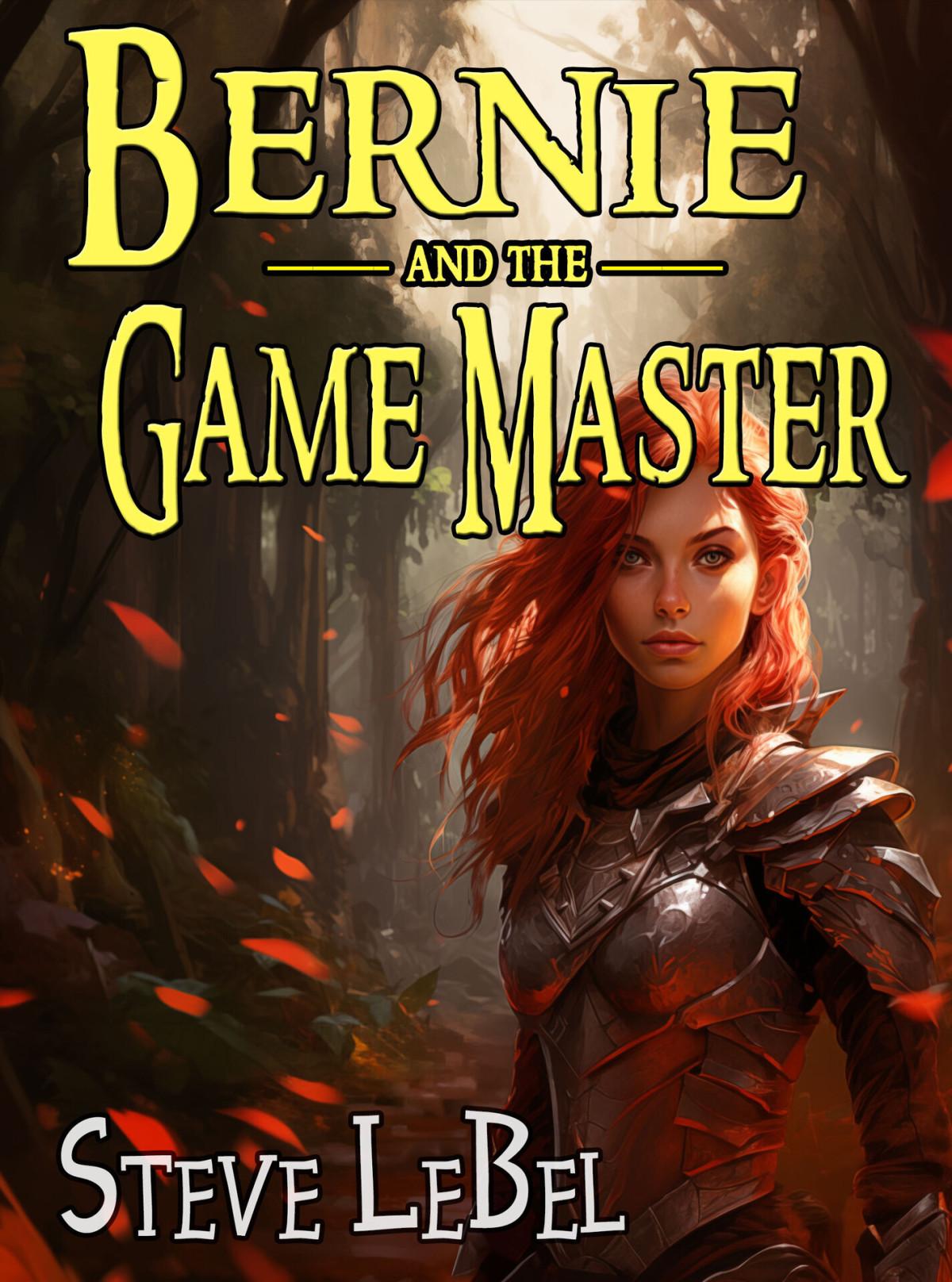
BernieandtheGameMaster
Bernie finds himself in a virtual world where godly powers mean nothing.
BernieandtheLostGirl
Bernie’s first adventure that took him into the deadly jungle beyond The Edge.
Genre(s):young adult fantasy, fantasy, sciencefiction,young adult, epic fantasy, coming of age, time travel, humorous, visionary and metaphysical, first contact, teen and juvenile fiction, fantasy and magic, science and technology, space opera, litrpg, gamelit, myths and legends, witches and wizards, fantasy adventure, and adult fiction.
Bernie and the Putty won 16 awards for excellence, including GrandPrize from Writer'sDigest, BookoftheYear(1stPlace) fromIAN,four GoldMedals,and10moreawardsforexcellence.
Dedication
To my readers who supported Bernie and his adventures for all these years:
Please accept our most sincere thank you.
Cast of Characters
Gods & Goddesses
Bernie, a young god
Suzie, Bernie’s girlfriend
Lenny, Bernie’s best friend
Shemal, Bernie’s boss
Isaiah, an importer, Cells’ owner
Ashley, president of Bernie’s fan club
Claudius, an ancient god
Others
Zephie, an AI
Sissy, Lenny’s little fluff ball
Denizens of Cells
Xoa, an elven fighter-magic user
Leuven, a halfling thief
Roderik, an elven ranger, Xoa’s boyfriend
The AI’s
Mother, raises and teaches the children
Torannah, warrior goddess
Kronge, the mad god System, manages the Game Game Master, supreme AI
What you seek, you shall never find. For when the Gods made man, They kept immortality for themselves.
The
Epic
of Gilgamesh
PROLOGUE
On most worlds, in most universes, higher life forms seek to better their lives. That usually begins with such things as shelter, physical safety, food, and meeting basic needs for survival. Given enough time, most species solve such problems.
Although one might think such needs, once met, would satisfy the species, it is not so. In fact, new needs emerge, dominating the species, until those needs are also met. Thus grows an unending evolution where one need is met, only giving rise to the next. Such needs tend to vary with the species and their environment. During the course of their advancement, it is common for a species to find their needs include social connections, status and recognition, autonomy and control, curiosity and understanding, and more.
When the gods surveyed the worlds they created, they found numerous forms of advancement, nearly as many as the number of life forms they’d created. The advancement path chosen by each species typically depended on two things: what the species was trying to avoid and/or what they wanted to gain.
This is a story of a species whose technology had virtually eliminated pain, suffering, and disease. They were left with a nearperfect existence leading to unbearable boredom – until they invented technology to solve that problem as well.
But, lest we forget, the gods don’t create worlds hoping those populations will exist in peace and contentment. They create worlds to produce a product. And when delivery of that product ceases, the gods become understandably upset.
And that’s when they send in a young god named Bernie. His job is to fix it…
WE WEREN’T READY
Huddled near the tree trunk with her two young friends, Xoa felt shame. She’d been so sure they were ready. She’d ignored everything, even refusing to listen to Mother. If the strangers hadn’t come along, she and her friends would have been slain and eaten.
Her sensitive elven ears heard the swords clashing, steel against steel, the sound echoing through the woods. Blocking such powerful swings had been impossible, and she’d lost her sword on the second blow. Her friends, huddled behind her, had been wise enough to avoid the orc blades, which was doubtless why they were still alive.
The strangers had appeared from nowhere. The big fighter pulled her from the ground before the orc’s next stroke could kill her. Her armor-clad rescuer shouted to get back, to hide, as he and his friends engaged the orcs. She did as he demanded, but less than a minute later, she crept forward, unable to tear herself away from the raging battle.
The fighter and another adventurer had pushed the orcs back through a narrow gap in the rocks. Xoa couldn’t count them all but saw at least seven orcs behind the two who were trading blows with her rescuer and his comrade. One orc cried out and fell, as if mysteriously injured by an unseen hand. Was there a thief striking from the shadows?
The person next to the fighter was a ranger, his thin blade moving with impossible speed, flashing faster than the fighter’s mace. So far, three orcs lay dead on the ground. But the orcs had the advantage of numbers and were slowly forcing the fighter and the ranger back from the narrow gap, allowing more orcs to join the fight. The fighter defended himself from two, now three, orcs, both swinging deadly blades. Even outnumbered, the orc blows were
blocked by mace or shield. Still, they forced the fighter to retreat, allowing a fourth orc and then a fifth to emerge from the gap. The orcs circled the fighter and the ranger. Xoa feared they would soon be overwhelmed and gripped her dagger, though she knew it would do no good. Suddenly, one orc groaned and clutched his chest where an arrow suddenly thudded. Before he hit the ground, a second orc raised his sword, searching desperately for the unseen archer. Xoa saw no one, but hiding would be easy in the thick brush. Turning back to the second orc, she saw him use his sword to partially deflect an arrow that still embedded itself in his shoulder. With his other hand, he pulled out the arrow and charged into the bushes.
A quick feint by the ranger, followed by an even quicker thrust of his sword into an orc’s belly, caused the orc to scream in pain. Its leather armor bore the scars of many glancing blows, but the ranger’s point-blank thrust had pierced its armor, and the orc went down, mortally wounded. The ranger turned swiftly, to strike one of the fighter’s two opponents, gashing a leg that spouted blood. The wounded orc turned on the ranger, but suddenly stiffened and fell from some unseen blow. Four orcs remained, now spreading out, intending to circle the two fighters.
Xoa realized what was wrong. The last orc had held back, not advancing to attack the ranger or the fighter; and she wore robes instead of leather armor. Xoa watched in horror as the orc raised a wand and gestured, mouthing words she could not hear.
“Magic user,” she shouted.
Although the fighter raised his shield, it was too late. He slumped to the ground, his heavy mace landing before he did. The ranger rushed to engage both orcs before either could harm his fallen comrade. Turning quickly, the two orcs flanked the ranger, clearing the way for the magic user’s next spell.
Xoa hissed to her two friends, “Stay here.” Without waiting for a reply, she broke cover and ran to the closest fallen orc, grabbing his sword. Her desperate action was foolish. She’d already learned she was no match for an orc, but she couldn’t let the strangers die
without trying to help. They’d risked everything, and Xoa owed them. But her action drew the attention of an orc who now squared off to face her.
The magic user gave a liquid cough, clutching at an arrow embedded in her throat. Had a hidden archer slain the other orc that had gone into the bush? He must have. That left two orcs. But Xoa was no match for even one. Orcs were bigger, stronger, older, and better trained. All she could hope was to survive long enough for the ranger to reach her.
She hadn’t meant for any of this to happen. The world of adventuring had seemed so simple and so full of opportunity. Maybe that is why she had disobeyed Mother and gone off on her own…
Xoa lived in the foundling home with her friends, and, like all foundlings, she’d lived there her whole life. It wasn’t a bad life. She had her own room, since only half of the rooms were occupied now. Mother was strict, but kind. Xoa spent her younger years in the classroom studying reading and writing and math. As she got older, Mother added classes like history of the races, map reading, and basic combat skills. When Xoa turned thirteen, she’d been allowed to choose her race.
There was nothing wrong with being a Mobian, of course. Most of the foundlings chose it. One of the advantages was unlimited advancement in the various occupations. But for Xoa, it wasn’t a consideration. She knew she wanted to be an elf. The delicate features, the high dexterity, improved hearing, and the unique connection to Nature called to her.
And, of course, there was Roderik; he had a lot to do with that decision. He’d been an elf for a year by then. He was a known trouble-maker with few friends, and Xoa probably should have avoided him. But she found his charm and charisma impossible to ignore.
After her race choice, Mother added elven studies to her classes, including the elven language, elven history, elven careers, as well as
elven philosophy and religion. She studied hard and when she turned fifteen, she chose an occupation. Although there were many to choose from, including normal professions like teaching, carpentry, and farming, Xoa knew she wanted to be an adventurer. She chose a dual-class occupation: fighter and magic user. Although that meant slower advancement (having to split her experience between two professions), she wanted the dual talents of combat and magic.
Mother had encouraged her to choose just one. “You can always add another later,” she said, but Xoa insisted. And, in the end, it was her choice.
That year she began training in both combat and magic. She’d thought one would tire her body and the other would tire her mind. That was not true. Both skills demanded her full attention, and she moved from one exhausted session to the next. Still, she drove herself, dreaming of the day when, with Roderik at her side, they would lead a group of adventurers in search of fame and fortune.
Orcs were monstrous creatures, over six feet tall and capable of striking fear into the hearts of even the bravest warriors. An Orc’s body was all corded muscle beneath dark leathery skin covered in scars and crude tattoos, telling tales of countless battles. Its snarling mouth showed rows of jagged, yellow teeth capable of tearing flesh and crushing bone with two large, pointed tusks jutting upward from its lower jaw.
Hatred filled the orc’s red eyes as it swung its long sword at Xoa. This time, instead of trying to block, she stepped back.
Mother had said, “When facing more powerful opponents, especially when you have no chance of winning, the best strategy is flight or defense. Stay alive until your allies can help you.”
Goodadvice,Xoa thought as she dodged again to avoid another blow.
Anger and frustration crossed the orc’s face. His muscles rippled under his moss-green skin as he gripped his iron sword tighter. Veins
in his thick forearms bulged as he raised the weapon high above his head. The sword gleamed, its razor edge promising certain death. A guttural growl escaped the orc's throat, nearly causing Xoa to freeze, as the beast prepared to end her life.
Xoa braced for the blow she knew she couldn’t dodge. But in mid-swing, the orc’s eyes opened wide. He tried to turn but could not. The ranger’s sword had impaled him from behind. A moment later, the orc dropped his sword and slumped to the ground, the burning red of his eyes fading as they closed for the last time.
The ranger put his foot on the orc’s back, pulling his sword free. He nodded and smiled at Xoa before going to the fighter’s side where he stooped next to the body.
“Is he okay?” came a voice from the bushes. A tall elf dressed in green and carrying a bow stepped into the clearing.
“He’s fine, I think,” the ranger said. “Just hit by a sleep spell.”
“I don’t know why he’s so vulnerable to them,” the elf said, shaking his head.
“He’s always been that way,” came another voice. A halfling sheathed his dagger as he emerged from behind a boulder. “Just kick him, and he’ll wake right up.”
The halfling strode toward the fighter as if intent on delivering the kick himself. “Don’t you dare,” said the ranger, glaring at the halfling.
The halfling changed directions, walking instead to Xoa. “And what are you and your friends doing here, young lady?” he demanded.
“Don’t worry about him,” said the elf in Elvish. “He’s bossy, opinionated, dishonest, and untrustworthy but, for the most part, harmless.”
“We’re from Cozy Corner,” said Xao as her friends emerged from their hiding places.
“Great,” the halfling grumbled. “Now we’ll end up wasting more time taking them home,”
The elf nodded. “A good idea, nonetheless.”
The ranger roused the fighter. Although he’d taken hard blows, the fighter shrugged it off, picking up his mace and slinging the shield over his back. The halfling moved between the fallen orcs, digging in pockets and opening purses.
“You are going to share those, aren’t you, Leuven?” asked the ranger with a stern tone.
“Um… Of course,” he said. “But I haven’t found anything worthwhile yet.”
After introductions, the fighter, whose name was Rogar, suggested getting started. “Do you know the way back?” he asked Xoa.
“Yes,” she said. Although unsure, she refused to appear even less competent to her rescuers.
“Then take the lead,” said Rogar.
Xoa prepared for the long walk back. Mother was going to be very upset.
WHAT’S WRONG WITH THIS STUPID THING?
They were late again.
Isaiah could barely suppress his frustration; his godly shimmer flickered with deep red anger. He scanned the desolate landscape, noting the dilapidated and deteriorating buildings he’d seen for centuries. Vehicles no longer moved on the abandoned streets. Vegetation and wildlife had invaded the city, reclaiming most of the land they’d lost so long ago.
Centuries ago, when the people disappeared, Isaiah had scoured the planet looking for them but found no trace. Only the robots remained. Well, as far as he was concerned, as long as the robots continued delivering the cells, he didn’t much care what happened to the people.
Isaiah directed part of his anger at himself. “I should have been more curious,” he muttered, “found out what happened to the people. Those robots were bound to fail sooner or later.” But there were always other things to worry about in the import business.
Looking into it further would have meant taking the universe offline and bringing it to The Business for who-knows-how-long to get it looked at. His retailers would be upset over any delivery delays. Which would only create opportunities for competitors to get into the fuel cell business. He didn’t need that.
And so, he’d limped along.
Where were the robots now? Impatient with waiting, Isaiah pushed forward through time, watching as hour by hour zipped past with no sign of the robots. There had been three robots once. One had verbal skills and did the talking for the other two. He’d
nicknamed that one Gabby; it was excessively and unnecessarily chatty, almost as if it was concerned about Isaiah’s customer satisfaction. The other two robots had separate assignments. He called them Give and Take. Give was responsible for delivering the fuel cells. As soon as Isaiah finished inspecting the cells, Take was waiting, arms out, to receive the high-grade plutonium from Isaiah. Gabby stopped showing up one hundred and forty-six years ago, but it hadn’t mattered. Give and Take were capable of doing what was needed.
Isaiah stopped traveling forward in time when he saw the heavy doors to the underground complex start to open. Six years had passed. They were six years late on their delivery. He resolved to bring the universe in for maintenance as soon as he picked up today’s delivery.
But it was not to be. The only robot who emerged from the tunnel was Take.
Isaiah frowned. “Where’s Give?”
Take stood silently, arms outstretched.
“No, no, no,” said Isaiah. “We’re trading here. There’s no Take without Give, and there’s no Give without Take.”
When Take made no further motions, the god turned toward the open tunnel. With the speed of thought, he moved into the dark corridor looking for the other robot. He found Give in a large room with other robots. Give was on a table, his casing open. Another robot bent over him, locked, motionless.
“It looks like the doctor died while you were on the operating table, Give,” said Isaiah pursing his lips. “And I don’t have a clue how to fix you.”
Isaiah made a deep sigh and shook his head. “I can’t imagine what this is going to cost me, but it looks like you’re going in for repairs.”
Moments later, Isaiah emerged from the viewing window hanging on the wall of his import company. He carefully lifted the picture
frame off its hooks and placed it under his arm.
“Call The Business and tell them I’m bringing in a broken universe,” he told his assistant. “And then call my customers and tell them I’m not going to have any power cells for a few days.”
“They’re not going to like that,” she said, stating the obvious.
“I know. Tell them I’ll call when I know more.”
BERNIE’S NEW ASSIGNMENT
She was waiting outside the double doors to the Maintenance Division. “Thank you for coming so quickly, Shemal,” said Dinah, head of the Maintenance Division. “And thank you for bringing Bernie.”
Bernie stole a quick glance at his boss. He’d worked for Shemal for eight months. His boss, famous for his disapproving frown, had proven to be both strict and fair. Bernie sensed that during the last two months, his boss might even be developing respect for him.
“No problem,” said Shemal. “But don’t get used to it. I’m not going to have him on permanent loan to Maintenance. At least not before I figure out if he’s good for anything besides winning Universe Awards.
“Was there a reason you asked for Bernie in particular?” he asked.
“Yes, the customer asked for him specifically. He’s an importer named Isaiah. He arrived a few minutes ago and is waiting in the conference room.”
“Anything we need to know before we go in?” asked Shemal.
“He’s a big customer, orders lots of high-end universes from us, especially energy and utility stuff. He pays top dollar to have them built, but he’s not good on maintenance. He thinks if he paid that much, they should run forever. So, expect him to gripe about the cost of whatever he has to pay to get it fixed.”
Dinah led the way into the conference room, a testament to the divine and pragmatic nature of its inhabitants. The room was vast, with high ceilings full of skylights. The walls were adorned with
holographic displays of countless universes in various stages of creation and maintenance, each a masterpiece of cosmic engineering.
The centerpiece of the room was a massive table made from a single obsidian slab, its surface gleaming under the soft, ambient lighting. The table was remarkable because of the massive viewing window that had to be constructed to allow importing such a large object into their world. The table was strewn with interactive screens, 3D models of galaxies, and various tools of the universe building trade.
Sitting alone in the room was Isaiah. Next to him, propped up against the wall was a window frame. In the center of the window, Bernie could see a green and blue sphere surrounded by wispy clouds. Both poles were white with frozen liquid. From this angle, the sun couldn’t be seen in the blackness that surrounded the world.
Dinah made introductions. When Bernie was introduced, Isaiah’s shimmer flickered with blue tendrils before he said, “So this is the young man everyone’s talking about. I saw your universe at The Museum last month. You absolutely deserved that Universe Award. I heard you also have a gift for fixing things.”
Bernie felt his cloud begin to squirm. Please, don’t embarrass me, he begged. Bernie’s cloud was an invisible chaotic force, a part of him since birth, and the cause of many embarrassing moments.
Frowning, Shemal said, “Well, he certainly has his own way of doing things.”
When everyone was seated, Dinah set a thick file on the table, “So why don’t you tell us what the problem is with…” she glanced at the file, “with Cells.”
“Yes, Cells. That’s what I call her,” said Isaiah. “Not very creative, I know, but when you have lots of universes, it’s easier to name them after the products.
“Cells is a high-tech world that produces the energy cells we use for power. I give them plutonium, and they make power cells with it. They keep a few cells for themselves, and I get the rest. They’re one
of my best products. Every home uses them, and places like The Business use hundreds. In fact, you’re my biggest customer.
“Cells has been a reliable producer for me. Almost never any problems. The traders used to show up with the robots who mostly just did pickup and delivery. Then one day, the people stopped showing up. Kinda bugged me, you know? But one of the robots apologized, and said they still wanted to do the trading.”
“When was that?” asked Shemal.
“I don’t know. A thousand years ago? Maybe more.”
Shemal nodded. “What happened to the people?”
“I don’t know. Never saw any after that. But I figured, as long as I’m getting the fuel cells, who cares? But in the last year or so, they’ve been missing deadlines. I’ve had to move time forward a few days to when they were able to deliver. But, today, nothing. No cells at all. That’s when I knew I had to bring it in.”
“So, get the delivery schedule working again,” said Dinah. “What about the people?”
Isaiah scratched his chin. “If you can fix the robots, I’m good with that.”
Dinah tilted her head. “That will be tough. Robots are rarely sophisticated enough to keep themselves in working order indefinitely. I’m surprised they made it this long. Robots aren’t very good adapting to changing circumstances, so it’s better to have people who can help them when they get stuck.”
Isaiah frowned. “Well, if it’s really necessary. I just don’t want a big bill out of this.”
“Anything else we should know?” asked Dinah.
“Yes. I need it fixed yesterday. Lots of homes and businesses are going to go dark if we don’t get them their power cells. I didn’t make them to last forever, you know.”
“Well, I have some good news for you. Bernie can start on Cells today,” said Shemal. Dinah smiled and mouthed a silent thank you to Bernie’s boss. Turning to Bernie, Shemal asked, “Do you have any questions?”
Bernie had just one. “Do you have any idea what happened to the people?”
“Not really. The population grew for a while and then stabilized. I never saw any evidence of destruction, like from wars. They were very high-tech, so I doubt they had problems with hunger or disease. The robots did everything for them. I always wondered what they did with all their free time. Can you die of boredom?”
“I’ve seen worse,” said Shemal. “Oh, and don’t expect a fast turnaround. This may take some time.”
Isaiah groaned. “How long?”
“I’ll contact you in three days with a progress report.”
“Three days! I can’t wait three days. I already have suppliers chewing my butt. I need this fixed now.”
“Be realistic, Isaiah,” said Dinah. “It’ll take time to investigate and more time to fix. We don’t even know what’s wrong yet.”
Isaiah’s shimmer sputtered with crimson streaks. “Just hurry. I need Cells back as soon as possible.”
BE PREPARED
Alone in his cubicle, Bernie placed the Cells universe in the easel on his desk. The world inside the viewing window seemed peaceful and quiet. He adjusted the view to include its normallooking yellow sun.
Next, he scanned the file Dinah gave him. It contained the complete history of Cells, from Isaiah’s first visit with the Sales Department all the way to Dinah’s hastily jotted notes today and her notation assigning the project to Bernie. The young god turned to the front of the chart. Phoebe, the sales engineer, noted that Isaiah needed to replace his Cells universe. This would be the third one he’d purchased. Phoebe even noted Isaiah’s displeasure over how temporary his previous universes had been.
I’ve purchased two of these universes from you, and I haven’t had a single one last more than ten thousand years,” Isaiah complained. “They’re no sooner out of warranty, and they start going bad.”
“High-tech universes are inherently unstable,” said Phoebe who hadn’t been involved with the previous sales. “I’m sure we explained that when you commissioned them. That’s why we can’t give longer guarantees.”
“Yeah, yeah,” said Isaiah, “That’s what the last guy said. All I know is this is the thirdoneI’ve had to buy.”
“I noticed we offered you a longer warranty if you purchased an upgraded maintenance plan, but it says here you declined.”
“I shouldn’t have to pay more for maintenance. I’ve got other universes that do just fine without having to bring them back in all the time.”
“Really? That’s impressive. How do you manage that?”
“Well, I have some people I call from time to time. They keep things running for me, and they’re cheaper than you are.”
“That’s always an option, of course, but we don’t recommend it. Unauthorized work voids your warranty, you know.”
Isaiah didn’t respond to that. Instead, he said, “I assume you’re going to tell me I should do a new universe.”
Phoebe nodded. “It’s the best solution for high-tech universes. Even if we re-populate this one with a different species, there are always trace artifacts from the old civilization that pop up. That often sends the new species in unpredictable directions. That’s why we don’t warranty re-builds for high tech worlds.”
“Well, I shouldn’t have to pay full price for you to duplicate a universe you’ve already built twice before. What kind of discount are you going to give me?”
Phoebe hid her smile. She knew she was going to make the sale. “I’ll see what we can do,” she promised.
Bernie scanned the design specs for Cells III. Since they’d used Mobia-34 twice before, there was some discussion about trying a different tech species, but the idea had been discarded. The alternative species was silicone-based and, although it performed well in other applications, it would require fundamental changes in Cells’ design.
Bernie recalled a discussion in school. He’d asked his teacher why most of the worlds they studied used carbon-based lifeforms.
“Well,” said Beatrice, “remember that we’re carbon-based life forms ourselves. So, to some extent, it’s a matter of building what you know. If you’re interested in other types, you should go to the Museum. They have a large section of non-standard lifeforms in the Biochemistry section. While you’re there, please note how little variety you will find in these other forms.”
“Why is that?”
“One might argue that the carbon-based lifeforms give us all the options we need, so we don’t spend much time creating alternatives. At least so far, the non-carbon lifeforms have proven more difficult to produce the variety we need; that’s undoubtedly why there are few examples.”
In any case, Phoebe stayed with the plan to duplicate Cells II. The notes that followed were mostly from the Walker, who’d supervised the construction of Cells III as it moved from one department to another. There were a few problems, but nothing significant. The sun had been a bit hotter than planned, so they recalculated the biozone region and moved the planet a bit farther out. They roughly matched the topography of the planet, 57% water in Cells II and 61% water in Cells III. The Walker had brought the project in under budget, and, although he cut corners here and there, Bernie saw nothing to concern him.
All in all, the planetary creation process had gone smoothly, and the selected flora and fauna were established without incident. Finally, the Population Division installed the tech species, called Mobia-34 (the same species used on Cells I and Cells II). They took a head-count, accelerated the world by a hundred years, and found the world relatively unchanged; the Mobian population had increased by 28%, a sign they had adapted successfully to their new world. The Walker then delivered Cells III to what he called a ‘tweak’ department.
The tweak department was a division specializing in accelerating the technological achievements of indigenous populations, in this case, the Mobians. The tweak specialists, after hearing the Mobians had to create advanced plutonium powered energy cells, suggested Yaxion-53 would have been a better choice. The Walker rejected their arguments but agreed to make a note in the chart in case there was a Cells IV in the future.
The tweakers reported several failures, as they introduced concepts and technologies to the Mobians. Invariably, they grasped most concepts quickly. Their six-fingered hands and advanced cranial capacity gave them advantages in tool manipulation and
conceptualization. As their society evolved, their technology advanced, and the Mobians produced a world of plenty, where hunger and even the need to work had been eliminated. That was normal and expected. However, instead of being content with what they’d achieved, the Mobians seemed to stagnate. Suicides and drug use were common, and the educational system required to maintain their advanced society was compromised. Few people graduated with the skills to maintain their standard of living. The Mobian society couldn’t sustain itself. So, the tweakers rolled back time and tried again.
After introducing several environmental components, they managed to produce a stable society. One of the tweakers suggested the earlier problems resulted from the lack of challenges in their advanced society.
“We need to give them continual challenges, so they have better ways to deal with boredom. They love technology, right? Let’s steer them in the direction of technological entertainment. If they’re sufficiently entertained, they won’t need the drugs.”
After discussion, they introduced video games; that seemed to do the trick. The Mobians responded by performing their duties, advancing their technology, all while entertaining themselves with challenging puzzles, paddle balls on electronic courts, and manning little gobblers intent on eating energy cells along its path.
It worked. As the Mobian technology advanced, they were soon producing the required energy cells. The tweakers supplied them with plutonium-237 and showed them how to encase it in energy cells. They learned quickly and were rewarded when they were allowed to keep a percentage of the cells for their own use. By doing this, the Walker knew they were less likely to develop their own ability to produce plutonium, a byproduct of nuclear reactors.
Still,a goodoutcome, thought Bernie. He was surprised to find he was at the end of the file. Apparently, Isaiah never brought Cells back for maintenance. The only notes after Cells III had been delivered nearly 5,000 years ago were from this morning. Actually,
Bernie closed the file and set it on the corner of his desk. Looking into the picture frame on his desk, he gave a small smile. “I guess it’s time for us to meet,” he said.