FundamentalsofBuildingConstruction:Materials andMethods6thEdition–EbookPDFVersion
https://ebookmass.com/product/fundamentals-of-buildingconstruction-materials-and-methods-6th-edition-ebook-pdfversion/
Instant digital products (PDF, ePub, MOBI) ready for you
Download now and discover formats that fit your needs...
Construction Planning, Equipment, and Methods – Ebook PDF Version
https://ebookmass.com/product/construction-planning-equipment-andmethods-ebook-pdf-version/
ebookmass.com
Estimating Construction Costs, 6th edition – Ebook PDF Version
https://ebookmass.com/product/estimating-construction-costs-6thedition-ebook-pdf-version/
ebookmass.com
Construction Materials, Methods, and Techniques: Building for a Sustainable Future 5th Edition Eva Kultermann
https://ebookmass.com/product/construction-materials-methods-andtechniques-building-for-a-sustainable-future-5th-edition-evakultermann/ ebookmass.com
Manticore Madness: A Paranormal Monster Romance (Possessive Monsters Book 5) Maggie Mayhem
https://ebookmass.com/product/manticore-madness-a-paranormal-monsterromance-possessive-monsters-book-5-maggie-mayhem/
ebookmass.com
Grumpy Boss Trouble: A Grumpy/Sunshine MM Sports RomanceAnthology (Snow Tip Falls Book 4) Alex Mcanders
https://ebookmass.com/product/grumpy-boss-trouble-a-grumpy-sunshinemm-sports-romance-anthology-snow-tip-falls-book-4-alex-mcanders/
ebookmass.com
Hinman’s Atlas of Urologic Surgery 4th Edition Joseph Smith
https://ebookmass.com/product/hinmans-atlas-of-urologic-surgery-4thedition-joseph-smith/
ebookmass.com
John Ruskin: Præterita John Ruskin
https://ebookmass.com/product/john-ruskin-praeterita-john-ruskin/
ebookmass.com
Chivalry & Sorcery: Creag Hill Paul Wade-Williams
https://ebookmass.com/product/chivalry-sorcery-creag-hill-paul-wadewilliams/
ebookmass.com
Prototyping Python Dashboards for Scientists and Engineers
Padraig Houlahan
https://ebookmass.com/product/prototyping-python-dashboards-forscientists-and-engineers-padraig-houlahan/
ebookmass.com
Thomas Paine: Britain, America, and France in the Age of Enlightenment and Revolution J. C. D. Clark
https://ebookmass.com/product/thomas-paine-britain-america-and-francein-the-age-of-enlightenment-and-revolution-j-c-d-clark/
ebookmass.com
4
Heavy Timber Frame
Construction 139
Fire-Resistive Heavy Timber Construction 142
■ Sustainability in Heavy Timber Constr uction 143
Heavy Timber in Other Construction Types 150
Lateral Bracing 152
Cross-Laminated Timber Construction 152
Accommodating Building Services 156
Wood-Concrete Composite Construction 156
Longer Spans in Heavy Timber 157
■ For Preliminary Design of Heavy Timber Str uctures 164
Heavy Timber and the Building Codes 164
Uniqueness of Heavy Timber Framing 165
5
Wood Light Frame
Construction 171
History 173
Platform Frame 174
■ Sustainability in Wood Light Frame Constr uction 176
Foundations for Light Frame
Structures 176
Building the Frame 184
Variations on Wood Light Frame
Construction 219
■ For Preliminary Design of a Wood Light Frame Str ucture 222
Wood Light Frame Construction and the Building Codes 222
Uniqueness of Wood Light Frame
Construction 224
6
Exterior Finishes for Wood Light Frame Construction 231
Protection from the Weather 232
Roofing 233
Windows and Doors 240
■ Paints and Coatings 244
Siding 248
Corner Boards and Exterior Trim 257
Sealing Exterior Joints 258
■ Sustainability of Paints and Other Architectural Coatings 260
Exterior Painting, Finish Grading, and Landscaping 260
Exterior Construction 260
7
Interior Finishes for Wood Light Frame Construction 265
Completing the Building Enclosure 273
■ Sustainability of Insulation Materials for Wood Light Frame Construction 282
Wall and Ceiling Finish 285
Millwork and Finish Carpentry 285
■ Proportioning Fireplaces 286
■ Proportioning Stairs 300
Flooring and Ceramic Tile Work 302
Finishing Touches 304
8 Brick Masonry 309
History 310
Mortar 313
■ Sustainability of Brick Masonry 316
Brick Masonr y 316
Masonry Wall Construction 339
9 Stone and Concrete
Masonry 349
Stone Masonry 350
■ Sustainability in Stone and Concrete
Masonry 362
Concrete Masonry 370
Other Types of Masonry Units 381
Masonry Wall Construction 382
10 Masonry Wall Construction 387
Types of Masonry Walls 388
■ For Preliminary Design of a Loadbearing Masonry Structure 396
Spanning Systems for Masonry Bearing Wall
Construction 396
Detailing Masonry Walls 400
Some Special Problems of Masonry
Construction 406
■ Movement Joints in Buildings 408
Masonr y Paving 414
Masonry and the Building Codes 415
Uniqueness of Masonry 415
11 Steel Frame Construction 421
History 422
The Material Steel 424
■ For Preliminary Design of a Steel Str ucture 427
Joining Steel Members 435
Details of Steel Framing 441
The Construction Process 451
Fire Protection of Steel Framing 468
Longer Spans and High-Capacity Columns in Steel 473
■ Fabric Structures 482
Industrialized Systems in Steel 486
■ Sustainability in Steel Frame Constr uction 487
Steel and the Building Codes 488
Uniqueness of Steel 488
12 Light Gauge Steel Frame Construction 499
The Concept of Light Gauge Steel
Construction 500
■ Sustainability in Light Gauge Steel Framing 501
Light Gauge Steel Framing 502
Other Uses of Light Gauge Steel Framing 511
■ For Preliminary Design of a Light Gauge Steel Frame Structure 513
Insulating Light Gauge Steel Frame Structures 513
Advantages and Disadvantages of Steel Framing 514
Light Gauge Steel Framing and the Building Codes 514
Finishes for Light Gauge Steel Framing 514
■ Metals in Architecture 516
FROM CONCEPT TO REALITY 522
Camera Obscura at Mitchell Park, Greenport, New York
13 Concrete Construction 527
History 528
Cement and Concrete 529
■ Sustainability in Concrete Constr uction 532
Making and Placing Concrete 535
Formwork 540
Reinforcing 541
Concrete Creep 555
Prestressing 555
ACI 301 560
Innovations in Concrete Construction 560
14
Sitecast Concrete Framing Systems 565
Casting a Concrete Slab on Grade 567
Casting a Concrete Wall 571
Casting a Concrete Column 577
One-Way Floor and Roof Framing Systems 578
Two-Way Floor and Roof Framing Systems 587
Other Uses of Sitecast Concrete 592
Sitecast Posttensioned Framing Systems 592
Selecting a Sitecast Concrete Framing System 594
Innovations in Sitecast Concrete
Construction 594
■ For Preliminary Design of a Sitecast Concrete Str ucture 597
Architectural Concrete 600
■ Cutting Concrete, Stone, and Masonry 604
Longer Spans in Sitecast Concrete 608
Designing Economical Sitecast Concrete
Buildings 611
Sitecast Concrete and the Building Codes 611
Uniqueness of Sitecast Concrete 612
15
Precast Concrete Framing Systems 621
Precast, Prestressed Concrete Structural Elements 624
■ For Preliminary Design of a Precast Concrete Str ucture 625
Assembly Concepts for Precast Concrete
Buildings 626
Manufacture of Precast Concrete Structural Elements 627
Joining Precast Concrete Members 633
■ Fastening to Concrete 634
Composite Precast/Sitecast Concrete Construction 647
The Construction Process 647
■ Sustainability in Precast Concrete Constr uction 648
Precast Concrete and the Building Codes 649
Uniqueness of Precast Concrete 649
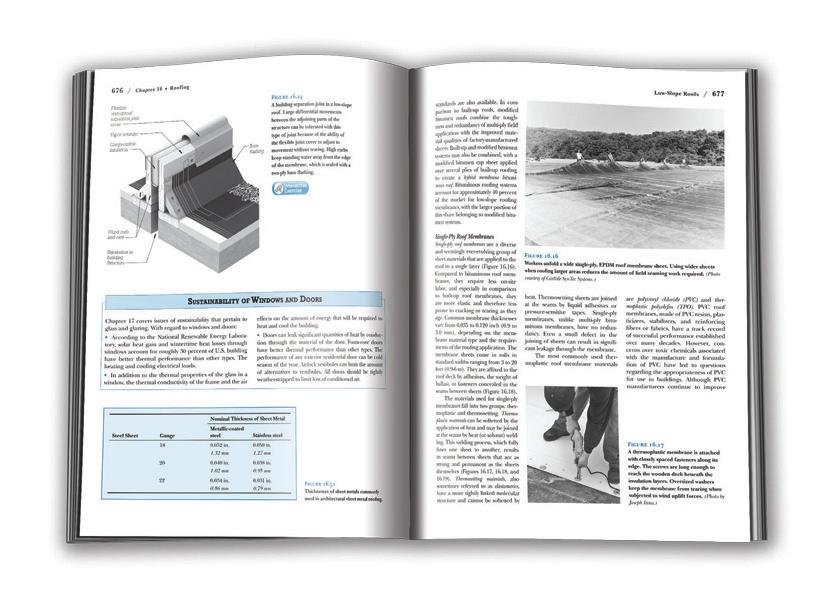
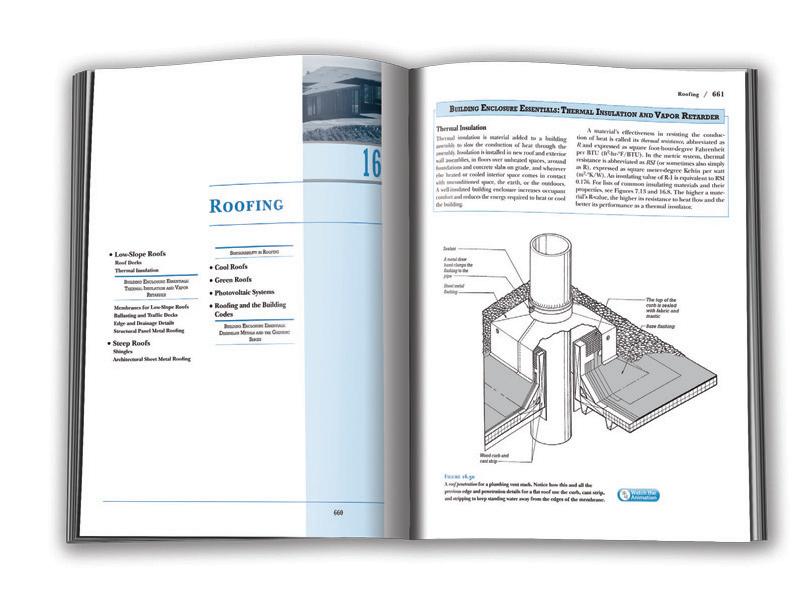
16 Roofing 661
Low-Slope Roofs 663
■ Building Enclosure Essentials:
Thermal Insulation and Vapor Retarder 668
Steep Roofs 688
■ Sustainability in Roofing 702
Cool Roofs 702
Green Roofs 705
Photovoltaic Systems 706
Roofing and the Building Codes 707
■ Building Enclosure Essentials:
Dissimilar Metals and the Galvanic Series 708
17 Glass and Glazing 717
History 718
The Material Glass 720
■ Sustainability of Glass 722
Glazing 734
Glass and Energy 744
Glass and the Building Codes 747
FROM CONCEPT TO REALITY 750
Skating Rink at Yerba Buena Gardens
18 Windows and Doors
Windows 756
755
■ Plastics in Building Construction 766
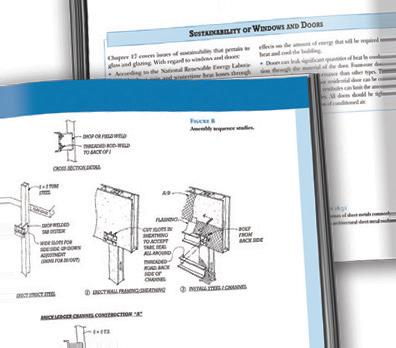
■ Sustainability of Windows and Doors 777
Doors 777
Other Window and Door Requirements 783
19
Designing Exterior Wall Systems 791
Design Requirements for the Exterior Wall 792
■ Sustainability of Exterior Wall Systems 797
Conceptual Approaches to Watertightness in the Exterior Wall 798
Sealing Joints in the Exterior Wall 803
Loadbearing Walls and Curtain Walls 807
■ Building Enclosure Essentials: Air Barrier 808
The Exterior Wall and the Building Codes 812
20 Cladding with Masonry and Concrete
817
Masonry Veneer Curtain Walls 818
Stone Curtain Walls 825
Precast Concrete Curtain Walls 830
Exterior Insulation and Finish System 836
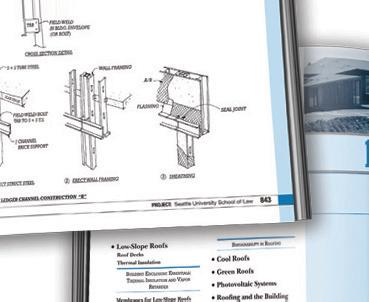
Keeping Water Out with Masonry and Concrete Cladding 840
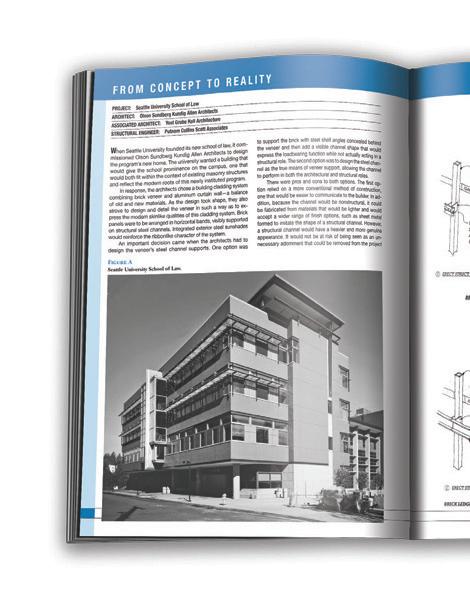
FROM CONCEPT TO REALITY 842
Seattle University School of Law
21 Cladding with Metal and Glass 847
Aluminum Extrusions 848
■ Sustainability of Aluminum Cladding Components 852
Aluminum and Glass Framing Systems 854
Double-Skin Facades 868
Sloped Glazing 869
The Curtain Wall Design and Construction Process 869
Metal Panel Cladding 871
22 Selecting Interior Finishes 877
Installation of Mechanical and Electrical Services 878
The Sequence of Interior Finishing Operations 880
■ Sustainability of Interior Finishes 882
Selecting Interior Finishes 883
Trends in Interior Finish Systems 888
23 Interior Walls and Partitions 891
Types of Interior Walls 892
Framed Partition Systems 893
■ Sustainability of Gypsum Products 898
■ Plaster Ornament 910
Masonr y Partition Systems 924
Wall and Partition Facings 924
24 Finish Ceilings and Floors 931
Finish Ceilings 932
Types of Ceilings 932
■ Sustainability of Finish Ceilings and Floors 943
Finish Flooring 944
Types of Finish Flooring Materials 948
Flooring Thickness 961
Appendix 966
Glossary 968
Index 999
Making Buildings
Trends in the Delivery of Design and Construction Services
Increasing Collaboration Among Team Members
Improving Efficiency in Production
Improving Information Management
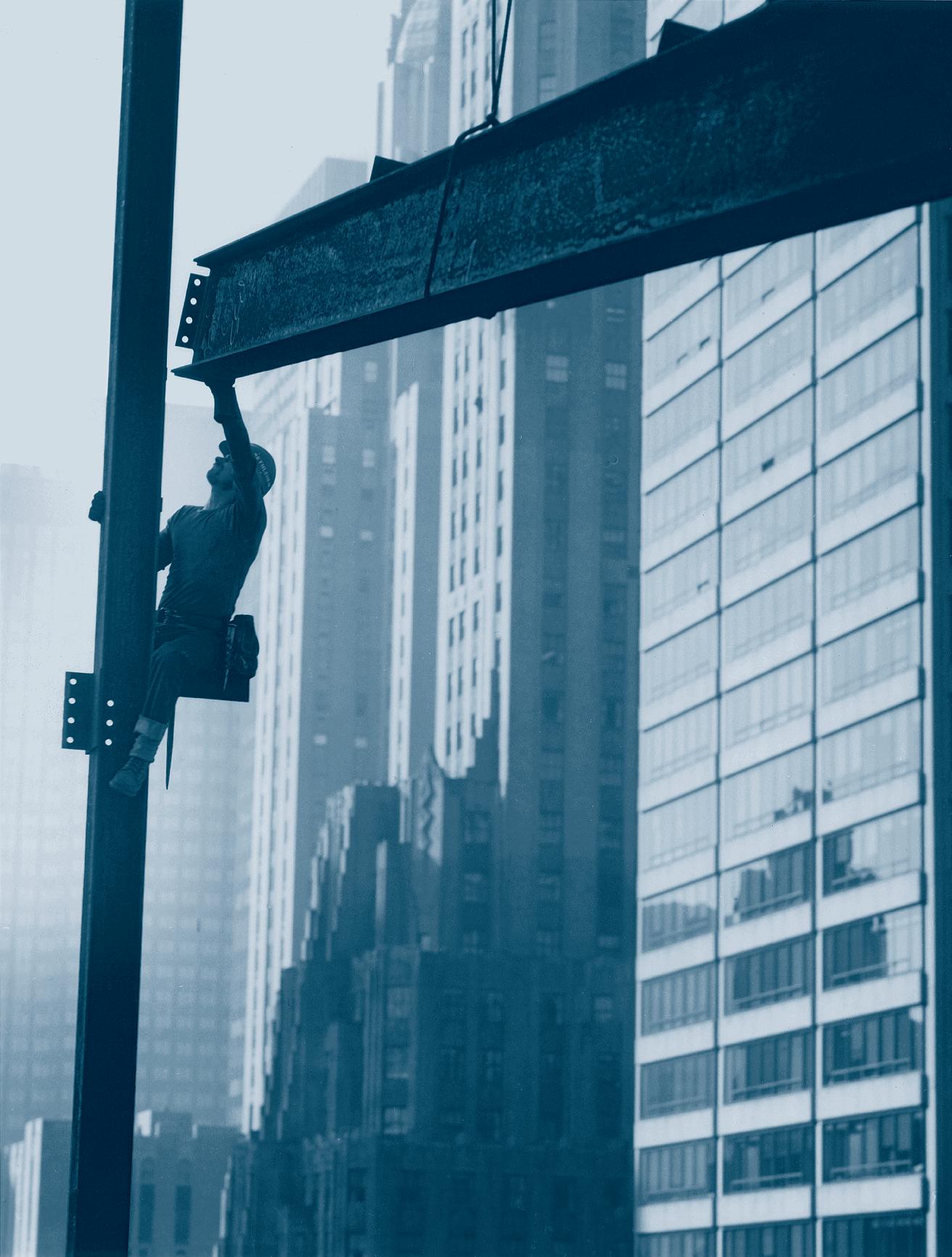
An ironworker connects a steel wide-flange beam to a column.
(Courtesy of Bethlehem Steel Company)
We build because not all human activity can take place outdoors. We need shelter from sun, wind, rain, and snow. We need dry, level surfaces for our activities. Often we need to stack these surfaces to multiply available space. On these surfaces, and within our shelter, we need air that is warmer or cooler, more or less humid, than outdoors. We need less light by day, and more by night, than is offered by the natural world. We need services that provide energy, communications, and water and dispose of wastes. So, we gather materials and assemble them into the constructions we call buildings in an attempt to satisfy these needs.
Learning to Build
This book is about the materials and methods of building construction. Throughout it, alternative ways of building are described: different structural systems, different methods of building enclosure, and different interior finishes. Each has characteristics that distinguish it from the alternatives. Sometimes a material is selected chiefly for its visual qualities, as in choosing one type of granite over another, selecting a particular color of paint, or specifying a special pattern of tile. Visual distinctions can extend beyond surface qualities. A designer may prefer the massive appearance of a masonry bearing wall building to that of a more slender exposed steel frame on one project, yet would choose the steel for another. Choices may be made for functional reasons, as in selecting a highly durable and water-resistant polished concrete instead of carpet or wood for a restaurant kitchen floor. Or, choices can be made on purely technical grounds, as, for example, in selecting a construction system that is noncombustible, so as to achieve a suitable level of building fire safety.
A building designer’s choices are frequently constrained by regulations intended to protect public safety and welfare. Choices may be influenced by considerations of environmental
sustainability. And frequently, selections are made on economic grounds. Sometimes one system is chosen over another because its first cost is less. Other times the full life-cycle costs— including first cost, maintenance, energy consumption, useful lifetime, and replacement—of competing systems are compared.
In describing the major systems of building construction, this textbook presents concerns that fall into two broad categories: building performance and building construction. Performance concerns relate to the inescapable problems that must be confronted in every building: fire; the flow of heat, air, and water vapor through the building enclosure; the small, but nonetheless important, movements of the building and its parts; water leakage; acoustical performance; aging and deterioration of materials; cleanliness; building maintenance; and so on. Construction concerns relate to the practical problems of getting a building built safely, on time, within budget, and to the required standards of quality: sequencing of construction operations for maximum productivity; optimum use of building trades; division of work between the shop and the building site; convenient and safe worker access to construction operations; effects of weather; making building components fit together; quality testing of materials and components during construction; and much more. To the novice, these matters may seem of minor consequence
when compared to the larger and often more interesting themes of building form and function. To the experienced building professional, who has seen buildings fail both aesthetically and functionally for want of attention to one or more of these concerns, these are issues that must be resolved as a matter of course to ensure a successful project outcome.
To gain a thorough knowledge of building construction, it is incumbent upon the student to go beyond what can be presented here—to other books, product literature, trade publications, professional periodicals, and especially the design office, workshop, and building site. One must learn how materials feel in the hand; how they look in a building; how they are manufactured, worked, and put in place; how they perform in service; how they deteriorate with time. One must become familiar with the people and organizations that produce buildings—the architects, engineers, materials suppliers, contractors, subcontractors, workers, inspectors, managers, and building owners—and learn to understand their respective methods, problems, and points of view. There is no other way to gain the breadth of information and experience necessary than to get involved in the art and practice of building.
In the meantime, this long and hopefully enjoyable process of education in the materials and methods of building construction can begin with the information presented in this textbook.
Go into the field where you can see the machines and methods at work that make the modern buildings, or stay in construction direct and simple until you can work naturally into building-design from the nature of construction.
—Frank Lloyd Wright, “To the Young Man in Architecture,” 1931
Buildings and the Environment
In constructing and occupying buildings, we expend vast quantities of the earth’s resources and generate a significant portion of its environmental pollution. Buildings account for 30 to 40 percent of the world’s energy consumption and carbon dioxide gas (CO2) emissions. In the United States, buildings consume approximately 35 percent of this country’s energy, 65 percent of its electricity, 12 percent of its potable water, and 30 percent of its raw materials. Building construction and operation together are responsible for roughly 40 percent of U.S. total greenhouse gas emissions and a third of its solid waste stream. Buildings are also significant emitters of particulates and other air pollutants. In short, building construction and operation cause many forms of environmental degradation and place a heavy burden on the earth’s resources.
One simple definition of sustainability is building to meet the needs of the present generation without compromising the ability of future generations to meet their needs. By consuming irreplaceable fossil fuels and other nonrenewable resources, by building in sprawling urban patterns that cover extensive areas of prime agricultural land, by using destructive forestry practices that degrade natural ecosystems, by allowing topsoil to be eroded by wind and water, by generating substances that pollute water, soil, and air, and by generating copious amounts of waste materials that are eventually incinerated or buried in the earth, we have been building in a manner that will make it increasingly difficult for our children and grandchildren to meet their needs for communities, buildings, and healthy lives.
Sustainable building construction demands a more symbiotic relationship between people, buildings, communities, and the natural environment. Sustainable buildings—in both their operation and construction—
must use less energy, consume fewer resources, cause less pollution of the air, water, and soil, reduce waste, discourage wasteful land development practices, contribute to the protection of natural environments and ecosystems, provide healthier interiors for building occupants, and minimize adverse social impacts.
The practice of sustainable design and construction, also called green building, continues to mature. The understanding of the interplay between buildings and the environment has deepened and standards for sustainability continue to evolve. Interest in and adoption of green building has broadened among public agencies, private owners, and building occupants. The design and construction industry has become more skillful at applying green practices, and sustainable building is becoming more integrated with mainstream practice. As a result, sustainable building performance is improving while the premium in cost and effort to design and construct such buildings in comparison to conventional buildings is declining or disappearing completely.
Sustainable Building Materials
Building sustainably requires access to information about the environmental impacts of the materials used in construction. For example, when selecting a material, the designer must ask: Does its manufacture depend on the extraction of nonrenewable resources, or is it made from recycled or rapidly renewable materials? Is additional energy required to ship the material from a distant location, or is it produced locally? Does the material contain toxic ingredients or generate unhealthful emissions, or is it free of such concerns? To enable meaningful decision making, reliable product information must be readily available to all the parties involved in the selection of materials for sustainable building design.
A series of international standards, designated as ISO 14020, distinguish
three types of environmental labels that define expectations for comprehensiveness and reliability of sustainable materials and product information:
Type I Ecolabels are independent, third-party certifications of environmental performance. Their accuracy and comprehensiveness are intended to ensure that the information provided is unbiased, relevant, and reliable.
Type II Self-Declared Environmental Claims are provided directly by product manufacturers, without independent verification. They may also be more limited in scope than Type I labels. Type II labels may provide useful information, but users must employ their own judgment in evaluating the appropriateness of these products for a particular application.
Type III Environmental Impact Labels provide the most comprehensive assessments of products and their environmental impacts on a comprehensive life-cycle basis. However, they do not in themselves provide environmental ratings or judgments—it is up to the user to interpret the data for this purpose. The information in Type III labels is independently verified, but the label itself may be prepared by the product manufacturer.
An example of a Type I Ecolabel is Green Seal Standard GS-11 for Paints and Coatings. Green Seal is a not-for-profit, independent organization that develops sustainability standards and certifications. For a paint or coating product to be certified to the GS-11 standard, it must:
Meet minimum performance requirements, such as adhesion, ease of application, hiding power, washability, and fade resistance
Be free of highly hazardous ingredients (for example, carcinogens)
Not exceed permitted amounts for other less hazardous ingredients such as volatile organic compounds (a class of chemicals that contribute to air pollution and can act as irritants to building occupants)
Be sold with instructions to the end user for safe application and responsible methods of disposal
By relying on this Green Seal certification, the paint specifier can easily and confidently identify environmentally responsible products from which to choose, without having to per form in-depth investigations of individual products.
Recycled materials content is an example of product information that is often provided in the form of a Type II Self-Declared Environmental Claim. That is, this information is usually reported directly by the product manufacturer, without thirdparty verification. This places more burden on the user of that information to determine its applicability. For example, the LEED® rating system (discussed later in this section) calculates recycled materials content as the sum of postconsumer content (materials recycled after use) plus one-half of preconsumer content (materials recycled during manufacturing). When relying on a Type II claim to determine recycled content for possible LEED credit, the designer must verify that the manufacturer’s content claims accurately correspond to this standard’s calculation method. At present, in North America, Type I and II environmental labels are the types in most common use.
An example of Type III labeling is the Western Red Cedar Association’s Typical Red Cedar Decking Product Declaration. This 10-page document describes this product’s material characteristics and quantifies—in detail—the environmental impacts of the product throughout its life. For example, for every 100 square feet of decking harvested, milled, trucked to the construction site, installed, maintained through its useful life, and then disposed of at the end of its life, this declaration reports the following impacts:
2,500,000 BTU (2600 MJ) of energy consumed
0.1 gallons (0.3 liters) of fresh water consumed
180 lb (80 kg) of nonhazardous waste generated
Additional information in the report quantifies materials consumption, global warming potential (total contribution to global warming), smog production, ozone depletion, acidification and eutrophication potential, and more. Information about the standards to which this information is prepared and independent verification of the reported results are also included. This document does not, in itself, provide an environmental rating of the product. But it can be used, for example, in comparing Western red cedar to some other decking material, such as recycled plastic decking, to assess the relative environmental consequences of choosing one of these materials over the other.
Not all sustainable product information necessarily fits neatly into one of these three label types. But considerations of comprehensiveness, independence, and relevance of information are appropriate to the review of building materials data from any source.
The Material Life Cycle
To most fully account for the environmental effects of a building material, its effects on the environment must be considered throughout its life cycle. This begins with raw materials extraction, continues with production and use, and finishes at end of life when a material is disposed of or put to an entirely new use. Such a life-cycle analysis (LCA) or cradle-to-grave analysis is considered the most comprehensive method for describing and quantifying environmental impacts associated with building materials. Through each life-cycle stage, environmental impacts are tallied: How much fossil fuel, electricity, water, and other materials are consumed? How much solid waste, global warming gasses, and other air and water pollutants
are generated? The total of all these impacts describes the environmental footprint of the material. As noted earlier in this section, this type of comprehensive life-cycle analysis is an essential part of a Type III Environmental Impact Label (Figure 1.1).
The concept of embodied energy also derives from life-cycle analysis. Embodied energy is the sum total of energy consumed during the material’s life cycle. Because energy consumption tends to correlate with the consumption of nonrenewable resources and the generation of greenhouse gasses, it is easy to assume that materials with lower embodied energy are better for the environment than others with greater embodied energy. However, in making such comparisons, it is important to be sure that functionally equivalent quantities of materials are considered. For example, a material with an embodied energy of 10,000 BTU per pound is not necessarily environmentally preferable to another with an embodied energy of 15,000 BTU per pound, if 2 pounds of the first material are required to accomplish the same purpose as 1 pound of the second. The types of energy consumed for each material, such as fossil, nuclear, or renewable, should be considered, as impacts differ from one energy source to another. Differences in the life span of materials must also be accounted for.
Embodied energy and other lifecycle effects may sometimes be calculated for only a part of the material life cycle. A cradle-to-gate analysis begins with materials extraction but extends only as far as when the material leaves the factory, excluding the effects of transportation to the building site, installation, use, maintenance, and disposal or recycling. In other cases, data may be reported from cradle to the construction site. Though less comprehensive, such analyses can in many cases still provide a useful basis for comparison between products. For example, for most materials, the difference in
Western Red Cedar Decking Life Cycle
Extraction
Construction of logging roads
Operation of logging equipment
Felling of trees
Delimbing
Log transport to mill
Manufacture or Processing
Log storage
Sorting
Debarking
Sawing
Seasoning
Planing
Packaging
Transportation
Shipping to construction site
Installation
Sawing
Nailing
Finishing
Disposal of cutoffs and waste
Use and Maintenance
Cleaning
Refinishing
Repair
Disposal or Recycling
Removal
Transport
Disposal in landfill
Environmental Impacts
Fossil fuel
Nuclear energy
Renewable energy
Biomass energy
Fresh water
Ancillary materials
Nonhazardous waste materials
Hazardous waste materials
Global warming
Acidification
Eutrophication
Smog
Ozone
embodied energy between a cradleto-cradle and cradle-to-construction site analysis is small, as most of the energy expenditure occurs prior to the material’s installation, use, and disposal.
The concept of embodied effects can also be applied to any other measured input or output from a material life-cycle analysis. For example, embodied water refers to the fresh water consumed as a consequence of building with a particular material.
Figure 1.1
Life-cycle analysis of Western red cedar decking. The underlined life-cycle stages (Extraction, Manufacture or Processing, etc.) are applicable to any building construction material LCA. The activities listed under each stage here are specific to the example of Western red cedar decking. For other materials, other activities would be listed. The right-hand column lists the types of environmental impacts associated with this material, both resources consumed (such as energy and water) and pollutants and wastes emitted (such as global warming gasses and nonhazardous waste). Though not included here, the LCA also quantifies these impacts so that one material can be readily compared with another.
Embodied carbon refers to the total carbon-related greenhouse gas emissions associated with a building material.
While life-cycle analysis represents the most comprehensive materials assessment method currently available, it does not necessarily address all environmental impacts. LCA of wood products, for example, does not capture the loss of biodiversity, decreased water quality, or soil erosion caused by poor forestry practices. These concerns are better addressed by sustainable forestry certification programs. As another example, although global warming potential is quantified in materials LCA, its ultimate consequences for ecosystems and wildlife populations are not described.
Unhealthy and Toxic Materials
Life-cycle analysis does not fully address human health impacts of materials used in the construction of buildings. For example, although LCA may describe a material’s contribution to various forms of air pollution, it will not account for the increase in incidence of asthma or shortening of life expectancy that may result therefrom. To address such concerns, green building
programs explicitly discourage the use of materials known to contain harmful ingredients or that generate such ingredients as byproducts of their manufacturing, use, or disposal. As an example, historically, formaldehyde commonly has been used as an ingredient in binders and adhesives for many kinds of manufactured wood products. However, this chemical is now a recognized carcinogen and associated with a variety of additional adverse human health impacts. As a consequence, the use of materials with added formaldehyde in buildings is discouraged, and where such materials must be used, strict limits are set on acceptable formaldehyde emission levels. Lead, cadmium, and asbestos are other examples of once-common ingredients that are now discouraged or banned from use in building materials due to their toxicity. These and other examples are discussed in more detail throughout this book.
Assessing Sustainable Buildings
In the United States, the most widely applied system for evaluating building sustainability is the U.S. Green Building Council’s Leadership in Energy and Environmental Design, or LEED®, rating system. LEED for New Construction and Major Renovation groups sustainability goals into eight broad categories addressing areas such as site selection and development, energy efficiency, conservation of materials and resources, and others (Figure 1.2). Within each category are mandatory prerequisites and optional credits that contribute points toward a building’s overall sustainability rating. Depending on the total number of points achieved, four levels of sustainable design are recognized, including, in order of increasing performance, Certified, Silver, Gold, and Platinum. The LEED rating system is voluntary. It is used when adopted by a private building owner or mandated by a public building agency.
Materials and Resources
Storage and Collection of Recyclables
and Demolition Waste Management
Building Life-Cycle Impact Reduction
Building Product Disclosure and Optimization - Sourcing of Raw Materials
Indoor Air Quality Strategies
Interiors
Indoor Air Quality Assessment
Views
The process of achieving LEED certification for a building begins at the earliest stages of project conception, continues throughout the design and construction of the project, and involves the combined efforts of the owner, design team, builder, subtrades, and materials suppliers. Its successful implementation
requires a high level of cooperation among all of these parties. During this process, the achievement of individual credits is documented and submitted to the Green Building Council, which then makes the final certification of the project’s LEED compliance after construction is completed.
The Green Building Council has also developed related rating systems for other types of construction, including existing buildings, commercial interiors, building core and shell construction, schools, retail building, healthcare facilities, homes, and neighborhood development. Through affiliated organizations, LEED is also
Figure 1.2
The LEED-NC v4 Project Checklist. (Courtesy of U.S. Green Building Council.)
implemented in Canada and other countries.
A second sustainability standard, the International Living Building Institute’s Living Building Challenge™, sets a more ambitious standard for sustainable building. The Living Building Challenge aspires to move society beyond making buildings that do less environmental harm, to constructing buildings that do no harm at all, or even provide benefit, to the natural environment. For example, a building constructed and operated to this standard will (when considered on an annualized basis) generate all its own energy from on-site renewable resources, consume no fresh water, and have no net carbon greenhouse gas emissions.
The Living Building Challenge consists of 20 imperatives (e.g., net zero energy or appropriate sourcing of materials), grouped into 7 broad categories, called Petals, such as Site, Water, Materials, Social Equity, and so on. For a new building to meet this standard, it must meet all 20 imperatives. There are two certification levels: “Living,” for buildings that fully meet the standard; and “Petal Recognition,” for buildings that meet minimum partial requirements. Certification occurs after a building has been operational for at least one year, when its real-life performance can be assessed.
With regard to construction materials and methods, the most relevant imperatives in this standard are found in the Materials category, including:
Red List: Materials considered toxic or highly detrimental to the environment are entirely excluded from buildings.
Embodied Carbon Footprint: Considered on a life-cycle basis, the building must not be a net emitter of carbon greenhouse gasses.
Responsible Industry: Materials must meet responsible third-party sustainability standards.
Appropriate Sourcing: Depending on material density, materials must be
manufactured within certain distances of the building construction site.
Conservation and Reuse: Materials waste must be minimized throughout all project life phases.
The Living Building Challenge can also be applied to neighborhoods, landscape and infrastructure projects, and building renovations. It is a testament to the progress of the sustainable building industry that buildings meeting this ambitious standard and achieving Living certification are now a reality.
Other green building programs and standards offer a variety of pathways to sustainable building construction, suitable to various building types, building owner objectives, and markets. The U.S. National Green Building Standard addresses residential building types, from single-family homes to multistory apartment buildings and hotels. The International Green Construction Code is a model code that puts green building standards into a legally enforceable format, useful for municipalities that wish to make sustainable construction mandatory. CALGreen is the sustainable construction code for the state of California. A variety of professional organizations and government agencies offer programs to support sustainable building, such as the 2030 Challenge, ASHRAE’s highperformance building standards, and the U.S. EPA’s green programs. Green Globes certifies new and existing commercial buildings in the United States, Canada, and other countries. The Building Research Establishment Environmental Assessment Method, or BREEAM, is an environmental assessment system for buildings constructed in the United Kingdom and other European countries. Sustainable building practice is producing measurable, positive results in building performance. An evaluation of sustainable facilities completed by the U.S. General Services Administration in the first decade of this century showed
reductions in energy consumption and greenhouse gas emissions in the range of 25 to 35 percent in comparison to conventional building stock. Meaningful improvements in other sustainability metrics were achieved as well. Sustainable buildings being designed to meet today’s best practices are capable of even higher performance levels.
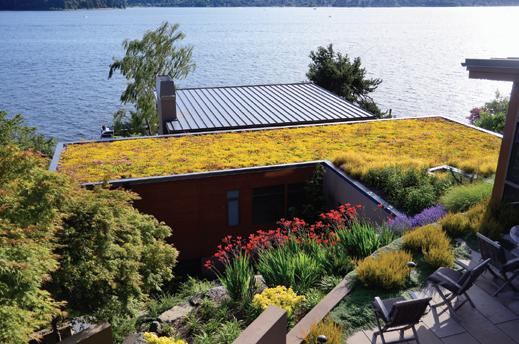
Along with its tangible success, sustainable building also presents new challenges and risks to the design and construction industry. Reformulated or entirely new materials may prove to be less durable than those they replace. Products from unique sources may be susceptible to supply shortages or price instability. Buildings constructed with more airtight enclosures may become vulnerable to problems of indoor air quality or moisture accumulation within exterior walls and roofs. Green roofs may be more vulnerable to leakage, and if they do leak, more expensive to repair. Inexperience with green building technologies may lead to design or construction errors. Completed buildings may not meet the performance goals to which they were designed or the heightened expectations of their owners. Uncertainties regarding the costs of green building design, construction, or operation may create financial uncertainty for the parties involved.
It is incumbent upon those involved with sustainable building to recognize and minimize these risks. All parties must collaborate effectively, to ensure that the broad goals of sustainability are understood and effectively implemented. Designers and builders must adequately educate themselves so that they properly apply new technologies. The selection of green materials and systems must be done with care, and without losing sight of traditional concerns such as durability, practicality, and safety. Further, the contractual agreements between designers, builders, and owners must appropriately set expectations and fairly balance risks.
Considerations of sustainability are included throughout this book. In addition, a sidebar in nearly every chapter describes the major issues of sustainability related to the materials and methods discussed in that chapter. For more information on sustainable design and construction resources, see the references listed at the end of this chapter.
The Work of the Design Professional
A building begins as an idea in someone’s mind, a desire for new and ample accommodations for a family, many families, an organization, or an enterprise. For any but the smallest buildings, the next step for the owner of the prospective building is to engage, either directly or through a hired construction manager, the services of building design professionals. An architect helps to organize the owner’s ideas about the new building while various engineering specialists work out concepts and details of foundations, structural support, and mechanical, electrical, and communications services.
[T]he architect should have construction at least as much at his fingers’ ends as a thinker his grammar.
—Le Corbusier, “Towards a New Architecture,” 1927
This team of designers, working with the owner, then develops the scheme for the building in progressively finer degrees of detail. Drawings, primarily graphic in content, and specifications, mostly written, are produced by the architect–engineer team to describe how the building is to be made and of what. These drawings and specifications, collectively known as the construction documents, are submitted to the local government
building authorities, where they are checked for conformance with zoning ordinances and building codes before a permit is issued to build. A general contractor is selected, who then plans the construction work in detail. Once construction begins, the general contractor oversees the construction process and hires the subcontractors who carry out many portions of the work, while the building inspector, architect, and engineering consultants observe the work at frequent intervals to be sure that it is completed according to plan. Finally, construction is finished, the building is made ready for occupancy, and that original idea—which may have been initiated years earlier—is realized.
Zoning Ordinances
The legal restrictions on buildings begin with local zoning ordinances, which govern the types of activities that may take place on a given piece of land, how much of the land may be covered by buildings, how far buildings must be set back from adjacent property lines, how many parking spaces must be provided, how large a total floor area may be constructed, and how tall the buildings may be. In larger cities, zoning ordinances may include fire zones with special fire-protection requirements, neighborhood enterprise districts with economic incentives for new construction or revitalization of existing buildings, or other special conditions.
Building Codes
In addition to their zoning ordinances, local governments regulate building activity by means of building codes. Building codes protect public health and safety by setting minimum standards for construction quality, structural integrity, durability, livability, accessibility, and especially fire safety.
Most building codes in North America are based on one of several model building codes, standardized
codes that local jurisdictions may adopt for their own use as a simpler alternative to writing their own. In Canada, the National Building Code of Canada is published by the Canadian Commission on Building and Fire Codes. It is the basis for most of that country’s provincial and municipal building codes. In the United States, the International Building Code® (IBC) is the predominant model code. This code is published by the International Code Council, a private, nonprofit organization whose membership consists of local code officials from throughout the country. It is the basis for most U.S. building codes enacted at the state, county, and municipal levels. The International Building Code is the first unified model building code in U.S. history. First published in the year 2000, it was a welcome consolidation of a number of previous competing regional model codes.
Building-code-related information in this book is based on the IBC. The IBC begins by defining occupancies for buildings as follows:
A-1 through A-5 Assembly: public theaters, auditoriums, lecture halls, nightclubs, restaurants, houses of worship, libraries, museums, sports arenas, and so on
B Business: banks, administrative offices, college and university buildings, post offices, banks, professional offices, and the like
E Educational: schools for grades K through 12 and some types of child day-care facilities
F-1 and F-2 Factory Industrial: industrial processes using moderateflammability or noncombustible materials, respectively
H-1 through H-5 High Hazard: occupancies in which toxic, corrosive, highly flammable, or explosive materials are present
I-1 through I-4 Institutional: occupancies in which occupants under the care of others may require assistance during a fire or other building
emergency, such as 24-hour residential care facilities, hospitals, nursing homes, prisons, and some day-care facilities
M Mercantile: stores, markets, service stations, salesrooms, and other retail and wholesale establishments
R-1 through R-4 Residential: apartment buildings, dormitories, fraternity and sorority houses, hotels, one- and two-family dwellings, and assistedliving facilities
S-1 and S-2 Storage: facilities for the storage of moderate- and low-hazard materials, respectively.
U Utility and Miscellaneous: agricultural buildings, carports, greenhouses, sheds, stables, fences, tanks, towers, and other secondary buildings.
The IBC’s purpose in describing occupancies is to establish different levels of life-safety hazard in buildings. For example, a hospital, in which patients are bedridden and cannot escape a fire without assistance from others, must be designed to a higher standard of safety than a hotel or motel occupied by ablebodied residents. A large retail mall building, containing large quantities of combustible materials and occupied by many users varying in age and physical capacity, must be designed to a higher standard than a warehouse storing noncombustible masonry materials and occupied by relatively few people who are all familiar with their surroundings. An elementary school requires more protection for its occupants than a university building. For a theater, with patrons densely packed in dark spaces, more attention must be paid to emergency egress provisions than for an ordinary office building.
These occupancy classifications are followed by a set of definitions for construction types. At the head of this list is Type I construction, made with highly fire-resistant, noncombustible materials. At the foot of it is Type V construction, which is built from combustible light wood framing—the
least fire-resistant of all construction types. In between are Types II, III, and IV, with levels of resistance to fire falling between these two extremes.
With occupancies and construction types defined, the IBC proceeds to match the two, stating which occupancies may be housed in which types of construction, and under what limitations of building height and area. Figure 1.3 is reproduced from the IBC. This table gives starting values for the maximum building height, in both feet and number of stories above grade, and the maximum area per floor for every possible combination of occupancy and construction type. Once the values in this table are adjusted according to other provisions of the code, the maximum permitted size for a building of any particular use and type of construction can be determined.
Consider, for example, an office building. Under the IBC, this building is classified as Occupancy B, Business. Reading across the table from left to right, we find immediately that this building may be built to any desired size, without limit, using Type I-A construction.
Type I-A construction is defined in the IBC as consisting of only noncombustible materials—masonry, concrete, or steel, for example, but not wood—and meeting requirements for resistance to the heat of fire. Looking at the upper table in Figure 1.4, also reproduced from the IBC, we find under Type I-A construction a listing of the required fire resistance ratings, measured in hours, for various parts of our proposed office building. For example, the first line states that the structural frame, including such elements as columns, beams, and trusses, must be rated at 3 hours. The second line also mandates a 3-hour resistance for bearing walls, which serve to carry floors or roofs above. Nonbearing walls or partitions, which carry no load from above, are listed in the third line, referring to Table 602, which gives fire resistance rating requirements for exterior walls
Figure 1.3
Height and area limitations of buildings of various types of construction, as defined in the 2012 IBC. These base values are modified according to various code provisions to arrive at the final allowable height and area for any particular building. For the purposes of this book, many of these modifications are simplified or ignored. (Table 503 excerpted from the 2012 International Building Code, Copyright 2011. Washington, D.C.: International Code Council. Reproduced with permission. All rights reserved. www.ICCSAFE.org)
of a building based on their proximity to adjacent buildings. (Table 602 is included in the lower portion of Figure 1.4.) Requirements for floor and roof construction are defined in the last two lines of Table 601.
Looking across Table 601 in Figure 1.4, we can see that fire resistance rating requirements are highest for Type I-A construction, decrease to 1 hour for various intermediate types, and fall to zero for Type V-B construction. In general, the lower the construction type numeral, the more fire-resistant the construction system is. (Type IV construction is somewhat of an anomaly, referring to Heavy Timber construction consisting of large wooden members that are relatively slow to catch fire and burn.)
Once fire resistance rating requirements for the major parts of a building have been determined, the design of these parts can proceed, using building assemblies meeting these requirements. Tabulated fire resistance ratings for common building materials and assemblies come from a variety of sources, including the IBC itself, as well as from catalogs and handbooks issued by building material manufacturers, construction trade associations, and organizations concerned with fire protection of buildings. In each case, the ratings are derived from large-scale laboratory tests of building components carried out in accordance with an
TABLE 503
ALLOWABLE BUILDING HEIGHTS AND AREASa,b
Building height limitations shown in feet above grade plane. Story limitations shown as stories above grade plane. Building area limitations shown in square feet, as determined by the definition of "Area, building." per story TYPE OF CONSTRUCTION
A = building area per story, S = stories above grade plane, UL = Unlimited, NP = Not permitted.
a.See the following sections for general exceptions to Table 503:
1.Section 504.2, Allowable building height and story increase due to automatic sprinkler system installation.
2.Section 506.2, Allowable building area increase due to street frontage.
3.Section 506.3, Allowable building area increase due to automatic sprinkler system installation.
4.Section 507, Unlimited area buildings.
b. See Chapter 4 for specific exceptions to the allowable height and areas in Chapter 5.
TABLE 601
RATING REQUIREMENTS FOR BUILDING ELEMENTS (HOURS)
For SI: 1 foot = 304.8 mm.
a. Roof supports: Fire-resistance ratings of primary structural frame and bearing walls are permitted to be reduced by 1 hour where supporting a roof only.
b. Except in Group F-1, H, M and S-1 occupancies, fire protection of structural members shall not be required, including protection of roof framing and decking where every part of the roof construction is 20 feet or more above any floor immediately below. Fire-retardanttreated wood members shall be allowed to be used for such unprotected members.
c. In all occupancies, heavy timber shall be allowed where a 1-hour or less fire-resistance rating is required.
d. An approved automatic sprinkler system in accordance with Section 903.3.1.1 shall be allowed to be substituted for 1-hour fire-resistancerated construction, provided such system is not otherwise required by other provisions of the code or used for an allowable area increase in accordance with Section 506.3 or an allowable height increase in accordance with Section 504.2. The 1-hour substitution for the fire resistance of exterior walls shall not be permitted.
e. Not less than the fire-resistance rating required by other sections of this code.
f. Not less than the fire-resistance rating based on fire separation distance (see Table 602).
g. Not less than the fire-resistance rating as referenced in Section 704.10
TABLE
For SI: 1 foot = 304.8 mm.
a. Load-bearing exterior walls shall also comply with the fire-resistance rating requirements of Table 601.
b. For special requirements for Group U occupancies, see Section 406.3.
c. See Section 706.1.1 for party walls.
d. Open parking garages complying with Section 406 shall not be required to have a fire-resistance rating.
e. The fire-resistance rating of an exterior wall is determined based upon the fire separation distance of the exterior wall and the story in which the wall is located.
f. For special requirements for Group H occupancies, see Section 415.5.
g. For special requirements for Group S aircraft hangars, see Section 412.4.1.
h. Where Table 705.8 permits nonbearing exterior walls with unlimited area of unprotected openings, the required fire-resistance rating for the exterior walls is 0 hours.
Figure 1.4
Fire resistance of building elements as required by the IBC. Types I and II construction allow the building structure to be made only of noncombustible materials, that is, steel, concrete, and masonry. Type V construction allows any material, including wood. Types III and IV allow combinations of internal wood structure surrounded by noncombustible exterior walls. (Tables 601 and 602 excerpted from the 2012 International Building Code, Copyright 2011. Washington, D.C.: International Code Council. Reproduced with permission. All rights reserved. www.ICCSAFE.org)