ESSENTIAL ENTOMOLOGY
SECONDEDITION
GeorgeC.McGavin
HonoraryResearchAssociateoftheOxfordUniversity MuseumofNaturalHistoryandHonoraryPrincipalResearchFellow, ImperialCollege
Leonidas-RomanosDavranoglou
LeverhulmeTrustEarlyCareerFellow, OxfordUniversityMuseumofNaturalHistory
GreatClarendonStreet,Oxford,OX26DP, UnitedKingdom
OxfordUniversityPressisadepartmentoftheUniversityofOxford. ItfurtherstheUniversity’sobjectiveofexcellenceinresearch,scholarship, andeducationbypublishingworldwide.Oxfordisaregisteredtrademarkof OxfordUniversityPressintheUKandincertainothercountries
Text©GeorgeC.McGavinandLeonidas-RomanosDavranoglou2022
Illustrations©RichardLewington2001exceptthoselistedonpagexi
Themoralrightsoftheauthorshavebeenasserted
FirstEditionpublishedin2001
SecondEditionpublishedin2022
Impression:1
Reprinted2003
Allrightsreserved.Nopartofthispublicationmaybereproduced,storedin aretrievalsystem,ortransmitted,inanyformorbyanymeans,withoutthe priorpermissioninwritingofOxfordUniversityPress,orasexpresslypermitted bylaw,bylicenceorundertermsagreedwiththeappropriatereprographics rightsorganization.Enquiriesconcerningreproductionoutsidethescopeofthe aboveshouldbesenttotheRightsDepartment,OxfordUniversityPress,atthe addressabove
Youmustnotcirculatethisworkinanyotherform andyoumustimposethissameconditiononanyacquirer
PublishedintheUnitedStatesofAmericabyOxfordUniversityPress 198MadisonAvenue,NewYork,NY10016,UnitedStatesofAmerica BritishLibraryCataloguinginPublicationData Dataavailable
LibraryofCongressControlNumber:2022921538
ISBN978–0–19–284311–1(hbk.) ISBN978–0–19–284312–8(pbk.)
DOI:10.1093/oso/9780192843111.001.0001
Printedandboundby
CPIGroup(UK)Ltd,Croydon,CR04YY
Linkstothird-partywebsitesareprovidedbyOxfordingoodfaithand forinformationonly.Oxforddisclaimsanyresponsibilityforthematerials containedinanythird-partywebsitereferencedinthiswork.
phyla pluralofphylum,themajor groupingsoftheanimal kingdom,composedof superclassesandclasses,that is,Mollusca,Arthropoda, Chordata,etc.
Preface
Trophiclevel thelevelsoffoodorenergy transferinfoodchains/webs. Foodproducersorautotrophs formthefirstlevel,herbivores formthesecondlevel,primary carnivoresthethirdlevel. Othercarnivoresformthe fourthandfifthlevels.
Lifebeganintheseas,andsaltwaterisstillhometomostoftheearth’s phyla. Onland,however,twogroupsdominate:theplantsandtheinsects.Theword insectcomesfromtheLatin, insectus,thepastparticipleof insecare,tocutor incise,andreferstothemajordivisionsofaninsect’sbody.
Insectshavebeenaroundforwellover400millionyears.Theywerethe firstanimalsonlandandthefirsttogetintotheair.TheyarethemostspeciesrichandabundantgroupofmulticellularanimalstheEarthhaseverseen. Morethanhalfofalldescribedspeciesandabout75%ofallanimalsareinsects.ButexactlyhowmanyspeciessharetheplanetEarthwithus?Thetruth is:wedon’thavethefoggiestidea.Someearlyguessesof30millionoreven 100millionhavebeenreplacedinthelastdecadewithmorerealisticestimatesofsomewherebetween5and10millionspecies.Despitethismassive uncertainty,onethingisindisputable:themajorityofEarth’sinhabitantsare insects.
Interrestrialecosystems,greenplantsaretheprimaryproducers,trappingthesun’senergyandusingittoconvertcarbondioxidetoorganic matter.Withoutphotosynthesistheplanetwouldbeaverydifferentplace. Autotrophslikeplantsformthebaseofterrestrialandfreshwaterfoodchains, butevery trophiclevel aboveisdominatedbyinsects.
Forexample,itmaycomeasasurprisetomanythatalltheheaving, snortingherdsofgrazingungulatesontheAfricansavannahsareentirely ‘out-munched’(perhapsbyafactoroftentoone)bymyriadsoftiny mandibles.Whataboutthemeateaters?Again,insectsconsumemanytimes moreanimalfleshthanallthevertebratecarnivoresputtogetherandants alonearethemajorcarnivorousspeciesinanyhabitatyoucouldmention. Ifthissoundsimplausible,considerthat,althoughinsectsareindividually small,thereareanawfullotofthem.
Insectspollinatethevastmajorityoftheworld’squarterofamillionorso speciesoffloweringplants.Pollinationisoneofthemostessentialsymbioses evertohaveevolved.Thisplant–insectversionof‘I’llscratchyourbackif youscratchmine’haslastedfor100millionyearsandithasgeneratedarich diversityofspecies.Twentythousandspeciesofbeeare,toalargeextent,responsibleforthecontinuedsurvivaloftheangiosperms,whichincludesa verylonglistofthethingsweeat:fruitandvegetablesfrompumpkins,plums, andpeastocherries,cucumbers,andcocoa.
Withouttheproteinprovidedbyinsectsmanygroupsofhigheranimals wouldsimplynotexist.Insectsfeatureexclusivelyorverylargelyinthediets ofawholebeastlybestiaryfromtheaardvarktothezorilla(anAfricanstriped polecat).Birds,thedescendantsofthedinosaurs,aremostlyinsectivorous. Abroodofninegreattitchickswillconsumearound120,000caterpillars whiletheyareinthenest.Asingleswallowchickmayconsumeupwards of20,000bugs,flies,andbeetlesbeforeitfledges,andevenspeciessuchas
Verticalbarchartshowing theapproximateproportions ofallspeciesonEarth.
Insects
Arachnids
Crustaceans
Other Arthropods 1.2% Molluscs
Nematodes 0.9%
Other Invertebrates
Vertebrates
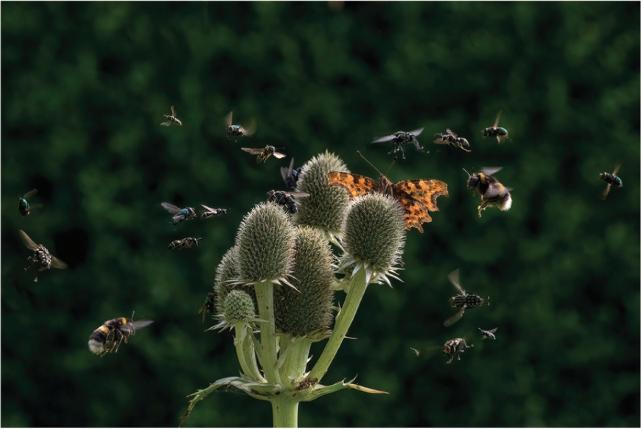
Theimageshownhereisa compositeofphotographsof individualinsectsattracted toaseahollyfloweroverthe courseof15minutes.Itis obviousthatwithoutinsects, pollinationwouldbe impossibleformostplants, andtheworld’sterrestrial ecosystemswouldcollapse.
buntings,whichareseedfeedersasadults,reartheiryoungonanutritious dietofinsects.Theearliestprimateswereinsectivores,andmanyprimatesstill aretoday.Incountrieswhereinsectsarelargeorveryabundant,theyform animportantsourceofprotein,vitamins,andmineralsforhumans.Locusts andgrasshoppers,beetlegrubs,caterpillars,andtermitesfeatureregularlyin tropicaldietsandtheirnutritionalvalueexceedsthatofwestern-stylefast foods.
Atleastaquarterofallinsectspeciesareparasitesorpredatorsofother speciesofinsect.Insectsrecyclenutrients,enrichsoils,anddisposeofcarcassesanddung.Apartfromtheseessentialecosystemservices,insects providehumanswithusefulproductssuchassilk,honey,waxes,medicines, anddyes.Weusethemtocontrolpestorganismsandasmodelsystemstohelp usstudymanyaspectsofbiologyfromgeneticsandbehaviourtophysiology andecology.
Ofcourse,insectshaveadarkside.Herbivorousinsectsmayeatupto15–20%ofallcropsgrownforhumanconsumption,andlocally,thepercentage maybemuchhigher.Although,contrastthiswiththe30%ofallfoodgrown thatiswastedbyhumans.Inaddition,insectscarrytheviruses,bacteria, spirochaetes,rickettsiae,protozoans,roundworms,andfungithatareresponsibleforinnumerableplant,animal,andhumandiseases.Aboutoneinsix humanbeingsalivetodayisaffectedbyaninsect-borneillnessofsomekind. Besidesstingsandallergies,whichcanbefatalforsome,thelistofdiseases carriedbyinsectsincludesplague,typhus,sleepingsickness,riverblindness, Chagas’disease,yellowfever,Zikavirus,epidemictyphus,trenchfever,loiasis,filariasis,andleishmaniasis.Intheearlytwentiethcentury,SirRonald Rossshowedconclusivelythatmosquitoeswereresponsiblefortransmitting malaria.Althoughmuchmoreisknownaboutmalariatoday,itremainsa deadlydiseaseresponsibleforhundredsofthousandsofdeathseveryyear. Tocompletethedestructivesideoftheiractivities,insectscausegreatdamagetowoodenstructuresandawiderangeofnaturalmaterialsandfabrics. Thereareeven,muchtotheaggravationofmuseumcurators,beetleswhose larvaehaveavoraciousappetiteforcollectionsofdriedinsects.
Beingmuchsmaller,insectsmaynothavetheimmediateappealofthe ‘furriesorfeatheries’,butifyoulookcloser,youwillfindthattheyarealot morevariedandinteresting.Whatanimalsotherthanhumansbuildairconditionedcondominiums,useanunderwaterbreathingapparatus,constructacousticequipment,causeexplosions,makepaper,cultivategardens, andfarmotheranimals?Theworldofinsectsisendlesslyfascinating,and theyhaveextraordinaryrelationshipswithotherorganisms.Someoftheir lifecyclesbeggarbelief.Therearemothsthatsuckmammalianblood,flies thatbreedinpoolsofcrudepetroleum,flieswhoselarvaedeveloponlyin thetrachealpassagesofredkangaroos,andlicethatsolelyinhabitthethroat pouchesofcertaincormorantsandpelicans.
Despiteallthetalkoftheneedtoquantifybiodiversityinrecentyears, taxonomyandsystematicsarestilllessfashionabletodaythantheyoncewere andthereisalackoffundingforbasictaxonomicresearch.Howarewegoing tosavebiodiversity,ifwedonotknowwhatwearetryingtosaveinthefirst
place?Perhapswehavelostsightofthefactthat,withoutasystemofclassification,ourinvestigationscanonlybeaconfusionofunconnectedfacts.We surviveinacomplexworldbydefiningwhatthingsare,namingthem,and thusidentifyingthem.Imaginethecolossaltaskofhavingtoremembereach andeverynovelobjectindividuallybyitsuniquecharacteristics.Classificationisacentralprocessofthehumanbrain,andit,notmathematics,ashas sometimesbeensuggested,isthefoundationandcornerstoneofallscience. AsBritishbiologistandbeetletaxonomistRoyCrowsonpointedout,you needtoknowwhatyouaregoingtocountormeasurebeforeyournumbers aregoingtomakeanysense.
Sex,violence,andacastoftrillions—thestudyofinsectsisexcitingand intellectuallysatisfying,butwheredoyoustart?Withclassificationofcourse. Inanystudy,whetherecological,physiological,orbehavioural,thefirstthing youneedtoknowiswhatsortofinsectyou’redealingwith.Textbookssometimesemphasizesystemsbiologyattheexpenseofsystematicswiththeresult thatstudentsarefamiliarwiththebroaderpictureofinsectphysiologyor behaviourbutareconfusedwhenitcomestorecognizingaspecificinsect. Whetherthereare2or10millioninsectspecies,youdonotneedtoknow themallindividually.Atfirstglance,abeetlemayresembleanant,andsome fliesareexcellentmimicsofbees,butantsdonothavewingcasesandbees havetwopairsofwings.Withineachorderthereareconspicuousfeatures thatweusetoaidcorrectidentification.
Theamountofbiologicalinformationavailable,especiallyconcerninginsects,isincreasingrapidlyandnewcomerstothestudyofinsectscanbe putoffsimplybytheenormityofthesubject.Somespecieshavereceived ahugeamountofattentionforvariousreasons.TheAmericanCockroach, Periplanetaamericana,andlocustspecies,suchas Schistocercagregaria,are enduringlypopularasmodelsforresearch,andfruitflies(Drosophila spp.) areextraordinarilyusefulingenetics.Particularresearchershavehadtheir favourites.Wigglesworth’spioneeringworkoninsectcuticleusedaSouth American,cone-nosed,reduviidbug,Rhodniusprolixus,andDethier’schoice ofaparticularblowfly, Phormiaregina,forhisworkoninsectfeedingand sensorybiologyresultedfromalunchtimechanceobservationofafemaleof thisspecieslayinghereggsonaliverwurstsandwich.These,andahandfulof otherspecies,arerareexceptions.Theresthaveyettoenjoytheir15minutes offame.Themajorityoftheworld’slivinginsectsarecompletelyunknown andthebiologyofmanyofthoseweknowaboutareobscure.Thereisstill plentyofworktobedone.
Butthereisaproblem.Humanactivitieshavebroughtaboutabiodiversitycrisis.Theconversionofmoreandmoreoftheplanet’snaturalcapital intoproducinghumanbeingsandservingtheirneedsanddesireshascome atanenormouscost.Weseemtohavedevelopedaseriousdisconnectwith thenaturalworldandthisdisconnectmaybeourdownfall.Populationsof majorgroupsoforganisms,forexample,birds,reptiles,andmammals,have declinedbyanaverageof68%inthelast50years.Almosteveryrecent studyundertakenpointstoamarkedslumpininsectspecies’richnessand abundance.Thedecreasesseeninwell-studiedinsectgroupslikebeesand
butterfliesareoccurringinmanyothergroups.Thecausesofthesedeclines areveryclear:theacceleratinglossofnaturalhabitat,mostlyduetoagriculturalintensification,coupledwiththeprodigiousamountsofpesticidesused, aretakingaheavytoll.Ontopofthiswearefacingglobalclimatechange causedbyouruseoffossilfuels,whichaffectseveryspeciesandeveryhabitat onEarth.
Ithaslongbeenthoughtthattheworld’stropicalforestsarehometomore thanhalfofallextantspecies.Ifthesecomplexhabitatscontinuetobefelled fortimber,cashcrops,andranchingateventheslowestratesuggested,itwill stillonlybeamatterofafewhundredyearsbeforetheyarecompletelylost. Itisthereforeaninescapableconclusionthatourplanetcouldlosemorethan halfofallitslivingspeciesinthetimeittakesforanacorntobecomeaveteran oaktree.Weknowthatnospecieslastsforever.Ofallspeciesthathaveever lived,99%arenowextinctanditwasthenumerousmassextinctionevents thatpavedthewayfortheappearanceofthosecreaturesthatledtohumanbeings.Thedifferenceisthatnowweknowenoughtodosomethingthatmight prolongourownsurvival.
Therecanbelittledoubtthathumansarethemostintelligentandcapable speciesyettoevolveonEarth.Intheveryshorttimesinceourappearance, wecoveredtheentireglobeandestablishedcolonieswhereveritwaspossible tosurvive.Afewofushavewalkedonthesurfaceofthemoonandvisited thedeepestabyssesoftheoceans.Wespendvastsumsofmoneytoprobethe verymake-upofmatterandexaminetheuniverse.Wewanttounderstand thescienceofeverythingfromtheinfinitesimallysmalltotheastronomically largebutseemtobepayinglittleheedtothehealthoftheveryecosystems thatsupportus.
Theaimofthisbookistoprovideareadableintroductiontothemost abundantmulticellularlifeformsonEarth.Itisnotafieldguidebut,should youneedtoknowtheessentialfactsaboutaparticularorderofinsect(e.g. wheretheyoccur,howmanyspeciesareknown,whatmakesthemdifferent andinterestingfromallotherorders),thisbookwillprovidethemanddirect youtospecialisttextsandsourcesofinformationtoguideyoufurtheralong anyparticularpath.Ifyoureallywanttounderstandhowthenaturalworld works,youneedtoknowaboutinsects.
Thebookislaidoutinanuncomplicatedfashion.Thefirstsectiongives abriefintroductiontotheinsectsandcoverstopicssuchastheevolution ofthegroupandthefactorsthatmadethemsuchsuccessfulorganisms.It discussestheimportanceoftheirroleinterrestrialecosystemsandoutlines thefeaturesofstructure,function,andphysiologythattheyshare.Thesecondsectionprovidesasemi-pictorialkeytotheinsectorders.Unambiguous text,coupledwithcleardrawingsdesignedtohighlightkeyfeatures,allowthe readertoassignmostadultinsectstothecorrectorder.Thebulkofthebook isdevotedtotheessentialsofthe28livinginsectorders.Thefinalsection dealswithcollectingtechniques.
Acknowledgements
Wethankthefollowingpeopleforprovidingthephotographsthatdecorate theneweditionofourbook:NickyBay,PaulBrock,JohnGausas,Martin Gore,MattDoogue,PiotrNaskrecki,EdPhillips,MikePicker,HansPohl, AnneRiley,GillesSanMartin,JohnSmit,ZestinSoh,RupertSoskin,and ManfredUlitzka.
Figure Acknowledgments
Allillustrationsnotlistedbeloware©RichardLewington,2001and2023 PrefacepageviVerticalbarchart©OxfordUniversityPress2001.
Pages4-7Diagramsofthearthropod-likegroups©OxfordUniversityPress 2001.
Page13DiagramfromWilmer,P.,Stone,G.andJohnston,I.(2000) EnvironmentalPhysiologyofAnimals.BlackwellScience,Oxford.
Page15DiagramfromGullan,P.J.andCranston,P.S.(2000) Theinsects:an outlineofentomology,2ndedition,BlackwellScience,Oxford.
Page17DiagramsfromChapman,R.F.(1998) Theinsects:structureandfunction, 4thedition.CambridgeUniversityPress.©AfterHepburn,H.R.(1985) Structureoftheintegument,in Comprehensiveinsectphysiology,biochemistry andpharmacology, Vol.3(edsG.A.KerkutandL.I.Gilbert),PergamonPress, Oxford.
Page19Diagram©OxfordUniversityPress2001. Page20DiagramredrawnfromKukulova-Peck,J.(1991) TheinsectsofAustralia,2ndedition.MelbourneUniversityPress,Australia.©CSIROAustralia 1991.
Page21DiagramafterChapman,R.F.(1998) Theinsects:structureand function, 4thedition.CambridgeUniversityPress.
Page22Diagram©OxfordUniversityPress2001.
Page36Diagramofthephylogenyofhexapods.Adaptedfrom©HansPohl (2014).
Page286Diagram©GeorgeC.McGavin2001.
Biographies
GeorgeMcGavin studiedZoologyatEdinburghUniversity,followedbya PhDinentomologyatImperialCollegeandtheNaturalHistoryMuseum inLondon.After30yearsasanacademic,mostlyatOxfordUniversity,he becameanaward-winningtelevisionpresenter.GeorgeisanHonoraryResearchAssociateoftheOxfordUniversityMuseumofNaturalHistoryand anHonoraryPrincipalResearchFellowatImperialCollege.HeisaFellowof theLinneanSocietyanHonoraryFellowoftheRoyalSocietyofBiology,and anHonoraryLifeFellowoftheRoyalEntomologicalSociety.In2019George becamethePresidentoftheDorsetWildlifeTrust.
Leonidas-RomanosDavranoglou studiedZoologyatImperialCollege London.HethenundertookhisDPhilthesisinentomologyattheDepartmentofZoology,UniversityofOxford,fundedbytheprestigiousOxford NaturalMotionandtheOnassisFoundationscholarships.In2021,Leonidas wasawardedwithbothaLeverhulmeTrustEarlyCareerFellowshipandthe JohnFellOUPFundattheOxfordUniversityMuseumofNaturalHistoryto studytheevolutionofinsectcommunication.Leonidaswillberesearching
howinsectscommunicateusingsoundsbyexaminingthemorphologyand biomechanicsoflivingspecies,aswellastheirextinctrelativespreservedin 100-million-year-oldCretaceousamber.
Glossary
Aedeagus Theorganofcopulationinmaleinsects.
Ametabolous Developmentwithoutmetamorphosis,suchasinbristletails andsilverfish.
Apodous Withoutlegs.
Apodemes Internaltendon-likeextensionsofthecuticle,whichserveas muscleattachmentsites.
Apolysis Theseparationoftheoldandnewcuticles.
Aposematic Havingbrightcolourationtoserveasawarningtopredators. Usuallyred,yellow,andblack.
Apterous Lackingwings.
Apterygota (adj.apterygote)Primitivelywinglessinsects.Thesmaller subclassoftheInsecta.
Arrhenotoky Parthenogenesiswherehaploidmalesareproducedfrom unfertilizedeggs.
Asexual Ofreproductionwithoutseparatesexes.Reproductionoccurring byparthenogenesis.
Autotomy Thecastingorsheddingoffofapartofthebody,forexample, whenunderthreat.
Batesianmimicry Whereanedibleorpalatablespeciesmimicsthecolours andpatternsofaninediblespecies.Themimicsarerarerelativetothe models.
Biologicalcontrol Useofnaturalpredators,parasites,ordiseaseproducing organismstoeffectareductioninthepopulationsofpestspecies.
Biramous Havingtwobranches.
Bisexual Havingtwoseparatesexes.
Caste Anygroupofindividualsinacolonyofsocialinsectsthatis structurallyorbehaviourallydifferentfromindividualsinothergroups, thatis,soldiers,workers,andreproductivesasseenintermites,bees,and ants.
Cerci (sing.cercus)Apairofterminalabdominalappendages,which typicallyhaveasensoryfunction.
Chitin Ahighmolecularweight,unbranched,amino-sugarpolysaccharide madeupof β(1–4)linkedunitsofN-acetyl-D-glucosamine.Chitinisthe mainstructuralelementinarthropodexoskeletonsandisalsofoundin fungalcellwalls.
Chrysalis Thealternativenameforalepidopteranpupa.
Class Amajortaxonomicsubgroup,aboveOrderandbelowPhylum.
Coelom Themainbodycavitysurroundingthegutinanimalssuchas annelidworms,starfish,andvertebrates.Inarthropodsandmolluscs,the coelomismuchreduced,andthemainbodycavityisahaemocoel.
Colony Anaggregationofsocialinsectssharinganest.
Corbiculum (pl.corbicula)Thepollenbasketofhoneybees,whichisa concave,shinyareaonthehindtibiae,fringedwithstiffhairs.
Cosmopolitan Occurringthroughoutmostoftheworld.
Coxa (pl.coxae)Thefirstsegmentofaninsect’sleg,joiningtherestofthe legtothethorax.
Crop Anareaoftheforegutininsectswherefoodisstored.
Cuckoo Atermusedforaninsectthatusesthefoodstoredbyanotherto reartheirownyoung.
DDT Dichlorodiphenyltrichloroethane.
Dimorphic Occurringintwodistinctforms.Thesexesofsomeinsectsare differentlycolouredorshaped.
Ecdysis Thelaststageofmoulting,whichisthecastingorsloughingofthe oldcuticle.
Elytra (sing.elytron)Therigidfrontwingsofbeetles,modifiedascoversfor thehindwingsandnotusedinflight.
Endite Alobeofalegsegmentthatisdirectedinwardstowardsthemidline ofthebody.
Endopterygota (adj.endopterygote)Insectswherethewingsdevelop internally.Metamorphosisiscompleteandthereisapupalstage (holometabolous).
Entognathous Havingeversiblemouthpartscontainedinsidethehead withinasmallpocket.
Epidermis Ininsects,thesinglelayerofcellsthatsecretesthecuticle.
Exite Alobeofalegsegmentthatisdirectedoutwardsawayfromthe midlineofthebody.
Exopterygota (adj.exopterygote)Insectswherethewingsdevelopoutside thebody.Metamorphosisisincompleteandthereisnopupalstage (hemimetabolous).
Family AtaxonomicgroupbelowthatofOrderandcomprisedof subfamilies,genera,andspecies.
Fatbody Anaggregationofmetabolicandstoragecellsinthehaemocoel.
Femur (pl.femora)Theportionofaninsect’slegthatcorrespondstothe mammalianthigh.Theorderofsegmentsis coax–trochanter–femur–tibia–tarsus.
Fungivorous Eatingfungi.
GABA Gamma-aminobutyricacid.Typicallyaninhibitorytransmitterof neuromuscularjunctions.Gammaisoftenshownsymbolically: γ-aminobutyricacid.
Gall Anabnormalplantgrowthcausedbyavirus,bacterium,fungus,mite, orinsect.
Genitalia Thehardpartsofinsectreproductivesystemsthatengage betweenmalesandfemalesduringmating.
Genus (pl.genera)Alowtaxonomicgroupcomposedofspecies.
Haemocoel Thehaemolymph-filledinternalbodycavityofarthropods, suchasinsects,whichisessentiallyanenlargedpartofthecirculatory system.
Haemolymph Afluidininvertebrateanimalsthatistheequivalentof blood.
Haltere(s) ThegreatlymodifiedhindwingsofDiptera,whichserveas balancingorgans.
Hemimetabolous Developingbyincompleteorgradualmetamorphosis, forexample,intheOrthopteraandHemiptera.Immaturestagesare callednymphs(seeexopterygota).
Hemimetabola Thoseorderswithincompletemetamorphosis.
Holometabolous Developingbycompletemetamorphosis,forexample,in theDipteraandLepidoptera.Immaturestagesarecalledlarvae(see endopterygota).
Holometabola Thoseorderswithcompletemetamorphosis.
Homeoticgenes Genesinvolvedintheregulationofbodyplan.
Homology Characterstatesacquiredbydirectinheritancefroman ancestralform.
Homoplasy Characterstatesacquiredbyconvergentevolution.
Honeydew Thecarbohydrate-richexcrementofplantsapfeederssuchas aphids.
Hyperparasitoid Aparasitoidofanotherparasitoid.
Idiobiont Aparasitoidthatkillsorparalysesitshostwhenlayinganegg, andthuspreventingthehostfromdevelopinganyfurther.
Inquiline Aspeciesthatlivesinthenest,gall,orhomeofanother.
Insect ThewordinsectcomesfromtheLatin, insectus,pastparticipleof insecare,tocutinto,andreferstothemajordivisionsofaninsect’sbody.
Integument Thecuticularandcellularcoveringofinsectsandother arthropods(i.e.,theepidermisandcuticlecombined).
Koinobiont Aparasitoidthatdoesnotkillthehostwhenegglaying,thus allowingthehosttodevelopfurther.
Lobopods Protoarthropodswithantennae,annularbodysegmentation (notajointedexoskeleton),andsoft,fleshyappendagesbearingclaws.
Meconium Theaccumulatedsolidwastesofthelarvalstagesofsome insects,whichareexpelledwhentheadultstageisreached.
Metamorphosis Thetransformationbetweentheimmatureformandthe adultform,withtheformsbeingdifferent.
Monophagous Restrictedtoeatingasinglespeciesplantortypeof foodstuff.
Monophyletic Oforganismsthathavedescendedfromasinglecommon evolutionaryancestororancestralgroup.
Mullerianmimicry Whereseveralinedibleorunpalatablespeciesconverge incolourpattern.Asallthespeciesarenon-palatable,mimicryrings,as theyareknown,areenhancedbythefrequencyallringmembersand evendistantlyrelatedspeciescanbeinvolved.
Mycetocytes Specialcellsthatpermanentlyhouseintracellularbacterial symbionts.
Myrmecophilous Greekforant-loving.Anyspeciesthatliveswithand dependsonantsforfood,protection,andcare.
Neotenic Retainingfeaturesoftheimmaturestagesintheadult.
Ocelli Simplelight-receptiveorgansontheheadofmanyinsects.
Oligophagous Restrictedtoeatingasmallrangeofrelatedplantsor foodstuffs(seepolyphagous,monophagous).
Ommatidia Individuallightreceptiveunitsinthecompoundeyesof insects.Eachommatidiumcomprisesaclearlenssystemand light-sensitiveretinulacells.
Omnivorous Havingvariableeatingpreferences.
Ootheca Protectiveeggcase.Cancontainasingleegginsomeorders,and uptoseveralhundredeggsinotherorders.
Order Ataxonomicrankbelowaclassandaboveafamily.
Oviparous Producingyoungbymeansofeggsexpelledfromthebody beforetheyarehatched.
Ovoviviparous Theyoungareproducedbymeansofhatchingeggsinside thebody.
Palaeozoic(Paleozoic) ThefirstofthethreeerasofthePhanerozoic (havingvisiblelife).ThePalaeozoicincludestheCambrian,Ordovician, Silurian,Devonian,Carboniferous,andPermianperiods.ThePalaeozoic isfollowedbytheMesozoicandCenozoiceras.
Parasite (adj.parasitic)Aspecieslivingoffthebodyortissuesofanother, butnotcausingthedeathofthehost.
Paraphyletic Ofagroupofspeciesthatincludessome,butnotall,ofthe speciesthatshareasinglecommonancestor.
Parasitoid Aspeciesthatdevelopsbyconsumingthebodytissuesofa singlehost,eventuallycausingitsdeath(seeidiobiontandkoinobiont).
Parthenogenesis (adj.parthenogenetic)Reproductionwithouttheneedfor fertilization.
Perineurium Alayerofglialcellsinsidetheneurallamella,whichactsas theblood–brainbarrier.
Pheromone Avolatilesubstanceproducedbyinsectstocommunicatewith othersforthepurposesofreproduction,aggregation,defence,etc.
Phloem Themaintransportvesselsofplantstakingnutrientsfromthe leavestootherparts.
Phyla (sing.phylum)Themajorgroupingsoftheanimalkingdom, comprisedofsuperclassesandclasses,forexample,Mollusca, Arthropoda,Chordata,etc.
Physogastric Whentheabdomen(usuallyinfemales)becomesgreatly distendedandmembranous,typicallyafterameal,whenpregnant,or whenstoringfatorfood.
Polyembryony Asingleegggivingrisetomanyembryosbysubdivision.
Polymorphic Havingmorethantwoforms.
Polyphagous Eatingawiderangeofplantsorfoodstuffs.
Polyphyletic Ofagroupofspeciesthathavedifferentancestors.Suchtaxa are‘unnatural’orincorrect.
Predacious (n.predator)Eatingotheranimals.
Proleg Afleshyabdominallimbofinsectlarvae.
Pronotum Thedorsalcoverofthefirstsegmentofthethorax.
Pruinescent (colouration)Ofapowder,orpowdery.
Pterygota (adj.pterygote)Wingedinsects.Thelargersubclassofthe Insecta.
Rostrum Theprolongedpartoftheheadofweevilsandscorpionflies.Also thetubular,slender,suckingmouthpartsofinsectssuchastheHemiptera (alsoknownasthelabiuminthelatter).
Saprophagous Eatingdecayedorganicmaterial.
Sclerite Ahardenedchitinousbodyplatesurroundedbyflexible membranesorsutures(Gk. skleros—hard).
Sistergroups Groupsofthesametaxonomicrankresultingfromthe splittingofanancestrallineage.
Solitary Occurringsinglyorinpairs,notinsocialgroups.
Somite Asinglebodydivisionofasegmentedanimal.
Species Agroupoflivingorganismsconsistingofrelatedsimilar individualscapableofexchanginggenesorinterbreeding.Ataxonomic rankbelowagenus.
Spiracle(s) Thebreathingholesofinsectsleadingtothetracheaeoccurring atthesidesoftheabdomenandthorax.
Stridulation Theactofproducingsound,usuallybyrubbingtwopartsof thebodytogether.
Subfamily AtaxonomicsubdivisionofFamily.
Subimago Pre-adultwingedstageofEphemeroptera.
Suborder AtaxonomicsubdivisionofOrder.
Suture Agrooveontheoutsideofaninsectbodysegmentthatindicatesthe fusionoftwosclerites.
Symbiosis Differentspecieslivinginanassociationthatbringsmutual benefit.
Synanthropic Associatedwithhumansandtheirhabitations.
Synonymy Whereasinglespecieshasbeendescribedandnamedmore thanonce
Tagmata (sing.tagma)Agroupofbodysegmentsthattogetherforma majorfunctionalunitsuchasthehead,thorax,orabdomen.
Tarsus (pl.tarsi)Thefootofaninsect.Itisattachedtotheendofthetibia andmadeupofasmallnumberofsubsegmentsortarsomeres.
Thelytoky Parthenogenesiswhereonlyfemaleoffspringareproduced.
Tibia (pl.tibiae)Thelowerlegsegmentofinsects,correspondingtothe mammalianshin.
Tracheae (sing.trachea)Theinternalairwaysofinsects.
Trochanter Thesmallsegmentoftheinsectlegbetweenthecoxaandthe femur.
Trophallaxis Theexchangeoffoodbetweencolonymembersinsocial insects.
Trophiclevel Thelevelsoffoodorenergytransferinfoodchain.Food producersorautotrophsformthefirstlevel,herbivoresformthesecond level,andprimarycarnivoresthethirdlevel.Othercarnivoresformthe fourthandfifthlevels.
Vector Anintermediatehostthatcarriesadiseaseorganismincontactwith itstargetorganism.