Theology and History in the Methodology of Herman Bavinck: Revelation, Confession, and Christian Consciousness (Oxford Studies in Historical Theology) Cameron D.
THE SYNOD OF PISTORIA AND VATICAN II Jansenism andthe Struggle for Catholic Reform
Shaun Blanchard
CATHOLICITY AND THE COVENANT OF WORKS
James Ussher andthe ReformedTradition
Harrison Perkins
THE COVENANT OF WORKS
The Origins, Development, andReception ofthe Doctrine
J. V. Fesko
RINGLEADERS OF REDEMPTION
How MedievalDance Became Sacred
Kathryn Dickason
REFUSING TO KISS THE SLIPPER
Opposition to Calvinism in the Francophone Reformation
Michael W. Bruening
FONT OF PARDON AND NEW LIFE
John Calvin andthe Efficacy ofBaptism
Lyle D. Bierma
THE FLESH OF THE WORD
The extra Calvinisticum from Zwinglito Early Orthodoxy
K. J. Drake
JOHN DAVENANT’S HYPOTHETICAL UNIVERSALISM
ADefense ofCatholic andReformedOrthodoxy
Michael J. Lynch
RHETORICAL ECONOMY IN AUGUSTINE’S THEOLOGY
Brian Gronewoller
GRACE AND CONFORMITY
The ReformedConformisttradition andthe Early StuartChurchofEngland
Stephen Hampton
MAKING ITALY ANGLICAN
Why the BookofCommon Prayer Was Translatedinto Italian
Stefano Villani
AUGUSINE ON MEMORY
Kevin G. Grove
UNITY AND CATHOLICITY IN CHRIST
The Ecclesiology ofFrancisco Suarez, S.J.
Eric J. DeMeuse
RETAINING THE OLD EPISCOPAL DIVINITY
John Edwards ofCambridge andReformedOrthodoxy in the Later StuartChurch
Jake Griesel
CALVINIST CONFORMITY IN POST-REFORMATION ENGLAND
The Theology andCareer ofDanielFeatley
Gregory A. Salazar
BEARDS, AZYMES, AND PURGATORY
The Other Issues That DividedEastandWest
A. Edward Siecienski
BISSCHOP’S BENCH
Contours ofArminian Conformity in the ChurchofEngland, c. 1674–1742
Samuel David Fornecker
JOHN LOCKE’S THEOLOGY
An Ecumenical, Irenic, andControversialProject
Jonathan S. Marko
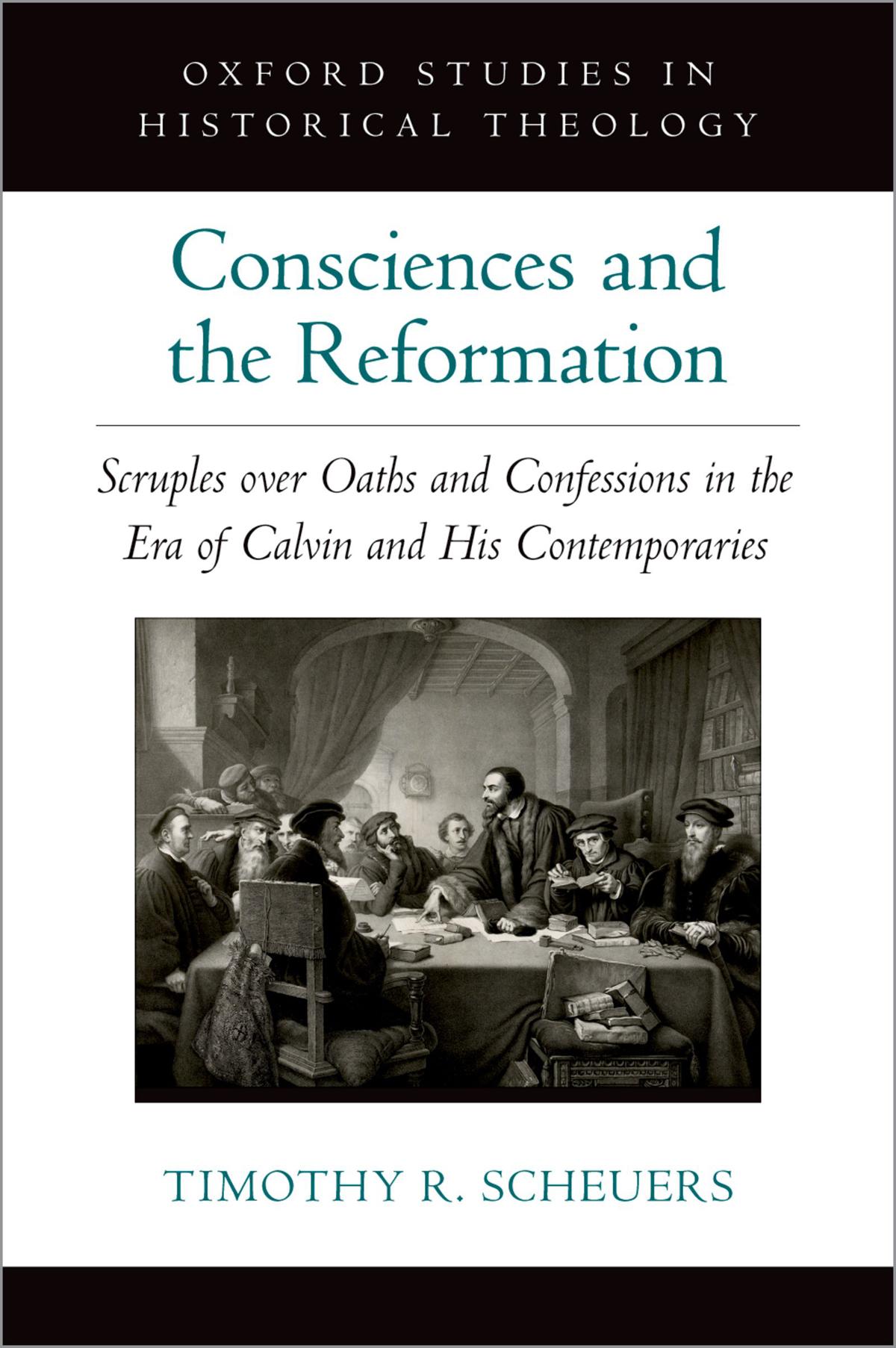
CONSCIENCES AND THE REFORMATION
Scruples over Oaths andConfessions in the Era ofCalvin andHis Contemporaries
Timothy R. Scheuers
Consciences and the Reformation
Scruples over Oaths andConfessions in the Era of Calvin andHis Contemporaries
TIMOTHY R. SCHEUERS
Oxford University Press is a department of the University of Oxford. It furthers the University’s objective of excellence in research, scholarship, and education by publishing worldwide. Oxford is a registered trade mark of Oxford University Press in the UK and certain other countries.
Published in the United States of America by Oxford University Press 198 Madison Avenue, New York, NY 10016, United States of America.
All rights reserved. No part of this publication may be reproduced, stored in a retrieval system, or transmitted, in any form or by any means, without the prior permission in writing of Oxford University Press, or as expressly permitted by law, by license, or under terms agreed with the appropriate reproduction rights organization. Inquiries concerning reproduction outside the scope of the above should be sent to the Rights Department, Oxford University Press, at the address above.
You must not circulate this work in any other form and you must impose this same condition on any acquirer.
CIP data is on file at the Library of Congress
ISBN 978–0–19–769214–1
eISBN 978–0–19–769215–8
DOI: 10.1093/oso/9780197692141.001.0001
Tomyparents, theReverendRonaldScheuers andFaye[Mulder]Scheuers and tomywifeAmanda— asCalvinsaidofhisbelovedIdelette, singularisexemplifemina, awomanofmatchlesstype.
Contents
Acknowledgments
Abbreviations
NotesonTranslationandTexts
Introduction
SECTION I: CALVIN AND THE REFORMERS’ INHERITED LEGAL TRAD ITION
1. Before Calvin: Oaths, Religious Coercion, and the Freedom of Co nscience from the Medieval Church to the Reformation
SECTION II: ANSWERING CONSCIENTIOUS OBJECTORS: CALVIN AN D THE REFORMERS AGAINST RADICAL DISSENT AND RELIGIOUS C OMPROMISE
2. Conscience, Confession, and the Consolidation of Early Public Re form in Strasbourg, 1530–1535
3. “Vera pietas veram confessionem parit”: Confession, Conscience, and Charity in the Anti-Nicodemism of Calvin and the Reformers
4. Confession, Conscience, and Christian Freedom in the Later AntiNicodemite Writings of Calvin and the Reformers, 1540–1562
SECTION III: OATHS, CONFESSIONAL SUBSCRIPTION, AND THE BI NDING OF THE CONSCIENCE IN REFORMATION GENEVA
5. Citizen’s Oath and Confession of Faith in Reformation Geneva, 1 536–1538: Necessary, Indifferent, or a TertiumQuid?
6. “Make Them Afraid of Bearing False Witness”: Oaths, Conscienc e, and Discipline in the Registers of the Genevan Consistory, 154
7. After Calvin: Oaths, Subscription, Conscience, and Compromise i n the Genevan Academy, 1559–1612
Conclusion
Bibliography Index
Acknowledgments
At the completion of this project, I am left with a debt of gratitude to many individuals whose help and inspiration I am happy to acknowledge.
Since this book first saw life as my PhD dissertation, initial gratitude belongs to those who facilitated my overall progress in the pursuit of this degree: library staff at the David Allan Hubbard Library at Fuller Theological Seminary; staff and administrators at Fuller’s Center for Advanced Theological Studies; fellow students and colleagues in seminars and post-class discussions; and professors who modeled the very standards of scholarly excellence they sought to inculcate in their students. My work was also made possible by the generous provision of a sizable academic merit grant offered through the seminary.
An early iteration of this material was presented at the Sixteenth Century Society Conference, where Karin Maag at the H. Henry Meeter Center for Calvin Studies gave an encouraging assessment of my research, while also suggesting areas of further study. Her willingness to provide access to Genevan archival materials is greatly appreciated.
I owe a special debt of thanks to the faculty of Mid-America Reformed Seminary, including J. Mark Beach and Cornelis Venema, who first encouraged me to pursue doctoral studies, as well as Mark Vander Hart, who introduced me to the rigors of Latin.
I am very thankful to several other scholars whose advice and resources proved immensely beneficial to my research. Anthony Perron of Loyola Marymount University was very kind to oversee my work in medieval canon law. Jeffrey and Isabella Watt graciously provided unpublished transcriptions of the Genevan Consistory Records and, along with Karen Spierling, assisted my translation of
some obscure entries. Michael Bruening, Grayson Carter, Jason Zuidema, as well as Oliver Crisp and Herman Selderhuis, my secondary readers, also deserve credit for their friendly counsel and availability to discuss research materials.
I owe a unique debt of thanks to the staff at Oxford University Press for overseeing the preparation and publication of this volume: to editors Tom Perridge and Rachel Ruisard, as well as to the anonymous readers at OUP who initially reviewed my manuscript and offered generous comments and constructive suggestions. I am particularly grateful to Richard Muller for his warm and insightful correspondence, and for initially agreeing to publish this book in the Oxford Studies in Historical Theology series while he was the editor.
My principal gratitude for the completion of this project goes to my doctoral mentor, John L. Thompson, whose scholarly erudition is matched only by his tireless commitment to his students. John significantly broadened my understanding of the texts and contexts of the Reformation and facilitated ample opportunities for me to hone my teaching and writing abilities while working as his teaching and research assistant. He always took great interest in my work and helped me to frame my thoughts in clearer, more cogent and interesting ways. It has been a privilege and an honor to study under Dr. Thompson, and I will forever appreciate his assistance and encouragement, as well as his delightful wit, warm hospitality, and pastoral patience. I only hope to inherit a small portion of his unequaled spirit.
I want to express heartfelt appreciation to my brothers and sisters in Christ at First United Reformed Church of Chino, California, where I currently serve as Associate Pastor. Many of these dear saints took an invested interest in my work and supported me through countless prayers and uplifting words. Special thanks belong to my pastor, colleague, and friend, Rev. Bradd Nymeyer, who enjoyed experiencing doctoral studies “vicariously” through me as we met each week for conference and prayer. The staff, faculty, and trustees of Providence Christian College, where I serve as an Adjunct Assistant Professor of History, also deserve credit for supporting my research endeavors.
Finally, I am grateful to all of my precious family members for their loving support, faithful prayers, and steady encouragement while I worked on this project. I am particularly thankful to my parents, Rev. Ronald and Faye Scheuers, for modeling the godly virtues of creativity, excellence, and humility, and for instilling these same values in me. I am also grateful to my parents-in-law, Scott and Kim Schelbauer, for their support of and interest in my work.
Singular appreciation is reserved for my dear wife Amanda and our lovely daughter Scottlynn. Over the course of this project, they have been a constant source of encouragement, blessing, and inspiration. They exhibited unparalleled patience with me as I sometimes wrote from dawn to dusk—this, despite many demands upon my wife’s own professional and domestic life. Mere words cannot express my gratitude for their enduring love and firm commitment to me and my work.
SoliDeoGloria
Abbreviations
AEG Archives d’Etat de Genève
AEG, Jur. Pen. Repertoire du Registres du Conseil des causes criminelles et consistoriales
AEG, R.Consist. Registres du Consistoire de Genève (archival manuscripts)
BOL MartiniBuceriOpera Latina. Leiden: Brill, 1982–.
Bonnet John Calvin. Letters ofJohn Calvin. Edited by Jules Bonnet. 4 vols. Philadelphia: Presbyterian Board of Publication, 1854.
CO John Calvin. Joannis CalviniOperaQuae SupersuntOmnia. Edited by G. Baum, E. Cunitz, E. Reuss. 59 vols. Brunswick, 1863–1900.
COR 4/4 John Calvin. Ioannis CalviniOpera Omnia. Series 4: Scripta Didactica et Polemica. Volume 4: Epistolae Duae(1537), Deux Discours(Oct. 1536). Edited by Erik Alexander de Boer and Frans Pieter van Stam. Geneva: Droz, 2009.
Crottet Alexandre Crottet, ed. Correspondance française de Calvin avec Louis du Tillet, chanoine d’Angoulême etcuréde Claix: Sur les questions de l’église etdu ministère évangélique. Geneva: Cherbuliez, 1850.
CTS John Calvin. Tracts andTreatises (Calvin Translation Society). 3 vols. Translated by Henry Beveridge. 1851; Grand Rapids, MI: Eerdmans, 1958.
CTSOT/CTSNT John Calvin. OldTestamentandNew TestamentCommentaries (Calvin Translation Society). 23 vols. Translated by Henry Beveridge. Reprint. Grand Rapids, MI: Baker Books, 2009.
ET English Translation
Herminjard A. L. Herminjard, ed. Correspondance des réformateurs dans les pays de langue française. 9 vols. Geneva; Paris: 1866–1897.
Institutes 1536 John Calvin. Institutes ofthe Christian Religion [1536 edition]. Translated by Ford Lewis Battles. Grand Rapids, MI: H. H. Meeter Center for Calvin Studies/Eerdmans, 1986.
LCC 20–21 John Calvin. Institutes ofthe Christian Religion. Edited by John T. McNeill. Translated by Ford Lewis Battles. The Library of Christian Classics. Vols. 20–21. 1960; Louisville, KY: Westminster John Knox Press, 2006.
LCC 22 John Calvin. TheologicalTreatises. Edited by J. K. S. Reid. Philadelphia: Westminster Press, 1954.
LW Martin Luther. Luther’s Works (“American Edition”). Edited by Jaroslav Pelikan and Helmut T. Lehmann, et al. 56 vols. St. Louis; Concordia; Philadelphia: Fortress Press, 1955–1986.
OS John Calvin. CalviniOpera Selecta. Edited by Peter Barth and Wilhelm Niesel. 5 vols. München: Kaiser, 1926–1952.
QGT Quellen zur Geschichte der Täufer. ElsaßI–II. Teil: Stadt Straßburg, 1522–1535. Edited by Manfred Krebs and Hans Georg Rott. Vols. 7–8. Heidelberg: Gütersloher Verlagshaus Gerd Mohn, 1959–1960.
RC Registres du Conseil
R.Consist. Registres du Consistoire de Genève à l’époque de Calvin (published editions)
RCP Registres de la Compagnie des Pasteurs au temps de Calvin. Edited by Robert M. Kingdon and Jean-François Bergier. 2 vols. Geneva, 1962–1964. English translation by Philip C. Hughes. The Register ofthe Company ofPastors ofGeneva in the Time of Calvin. Grand Rapids, MI: Eerdmans, 1966 (cited as Hughes ed.).
SCJ SixteenthCentury Journal
ST Thomas Aquinas. Summa Theologica. Vols. 2–3. In Doctoris angelicidiviThomae Aquinatis opera omnia. Edited by Stanislai Eduardi Fretté and Pauli Maré. 34 vols. Paris: Ludovicum Vivés, 1871.
WA Martin Luther. Martin Luthers Werke: Kritische Gesamtausgabe. Weimar: H. Boehlaus Nachfolger, 1883–.
Medieval Legal Texts
Dist. 1, c. 1
C. 1, q. 1, c. 1
Dig. 1.1.1
Cod. 1.1.1
Inst. 1.1.1
Decretum Gratiani, Distinctio 1, canon 1
Decretum Gratiani, Causa 1, quaestio 1, canon 1
Digestum Justiniani, book 1, tit. 1, lex 1
Codex Justiniani, book 1, tit. 1, lex 1
Institutiones Justiniani, book 1, tit. 1, lex 1
Nov. Novellae (Justinian)
Notes on Translation and Texts
Translations are mine unless otherwise noted. In all cases where a modern translation is used, I also include references to the Latin, French, or German editions that I have consulted.
I have modernized the spelling and punctuation of the early modern English editions of several treatises (except for the titles) by conforming the use of “u” and “v” to modern conventions, removing redundant consonants and antiquated vowel combinations, as well as inserting or removing commas where appropriate.
Introduction
Was the Reformation “a success story” or “the tale of a failure”?
Gerald Strauss’s decades-old question continues to stimulate scholarship on the tactics and trajectories of moral reform in Protestant urban centers during the Reformation.1 The controversial conclusion of Strauss’s article, that early optimism gave way to disillusionment and discontent among the reformers as their disciplinary tactics failed to bring about the desired reform, has sparked diverse responses since its publication in 1975.2 Yet despite its mixed reception, the impressive corpus of textual evidence unearthed by Strauss clearly demonstrates that no study of the Reformation can expect to judge the success or failure of that movement without accounting for the reformers’ assessment of their own labors—the success or failure of which was often measured by the responses of the laity and civil magistrates to the reformers’ sometimes controversial measures for reform.
This monograph examines the complex relationship between oath-taking, confessional subscription, and the binding of the conscience in John Calvin’s reform in light of an important but still unresolved question raised by Strauss’s article, namely: “Had anything changed in the consciences and minds of men as a result of the Reformation?”3 Scholars of this period generally acknowledge that, within the historiography of religious tolerance and claims to freedom of conscience, “the Reformation era has always been considered of paramount importance for the developments which led to the achievement of ‘a liberal and tolerant society.’ ”4 The Reformation effectively broke up the monolithic edifice of medieval Catholic Christianity, spawning a diversity of reformist groups enamored with the possibility of newfound religious liberties. When Luther’s conscientious objection to the alleged spiritual abuses of the Roman Church went public in 1517 with his Ninety-Five Theses, his
bold invective sparked renewed passion for and appeals to the freedom of conscience among reform-minded clergy and laity in sixteenth-century Germany and its surrounding lands. The combined effect of Luther’s later emphasis on the principles of sola scriptura and solafidewas to assert that believers were utterly free in matters not explicitly commanded by Scripture. The individual conscience—a person’s innate knowledge of God’s judgment was now “man’s highest court of appeal.” This message proved to be a refreshing change for laypeople languishing under a bevy of Catholic human traditions and burdensome regulations.5
Although it is well established that appeals to conscience played a prominent and public role in theological, civil, and social discussions during the Reformation, Strauss’s question nonetheless poses unique challenges to the historian, in no small part because it calls for an assessment of people’s thoughts about conscience based upon an often-fragmentary record of their words and actions under diverse historical circumstances. Notwithstanding the daunting nature of this task, Reformation historians have regularly chimed in on the matter —some praising the reformers for rescuing the sacredness of the private conscience, and others expressing belief that the reformers’ failure to build their entire movement according to the pattern initially set by its cornerstone of freedom of conscience effectively “tarnished the tremendous legacy of the Protestant Reformation.”6 Bob Scribner, for example, has argued that the reformers allowed three of their core principles—freedom of conscience, separation of secular and spiritual authority, and protection of weaker brothers and sisters—to be “compromised or overridden in the course of the early Reformation. The imperative demands of the Word of God took precedence over claims of individual conscience; . . . the urgent need to organise new evangelical churches led to implicit (and often explicit) abandonment of the separation of secular and spiritual authority; and the urgency to effect immediate reform overrode love of neighbor and concern for weaker brethren.”7
In light of such claims, this study’s choice of Calvin as a primary interlocutor seems appropriate, not simply because of persistent
caricatures of Calvin as one of the Reformation’s most notorious and tyrannical authoritarians, but also because Calvin and his Reformed colleagues were not spared from having to deal with objections leveled against their own brand of confessional Christianity even in their own day.8 Indeed, two driving principles of the Reformation, sola Scriptura and individual freedom of conscience, occasionally produced unintended consequences for Calvin and the other reformers, especially when it came to organizing and enforcing reform in sixteenth-century Geneva and its local regions. The reformers faced the challenge of distinguishing what they believed were “impious constitutions” of the Roman Church—human traditions claiming to bind the consciences of the faithful—and “legitimate church observances,” such as oaths and formal subscription to Reformed confessions of faith.9 Organizing reform in the cities became somewhat precarious when friends and foes alike accused Calvin and his partners of burdening their consciences with extra-Scriptural statements of faith composed by human authorities a claim that, if true, would necessarily shape our assessment of the integrity of the Reformation during Calvin’s lifetime.
The principal goal of this study is to offer a close reading and evaluation of the texts and controversies surrounding Calvin’s struggle for reform, especially as they reveal some of the unique challenges Calvin and his pastoral colleagues encountered in their attempts to employ oath-swearing and formal confession of faith as a necessary means to consolidate the reformation of church and society. This study aims to provide a more nuanced understanding of how the reformers navigated the often-complex relationship between exegesis, theory, and practice in Reformed communities during Calvin’s lifetime. Some biblical commentators from Calvin’s inherited tradition—as well as Anabaptist interpreters in his own day —believed that Scripture taught a complete prohibition of any and all oaths and vows, and typically appealed to Matthew 5:34–37 as evidence for the complete abrogation of all “external ceremonies” that cruelly bound the consciences of believers.10 Such claims often forced Calvin and his colleagues to defend the occasional necessity
of sworn oaths and confessional subscription, not only by distinguishing their opponents’ reading of Scripture from their own, but also by contending for a modified form of individual liberty on the basis of a highly nuanced conception of the relationship between conscience and tradition. Nonetheless, the matter of oath-swearing provides a fascinating example of how pragmatism and the practical concerns of reform directly influenced the conclusions to which the reformers’ exegesis brought them. At times, Calvin’s ideas about a well-ordered society were challenged and needed to be altered in order to accommodate the often-messy reality of life in Reformed cities, in which justice, truth, and order did not always prevail, and in which individual consciences—including Calvin’s—were not always appeased, but rather acclimated to the overarching cause of personal and communal reform. Thus, the collateral goal of this project is to discover what such accommodations reveal about Calvin as a pastoral theologian, in that they help us distinguish the beliefs and practices he believed were essential to the Reformed faith and life from those that, in the end, belonged to the periphery and were far more negotiable or malleable. The principal aim of this study, then, is to demonstrate how oaths and vows were used to shape confessional identity, secure social order, forge community, and promote faithfulness in public and private contracts, as well as to illustrate the complex and difficult task of simultaneously protecting the individual conscience as part of bringing a new take on Christian freedom to Reformed communities.
I.1. State of the Question
In addition to R. H. Hemholz’s comprehensive study of classical canon law, which describes the various types of oaths used in ecclesiastical courts, the general topic of oaths and vows has received several historical treatments in recent decades.11 Works by Paolo Prodi, Giorgio Agamben, Stefania Tutino, and Jonathan Grey address the historical development and use of oaths in late medieval and early modern Europe—albeit with only limited attention to
Calvin’s Geneva—by exploring the religious, legal, and linguistic roots of oaths in the human experience.12 Tutino acknowledges that, whereas in the Western tradition the oath was normally seen as a powerful tool for connecting humans with God and with each other, the “ways in which the oath connects the sphere of the sacred and that of the law, however, are still very much in dispute among scholars from a variety of disciplines, from anthropologists to philosophers to historians to jurists.”13 By focusing attention on Calvin’s use of oaths and vows as charitable bonds to promote social order and to protect the purity of consciences, my intention is to shed greater light on the value and importance of oaths in early modern Reformed communities, especially Calvin’s Geneva, where conflicts between the “sphere of public authority” and the “sphere of private conscience” were often expressed through the practice of oath taking.14
As this study will also explore, Calvin and the reformers repeatedly faced the difficult question of how the realm of private judgment should relate to the governance of ecclesiastical and civil rulers. With respect to Calvin’s ethical legacy, several prominent works have explored the concepts of justice, human rights, and liberties in early modern Protestant thought, including Calvin’s views on the relation between church and state, the two kingdoms, and the law-gospel distinction. Works by Josef Bohatec, Andre Bieler, John Witte, and most recently, Matthew Tuininga, provide helpful background for assessing Calvin’s widely applied principles of equity and charity, which informed his views on truthful speaking and living —essential concerns underlying the use of oaths and vows in society.15 Nevertheless, these works do not deal specifically or at length with the matter of oaths and confessional subscription in Genevan society, and have tended to deal with Calvin’s theoretical thought to the exclusion of his own practice amid complex moral situations (as revealed in the Genevan city and church records).
There is also a growing body of scintillating literature devoted to understanding life, worship, and discipline in sixteenth-century Geneva. The translation, editing, and transcription efforts of Robert
Kingdon, Jeffrey and Isabella Watt, Thomas Lambert, and M. Wallace McDonald have made the Registers of the Consistory of Geneva more accessible to students of Calvin’s pastoral ministry. In addition to work done by Witte and Kingdon on marriage and the family, major studies by William Naphy, Scott Manetsch, Karen Spierling, as well as a very recent work by Jeffrey Watt, have contributed greatly to our understanding of the consolidation of Reformed doctrine and life in Geneva through the disciplinary oversight of the Genevan consistory. My study will hopefully enhance this ongoing study by demonstrating how the practices of oathswearing and confessional subscription also proved to be an integral concern for those striving to cultivate social order and purity of conscience among Geneva’s residents during Calvin’s lifetime.16
Finally, this study aims to shed light on Reformation-era notions about the individual conscience. It is not a survey of the philosophy of conscience leading up to the Reformation period—such studies are already in print.17 Although this study accounts for the different theories of conscience that shaped the reformers’ general thought, as a work of intellectual history it primarily seeks to identify and assess various personal appeals to conscience within the context of late-medieval and Reformation-era conflicts over doctrine and piety. Several recent articles by John L. Thompson have begun to explore the complexity of Calvin’s views on conscience, natural law, and adiaphora as they came to expression in his pastoral ministry.18 In a similar way, this work attempts to add nuance to our assessment of the reformers’ understanding of the freedom of conscience as illustrated by their attempts to enforce Reformation-era creeds, confessions, and prudent regulations for church and state, despite the crisis of conscience that such efforts provoked in those under their care.
I.2. Significance of the Topic
As of yet, no full-length academic study on the history of oaths and conscience has given specific attention to the unique circumstances
and controversies surrounding Calvin’s own promotion of oathswearing in Geneva. Moreover, works focused on Calvin’s legal background have not taken a thorough look at how his views on justice, charity, and the freedom of conscience played into his theory and utilization of oaths in the service of the public confession of faith. As a work of social and intellectual history, this project contributes not only to a more complete understanding of the historical development and significance of oaths and vows in latemedieval and early-Reformation society, but also to a better grasp of Calvin’s social ethics.
This study will also contribute modestly to the ongoing assessment of Calvin’s exegetical legacy. Although it is not a work on Reformation exegesis per se, this study does take ample consideration of relevant exegetical issues by elucidating the sometimes complex relationship between the interpretation of Scripture and the ecclesiastical, political, and social concerns of reform. Past studies on oaths in the thought of Calvin and his Reformed peers have tended to treat the exegetical question from mainly one of two angles, either as an issue of biblical interpretation (hermeneutical)19 or as a matter of struggle for authority in Geneva (political).20 In contrast, this study is conducted on the principle that these two elements are best studied in an integrated fashion. Calvin’s pastoral and civic leadership in Geneva was guided by his interpretation of Scripture. We also observe that his pastoral concerns occasionally had an effect upon his exegesis, prompting him to place special emphasis on certain parts of Scripture more than others. As our study will show, this integration of exegesis and social praxis, in particular, accounts for Calvin’s prevalent use of Scripture to justify his own tactics for reform, while also appealing to his own conscience as a type of secondary confirmation of what he believed to be biblical courses of action.
By further mining the wealth of information contained in the official records of the Genevan consistory and Company of Pastors, this study will also illustrate how doctrine and theory were implemented in the city with respect to oaths and vows, and how