Chapter 1. Introduction to gas flooding technique: fundamentals and applications
Abstract
1.1 Overview
1.2 Gas injection methods
1 3 Gas types
1.4 Gas flooding design
1.5 Macroscopic displacement efficiency
1.6 Microscopic displacement efficiency
1.7 Vaporizing and condensing mechanisms
1.8 Screening criteria
1.9 Geological factors
1.10 Reservoir heterogeneity and rock structure
1.11 Fluid characterization
1.12 Mineralogy
1.13 Economic consideration
1.14 Soft issue evaluation
1.15 Environmental considerations
References
Chapter 2. Cyclic gas injection
Abstract
2.1 Introduction to cyclic gas injection
2.2 Process definition
2.3 Recovery mechanisms
2.4 Experimental investigation on huff and puff process
2.5 Field application of huff and puff enhanced oil recovery method
2.6 Limitation and challenges
References
Chapter 3. Immiscible carbon dioxide injection
Abstract
3.1 Introduction
3.2 Carbon dioxide sources
3.3 Analytical models for immiscible displacement
3.4 Recovery mechanisms of immiscible carbon dioxide Injection
3.5 Limitations and challenges
3.6 Carbon dioxide immiscible field experience
3.7 Vapor extraction of heavy oils
References
Chapter 4. Carbon dioxide miscible flooding
Abstract
4.1 Minimum miscibility pressure
4.2 Reservoir fluid thermodynamics
4.3 Reservoir fluid condition
4.4 First-contact miscibility
4.5 Multiple-contact miscibility
4.6 Using carbon dioxide for shale oil recovery
4.7 Field experience
References
Chapter 5. Carbon dioxide huff-n-puff
Abstract
5.1 Introduction
5.2 Stages of huff-n-puff processes
5.3 Recovery mechanisms
5.4 Factors affecting carbon dioxide huff-n-puff
5.5 Mathematical and numerical studies
5.6 Experimental studies
5.7 Screening criteria for carbon dioxide huff-n-puff
5.8 Pilot test studies
5.9 Field cases
5.10 Advantages and disadvantages of carbon dioxide huff-npuff
5.11 Challenges of carbon dioxide huff-n-puff
5.12 Pre-Darcy flow in carbon dioxide huff-n-puff
References
Chapter 6. Carbon dioxide injection enhanced oil recovery and carbon storage in shale oil reservoirs
Abstract
6 1 Introduction
6.2 Enhanced oil reocvery methods in shale oil reservoirs
6.3 Carbon dioxide-enhanced oil recovery in shale reservoirs
6 4 Experimental carbon dioxide studies
6.5 Carbon dioxide-enhanced oil recovery pilot projects
6.6 Field-scale simulations
6 7 Carbon dioxide adsorption and storage potential in shales
6.8 Environmental considerations
6.9 Economic evaluation
References
Chapter 7. Carbonated water injection
Abstract
7.1 Introduction
7.2 Carbon dioxide-brine system
7.3 Carbonated water–oil system
7.4 Carbonated water-rock system
7.5 Impact of pertinent parameters during the carbonated water injection process
7.6 Mechanistic investigation of carbonated water injection
7 7 Carbon dioxide storage capacity of carbonated water injection
7.8 Operational challenges associated with carbonated water injection
7.9 Key research findings and gaps
7.10 Exercises
References
Chapter 8. Enhanced oil recovery by water alternating gas injection
Abstract
8.1 Introduction
8.2 Water alternating gas recovery factor and mechanisms
8.3 Classification of the water alternating gas process
8.4 Effects of petrophysical properties on water alternating gas
8.5 Effects of fluid properties on water alternating gas
8.6 Effects of operational parameters on water alternating gas
8.7 Challenges of water alternating gas implementation
8.8 Screening criteria
8.9 Economical aspects
References
Chapter 9. Carbon dioxide injection in tight oil reservoirs
Abstract
9.1 Introduction
9.2 Effect of carbon dioxide molecular diffusion
9.3 Comparison of continuous carbon dioxide injection and carbon dioxide huff-n-puff
9.4 Impacts of the various reservoir and fracture properties
9.5 Optimization operational parameters of carbon dioxide enhanced oil recovery in tight reservoirs
9.6 Carbon dioxide flooding coupled with pressure maintenance
9.7 Effect of well-pattern on carbon dioxide flooding
9 8 Molecular dynamic simulation of carbon dioxide flooding in tight oil reservoirs
References
Chapter 10. Formation damage in gas injection methods
Abstract
10.1 Introduction
10 2 Probable formation damage mechanisms for CO2 flooding and/or sequestration
10.3 Potential formation damage mechanisms for water alternating gas injection
10.4 Challenges of CO2 huff-n-puff operation
10.5 Summary and conclusions
References
Chapter 11. Application of data mining in gas injection methods
Abstract
11.1 Introduction
11.2 Modeling minimum miscibility pressure of gas–crude oil
11.3 Modeling solubility of gases in crude oil
11.4 Modeling properties of gases
11.5 Modeling gas–oil relative permeability
11.6 Multiobjective optimization of water alternating gas flooding
11.7 Proxy model for gas injection
References
Chapter 12. Field case studies of gas injection methods
Abstract
12 1 Field case studies of carbon dioxide injection
12.2 Field case studies of nitrogen injection
12.3 Field case studies of lean gas injection
12.4 Field case studies of enriched gas injection
12.5 Field case studies of carbonated water injection
12.6 Field case studies of water alternating gas injection
References
Index
Copyright
Gulf Professional Publishing is an imprint of Elsevier 50 Hampshire Street, 5th Floor, Cambridge, MA 02139, United States The Boulevard, Langford Lane, Kidlington, Oxford, OX5 1GB, United Kingdom
No part of this publication may be reproduced or transmied in any form or by any means, electronic or mechanical, including photocopying, recording, or any information storage and retrieval system, without permission in writing from the publisher. Details on how to seek permission, further information about the Publisher’s permissions policies and our arrangements with organizations such as the Copyright Clearance Center and the Copyright Licensing Agency, can be found at our website: www.elsevier.com/permissions.
This book and the individual contributions contained in it are protected under copyright by the Publisher (other than as may be noted herein).
Notices
Knowledge and best practice in this field are constantly changing. As new research and experience broaden our understanding, changes in research methods, professional practices, or medical treatment may become necessary.
Practitioners and researchers must always rely on their own experience and knowledge in evaluating and using any
information, methods, compounds, or experiments described herein. In using such information or methods they should be mindful of their own safety and the safety of others, including parties for whom they have a professional responsibility.
To the fullest extent of the law, neither the Publisher nor the authors, contributors, or editors, assume any liability for any injury and/or damage to persons or property as a maer of products liability, negligence or otherwise, or from any use or operation of any methods, products, instructions, or ideas contained in the material herein.
ISBN: 978-0-12-822302-4
For Information on all Gulf Professional Publishing publications visit our website at hps://www.elsevier.com/books-and-journals
Publisher: Charloe Cockle
Acquisitions
Editor: Katie Hammon
Editorial Project Manager: Ali Afzal-Khan
Production Project Manager: Anitha Sivaraj
Cover Designer: Christian J. Bilbow
Typeset by MPS Limited, Chennai, India
List of contributors
Hadi Abdollahi, Department of Petroleum Engineering, Science and Research Branch, Azad University, Tehran, Iran
Forough Ameli, School of Chemical, Petroleum and Gas Engineering, Iran University of Science and Technology, Tehran, Iran
Sefatallah Ashoorian, Institute of Petroleum Engineering, School of Chemical Engineering, College of Engineering, University of Tehran, Tehran, Iran
Mohammadreza Bagheri, Enhanced Oil Recovery (EOR) Research Centre, IOR/EOR Research Institute, Shiraz University, Shiraz, Iran
Mehdi Ghasemi, Department of Petroleum Engineering, Amirkabir University of Technology, Tehran, Iran
Fahimeh Hadavimoghaddam
Key Laboratory of continental shale hydrocarbon accumulation and efficient development (Northeast Petroleum University), Ministry of Education, Northeast Petroleum University, Heilongjiang, Daqing, China
Institute of Unconventional Oil & Gas, Northeast Petroleum University, Daqing, China
Vahideh Shirvani Harandi, International Institute of Earthquake Engineering and Seismology (IIEES), Tehran, Iran
Maryam Hasanzadeh, Department of Petroleum Engineering, Persian Gulf University, Bushehr, Iran
Mohammadreza Imanivarnosfaderani, School of Computing, Engineering and Digital Technologies, Teesside University,
Middlesbrough, United Kingdom
Amin Izadpanahi, Oil and Gas Research Center, Persian Gulf University, Bushehr, Iran
Yousef Kazemzadeh
Enhanced Oil Recovery (EOR) Research Centre, IOR/EOR Research Institute, Shiraz University, Shiraz, Iran
Department of Petroleum Engineering, School of Chemical and Petroleum Engineering, Shiraz University, Shiraz, Iran
Ali Khoshsima, Faculty of Petroleum and Chemical Engineering, Hakim Sabzevari University, Sabzevar, Iran
Vahid Khosravi, Petroleum Engineering Department, Universiti Teknologi PETRONAS, Seri Iskandar, Perak, Malaysia
Mohsen Mahmoudvand, Department of Chemical & Petroleum Engineering, University of Calgary, Calgary, AB, Canada
Farzaneh Moeini, Sharif Upstream Petroleum Research Institute (SUPRI), Tehran, Iran
Saber Moghaddam, School of Chemical, Petroleum and Gas Engineering, Iran University of Science and Technology, Tehran, Iran
Majid Mohammadi, Department of Energy Engineering, Qom University of Technology, Qom, Iran
Masoud Mostajeran, Gubkin University of Oil and Gas, Moscow, Russia
Arefeh Naghizadeh, Department of Petroleum Engineering, Shahid Bahonar University of Kerman, Kerman, Iran
Yasin Noruzi, Department of Petroleum Engineering, Amirkabir University of Technology, Tehran, Iran
Aisan Rezaei, PanTerra Geoconsultants B.V., Leiderdorp, South Holland, Netherlands
Amin Rezaei
Univ Rennes, CNRS, Geosciences Rennes, UMR 6118, Rennes Cedex, France
Institute of Fluid Mechanics and Environmental Physics in Civil Engineering, Leibniz Universität Hannover, Hannover, Germany
Masoud Riazi
Enhanced Oil Recovery (EOR) Research Centre, IOR/EOR Research Institute, Shiraz University, Shiraz, Iran
Department of Petroleum Engineering, School of Chemical and Petroleum Engineering, Shiraz University, Shiraz, Iran
Ali Safaei
Enhanced Oil Recovery (EOR) Research Centre, IOR/EOR Research Institute, Shiraz University, Shiraz, Iran
Department of Petroleum Engineering, School of Chemical and Petroleum Engineering, Shiraz University, Shiraz, Iran
Zahra Sakhaei
Enhanced Oil Recovery (EOR) Research Centre, IOR/EOR Research Institute, Shiraz University, Shiraz, Iran
Department of Petroleum Engineering, School of Chemical and Petroleum Engineering, Shiraz University, Shiraz, Iran
Mohammad Salehpour
Enhanced Oil Recovery (EOR) Research Centre, IOR/EOR Research Institute, Shiraz University, Shiraz, Iran
Department of Petroleum Engineering, School of Chemical and Petroleum Engineering, Shiraz University, Shiraz, Iran
Mehdi Sedighi, Department of Chemical Engineering, University of Qom, Qom, Iran
Saeed Shad, Department of Chemical and Petroleum Engineering, Sharif University of Technology, Tehran, Tehran, Iran
Samiye Shahmarvand, School of Chemical, Petroleum and Gas Engineering, Iran University of Science and Technology, Tehran, Iran
Mohammad Sharifi, Department of Petroleum Engineering, Amirkabir University of Technology, Tehran, Iran
Mirhossein Taheriotaghsara, Oil and Gas Field Development Group, Research Institute of Applied Sciences, Shahid Beheshti University, Tehran, Iran
Reza Zabihi, Department of Petroleum Engineering, Shahid Bahonar University of Kerman, Kerman, Iran
Davood Zivar, PanTerra Geoconsultants B.V., Leiderdorp, South Holland, Netherlands
Preface
Abdolhossein Hemmati-Sarapardeh
Oil production is normally divided into three categories: primary, secondary, and tertiary stages (enhanced-oil-recovery (EOR)). After the primary and secondary stages, only part of the oil is produced and the remaining hydrocarbons should be produced by EOR. Generally, EOR can produce oil up to 75%. EOR techniques are also applicable to unconventional reservoirs such as tight gas, oil sands, coal bed methane, and shale oil reservoirs. EOR methods are generally classified into thermal recovery, gas injection, chemical injection, and new emerging technologies such as microbial, electrical, mechanical, and chemical leaching.
The Gas Injection Methods book, the second book in the Enhanced Oil Recovery series, helps engineers to focus on the latest developments in one fast-growing area of EOR. The book presents the latest research and practical applications specific to gas-based EOR. The first chapter focuses on introduction of fundamental and applications of gas-based EOR methods. In Chapters 2–5 the main gas injection methods including cyclic gas injection, CO2 immiscible injection, CO2 miscible injection and CO2 Huff and Puff are described. Chapter 6 presents CO2 injection for EOR and carbon storage in shale oil reservoirs. Chapter 7 describes fundamentals and applications of carbonated water injection. Chapter 8 reviews water alternative gas injection method, and chapter 9 discusses CO2 injection in tight oil reservoirs. Oil formation damage during gas injection for EOR is the next topic covered in Chapter 10. Application of intelligent models in gas injection processes is presented in
Chapter 11. The last chapter elucidates field case studies of gas injection for EOR.
All chapters have been peer-reviewed by the editors of the gas injection book, and they have been accepted after considering the editors’ comments and suggestions.
The book is helpful for all scientists/researchers involved in petroleum engineering, EOR, and reservoir engineering. The book also helps graduate, postgraduate, and PhD candidates to know fundamentals and applications of gas injection methods.
I would like to express my sincere thanks to all the editors and authors for their timely contributions. The successful completion of this book is the result of the cooperation of many individuals, and I express my gratitude to all of them especially the editors of this book, Prof. Zhaomin Li and Prof. Maen Husein.
I also acknowledge the support by Ali Afzal-Khan, Katie Hammon, and Anitha Sivaraj from Elsevier, for their help in completing the publication process. I express my profound gratitude and thanks to Amin Rezaei from Université de Rennes, Géosciences Rennes, UMR 6118, 35042, Rennes, Cedex, France, for designing the cover image for this book.
C H A P T E R 1
Introduction to gas flooding technique: fundamentals and applications
Forough Ameli, Saber Moghaddam and Samiye Shahmarvand, School of Chemical, Petroleum and Gas Engineering, Iran University of Science and Technology, Tehran, Iran
Abstract
Gas flooding is a beneficial technique in comparison to water injection, due to its higher injectivity and lower viscosity. Hydrocarbon or nonhydrocarbons injection into the oil reservoirs is called gas flooding. This technique might be used as the primary or secondary method or as an enhanced oil recovery technique for a water-flooded oil reservoir. This chapter discusses various gas types and different gas injection methods. Also, the screening criteria for choosing a gas injection method is described, including temperature, pressure, reservoir porosity, and permeability. Soft issue evaluation is performed in terms of regulation, new technologies, and public information. Environmental considerations are studied in the last part of this chapter.
Water flooding is known as a common technique in conventional oil reservoirs for enhanced oil recovery (EOR). It would be more challenging in low permeability reservoirs due to clay swelling, low sweeping efficiency, and poor injectivity. Gas injection is a more beneficial technique due to higher injectivity and lower viscosity in comparison to water. Hydrocarbon or nonhydrocarbons injection into the oil reservoirs is called gas flooding. This method might be used as the primary or secondary technique or as an EOR technique for a water-flooded oil reservoir. The injected gas could be a mixture of hydrocarbons including C1 to C5, or no hydrocarbons including CO2 and N2. These gases are vapor in atmospheric pressure and temperature but might be supercritical (SC) fluids under reservoir conditions. For instance, CO2 has a viscosity close to vapors but a density similar to vapors at reservoir conditions [1–3].
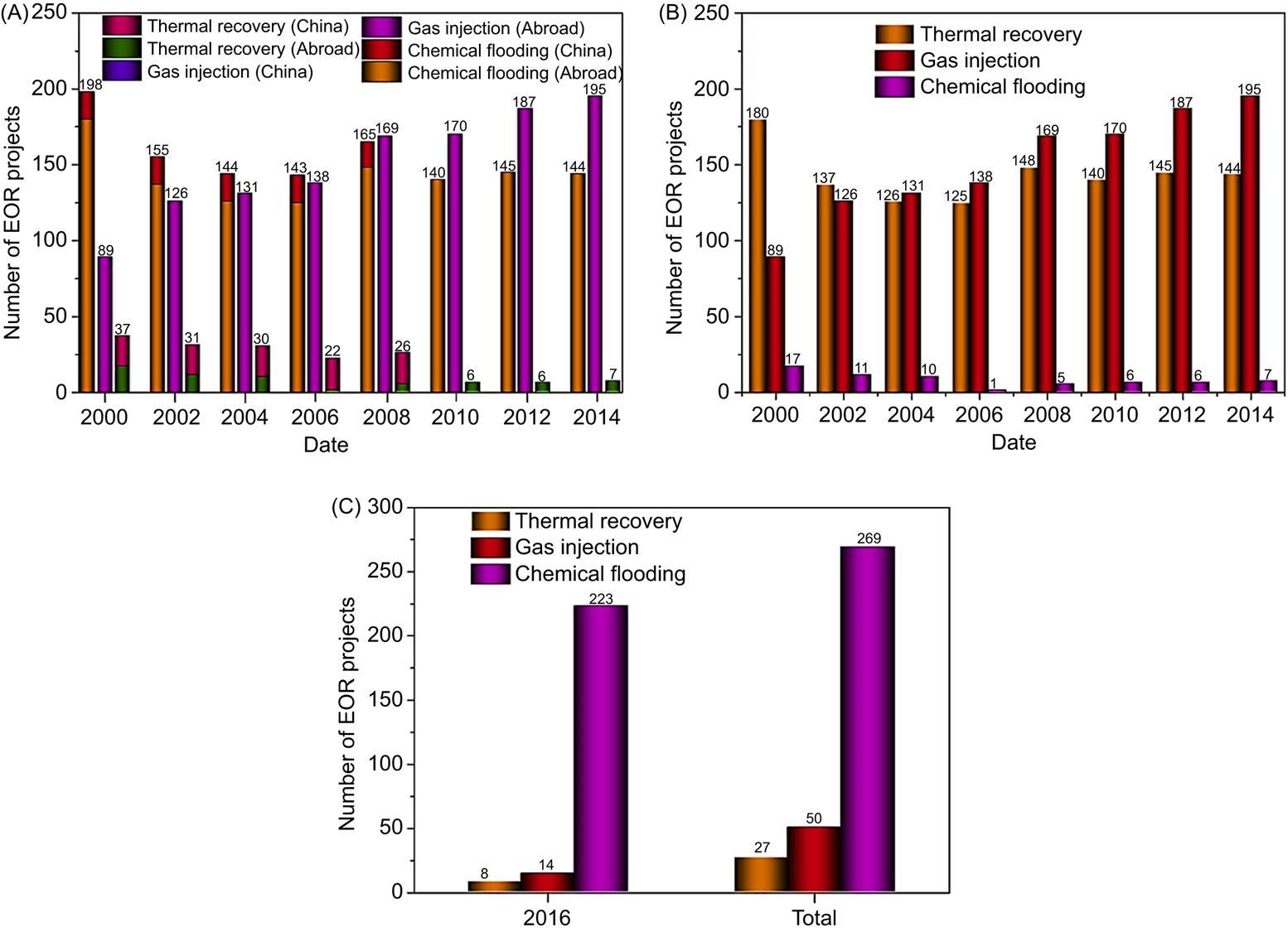
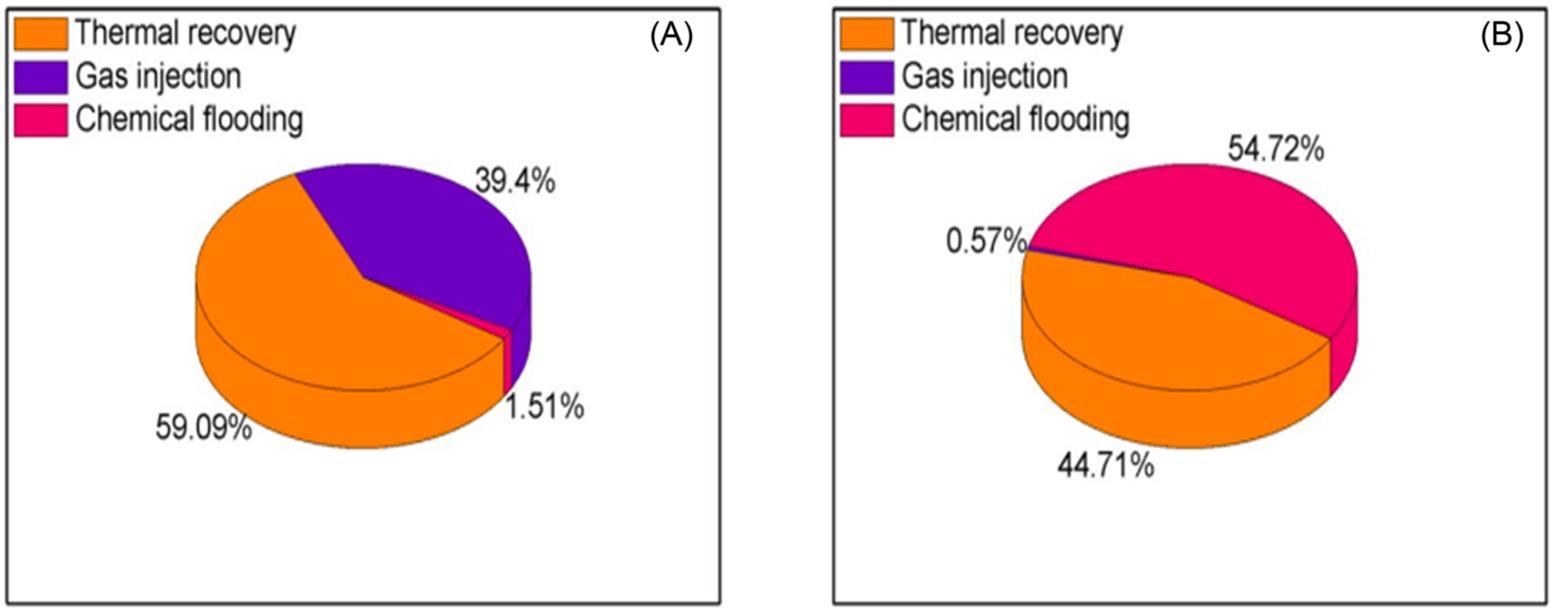
The minimum miscibility pressure (MMP) of CO2 is less than that of other gases (CH4, N2). MMP is referred to as the minimum pressure in which 95% of the contacted oil is recovered. This parameter is a function of crude oil composition and temperature [4]. As stated before, this EOR technique mainly includes N2 flooding, CO2 flooding and gravity-assisted gas flooding. Fig. 1.1 and 1.2 represent that the number of gas injection projects increased to 195 in 2014 and 39.4% in comparison to other EOR processes [5]. This technique was not widely applied in China before 2010. The increasing trend was slow before 2016. However, due to high coal reserves and high CO2 emissions, this EOR method has been widely applied to reduce carbon emissions and increase oil production. There are also various successful CO2 flooding processes in the United States [6].
FIGURE 1.1 Enhanced oil recovery projects: (A) 2000–14 (with China); (B) 2000–14 (without China); (C) 2016 and total with China [5].
FIGURE 1.2 Proportion distribution of worldwide daily oil production: (A) abroad in 2014; (B) China in 2016 [5].
There are two mechanisms for oil recovery through gas injection processes. The first of which is the component mass transfer between oil and gas. This mechanism is enhanced by increasing the miscibility of oil and gas. The second mechanism is reducing the oil viscosity, and its swelling as gas components condense in oil. More oil is recovered by increasing the contact between gas and reservoir. The injected gases are miscible, and the trapped oil is mixed with injected gas. Then hydrocarbons or the injected gas drive the oil to the production well [1].
In field applications, fingering phenomena would occur in gas flooding processes. This might be due to gravity override or heterogeneity of the reservoir. Thus the injected gas would pass through high permeability areas, and some oil is bypassed, which causes low sweeping efficiency. The nonpiston-like motion would also happen in homogeneous reservoirs. The economics and physics of displacements are both effective parameters for designing gas flooding processes. Various parameters, including rock properties, fluid specifications, viscosity, and phase behavior, are effective in the gas flooding process [1].
1.1.1 Miscible flooding
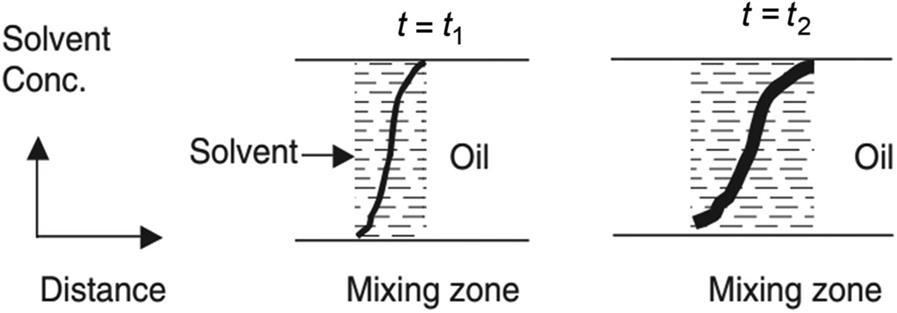
In miscible flooding, the displacing fluid is miscible with oil at initial contact or after multiple contacts [multicontact miscibility (MCM)]. The transient region between oil and gas is called the mixing zone in which a piston-like motion is observed. This zone is spread by advancing the front. Changes in the concentration profile are represented in Fig. 1.3. In miscible flooding, there is no interfacial tension (Nc=∞). For mobility ratios of less than 1, the displacing efficiency is about 1. Miscible flooding approaches are as follows:
1. Enriched gas drive
2. CO2 or N2 injection at high pressures
3. Miscible slug process
4. Vaporizing gas drive [7].
FIGURE 1.3 Concentration profile and transient region in miscible flooding [7].
1.1.1.1 Miscible slug process
In this process, pentane or propane slugs are injected into the reservoir using a single contact approach. Gravity segregation would occur in this process. The displacing efficiencies are low and viscous instabilities would occur. Miscible slug processes are successfully performed in Canada. The reservoir geology and solvent availability are the key points in choosing this process. Moreover, asphaltene precipitation and hydrate formation might also occur [7].
1.1.1.2 Enriched gas drive
In this mechanism, continuous injection of flue gas enriched with C2–C4 fractions, nitrogen, and natural gas is involved in the MCM process. At high-pressure values, the transitional zone might be formed due to the condensation of these fractions. Total miscibility would achieve by multiple contacts between the phases. The volume of the oil phase might increase, and the viscosity would reduce. This mechanism is observed in deep reservoirs (>6000 ft) [7].
1.1.1.3 Vaporizing gas drive
In this multicontact technique, nitrogen, flue gas, or natural gas are continuously injected into the reservoir at high-pressure values. The transition region is developed to achieve miscibility. The pressure of the injected gas should maintain below the bubble point pressure.
1.1.1.4 CO2 miscible
Despite the fact that various gases are applied for injection, CO2 and hydrocarbon gases are mostly applied (90%). In the United States, CO2 is appropriate for injection. The development of CO2 injection procedures in the United States has been driven by an abundance of pure CO2 deposits and the existence of technological know-how. CO2 injection programs now have the added benefit of carbon sequestration [8]. CO2 miscible is an important mechanism due to the special characteristics of CO2. As the MMP of CO2 is relatively low, it is an inimitable displacing agent. CO2 sequestration is another important environmental issue. It extracts heavy oil fractions (C5–C30) after multiple contacts with crude oil. This process applies to oils with API values of more than 30 in shallow reservoirs with low temperatures. The required CO2 is 500–1500 sm3/sm3 oil. Various injection schemes are applied in this process including, the water alternating gas technique. In this process, water and CO2 slugs are alternatively injected to reach the required CO2 slug. The cost and availability of CO2 are other important parameters in this process. Moreover, asphaltene precipitation might also occur [7].
1.1.1.5 N2 miscible
This process is the same as CO2 flooding. However, the MMP of nitrogen is high and is applicable to light oils (>30° API) with a moderate temperature of the reservoirs and high depth [7].
1.2 Gas injection methods
The second-largest EOR approach, after thermal techniques for heavy oil, is gas injection. The gas is typically injected with water to expand the contact of injected gas with reservoir rock. This technique was created to enhance flood profile control. In comparison to a plain waterflood, increasing the microscopic sweep
efficiency in gas and improved macroscopic displacement efficiency in water, greatly enhance the produced oil.
For recovering oil from conventional reservoirs, gas injection is an acceptable technology. Many recent types of research, represent it as the most successful approach for shale reservoirs. In general, gas may be injected into the reservoir in three ways: Water-alternatinggas (WAG), continuous flooding and huff-and-puff (HnP) injection, each of which has its own variety of advantages and disadvantages.
1.2.1 Continuous flooding
In this process, gas is continually injected, while oil is continually produced. The multicontact process, condensing or vaporizing mechanisms, or their combination, are used to generate miscibility between gas and oil. Gas injecting to drive the oil to the surface from the production well is known as continuous gas flooding. In HnP, however, just one well is engaged for injection and production processes [9].
1.2.2 Water-alternating-gas technique
Nowadays, the WAG method is applied in almost all gas injection processes. However, despite past studies and field applications demonstrating the WAG approach’s inadequacies, it is still the first technique that is selected. Low recovery factors in WAG field applications have prompted extensive research into the process, leading to optimized values for WAG ratio and limitations of low injectivity. Despite these advances, the WAG field performance remains poor. The majority of WAG applications in the United States are onshore. There are various injection gases for miscible flooding to be compatible with various reservoir properties. Fig. 1.4 represents various methods of gas flooding techniques. The total volume of gas to be injected, as well as the water–gas ratio and frequency (number of gas water cycles), must all be calculated for WAG. Simultaneous water gas injection (SWAG) has also been done, although due to the injection of several phases, this needs