Sanjoy Chakravorty, Devesh Kapur, and Nirvikar Singh
Social Justice through Inclusion
Francesca R. Jensenius
The Man Who Remade India
Vinay Sitapati
GAMBLING WITH VIOLENCE
STATE OUTSOURCING OF WAR IN PAKISTAN AND INDIA
YELENA BIBERMAN
Oxford University Press is a department of the University of Oxford. It furthers the University’s objective of excellence in research, scholarship, and education by publishing worldwide. Oxford is a registered trade mark of Oxford University Press in the UK and certain other countries.
Published in the United States of America by Oxford University Press 198 Madison Avenue, New York, NY 10016, United States of America.
All rights reserved. No part of this publication may be reproduced, stored in a retrieval system, or transmitted, in any form or by any means, without the prior permission in writing of Oxford University Press, or as expressly permitted by law, by license, or under terms agreed with the appropriate reproduction rights organization. Inquiries concerning reproduction outside the scope of the above should be sent to the Rights Department, Oxford University Press, at the address above.
You must not circulate this work in any other form and you must impose this same condition on any acquirer.
Library of Congress Cataloging-in-Publication Data
Names: Biberman, Yelena, author.
Title: Gambling with violence: state outsourcing of war in Pakistan and India / Yelena Biberman.
Description: New York : Oxford University Press, 2019. | Includes bibliographical references and index.
Identifiers: LCCN 2018029520 | ISBN 9780190929978 (paperback : alkaline paper) | ISBN 9780190929961 (hardback : alkaline paper)
Subjects: LCSH: Counterinsurgency—Pakistan. | Counterinsurgency—India. | Non-state actors (International relations)— South Asia. | Civil war— South Asia. | South Asia—Politics and government. | Alliances. Classification: LCC DS341 .B55 2019 | DDC 355.02/180954—dc23 LC record available at https://lccn.loc.gov/2018029520
1 3 5 7 9 8 6 4 2
Paperback printed by WebCom, Inc., Canada
Hardback printed by Bridgeport National Bindery, Inc., United States of America
For Mom, Jane, and Bas’ka
Why Study State-Nonstate Alliances in Civil War? 3
Why South Asia? 6
Existing Research and Book’s Contribution 7
State Alliances 8
Rebel Alliances 9
Militias 11
The Argument 11
Book Plan 12 2 STATE- NONSTATE ALLIANCES IN CIVIL WAR: A NEW BALANCE- OF- INTERESTS THEORY 14 A Typology of Nonstate Allies 15
Auxiliary 20
Proxy 21
Freelancer 22
Potential Explanations Suggested in the Existing Literature 23
A New Balance-of-Interests Framework 24
Scope Conditions 30
Cases, Data, and Research Methods 32
Research Design and Case Selection 32
Data Collection 34 3
SAVING THE HOUSE OF ISLAM: PAKISTAN’S “VOLUNTEERS” IN THE WAR OF 1971 37
Pakistan Regains Control in East Pakistan, March–May 1971 41
From State Control to Parity, May–June 1971 47
Alliance between Pakistan and Razakar Opportunists 51
From Parity to Insurgent Dominance, June–December 1971 54
Alliance between Pakistan and al-Badr Activists 56
Conclusion 59 4
“GUNS PLUS INTEREST”: RENEGADES AND VILLAGERS IN INDIA’S KASHMIR WAR 64
From Insurgent Control to Parity in Kashmir Valley, 1989–1993 67
From Parity to India’s Control in Kashmir Valley, 1993–1996 72
Alliance between India and Ikhwan-ul-Muslimoon Opportunists 73
Alliance between India and Muslim Mujahideen Opportunists 82
1996 Elections Mark a Turning Point 88 New Theater of War in Jammu 92
Alliance between India and Village Defense Committee Activists 92
Conclusion 94
TRIBAL “AWAKENINGS” IN PAKISTAN AND INDIA 97
Anti-Taliban “Awakening” in Pakistan 100
Pakistan’s Interests in Context 101
Misalignment of Interests and Weak Alliance between Pakistan and Lashkars 106
Anti-Naxalite “Awakening” in India 112
Background of Naxalite (a.k.a. Maoist) Insurgency 113
India’s Interests in Context 115
From India’s Weakness to Parity in Chhattisgarh 117
Alliance between India and Salwa Judum Opportunists 119
Conclusion 127 6
ALL THE STATE’S PROXIES IN TURKEY AND RUSSIA 129
Turkey’s War against Kurdish Rebels 133
Alliance between Turkey and Kurdish Clans 135
Alliance between Turkey and Kurdish Hizbullah 140
Russia’s First War in Chechnya 143
Russia’s Second War in Chechnya 149
Alliance between Russia and Gantamirovtsy 152
Alliance between Russia and Kadyrovtsy 153
Conclusion 155 7
CONCLUSION 157
Policy Recommendations 161
Directions for Future Research 165
Implications for South Asian Security 168
Notes 171 Index 209
ACKNOWLEDGMENTS
When conceiving this project over eight years ago, I could have hardly imagined how many people and institutions would help me carry it out. I begin by thanking those who took the time to share their experiences and thoughts with me in Islamabad, Srinagar, New Delhi, Dhaka, Diyarbakır, Ankara, Moscow, London, and Washington, DC.
I owe a most profound debt to my mentor and dissertation advisor, Ashutosh Varshney. His brilliance, boldness, passion, and extraordinarily generous support at every step of the process inspired me to produce my very best work. His example emboldened me to take intellectual risks and conquer new territories.
Peter Andreas has not only been my advisor as a graduate student and mentor thereafter but also a role model of intrepid and ground-breaking research on illicit state behavior. The journey I embarked on over eight years ago that culminates in this book is unimaginable without the wise and cheerful counsel of Pauline Jones.
I am very grateful to the Center for Contemporary South Asia at the Watson Institute for International and Public Affairs at Brown University for hosting a day-long workshop devoted to my book manuscript and to the workshop participants—Fotini Christia, Christopher Clary, Christine Fair, Dipali Mukhopadhyay, and Vipin Narang—for their extensive and valuable feedback.
Brown University and the Watson Institute provided me with an extraordinarily rich learning environment that fostered exploration and creativity over narrow notions of success. The late Alan Zuckerman’s “boot camp” for first-year graduate students instilled fidelity to rigor. Richard Snyder’s survey of the diverse paths taken by some of the most prominent scholars in comparative politics broadened my image of what it means to be a political scientist, helped me recognize the enduring importance of “big questions,” and created an appetite for fieldwork.
Skidmore College regularly reminds of me why I became an academic in the first place. It has become my new intellectual home, where I can focus on creative research projects. My students keep me inspired to pursue new questions and share what I learn in an environment that values both teaching and research. The exceptional friendliness and support of my colleagues in the Department of Political Science, as well as the college as a whole, has made these early years as a professor uniquely gratifying. For this, I am particularly grateful to Roy Ginsberg and Kirsten Mishkin, Kate Graney, Steven Hoffmann, Christopher Mann, Barbara McDonough, Ron Seyb and Grace Burton, Natalie Taylor and Flagg Taylor, Bob Turner, and Aldo Vacs, as well as Michael Arnush and Leslie Mechem, Beau Breslin, Margaret Greaves, Eliza Kent, and Mahesh Shankar. A special thanks to my talented research assistants Trevor Cloen, Zewen Hu, Jan Janiszewski, Gage Willand, and Mende Yangden.
My work has benefited from the feedback it received at the Massachusetts Institute of Technology Strategic Use of Force Working Group, American Institute of Pakistan Studies Junior Scholars Conference, Modern South Asia Workshop at Yale University, and Olympia Summer Seminars, as well as at the International Studies Association, American Political Science Association, Conference on South Asia, Association for the Study of Nationalities, and New England Political Science Association annual meetings.
The research I conducted for this book was also enriched by the comments I received at the National Police Academy in Islamabad, Institute of Kashmir Studies at the University of Kashmir, Observer Research Foundation in New Delhi, Center for International Politics,
Organization and Disarmament at Jawaharlal Nehru University, Nelson Mandela Centre for Peace and Conflict Resolution at Jamia Millia Islamia, Diplomatic Academy of the Ministry of Foreign Affairs of the Russian Federation, and National Ground Intelligence Center of the US Army Intelligence and Security Command. So too was highly instructive my participation in the Raisina Dialogue in New Delhi, US Army War College National Security Seminar, Philip Merrill Center for Strategic Studies Basin Harbor Workshop, United States Institute of Peace Jennings Randolph Senior Fellows and Peace Scholars Workshop, and Summer Workshop on Analysis of Military Operations and Strategy at Cornell University.
I am indebted to colleagues and friends for their contributions to this project. Some of them supported me during fieldwork, others commented on countless presentations and drafts, or provided moral support. Many have helped sharpen my ideas. Thank you: Malik Hammad Ahmad, Ariel Ahram, Belgin Şan Akça, Azhar Ali, Michele Angrist, Ekim and Eren Arbatli, Ana Arjona, Victor Asal, Bilal Baloch, Regina Bateson, Maria Angelica Bautista, Abu Syed Muhammad Belal, Samir Ahmad Bhat, Stephen Biddle, Gavril Bilev, Filly and Lawson Brown, Erica De Bruin, Charles Burnett, Ahsan Butt, Melani Cammett, Rachel Castellano, Uday Chandra, Stephen P. Cohen, Brian Dudley, Sumit Ganguly, Robert Gerwarth, Larry Goodson, Bharath Gopalaswamy, Philip Hultquist, Oleg Ivanov, Corinna Jentzsch, Stathis Kalyvas, Nickolas Katsakis, Bettina Koch, Walter Ladwig, Sameer Lalwani, Anatol Lieven, Romain Malejacq, Kimberly Marten, Katya Mellott, Raja Mohan, Shivaji Mukherjee, Shuja Nawaz, T.V. Paul, Roger Petersen, Srinath Raghavan, Muhibbur Rahman, Sadia Saeed, Lee J. M. Seymour, Swaran Singh, Paul Staniland, Niloufer Siddiqui, Shawn Tabankin, Megan Turnbull, Andrey Turovsky, Michael Weintraub, and Farhan Zahid.
Archival research was indispensable to my findings and so was the help of Nuzhat Khatoon at the Asia Division of the Library of Congress, Thomas Lannon at the Manuscripts and Archives Division of the New York Public Library, and Andrea Singer at the Indiana UniversityBloomington Library. I am also grateful to the librarians at the Liberation
War Museum Archives in Dhaka, University of Kashmir Library, Nehru Memorial and Library Archives in New Delhi, Defence Studies and Analyses Library in New Delhi, British Library—Asia, Pacific, and Africa Collections (formerly the India Office Library), British National Archives at Kew, King’s College London Archives, US National Archives at College Park, Human Rights Association office in Diyarbakır, and Columbia University Rare Book and Manuscript Library (Human Rights Watch Collection).
This book has benefited a great deal from the research I conducted for my dissertation, which was generously supported by the United States Institute of Peace Jennings Randolph Peace Scholar Dissertation Fellowship, American Institute of Pakistan Studies Junior Fellowship, Smith Richardson Foundation World Politics and Statecraft Fellowship, Horowitz Foundation for Social Policy Research Grant (Special Recognition: John L. Stanley Award), New York Public Library ShortTerm Research Fellowship, Brown University Graduate School Internal Dissertation Fellowship, and Brown University Office of International Affairs, as well as Graduate School Research Travel Grants. My study of Urdu language at the South Asia Summer Language Institute (SASLI) was made possible by the Foreign Language and Area Studies Summer Fellowship. Further research for this book was generously supported by the Atlantic Council US-Pakistan Exchange Fellowship, Judith Johns Carrico Faculty Grant, and Skidmore College Faculty Development Grant.
One of the real pleasures of producing this book has been working with Dave McBride, my editor at Oxford University Press. I owe him a great debt not only for being interested in my manuscript but also for all the work he put into enhancing it through incredibly insightful and thorough feedback, for which I am also very grateful to my reviewers.
A special thanks to my brother, Aleksandr, sister-in-law, Rachel Casseus, and cousins, Yan and Sammy Shurin, for their cheer and moral support. My family has been, and always will be, my main reason for it all. This book is for and because of them. Like so many others before and after us, we arrived in the United States as refugees fleeing persecution
and violence. From where we came discussing politics, even at home, could get one into serious trouble. I am grateful to my family for making it possible for me to talk about and to study politics, and especially to study persecution and violence.
My husband, Feryaz Ocakli, deserves more credit than I can ever convey for helping and bolstering me through it all. That he has maintained high spirits despite reading nearly all of my drafts is a testament to his resilience and devotion. Our shared love of what we do and, of course, our new son, Timur, are my greatest treasures. I am grateful to my Turkish family, and especially the late Bedri Ocakli as well as Ayşe, Fevzi, Pelin, and Beste Ocakli, for my comrade in arms.
GAMBLING WITH VIOLENCE
INTRODUCTION
As anyone who has ever been in combat will tell you, the last thing you want is a fair fight.1
By 1999, the Clinton Administration wanted Osama bin Laden dead. The bombing of two US embassies in East Africa made obvious the al- Qaeda leader’s intention to attack the United States worldwide. His shopping list included nuclear material. But who could get the mission accomplished? Bin Laden was effectively out of reach of the United States and its state allies. He was in Afghanistan, under the protection of the Taliban. So the US Central Intelligence Agency (CIA) turned to nonstate actors: paid “tribal assets” in Afghanistan. “From the American President down to the average man on the street, we want him [bin Laden] stopped,” a CIA field officer instructed the tribals. Their response, however, caught the agency off guard. The tribals agreed to capture bin Laden but refused to kill or harm him. They explained that their actions were constrained by their “beliefs and laws we have to respect,” and that is what distinguished them from bin Laden. The CIA was “impressed” the tribals were “not in it for the money but as an investment in the future of Afghanistan” and grudgingly acquiesced.2
The lesson of this story is twofold. First, militarily superior states are not always capable of tackling insurgents on their own. Sometimes they
need the help of nonstate partners. This is especially the case at the local level, or “on the ground,” where states’ reach may be severely limited. Second, the relationship between states and nonstate actors is far more complex than the existing literature allows. Assets are not mere puppets at the hands of their principals. They have agency and interests of their own. Even those operating in “weak and collapsing states characterized by fluid alignments among armed actors”3 can be surprisingly nonmaterialistic and farsighted. The aforementioned Afghan tribals were not the ferocious opportunists the CIA assumed they were. They had principles and a long-term outlook.
This book tackles a particularly perplexing and underexplored type of alliance. Much of the existing work focuses on either interstate or interrebel alliances, or on states supporting rebels against rival states.4 This book explores state-nonstate alliances. Its focus is on counterinsurgency. As Carl von Clausewitz reminds us, to fight any war is to gamble.5 But to fight a war inside one’s borders with nonprofessionals is a particularly dicey proposition. This is not merely because of the questionable loyalty of those driven solely by their own interests that so preoccupied Niccolò Machiavelli,6 or the inferior proficiency Adam Smith attributed to those for whom war is not “the sole or principal occupation.”7 It is also because, as army commanders George Washington and Leon Trotsky equally observed, arming individuals who are neither professional nor loyal soldiers tends to exacerbate internal problems, thereby strengthening the hands of powerful foreign adversaries.8
The phenomenon of governments outsourcing violence to nonstate actors inside their borders is particularly puzzling when we consider states with robust militaries—such as Pakistan and India. Why would these countries’ powerful armies share their resources and responsibilities with characters of questionable capability and loyalty? Pakistan’s military is so protective of its turf that it barely entrusts domestic security to the police.9 India prides itself on being the “world’s largest democracy.” But it has continued to outsource counterinsurgency to nonstate actors despite its Supreme Court’s condemnation, which characterized
the practice as “tantamount to sowing of suicide pills that could divide and destroy society.”10
The disturbingly high prevalence of (and marked variation in) Pakistan and India arming their own citizens against insurgents, without fully and formally incorporating them into their security apparatus, offers an opportunity closely and systematically to study the phenomenon. It allows us to generate hypotheses about its causes and mechanisms while controlling for many plausible alternative explanations. It also sheds light on an important but largely overlooked source of human rights violations and states’ low infrastructural power in South Asia.
Why Study State- Nonstate Alliances in Civil War?
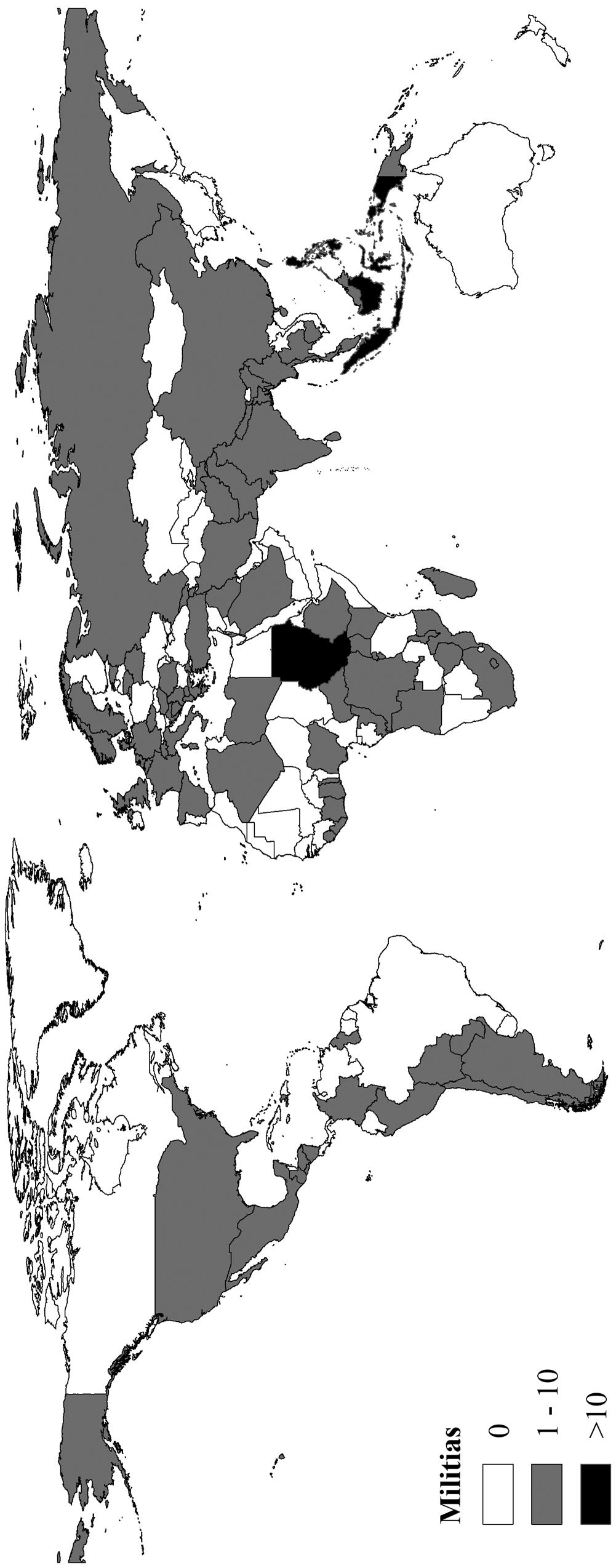
Uprisings in states with robust armed forces are surprisingly common. Eleven of the fifteen states with the world’s strongest militaries confronted an insurgency of some magnitude inside their borders in 2000–2015.11 The global prevalence of state outsourcing of violence is no less astounding. Figure 1.1 displays the geographical distribution of “pro-government militias” between the years 1981 and 2007.12 At least 64 percent of the 332 identified groups had direct links to a state institution.13 Given the significant limitations to collecting accurate cross-national data on armed nonstate groups’ relationships with state institutions, the figures very likely underestimate the incidence of state outsourcing of violence.
Violence outsourcing is a high-stakes gamble carrying serious political and security risks. In the short run, states chance betrayal and further exacerbating the conflict. The long-term risks of violence outsourcing include loss of local legitimacy and international prestige.14 Backlash can also be a serious problem: the empowered nonstate groups may turn into their sponsor’s gravediggers,15 or new militant forces may rise in reaction to the abuses perpetrated by the proxies.16 The ensuing disorder may compel powerful outside actors, such as India in 1971 (see chapter 3), to get involved in the conflict.17
Figure 1.1 Prevalence of ProGovernment Militias, 1981–2007
Source : GIS map created using Carey, Mitchell, and Lowe dataset. Sabine C. Carey, Neil J. Mitchell, and Will Lowe, “States, the Security Sector, and the Monopoly of Violence: A New Database on ProGovernment Militias,” Journal of Peace Research 50, no. 2 (March 2013): 249–258.
Cases as diverse as Syria, Guatemala, and Afghanistan remind us of the high costs of violence outsourcing. Syrian President Bashar al-Assad used the notorious shabiha (ghosts) forces, comprising racketeers and smugglers, to torture and execute regime opponents in the aftermath of the Arab Spring. The shabiha quickly became a symbol of the Syrian regime’s brutality and further mobilized domestic and international opposition. What ensued was a full-fledged civil war with a hefty dose of foreign involvement.
During a nearly four-decade-old civil war, the Guatemalan military collaborated with nonstate counterinsurgent groups comprising roughly 1 million peasant farmers. These so-called Patrullas de Autodefensa Civil (civil self-defense patrols) committed over 3,000 human rights violations, with some 14,000 victims.18 Two decades after the end of the civil war, and despite the state’s demobilization efforts, the proxies persist, detaining and interrogating “suspicious individuals, who are sometimes punished, tortured, or even lynched.”19
The Afghan government and its international supporters enlisted the help of tribal fighters against the Taliban-led insurgency as part of the international exit strategy. However, these efforts were frequently “hijacked by local strongmen or by ethnic or political factions, spreading fear, exacerbating local political tensions, fueling vendettas and ethnic conflict, and in some areas even playing into the hands of Taliban insurgents.”20
The jury is still out on whether nonstate counterinsurgents are actually useful. It might be tempting to conclude that they are. Counterinsurgency is, after all, “an intelligence-driven endeavor” requiring high familiarity with the local context.21 As insurgents and states compete for local influence, nonstate partners may help states by collecting tactical intelligence, building the state’s legitimacy at the local level, making credible threats against civilians in the case of noncooperation, providing plausible deniability, supplying low-cost auxiliary manpower in operations, and carrying out selective violence.22 However, according to a classified CIA report, nonstate allies often have “a minimal impact on the longterm outcome of a conflict.”23 Moreover, in all the cases closely examined
in this book (chapters 3–6), the victories states achieved with the help of nonstate allies were either ephemeral or incomplete.
The usefulness of nonstate counterinsurgents notwithstanding, violence outsourcing violates national and international norms. International humanitarian law requires combatants to be clearly distinguished from civilians and expressly prohibits them from posing as such.24 Statesponsored nonstate combatants raise a number of legal issues: Does the military’s code of conduct apply to them? If captured, do they receive the protections offered to soldiers by the Geneva Conventions? Which courts have jurisdiction over them—military or civil? Can their sponsor be held accountable for their misbehaviors? The irresolution of these questions makes violence outsourcing a deeply controversial subject. Hence, when India’s defense minister let it publicly slip that his country should “neutralize terrorists through terrorists only,” observers gasped: “Even if you want that as a part of your strategy, you don’t say it publicly.”25
Why South Asia?
South Asia is the ideal setting for exploring the question of state-nonstate alliances for several important reasons. First, although Pakistan is most notorious for using nonstate proxies, the less known instances of India’s violence outsourcing offer a rich universe of cases to select those most appropriate for our comparative purposes. Among them are the Ikhwan in Kashmir, the Salwa Judum in Chhattisgarh, the Cats in Punjab, the Tigers and Cobras in Andhra Pradesh, and the SULFA (Surrendered ULFA, or United Liberation Front of Assam) in Assam. Some also see the Bodo Liberation Tigers as a force propped up by the state to counter the National Democratic Front of Bodoland (NDFB) in Assam, or the National Socialist Council of Nagaland-Khaplang (NSCN-K) used as a counterforce to the National Socialist Council of Nagaland-Isak-Muivah NSCN(IM) in Nagaland.26
Second, South Asia is a region of high geostrategic importance. This is not only because of its size, location, environmental vulnerability, and economic prospects.27 It is also because of its high potential for nuclear
conflict and the critical role state-nonstate alliances play in either aggravating or lessening that potential.28
Finally, much of the existing work on state use of nonstate proxies centers on Latin America, especially Colombia, and the Middle East. This book contributes to a better understanding of state outsourcing of violence as a global phenomenon with cases that have received little accurate in-depth analysis.
Existing Research and Book’s Contribution
What distinguishes the modern state from its medieval and early modern predecessors is the possession of an unprecedented resource: the legitimate use of physical force. The state is the only organization that has the widely, if not universally, recognized right to use violence as a means of achieving its goals. No other organization is granted such power over the creation, and destruction, of security. No other organization so jealously guards it.
Warfare is conventionally viewed as the state’s quintessential and exclusive domain. Centralization, nationalization, and bureaucratization of violence are deemed necessary for the making and survival of the modern state within the anarchic international system.29 The standing army is widely acknowledged as “necessary for the constant pacification of large territories as well as for warfare against distant enemies.”30 States that reach beyond it are considered problematic and pathological. Pakistan is a case in point. It has been labeled “an abnormal state” for using “Islamic militants—jihadi groups, nonstate actors—in addition to diplomacy and trade to pursue its defense and foreign policies.”31 Prominent experts describe the country’s security policy as emblematic of a “greedy state determined to pursue its revisionism for ideological and even religious goals,” and therefore dangerous to the existing world order.32
Many believe that violent nonstate actors arise and proliferate because states are too weak to contain them.33 Currently emerging is a new body of work that recognizes states can play an active role in the rise of armed nonstate groups on their territory. However, it too associates violence