Great Clarendon Street, Oxford, 2 6, United Kingdom
Oxford University Press is a department of the University of Oxford. It furthers the University’s objective of excellence in research, scholarship, and education by publishing worldwide. Oxford is a registered trade mark of Oxford University Press in the UK and in certain other countries
The moral rights of the authors have been asserted
First Edition published in 2021
Impression: 1
All rights reserved. No part of this publication may be reproduced, stored in a retrieval system, or transmitted, in any form or by any means, without the prior permission in writing of Oxford University Press, or as expressly permitted by law, by licence or under terms agreed with the appropriate reprographics rights organization. Enquiries concerning reproduction outside the scope of the above should be sent to the Rights Department, Oxford University Press, at the address above
You must not circulate this work in any other form and you must impose this same condition on any acquirer
Published in the United States of America by Oxford University Press 198 Madison Avenue, New York, NY 10016, United States of America
British Library Cataloguing in Publication Data
Data available
Library of Congress Control Number: 2021930461
ISBN 978–0–19–885583–5
ebook ISBN 978–0–19–259786–1
Printed and bound in Great Britain by Clays Ltd, Elcograf S.p.A.
Links to third party websites are provided by Oxford in good faith and for information only Oxford disclaims any responsibility for the materials contained in any third party website referenced in this work.
This book is dedicated to Joseph Kindle Allen, United States Navy, George Scott Davis, US Coastguard, Katherine Jolliffe, US Army Nurse Corps, Clifford Lindley-French, Royal Navy, and Walter Saunders, Royal Navy. They fought for Europe’s freedom and a just peace in the fervent hope that it would be defended and never have to be fought for again.
Preface
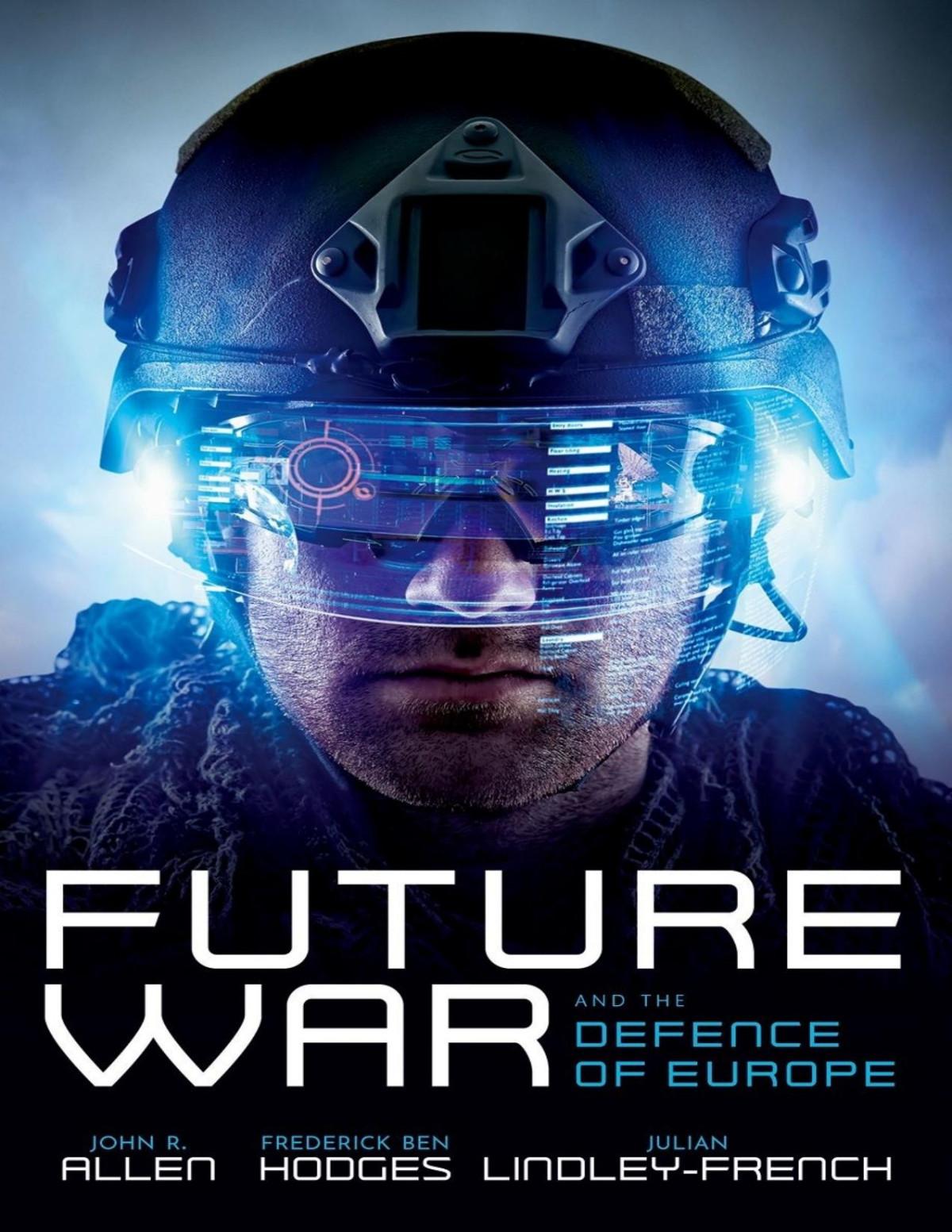
There are two theses central to this book. Firstly, the defence of Europe in the face of future war will require a new comprehensive concept of security in which human security and national defence are not only harmonized but seen as central to a new kind of deterrence that stretches across a complex and interlocking mosaic of hybrid, cyber, and hyper-warfare. Secondly, the impact of emerging technologies on future high-end warfare and by extension European defence will be profound.
The 2018 commemoration of the Armistice at the end of the ‘war to end all wars’ prompted questions that Plato inspired when he is believed to have suggested that only the dead have seen the end of wars.1 Could Europe again face a major war; if so, what would it look like; and, above all, how could it be prevented and, if needs be, fought? How would such a war unfold? Could Europe withstand the shock of war?
The 2020–1 COVID-19 crisis would suggest there is much work to be done to make European states and their institutions more resilient if the peace to which so many Europeans have become accustomed is to be preserved in the face of emerging threats and natural hazards. If nothing else, COVID-19 has reminded Europeans that shock happens, even if many seem to be in denial. In August 1919 the British government initiated the Ten-Year Rule by which London assumed it would not be involved in a major war for at least a decade and could plan accordingly. In March 1932 Britain scrapped the Rule as war clouds began to appear again in the midst of the Depression. Strategic uncertainty has grown exponentially since the COVID-19 crisis began and such uncertainty is likely to worsen with the economic crisis but, locked into a kind of perpetual and virtual
Ten-Year Rule, much of Europe seems unwilling to consider the eloquence of history and just how dangerous such moments can be in the eternal struggle between peace and war.
Future War and the Defence of Europe is thus set against a backdrop of crisis and contemporary history, and the rapidly changing strategic, political, and technological environment with which Europeans, and those charged with defending them, must contend. The book also questions contemporary assumptions about the transatlantic relationship and its future, as well as the respective roles of both the North Atlantic Treaty Organization (NATO) and the European Union and the maintenance of peace and stability in Europe.
The focus of the book is thus the future military defence of Europe and, specifically, the future military art, science, and structure sound European defence and deterrence will demand. At its heart, the book is a consideration of the impact of what some have called the Fourth Industrial Revolution on the defence of Europe, and the sweeping changes that are unfolding in civil–military technologies across the globe.2 Put simply, this book is European defence re-envisioned by three authors with over one hundred years of professional knowledge and experience combined.
John R. Allen F. Ben Hodges
Lindley-French
Colin S. Gray (2005) Another Bloody Century: Future War (London: Weidenfeld and Nicolson), front cover.
Min Xu, Jeanne David, and Suk Kim state, ‘The fourth industrial revolution, a term coined by Klaus Schwab, founder and executive chairman of the World Economic Forum, describes a world where individuals move between digital domains and offline reality with the use of connected technology to enable and manage their lives The first industrial revolution changed our lives and economy from an agrarian and handicraft economy to one dominated by industry and machine manufacturing. Oil and electricity facilitated mass production in the second industrial revolution. In the third industrial revolution, information technology was used to automate production. Although each
industrial revolution is often considered a separate event, together they can be better understood as a series of events building upon innovations of the previous revolution and leading to more advanced forms of production’ See Min Xu, Jeanne David, and Suk Kim (2018) ‘The Fourth Industrial Revolution: Opportunities and Challenges’ International Journal of Financial Research, vol 9, p 90
Acknowledgements
The authors would like to thank the many people who have contributed to the writing of this book. Three people stand out for special mention. Paul Cornish, William Hopkinson, and Jim Townsend gave both their time and expertise to render this book a far better work than it otherwise might have been. With many years of experience working at the highest levels of both the British and American governments on matters germane to this book, they not only have a deep knowledge of the issues at hand, but were also instrumental in helping to shape many of them.
JRA, FBH, JLF January 2021
Contents
About the authors
The Ten-Year Rule
Scenario 1: Europe defeated
COVID-29
Far, far away…
Chaos in the south
North Cape War!
Crash!
If only…
Meanwhile…
War in the East
End-game
America overstretched, Europe defeated
Introduction
The hinge of history
Megatrends, technology, and European decline
The state of the debate
The structure of the book
Power and defence
1.
COVID-19 and the European defence dilemma
The defence implications of COVID-19
COVID-19 and the shifting balance of power
National distancing?
Comprehensive security and national defence
Russia, 5D warfare, and information shock
The world beyond COVID-19
COVID-19, Europe, and military megatrends
European defence in the post-COVID-19 world
The end of the beginning?
D-Day, NATO, and the importance of legitimate military power
Defence and power
European defence and leadership
NATO and the importance of alliance
Europe and European defence
An uneasy Alliance
Coping with peace
Integration or isolation?
A new hinge of history?
Russia and Europe’s northern and eastern flanks
Another bloody European war?
Complex strategic coercion and the nature of future war
Why complex strategic coercion?
The Russian national interest under Putin
How strong are Russia’s armed forces?
Road-bumps on the way to Russia’s future force
Russia versus Europe
The Black Sea region and the virtual Soviet Union
Turkey, Russia, and the values-interest dilemma
Conclusion: a challenging neighbourhood
Demons and dragons: Europe’s southern flank
360-degree Europe?
The state versus the anti-state
Syria and the humbling of the West
The prospects of regional-strategic war
Iran and the West’s nuclear dilemma
Libya, Europe, and failed transition
COVID-19 and fragile states
MENA and the bonfire of European illusions
China
The irresistible rise of China?
Jekyll and Hyde China
Chinaization
Belt and chains?
China, the US, and European defence
COVID-19, China, and geopolitics
Could NATO (still) defend Europe?
America, Europe, and multi-domain warfare
Overstretch and under-stretch
The US, NATO, and the future defence of Europe… …and deterring means defending
NATO: adapting to what?
NATO, the UK, and COVID-19
Future war NATO?
Europeans must wake up and smell the American coffee
Could Europe defend Europe?
The European defence of Europe
Strategic autonomy?
The Franco-German defence axis
Strategic autonomy is a consequence
An integrated European defence?
A European strategic public–private defence partnership?
Can Europeans defence innovate?
PESCO
Could Europe defend Europe?
Hyperwar: Europe’s digital and nuclear flanks
The digital Dreadnought
Hyperwar law
NATO and hyper-deterrence
Europe and hyperwar
5G, digital decapitation, and disruptive technologies
Europe’s nuclear flank
Public policy, private technology
The revolution in (applied) military technology
The gathering (tech-)storm
Technology and future defence
Defending Europe
A return to European statecraft
Specific lessons from COVID-19
Managing Russia: the new dual-track
Re-establishing European strategic realism and responsibility
Building a strategic public–private partnership
Crafting the future NATO–EU strategic partnership
Sharpening the spear-tip of NATO
Future war and the defence of Europe
Scenario 2: Europe defended
COVID-29
Salafist chaos: resisted and restored
A new European war?
The Second Battle of North Cape
Land war
Crash and counter-crash!
The future war, future defence of Europe has held
Bibliography Index
About the authors
General John R. Allen,
USMC (Ret.)
John Rutherford Allen assumed the presidency of the Brookings Institution in November 2017, having most recently served as chair of security and strategy and a distinguished fellow in the Foreign Policy programme at Brookings. Allen is a retired US Marine Corps four-star general and former Commander of the NATO International Security Assistance Force (ISAF) and US forces in Afghanistan. Allen served in two senior diplomatic roles following his retirement from the Marine Corps: first, for fifteen months as Senior Advisor to the Secretary of Defense on Middle East Security, during which he led the security dialogue for the Israeli/Palestinian peace process. President Barack Obama then appointed Allen as special presidential envoy to the Global Coalition to Counter ISIL, a position he held for fifteen months. Allen’s diplomatic efforts grew the coalition to sixty-five members, effectively halting the expansion of ISIL. In recognition of this work, he was presented with the Department of State Distinguished Honor Award by Secretary John Kerry and the Director of National Intelligence Distinguished Public Service Award by Director James Clapper.
During his nearly four-decade military career, Allen served in a variety of command and staff positions in the Marine Corps and the Joint Force. He commanded 150,000 US and NATO forces in Afghanistan from July 2011 to February 2013. Allen was the first Marine to command a theatre of war. During his tenure as ISAF Commander, he recovered the 33,000 US surge forces, moved the Afghan National Security Forces into the lead for combat operations,
and pivoted NATO forces from being a conventional combat force into an advisory command.
Allen’s first tour as a general officer was as the Principal Director of Indo-Pacific Policy in the Office of the Secretary of Defense, a position he held for nearly three years. In this assignment, he was involved extensively with policy initiatives concerning China, Taiwan, Mongolia, and Southeast Asia. Allen also participated in the SixParty Talks on the denuclearization of the Korean Peninsula and played a major role in organizing the relief effort during the South Asian tsunami from 2004 to 2005.
Beyond his operational and diplomatic credentials, Allen has led professional military educational programmes, including as Director of the Marine Infantry Officer Program and commanding officer of the Marine Corps Basic School. He twice served at the United States Naval Academy, first as a military instructor, where he was named instructor of the year in 1990, and later as commandant of midshipmen, the first Marine Corps officer to hold this position. Allen was the Marine Corps fellow to the Center for Strategic and International Studies and the first Marine officer to serve as a term member of the Council on Foreign Relations, where today he is a permanent member.
Among his other affiliations, Allen is a Senior Fellow at the Merrill Center of the Johns Hopkins School of Advanced International Studies and a Senior Fellow at the Johns Hopkins Applied Physics Laboratory. He is an ‘Ancien’ of the NATO Defense College in Rome, and a frequent lecturer there.
Allen is the recipient of numerous US and foreign awards. He holds a Bachelor of Science in operations analysis from the US Naval Academy, a Master of Arts in national security studies from Georgetown University, a Master of Science in strategic intelligence from the National Intelligence University, and a Master of Science in national security strategy from the National Defense University.
A native of Quincy, Florida, Lieutenant-General Ben Hodges (retired) graduated from the United States Military Academy in May 1980 and was commissioned in the Infantry.
After his first assignment as an Infantry Lieutenant in Germany, he commanded Infantry units at the Company, Battalion, and Brigade levels in the 101st Airborne Division and in Operation IRAQI FREEDOM. He also served in an operational assignment as Director of Operations, Regional Command South, in Kandahar, Afghanistan.
Lieutenant-General Hodges (retired) has also served in a variety of Joint and Army Staff positions to include Tactic Instructor at the Infantry School; Chief of Plans, 2nd Infantry Division in Korea; Aidede-Camp to the Supreme Allied Commander Europe; Army Congressional Liaison Officer; Task Force Senior ObserverController at the Joint Readiness Training Center, Fort Polk, LA; Coalition/Joint—3 (CJ3) of Multi-National Corps-Iraq in Operation IRAQI FREEDOM; Chief of Staff, XVIII Airborne Corps at Fort Bragg; and Director of the Pakistan Afghanistan Coordination Cell on the Joint Staff, Chief of Legislative Liaison for the United States Army, and Commander, NATO Allied Land Command. His last military assignment was as Commander, United States Army Europe from 2014 to 2017.
Lieutenant-General Hodges (retired) currently holds the Pershing Chair in Strategic Studies at the Center for European Policy Analysis (CEPA).
Professor Julian Lindley-French
Educated at the University of Oxford, University of East Anglia, and the European University Institute in Florence, Italy, Professor Dr Julian Lindley-French (PhD, MA (Dist.), MA (Oxon.)) is a leading advisor, strategist, and author with many published books and articles to his name. He has three advanced degrees and has held three professorial chairs (Professor of Military Art and Science and Eisenhower Professor of Defence Strategy, Netherlands Defence
Academy, and Special Professor of Strategic Studies, Leiden University).
Vice-President of the Atlantic Treaty Association in Brussels until 2017, he is a Distinguished Visiting Research Fellow at the National Defense University in Washington, Senior Fellow at the Institute for Statecraft in London, Director of Europa Analytica in the Netherlands, and a Fellow of the Canadian Global Affairs Institute. He is also founder and chair of The Alphen Group, a high-level strategic ‘do-tank’ (https://thealphengroup.home.blog).
In 2015 he was made an Honorary Member of the Association of Anciens of the NATO Defense College in Rome. He also served General Sir David Richards and General Sir Nicholas Houghton on the Chief of Defence Staff’s Strategic Advisory Group and as Head of the Commander’s Initiative Group for Lt.-General Sir Richard Shirreff, Commander of the Allied Rapid Reaction Corps.
In November 2017 he co-published The Future Tasks of the Adapted Alliance (The GLOBSEC NATO Adaptation Reports), for which he was lead writer, with (inter alia) General John R. Allen, Admiral Giampaolo di Paola, and Ambassador Sandy Vershbow. This major senior leader project considers NATO adaptation and the future role of the Alliance in a changing strategic environment. The final report was presented to the NATO Secretary-General and can be downloaded at https://www.globsec.org/news/globsec-natoadaptation-initiative-final-report.
His influential books and high-level reports combine policy experience and academic expertise. In early 2018 he was made a member and Senior Counsellor to the high-level US–German Loisach Group set up by the George C. Marshall Center and the Munich Security Conference. In October 2018 he received the distinct honour of giving the Trafalgar Night dinner speech to the Royal Navy on board HMS Nelson at HM Naval Base Portsmouth entitled ‘Nelson and the Pursuit of Victory’.
The Ten-Year Rule
‘It should be assumed, for framing revised Estimates, that the British Empire will not be engaged in any great war during the next ten years, and that no Expeditionary Force is required for this purpose’.
In 1928 the Ten-Year Rule became a rolling rule and was not abandoned until 1932. As such, the Rule has become a metaphor for British strategic complacency during the Interbellum.3
3.
War Cabinet 616A, Minutes of a Meeting of the War Cabinet at 10 Downing Street, Friday 15 August 1919. The Cabinet Papers, Defence Policy 1919–32, www.nationalarchives.gov.uk.
Scenario 1
Europe defeated
COVID-29
It all started with COVID-29. Early in 2029 a new pandemic spread across the world. It was similar to COVID-19, which had locked Europe down in 2020 and brought healthcare systems close to collapse. A decade on and Europe’s economy has yet to recover from the extended post-crisis U-shaped depression which followed COVID-19. Throughout the 2020s Europe’s overstretched and underfunded armed forces saw their already meagre budgets raided by governments desperate to build more capacity into their healthcare and social care systems.
In 2029 many Western sailors, soldiers, and airmen contract COVID-29. Exercises and training are cancelled, including NATO’s massive and hurriedly scheduled Defender 29 exercise. Strangely, Chinese and Russian forces seem far less affected. There is a reason.
It was mid-April 2030 when Jim received a text message during leave to immediately report back to Fort Hood. For days now Jim had been recovering from COVID-29, having contracted the illness during an exercise with British forces. He had been vaguely aware that something was ‘up’, because the newspapers, TV, and internet were full of ‘experts’ warning about the build-up of Russian forces in Europe on NATO’s eastern border The Middle East was also in chaos…as usual. Still, it was all far away and as far as Jim was concerned, it was somebody else’s problem. In any case, this was not the first time he had heard such ‘stuff’ so Jim had let any clouds
of concern he might have drift on by He had other things on his mind. Unlike COVID-19, COVID-29 also affected young people in huge numbers. It did not kill them, but laid them low. Jim worried for his wife and kids.
Still, as he slowly recovered, something nagged at Jim. He was a member of the elite US Army’s ‘Ironhorse’ Brigade and had twice been deployed to Europe as part of an armoured Brigade Combat Team. For months now American forces had been in a stand-off with the Chinese in the Indo-Pacific. As a frontline combat soldier, and an experienced non-commissioned officer, Jim also knew that in another European emergency he would be one of the first to go, and right in the firing line. During all of those great NATO exercises, Defender 22 (Defender 20 had been cancelled because of COVID19), Defender 24, and Defender 28, Jim had been at the spear-tip of danger alongside the Marines of Regimental Combat Team 2.
Even though he was only barely fit, Jim left his now concerned wife with the usual assurances that it was just another scare and, like before, he would soon be home. However, deep in Jim’s gut something felt different. When he got back to Fort Hood it was clear just how different it was. This was no ‘keep the generals happy, tick the box, go through the motions, and get back to business as quick as usual’ exercise. There was a real sense of purpose. Jim’s force was soon joined by other formations rapidly preparing for enshipment to Bremerhaven in Germany. Jim also quickly learnt that the plan was then to trans-ship across Europe by rail, which worried him. From past experience Jim knew that Europe’s rail system, even in ideal circumstances, was simply not up to the task of getting his force forward and deployed quickly enough or anything like secure enough. Now, with much of the workforce ill? Nor was he entirely confident about crossing the Atlantic safely. He had read about Russian nuclear-powered hunter-killer submarines and their scary missiles and, more disturbingly, their super-quiet, extended-range, improved Kilo-class diesel submarines, which had even been reported off the eastern US seaboard. The decision had been taken by the ‘brass’ to use requisitioned civilian ships and escort them across the Atlantic to Bremerhaven for onward despatch. However, by 2029 less than 1 per cent of US goods were carried by US-
flagged merchant ships and assembling such a fleet proved challenging. Still, it had worked for his great-grandfather back in 1943, and who was he to quibble?
In fact, Jim’s concerns were reasonable. With tensions so high, shipping any army across the Atlantic in the face of the renewed Russian threat was a risky course of action should a fighting war break out mid-crossing. The US Air Force was moving what squadrons and critical support it could across the Atlantic in force— both regular and National Guard formations, whilst at the same time deploying critical early-deployment formations through the rapidly mobilized Civilian Reserve Air Fleet. However, Washington had a delicate balancing act to perform. If the Americans moved too quickly, far from preventing a war, they could actually trigger one, like the mass force mobilizations that had taken place on the eve of World War One. That is why the decision had been taken to move the bulk of US ground forces across the North Atlantic through a mix of US military fast sealift and civilian ships, even though such a course of action was risky. Such a move would have been a challenge for US planners if Europe was the only threat the Americans faced. It was not. The situation in the East China Sea was also dire. It was no accident.
Jim had probably spent too much time watching TV and the seemingly endless parade of retired senior officers who expressed their stony-faced concern about the risks Jim and his comrades faced. ‘Don’t these guys have anything better to do?’ he once exclaimed. Still, he could not stop himself from watching. For almost a decade the Americans had been embroiled in an on-off crisis with the powerful Chinese. Consequently, the US Navy was overstretched and tired, with the bulk of its forces in the Indo-Pacific region. There were other problems. The Navy had been hardpressed to find the ships or officers who had any idea how to run a convoy in wartime. In spite of the impressive firepower on the ships that surrounded him once Jim had embarked, in reality the force lacked the anti-submarine and air defence capabilities needed to properly defend such a large, vital, and cumbersome convoy against Russia’s latest anti-ship weapons. Worse, some of America’s ‘mighty’ aircraft carriers of the Gerald R. Ford class were deemed by
some in government as so vulnerable (and expensive) that they were not to be risked. The simple strategic truth faced by those far above Jim’s pay grade was that the Navy could either escort the convoy or the carriers, but not both. The days of the 600-ship navy had long gone.1
At least the politicians were still talking and, as ever, the US would again come to the rescue of the Europeans, as it always had, or so Jim thought. Still, in his meaner moments Jim did wonder why he was trudging off to Europe again, as his father and grandfather had before him. Surely Europeans could find a way to defend themselves? But Jim was a soldier, and those were issues for others with gold braid on their shoulders to worry about.
It also took time for the force to be marshalled and embark on its perilous journey. The US had done nothing on this scale since 1945. It was not until mid-May that Jim finally got underway. Once underway Jim and his men settled down into a sort of routine, which helped shield them from their many fears and doubts. Constant weapons checks and seemingly endless deck exercises were only interrupted for operation ration packs, or air and sea defence drills. They also engaged in friendly and occasionally not-so-friendly banter with the Marines on board. For all the bravado, Jim could smell the apprehension, even among the Marines who Jim regarded as too dumb to be scared. Some men talked too much; others too little. In fact, the voyage to Bremerhaven went surprisingly smoothly. From time to time he would hear large explosions far off to the north, as the Navy exercised, but nothing close. Like so many American soldiers before him, Jim even enjoyed seeing the white cliffs of Dover, that traditional symbol of British defiance which had stood proud against the Armada, Napoleon, the Kaiser, and, of course, the Nazis so many years before.
Far, far away…
At 0925 hours on 10 August 2030, the USS John C. Stennis, a 103,000-ton nuclear-powered American fleet aircraft carrier, entered
the disputed South China Sea, the command core of a US carrier strike group. The mission was to conduct a freedom of navigation operation in strength, even though half the crew were either suffering from COVID-29 or showing symptoms.
As recently as June 2016 the US and Chinese navies had conducted a joint tactical manoeuvre exercise in the North Pacific. How times had changed. In 2018, a ruling by the International Tribunal for the United Nations Convention on the Law of the Sea had found in favour of the Philippines and against Beijing’s claim that China had exclusive territorial rights to over 80 per cent of the South China Sea. In 2019, President Trump had imposed trade tariffs on Chinese goods entering the United States, and the Chinese had retaliated. Apart from the odd false dawn of hope, Sino-American relations had been difficult ever since, particularly in the wake of the COVID-19 crisis and China’s 2021 military occupation of Hong Kong. Throughout the 2020s relations between Beijing and Washington had steadily deteriorated as China redoubled its efforts to impose itself over the entire region, increasingly through the threat of force.
Beijing’s strategic aims were sixfold: to create a military capability on the disputed Spratly Islands that would at a stroke end sovereignty disputes in its favour; to control the oil and gas resources believed to lie under the Spratly Islands; to reinforce China’s self-proclaimed Air Defence Identification Zone; to extend Beijing’s self-proclaimed Exclusive Economic Zone right across the South China Sea; to end the ‘Two Systems, One China’ policy, intimidate Taipei, and in time force Taiwan under Beijing’s yoke; and to tip the strategic balance in the region against the US and Japan, and any other state foolish enough to challenge China’s assertions of sovereignty.
In 2029, China’s specific military goal was to finally control the South China Sea. The Stennis was ordered to stop it. Since 2025 tensions had become steadily more acute when China had begun reinforcing its forces on several of the artificial islands it had constructed along the Nine-Dash Line. Completed in 2017, one such facility, Fiery Cross Reef, boasted a military airstrip, together with a 5,000-ton sea-berth and an arsenal of hypersonic anti-ship missiles in hardened bunkers. China also had ambitions that stretched far
beyond the South China Sea. In the wake of the COVID-19 chaos, China had sought to project Chinese power across the Indian Ocean to East Africa.
At 0425 hours on 11 August, twenty-five Chinese J-31 fighters armed with advanced anti-ship technology approached the US force with orders to engage. After repeated warnings to turn away, the US commander ordered the Chinese aircraft to be engaged and ‘downed’. Ten of them were quickly shot down by ‘active countermeasures’, whilst a further two were badly damaged. However, eight aircraft continued their attack and, before they could be destroyed, an ageing AEGIS-class cruiser, the USS Mobile Bay, was struck by several missiles. She sank with heavy loss of life, throwing the Indo-Pacific into full-blown crisis. The Stennis was also hit by a Chinese projectile fired from a shipborne hypersonic gun which had flown at more than 5,000 mph/8,000 kph for over 100 miles.
Washington warned Beijing of the consequences, but China was in no mood to back down. For an ageing President Xi, this was China’s moment of destiny. The action had been carefully planned. Its ultimate aim was to force the reunification of Taiwan with mainland China after the new Taiwanese president had called a plebiscite on permanent independence. Beijing was also determined to become the dominant strategic power in East and quite possibly South Asia, and sensed weakness in Washington. Having helped foment growing crises in Europe and the Middle East, China was also simply ready for ‘this supreme test of national destiny’, in the words of President Xi. Russia had also proven a useful surrogate for Beijing’s ambitions. Indeed, in the face of growing Chinese and Russian military might, US forces were simply unable to engage in strength simultaneously in the Indo-Pacific, the Middle East, and Europe. Knowing this, Beijing had built up its military power patiently and relentlessly, seducing, intimidating, and coercing its neighbours, and buying the sullen compliance of many beyond, even in Europe, through the Belt and Road Initiative and the siren song of cheap but very capable Chinese technology. China and Russia had also begun a sustained campaign of information warfare to prepare the ‘ground’ for military action, using ‘information shock’ to engineer
disinformation, deception, destabilization, and growing disruption that reinforced coercion and the implied threat of destruction. On this summer’s day in 2030 the world stared down the many ‘barrels’ of global hyperwar. Realpolitik was back, red in tooth and claw.
China was, of course, also fully aware of what Putin, now President-for-Life, planned next. As the crisis in Indo-Pacific deepened, the US was forced to respond in force. However, American action was only likely to prevail if Washington could commit the bulk of its forces to the Indo-Pacific. That meant withdrawing its pre-positioned forces in Europe, many of which had been earmarked for the defence of Europe. In mid-July 2030 Russia had begun Zapad 2030 (West 2030), a massive military exercise that stretched from the Mediterranean through the Black and Baltic Seas to the Arctic, along the borders of Moscow’s Southern and Western Military Districts (Strategic Commands). Europe? Exhausted and worn down by years of austerity, the social and economic consequences of COVID-19, terrorist attacks, relative economic decline, populism, and Brexit, Europe was too divided and too weak to defend itself from war at the seams of its complex societies and at the margins of its fading institutions. Sadly, COVID-29 was decimating the few ranks European forces could muster.
Chaos in the south
Worse, a significant portion of Europe’s underequipped and undermanned armed forces had for some time been engaged in Algeria, Libya, and Tunisia trying to shore up states from a series of Salafist insurrections, partly fomented by Moscow and Tehran. Libya was of particular concern as it was the main jumping-off point for millions of desperate refugees and irregular migrants who had embarked on a desperate march of misery towards what they hoped would be a better life in Europe. The wider Middle East and North African region was a powder keg of regional strategic competition between states, exacerbated by the ever-present threat of state collapse. In a kind of grotesque twenty-first-century homage to the
Great Game, China, Russia, and the West were competing through a host of proxies for regional dominance.2
The threat of war was ever-present. The proxy fighting that so disfigured Syria had steadily given way to a series of full-on confrontations between a Russian-backed Iran and a Saudi- and Egyptian-led coalition. In 2021 Turkey had seized and held a 60kilometre strip that now extended along the entirety of its border with Iraq and Syria—an armed buffer zone between Kurds and Turks. Ankara and Tel Aviv were also settling old scores, and Israel was becoming steadily more concerned about the stability of Jordan, as the Iranian Revolutionary Corps of Guards in Syria edged ever closer to the Israeli border and the Golan Heights.
By 2029, the situation in North Africa was close to chaos as many of the states therein existed in name only. Daesh had risen from the ashes of its 2018 defeat in Syria following President Trump’s 2019 withdrawal of 2,000 US Special Forces in northwest Syria, and the series of Kurdish–Turkish wars that had ensued. Consequently, and in part aided by China and Russia, both al-Qaeda and Daesh had increased their influence markedly in North Africa throughout the 2020s. The small European force that had landed in Libya in June 2029 in an effort to stabilize the situation was beaten back with significant loss of life by a mix of local militias and Salafist Jihadis, with support and training provided by the Russian ‘private’ Security Company, the Wagner Group. Hundreds of European nationals also remained trapped in Tunisia and Morocco, where the situation was little better than in Libya. Some were held hostage by criminal gangs which threatened to sell them on to mushrooming Salafist Jihadi groups, steadily being reinforced by battle-hardened foreign Jihadis. Beheadings of captured Westerners began again. Algeria was holding together, but only barely with some 800,000 Ethiopians, Somalis, Nigerians, and people from a host of Sub-Saharan states trapped therein seeking to gain illicit entry into the European Union (EU). As the last vestige of state authority collapsed around them, these already desperate people were driven even deeper into despair as COVID-29 decimated people already weakened by hunger and poverty. They were slaves…and pawns.