Oxford University Press is a department of the University of Oxford. It furthers the University’s objective of excellence in research, scholarship, and education by publishing worldwide. Oxford is a registered trade mark of Oxford University Press in the UK and certain other countries.
Published in the United States of America by Oxford University Press 198 Madison Avenue, New York, NY 10016, United States of America.
All rights reserved. No part of this publication may be reproduced, stored in a retrieval system, or transmitted, in any form or by any means, without the prior permission in writing of Oxford University Press, or as expressly permitted by law, by license, or under terms agreed with the appropriate reproduction rights organization. Inquiries concerning reproduction outside the scope of the above should be sent to the Rights Department, Oxford University Press, at the address above.
You must not circulate this work in any other form and you must impose this same condition on any acquirer.
Library of Congress Cataloging-in-Publication Data
Names: Panaccio, Claude, 1946– author.
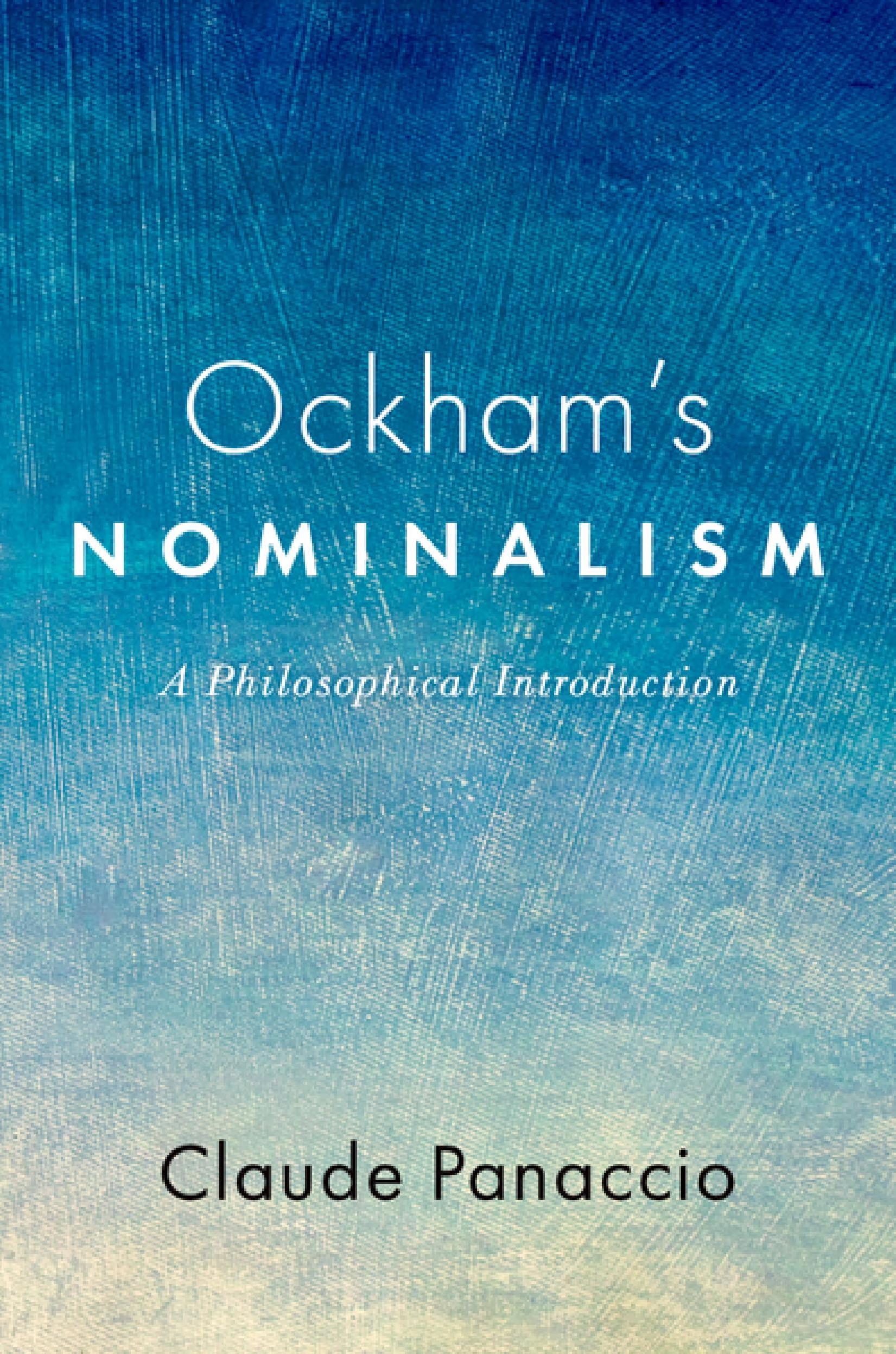
Title: Ockham’s nominalism : a philosophical introduction / Claude Panaccio. Description: New York : Oxford University Press, 2023. | Includes bibliographical references and index.
Identifiers: LCCN 2022027373 (print) | LCCN 2022027374 (ebook) | ISBN 9780190078980 (hardback) | ISBN 9780190079000 (epub)
Subjects: LCSH: William, of Ockham, approximately 1285-approximately 1349. | Nominalism. | Philosophy, Medieval.
LC record available at https://lccn.loc.gov/2022027373
LC ebook record available at https://lccn.loc.gov/2022027374
DOI: 10.1093/oso/9780190078980.001.0001
1 3 5 7 9 8 6 4 2
Printed by Integrated Books International, United States of America
Ackowledgments
I was greatly helped by a number of persons in the preparation of this book. First and foremost, I want to thank Jenny Pelletier, who kindly accepted to look at it with the critical eye of a native speaker of English. Her many judicious suggestions had a significant effect on both the form and the substance of the work.
I also wish to express my gratitude to Susan Brower-Toland, Calvin Normore, Robert Pasnau, and an anonymous reader for OUP, who all generously made me benefit from their precise comments, questions, and objections on partial or complete preliminary versions. Almost all of their remarks led me to rewrite some passages here and there, sometimes importantly.
Martin Pickavé was the spark for this book since he first recommended me to OUP for an introduction to Ockham, and Peter Ohlin acted from then on as my guide and my contact with the publisher with great efficiency and kindness. I am very grateful to the two of them.
Although I have been officially retired since 2016, the University of Quebec at Montreal and its department of philosophy have kindly offered to keep me around by generously granting me the status of emeritus professor along with certain academic facilities. I want to acknowledge the significant support that this has brought to my work.
My greatest debt in the end is to my wife, Claude-Élizabeth, for her daily and affectionate care, especially in the pandemic period, during which most of this book was written.
Ockham’s Writings: Abbreviations
All references to Ockham’s writings will be to the St. Bonaventure critical edition of the Latin text of his philosophical and theological works:
Opera philosophica. Ed. Gedeon Gal, et al. St. Bonaventure, NY: The Franciscan Institute, 7 vols., 1974–1988 (henceforth: OPh).
Opera theologica. Ed. Gedeon Gal, et al. St. Bonaventure, NY: The Franciscan Institute, 10 vols., 1967–1986 (henceforth: OTh).
When an English translation is available, the reference will also be given.
For individual works, the following abbreviations will be used:
Brev. summ. libr. Phys. Brevis summa libri Physicorum [A Short Summa on the Books of The Physics]
Exp. in libr. Perih.
Expositio in librum Perihermenias Aristotelis
[Commentary on Aristotle’s On Interpretation]
Exp. in libr. Phys. Expositio in libros Physicorum Aristotelis
Exp. in libr. Porph.
[Commentary on Aristotle’s Physics]
Expositio in librum Porphyrii de praedicabilibus
[Commentary on Porphyry’s On Predicables]
Exp. in libr. Praedic. Expositio in librum praedicamentorum Aristotelis
[Commentary on Aristotle’s On Categories]
Exp. sup. libr. Elench. Expositio super libros Elenchorum [Commentary on Aristotle’s On Sophistical Refutations]
Ord. Ordinatio [Commentary on Book I of Peter Lombard’s Sentences] (NB: This huge work is divided into 48 parts called “Distinctions,” each one being subdivided in turn in a number of “Questions”)
Quaest. in libr. Phys. Quaestiones in libros Physicorum Aristotelis
[Questions on Aristotle’s Physics]
Quaest. var. Quaestiones variae [Various Questions]
Quodl. Quodlibeta septem [Quodlibetal Questions]
Rep. Reportatio [Questions on Book II, III and IV of Peter Lombard’s Sentences]
x Ockham’s Writings: Abbreviations
SL Summa logicae [Summa of Logic]
Summ. phil. nat. Summula philosophiae naturalis [Summa of Natural Philosophy]
Tract. de corp. Christi Tractatus de corpore Christi [Treatise on the Body of Christ]
Tract. de praedest. Tractatus de praedestinatione et de praescientia Dei respectu futurorum contingentium [Treatise on Predestination, God’s Foreknowledge and Future Contingents]
Tract. de quant. Tractatus de quantitate [Treatise on Quantity]
Introduction
This book is about William of Ockham’s views on universals, relations, and quantities. The underlying conviction is that his ideas on these matters are still of interest for today’s philosophical discussions and that taken together they constitute a rich network of positions and arguments that deserve to be taken into consideration in metaphysics, epistemology, and philosophy of language. Ockham indeed is a towering figure. He is arguably the most important Western thinker between Aquinas in the thirteenth century and Descartes in the seventeenth. Although most of his non-political works were written in the span of about a decade, between 1315 and 1325 or so, his thought quickly spread across Europe and was both highly controversial and exceptionally influential for more than two centuries. Significant traces of it are found in Descartes and Leibniz, for example. Yet, his fame progressively faded in the early modern period. By the early twentieth century, whatever was kept alive from the medieval Latin scholastic period was confined to Catholic milieus, where Thomism was triumphant, and Ockham was no longer seriously studied. Nowadays, although his way of philosophizing bears important affinities with contemporary analytic approaches, most of his works remain untranslated into any modern language; for those that are translated, such as the Summa of Logic and the Quodlibetal Questions, their technicality is an obstacle that dissuades casual readers who are primarily interested in philosophy, as they heavily combine the vocabularies of Aristotelianism and medieval logic with scholastic modes of exposition that now seem rather odd. This is why an introduction is needed.
The focus will be on three central Ockhamist theses that can be brought together under the label of “nominalism.” Here they are in preliminary formulations:
(1) Everything in the world is singular; generality is a semantic feature, not an ontological one: universals are nothing but signs.
(2) Relations are not a special kind of beings; relational signs are special indeed, but this is a matter of the distinctive ways in which they refer to non-relational things.
(3) Quantities, such as numbers and geometrical dimensions, are not a special kind of beings either; quantitative signs are special, but this is also a matter of the distinctive ways in which they refer to things in the world.
These theses are logically independent of each other. One could be a nominalist with respect to universals while accepting singular relations or singular quantities in one’s ontology. Conversely, one might want to countenance universals, but only non-relational ones, or nonquantitative ones. But we can prima facie detect a common inspiration for all three ideas: Ockham wanted to keep the ontology as simple as possible. As we shall see, he did maintain a real distinction between singular substances and singular qualities, but he firmly rejected any additional multiplication of entities. The conjunction of theses (1), (2), and (3) is basically what I call Ockham’s “nominalism”—although he himself never used the term.
Ockham did not mean these theses to invalidate our usual ways of speaking: general predication in his view is a perfectly legitimate tool for describing the world; and relational as well as quantitative statements can be mind-independently true. The challenge, then, is to hold all of this together in a systematic, coherent, and plausible theory without falling into extreme skepticism and relativism. This is precisely what Ockham strives to accomplish. My aim is to explain how he does it, and thus to outline a fascinating nominalist system that is liable, I hope, to enrich the current philosophical conversation.
That this book is an introduction means in particular that it will avoid detailed discussions of interpretation. The exact nature of Ockham’s positions on various subjects has given rise to many a scholarly controversy—which I have at times contributed to—but I will be content here to present my own understanding of his ideas with references to the main Ockham passages where they are developed and a few occasional quotations. On each particular topic, I will mention
along the way a limited number of salient studies that the reader can turn to for further analysis and bibliographical references, and I will often take the liberty of referring to previous writings of mine in which I have more fully argued in support of some of my interpretations.
That this introduction is intended as a philosophical one means that it aims to bring out the significance of Ockham’s thought for philosophical debates that are still on-going about universals, relations, and mathematics. It is in this spirit that the non-Ockhamist term “nominalism” occurs in the title of this book: it points both to the cluster of recent discussions which I think Ockham can fruitfully contribute to and to the school of thought he belongs to. A historian of philosophy always reformulates the doctrines he or she is talking about to some extent. Such reformulations are heavily constrained by a strong requirement of historical accuracy: we do not care much for a pseudoOckham! Historical accuracy, however, leaves room for wide variety in the modes of presentation according to what the historian is interested in in the works of the past, to the intended audience, and to the project the historian is engaged in. We always make selections in the original material, and we have significant leeway as to the vocabulary and categories that we use for describing the ideas we want to draw attention to.1 Although I will not be comparing in any detail Ockham’s positions with those of recent philosophers, I want to stress the aspects of his thought that I take to be relevant today and to present them accordingly. And I will occasionally develop certain ideas that are not explicit in Ockham but that he is committed to or that are strongly suggested by what he says. In such cases, I will make it clear that this is what is going on.2
I will mostly leave aside, on the other hand, the theological aspects of Ockham’s thought. This is not innocuous, admittedly. Ockham was a Franciscan and one of the great theologians of his time. He was deeply and sincerely concerned with theological issues such as the Divine Trinity and the Eucharist, and many of his works are of a theological
1 I develop this point in Panaccio 2019a.
2 For references to contemporary philosophy, I will often be content to cite encyclopedia entries, where the reader will find good general presentations of relevant issues and debates and more bibliographical references.
nature. Even in philosophy proper his positions often had religious motivations, and he regularly made use of theological arguments, having to do most saliently with God’s omnipotence.3 His ideas about universals, relations and quantities, however, are interesting independent of this theological context and can be detached from it to a large extent. Indeed, Ockham himself thought of philosophy as capable of standing by itself, independent of one’s religious convictions, and he considered that Aristotle—as he interprets him—mostly had it right despite not being a Christian. The theological arguments and examples Ockham used in logic, physics, and epistemology were usually treated by him as persuasive means given his intended audience, rather than as indispensable parts of these philosophical disciplines. I am not suggesting that he did not take them seriously. He did. And I will mention some of them along the way. But much of his nominalism is of philosophical value without them.
Here is how I will proceed. Chapter 1 introduces the general notion of “nominalism” that I will be using and shows how it applies to Ockham’s positions on universals, relations, and quantities. Chapter 2 discusses some of Ockham’s main arguments against the corresponding forms of realism. Chapter 3 offers a sketch of Ockham’s positive ontology, with only singular substances and singular qualities in it. Chapter 4 expounds the semantic theory that Ockham devises to support his nominalist claims about general terms, relational terms, and quantitative terms. Chapter 5, finally, shows how he accounts for human knowledge with a theory of mental acts and an elaborate conception of thought as mental language (oratio mentalis).
Before we get to the heart of the matter, a few words must be said about Ockham’s life, works, and intellectual environment. This will help to better understand what he was up to. As far as we know, he was born around 1287 in the village of Ockham, some twenty-five miles southwest of London, and he was entrusted to the Franciscan Order in his childhood. His school curriculum as an adolescent included a lot of Aristotelian philosophy, especially logic, in which he was to eventually become a prominent expert. He was ordained subdeacon in 1306 and
3 For detailed presentations of Ockham’s theology, see in particular Adams 1987: 901–1347, and Maurer 1999: 157–292.
began his theological studies in Oxford shortly thereafter. This was a time of rivalry between the Franciscans and the Dominicans for intellectual leadership in Christian theology. The Dominicans already had a well-established hero, Thomas Aquinas, who died in 1274. On the Franciscan side, the best candidate during Ockham’s youth was the British philosopher and theologian John Duns Scotus. When Ockham was studying theology, Scotus had just died (in 1308), and Ockham eagerly scrutinized his writings. As it happened, though, Ockham found himself in disagreement with much of what Scotus thought.
Before receiving their doctoral degree, advanced medieval students in theology were required to teach a one- or two-year course that consisted in commenting on the standard textbook of theology at the time, Peter Lombard’s Sentences, a treatise in four books dating from the twelfth century. This was their occasion to develop their own thoughts by discussing a wide variety of questions directly or indirectly raised by this textbook. Ockham did this in Oxford between 1317 and 1319, and his first major work, accordingly, is a huge commentary on the Sentences. The part that deals with Book One is by far the most important. It occupies four volumes in the modern critical edition, with a total of more than 2,300 pages. Because it was carefully revised by the author himself for distribution, it is referred to as the Ordinatio. The other three books circulated only as student transcriptions of the original lectures (approved by Ockham, however), and they are collectively known as the Reportatio. Throughout this commentary, Ockham systematically developed keen criticisms of both Aquinas and Scotus, among others, and put forward his own views on a great number of issues, philosophical as well as theological. On the matters of universals, relations, and quantities, in particular, he sharply broke with the dominant realist consensus and defended strong nominalist positions.
This got him into trouble. His doctrines were suspected of having unorthodox theological consequences, and before he could receive his doctoral degree (which he never obtained in the end), he was transferred by the Franciscans to their London college, where he taught logic and natural philosophy from 1320 to 1324. In connection with this teaching he wrote detailed commentaries on Porphyry’s famous treatise on universals, the Isagoge (the Greek word for “introduction”); on Aristotle’s logical treatises On Categories, On Interpretation, and
Sophistical Refutations, and on Aristotle’s Physics; as well as two systematic treatises in natural philosophy, the Short Summa on Physics and the Summa of Natural Philosophy; plus a lengthy series of Questions on Aristotle’s Physics. Even though he did not teach theology during this period, he did not drop it altogether. For one thing, he wrote two short works to defend himself against the suspicion that his views on quantity had unacceptable consequences for the Christian doctrine of the Eucharist: On Quantity and On the Body of Christ. And he participated in biannual public events, during which he answered a wide variety of questions about his innovative positions in both philosophy and theology, thus progressively bringing about one of his most important works, the Quodlibetal Questions (literally: Questions on any subject whatsoever).
Hostility did not calm down, however. In 1324, Ockham was summoned to the papal court in Avignon under suspicion of heresy. A special committee was appointed by Pope John XXII to investigate a list of fifty-one theses allegedly endorsed by Ockham. The work of the committee lasted a few years, during which time Ockham stayed at the Franciscan convent in Avignon. It is probably in this period that he wrote—or at least completed—his magisterial compendium, the Summa of Logic.4 The committee eventually concluded that some heretical doctrines had indeed been defended by Ockham, but the official papal condemnation never came, as Ockham ran into even more serious trouble in the meanwhile by getting involved in a raging controversy between John XXII and the Franciscan Order over Apostolic poverty. The dispute reached such heights that at one point in 1328, the General of the Franciscan order, Michael of Cesena, was placed under house arrest along with Ockham and three other Franciscans. The five friars came to fear for their lives and daringly escaped from
4 According to Ockham’s modern editors, the Summa was written in London in the summer of 1323, but their arguments are not conclusive. It is a lengthy treatise (some 850 pages in the Saint-Bonaventure edition) and a very carefully crafted one, which could hardly have been produced in such a short time, especially given the impressive amount of other works Ockham is thought to have authored during his London period. The Avignon enforced stay, on the other hand, would have been an ideal occasion for him to systematically develop his logical views.
Avignon on the night of May 26, 1328. They were excommunicated shortly thereafter.
The small group found refuge in Pisa with the army of Emperor Louis of Bavaria, who had his own political disagreements with John XXII, and from there they were taken to Munich, where Ockham spent the rest of his life extensively writing on political issues until his death on April 10, 1347. Because of the works he then produced, Ockham stands out as one of the founders of modern political theory.5 This aspect of his thought, however, will be left aside in the present book. My focus here is on doctrines that he developed before his Munich period and to which he never returned.6
5 For an overview of Ockham’s political thought, see McGrade 1974.
6 For general introductory presentations of Ockham’s life and thought, see Spade 1999, Keele 2010, Spade and Panaccio 2019.
1 Nominalism
The term “nominalists” (nominales in Latin) was introduced in philosophy in the second half of the twelfth century to designate the followers of Peter Abelard (1079–1142). The appellation had to do with their solution to the famous problem of universals: species such as man or tulip and genera such as animal or flower were held by them to be mere names (nomina). Their opponents, by contrast—of which there was quite a variety—were called “realists” (reales) because they took species and genera to be real things out there in the world (res).1 By Ockham’s time, a century and a half later, the term had been all but forgotten, and he never used it himself. It only reappeared in the early fifteenth century, sometimes under the slightly revised form “nominalistae,” as the need was felt again for a taxonomy of the schools of thought that were competing with one another across Latin Europe. And again, although several theses were ascribed to the nominalists both in philosophy and in theology, the label was mostly evocative of their distinctive position that universals are signs rather than external things.2 Nowadays, the term is common in philosophy, but it has gained a wider variety of uses. It is necessary therefore to explain in some detail what will be meant here by “nominalism” and how the label applies to Ockham.
1 This is what I take to be the main conclusions of an interesting discussion among specialists that took place in Madison, Wisconsin, in the early 1990s about the origin and scope of the word “nominales” in the twelfth century. See the papers assembled in Courtenay 1992.
2 See Kaluza 1988; Biard 2010, 2017. Kaluza, in particular, identifies three main schools of thought that were recognized as such in the fifteenth century: the peripatetici (followers of Albert the Great and Aquinas), the formalizantes (followers of John Duns Scotus), and the nominales, and he insists that “even though the subjects of disagreement between the schools were numerous, one of them was certainly predominant over all the others and was at the origin of the threefold division of the schools: the topic of universals” (Kaluza 1988: 22; my transl.).
Nominalism is often defined as the thesis that every real thing is particular, or singular. In his groundbreaking 1978 book on universals, the Australian philosopher David Armstrong, for example, writes that “the fundamental contention of Nominalism is that all things that exist are only particulars.”3 This is a useful characterization and I have frequently used it myself in previous writings. It makes it clear that we are dealing with an ontological doctrine, a position that has to do with what kinds of things there are, and more precisely with what the most general kinds of things are. Thus understood, nominalism comes out as a position about the so-called problem of universals, just as it was taken to be in the twelfth and fifteenth centuries: Do universals exist out there in the world? If you say “yes,” you are a realist; if you say “no,” you are a nominalist.
Then again, there are those who prefer to say that nominalism is the refusal to countenance abstract entities in the ontology. And some purported abstract entities, they point out, might not be universals: numbers, for example, or the null set, the one and only set that, according to standard mathematical theory, has no member at all. Think of the opening declaration of Nelson Goodman and W. V. O. Quine’s joint paper “Steps toward a constructive nominalism,” published in 1947: “We do not believe in abstract entities. [ . . . ] We renounce them altogether.”4 Others, such as Keith Campbell, define nominalism as the denial of properties.5 In this sense the so-called trope-theorists, including Campbell himself, are not to be called “nominalists,” since they accept the reality of what they call tropes, which they take to be properties, albeit singular properties such as this particular patch of redness.
Now consider those who want to exclude relations from the ontology. Can’t they be counted as nominalists, too, in a certain sense? One is tempted to say at this point that such philosophers are nominalists with respect to relations. My first suggestion is that this
relativizing strategy should be extended to the other characterizations I previously mentioned. We would thus have: nominalism with respect to universals, nominalism with respect to abstract entities, nominalism with respect to properties, as well as nominalism with respect to relations, each one of them being independently opposed to a corresponding form of realism.
Should we choose one of these or even a fifth one as the right way, or the privileged way, of applying these old labels? Any such choice, I am afraid, is bound to be unduly restrictive. This is best seen in the case of properties. If “nominalism” is taken to be the refusal to countenance properties, then even William of Ockham will be denied the label, since he admitted singular qualities in his ontology in addition to singular substances. And similar inconveniences will follow if we pick the denial of universals or the denial of abstract entities or the denial of relations as the single primary mark of nominalism. A more fruitful approach, I submit, is to take “nominalism” and the corresponding opposite term “realism” as relational terms. A doctrine will be said to be nominalist or realist with respect to something, rather than merely nominalist or realist, period. This makes room for important distinctions between various forms of nominalism and realism while stressing the prima facie connection between these positions: they all have to do with accepting or not accepting certain sorts of entities in the ontology.
This is only a first step, though. As Quine has famously remarked, a philosopher who wants to deny the reality of a certain sort of entities cannot simply say that there are certain things that do not exist.6 What the philosopher has to do is to introduce a description of the purported entities and then deny that such a description applies to anything. Nominalism with respect to universals, say, must provide a reasonably informative description of what a universal is supposed to be. Nominalism with respect to abstract entities must provide a reasonably informative description of what an abstract entity is supposed to be, and so on. But new difficulties arise at this point.
6 See Quine 1963: 1.
Take universals. In the medieval period, a universal was defined as what can be predicated of many. Yet several medieval authors who do not normally count as nominalists, such as Aquinas and Duns Scotus, were quite ready to grant that universals in this sense do not exist in the extramental world. Predication, they reasoned, occurs only in propositions, and propositions occur only in language or in thought; universals, therefore, occur only in language or in thought. Both Aquinas and Scotus, on the other hand, admitted mind-independent common natures within the external things themselves.7 Are we to say that Aquinas and Scotus were realists with respect to common natures, but nominalists with respect to universals? This would be misleading. Things seem to turn out this way only because of the technical sense of the term “universal” (universale) in the Middle Ages, but surely the philosophically interesting feature of Aquinas’s and Scotus’s solutions to the problem of universals is that they countenanced mind-independent common natures even if they did not call them “universals.”
If we want to devise a useful taxonomy of nominalist approaches across the history of philosophy, we should use our own vocabulary and investigate how well it retrospectively applies to certain doctrines of the past. This is not an easy task, either. In the Nominalism entry of the Stanford Encyclopedia of Philosophy, Gonzalo Rodriguez-Pereyra, for example, stipulates that something is a universal if and only if it can be instantiated.8 “Instantiation,” however, is itself a term of art, albeit in recent analytic philosophy rather than in medieval philosophy, and it is not immediately clear what it means and how it can be transposed to medieval philosophy. Professional historians of philosophy often insist that the theoretical vocabularies of distant periods in the history of the discipline are incommensurable with one another in a great number of cases.
What are we to do? On the one hand, we have arrived at the conclusion that the term “nominalism” should be a relational one. We want to speak of nominalism with respect to something or other. On
7 See, e.g., Aquinas, On Being and Essence 3. For an introduction to Scotus on universals and common natures, see Noone 2003.
8 See Rodriguez-Pereyra 2016.
the other hand, we would like, if possible, to provide descriptions of these “somethings” independent of the technical vocabularies of the doctrines we are thus classifying and in such a way that we could detect from the outside, as it were, what these doctrines have to say about them. But we must be careful not to presuppose in doing so that the things the nominalists want to reject do exist after all.
The key to this conundrum is to be found, unexpectedly, in a short text from the fifteenth century, known today as Defense of Nominalism, in which a group of Parisian philosophers apologetically reacted to a decree issued in 1473 by the King of France, Louis XI, prohibiting the teaching of nominalism at the University of Paris, a doctrine that the King himself traced back to Ockham.9 At the very beginning of this text, the authors propose a definition of what they take nominalism to be:
Those doctors are called nominalists [nominalistae] who do not multiply things that are principally signified by terms according to the multiplication of terms. Realists, on the other hand, are those who contend that things are multiplied with the multiplication of terms. [ . . . ] Also, nominalists are called those who apply diligence and study to know all the properties of terms from which depend the truth and falsity of speech, and without which there can be no perfect judgment of the truth and falsity of propositions.10
This characterization of nominalism has two parts to it. First, it says, in substance, that the nominalists do not take it that a distinct category of things in the world corresponds to every distinct category of terms in language.11 And second, the nominalists typically apply great care to the study of semantics. As laconic as it is, the first clause is the one that will especially inspire us. The second clause hardly sorts out a distinctive feature of nominalists. Even in Ockham’s time, there were realist
9 An English translation of this text can be found in Thorndike 1944: 355–360.
10 Ibid., 355–356.
11 Note indeed that, strictly speaking, what the medieval as well as the contemporary nominalists refuse to multiply is not the singular things, but the categories of things. Ockham, for instance, considered that there are as many singular rednesses in the world as there are singular red objects, but he rejected any fundamental distinction between universal things and singular things.
philosophers who did apply diligence and care to the study of semantics. Walter Burley is a salient case in point.12 And of course this is still true of many of today’s realists. This second clause is not to be ignored, as we will see, but it is of interest to us only in virtue of its connection with the first one: insofar as nominalists refuse to multiply things according to the multiplicity of terms, they have to provide some appropriate semantic account for those categories of terms that do not correspond in their view to special categories of things. Nominalists, then, will typically care for semantics even if they are not the only ones to do so. Their distinctive characteristic, however, has to do with the refusal to construe the ontology by projecting the structure of language into it.
This is still too rough, though. Few philosophers ever wanted to multiply things according to the multiplicity of terms. Even among realists with respect to universals, most of them would deny that there is a distinct universal for every linguistic predicate. David Armstrong, for one, subscribes like many others to what he calls a “sparse” theory of universals, which does not, as he puts it himself, make an “uncritical use of predicates” to pick out which universals there are.13 The idea that the distinctive feature of nominalism is that it does not posit a category of things for each category of terms requires some refinement if it is to be of any help. A first step is to take “nominalism” as a relational term as proposed earlier and to speak of “nominalism with respect to something” rather than of nominalism tout court. But here comes a second proposal, inspired by the fifteenth-century Parisian doctors: what nominalism should be relativized to are linguistic categories. We will cash out the idea that nominalists do not multiply entities according to the multiplicity of terms by defining a nominalist position with respect to a certain group of linguistic units as that position according to which there are no special entities corresponding to such linguistic units. This is the definition I will be working with from now on.
It significantly differs from what we had been considering so far. Instead of speaking of nominalism with respect to universals, or with
12 Burley was a bit older than Ockham and he significantly influenced him, especially in semantic theory. On this important author, see Conti 2016.
13 Armstrong 2010: 18. This use of “sparse” in ontology comes from Lewis 1986: 59–60.
respect to relations, or with respect to numbers, as I was informally doing, what will now be required to complete the phrases of the form “nominalism with respect to _ ” is a reference to certain linguistic items. We will speak of nominalism with respect to general terms (or a subgroup of them), or nominalism with respect to relational terms, or nominalism with respect to quantitative terms, and so on.
There are several advantages to this approach. First, “nominalism” now comes out as a genuinely relational term. It relates certain philosophers with certain linguistic units, regardless of whether those linguistic units have external referents or not. Should we keep saying that a philosopher is a nominalist with respect to numbers, for example, we would have to understand the term “number” as a shorthand for a description. And even if we agreed on a particular description of what a number would be if it existed—which might not be an easy task—we should be prepared to admit that this description might apply to nothing in the world, just as the nominalist claims. If so, saying that a philosopher is a nominalist with respect to numbers would not relate the philosopher in question with anything at all and it would not, consequently, be very informative. It would not tell us what the philosopher’s claim is about. By contrast, saying that this philosopher is a nominalist with respect to numerical terms does relate the philosopher with certain real things—namely numerical terms— and tells us what his claim is about: it is about numerical terms.
A second advantage is that what this relational characterization of nominalism relates the philosopher to—namely, linguistic items—is in all cases something that we are familiar with independent of any philosophical theory, whether our own or those of the philosophers we are talking about. The categorization of linguistic items might require a minimum of theoretical framework, admittedly, but very little of it is needed for sorting out the varieties of nominalism we might be interested in. Whether on the basis of their syntax or of their most conspicuous semantic features, we usually have no trouble identifying general terms or relational terms or numerical terms in our language or in the language of the philosophers of the past.14 Describing a given
14 To be sure, identifying the category of abstract terms might be a bit more difficult. Ockham at any rate uses for this a purely morphological feature; see below, pp. 23–26.
doctrine as denying (or asserting, for that matter) that a special category of real things corresponds to general terms, or to relational terms, or to numerical terms is prima facie more manageable than saying that it denies (or asserts) the reality of universals or relations or numbers.
Furthermore, the philosophers we are dealing with were also quite familiar with linguistic units of the said categories. There were general terms, relational terms, and numerical terms in Greek, Latin, and Arabic, just as there are in English, French, Italian, and German. I am not claiming that such terms are to be found in all past, present, and possible future human languages. But they certainly are present in the languages of the philosophers we want to classify as nominalists or realists in the relevant respect. And these philosophers are (or were) usually aware that their theses—the theses at least that we want to stamp as nominalist or realist—had to do with such terms somehow. It was clear to Abelard, Scotus, and Ockham, as much as to Locke, Hume, and Russell, or to Nelson Goodman, David Armstrong, and Gonzalo Rodriguez-Pereyra, that their positions on “universals” crucially required an account of how general terms work. And it was clear to Ockham and to Leibniz as much as to Russell and Moore or to E. J. Lowe and Peter Simons that their theory of “relations” crucially required an account of how relational terms work. They might not have thought that providing such accounts was the primary goal of their respective doctrines, but they all more or less self-consciously knew or felt that it was a requirement they had to fulfil. Defining the different varieties of nominalism and realism by reference to linguistic categories thus allows us to pinpoint a common object for all of these theories from different periods in the history of philosophy and a common requirement with respect to which their degree of success can be evaluated.
This is not to reduce the question of universals, or relations, or numbers merely to a matter of philosophy of language. A satisfactory account of general, or relational, or numerical terms must involve metaphysics and epistemology as well as semantics. And we should not presume that semantics is necessarily predominant. The structure of the various theories we are interested in can vary indefinitely. But