all pagesshowinfull version,BuyNowVitalsourceDownloader www.ebook-converter.com
AbouttheAuthor
Lucy Hood, PhD, RN is the daughter of an American auto worker. She graduated from St. Luke’s Hospital of Kansas City Diploma Nursing School. She returned to school and earned a BSN from Webster College (now Webster University), an MSN from UMKC, and a PhD in Nursing from Widener University, Chester, Pennsylvania. With 14 years of experience in the areas of medical-surgical and neuroscience nursing, she embarked on a career in nursing education. Dr. Hood currently serves as the Department Chair, Pre-Licensure Nursing Education in the School of Nursing and Health Sciences at MidAmerica Nazarene University in Olathe,Kansas.Prior toher current position,shehasmorethan25yearsof teachingexperienceintraditional undergraduate,RNtoBSN,andgraduate nursing programs at Saint Luke’s College of Health Sciences in Kansas City, Missouri and MidAmerica Nazarene University. She also has taught in the Clinical Pastoral Education Program at St. Luke’s Hospital of Kansas City. Professional nursing activities include membership in the ANA, MONA, ONS, NLN, and AANN. She has been a member of the MONA Advocacy Committee which involves political activism. She is a volunteer musician for St. Margaret of Scotland Catholic Church. Currently, she and her husband enjoy antiquing, gardening, and caring for their dachshund,Yoda.
all pagesshowinfull version,BuyNowVitalsourceDownloader www.ebook-converter.com
Contents
Section 1
Exploring Professional Nursing
Chapter 1 TheProfessional Nurse
Characteristicsof Professional NursingPractice: TheHood
Sue graduated from an Associate’s Degree in Nursing (ADN) program and has been working as a night charge nurse on a medical-surgical unit. Her nurse manager recently hired a new nurse with a Bachelor of Science in Nursing (BSN) degree. Sue thinks that perhaps she should go back to school and earn a BSN in order to feel secure about her current position. While speaking with a friend, Sue says, “I am a good nurse even though I don’t have a BSN. I don’t see how more education will make me more professional or improve my patient care, but I see where it may make my charge nurse position secure.”
What assumptions has Sue made relative to the importance of education in nursing practice?
How would you respond to her?
What are your thoughts about the BSN and higher education for nurses?
Professional nurses comprise the largest group of health care workers in the United States. More than 3 million registered nurses (RNs) are living in the United States, about 2.8 million of whom are employed as professional nurses (Kaiser Family Foundation, 2016; U.S. Bureau of Labor Statistics [BLS], 2015a [U.S. Department of Health & Human Services, 2014]). Professional nurses are RNs with a broad scope of practicethat isdeterminedbyeachstate.
Some people consider all caregivers as “nurses.” This logical confusion stems from the fact that people who tend to the sick, injured, disabled, or elderly commonly have the word “nurse” in their job title, such as nursing assistants or licensed practical/vocational nurses (LPN/LVNs). However, professional nurses offer a specialized service to society. They assume ultimate accountability for client outcomes, and they supervise and educate LPN/LVNs and unlicensed assistive personnel (UAP) as they assist innursingcaredelivery.Althoughtheyfrequentlyperform tasksthat could be done by other health team members, professional nurses bring an ability to improvise while individualizing client care in a variety of
settings. Professional nurses use science and theories as a basis for professional practice along with art when modifying care approaches. Thus nursing is often considered both an art and a science (see Box 1.1, Professional Prototypes,“Essential Featuresof Professional Nursing”).
1.1 ProfessionalPrototypes
EssentialFeatures of ProfessionalNursing
Professional nurses assume responsibility to the public for using the best evidence to provide safe, high-quality health-related services for all whom they serve. In Nursing’s Social Policy Statement, the American Nurses Association (2010) identified the following “key essential features of professional nursing” (p. 9).
1. Provide “a caring relationship” that facilitates health and healing.
2. Attend “to the range of human experiences and responses to health and illness within the physical and social environments.”
3. Integrate “assessment data with knowledge gained from an appreciation of the patient or the group.”
4. Apply “scientific knowledge to the process of diagnosis and treatment” by using “judgment and critical thinking.”
5. Advance “professional nursing knowledge through scholarly inquiry.”
6. Influence “social and public policy to promote social justice.”
7. Assure “safe, quality, and evidence-based practice.”
CHARACTERISTICS
OF PROFESSIONAL NURSING PRACTICE: THE HOOD PROFESSIONAL NURSE CONTRIBUTIONS MODEL
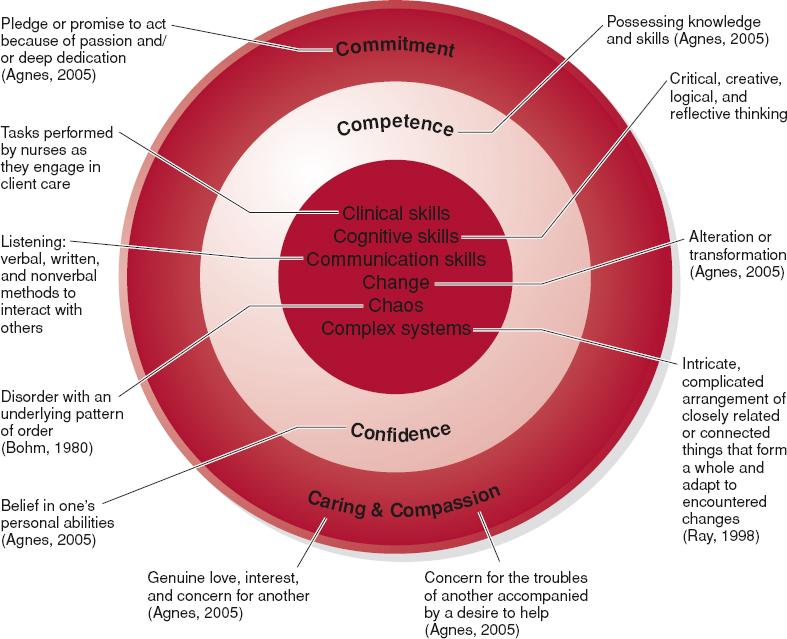
As interdisciplinary health team members, nurses make many unique contributions to health care delivery in clinical settings. The Professional Nurse Contributions Model (Fig. 1.1) synthesizes the affective, cognitive, behavioral, and psychomotor domains of professional practice. Themodel’scircular form designateshowtheinterprofessional healthcare team surrounds healthcare consumers.Asolidouter circle emphasizes the importance of all team members working cohesively for the benefit of care recipients. Each of the concepts in this model is integrally connected totheotherstoresult inaunifiedwhole.
In an ideal world, all health care team members share an altruistic attitude toward the individuals they serve. Many people enter the nursing profession because they genuinely care (caring) about other people and have a desire to help others in time of need (compassion). Caring, compassion, and commitment are the key affective domains for optimal professional nursing that are intricately linked and comprise the outer circle of the model. The attitudes of caring, compassion, and commitment are key for nurses to view nursing as a profession rather than just a job. Two additional attributes of nurses that are closely linked are competence and confidence. Clients expect competence from health care providers. Likewise, health care providers expect competence from each other. To provide safe, effective patient care, nurses must have competence with clinical skills and decision making. Many nursing education programs use simulations with high- or low-fidelity manikins to provide students with the opportunities to learn essential clinical skills and clinical decision making in a safe learning environment (Wilson & Rockstraw, 2012). Current literature emphasize that students gain and retain knowledge, learn clinical skills, and develop confidence in nursing abilities from simulated learning experiences (Alexander et al., 2015; Aqel & Ahmad, 2014; Engum & Jeffries,2012; Weaver,2011).
Before competence can be achieved, however, professional nurses must have confidence in their ability to execute the clinical, communication,
and cognitive skills needed for effective practice. Simulated clinical experiences in nursing education also build confidence in nursing students (Weaver, 2011). As the nurse’s confidence improves, he or she becomes willing to question orders and actions by others that may not appear to be logical or safe.Patients andfamilies feel moreat easewhenreceivingcare from a confident nurse. For example, the nurse who knows howto start an IVlineandhasconfidenceinhisor her abilitywill attempt tostart IVs.As the nurse gains experience in starting IVs, he or she refines his or her techniqueandeventuallypossesstheabilitytostart IVsinanypatient.The nurse’s colleagues identify him or her as the IVstarting expert on the unit (confidence booster). The nurse gains more experience starting IVs even when colleagues cannot (increasing competence). Thus, there appears to beasymbioticrelationshipbetweenconfidenceandcompetenceinnursing practice.
The innermost circle in the model depicts the overlapping skills and circumstances with which nurses must work and cope. The roles assumed by nurses require that they have a repertoire of clinical, cognitive, and communication skills. The nurse must always have sound reasons behind clinical decisions and actions and be able to communicate the reasons well. A broad knowledge base related to all information and strategies availableenablethenursetodecidethebest courseof actiontotakeinany given clinical situation. Highly refined clinical, cognitive, and communication skills delineate professional nurses from all other membersof thehealthcareteam.
Nurses deliver health care in complex systems, so it is important that they understand the nature of these systems and are able to manipulate them. Wiggins (2008) described health care systems as complex adaptive systems in which interdependency exists among individuals and groups. Each individual’s actions within complex adaptive systems are based on current knowledge and past experiences. Just like the human body is composed of interacting systems, the client is part of a community, communities form states, states form nations and nations are part of the global community. The earth is part of a solar system which is part of a galaxywhichispart of theuniverse.
Nurses frequently encounter complicated client situations and must adapt to change asnewscientificevidenceemerges,reformsoccur inlegal aspects of health care delivery, and, most importantly, patient conditions fluctuate. Finally, professional nursing practice has an element of unpredictability and disorder that is conceptualized as chaos. Nurses continuouslymakecomplexandmultipledecisionsandmaybringorder in today’s clinical environments. Once order is achieved, something occurs that results in disorder. The pattern of ever-emerging chaos creates constant challenges for nurses. Upon acknowledgment of the deeper underlying, uniform pattern of chaos, nurses understand that they cannot control all clinical practice events. Even though a clinical setting may have a well-defined organization, nurses must adapt to and work in an ever-changing,highlycomplex,andchaoticenvironment.
CORE COMPETENCIES FOR PROFESSIONAL NURSES
The concept of core competency arose in the 1990s. A core competency can be defined as “a defined level of expertise that is essential or fundamental to a particular job; the primary area of expertise; specialty; the expertise that allows an organization or individual to beat its competitors” (Dictionary.com, n.d.). In professional nursing, core competencies are fundamental knowledge, abilities, and skills that enable nurses to provide safe, effective care to other persons in health care settings. In many health care settings, professional nurses are expected to display competence in a particular area of practice on an annual basis. Frequently, nursing staff development departments design and deploy activities to verify that nurses possess a certain level of competence with theknowledgeandskillsappropriatetotheir clinical practiceareas.
In 1973, the American Nurses Association (ANA) published the first Standards of Nursing Profession. The goal was to develop a generic list of standards for professional nurses that wouldapplyacross practice settings. The standards primarily focused upon nursing process (assessment, diagnosis, planning, implementation, and evaluation) which at the time articulated a thinking model for all nurses to use in clinical practice. As time passed, the original standards of nursing practice have evolved into the Scope and Standards of Nursing that outline all key elements of professional nursing practice including nursing process and key competencies (knowledge and skills) for meeting each standard of professional practice. Although the competencies are designated, the execution of each competency may be context dependent. For example, Standard 3 Outcome Identification and Standard 4 Planning specify that the patient, significant others, and other health team members should be involved in determining the desired outcomes and how to achieve them (ANA, 2015c). If the patient is unconscious or has been legally declared mentallyincompetent,thenthepatient is unabletobeanactiveparticipant inthedeterminationof caregoalsandplannedactionstoattainthem.
By the 1990s, the ANA recognized the need to develop standards of practice for nursing specialty areas and collaborated with the nursing specialty organization to develop context-based scope and standards or practice including those for school faith community, psychiatric–mental
health, transplant, holistic, pediatric, forensic, hospice and palliative care nursing, and nursing administration. The ANA’s (2015c) third edition of the Nursing: Scope and Standards of Practice, contains 6 standards addressingnursingprocess (assessment,diagnosis,outcomeidentification, planning, implementation, and evaluation) and 11 standards related to professional performance (ethics, culturally congruent practice, communication, collaboration, leadership, education, evidence-based practice and research, practice quality, professional practice evaluation, resource utilization, and environmental health) (ANA, 2015a). Disposing usedneedles andsharpimplements (e.g.,needles,disposable scissors) into hard, impermeable boxes labeled “biohazard” is an example of a competency related to environmental health. In 1990s, the Institute of Medicine (IOM) published a series of reports outlining safety and quality concerns within the American health care system. The Robert Wood Johnson Foundation provided funding to Linda Cronenwett, PhD as principal investigator and the American Association of Colleges of Nursing(AACN) for the QualitySafetyEducationfor NursingInitiative to develop strategies for nursing practice and education for continuously improving and enhancing safety in health care delivery. During the first phase of the project, the following six core competencies were identified for professional nursing: “patient-centered care, teamwork and collaboration, evidence-based practice, quality improvement, informatics, and safety” (QSEN Institute, 2014, para 4). Along with identifying the competencies, the initiative developed sets of knowledge, skills, and attitudes for each of them. The project initially addressed pre-licensure nursing education, but eventually was expanded to address graduate nursingeducation(QSENInstitute,2014).
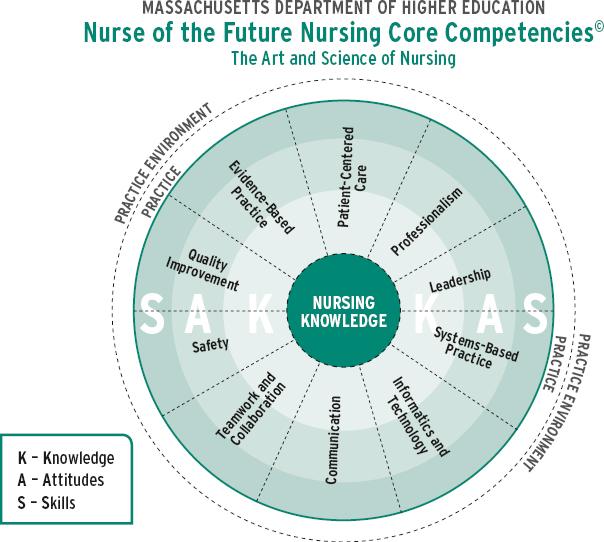
In March 2006, the Massachusetts (MA) Department of Higher Education and the MA Organization of Nurse Executives held a workshop Creativity and Connections: Building the Framework for the Future of Nursing Education and Practice that was attended by 32 key stakeholders in nursing education and practice. An outcome of the workshop was the formation of a subcommittee to develop a set of core professional nursing competenciestofacilitateaseamlesscontinuum for progressioninnursing education. Between 2006 and 2009, the committee reviewed the best practices,standards andinitiatives educationprogressiontocreate a list of
Nurses assume multiple roles while meeting the health care needs of clients. They serve as caregivers when providing direct client care. Their client advocate role emerges when they intervene on behalf of clients to ensure that adequate information and decision-making resources are providedandthat client wishes are respectedat all times.Theyassume the role of teacher when providing education to UAP, clients, family members, students, each other, and interprofessional colleagues. When working to reform public policy, modify work processes, or transform workplace environments, nurses become change agents. They accept the role of coordinator when assuming supervisory and managerial responsibilities. Nurses also act as counselors, providing emotional and spiritual support to clients. Finally, they assume the role of colleague among all health team members. To execute these multiple roles effectively and with genuine compassion, nurses must commit themselves tolifelonglearning.
Take Note!
To execute multiple roles effectively and with genuine compassion, nurses must commit themselves to lifelong
learning if they are to effectively and compassionately execute their multiple roles.
CHALLENGES OF THE PROFESSIONAL NURSING STUDENT
Anyone who assumes the role of professional nursing student will need to make lifestyle changes to be successful. The added responsibilities of nursing school means that life as previously known will be greatly altered. Previous routines will be disrupted and personal sacrifices will be needed. Money once used for recreation is spent on tuition, student fees, books, and other school supplies. Less time is available to spend with family and friends. Families and friends have different reactions as the nursing student role is assumed. The reactions vary from feeling neglected (which may result in actions to derail the educational process) to intense pride (as they watch their significant other grow). Ongoing communication between the new student, family, and friends enables all involved parties to understand how roles will be altered and what lifestyle changes will need tooccur (Dunham,2008; Quan,2006).
Meeting job and school responsibilities may be challenging for employed students. Employers may not support educational endeavors. Some coworkers may add to the difficulties by complaining about or refusing work schedule changes; others may express pride in their colleagueandhelptoaccommodatethestudent’sschedule.
Part of thetoll of returningtoschool isenteringintounfamiliar learning situations. The once-confident honor student or professional nurse may question his or her ability to survive in an intense academic program. The educational process is designed to change people. During times of change, peoplefrequentlyencounter feelingsof discomfort.
REAL-LIFE REFLECTIONS
Remember Sue, from the beginning of the chapter.
What obstacles might she encounter at home and in the workplace if she decides to return to school?
Can you suggest strategies Sue can use to defray the potential chaos that returning to school might bring?
SKILLS FOR EDUCATIONAL SUCCESS
In ideal educational situations, students and faculty interact with each other as colleagues. Faculty design educational experiences and students bear the responsibility for active engagement in learning activities. In traditional education, faculty members serve as authoritarian experts who impart knowledge to students and may create oppressive climates. In educative-caring education, students and faculty members hold equal status and faculty members strive to create effective learning climates basedonactiveandparticipativelearning(Bevis& Watson,2000; Billings & Halstead, 2005; Young & Paterson, 2007). Such egalitarian interactions withfacultymembersprovidestudentswithexperienceincollegiality. When students assume responsibility for learning, they reap maximum benefits from the educational process. To make professional transitions, nurses focus their educational efforts on refining previously learned skills while establishing theoretical foundations for professional practice. Theory-based practice enables professional nurses to understand complex situations and anticipate potential complications in clinical settings. Learners need a variety of skills to be successful in the educational process.
Take Note!
To make the most of the educational process, students must assume responsibility for learning and utilize a variety of skills.
Reading,Listening,and Speaking
Reading constitutes a major component of a successful education experience, but finding time to read remains a challenge for today’s busy students—especially as they juggle multiple roles. Effective reading skills streamline the study process. Trying to read and digest each word printed on a page (or screen) is inefficient. When students master the skill of reading for major ideas within a passage, reading becomes more efficient (Dunham, 2008; Osuna, 2014). Strategies to develop reading effectiveness and efficiency include reading for general understanding of ideas, using learning outcomes to identify key concepts, taking notes while reading, highlighting key points, and taking brief reading breaks between major headings within a chapter. During reading breaks, some students find it beneficial toparaphrasewhat hasbeenread.
In educational settings, effective speaking and listening skills are essential to success. Students listen to faculty members as they share their nursing expertise. Taking time to think before responding to faculty-posed questions enables better organization of thoughts and selection of the best words to convey an answer. Most nursing programs require that students give oral classroom presentations to facilitate refinement of public speakingskills.
Asking questions is essential to avoid making errors in both education and health care settings. Most people (especially clinical nursing faculty and nurses) welcome questions from students. However, fear prevents some students from asking questions. Sometimes, the most difficult task to master is learning what questions need to be asked and having the couragetoaskthem.
Because nursing relies on teamwork, faculty frequently assign group project. Some students dread group projects because of the difficulty finding time to connect with group members. Osuna (2014) offers the followingsuggestionstosurvivegroupprojects:
1. Provide all members of the group with contact information to facilitate thesharingof project information.
2. Appoint a group leader who organizes the project timeline, requests member project sections, pulls the entire project together for a finished