Exploring the Variety of Random Documents with Different Content
Supratemporal much produced posteriorly, extending over the anterior vertebrae; suborbitals absent; snout forming a long tube, which terminates in a narrow mouth with minute teeth. Spinous dorsal entirely absent. Pterygials of pectoral fin very elongate. Ventral fins very small, with 6 soft rays, inserted far behind the pectoral girdle.
The Flute-mouths, Fistularia, which Dr. Günther describes as "gigantic marine Sticklebacks living near the shore, from which they are frequently driven into the open sea," are represented by three species, from the tropical and subtropical parts of the Atlantic and Indo-Pacific. The middle rays of the forked caudal fin are produced into a long filament. The largest species, F . tabaccaria, reaches a length of 6 feet. The same genus is represented by two species in the Upper Eocene and Oligocene of Europe, and Urosphen, from the Upper Eocene, is regarded as allied to it.
Fam. 7. Centriscidae.—Body moderately elongate, partially enclosed in a bony armour, which is distinct from the endoskeleton. Anterior vertebrae elongate, with strong parapophyses ankylosed to the exoskeleton; no ribs. Suborbitals absent; snout forming a long tube, with small, terminal, toothless mouth. Two dorsal fins, the anterior with a very strong spine. Pterygials of pectoral fin very small. Ventral fins small, with 4 or 5 rays, the pelvic bones in contact with the postclavicles.
Centriscus, with five species in the Atlantic and Pacific Oceans, represents this family at the present day. C. scolopax has occasionally been found on the English coast. Isolated spines from the Pliocene of Tuscany have been referred to the same genus. Rhamphosus, from the Eocene of Monte Bolca, is believed to have been allied to Centriscus.
Fam. 8. Amphisilidae.—Near the preceding, but body extremely compressed and completely enclosed in a thin bony armour which is fused with the endoskeleton; the caudal region, much abbreviated, is free and relegated to the ventral surface, the body terminating in the two dorsals, of which the first bears a strong spine. The ventral fins are far back, very small, formed of 3 or 4 rays.
Amphisile is represented by three or four recent species in the Indian and Pacific Oceans, and two are known from Upper Eocene and Oligocene beds in Europe. Dr. Arthur Willey has observed these fishes in the Southern Pacific. A. strigata "lives in small shoals of about half-a-dozen individuals, and swims about with rapidity in a vertical position, cleaving the water with its razor-shaped body."
Fam. 9. Solenostomidae.—Body moderately elongate, with large star-like ossifications. Anterior vertebrae elongate, without transverse processes; no ribs. Snout much produced, tubiform; mouth, small, terminal, toothless; no praeoperculum; symplectic elongate; gill-opening wide; gill-lamellae small rounded lobes. Two short dorsal fins, the rays of the anterior not articulated, flexible spines. Pterygials of pectoral fin very small. Ventral fins large, with 7 rays, behind the pectoral arch. No air-bladder.
The unique genus, Solenostomus, with three or four species from the Indian and Pacific Oceans, may be regarded as in many respects intermediate between the Centriscidaeand the Syngnathidae. In the female the inner side of the ventral fins coalesces with the integuments of the body, forming a large pouch for the reception of the eggs.
Solenorhynchus, from the Upper Eocene of North Italy, probably belongs to this family, but its form is much more elongate, and the exoskeleton is in regular rings.
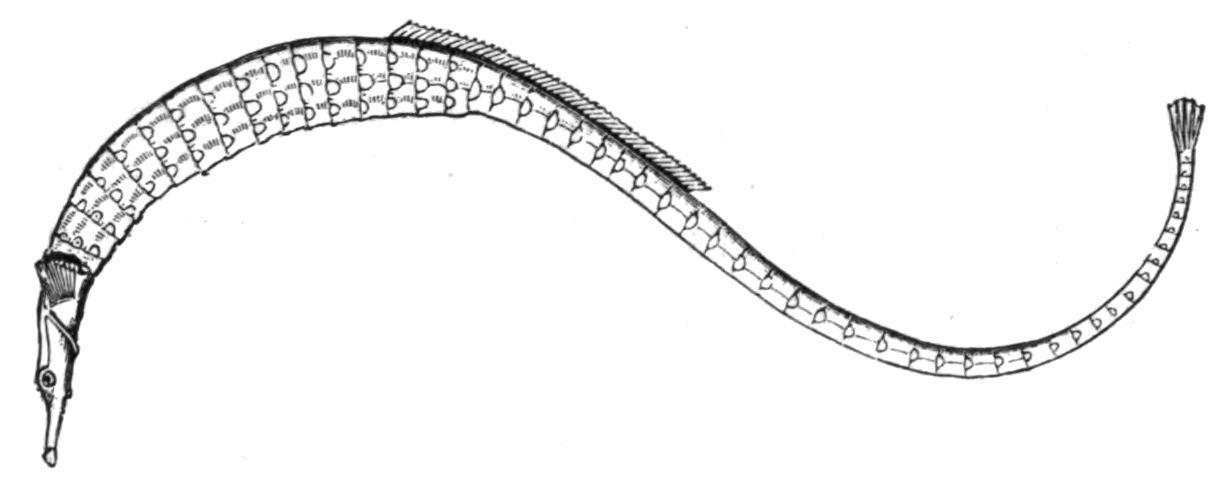
Fam. 10. Syngnathidae.—Body more or less elongate, protected by an exoskeleton forming rings. Anterior vertebrae not elongate; parapophyses strong, ankylosed to the exoskeleton; no ribs. Snout much produced, tubiform; mouth small, terminal, toothless; no praeoperculum; symplectic elongate; gill-cleft reduced to a very small opening near the upper posterior angle of the gill-cover; gilllamellae small rounded lobes. A single dorsal fin. Pectoral fins, if present, with very small pterygials; ventrals absent. Caudal fin often absent; tail sometimes prehensile.
FIG. 386. Syngnathuspelagicus.
This family embraces about 175 marine species, and is represented over the greater part of the world. Principal genera: Siphonostoma, Syngnathus, Penetopteryx, Ichthyocampus, Nannocampus, Osphyolax, Urocampus, Doryichthys, Coelonotus, Stigmatophorus, Nerophis, Protocampus, Gastrotoceus, Solenognathus, Hippocampus, Acentronura, Phyllopteryx.
Remains are found in the Upper Eocene and Miocene beds of Europe, and have been referred to Siphonostoma and Syngnathus, and to the extinct genus Calamostoma. It is probable that Pseudosyngnathus, from the Upper Eocene of Monte Bolca, is the type of a distinct family.
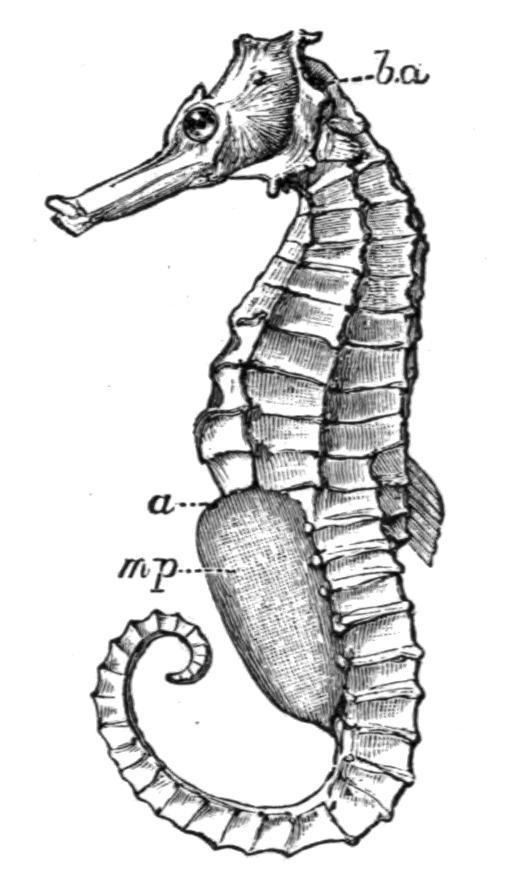
The best known members of this family are the Needle-Fish or PipeFish (Siphonostomaand Syngnathus) and Sea-Horse (Hippocampus) of our coasts. The latter, like Amphisile, swims with the body in a vertical position. In most species the male takes charge of the eggs, in a pouch under the tail (Siphonostoma, Syngnathus, Penetopteryx, Nannocampus, Stigmatophorus, Hippocampus), in a groove under the tail (Phyllopteryx), or in a groove on the abdomen (Doryichthys, Coelonotus, Nerophis, Gastrotoceus).
FIG. 387.—Hippocampusguttulatus. Male, showing brood-pouch (mp). a, Anus; b.a, branchial aperture.
FIG. 388.—Phyllopteryxeques. ½ nat. size.
An Australian species of Syngnathus has been described by E. P. Ramsay under the name of S. intestinalis, from its living inside Holothurians, in the manner of Fierasfer, and G. Lunel has observed a Doryichthysto offer a similar instance of inquilinism.
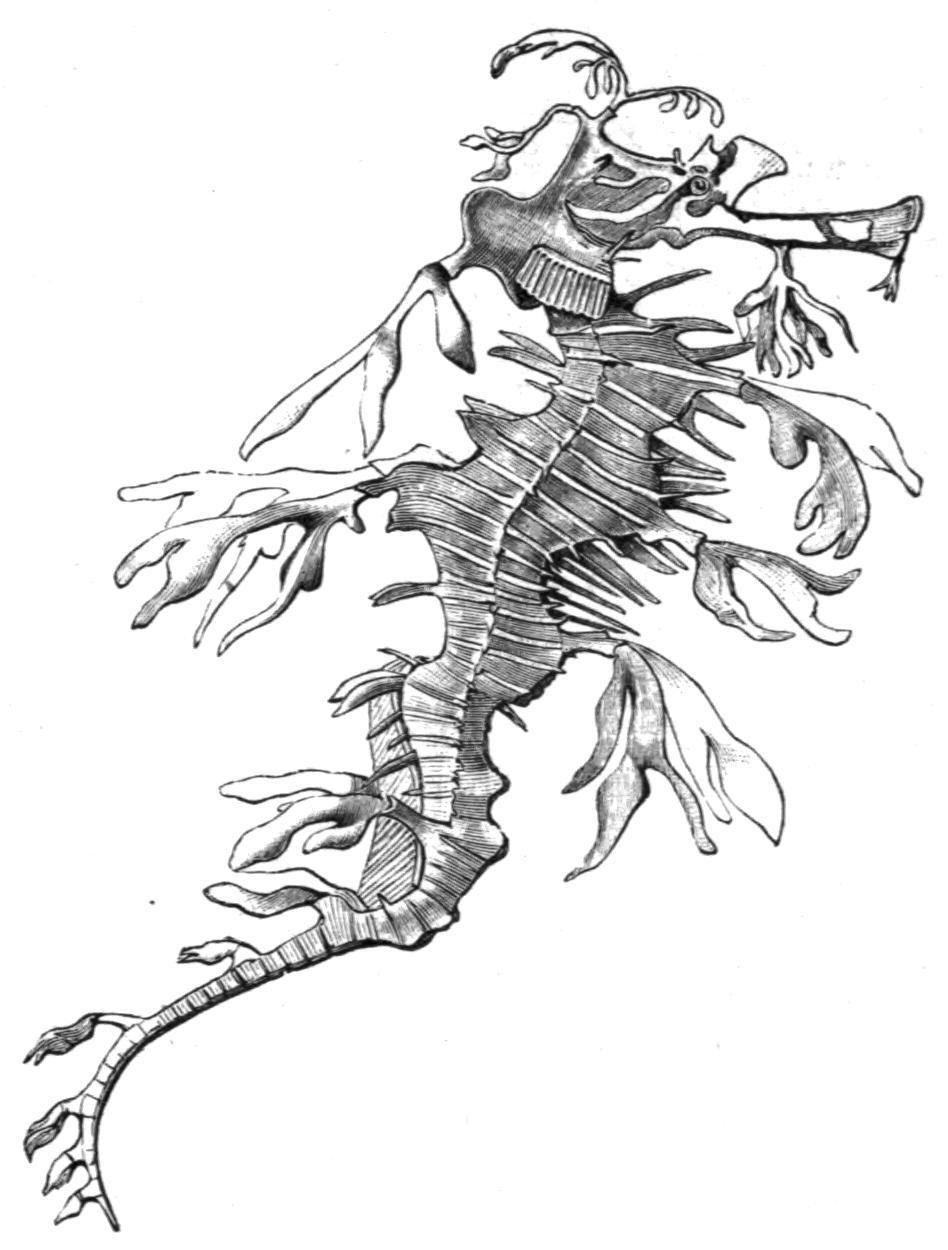
One of the most remarkable types of Syngnathids is Phyllopteryx, from Australia. The spines and knobs of the head and body are furnished with dermal appendages, which closely imitate the fucus among which they live.
Fam. 11. Pegasidae.—Body short or moderately elongate, encased in an exoskeleton forming rings. Anterior vertebrae not elongate; no ribs. Snout produced beyond the mouth, which is small, inferior, and toothless; no praeoperculum, no symplectic; gill-opening very small; gills pectinated. A single dorsal fin. Pectoral fins large, horizontal; ventrals reduced to one or two filamentous rays, behind the scapular arch. Air-bladder absent.
Five or six species, referable to two genera, Pegasus and Parapegasus, make up this family. They are very small fishes, inhabiting the coasts of China, Japan, Arabia, the Malay Archipelago, and Australia. Pegasus is remarkable among all fishes in having the five anterior rays of the pectoral fin transformed into strong spines.
Sub-Order 8. Percesoces.
Air-bladder, if present, without open duct. Parietal bones separated by the supraoccipitaL Pectoral arch suspended from the skull; no mesocoracoid arch. Ventral fins, if present, abdominal, or at least with the pelvic bones not solidly attached to the clavicular arch.
This group connects the Haplomi with the Acanthopterygii, the Scombresocidae being somewhat related to the Cyprinodonts,[706] whilst the Anabantidae show distinct affinity to the Osphromenidae in the following sub-order. Other families, previously included among the Scombriform Acanthopterygians, are placed here on the assumption that the loose attachment of the pelvic bones to the clavicles is a primitive character, and not the result of degeneration, such as occurs in some cases among true Acanthopterygians. Although this sub-order is perhaps only an artificial association, it must be borne in mind that, notwithstanding the very wide divergence which exists between the first and last families, and however dissimilar their members may appear to be at first sight, a gradual passage may be traced connecting the most aberrant types.
SYNOPSIS OF THE FAMILIES.
I. Ventral fins, if present, inserted far behind the pectorals; no spines to the fins.
Ribs attached to the extremity of much-developed parapophyses; lower pharyngeal bones completely united; pectoral fins inserted very high up .......... 1. Scombresocidae.
Ribs mostly sessile; lower pharyngeal bones distinct; pectoral fins nearer the ventral than the dorsal line .......... 2. Ammodytidae.
II. Ventral fins, if present, more or less approximated to the pectorals.
A. Two well-developed dorsal fins, the anterior small and formed, at least in part, of spinous rays.
1. Ribs attached to strong parapophyses.
Pelvic bones free or connected with the clavicles by ligament; pectoral fins inserted high up .......... 3. Atherinidae.
Pelvic bones suspended from the postclavicles; pectoral fins inserted very high up; teeth very feeble or absent .......... 4. Mugilidae.
Pelvic bones suspended from the postclavicles; pectoral fins low down, with detached lower rays .......... 5. Polynemidae.
Pelvic bones connected with the clavicles by ligament; pectoral fins nearer the ventral than the dorsal line; dentition powerful, cardiform; scales minute or absent .......... 6. Chiasmodontidae.
2. Anterior ribs sessile; pelvic bones not connected with the scapular arch; pectoral fins nearer the ventral than the dorsal line .......... 7. Sphyraenidae.
B. Spinous dorsal, if present, connected with the soft.
1. Anterior vertebrae without parapophyses; scales on head, if present, small.
Oesophagus with lateral sacs which are beset with papillae internally; spinous dorsal long; scales rhomboidal, in oblique transverse series; pelvic bones free .......... 8. Tetragonuridae.
Oesophagus with lateral sacs which are beset with toothed papillae internally; spinous dorsal, if distinct, shorter than the soft dorsal; scales moderate or small, cycloid, often deciduous .......... 9. Stromateidae.
No sacs in the oesophagus; fins without spines; scales very small or absent .......... 10. Icosteidae.
2. All, or all but the anterior two vertebrae with parapophyses; scales on head large; a superbranchial cavity.
No spines to the fins .......... 11. Ophiocephalidae.
Strong spines to the dorsal, anal, and ventral fins .......... 12. Anabantidae.
Fam. 1. Scombresocidae.—Maxillary entering the border of the upper jaw; dentition moderately strong or feeble. Lower pharyngeal bones united. Praecaudal vertebrae with strong parapophyses supporting the ribs. Body covered with cycloid scales. Pectoral fins
inserted very high up; ventral fins widely separated from the pectorals, without spines, with 6 rays. Dorsal fin opposed to the anal, and likewise formed entirely of soft rays. Air-bladder generally present, sometimes cellular.
The shape of the head and body vary greatly, and the pectoral fin may reach an extraordinary wing-like development. The dorsal fin may be followed by a series of finlets, as in many of the Scombridae.
Most of the Scombresocidae, of which about 200 species are known, are marine; some are carnivorous, others (Hemirhamphus) mainly herbivorous, feeding on green algae. Nearly all are in the habit of making great leaps out of the water, this tendency culminating in the Flying-Fish (Exocoetus), which skip or sail through the air in a manner the explanation of which has given rise to much controversy. According to the latest evidence[707] the sole source of motive power is the action of the strong tail while in the water; no force is acquired while the fish is in the air. The pectorals are not used as wings but as parachutes. There is every passage between the small pectoral fin of a Saurie (Scombresox) or a Hemirhamphus and the swallow-like wings of the most developed Exocoetus. The genus Hemiexocoetus is a very remarkable connecting form. The Gar-Pike (Belone), of which one species is common on our coasts, have both jaws produced into a long slender beak; the bones are green. In Hemirhamphus the lower jaw only is prolonged; some of the species, living in fresh water, are viviparous, the anal fin being modified into a copulatory organ, as in many Cyprinodonts.
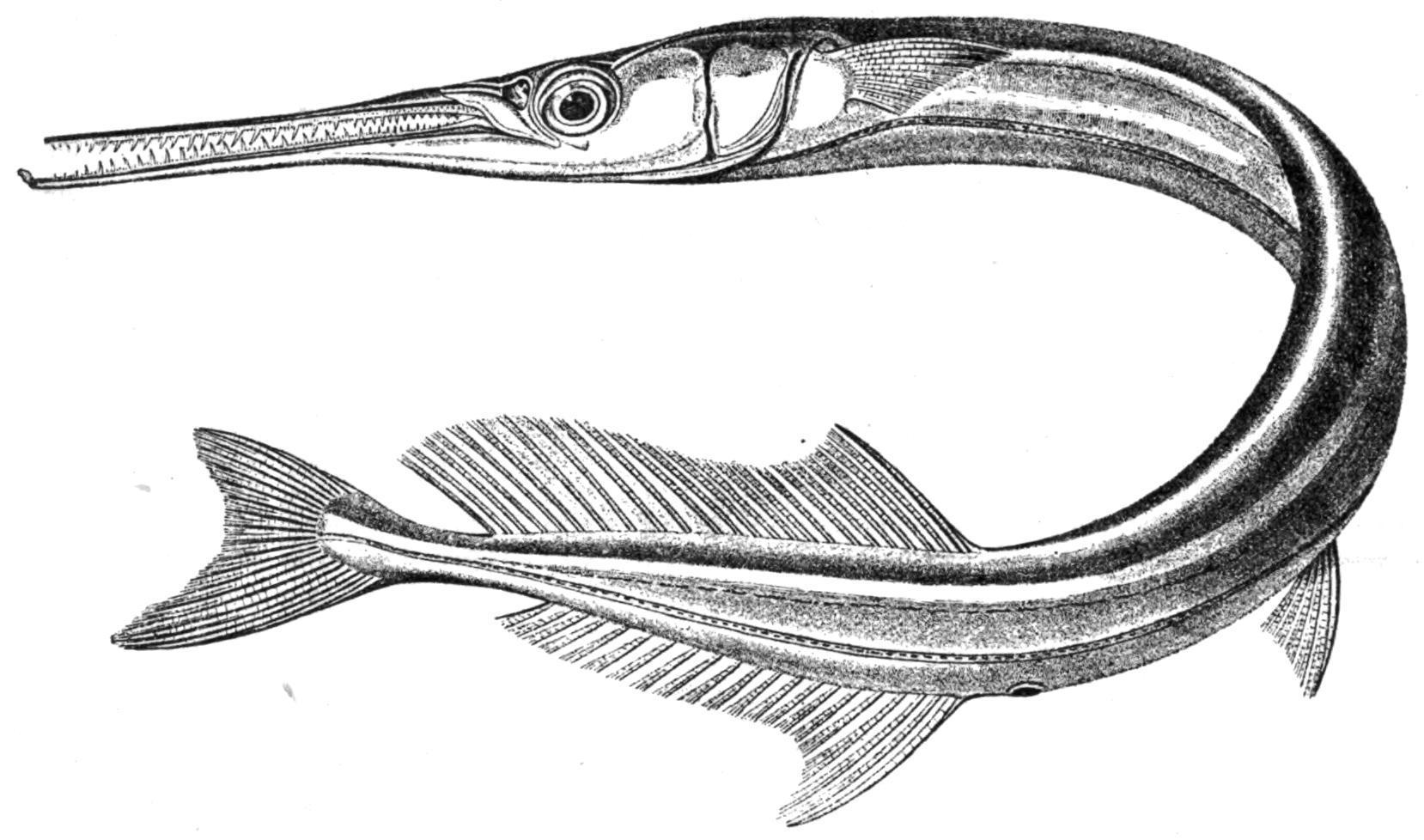
FIG. 389. Gar-Pike (Beloneannulata), × ⅓. (After Cuvier and Valenciennes.)
Scombresocidae occur in all the tropical and temperate seas. Belone, Scombresox, and Hemirhamphus are found in Upper Eocene and Miocene beds of Europe, and, as stated above, Protaulopsis should perhaps be referred to this family.
Fam. 2. Ammodytidae.—Maxillary excluded from the border of the upper jaw; mouth protractile; dentition feeble or absent. Lower pharyngeal bones separate. Praecaudal vertebrae without parapophyses. Body covered with very small cycloid scales. Pectoral fins nearer the ventral than the dorsal line; ventral fins, if present, widely separated from the pectorals, without spine, with 6 rays. Dorsal and anal fins more or less elongate, formed of soft rays. Airbladder absent.
The existing genera, Ammodytes, with 8 species, from the temperate coasts of the northern hemisphere, and Hypoptychus, from northern Japan, with a single species, are deprived of ventral fins, and their exact relations remained obscure until the structure of the Oligocene Cobitopsis revealed their affinity to the Scombresocidae, or at least their pertinence to the present suborder. The Greater Sand-Eel or Launce (Ammodytes lanceolatus) and the Lesser Sand-Eel (A. tobianus) are common on our coasts, and are remarkable for the manner in which, by means of their sharppointed snout, they bury themselves with great rapidity in the sand, darting in and out like arrows.
FIG. 390. Cobitopsisacuta. (Restoration by A. S. Woodward.)
Fam. 3. Atherinidae.—Maxillary excluded from the border of the upper jaw; dentition more or less developed. Body covered with cycloid or ctenoid scales. Ribs attached to strong parapophyses. Pectoral fins inserted high up; ventral fins more or less approximated to the pectorals, with one spine and five soft rays; pelvic bones connected with the clavicular symphysis by a ligament. Two wellseparated dorsal fins, the anterior small and formed, at least in part, of spinous rays. Air-bladder present.
Carnivorous Fishes, mostly marine and of small size, much valued as food, and distributed along the coasts of most tropical and temperate seas; some inhabit fresh waters. A silvery lateral band, or "stole," is usually present. About 65 species are known, referred to 14 genera: Atherina, Iso, Chirostoma, Thyrina, Atherinella, Labidesthes, Atherinopsis, Atherinops, Telmatherina, Neatherina, Pseudomugil, Rhombatractus, Aida, Melanotaenia.
Represented in the Upper Eocene of Europe by several species of Atherinaand by the extinct genus Rhamphognathus.
Fam. 4. Mugilidae.—Maxillary excluded from the border of the upper jaw; dentition feeble or absent. Body covered with cycloid scales. Ribs attached to the extremity of strong parapophyses. Pectoral fins inserted high up; ventral fins more or less approximated to the pectorals, with one spine and five soft rays; pelvic bones suspended from the post-clavicles. Two well-separated dorsal fins, the anterior formed of a small number of spines. Air-bladder present.
These Fishes are closely related to the preceding, of which they are a further specialisation, the pharyngeal bones having a complicated structure, much reducing the oesophageal opening, and the vertebrae being reduced in number (24 to 26 instead of 32 to 60). They feed on organic matter contained in mud, and inhabit the fresh waters and coasts of the temperate and tropical regions. The species
number about 100. Principal genera: Mugil, Myxus, Anostomus, Joturus. Grey Mullets (Mugil) are represented on our coasts by three species, valued as food, one of which (M. capito) has a remarkably wide range, occurring from Scandinavia to the Cape of Good Hope. Remains referred to the same genus occur in the Miocene and Oligocene.
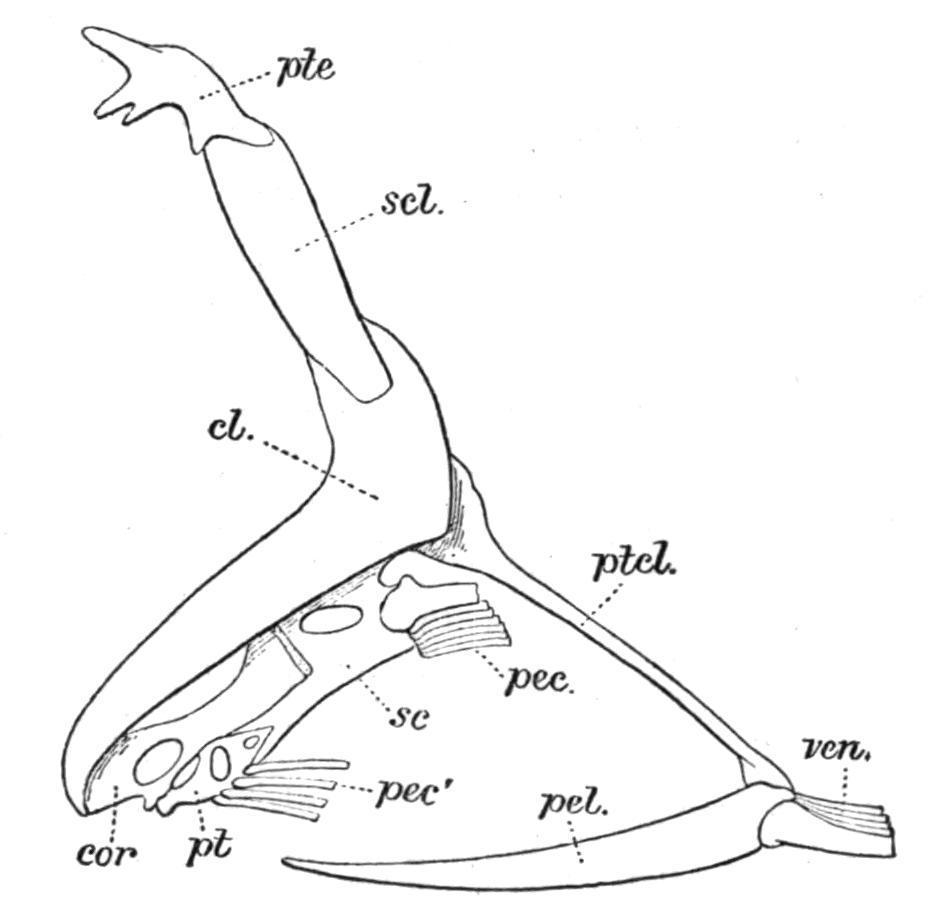
FIG. 391. Shoulder-girdle and pelvis of Polynemus quadrifilis. cl, Clavicle; cor, coracoid; pec, pectoral rays; pel, pelvis; pt, pterygials; ptcl, post-clavicle; pte, post-temporal; sc, scapula; scl, supra-clavicle; ven, ventral rays.
Fam. 5. Polynemidae.—Maxillary excluded from the border of the upper jaw; dentition feeble. Body covered with ctenoid scales. Ribs attached to the extremity of strong parapophyses. Pectoral fin inserted low down, with a lower portion consisting of free rays; the upper portion, or fin proper, attached to the scapula, the lower to a fenestrate bone which appears to be formed by coalesced pterygials (Fig. 391, pt.). Ventral fin more or less approximated to the pectoral, with one spine and five soft rays; pelvic bones suspended from the post-clavicles. Two well-separated dorsal fins, the anterior formed of a small number of spines. Air-bladder, if present, very large.
The vertebrae number 24 (10 + 14).
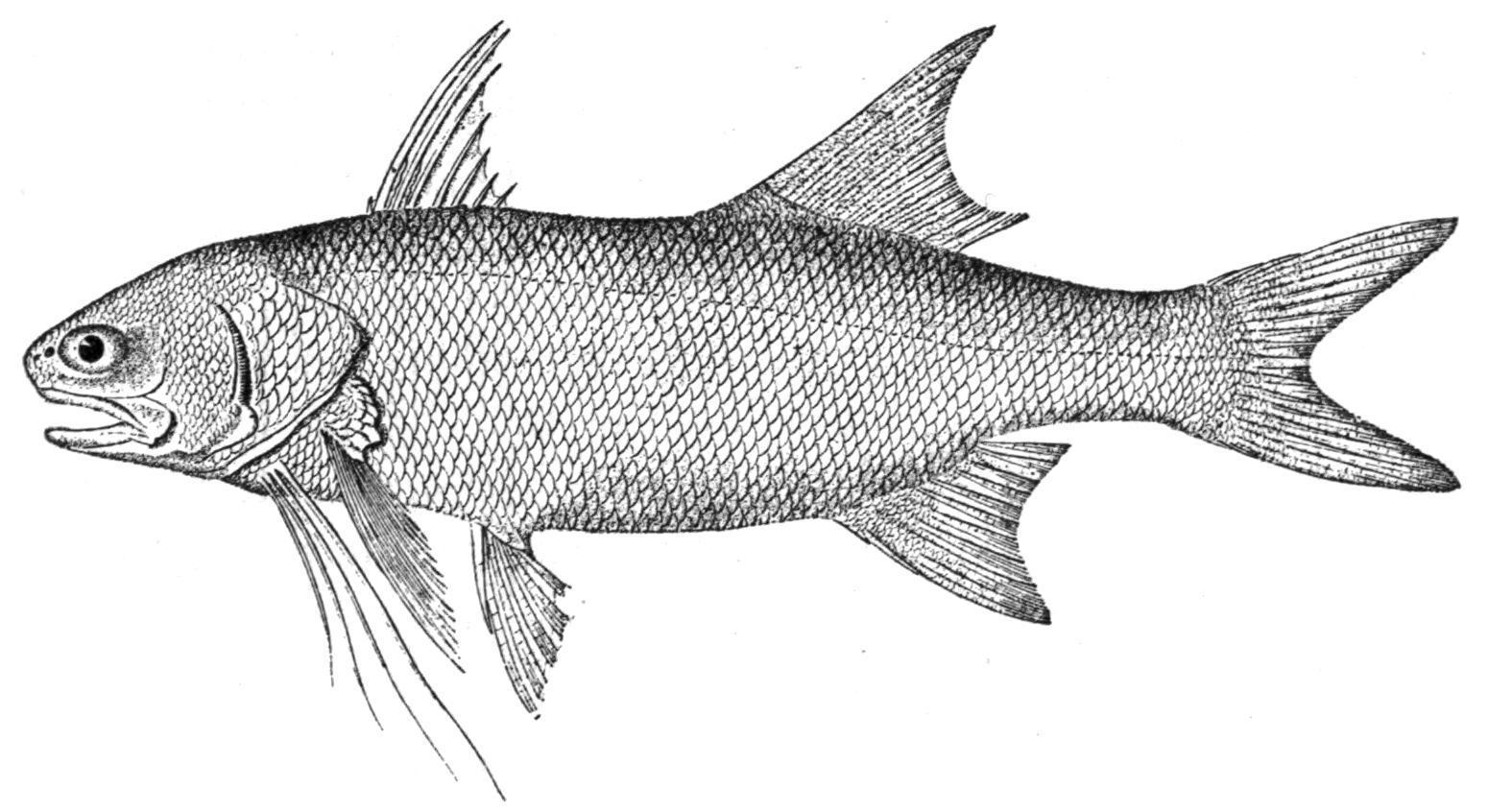
FIG. 392. Polynemusquadrifilis, × ¼. (After Cuvier and Valenciennes.)
Three closely allied genera: Polynemus, Pentanemus, and Galeoides, with about 25 species, from the shores of tropical seas, often entering rivers. Some attain a length of 4 feet, and are valued as food or for the isinglass yielded by their air-bladder. The free pectoral filaments are organs of touch, and can be moved independently of the fins.
Fam. 6. Chiasmodontidae.—The deep-sea genera, Chiasmodon, Pseudoscopelus, and Champsodon, which have been placed either with the Gadidae, the Trachinidae, or the Berycidae, may be referred to the Percesoces, as the pelvic fins have only a ligamentous connexion with the pectoral arch. Unfortunately, the skeleton has only been examined in Champsodon; it is remarkably similar to that of the Atherinidae. As in Atherinichthys, the posterior extremity of the air-bladder is protected by a bony sheath formed by the expanded ring-like haemal processes of the anterior caudal vertebrae. Vertebrae 32 (16 + 16). The scales are absent or very small and spinulose, the mouth large, with cardiform teeth; spinous dorsal short, soft dorsal and anal elongate. Chiasmodon and Pseudoscopelushave a complicated system of sensory organs on the body, which in the latter suggest the photophores of Scopelids. Champsodon vorax is a fish of extreme voracity, swallowing prey much larger than itself. Only four species of this family are known.
Fam. 7. Sphyraenidae.—Maxillary excluded from the border of the upper jaw; dentition very strong. Body covered with cycloid scales. Anterior ribs sessile, the rest inserted on parapophyses. Pectoral fin
nearer the ventral than the dorsal outline; ventral fin more or less approximated to the pectoral, with 1 spine and 5 soft rays; pelvis not connected with the pectoral arch. Two well-separated dorsal fins, the anterior formed of a small number of spines. Air-bladder large. Vertebrae 24.
Carnivorous Pike-like Marine Fishes from the tropical and sub-tropical seas, often found at the mouths of rivers. The "Barracudas" form a single genus, Sphyraena, with about 20 species, the largest of which grow to 8 feet and are dangerous to people bathing; many are valued as food, but some are reported to be poisonous, at least at certain seasons. Remains of several species are known from the Eocene and later periods in Europe and North America.
Fam. 8. Tetragonuridae.—Maxillary excluded from the border of the upper jaw; dentition feeble. Oesophagus with lateral sacs which are beset with papillae internally; a series of gill-raker-like knobs below the pseudobranchiae. Body covered with rhomboidal, striated scales in oblique transverse series, those of every single transverse series coherent. Ribs mostly sessile. Pectoral fin nearer the ventral than the dorsal outline. Ventral fin with 1 spine and 5 soft rays, near the pectoral, but pelvis free from the pectoral arch. A long continuous dorsal fin, its anterior portion formed of numerous short spines. Air-bladder absent. Vertebrae 58.
This family includes a single, rather rare fish, Tetragonurus cuvieri, from the Mediterranean and neighbouring parts of the Atlantic and the South Pacific. It is said to descend to great depths at certain seasons, and to feed on Medusae; its flesh is poisonous. Young specimens have been observed by Emery to live in the respiratory cavity of large Salpae.
Fam. 9. Stromateidae. Although including a number of forms very unlike Tetragonurus in external appearance, there is no doubt
that this family, hitherto placed near the Scombridae, is very closely allied to the preceding, agreeing with it in the presence of lateral oesophageal sacs bearing internally papillae (which are besides beset with setiform teeth), and, in most genera, in the presence of a series of knobs, more or less similar to gill-rakers, below the pseudobranchiae. The pelvic bones are sometimes free from the pectoral arch, as in the Tetragonuridae, sometimes more closely attached, but only by ligament, and movable. The principal difference resides in the scales, which are always cycloid and usually very small and more or less deciduous, and in the spinous dorsal being shorter than the soft, or even quite rudimentary. The ventrals are sometimes absent. The air-bladder is present or absent. The number of vertebrae varies from 24 to 46.
Marine Fishes, pelagic or deep-sea, feeding on Crustaceans, Medusae, or the fry of other fish. About 45 species are known, referable to 10 genera: Nomeus, Cubiceps, Psenes, Seriolella, Psenopsis, Centrolophus, Lirus, Stromateus, Peprilus, and Stromateoides. Many of the species have a wide distribution, but are rare in collections.[708] The Black-Fish (Centrolophus niger) and its close ally C.britannicus, and the Rudder-Fish (Lirusperciformis and L. medusophagus), have occurred, at rare intervals, on the British coasts. The Stromateidae were represented by several species in the Cretaceous (Platycormusand Homosoma).
The widely distributed Nomeus gronovii, so remarkable for its enormous ventral fins, folding in a ventral groove, has been observed in New South Wales to be only found on the coast when the Siphonophores called "Portuguese Men-of-War" or Physalia are driven ashore, the fish swimming beneath them, as the young Caranx are in the habit of doing under Medusae. As observed by Waite,[709] the benefit of such a partnership must primarily be with the fish, for it is a voluntary agent, whereas the Physalia has no power of locomotion. "If the fish secures safety from its enemies by
entering the area embraced by the deadly tentacles of the Physalia, which attain a length of 10 to 12 feet, it must be immune to their influence: a remarkable condition, considering that small fish have often been seen in their stomachs and entangled in their tentacles." This observer adds: "It is probable that, in addition to protection, the fish derives its food from association with the Physalia, much as does the Remora in accompanying a shark. The Physalia doubtless paralyses many more animals than it can consume—the residue falling to the lot of the fishes, which may be present to the number of ten."
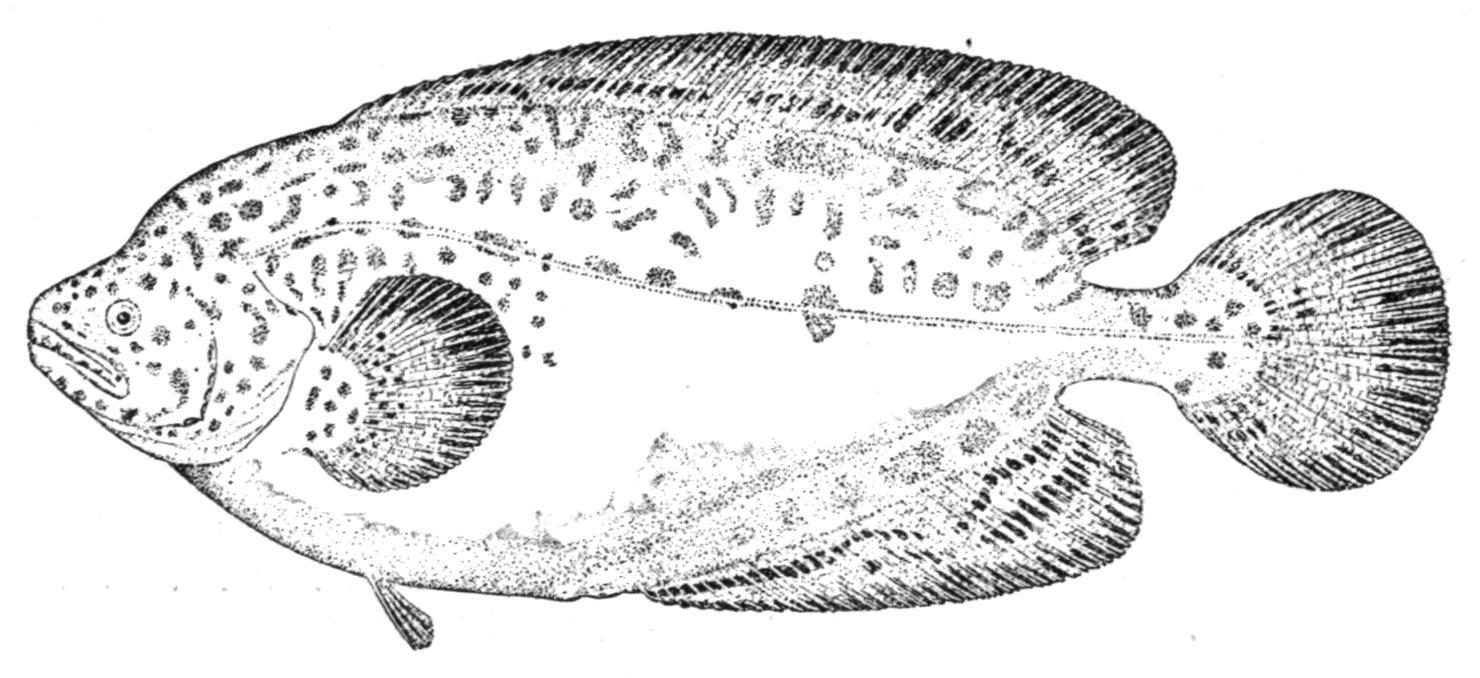
Fam. 10. Icosteidae.—The so-called "Rag-Fishes," in which the skeleton is quite soft and cartilaginous, are aberrant deep-sea forms evidently related to the Stromateidae; they lack the oesophageal teeth and the processes of the last gill-arch, but Icosteus at least has the gill-raker-like knobs below the pseudobranchiae. The pelvis is widely separated from the clavicles. Spines are absent in the fins, and the body is naked or covered with small cycloid scales. Vertebrae in large number (up to 70).
Icosteus, Icichthys, and Acrotus, each with a single species, from the Pacific coast of North America.
FIG. 393.—Icosteusenigmaticus, × ⅓. (After Goode and Bean.)
Fam. 11. Ophiocephalidae.—Maxillary excluded from the border of the upper jaw. Head and body covered with cycloid scales. Anterior ribs sessile, the remainder inserted on the parapophyses. Pectoral fin low down; ventral fin, if present, near the pectoral, with 6 soft rays; pelvic bones connected with the clavicular symphysis by
ligament. Dorsal and anal fins long, without spines. Air-bladder present, much elongate.
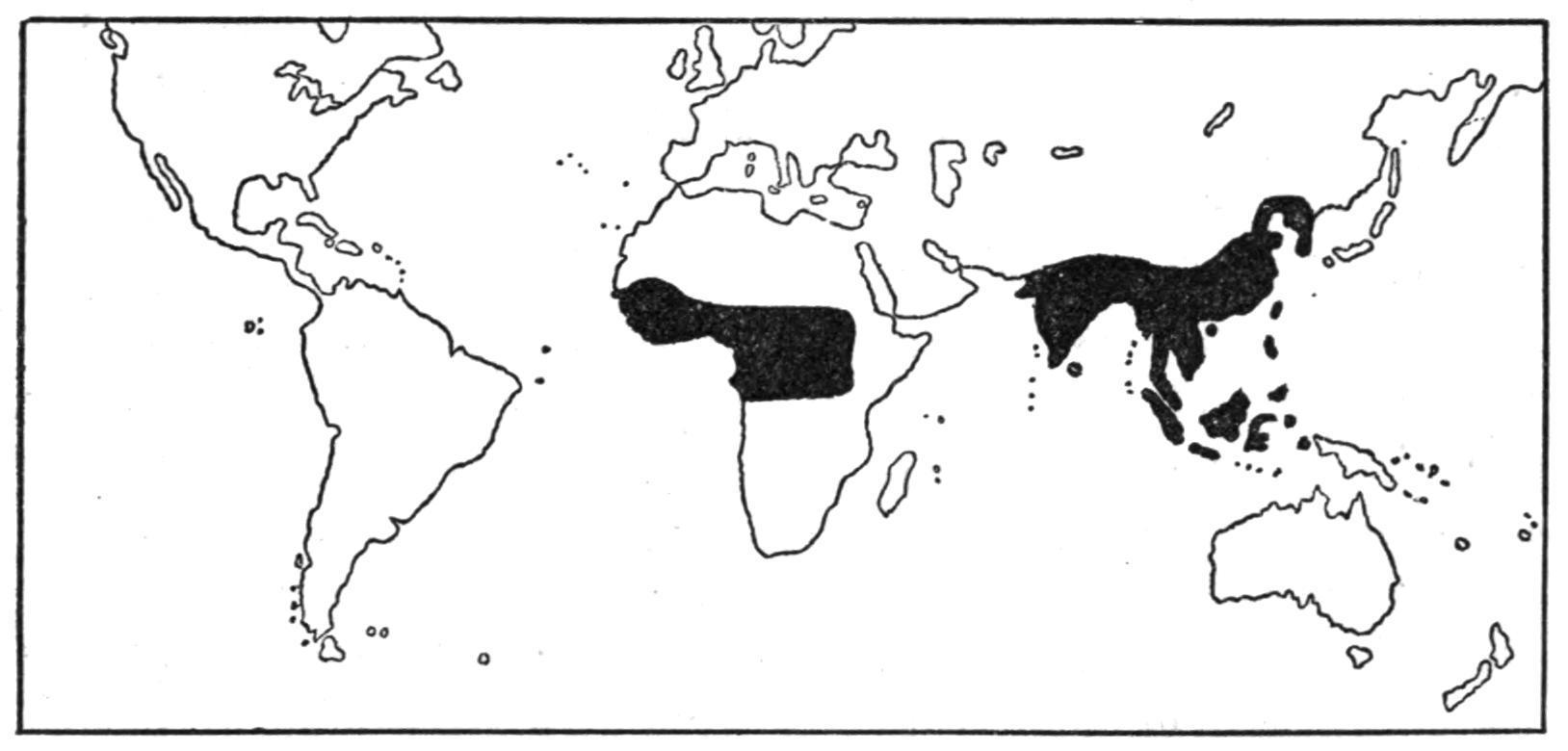
These Fishes are provided with an accessory superbranchial cavity, and are able to breathe atmospheric air. All are inhabitants of fresh waters and are carnivorous. Only two genera are known: Ophiocephalus, with about 25 species from Eastern Asia and 3 from Tropical Africa, and Channa, distinguished by the absence of ventral fins, with 3 species from Ceylon and China.
FIG. 394.—Distribution of the Ophiocephalidae.
FIG. 395. Distribution of the
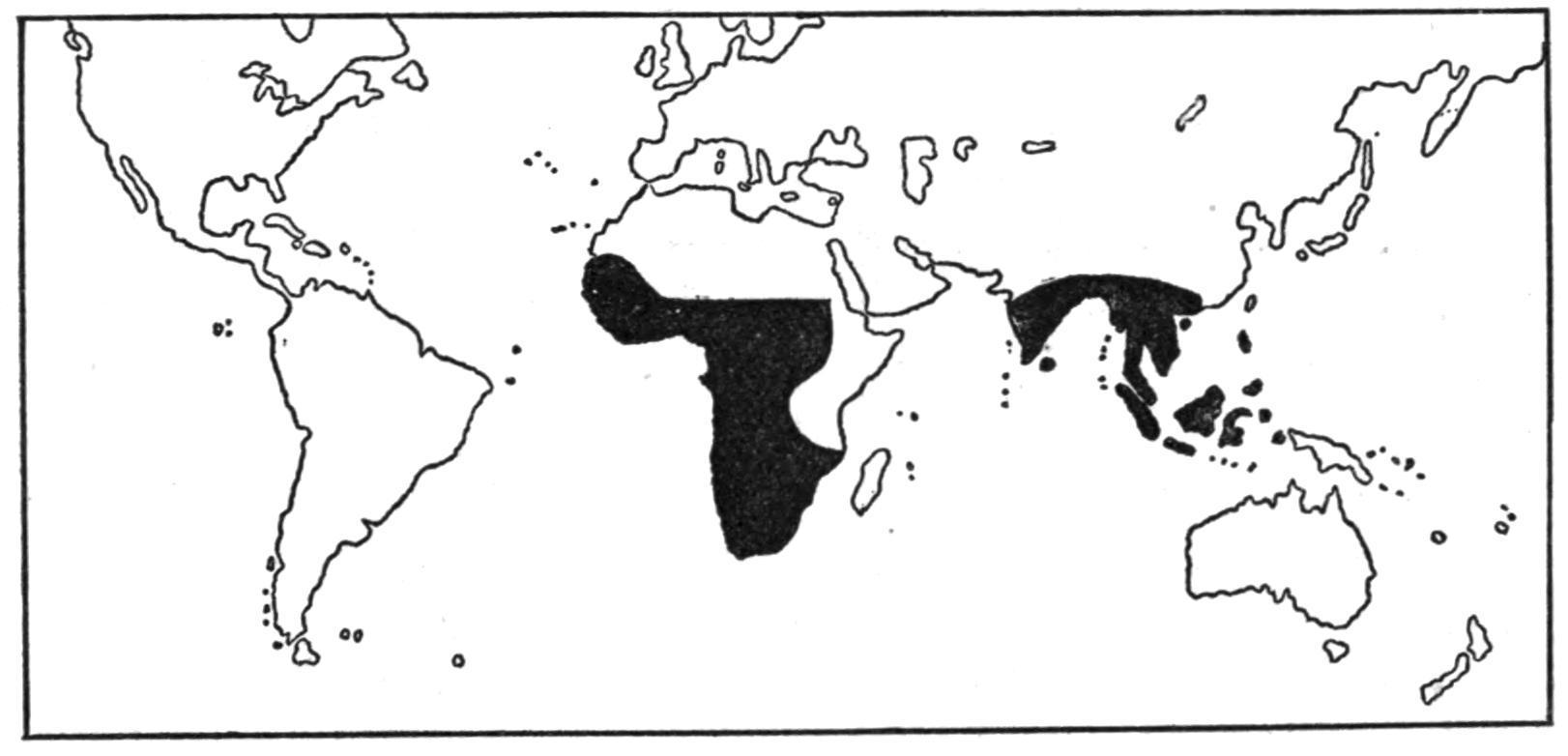
Fam. 12. Anabantidae.—Differ from the preceding, to which they are closely related, in having part of the dorsal and anal fins and the outer ventral ray spinous, and a shorter, Perch-like body covered with ctenoid scales. The accessory superbranchial organ is still more developed, with thin bony laminae, which are more or less folded and covered with a mucous membrane. These Fishes can live a long time out of water, and the name Anabas scandens, or Climbing Perch, recalls the fact that its first observers in India ascribed to it the habit of climbing up low trees by means of the spines with which its gill-covers and ventral fins are armed. This species, which attains
Anabantidae.
a length of 8 inches, is found in estuaries and fresh waters of India, Ceylon, Burma, and the Malay Peninsula and Archipelago; 3 other species occur in the Malay Archipelago, and 11 in Africa.
Sub-Order 9. Anacanthini.
Air-bladder without open duct. Parietal bones separated by the supraoccipital; prootic and exoccipital separated by the enlarged opisthotic. Pectoral arch suspended from the skull; no mesocoracoid arch. Ventral fins below or in front of the pectorals, the pelvic bones posterior to the clavicular symphysis and only loosely attached to it by ligament.
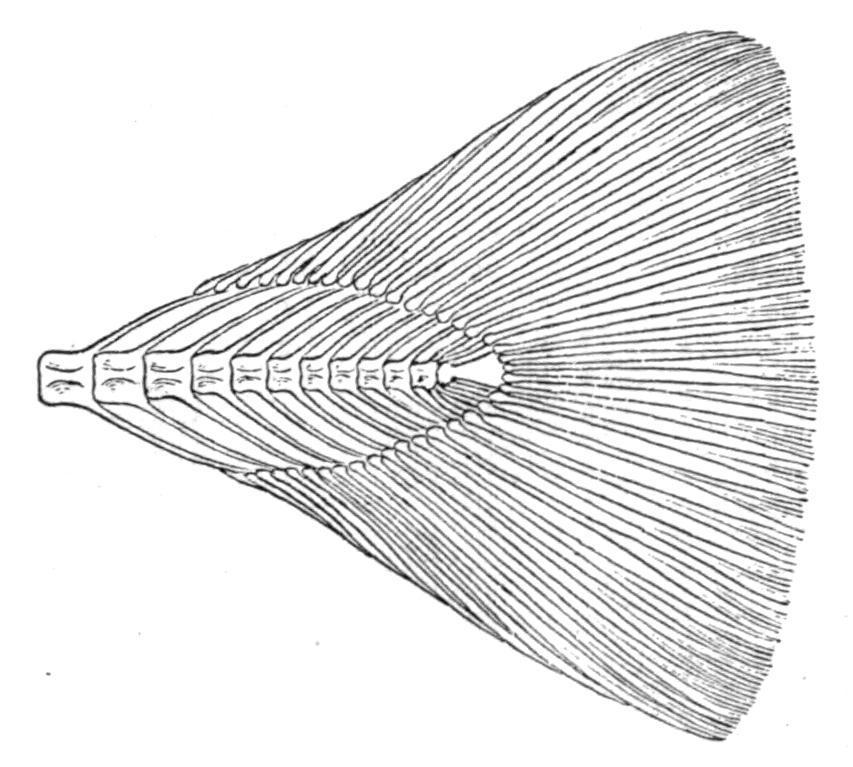
Fins without spines; caudal, if present, without expanded hypural, perfectly symmetrical, and supported by the neural and haemal spines of the posterior vertebrae and by basal bones similar to those supporting the dorsal and anal rays. This type of caudal fin must be regarded, as I have pointed out,[710] as secondary, the Gadidae being, no doubt, derived from Fishes like the Macruridae, in which the homocercal fin had been lost. The scapular foramen or fenestra is nearly always between the scapular and coracoid bones, as in the Trachinidae and several allied families, not in the coracoid, as in the other Acanthopterygians. The first two vertebrae have no epipleurals.
Mr. C. Tate Regan,[711] who has recently given a good definition of the Anacanthini, divides them into three families.
FIG. 396. Skeleton of caudal fin of Gadusvirens.
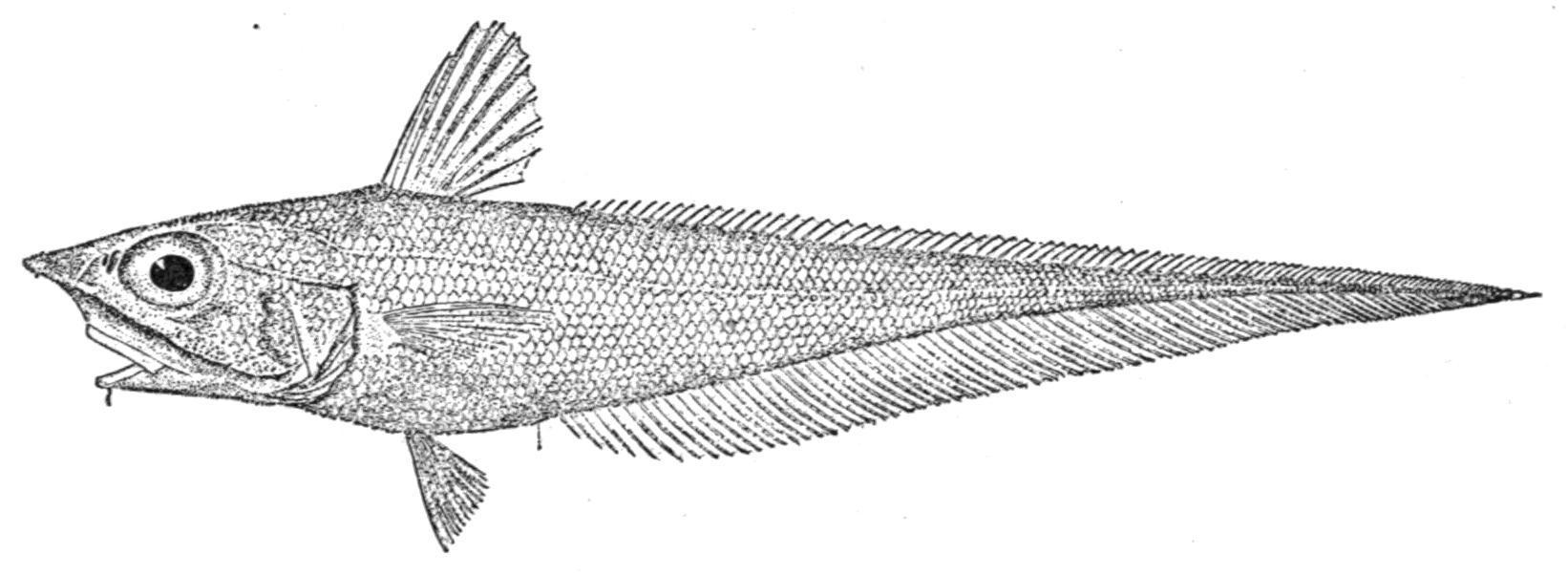
Fam. 1. Macruridae.—Mouth more or less inferior, protractile; teeth small, none on palate. Anterior vertebrae without transverse processes, with the ribs sessile, the rest with strong transverse processes supporting the ribs, which themselves bear epipleurals. Gill-membranes free from isthmus or narrowly attached; 6 or 7 branchiostegal rays; gills 3½ or 4; pseudobranchiae rudimentary or absent. Ventral fins below the pectorals, with 7 to 12 rays. Body short, tail elongate and tapering to a point, without caudal fin. A short anterior dorsal, with a single simple ray, and a long dorsal and anal meeting together at the end of the tail, formed entirely of articulated rays—the two dorsals sometimes continuous (Lyconus).
Deep-sea Fishes with very large eyes and small or rather large mouth, usually covered with rough spiny scales; a mental barbel is present, except in Lyconus, and the muciferous cavities of the skull are strongly developed, the bones being remarkably thin. About 120 species are known, some of which have a wide distribution. Macrurids have been found in all the seas where deep-sea dredging has been practised—the greatest depth at which they have been obtained being 2650 fathoms. Principal genera: Macrurus, Gadomus (with perforate scapula) Coryphaenoides, Hymenocephalus, Malacocephalus, Lionurus, Trachyrhynchus, Steindachneria, Bathygadus, Lyconus, Macruronus. A larval form of this family has received the name of Krohnius; it is remarkable for the filamentous prolongation of the ventral rays, which recalls the larval Trachypterus.
FIG. 397. Macruruscarminatus, × ⅓. (After Goode.)
Fam. 2. Gadidae.—Mouth moderate or large, more or less protractile. Anterior vertebrae without transverse processes, with the ribs sessile, the rest with strong transverse processes, usually supporting ribs,[712] which themselves bear epipleurals. Gillmembranes free from isthmus or narrowly attached; 6 to 8 branchiostegal rays; gills 4, a slit behind the fourth; no pseudobranchiae. Ventral fins jugular, with 1 to 9 soft rays. Body more or less elongate, covered with small cycloid scales. Dorsal and anal fins elongate, formed of articulated rays, sometimes divided into two or three distinct portions. Caudal fin more or less distinct, supported by the unmodified or but slightly modified neural and haemal spines of the last vertebrae, which are perfectly symmetrical (diphycercal or isocercal type).
A mental barbel is often present, as in the Macruridae, and the suture between the frontal bones has disappeared in most of the members of this very natural family. About 120 species are distinguished, mostly marine, many being adapted to life at great depths. All are carnivorous. They inhabit chiefly the northern seas, but many abyssal forms occur between the tropics and in the southern parts of the Atlantic and Pacific. Principal genera: Gadus, Merluccius, Holargyreus, Lotella, Physiculus, Phycis, Haloporphyrus, Tripterophycis, Lota, Molva, Onus, Bregmaceros, Antimora, Raniceps, Brosmius.
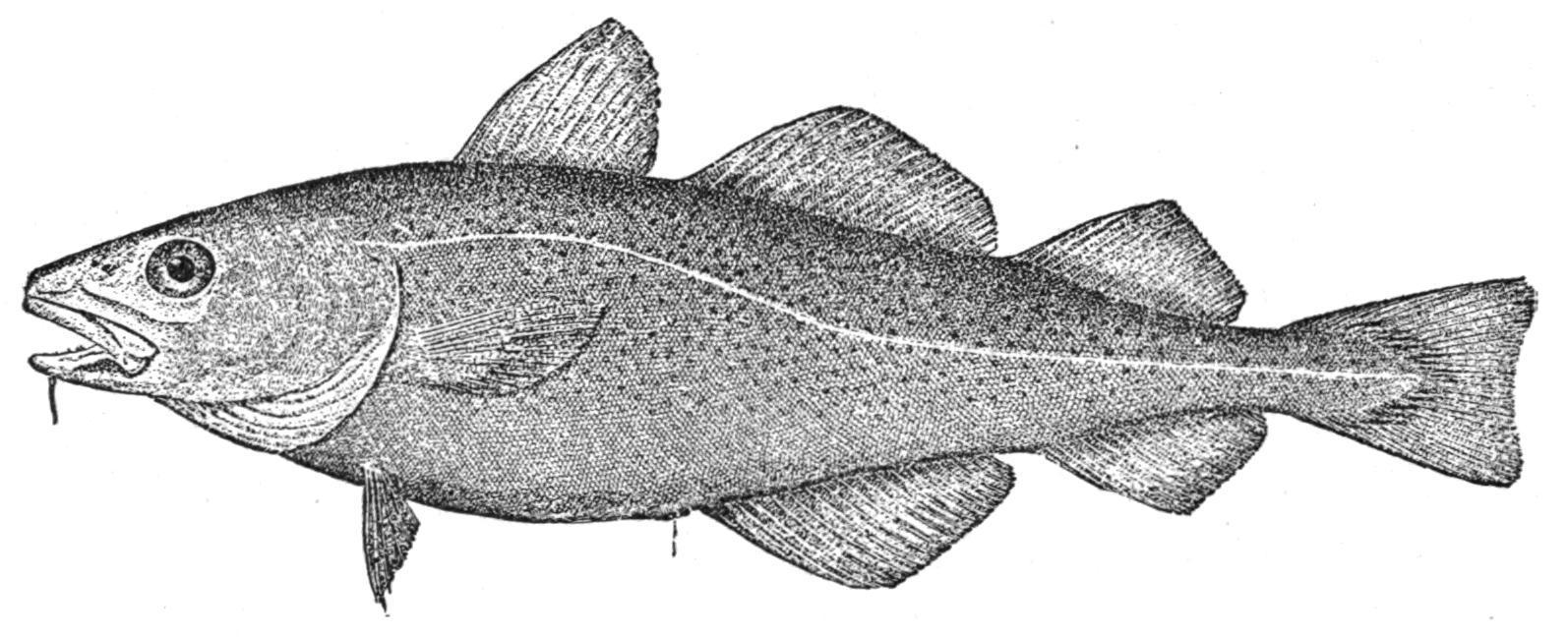
FIG. 398.—Cod (Gadusmorrhua), × ⅕. (After Goode.)
Several species, referred to Gadus and Brosmius, have been described from the Miocene. Nemopteryx, which is allied to Gadus, is from the Oligocene.
The fishes of this family are among the most important from an economic point of view. It will suffice to allude merely by name to the following among the European forms:—The Cod-Fish (Gadus morrhua), the largest species, reaching a length of 4 feet and a weight of 100 lbs., the Haddock (G. aeglefinus), the Whiting (G. merlangus), the Bib or Pout (G. luscus), the Pollack (G.pollachius), the Coal-Fish (G. virens), the Hake (Merluccius vulgaris), and the Ling (Molvavulgaris). Species of Merlucciusoccur also on the coasts of Chili and of New Zealand. The Rocklings (Onusor Motella) are of small size; several species are of common occurrence in our tidepools. The Burbot (Lota vulgaris) is a freshwater fish, exceeding a length of 3 feet, of excellent quality, but unfortunately local and rare in this country.
Fam. 3. Muraenolepididae.—Closely related to the Gadidae, from which they differ in not having a separate caudal fin, in the gillopenings being narrow and below the base of the pectorals, in the increased number (ten) of the pectoral pterygials,[713] and in the peculiar scales, similar to those of the Anguillidae. Ventrals with 5 rays. A mental barbel.
A single genus, Muraenolepis, from the coast of Kerguelen Island.
CHAPTER XXIII
Sub-Order 10. Acanthopterygii.
Air-bladder usually without open duct. Opercle well developed; supraoccipital in contact with the frontals. Pectoral arch suspended from the skull; no mesocoracoid. Ventral fins thoracic or jugular, more or less firmly attached to the clavicular arch. Gill-opening usually large, in front of the base of the pectoral fin.
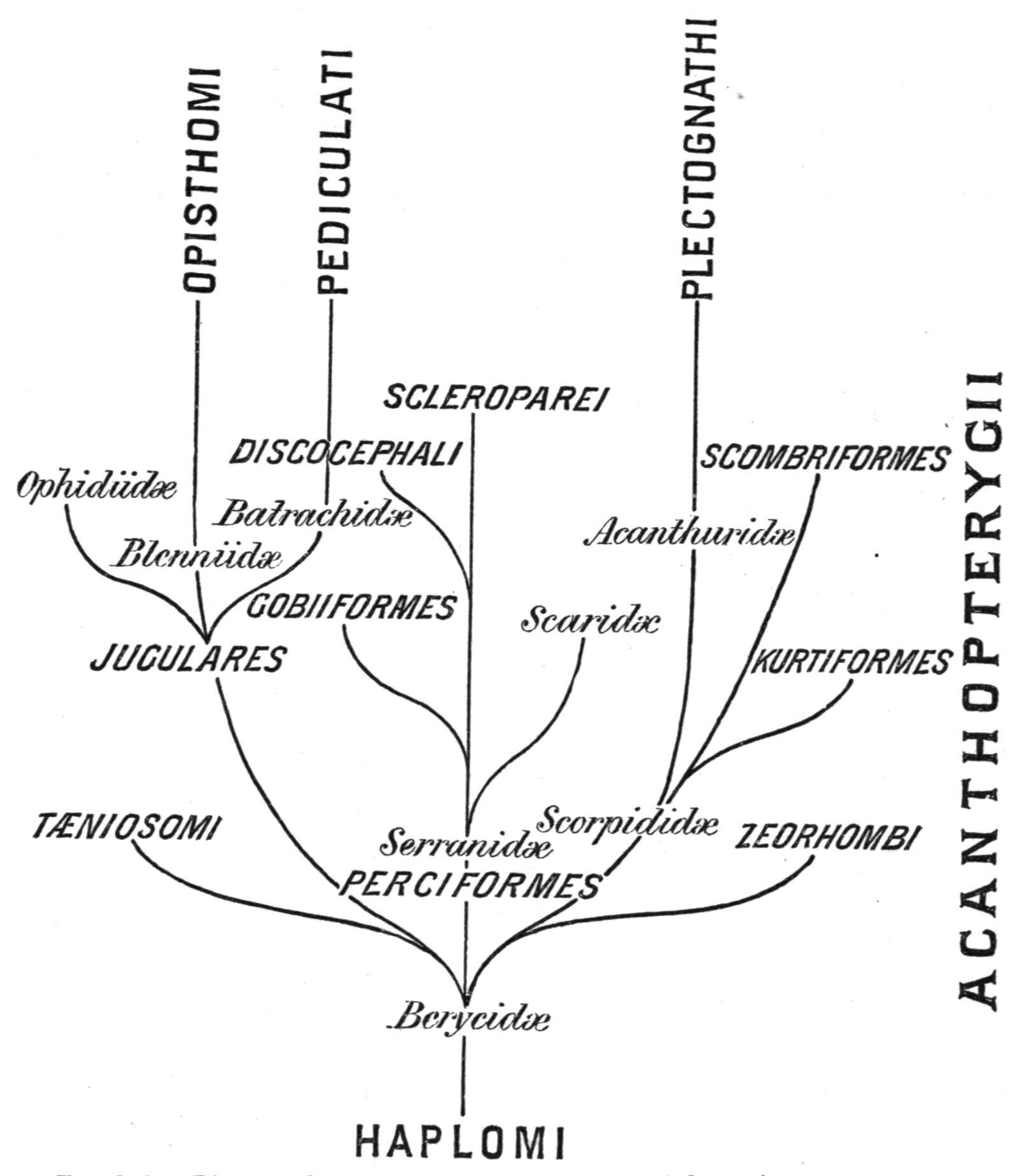
The character from which this sub-order, the most comprehensive of the whole class, derives its name, viz. the presence of nonarticulated, more or less pungent, rays in the dorsal and anal fins, is by no means universal, exceptions to the rule being numerous. The mouth is usually bordered by the premaxillaries to the exclusion of the maxillaries, and if these should, by exception, enter the oral edge, they are always toothless. The ventral fins are sometimes inserted at some distance behind the base of the pectorals (Haplodactylidae, Platycephalidae), in which case, however, this is due to the elongation of the pelvic bones, which are solidly attached to the clavicular arch. The sub-order is broken up into divisions, which follow in somewhat arbitrary order, the natural affinities being opposed to a linear arrangement; the annexed diagram is intended to remedy this defect.
SYNOPSIS OF THE DIVISIONS.
I. No suborbital stay, or process extending from the suborbital bones towards the praeoperculum; basis cranii double in the symmetrical forms. Primary shoulder-girdle composed of a perforate scapula and a coracoid; of the four or five pterygials, or basal bones of the pectoral fins, only one or two are in contact with the coracoid; ventral fins thoracic.
Rays of the caudal fin not strongly forked at the base; hypural usually with a basal spine or knob-like process on each side; epipleural bones usually inserted on the parapophyses or on the ribs; dorsal fin usually with strong spines; caudal peduncle rarely much constricted .......... I. PERCIFORMES.
Rays of the caudal fin strongly forked at the base, embracing a considerable portion of the hypural, which always bears a basal spine; epipleural bones usually inserted on the centra or on the parapophyses, rarely on the ribs; dorsal spines feeble or detached; caudal peduncle much constricted; scales usually very small or absent .......... II. SCOMBRIFORMES.
FIG. 399. Diagram showing probable relationship of the various groups to one another.
Rays of the caudal fin not strongly forked at the base; ventral fins with one spine and six to eight soft rays, or cranium asymmetrical .......... III. ZEORHOMBI.
II. No suborbital stay; basis cranii double; scapula absent, the pterygials inserted on the coracoid; ventral fins thoracic .......... IV. KURTIFORMES.
III. No suborbital stay; basis cranii simple; scapula and coracoid more or less reduced, sometimes vestigial; pterygials large, only one or two in contact with the coracoid; ventral fins thoracic .......... V. GOBIIFORMES.
IV. No suborbital stay; basis cranii simple; a perforate scapula; three pterygials in contact with the coracoid; ventral fins thoracic; a suctorial laminated disk on the upper surface of the head .......... VI. DISCOCEPHALI.
V. A suborbital stay, the second suborbital bone more or less produced on the cheek or joining the praeoperculum; ventrals thoracic .......... VII. SCLEROPAREI.
VI. No suborbital stay; ventrals usually jugular or mental; if thoracic, structure of the pectoral arch differing from that ascribed to the first five divisions of this Synopsis.
Pectoral fin with vertical or subvertical base; anal fin usually elongate, rarely small .......... VIII. JUGULARES.
Pectoral fin with horizontal or sub-horizontal base; body exceedingly compressed; dorsal fin with all the rays simple; anal fin absent or very small .......... IX. TAENIOSOMI.
DIVISION I.—PERCIFORMES.
No bony stay for the praeoperculum. Basis cranii double. Spinous dorsal usually well developed. None of the epipleural bones attached to the centra of the vertebrae in the praecaudal region. Pectoral arch with well-developed scapula and coracoid, the former pierced by a foramen or fenestra; pterygials longer than broad, more or less regularly hour-glass-shaped, four or five in number, one or two of which are in contact with the coracoid. Ventral fins thoracic.
This large group, consisting chiefly of marine forms, has members in all parts of the world, with the exception of the Arctic and Antarctic regions, and was already represented by numerous Berycidae and a few Serranidae and Scorpididae in the Upper Cretaceous. The division into families is a task of considerable difficulty, and the necessities of a linear arrangement result in the breaking up of some natural sequences. Thus it appears highly probable that the Scorpididae, themselves derived, together with the Serranidae, from the Berycidae, lead to the Carangidae in the division Scombriformes, whilst a nearly perfect passage can be traced between the Acanthuridae of this division and the Balistidae among the Plectognaths.
SYNOPSIS OF THE FAMILIES.
I. Gills four, a slit behind the fourth.
A. Two nostrils on each side.
1. Ventrals with 1 spine and 6 to 13 soft rays. .......... 1. Berycidae.
2. Ventrals with not more than 5 soft rays.
a. Lower pharyngeal bones not completely united, showing at least a median suture.
α. Gill-membranes nearly always free from isthmus.
* Ventrals little if at all behind the pectorals.
† Third vertebra without transverse processes or with sessile ribs.
§ A more or less developed subocular shelf, or inner lamina of the suborbitals supporting the eye-ball, sometimes reduced to a mere process of the second suborbital.
ǁ Ribs inserted on the transverse processes, when these are developed.
Body covered with very large bony scales; ventrals with a very strong spine and 2 or 3 very short soft rays .......... 2. Monocentridae.
Dorsal very short, with few graduated, adnate spines, anal very long .......... 3. Pempheridae.
Spinous dorsal usually well developed, soft dorsal usually not much more developed than the anal; palate usually toothed .......... 11. Serranidae.
Dorsal and anal fins elongate and formed mostly of articulated soft rays, the spines feeble and few .......... 12. Pseudochromididae.
Dorsal and anal fins much elongate, without distinct spines; body band-like .......... 13. Cepolidae.
Teeth in the jaws fused to form a beak .......... 14. Hoplognathidae.
Soft dorsal and anal much elongate; a separate spinous dorsal .......... 15. Sillaginidae.
Soft dorsal much longer than the anal; a separate spinous dorsal .......... 16. Sciaenidae.
ǁǁ Ribs mostly sessile, behind the parapophyses; body deep; mouth moderately large and protractile.
Post-temporal forked, distinct from skull .......... 25. Scorpididae.
Post-temporal completely ankylosed to the skull; mouth very protractile .......... 26. Caproidae. §§ No subocular shelf.
ǁ Ribs mostly sessile, behind the parapophyses; anal spines 3 to 14.
Teeth conical; palate toothed; mouth feebly protractile .......... 4. Centrarchidae.
Teeth incisor-like; fins densely scaled .......... 5. Cyphosidae.
Teeth conical; palate toothless .......... 6. Lobotidae.
Maxillary very slender; mouth very protractile .......... 7. Toxotidae.
No entopterygoid; mouth very protractile .......... 8. Nandidae.
ǁǁ Ribs inserted on the transverse processes when these are developed; not more than 3 anal spines.
Mouth not or but feebly protractile; spinous dorsal usually longer than the soft; anal with 1 or 2 spines .......... 9. Percidae.
Mouth moderately protractile; palate toothed; spinous dorsal not longer than the soft; anal with 2 or 3 spines .......... 10. Acropomatidae.
Mouth very protractile; palate toothless; praemaxillary with an upwardly directed lateral process .......... 17. Gerridae.
Mouth moderately protractile; palate toothed; anal longer than soft dorsal; body scaly .......... 18. Lactariidae.
Mouth moderately protractile; palate toothless; anal much longer than soft dorsal; body naked .......... 19. Trichodontidae.
†† Transverse processes developed on the third vertebra and bearing the ribs; palate usually toothless.