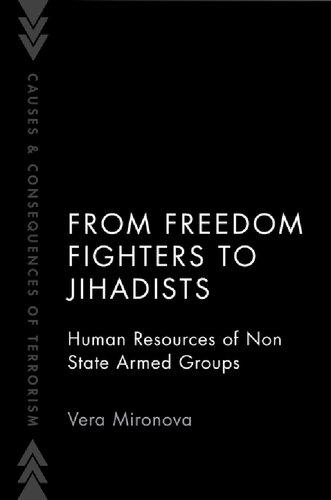
From Freedom Fighters to Jihadists: Human Resources of Non-State Armed Groups
Vera Mironova
Published in partnership with The National Consortium for the Study of Terrorism and Responses to Terrorism and the University of Maryland
From Freedom Fighters to Jihadists
Human Resources of Non-State Armed Groups
Edited by
VERA MIRONOVA Visiting Fellow, Harvard University
3
Oxford University Press is a department of the University of Oxford. It furthers the University’s objective of excellence in research, scholarship, and education by publishing worldwide. Oxford is a registered trade mark of Oxford University Press in the UK and certain other countries.
Published in the United States of America by Oxford University Press 198 Madison Avenue, New York, NY 10016, United States of America.
All rights reserved. No part of this publication may be reproduced, stored in a retrieval system, or transmitted, in any form or by any means, without the prior permission in writing of Oxford University Press, or as expressly permitted by law, by license, or under terms agreed with the appropriate reproduction rights organization. Inquiries concerning reproduction outside the scope of the above should be sent to the Rights Department, Oxford University Press, at the address above.
You must not circulate this work in any other form and you must impose this same condition on any acquirer.
Library of Congress Cataloging-in-Publication Data
Names: Mironova, V. G. (Vera Grigor’evna), author.
Title: From Freedom Fighters to Jihadists: Human Resources of Non-State Armed Groups / Vera Mironova.
Description: New York : Oxford University Press, 2019. | Series: Causes and consequences of terrorism
Identifiers: LCCN 2018057012 | ISBN 9780190939762 (paperback) | ISBN 9780190939755 (hardback)
LC record available at https://lccn.loc.gov/2018057012
1 3 5 7 9 8 6 4 2
Paperback printed by WebCom, Inc., Canada Hardback printed by Bridgeport National Bindery, Inc., United States of America
This book is dedicated to the memory of all the people who died on all sides of the war in Iraq and Syria.
Preface
“10 . . . 9 . . . 8 . . . 7 . . . ”
An Iraqi Special Operations Forces (ISOF) officer would count backward after sending the GPS coordinates for a target building to the aircraft circling above us. The countdown was the ten seconds it took for the building to disappear in a mushroom of dust and enemy fighters to disappear under the debris. Once that was done, we would move out of hiding and continue down the narrow streets of the Old City of Mosul, trying hard to be as quiet as possible; the enemy was hiding not only in the destroyed buildings on both sides, but often below in tunnels.
As we went, the soldiers casually stepped over the bloated bodies of enemy combatants in their signature uniforms complete with suicide belts. They had been left to rot there for weeks under the hot Iraqi sun, and occasionally someone would wonder out loud why those bodies were still there, like they were some kind of abandoned roadblocks. The soldiers considered these once-men solely as objects, but I didn’t. I saw them from a different angle. These were not stones or fallen trees so inconveniently blocking the way. They used to be people, people who had made decisions in life that brought them to the spot where they lay.
At this point I, an academic, had been embedded with ISOF for ten months. I had begun my research on rebel fighters in the Middle East five years prior, and it had led me there, among their lives and deaths, and in close proximity to the organizations that facilitated both.
In life, those people had once been part of a feared rebel organization. They had fought, lived and trained in camps, reported to their chain of command, slept on bunkbeds in shifts, and ate in the dining hall on long plastic tables. They lived like those in any other similar institution, except for an Islamic State of Iraq and the Levant (ISIS) twist to some details, like a sign on the door of a camp I once visited. The sign could be roughly translated as, “Dear Brother Jihadists, for everything holy on this planet, please wash the dishes. God bless you.” That made me pause for a second. If fighters did not care about such a mundane thing as doing dishes (that the sign had to
Preface
almost beg them to wash), how hard was it to organize them to not only work but die for one goal?
After we had stormed one camp and military intelligence personnel collected everything they needed, I saw a book lying on the floor in the hallway. It was the Book of Jihad, a common propaganda book, written in Russian because many Russian-speaking men from the former Soviet Union joined ISIS to fight in Syria and Iraq and did not speak Arabic. It would never have caught my attention if not for a handwritten note on its cover that, in very direct prison slang, warned future readers not to steal it. Who would expect that people who had gone to Mosul to fight the ultimate war were in fact prone to stealing the Book of Jihad from each other? As comical as that was, it showed a glimpse of a much bigger problem that ISIS leaders faced— controlling thousands of different people. And based on the handwritten notes from the ISIS officer school that were lying next to the book, they were also not sure how to address it. “A group emir [leader] should know everything about his group members” was written in big letters in the notebook under the lecture title “Organization of Units,” including, in addition to biographic information, questions about individual character such as “self-esteem” and “goals in life.”
Visiting abandoned houses in Mosul provided me with pictures of ISIS members in their private lives. Sometime those pictures were literal. In one house, children had drawn European-style houses on the walls, maybe the houses of grandparents they missed. In another house, the refrigerator was decorated with quotes from an old TV advertisement. And among the things I expected to find in those partially destroyed buildings—military lectures, lists of equipment, religious literature—I also found a love poem, written in Russian from one of the foreign fighter’s wives:
We were made for each other
Our marriage sealed in heaven. . . . When you left to Beiji I missed you enormously
Counting the days we were apart
Until finally, you came back. . . . For seven happy days that flew by like a second
And you were gone again
To a place of war
And even if you are gone forever I will be still counting days ’Til we see each other again My beloved Zakhari.
I realized that Zakhari, his wife Umm Fatima (mother of Fatima), and even their daughter Fatima were most likely all dead by then, like so many in Mosul. But despite how people looked at them, they were not just dehumanized enemy combatants or terrorists; they were people who once had hopes and desires like everyone else, and, like everyone else, those hopes and desires had influenced their behavior.
There were other papers of interest laying in the stash of ISIS documents, and while the soldiers were obviously only interested in the military information, it was the poem and a recipe for a classic Eastern European cake, carefully written in the same notebook, that intrigued me most. It called for Russian condensed milk, and I couldn’t imagine how they could ever find that milk in Mosul. That thought brought me again to the biggest piece of the ISIS puzzle, and the reason I was there in the midst of a bloody civil war—to study the lives, thoughts, and motives of the fighters, both local and foreign, who, sometimes selflessly and sometimes thoughtlessly, gave their lives. What chain of decisions had brought them to Mosul? How different were they from ordinary people? And most important, how did ISIS as an organization channel these people’s decision-making process to transform them into productive members of the group?
When the Iraqi forces defeated ISIS in Mosul, I did an interview in a tiny Soviet-style studio apartment in an industrial town in Eastern Europe. Sitting across from me was Usama, a former ISIS fighter from North Caucasus. My first question caught him off guard: “How could you get Russian condensed milk in Mosul?” That quickly, Usama, the fearless jihadi fighter of ISIS propaganda, was gone, replaced with a young, lonely man named Ali (name changed), who told me how. In the midst of the war, his mother had come to Syria to check on him. She had stayed for a month, and the only thing she brought with her was food from home, including condensed milk. He was an ordinary person with an ordinary mother. It made me realize that, in addition to just managing those ordinary (at least in some ways) people, ISIS had to make them into the fighters that would be feared by so many.
Before Mosul, I had been interviewing fighters from many different Syrian rebel subgroups for five years when I realized it wasn’t good enough.
I could hear what these men were saying, but without context, I felt my research would be incomplete. To truly understand, I had to feel what they felt and experience what they had experienced. So I took a year off from my academic job, bought a military-grade bulletproof vest, and moved to the battlefield full time despite the obvious dangers involved. In fact, my goal was to be in the same danger as the people fighting there.
For nearly a year I was embedded with several different armed groups, experiencing firsthand the conditions and environment rebel fighters made their decisions in, staying in smoke-filled safe houses on the frontline, sleeping on the floor among soldiers, and eating the same food they did. I begged Iraqi commanders to take me on every mission and forward operation. Despite being the first female ever in their military, they soon got used to me and, surprisingly, gave me permission to move freely with different units on the frontline. I even had the honor of being the only foreigner (and female) present when the Iraqi flag was planted on the remains of the famous al-Nuri Mosque, where ISIS leader Abu Bakr al-Baghdadi had once declared the formation of the caliphate.
While embedded with Kurdish Peshmerga liberating villages around Mosul, I entered treacherous ISIS tunnels before they had even been swept of militants and explosives. With ISOF and Hasd Shabi (Shia militia) in the town, I’d been to ISIS training camps, weapons factories, bases, and safe houses. Many of those visits to militia outposts occurred right after fighters had either fled or been killed, their uneaten food and hot tea still on the table. I tried on a suicide belt abandoned by retreating fighters and sat in the driver’s seat of an infamous “Mad Max”–style ISIS suicide car after it was captured, trying to get as close to what it felt like to be a driver going on his last mission.
Because I was in Mosul until the end of the operation, I also got to experience many things some of the rebel fighters did not, at least from my perspective. I was with soldiers as they pulled living ISIS members from beneath the rubble. Here I was even of some help, translating for wives of foreign fighters from Russian to Arabic. I visited houses ISIS had used as prisons while they were being liberated. I found an address book of ISIS fighters and traced people in it through Russian social media. I was with soldiers searching for ISIS militants hiding among civilians and doing interrogations in detention centers. After the operation was over, I was also in counterterrorism courts following investigations and attending the prosecutions of ISIS members.
This field research steeped me not only in the physical conditions fighters faced, but in their psyche. During operations, I sat in a Humvee while enemy bullets bounced against the car’s armor. I was shot at not only by the enemy, but also by my own side. With snipers, I spent hours waiting on the roofs of houses, and days in the headquarters with Joint Terminal Attack Controllers (JTACs) coordinating airstrikes. I stayed on the base that was a main ISIS target. At night it was shelled with chemical weapons (although they missed by far), and during the day, the enemy tried hard to plant improvised explosive devices (IEDs) around us.
After the Mosul operation (and numerous heat strokes), I thought I had everything I needed for a book, so I came back home. But instead of sitting in a library and writing, I found myself talking to Ali, a former ISIS fighter from North Caucasus, about five hours a day, despite the inconvenient time difference (luckily, he did additional night prayer and was awake during Boston’s day hours). He was bored and alone, waiting for his new fake documents (he had burned his own passport while in Syria, and his real name was known to Russian authorities), and was thrilled to talk with someone who was not afraid of him, would not call the police, and, more importantly, had shared his experiences. And since all of his ISIS comrades were dead, someone from the other side of the frontline was good enough.
I knew what he was talking about. While embedded with ISOF fighters, I had been in absolutely identical conditions as ISIS fighters, often with only a house wall between us. Ali and I had both breathed the same dusty, suffocating heat, sometimes thick with the chemical weapons. We had experienced similar life dangers. We even had both been in serious car crashes while in Mosul because driving fast and reckless was considered normal no matter which side you were on.
Ali and I also had a lot of other things in common from our pre-Iraq and Syria lives. Not only did we speak the same native language and hold Russian passports, we were also of similar age, grew up in middle-class families in Moscow, and had shared similar childhood experiences. We even had the Moscow State University computer science department in common, where I had studied and he had worked.
Yet his background and knowledge drove him to help ISIS with its technical tasks (including their drone program) while I used mine to understand the ISIS drone documents found in a makeshift drone factory in Mosul for a report published by the U.S. military. To me, this was the real draw to my communication with him. It made me want to understand him
better, not only for this book, but for my own curiosity. We were such similar people; how had our paths veered off in such different, actually opposite, directions?
I did not just want to interview Ali like I had everyone else. I wanted to understand him no matter how much time it took or how much potential interest the U.S. government could have in such a relationship. Our conversations covered everything from politics to childhood memories. By phone, he taught me how to fix a broken heater, and I explained how to care for the cat that regularly visited his balcony. When I would visit him, spending the whole day together from the first morning until the night prayer either walking around the city or eating homemade chicken soup and dates in his apartment, he would tell me the most personal parts of his experiences in Raqqa, Tabqa, Tal Afar, Sinjar, and Mosul. In some ways, he was like many of the fighters I had talked to over the previous five years. But I learned there was something else about him—something about his opinions that was very different, and more than a little disturbing.
By that point, I had gotten to know his whole family, the male part of which is now in Russian prison for supporting ISIS. Interestingly, they not only did not share many of Ali’s opinions (particularly on religion) but privately referred to his religious beliefs as being simply crazy. It turned out that Ali’s religious views were, in fact, much more radical than those of ISIS or any other armed group that had fought in the conflict. He belonged to a radical sect of chain takfiris, which is one of the most radical branches of Salafi Wahhabism to date; adherents believe that a person who does not accuse an apostate of heresy is an apostate himself. He had left ISIS only because ISIS was not radical enough. According to him, ISIS was not properly enforcing sharia law and had been too lenient with Syrian locals (whom he did not consider to be Muslims). For that matter, he did not even consider his own family members to be Muslims.
Compared to other former fighters and ISIS supporters, he also followed all the rules he believed in meticulously. For example, since he considered any interaction with the civilian (non-sharia) institutions prohibited, before installing any computer application he would carefully read its thirty pages of terms and conditions through Google translate to make sure that he did not click to accept it if there was any mention of solving potential disputes in court.
For half a year, I studied everything I could about his sect and their views. By that time, Ali trusted me and was eager to share religious ideas
that, in general, he tried to hide, realizing they would not be understood by most people. He taught me everything I wanted to know. He made a list of books and articles I had to read and added me to the sect’s closed social media groups; some were as big as four thousand members, while others did not have more than three hundred members. He shared with me screenshots of his online chats with other sect members. He also shared group lectures with me and, in sum, I listened to approximately seventy hours of them. Although at no point did those lectures explicitly call for the use of weapons, the content of those materials was more radical than anything I had ever seen or heard in ISIS propaganda.
Getting so deep into their teachings and so close to some members of his family also put me into a very unexpected position. One time his father asked me, “Since Ali listens to you, can you please tell him to stop calling his mother kafir [infidel], because it really offends her, a devoted Muslim woman?” His mother, the only person in the family who was not having problems with the law and was still able to travel, would visit him from time to time, but the only thing Ali would do is try to convert her to his sect. Of course there was not much I could have done about it, but it raised another question about ISIS: If Ali’s own family, whom he totally depends on for survival while he is in hiding, could do nothing about his religious dedication, how did ISIS as an organization manage people like him? To me, it seemed like a human resources problem that was almost impossible to solve.
My research for this book landed me far away from where I had begun— doing academic surveys of Syrian fighters to understand why they had joined the war. I would never have imagined it would take me to the frontlines of the biggest urban military operation since World War II, all over Europe and Central Asia to visit former ISIS foreign fighters in hiding, into prisons to visit ISIS defectors, and even into the bowels of an ultraradical sect of Salafi Wahhabism. And though on finishing this book I have more questions than answers, I hope what I have gathered will shed at least some light on the goals and thoughts of the individuals, both local and abroad, who took up arms to fight, and how armed groups as organizations manage those people to make them the most effective in pursuing the goals the group was fighting for.
Acknowledgments
First of all I want to thank all of my research participants, many of whom are not alive anymore. And though some of those (members of ISIS) who lived are wanted by Interpol, I am very grateful for the hours, and sometimes days, they took to painstakingly explain different complicated religious and ideological concepts and relations inside their groups. As a teacher myself, I know for sure that I personally would not have the patience for a student as inquisitive as myself. Sometimes they even did it by phone from the battlefield, despite limited access to the internet and electricity. I am also extremely grateful, as the rest of the world, to all members of ISOF and other coalition forces for defeating ISIS in Iraq and Syria.
I want to personally thank several members of ISOF; Khalid, for making sure I did not get killed during the times I was lost somewhere on the frontline in Mosul; Mohammed Amar, for doing his best to minimize the number of times I got lost; Senan, for being the ultimate example of calmness in any situation; Fuoad, for being the best roommate in the East Mosul safe house I could dream of; Ahmed, for his sense of humor; Ibraheem Al No’aimy and Raed Fakhri, for protecting everyone from the air and allowing me to stay in their safe house in West Mosul—and separately, Ibraheem, for seriously answering my really strange questions like “Since chicken body temperatures are much higher than that of humans, could they potentially affect the precision of airstrikes in rural areas?”
I especially want to thank Hadi Hamid for absolutely everything. There is nothing I could have done without his help.
I also learned a lot from ISOF leadership. From Gen. Abdul Wahab, I learned how important it is to be on the ground with soldiers. From Gen. Sami, I learned how important it is to stay in the headquarters and think. From Col. Arkan, I learned to pay attention to details and how to be a rock star, even in the middle of a total mess. I am so proud to know these people. Also, this book would not have been possible without help from my colleagues from Syria, Iraq, Ukraine, and Kyrgyzstan: Loubna Mrie, who from the very beginning of the conflict in Syria, and despite the obvious dangers and loss of many colleagues, continued to work
on the frontlines in Aleppo and Idlib and with different groups from moderate Free Syrian Army (FSA) to ISIS. Her incredible intelligence enabled her to navigate different frontlines in work so brave, it was sometimes scary.
Karam Al Hamad, who not only followed Syrian armed groups in their battles, he also (unfortunately) experienced the Assad prison system personally. For a year, he was imprisoned in a so-called Palestinian Branch prison in Damascus. However, even the torture he endured did not stop his dedication to understand the conflict and share it with the outside world. Despite being wanted by both the Assad regime and ISIS, he continued working in one of the most dangerous areas of Syria (Deir Ezzor) until the last possible moment. Later he moved abroad, and even there he worked with local activists despite getting death threats from ISIS on a weekly basis.
Ekaterina Sergatskova, who helped me navigate a world even more complicated than the war zone—the underground of foreign fighters in hiding and group supporters all over Europe. She conducted interviews in the most obscure places and under the greatest secrecy possible, and often retrieved information just before subjects were imprisoned or assassinated.
Without Khulkar Isamova, my work in Fergana Valley would not have been possible. Not only did she help me make contact with a number of former Syrian foreign fighters, but more importantly she steered me through local government officials and law enforcement.
I am also forever indebted to Mohammed Hussein, not only for being one of the best journalists in Iraq (he knows about everything even before it happens!), but also for being a great friend and supporting me physically, morally, and emotionally. Even in a very dangerous moment, when his car was almost hit by a coalition airstrike, shrapnel flattened his tires, and he was almost shot by soldiers, the only thing he cared about was me doing my job. I am lucky to call him my fiend.
In academia, I first of all want to thank Lt. Col. Craig Whiteside US Army (Ret.) for giving me the best advice in my academic career: “To get combat experience, you need to be on the battlefield. . . . Just do not join U.S. military. By the time they send you somewhere, you will miss everything.” I am also grateful to Stathis Kalyvas, Jacob Shapiro, Fatini Christia, Richard Nielsen, Jessica Stern, Martin Feldstein, Martin Malin, Steven Miller, Gary Samore, Stephen M. Walt, and Rachel M. McCleary for supporting my nonconventional fieldwork and Belfer Center for Science and International Affairs at Harvard Kennedy School for giving me an opportunity to conduct it. Finally, without the support of my research adviser at the University
of Maryland, Paul Huth, my dissertation defense would not have been possible.
I am also thankful to my editor, Dagny Griffin, who carefully helped me transform all the information and ideas into a coherent book manuscript, and to two anonymous reviewers who provided feedback on it.
Although it is popular to blame everything on ISIS (and often ISIS is happy to take the credit), I have to admit that any mistakes in this book are only mine.
Introduction
As of the first part of 2018, the Syrian civil war is the bloodiest ongoing conflict in the world, and the many attempts to bring the struggle to an end have been ineffective at best and counterproductive at worst. One central reason this war has been so protracted is the number of armed factions involved. As the American Chairman of the Joint Chiefs of Staff, General Martin Dempsey, commented in 2013, “Syria is not about choosing between two sides, but rather about choosing one among many sides.”
This multifactional front is a growing military trend in conflicts. Twothirds of all civil wars between 1989 and 2003 involved more than one rebel group fighting against the government,1 and since that time, the number of armed groups per civil war is constantly increasing. Moreover, while proxy wars were still mostly waged along a frontline in the late twentieth century, now foreign countries often support different factions fighting on the same side, making civil conflicts complex, two-level proxy wars.
Although all groups participating in civil wars are fighting to maximize their share of power,2 they often differ in their ideologies. The ongoing conflicts in Iraq, Libya, Syria, and Ukraine all involve groups of different ideologies, ranging from pro-democracy units to Islamist groups (such as in the Middle East) and from pro-West units to World War II–style, neoNazi groups (such as in Ukraine). With very few exceptions, radical groups become some of the strongest. Why those particular groups were able to rapidly increase in power and size while others simply disappeared is a puzzle that requires an explanation.
This additional layer of complexity makes managing such conflicts especially challenging for foreign governments and international organizations. Previously, it was sufficient to choose one side of the conflict to support
1 UCDP/PRIO.
2 U.S. Army and Marine Corps, The US Army/Marine Corps Counterinsurgency Field Manual (Chicago: University of Chicago Press, 2008).
(government or opposition), but it is now equally important to determine which opposition group will take control if the government is defeated.
In their efforts to resolve conflicts, foreign governments and the international community that choose to support the opposition have to simultaneously work on two dimensions: managing relative powers between enemies and the power dynamics inside the rebel bloc. On one hand, they are trying to aid the fight against the government, and on the other, they are supporting moderate rebel groups while weakening more radical ones.
And although academics and policymakers have accumulated a substantial body of knowledge about the interaction between groups fighting on opposite sides of the frontline, the internal dynamics between rebel factions and, more specifically, the role ideology plays in these dynamics is not understood as well, which makes choosing a group to support a dangerous guessing game. And although virtually all ongoing conflicts have more than one group fighting on the rebel side, the confusion about such multifactional wars is so apparent that there is no consensus among government policymakers on how to even approach this problem on the group or individual fighter level.
In 2015, for example, the Obama administration vetted individual fighters who wanted to join U.S.-backed rebel groups in Syria so as to screen out people likely to switch to radical groups after receiving training and weapons. At the same time, the United States officially blacklisted a particular armed group in Ukraine—accused of being ultra-nationalist or even neo-fascist—from receiving U.S.-sponsored training, equipment, or any other support. So, while the United States was trying to work with individual fighters to prevent them from joining radical armed groups in Syria, the United States was also supporting anti-Russian fighting on the group level by refusing to give support to a particular group without looking at its existing and potential members.
This inconsistent approach to rebel groups is not surprising since every group ideology and membership taken together is interdependent, complex, and difficult to untangle. Yet it is impossible for governments to design effective policies to either defeat or empower a group without understanding these internal dynamics. And while previous research has looked at this problem from militaristic or religious points of view, my goal is to contribute to understanding how internal competition between rebel factions works and what makes a rebel group successful. I will do this by employing labor market theory and comparing, among other important factors, the
human resource policies of different groups. This entails looking at not only the groups, but also the individual fighters.
It is difficult to understand the factions inside rebel forces without understanding the group’s human resources; no armed group can be successful without qualified manpower. Therefore, groups fighting for the same goal within a rebel bloc are also competing for the same potential members, and it is a group’s policies that determine its recruiting, and ultimately its overall, success. In understanding which policies are successful, it is also important to understand the fighters these groups recruit. First, what decision-making process leads prospective fighters to take up arms? And then, once they choose to fight, how do they choose a group to fight with?
In this book, I will explain what I have discovered about different fighters’ rational decision-making processes, step by step. I show that after the initial decision to take up arms (which is based on individual grievances), fighters view armed groups (fighting for the goal they are interested in) as institutions and make the decision to join or switch groups by comparing their organizational capabilities. The groups that are the best organized internally, have less corruption, and provide more for their members become the most popular with fighters.
At the same time, once a group becomes popular (its supply of potential fighters exceeds group demand), it is in danger of decreasing the quality of its manpower. In this case, adopting strict rules grounded in an ideology ensures that only the most dedicated people are in its ranks. Individuals joining for reasons other than dedication to the group’s goal will think twice before joining because membership requires a great deal of individual sacrifices.
However, one side effect of using ideology as a screening mechanism is attracting people more interested in ideology than in the actual goal of the group: power. Not only do those people waste group resources, but their presence is dangerous and leads to internal conflicts. So to be the most effective, a group has to strike a delicate balance between using ideology as a screening mechanism and preventing it from attracting fighters who negatively affect a group’s military and political strategies.
I illustrate my theory with data based on more than 600 interviews and a focus group conducted with local and foreign members of different armed groups on the Syrian frontlines—ranging from the moderate Free Syrian Army (FSA) to an al-Qaeda affiliate, Jabhat al-Nusra, and the Islamic State of Iraq and the Levant (ISIS)—and a dataset of human resource policies
from forty armed groups based on qualitative interviews with group leaders. I also conducted in-depth interviews with members of an ultra-radical sect inside of ISIS, who are currently in hiding.
Most previous evidence in insurgency violence literature is post hoc, relying on retrospective interviews of survivors or an individual fighter’s online footprint. My data, drawn from in-person surveys and interviews on the frontlines of the ongoing conflict, affords information gathered in near real-time, avoids survivorship bias, and also sheds light on the intentions of fighters in making particular decisions. My year embedded with Iraqi Special Operations Forces for the Mosul Operation against ISIS allowed me to further confirm these findings through ethnographic research.
Increasing Fractionalization
Why are current civil wars so fractionalized? The increasing availability of new communication technologies, especially the internet, makes it much easier and less costly for prospective leaders to organize their own groups. Previously, it was all but required for armed groups to secure assistance from foreign governments or other major international actors if they were to have any hope of organizing an armed rebellion culminating in victory. To obtain adequate funding, information, training, and weapons, prospective leaders had to have powerful foreign patrons who would sponsor them with weapons, cash, and military advisers. Even if a group managed to acquire natural resources and use them to fund its activities, it still needed support from those outside contacts to grow from being a small, marginal gang to being powerful enough to overthrow a government and win international recognition.
Revenue generated from natural resources alone was rarely sufficient to buy expertise, information, and foreign public support; and even if it could, these goods were very expensive. Armed groups needed substantial startup capital and networks from the very onset of the conflict. In industrial organization language, barriers to entry into such a market—a territory where different rebel groups operate and compete—were very high, ensuring that nongovernmental armed groups had a monopoly, or at bare minimum an oligopoly. One or a small number of rebel groups were already challenging the government, and there was no easy way for another group to enter. With this setup, the small number of groups already operating had the monopoly
on funding and support from interested government and international actors. Internally, they also had fewer manpower problems. The small number of groups (often just one) meant prospective fighters who wanted to join the rebellion had few (or one) options.
Even as late as the 1990s, for example during the Yugoslavian wars, only a few political umbrella organizations managed the several semiautonomous groups on their respective sides (Serbian, Croatian, and Bosnian). All Serbian militias depended on Belgrade for money, supplies, and political connections; Croatian groups went to Zagreb for everything they needed; and all Bosnian groups were in constant contact with Sarajevo. Only the leadership of the respective political parties went to foreign countries to establish contacts with international actors and diasporas to raise funds. As a result, new groups could not easily organize without direct connections to existing political leadership and their organizations. Likewise, an existing armed group could not easily break ties with its leadership without losing sources of funding and supplies. To break with a political umbrella organization was costly in terms of time, funds, and supplies of materiel. Armed groups had few options if they were dissatisfied with their political umbrella organization. Potential foreign supporters were also reluctant to enter the armed conflict by funding autonomous armed groups, calculating that their chance of succeeding was too low. Therefore, serious independent groups had little chance of developing.
In the twenty-first century, however, that situation has changed dramatically. The 2008 U.S. Army counterinsurgency manual warns, “Interconnectedness and information technology are new aspects of this contemporary wave of insurgencies. Using the Internet, insurgents can now link virtually with allied groups throughout a state, a region, and even the entire world.”3
With the increased availability of communications technologies, particularly the internet, connections between like-minded people are much easier. Potential leaders can now organize armed groups from anywhere using only their laptops and at a negligible cost. Theoretically, anyone can connect with anyone anywhere else in the world in a matter of seconds, so little stops potential leaders from directly connecting to outside support rather than working under the aegis of umbrella organizations. There is no longer a need