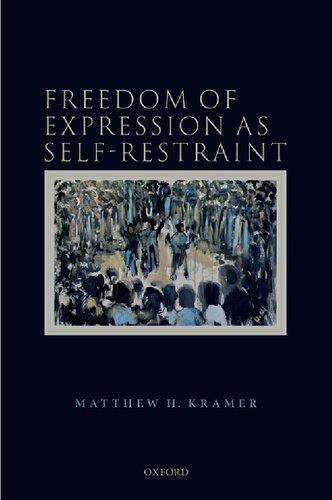
Freedom of Expression as Self-Restraint
MATTHEW H. KRAMER
University of Cambridge
3
Great Clarendon Street, Oxford, OX2 6DP, United Kingdom
Oxford University Press is a department of the University of Oxford. It furthers the University’s objective of excellence in research, scholarship, and education by publishing worldwide. Oxford is a registered trade mark of Oxford University Press in the UK and in certain other countries
© Matthew H Kramer 2021
Te moral rights of the author have been asserted
First Edition published in 2021
Impression: 1
All rights reserved. No part of this publication may be reproduced, stored in a retrieval system, or transmitted, in any form or by any means, without the prior permission in writing of Oxford University Press, or as expressly permitted by law, by licence or under terms agreed with the appropriate reprographics rights organization. Enquiries concerning reproduction outside the scope of the above should be sent to the Rights Department, Oxford University Press, at the address above
You must not circulate this work in any other form and you must impose this same condition on any acquirer
Crown copyright material is reproduced under Class Licence Number C01P0000148 with the permission of OPSI and the Queen’s Printer for Scotland
Published in the United States of America by Oxford University Press 198 Madison Avenue, New York, NY 10016, United States of America
British Library Cataloguing in Publication Data
Data available
Library of Congress Control Number: 2020948081
ISBN 978–0–19–886865–1
DOI: 10.1093/oso/9780198868651.001.0001
Printed and bound by CPI Group (UK) Ltd, Croydon, CR0 4YY
Links to third party websites are provided by Oxford in good faith and for information only. Oxford disclaims any responsibility for the materials contained in any third party website referenced in this work.
To the memory of John Gardner (1965–2019) and
To the memory of Liu Xiaobo (1955–2017)
Preface
I have presented some small portions of this book as lectures at several venues: Cambridge University’s Apotheosis Society in May 2019; University College London in July 2019; the University of Hildesheim in November 2019; and King’s College London in January 2020. I am very grateful to the people who hosted me on those occasions (Edward Young, Jefrey King, Richard Bellamy, Stefani Brusberg-Kiermeier, and Christoph Kletzer), and I am likewise grateful to the attendees for their stimulating feedback.
I owe special thanks to the following people, who each provided extensive and insightful comments on one or more of the chapters: Ian Carter, Rowan Cruf, Michael Ezra, Jelena Gligorijevic, and Christopher Kutz. Also valuable were remarks from Karamvir Chadha, Patrick Duggan, Michael Foran, and Rae Langton. Reports from the Oxford University Press’s two anonymous readers were salutarily perceptive.
Jamie Berezin and Brianne Bellio and their colleagues at the Oxford University Press have been most helpful at every stage, in line with what I have come to expect from the OUP.
Te fnal stages of my work on this book have occurred during a worldwide public-health catastrophe. In such a time, I am especially grateful to the Catering and Housekeeping and Maintenance and Portering staf of Churchill College, Cambridge for their support (with particular thanks to David Oakley, the College’s Catering Manager).
One of the two people to whose memory this book is dedicated, John Gardner, was a friend of mine—and a champion of the values of liberal democracy—who died of oesophageal cancer at the age of 54. I never met the other dedicatee, Liu Xiaobo, but I long admired his courage and tenacity in pursuit of the ideals of liberal democracy against a tyranny that is ferociously opposed to those ideals. Before and since his death, his endeavors have been paralleled by the struggles of quite a few of his compatriots in mainland China and in Hong Kong. I am proud to codedicate a book on freedom of expression to him and implicitly to them.
Matthew H. Kramer
Cambridge, England August 2020
2.3.1.3
2.3.1.4
2.3.3.1
2.3.3.2
3.2.7.1
4.2.2.1
4.2.2.1.1 Te Eagle and the Little Birds
4.2.2.1.2 Bird-Bolts and Cannon-Bullets
4.2.2.2 Te Dynamic of Self-Aggrandizement and Self-Abasement
4.2.2.2.1 A Government-Focused Justifcation
4.2.2.2.2 Overweeningness and Demeaningness: Lessons from Olivia and Tamora
4.2.2.2.3 Overweeningness and Demeaningness: Te Quidnunc Mentality
4.2.2.2.4 Overweeningness and Demeaningness: Harmful Communications
4.2.2.3 Te Connection to Warranted Self-Respect
4.2.2.4 Return to a Troubling Tought-Experiment
5.1 Preliminary Clarifcations
5.2 An Elementary Précis of Speech-Act Philosophy
5.3 Langton on the Subordination of Women by Pornography
5.3.1
5.3.2 Starkly De Facto Authority versus Morally Binding Authority
5.3.3 Practical
5.3.3.1
5.3.3.1.2
5.3.4
5.3.3.2
5.3.3.3
5.3.4.1
5.3.4.2
5.3.4.2.1
5.3.4.2.3
5.3.4.2.4
5.3.4.2.5
5.3.4.2.6
5.3.4.2.7
5.3.5
5.3.5.1
5.3.5.2
5.3.5.3
5.4
5.4.1
5.4.2
5.4.3
5.4.3.1
5.4.4
5.4.3.2
5.5.1
5.5.2
5.5.3
5.5.4
5.5.5
6.
6.4
6.4.1
6.4.2
5.4.4.1
5.4.4.2
7.
7.2
7.2.1
7.2.2
7.2.3
Introduction: Philosophical Preliminaries
At a time when the values of liberal democracy are frequently under attack both in lofy intellectual settings and in the politics of despotism and demagoguery, this book argues that the principle of freedom of expression—one of the cornerstones of liberal democracy—is always and everywhere binding. Every system of governance that exists in any era is morally obligated to abide by that principle in all circumstances. By contending that the sway of the principle of freedom of expression is indeed exceptionless, I will be afrming that that principle is absolute. However, the nature and implications of its absoluteness will have to be expounded carefully. Absolutism in the domain of freedom of expression is sometimes construed (by its opponents) as the thesis that no type or instance of communicative conduct can ever legitimately be prohibited by a system of governance.1 As will become apparent, that extravagant thesis is not what this book will be advancing. Rather, the principle of freedom of expression imposes absolute restrictions on the purposes— the ends and means—that can legitimately be pursued by a system of governance through any measures that prohibit types or instances of communicative conduct. Tose moral restrictions on governmental purposes are unyielding, but they are consistent with laws which pursue morally permissible purposes and which nonetheless forbid certain types or instances of communications.
In Chapters 2 and 3, this book will elaborate the principle of freedom of expression in depth and will explore its implications. Chapter 4 will unfold a complex justifcation for the status of that principle as one of the absolutes of political morality, by showing how it relates to the paramount responsibility of every system of governance. Chapters 5 and 6 will then defend the principle of freedom of expression against some powerful assaults upon it that have been mounted in recent years by Rae Langton and other feminist philosophers and by Jeremy Waldron; those chapters will investigate the especially controversial topics of pornography and hateful extremism. My fnal chapter will briefy conclude the volume by mulling over a few of the procedural issues that arise in the implementation of the principle of freedom of expression through the operations of legal systems.
Tis opening chapter is a prolegomenon to the rest of the book, as it elucidates a number of complicated philosophical matters that will be invoked at various
1 For a notorious example of this kind of interpretation, see Bork 1971, 21. For some correctives, see Baker 2012, 57–8 n1; Ely 1975, 1500; Frantz 1963, 751; Jacobson 2004, 49–50; Linde 1969, 1285–6; Meiklejohn 1948, 18–19.
Freedom of Expression as Self-Restraint. Matthew H. Kramer, Oxford University Press (2021). © Matthew H. Kramer. DOI: 10.1093/oso/9780198868651.003.0001
junctures hereafer. Although this volume will engage quite frequently with American constitutional law—which, under the heading of the First Amendment to the U.S. Constitution, has developed an extraordinarily rich set of doctrines and distinctions pertaining to freedom of expression—it is not a work of constitutional theory. Rather, it is a work of political philosophy. Notwithstanding that the principle of freedom of expression which I explore and commend is convergent with the First Amendment on some signifcant points, it is a precept of political morality rather than of American constitutional law. It is incumbent as a moral principle on every system of governance, rather than solely on the system of governance in the United States. Whether or not its requirements have been given efect in law (or in a society’s conventional morality) to any considerable degree in this or that jurisdiction, it is morally binding there as well as in all other jurisdictions. Moreover, on some points its requirements are markedly diferent from those of the First Amendment. Tus, although the principle of freedom of expression is ofen illuminated by the ideas and categories that have been developed under the auspices of the First Amendment, it is also a basis for critiques of some of those ideas and categories. My endeavor to expound and vindicate that principle is a philosophical undertaking.
As a work of philosophy, this book quite frequently draws on philosophical concepts that are not distinctively associated with debates over freedom of expression. Tose concepts are of course applicable to such debates, but also extend far beyond them into numerous other matters of political and moral and legal philosophy. Having treated of most of those other matters at length elsewhere, I will here merely outline some of the key notions that pertain to them. In this chapter, which is devoted to the task of delineating those notions, the aim is to smooth the way into the subsequent chapters by clarifying the philosophical technicalities that will surface in them from time to time. Let us begin with the property of absoluteness, to which this chapter has already prominently adverted.
1.1
Weak Absoluteness versus Strong Absoluteness
In debates over the principle of freedom of expression, one of the frequent points of controversy is whether the moral constraints established by that principle are absolute. Such a question is in need of disambiguation, however. It might be asking whether those moral constraints are always and everywhere binding in all possible worlds, or it might be asking whether the stringency of those ever-binding constraints is always and everywhere greater than the stringency of any duties that might confict with them. Whereas the former version of the question is about weak absoluteness, the latter version is about strong absoluteness. Although an affrmative answer to the former version of the question is entailed by an afrmative
answer to the latter version, there is no entailment between afrmative answers in the other direction. Strong absoluteness entails weak absoluteness, but not vice versa.
Any weakly absolute moral principle WM is binding always and everywhere in all possible worlds. No circumstances, however exigent, can ever negate or diminish the demands of such a principle. Nonetheless, although WM is irrepressibly binding in all possible situations, it can be locked in conficts with competing moral requirements. Moreover, in some imaginable circumstances, the competing moral requirements are more stringent than WM with which they confict. In such circumstances, compliance with WM would be even more gravely wrong than a contravention of it. Still, any contravention of WM is indeed a contravention—that is, a moral wrong—and it will thus trigger remedial obligations. (Of course, if WM is formidably stringent, there might never materialize any actual situation in which a transgression of WM would be less gravely wrong than compliance therewith. Nevertheless, so long as there could arise some context in which such a transgression would be the lesser of two wrongs, WM is only weakly absolute rather than strongly absolute.)
If a moral principle is strongly absolute, it is not only binding at all times in all places in all possible worlds; in addition, it is always more stringent than any possible countervailing moral requirements. Of course, the absoluteness of that principle in this strong sense is perfectly consistent with the possibility of countervailing moral requirements that militate against compliance with the principle. In other words, a strongly absolute moral obligation can be locked in conficts with competing moral obligations that are inferior in their stringency. Although those latter obligations are indeed less stringent, they impose genuine moral demands that will give rise to remedial duties if they are lef unfulflled.2
Now, when this book maintains that the principle of freedom of expression is absolute, it is contending that that principle is weakly absolute. As has been declared in the book’s opening paragraph, exceptionlessness—rather than anything stronger—is the property which I ascribe to the principle of freedom of expression when I defend it as a moral absolute. Pressingly stringent though the requirements imposed by that principle are, there is no suggestion herein that those requirements are always and everywhere of greater stringency than is every moral obligation that might confict with them.
2 For some longer ruminations on the distinction between weak absoluteness and strong absoluteness, see Kramer 2014, 8–9.
1.2 Moral Conficts, Permissibility, and Stringency
In my explication of the properties of weak absoluteness and strong absoluteness, I have referred at several junctures to conficts between moral duties. Like many other philosophers, I use the phrase “moral confict” to denote any situation in which someone is under a moral duty to φ and is simultaneously under a moral duty not to φ. (Te variable “φ” stands for any verb or verbal phrase that refers to any action or omission.) Again like many other philosophers, I additionally use the phrase “moral confict” to denote any situation in which the contents of the clashing duties are contraries rather than contradictories. Such a situation arises when someone is under a moral duty to do x and is simultaneously under a moral duty to do y, where (i) doing x is logically inconsistent with doing y and (ii) not doing x is logically consistent with not doing y. Tough the clashing duties within a moral confict can perfectly well coexist, they can never be jointly fulflled; the fulfllment of either of them entails the non-fulfllment of the other.
Slightly more involuted is the matter of moral permissibility. Crucial here is a distinction between two broad types of permissibility, which can best be approached through a distinction between two main kinds of moral duties.3 An overtoppingly stringent moral requirement exceeds in stringency all the moral duties with which it conficts, or is not in confict with any other moral duties. A non-overtoppingly stringent moral requirement R does not exceed in stringency all the moral duties that confict with it. (Any competing moral requirements might be equal in importance to R, or they might exceed it in importance, or they might be insusceptible to any determinate comparisons with it because of problems of incommensurability.)
Now, through this dichotomy between overtoppingly stringent and nonovertoppingly stringent duties, we can diferentiate between weak permissibility and strong permissibility:
Weak Permissibility. Some person X is morally permitted to perform some action q if and only if X is not under any overtoppingly stringent moral obligation to not perform q 4
X can be weakly permitted to perform q while being under a non-overtoppingly stringent moral obligation to not perform q. In that respect, weak permissibility difers from strong permissibility.
3 For some more expansive accounts of the distinction between strong permissibility and weak permissibility, see Kramer 2014, 4–7; 2016, 165–8. Troughout this book, I use the terms “permissible” and “legitimate” (and the terms “permissibility” and “legitimacy”) interchangeably. I also use the terms “duty” and “obligation” and “requirement” interchangeably. Whenever I use “responsibility” as a count noun rather than as a mass noun, it too is synonymous with “duty” and “obligation” and “requirement.”
4 To avoid ambiguities in my prose, my placement of “not” will create some ugly split infnitives at several junctures in this discussion.
Strong Permissibility X is morally permitted to perform q if and only if X is neither under an overtoppingly stringent moral obligation to not perform q nor under a non-overtoppingly stringent moral obligation to not perform q.
X is strongly permitted to perform q if and only if X is under no moral obligation whatsoever to not perform q. Note that the proposition “X is strongly permitted to perform q” entails the proposition “X is weakly permitted to perform q,” but not vice versa.
Whenever this book uses the term “permissible” or “legitimate” (or “permissibility” or “legitimacy”) without any qualifcation, it is invoking the notion of permissibility in the strong sense. Consequently, the term “impermissible” or “illegitimate” is to be understood as “not strongly permissible.” Tat is, I generally assume that some action or policy q is morally impermissible for a system of governance unless that system is under no moral obligation whatsoever to not undertake q. Moreover, the adjectives “wrong” and “impermissible” are interchangeable throughout this book; a course of conduct is morally wrong unless it does not contravene any moral duties.
In these frst two sections of this chapter, I have adverted repeatedly to the property of deontic stringency. Tat property can be understood in several ways (Kamm 2007, 248–68), and a choice among them is not necessary for my purposes in this book. By any reckoning, deontic stringency is a measure of the moral importance of a duty. Still, worth indicating here is the conception of stringency that implicitly underlies my numerous invocations of that notion. Te stringency of a moral duty is given by the onerousness or sizeableness of the step(s) required in order to remedy a contravention of the duty. If the remedial obligations engendered by wholesale violations of some duty D1 are heavier than the remedial obligations engendered by wholesale violations of some other duty D2, then D1 is more stringent than D2.5
1.3 Deontology versus Consequentialism
As will be emphasized at many junctures in this book, my account of the principle of freedom of expression is strongly deontological. Hence, another point of preliminary clarifcation that is requisite here is the distinction between deontology and consequentialism. Tat distinction can be drawn in more than one way, and elsewhere I have indeed drawn it in two main ways (Kramer 2014, 20–4). For the purposes of this book, however, the most general and straightforward demarcation between deontology and consequentialism is perfectly sufcient on its own.
5 Tis conception of stringency is integrally connected to the account of moral rights which I have propounded in Kramer 2004, 249–94.
Tat demarcation is centered on the basic moral import—the moral permissibility or impermissibility—of certain modes of conduct (Kramer 2014, 20–1). A deontological moral theory holds that some modes of conduct are morally impermissible regardless of the benignity of the consequences that are likely to fow from the occurrence of any such modes of conduct. If somebody is under a deontological duty not to perform some action q, then his performance of q is wrong regardless of how valuable the state of afairs ensuing from his performance of q might be. Tat is, every deontological duty proscribes some course of conduct even if one’s adoption of that course of conduct in particular circumstances would yield much better consequences than one’s refraining therefrom.
While deontologists ascribe consequence-independent moral statuses to various types of actions and omissions, consequentialists of course maintain that the moral character of any type or instance of conduct is fully determined by the causal consequences that will probably or actually fow therefrom.6 In the eyes of the latter theorists, no type or instance of conduct is ever endowed with any inherent moral import. Instead, every action or omission derives its moral import from the efects with which it is causally associated. Accordingly, as John Finnis has aptly remarked, a proponent of any consequentialist doctrine “holds himself ready to do anything” (Finnis 1980, 121, emphasis in original). According to the consequentialists, there are no principled limits on the range of actions that can legitimately be undertaken in sundry circumstances. Te breadth or narrowness of that range will depend entirely on the results that are likely to follow causally from each of the multitudinous modes of conduct that might be adopted by people in any number of contexts. No mode of conduct, however abhorrent it may be, is unconditionally disallowed by the reckoning of a consequentialist theory. Te only thing unconditionally disallowed by such a reckoning is the inconduciveness of one’s behavior to the attainment of a maximally good state of afairs—where maximal goodness is gauged with reference to the desideratum or set of desiderata commended by the theory.
As is evident, this distinction between deontology and consequentialism is directly relevant to the matter of moral absolutes. Whereas the only moral absolute that is postulated by consequentialists is a prohibition on impeding the maximal attainment of some fundamental desideratum or set of desiderata, any full-blown deontologists afrm that some specifed moral prohibitions are binding always and everywhere irrespective of the likely consequences of compliance therewith. In particular, deontologists afrm that each such specifed prohibition is binding even when some contraventions of it will serve to lower greatly the overall frequency with which it is contravened. Insofar as anyone contends that some mode
6 I am of course here assuming that the types or instances of conduct are identifed without reference to the desideratum or set of desiderata pursued by any consequentialist theory that is under consideration.
of conduct is always and everywhere morally wrong—and, thus, insofar as anyone maintains that the forbiddenness of such conduct is a moral absolute—he or she is a deontologist. (Note that the absoluteness integral to deontological prohibitions is exceptionlessness—weak absoluteness—rather than the stronger property of invariably supreme stringency.)
1.4 Physical Freedom versus Deontic Freedom
In a book on freedom of expression, the nature of freedom is obviously a matter of great importance. Although quite a few distinctions would have to be drawn in a full-length account of that nature,7 the chief dichotomy for the purposes of this book is between physical freedom and deontic freedom. In a nutshell, on which I will briefy expand here, that dichotomy is between freedoms as abilities and freedoms as permissions.
Someone is physically free to φ if and only if she is able to φ—that is, if and only if she is not prevented from φ-ing either by internal incapacities or by external obstacles. Her being physically free to φ does not entail her φ-ing, since she might choose not to φ; but her being physically free to φ entails that, if she carefully endeavors to φ, she will indeed φ. By contrast, someone is physically not free to φ if and only if she is not able to φ. She is physically unfree to φ if and only if her being physically not free to φ is causally attributable to some actions or dispositions-toperform-actions on the part of some other person(s).
In the preceding paragraph’s terse remarks on physical freedoms and unfreedoms, which I have elsewhere elaborated and defended at great length, the key concepts are modal rather than deontic. Tat is, they concern what can or cannot occur, rather than what should or should not occur. Tey concern what each person is able or unable to do, rather than what each person is permitted or forbidden to do. Being physically free to φ consists in being able to φ—whether or not one actually chooses to φ—and being physically not free to φ consists in being unable to φ. Whereas the antithesis of being physically free to φ is being prevented from φ-ing, the antithesis of being physically not free to φ is being unprevented from φ-ing. Note that “physically” is not to be understood here in contrast with “mentally” or “psychologically.” Unless someone is psychologically able to φ, he or she is not able to φ and is therefore not physically free to φ. Hence, “physically” includes “psychologically,” as physical freedoms (in the relevant sense of “physical”) are always partly constituted by psychological abilities. Instead of being contrasted with “mentally” or “psychologically,” “physically” is to be understood in contrast
7 For a full-length account, see Kramer 2003. See also Carter 1999; Kramer 2010; and Carter, Kramer, and Steiner 2007. Troughout this book, I use the terms “freedom” and “liberty” (and the terms “freedoms” and “liberties”) interchangeably.
with “deontically.” (Although “physically” is in contrast with “deontically,” it is not in contrast with “normatively.” As will be noted in §1.5.3 below, legal powers to alter legal relationships and moral powers to alter moral relationships are abilities rather than permissions. Hence, they too are classifable as physical freedoms in contradistinction to deontic freedoms.)
Deontic freedoms are permissions rather than abilities. Tey consist not in unpreventedness but instead in permittedness or unforbiddenness. If somebody is deontically free to φ, then he is allowed to φ by any applicable authoritative norms such as legal mandates or moral principles or institutional rules. Conversely, if somebody is deontically unfree to φ, then he is prohibited from φ-ing by one or more of those authoritative norms. When we ask whether somebody is deontically free to φ, we are not asking whether he is capable of φ-ing; we are asking whether he is entitled to φ. Tus, the antithesis of being deontically free to φ is being forbidden to φ, and the antithesis of being deontically unfree to φ is being under no obligation to abstain from φ-ing.
Physical liberty and deontic liberty diverge in a number of respects that derive in various ways from the basic modal/deontic diference—the diference between abilities and permissions—that has just been recounted (Kramer 2003, 60–75). Most obvious among the dissimilarities between the concept of physical freedom and the concept of deontic freedom is their extensional non-equivalence. Tat is, a person will ofen be deontically free to φ without being physically free to φ, and vice versa. For example, although I am both legally and morally permitted to run a one-mile race under four minutes, I am not physically able to do so; my deontic liberty to run at that speed is not accompanied by a corresponding physical liberty. Conversely, although I am physically able to assault unprovokedly the person standing ahead of me in a queue, I am neither legally nor morally permitted to do so. My physical freedom to commit the assault is not accompanied by any corresponding deontic freedom. Permissibility and ability can coincide and very frequently do coincide, but they likewise frequently diverge.
Of course, the extensional non-equivalence and the several other contrarieties between physical liberty and deontic liberty should not induce us to overlook the many afnities between them. For one thing, as has just been stated, the two types of freedom very frequently converge extensionally; people are ofen able to do things which they are permitted to do, and they are ofen permitted to do things which they are able to do. Moreover, liberty of each type consists in an absence of constraints. Tough the constraints that negate abilities are diferent in sundry ways from the constraints that negate permissions, unconstrainedness is the essence of deontic freedom just as it is of physical freedom. Freedom of each type consists in opportunities.
Both kinds of freedom will fgure prominently in this book, though deontic freedom and unfreedom will fgure especially saliently. As will be argued in support of the central thesis of this book, systems of governance are always morally
obligated to refrain from imposing legal constraints on communicative activities qua communicative activities—which is to say that this book’s central thesis is concerned with the deontic unfreedom (moral unfreedom) of any system of governance to impose deontic unfreedoms (legal unfreedoms) on citizens in their communicative endeavors.8 Also crucial, however, are physical freedoms to engage in communicative activities. Any system of governance is morally obligated to refrain from eliminating such freedoms for certain purposes, and is also morally obligated to keep hecklers and hostile audiences from eliminating such freedoms in some circumstances. We shall encounter these freedom-pertaining matters again and again in the chapters that follow.
1.5 Te Hohfeldian Analysis
Somewhat over a century ago, the American jurist Wesley Hohfeld propounded an analysis of legal positions that has remained enormously infuential to the present day.9 Hohfeld diferentiated among four main kinds of entitlements that are commonly designated as “rights,” and he sought to highlight their distinctness. Among those four categories are deontic liberties. (Hohfeld concentrated on legal positions, but most aspects of his analysis are equally applicable to moral positions. Beyond the scope of the present book are the aspects of the Hohfeldian analysis that are not straightforwardly transferable from the legal domain to the moral domain.)
Hohfeld’s analysis of legal entitlements and their correlates is encapsulated in the following table:
HOHFELDIAN TABLE OF LEGAL POSITIONS
ENTITLEMENTS claim (or claim-right) liberty power immunity
CORRELATES duty no-right liability disability
8 Here and elsewhere throughout this book, I use the word “citizens” expansively to denote private individuals (including public ofcials in their capacities as private individuals). Tat word is not limited to the people in any jurisdiction who are full members of the polity there. It extends also to residents who are not such members. Te operative contrast is not between citizens and other residents, but is instead between citizens and people who are acting in their capacities as ofcials.
9 Hohfeld’s main law-review articles were collected posthumously in Hohfeld 1923. Especially germane are the frst two chapters in that book. I have elsewhere expounded the Hohfeldian analysis in some of my many essays on rights. See especially Kramer 1998, 7–60, 101–11; 2001, 73–89; 2008, 415–17; 2019a.
Each of the four positions in the top half of the table is an entitlement that is correlated with a position in the lower half of the table. Correlativity in the Hohfeldian sense is biconditional entailment; the existence of any Hohfeldian entitlement with a certain content entails the existence of the correlative position with the same content, and vice versa. For example, Joe’s claim-right to be paid $10 by Sally entails Sally’s duty to pay $10 to Joe, and vice versa. Neither an entitlement with a certain content nor its correlate with that same content can ever exist without the other. Each exists if and only if the other exists.
One major logical relationship exhibited in the Hohfeldian table, then, is that of correlativity (biconditional entailment) between the two positions in each of the four columns of the table. In addition are some logical relationships between the two columns on the lef-hand side of the table, and between the two columns on the right-hand side. Whereas the positions diagonally across from each other on the lef-hand half of the table are logical duals, the positions diagonally across from each other on the right-hand half are logical contradictories.
A terse elucidation of the distinction between duals and contradictories is advisable here. Consider, for example, the proposition “Sally bears a duty to pay $10 to Joe” and the proposition “Sally is at liberty not to pay $10 to Joe.” Te former proposition is true if and only if the negation of the latter proposition is true. Each proposition is the negation of the other, and the content of the deontic predicate (that is, the content of the duty or liberty) in each proposition is the negation of the content of the deontic predicate in the other proposition. Tese twofold instances of negation, the negation of the proposition and the negation of the predicated content, are characteristic of logical duals.
By contrast, the diagonal opposites on the right-hand side of Hohfeld’s table are contradictories rather than duals. Tus, for example, “Peter is liable to undergo a certain change X in his legal relations brought about by Melanie” is the contradictory of “Peter is immune from undergoing that change X in his legal relations brought about by Melanie.” Te former proposition is true if and only if the negation of the latter proposition is true, but the content of the normative predicate (that is, the content of the liability or immunity) in each proposition is the same as the content of the normative predicate in the other proposition.
1.5.1 Claim-Rights and Duties
Because the Hohfeldian framework is indispensable for a precise understanding of the principle of freedom of expression, a brief column-by-column conspectus will be salutary here—starting, of course, with the claim-right/duty axis. A claim-right confers deontic protection on its holder against the interference or uncooperativeness of some other person(s). Interference and uncooperativeness are both understood very broadly here to encompass the countless ways in which the actions or
omissions of some person(s) can harm or disadvantage some other person(s). Anyone who bears a duty correlative to a specifed claim-right is required by some norm(s) to behave in accordance with the content of the claim-right, whether that content calls for non-interference or for cooperativeness. Tus, to return to the example above, the fact that Joe has a claim-right to be paid $10 by Sally is something that endows him with deontic protection (legal or moral protection, for example) against her withholding of the payment of $10. As the bearer of the duty correlative to his claim-right, Sally is required by some norm(s) to behave in accordance with the content of the claim-right by paying $10 to Joe.
As has been indicated, the protection bestowed by a claim-right on its holder is deontic rather than physical. Hence, Joe’s claim-right to be paid $10 by Sally is not in itself a physical constraint on Sally’s latitude. However, if a claim-right is legal or institutional, it will usually be backed up with the prospect of enforcement in the event of noncompliance with its requirements. Tat prospect of enforcement does serve as a physical constraint on the latitude of the duty-bearer, not typically by eliminating certain physical freedoms discretely ab initio but instead typically by eliminating the ability of the duty-bearer to exercise certain physical freedoms in conjunction with certain other physical freedoms. Given that a duty-bearer will be subjected to a legal sanction at some time t2 for having exercised a specifed physical freedom (athwart her duty) at some earlier time t1, and given that the imposition of the sanction will deprive the duty-bearer of some physical freedoms that could otherwise have been exercised by her at t2, the duty-bearer is not able to exercise both the specifed physical freedom at t1 and the physical freedoms that will be removed by the sanction at t2. For example, if Sally declines to pay $10 to Joe at the time when her payment is due, and if a legal sanction will subsequently be imposed on her for her breach of the legal duty which she has owed to Joe, she is not able to exercise both her physical freedom to withhold the payment of $10 and any physical freedoms that will be removed from her by the imposition of the legal sanction. Accordingly, although the legal claim-right held by Joe vis-à-vis Sally or the correlative legal duty owed by her to him is not in itself a physical constraint on her latitude, the prospect of legal enforcement that will be triggered in the event of her noncompliance with his claim-right (and with her own correlative duty) is such a physical constraint.
1.5.2 Liberties and No-Rights
Te holder of a Hohfeldian liberty is free of any duty to some other person(s), with regard to the act or omission or state of afairs covered by the liberty. Suppose that Agnes is legally at liberty vis-à-vis Fred to visit her grandmother on Saturday morning. In that case, she does not owe Fred any legal duty not to visit her grandmother on Saturday morning. She might owe Fred a moral duty not to visit her