J. G. Fichte: Foundation of the Entire Wissenschaftslehre and Related Writings (1794–95)
J. G. Fichte: Foundation of the Entire Wissenschaftslehre and Related Writings (1794–95)
Edited and Translated by DANIEL BREAZEALE
1
Great Clarendon Street, Oxford, OX2 6DP, United Kingdom
Oxford University Press is a department of the University of Oxford. It furthers the University’s objective of excellence in research, scholarship, and education by publishing worldwide. Oxford is a registered trade mark of Oxford University Press in the UK and in certain other countries
All rights reserved. No part of this publication may be reproduced, stored in a retrieval system, or transmitted, in any form or by any means, without the prior permission in writing of Oxford University Press, or as expressly permitted by law, by licence or under terms agreed with the appropriate reprographics rights organization. Enquiries concerning reproduction outside the scope of the above should be sent to the Rights Department, Oxford University Press, at the address above
You must not circulate this work in any other form and you must impose this same condition on any acquirer
Published in the United States of America by Oxford University Press 198 Madison Avenue, New York, NY 10016, United States of America
British Library Cataloguing in Publication Data Data available
Library of Congress Control Number: 2020944357
ISBN 978–0–19–884290–3
Printed and bound in Great Britain by Clays Ltd, Elcograf S.p.A.
Links to third party websites are provided by Oxford in good faith and for information only. Oxford disclaims any responsibility for the materials contained in any third party website referenced in this work.
To Viv, Summoner and Sustainer
Table of Contents
Editor’s Introduction 1
Genesis and First Presentation of the Wissenschaftslehre (1793–95) 1
Contents and Outlines of Foundation of the Entire Wissenschaftslehre and Outline of What is Distinctive of the Wissenschaftslehre with Regard to the Theoretical Power
TEXTS
I. CONCERNING THE CONCEPT OF THE WISSENSCHAFTSLEHRE , OR OF SO-CALLED “PHILOSOPHY” Preface to the First Edition (1794)
to the Second Edition (1798)
First Part: Concerning the Concept of the Wissenschaftslehre as Such
§ 1. Hypothetically Proposed Concept of the Wissenschaftslehre
§ 2. Development of the Concept of the Wissenschaftslehre
Second Part: Explication of the Concept of the Wissenschaftslehre
§ 3.
§ 4. To What Extent Can the Wissenschaftslehre Be Sure That It Has Exhausted Human Knowledge as Such?
§ 5. What Is the Boundary Separating the Universal Wissenschaftslehre from the Particular Sciences Based Upon It?
§ 6. How Is the Universal Wissenschaftslehre Related to Logic in Particular?
§ 7. How Is the Wissenschaftslehre Related to Its Object?
Third Part: Hypothetical Division of the Wissenschaftslehre
II. FOUNDATION OF THE ENTIRE WISSENSCHAFTSLEHRE
Preface to the First Edition (1795)
Forward to the Second Edition (1802)
Part One: Foundational Principles of the Entire Wissenschaftslehre 200
§ 1. First, Purely and Simply Unconditioned Foundational Principle 200
§ 2. Second Foundational Principle, Conditioned with Respect to its Content 207
§ 3. Third Foundational Principle, Conditioned with Respect to its Form 210
Part Two: Foundation of Theoretical Knowledge 225
§ 4. First Theorem
A. Determination of the Synthetic Proposition to be Analyzed
B. General Nature of the Synthesis of Terms Posited in Opposition to Each Other as Such in the Indicated Proposition 228
C. Synthesis by Means of Reciprocal Determination of the Contradictions Implicit in the First of the Two Propositions
Posited in Opposition to Each Other 230
D. Synthesis by Means of Reciprocal Determination of the Opposing Propositions Contained in the Second of the Two Propositions
Posited in Opposition to Each Other 235
E. Synthetic Unification of the Oppositions Occurring between the Two Indicated Types of Reciprocal Determination
Deduction of Representation
Part Three: Foundation of the Science of the Practical
§ 5. Second Theorem
§ 6. Third Theorem: In the Striving of the I There Is Posited at the Same Time an Opposed Striving of the Not-I, which Counterbalances that of the I
346
§ 7. Fourth Theorem: The Striving of the I, the Opposed Striving of the Not-I, and the Equilibrium between Them Must Be Posited 347
§ 8. Fifth Theorem: Feeling Must Itself Be Posited and Determined 350
§ 9. Sixth Theorem: Feeling Must Be Further Determined and Delineated 354
§ 10. Seventh Theorem: Drive Itself Must Be Posited and Determined 357
§ 11. Eighth Theorem: Feelings Themselves Must Be Capable of Being Posited in Opposition to Each Other 374
III. OUTLINE OF WHAT IS DISTINCTIVE OF THE WISSENSCHAFTSLEHRE WITH REGARD TO THE THEORETICAL POWER
§ 1. The Concept of the Particular in the Theoretical Wissenschaftslehre 382
§2. First Theorem: The Indicated Factum Is Posited through Sensation, or, Deduction of Sensation
§3. Second Theorem: The Sensing Subject Is Posited through Intuition, or, Deduction of Intuition
§ 4. The Intuition Is Determined in Time; What Is Intuited Is Determined in Space
384
388
Preface
Early in 1801, having taken refuge in Berlin in the wake of the “Atheism Controversy,” which led to the loss of his professorship in Jena, and convinced that his system of philosophy, the so-called “Doctrine of Scientific Knowledge” or Wissenschaftslehre, had been universally misunderstood, Fichte issued a Crystal-Clear Report on the Most Recent Philosophy, which bore the plaintive subtitle “an effort to force the reader to understand.” This has served — with equal poignancy — as my personal motto over the several years I have labored over this translation and edition.
Having for many years studied, taught, and written about the texts translated in this volume, I remained only too well aware of how far I still was from truly “understanding” them, and I wanted to do something to remedy that situation. Fichte constantly challenged his own students and readers “to think the Wissenschaftslehre” for themselves and in their own way, and he added that only by doing so could anyone ever really succeed in “thinking it” — that is, the Wissenschaftslehre — at all. For me, that meant thinking it in English. Hence my decision to tackle a work described by a recent commentator as “the most difficult text to comprehend of all of those that have been produced in the history of philosophy since antiquity.”1
This new English translation of the 1794/95 Foundation of the Entire Wissenschaftslehre is my effort to force myself to understand it, while at the same time helping others do the same. Accordingly, I have tried to produce an English version that is not only as accurate as I can make it but is as broadly accessible as possible. For this reason, I have supplemented my translations with rather extensive annotation and commentary, as well as with detailed outlines of the contents and structure of the Foundation and Outline. It is my hope that the latter will help orient readers who — like myself — sometimes find themselves rather lost in the wilderness of Fichte’s complex “derivations.”
After completing my translation of the Foundation, I realized that it really should appear, as Fichte himself had insisted, along with the shorter companion treatise of 1795, Outline of What is Distinctive of the Wissenschaftslehre with Regard to the Theoretical Power, as well as with the shorter Concerning the Concept of the Wissenschaftslehre, which Fichte published in May of 1794 as an introduction to his project for prospective students at the University of Jena. Though I first translated both of these texts more than thirty years ago,2 they have been translated anew for
1 Émil Jalley, “Présentation,” in Fichte, La Doctrine de la science (1794), Vol. 2, Naissance et devenir de l’impérialisme allemand (Paris: L’Harmattan, 2016), p.49.
2 Fichte: Early Philosophical Writings (Ithaca, NY: Cornell University Press, 1988). I have subsequently translated and edited three more volumes of Fichte’s writings: Foundations of Transcendental Philosophy (Wissenschaftslehre) nova methodo (Ithaca, NY: Cornell University Press, 1992); Introductions to the Wissenschaftslehre and Other Writings (Indianapolis, IN: Hackett, 1994) and, with Günter Zöller, System of Ethics (Cambridge: Cambridge University Press, 2005).
this volume, which also includes, as an Appendix, a translation of the transcriptions of the surviving portions of Fichte’s lectures in Zurich during the first months of 1794. It was in these “Zurich lectures” that he made his very first effort to formulate and to articulate the system he would soon be presenting in printed form in his lectures in Jena.
I wish I could report that my experiment was a complete success and that I now truly understand every facet of this, Fichte’s first and most influential presentation of the Wissenschaftslehre. I can make no such claim, however, though work on this project has certainly advanced my understanding of this remarkable thinker and of these challenging but rewarding texts. My sincere hope is that it may do the same for readers of this volume.
I first encountered these writings in graduate school, when I dropped out of a seminar on Fichte and Schelling taught by Miklos Vetö, because the key texts were then unavailable in English and because my German was not up to the challenge of reading the Grundlage der gesamten Wissenschaftslehre. I had more success with Alexis Philonenko’s French translation, but even that was insufficient. I was therefore delighted when, shortly thereafter, Peter Heath published his English translation of the Foundation, in a volume that also included John Lachs’ English version of Fichte’s 1797 “Introductions” to the Wissenschaftslehre.3 I have used Heath’s translation in my graduate and undergraduate classes for many years, supplemented by an extensive list of “corrections and omissions,” prepared and privately distributed by Fritz Marti.
Like many others, I have profited from Heath’s work, as well as from Philonenko’s, though I am not unaware of certain shortcomings in each. There are undoubtedly shortcomings in these new translations as well, though I hope they will not be debilitating. After completing the first drafts of my new translations, I compared them carefully and profitably with Heath’s and Philonenko’s versions, which allowed me to catch numerous errors and to improve my own translations. Regarding matters of translation, I also consulted with Joseph O’Neill, Erich Fuchs, and David W. Wood.
An invaluable resource for the annotation has been the comprehensive “commentary” on the Foundation prepared by Wolfgang Class and Alois Soller.4 I have also benefited enormously from the substantial scholarly literature devoted to the Foundation and associated works, as indicated in the bibliography to this volume, as well as from the many scholarly conferences and symposia devoted to the early Wissenschaftslehre in which I have had the good fortune to participate over the years.
I am especially grateful to Reinhard Lauth, who fostered my budding interest in Fichte, and to Erich Fuchs, who has been a constant and reliable source of information and inspiration, as well as a dear friend. I am grateful too to my fellow Fichte scholars and friends around the world, with whom I have engaged for so long and
3 The Science of Knowledge, trans. and ed. Peter Heath and John Lachs (NY, NY: Meredith, 1970; rpt. Cambridge: Cambridge University Press, 1982). There was also an earlier nineteenth-century translation, The Science of Knowledge, trans. and ed. A. E. Kroeger (Philadelphia: J. B. Lippincott, 1868; rpt. London: Trübner, 1889); however, the less said about this well-intended but utterly unreliable effort the better.
4 Wolfgang Class and Alois K. Soller, Kommentar zu Fichtes Grundlage der gesamten Wissenschaftslehre (Amsterdam: Rodopi, 2004).
from whom I have learned so much. These include Tom Rockmore, Günter Zöller, Wayne Martin, Michael Vater, Fred Neuhouser, Claude Piché, Ives Radrizzani, Marco Ivaldo, Jacinto Rivera de Rosales, Mário Jorge de Carvalho, Jürgen Stolzenberg. Helmut Traub, Halla Kim, Violetta Waibel, Alois Soller, Faustino Fabianelli, Michael Gerten, Steven Hoeltzel, Jeffery Kinlaw, George Seidel, Marina Bykova, Alain Perrinjaquet, Yukio Irie, Elizabeth Millán Brusslan, Benjamin Crowe, Owen Ware, Gabriel Gottlieb, Kevin Zanelotti, Arnold Farr, Joseph Trullinger, Brett FulkersonSmith, Janet Roccanova, Yolanda Estes, and Carolyn Buchanan.
I would also like to thank my colleagues in the College of Arts and Sciences and Department of Philosophy at the University of Kentucky, who have granted me free reign to pursue my scholarly interests for half a century now, as well as to the generations of students who have gamely followed my instructions “to think the person who is thinking the wall.” These students, many of whom were exposed to and helped improve earlier “beta versions” of these translations, were the readers I envisioned as I prepared these translations and notes.
I am indebted as well to the institutions and agencies that have generously supported my study of Fichte over the decades: the University of Kentucky, the National Endowment for the Humanities, and the Alexander von Humboldt Stiftung.
I am also grateful to Viviane Breazeale and David W. Wood for their diligent proofreading of this material and for their many valuable suggestions for improving both the accuracy and the readability of these texts.
I must also mention the highly professional editorial and production team at Oxford University Press, including the philosophy editor, Peter Momtchiloff, the project manager, Chandrasekaran Chandrakala, the copy-editor, Joy Mellor, and the proofreader Michael Janes—with all of whom it was a pleasure to work.
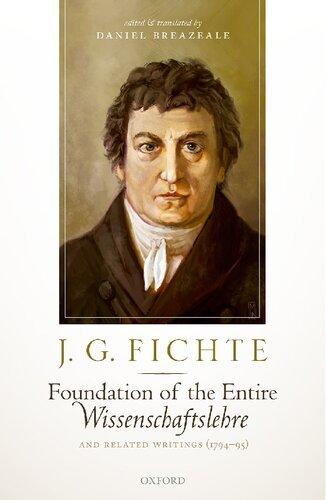
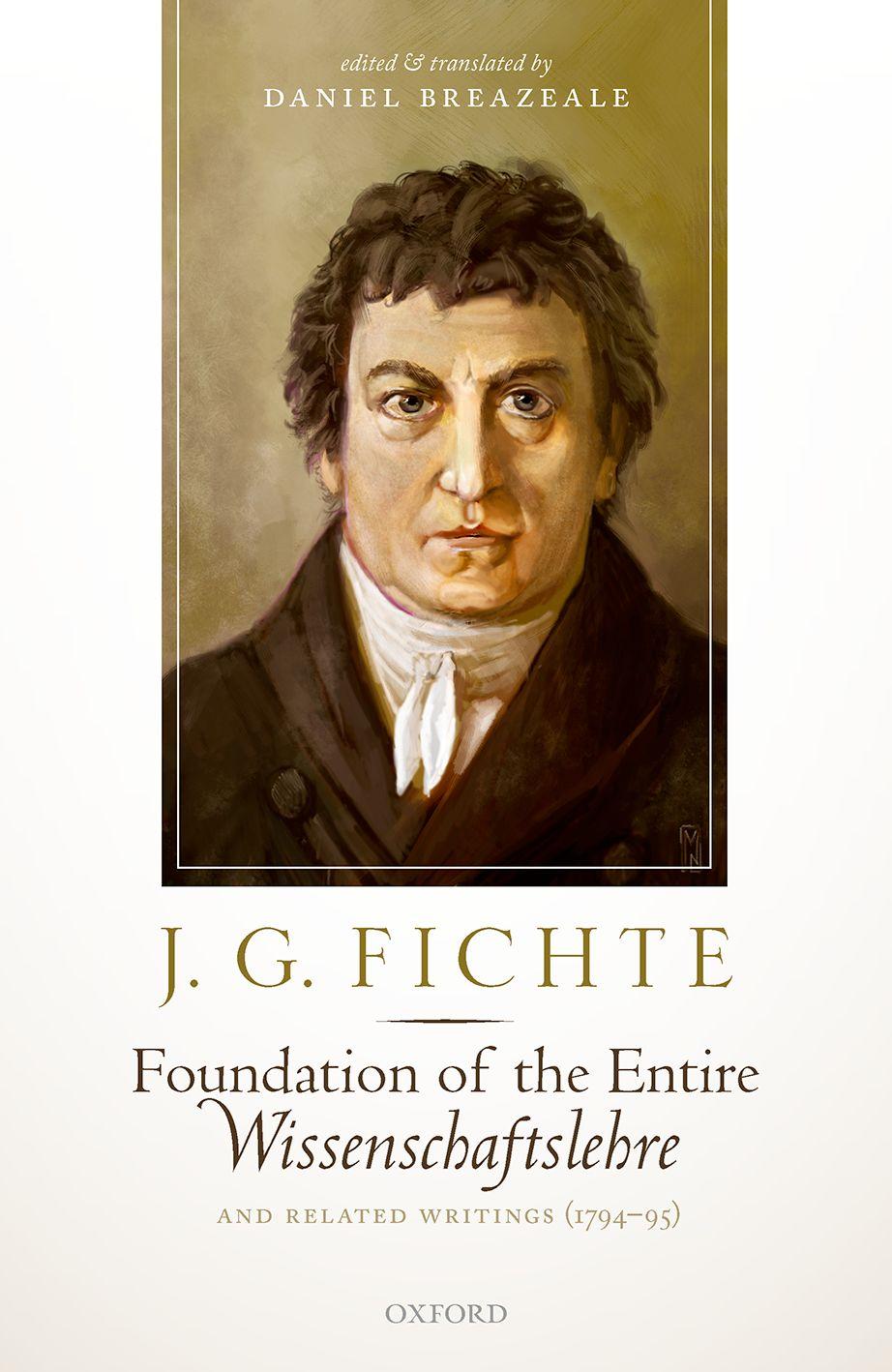
Thanks are due as well to Mitchell Nolte for his generous permission to reproduce his portrait of Fichte on the cover of this volume.
As a final thought regarding the daunting challenges of translating, understanding, and interpreting the original Wissenschaftslehre, allow me to misappropriate Fichte’s own words:
Let us rejoice over the immense prospect that is ours to cultivate! Let us rejoice, because we feel our own strength—and because our task is endless!5
Lexington, Kentucky 2020
5 These are the concluding words of Fichte’s fourth lecture concerning the vocation of the scholar, delivered in Jena in June of 1794 (EVBG, GA, I/3: 68; SW, VI, p. 346; EPW, p. 184).
Editor’s Introduction
Genesis and First Presentation of the Wissenschaftslehre (1793‒95)
In the summer of 1793, following the quite astonishing success of his first book, Attempt at a Critique of all Revelation,1 and after publishing (anonymously) the “First Installment” of his even more controversial Contribution toward Rectifying the Judgment of the Public concerning the French Revolution, Fichte returned to Zurich, where he had previously spent a tumultuous year and a half as a private tutor, while also becoming engaged to Johanna Rahn, daughter of a well-to-do local official.2 Having finally achieved a measure of public success and professional recognition, he was preparing to marry his fiancée later that year and looking forward to spending an extended period of time living with her in her father’s house, while pursuing his burgeoning philosophical projects at a deliberate pace.
Fichte had been an enthusiastic admirer of Kant’s philosophy ever since the moment of his first exposure to the same in the summer of 1790, and, on the strength of his treatise on revelation, he was already being hailed in some influential quarters as a new, rising star in the firmament of Kantian (or “Critical”) philosophy. He was therefore invited to become a contributor to one of the more important organs associated with this new philosophical movement, the Allgemeine Literatur Zeitung (A.L.Z.), which was edited and published in Jena, the city and university most closely associated with these new advancements. Indeed, K. L. Reinhold, the best-known exponent of the effort to “improve” Kant’s philosophy by providing it with a more systematic form and a deeper, more secure foundation, was a professor at Jena. An essential part of this endeavor, upon which Reinhold conferred the name Elementarphilosophie (“Elementary Philosophy” or “Philosophy of the Elements”), was Reinhold’s effort to demonstrate
1 Fichte had previously lived in Zurich from September of 1788 through March 1790.
The first edition of VKO was composed during his stay in Königsberg in the summer and early fall of 1791 and published—minus both its preface and the name of its author—in the spring of 1792. An expanded second edition, which included an important new “Doctrine of the Will,” was prepared in Danzig during the winter of 1792–93 and appeared in April of 1793, a few months prior to Fichte’s triumphal return to Zurich.
For the fascinating story of how Fichte’s inaugural work happened to be published without the name of its author and the incalculable consequence this had for Fichte’s reputation and career, as well as for additional information on Fichte’s activities and writings up to 1800, see “Fichte in Jena,” EPW, pp. 1–49.
2 Beitrag zur Berichtigung der Urtheile des Publikums über die französische Revolution. The “First Installment” of Part One was composed in Danzig during the first months of 1793 and published (anonymously) in April of that year. Fichte wrote the “Second Installment” of Part One during the summer of 1793, immediately following his arrival in Zurich and prior to his marriage to Johanna Rahn (October 22, 1793). This “Second Installment” was published (also anonymously) in the first months of 1794. Under pressure from the authorities in Weimar and on the advice of friends, Fichte subsequently abandoned his plans to compose and to publish the projected Part Two of this work.
how the cognitive powers of intuition and understanding are both grounded in and hence derivable from a single, more fundamental mental power, the “power of representation” or Vorstellungsvermögen. This effort took the concrete from of a philosophical system in which all the results of the first Critique could allegedly be derived from a single, foundational principle: the so-called “Principle of Consciousness,” according to which, in every state or moment of consciousness, the conscious subject distinguishes a mental representation both from itself and from the object to which that representation refers, while at the same time relating it to both the subject and the object. But Reinhold’s project was even more ambitious; he also envisioned unifying Kant’s theoretical and practical philosophy in the same way, by deriving both from a single foundational principle, though he did not manage to accomplish this before abandoning his own Elementary Philosophy for something even newer and more radical—namely, the system proposed by his successor in Jena, J. G. Fichte.
In the fall of 1793, however, there was as yet no “Fichtean” system of philosophy. Instead, he was preoccupied, first with defending and then with re-thinking his own allegiance not only to Kant, but also to Reinhold, of whose recent writings he had also become a sincere admirer and advocate. The re-examination in question was occasioned by a series of aggressive attacks upon the philosophies of both Kant and Reinhold. Of these criticisms, the ones that most affected Fichte were not those launched by defenders of older, now-threatened systems of philosophy, which he believed had already been adequately addressed by Kant himself. Instead, what profoundly shook Fichte’s new philosophical commitments were the skeptical objections to the Critical philosophy raised by such authors as F. H. Jacobi, Salomon Maimon, and G. E. Schulze (a.k.a., “Aenesidemus”).3
Writing in 1795, he observed that “anyone who has not yet understood Hume, Aenesidemus (when he is correct), and Maimon and has failed to come to terms with himself concerning the points they raise, is not yet ready for the Wissenschaftslehre. It answers questions for him that he has not posed; it bandages him, where he has suffered no wound.”4 In contrast, Fichte’s earlier commitment to transcendental idealism was indeed “wounded” in the second half of 1793, and he spent the rest of his life applying the bandage.
At the very moment that Fichte’s philosophical commitments were being challenged, he found himself committed to reviewing three books for the A.L.Z.
3 In the appendix to his 1797 work, David Hume über den Glauben, oder Idealismus und Realismus, Jacobi had criticized Kant’s notion of “things in themselves” as incoherent and incompatible with his own transcendental idealism. Maimon’s first book, Versuch über die Transcendentalphilosophie (1790), subjected Kant’s Critique of Pure Reason to a withering examination and re-interpretation. Among other things, Maimon criticized Kant for having failed to demonstrate that pure, a priori concepts actually can and do—in fact—apply to sensible experience. Schulze’s anonymously published work, Aensidemus oder über die Fundamente der von dem Herrn Professor Reinhold in Jena glieferten Elementar-Philosophie (1792), launched a full-bore skeptical attack not only upon both Kant’s theoretical and practical philosophy, but also upon Reinhold’s “new and improved” version of the same. For an excellent account of these skeptical assaults upon Kant and Reinhold, see chs. 2, 9, and 10 of Frederick C. Beiser’s The Fate of Reason: German Philosophy from Kant to Fichte (Cambridge, MA: Harvard University Press, 1987).
4 Wer Hume, Aenesidemus, wo er Recht hat, u. Maimon noch nicht verstanden, GA, II/3:389. This is a short unfinished manuscript from the spring of 1795.
The first two of these books were contributions to a then-raging debate concerning the implications of Kant’s practical philosophy, especially regarding freedom of the will and the imputability of immoral actions. The first of these reviews, a review of Leonhard Creuzer’s Skeptical Reflections on Free Will, was published anonymously (as was the custom at the A.L.Z.) October 30, 1793, with the second, a review of F. H. Gebhard’s On Ethical Goodness on the Basis of Disinterested Benevolence, appearing in the next day’s issue.5 Taken together, these two reviews reveal how preoccupied Fichte was at this point with interpreting the Critical philosophy in a way that would permit him to reconcile the noumenal freedom of the will with empirical necessity, a project he now realized would require something still absent from the writings of both Kant and Reinhold: namely, a demonstration that reason is indeed practical, or capable of determining the will a priori.
The third volume was one that Fichte himself had originally requested to review, an anonymously published treatise by a self-proclaimed “Humean skeptic” entitled Aenesidemus, or Concerning the Foundations of the Elementary Philosophy Propounded in Jena by Professor Reinhold, including a Defense of Skepticism against the Pretensions of the Critique of Reason.6 Fichte was at this point already acquainted with Jacobi’s criticism of the kind of dogmatic Kantianism that affirms things in themselves, as well as with Salomon Maimon’s more profound questioning of the quid facti supposedly underlying Kant’s project of justifying the a priori application of pure forms of intuition and thinking to the sensory manifold. And he was, of course, quite familiar with (and already involved in) the debate surrounding the relation of free will to both natural determinism and moral obligation. But now he found his allegiance to Kant and Reinhold even more directly challenged by “Aenesidemus.”7 As he explained to the long-suffering editor of the A.L.Z., “I have been thrown into an unforeseen labor by Aenesidemus’ skepticism.”8
5 Crev and Grev. See Wayne Martin, “Fichte’s Creuzer Review and the Transformation of the Free Will Problem,” European Journal of Philosophy 26/2 (2018): 717–29.
6 Though Aenesidemus was published anonymously, Fichte was aware of its author’s identity, the same person he believed to have been the author of an anonymous and quite sarcastic review of VKO: namely, G. E. Schulze (1761–1833), Professor of Philosophy at Helmstedt and a former classmate of Fichte’s at Pforta and Leipzig.
7 For a detailed account of Fichte’s encounter with and reply to such skepticism, see Breazeale, “The Aenesidemus Review and the Transformation of German Idealism,” Ch. 2 of TWL; and “Reinhold/ Schulze/Fichte: A Re-Examination,” in Krankheit des Zeitalters oder heilsame Provokation? Skeptizismus in der nachkantischen Philosophie, ed. Martin Bondeli, Jiří Chotaš, and Klaus Vieweg (Paderborn: Fink, 2016), pp. 161–79.
8 Fichte to C. G. Schütz, December 14, 1793, GA, III/2: 26. Fichte volunteered to review Aenesidemus early in 1793, and in a letter of May 25, 1793 to Schütz, editor of the A.L.Z., he promised to submit his review “within a short time.” In fact, he did not submit it until mid-January of the following year, and it finally appeared in the February 11 and 12, 1794, issues of the A.L.Z. Insight into the “unforeseen labor” mentioned by Fichte is provided by his correspondence during this period. See, for example, the draft of his November 1793 letter to L. W. Wloemer, GA, III/2: 4–17 and his mid-December letter to Henrich Stefani, GA, III/2: 27–9; EPW, pp. 370–1. See too his letters of November–December 1793 to J. F. Flatt, GA, III/2: 17–18; EPW, pp. 366–7, of December 6, 1793, to F. I. Niethammer, GA, III/2: 19–22; EPW, pp. 367–9, and of January 15, 1794, to H. V. Reinhard, GA, III/2: 39–41; EPW, pp. 372–4.
It was while working on this review that Fichte turned from simply questioning the adequacy of Kant’s and Reinhold’s presentations of transcendental philosophy to attempting to construct his own, radically new presentation of what he still took to be basically the same philosophical system. As he wrote in November of 1793, “I immediately began a book by a resolute skeptic, which led me to the clear conviction that philosophy is still very far from being a science. I was therefore forced to abandon my previous system and think of a tenable one.”9 He appears to have begun working seriously on the Aenesidemus review just after returning from his honeymoon in late October and to have continued working on it through the first few weeks of 1794. At the same time, and in close conjunction with his work on the Aenesidemus review, he began composing a long manuscript with the dual title “Personal Meditations on Elementary Philosophy/Practical Philosophy”—a work the editors of the new edition of Fichte’s complete works describe as “a Wissenschaftslehre in statu nascendi,”10 even though its author had at that point not yet decided upon that name for his emerging system.
By mid-December he had made great strides in developing his new ideas and could boast to his friend Heinrich Stephani that:
[Aenesidemus] has overthrown Reinhold in my eyes and made me suspicious of Kant. It has overturned my whole system from the ground up. One cannot live under the open sky. It cannot be helped; the system has to be rebuilt. And this is just what I have been doing for the past six weeks or so. Come celebrate the harvest with me! I have discovered a new foundation, out of which it will be easy to develop philosophy in its entirety. Kant’s philosophy is correct as such—but only with respect to its results, not its reasons. This singular thinker looks more marvelous to me every day. I believe he possesses a genius that reveals to him the truth without showing him why it is true. In short, I believe that in a few more years we shall have a philosophy that will be just as self-evident as geometry.11
When the Aenesidemus review finally appeared, in mid-February of 1794, Fichte’s reservations concerning certain aspects of both Reinhold’s Elementary Philosophy and Kant’s Critical philosophy became public, along with the first tantalizing hints of his audacious new strategy for re-establishing transcendental idealism on a new, more secure foundation, one that would be immune to skeptical challenges, while at the same time resolving the controversies concerning the reality of human freedom and its relationship to dutiful action. This new foundational principle would be even deeper (or, if one prefers, even higher) than
9 Fichte to L. W. Wloemer, November 1793 (draft), GA, III/2: 14.
10 GA, II/3: 19. Eigne Meditationen über ElementarPhilosophie/Practische Philosophie, GA, I/3: 21–266. According to the editors of GA this manuscript was begun in early November 1793 and finished in mid-January 1794. See Reinhard Lauth, “Die Entstehung von Fichte’s ‘Grundlage der gesammten Wissenschaftslehre’ nach den ‘Eignen Meditationen über ElementarPhilosophie,” in Transzendentale Entwicklungslinien von Descartes bis zu Marx und Dostojewski (Hamburg: Meiner, 1989), pp. 155–79.
11 Fichte to Stefani, mid-December 1793, GA, III/1: 28; EPW, p. 371.
Reinhold’s “Principle of Consciousness” and would be capable of grounding the practical as well as the theoretical part of the entire system. Unlike Reinhold’s Principle of Consciousness, Fichte’s new principle would not be grounded in empirical reflection upon “facts (Tatsachen) of consciousness”; instead, it would be based upon an intellectual intuition of that original act by means of which the I first posits itself for itself, an act which Fichte dubbed a Tathandlung or “F/Act.” The new system would begin with a foundational principle asserting that “the I is what it is” purely and simply “because it is.”12
Near the conclusion of the Aenesidemus review, while responding to Schulze’s objections to Kant’s moral theology and his effort to ground belief in God upon the alleged primacy of practical reason, Fichte provides his readers with what amounts to the first, rough public blueprint of the system he himself would spend the next few years expounding—first before a circle of friends and patrons in Zurich, next before his students in Jena, and then in a series of groundbreaking books based upon those same lectures.
If, in intellectual intuition, the I is because it is and is what it is, then it is, to that extent, self-positing, absolutely independent and autonomous. The I that is present in empirical consciousness, however, the I as intellect, is only in relation to something intelligible, and is, to that extent, dependent. But the I that is thereby posited in opposition to itself is supposed to be not two, but one—which is impossible, for dependence contradicts independence. Since, however, the I cannot relinquish its absolute independence, this engenders a striving: the I strives to make what is intelligible dependent upon itself, in order thereby to bring the I that entertains representations of what is intelligible into harmony with the self-positing I. This is what it means to say that reason is practical. In the pure I, reason is not practical; nor is reason practical in the I as intellect. Reason is practical only insofar as it strives to unify these two. [. .] Far from practical reason having to recognize the superiority of theoretical reason, the entire existence of practical reason is founded on the conflict between the selfdetermining element within us and the theoretical-knowing element, and practical reason itself would be abolished were this conflict to be eliminated.13
At the time he wrote this outline of the basic strategy for the foundational portion of his new version of transcendental philosophy, Fichte had still not yet hit upon the term “Wissenschaftslehre” and was continuing to refer simply to “my elementary philosophy,” or, on one occasion, to his “philosophy of striving.”14 And of course he was still a long way from being able to provide a complete and adequate articulation—or, as he would put it, “presentation” (Darstellung)—of this new “philosophy of striving.” Indeed, he fully expected to be spending the next few years in Zurich, patiently nourishing the seed planted in the Aenesidemus review. That, however, was not what happened.
12 See RA, GA, I/2: 46–8 and 57; SW, I, pp. 9–10 and 16–17; EPW, pp. 64–5 and 70–1.
13 RA, GA, I/2: 65–6; SW, I, pp. 22–4, EPW, pp. 75–6.
14 StrebungsPhilosophie EM, GA, II/3: 265.
“Zurich Lectures” Zurich, February‒April
1794
At the very moment he was completing the Aenesidemus review and making major breakthroughs in his private efforts to clarify his new insights concerning the foundations, structure, and methods of transcendental philosophy as a whole, Fichte learned from sources in Weimar and Jena that he was being actively considered as Reinhold’s replacement at the University of Jena, and shortly after the beginning of the new year he received an official offer from the university.15
This was, of course, not only a welcome surprise and yet another major stroke of good fortune, but also a remarkable honor for the 32-year-old author of the Critique of all Revelation and Contribution toward Correcting the Judgment of the Public regarding the French Revolution—two works that, albeit in different ways, were responsible for Fichte’s reputation as both a political and a religious radical— an “enemy of throne and altar,” as some put it. Nevertheless, as his correspondence with university officials and various intermediaries in Jena and Weimar reveals, Fichte made a determined effort to postpone his new appointment—first for “several years” and then for a single one—until he had time to develop adequately his new, as yet unnamed, system. As he wrote to his old Pforta classmate, Karl Böttinger, who was a member of the Consistory in Weimar and Director of the Gymnasium and who had been the first person to notify him of the forthcoming offer from Jena: “a discovery around the end of the fall made me wish for nothing more than a few years of independent leisure.” Surely, he continued, the university authorities would prefer to have him assume his new position only after he had adequately worked out the details of his new system, which, he added, might well require “a few years of independent work.”16 He made a similar case in his response to C. G. Voigt, the Weimar official in charge of administrative matters at Jena, to whom he wrote as follows:
To the extent that I have made any progress as an independent thinker, I have become more and more convinced that [. . .] philosophy, thanks to the Critical attention it has received, has come very near to its lofty goal of becoming a science possessed of certainty, though it has not yet attained that goal. One of the chief aims of the studies in which I am presently engaged (and to which
15 Reinhold, who was then at the pinnacle of his fame and who had a large and enthusiastic following among the students at Jena, notified the authorities sometime during the Fall Semester of 1793/94 that he would be leaving Jena for Kiel following the conclusion of that semester. On December 26, 1793, C. G. Voigt informed Fichte that an official offer would soon be arriving and stipulated that Fichte would be expected to assume his new professorial duties immediately following the Easter recess, that is, at the beginning of the Summer Semester of 1794. On January 5, 1794, Fichte received a letter from Gottlieb Hufeland, a Professor of Law at Jena, urging him to accept the forthcoming official offer and warning that any delay might well result in an open competition for Reinhold’s chair, giving Fichte’s opponents time to make an issue of his rumored “democratism.”
16 “The question is whether or not Jena wants to hinder a project that can be completed only in a period of independent leisure—whether they wish to have in me a quite ordinary professor, of the sort one can easily obtain, or whether they would prefer to see me enter upon my post with some distinction. If it is the latter, then I cannot start before Easter 1795—but then I will certainly have students” (Fichte to Böttiger, January 8, 1794, GA, III/2: 33–4).
I intended to dedicate the leisure I had acquired) was to determine whether this goal should be abandoned or what needed to be done in order to achieve it. Thanks to a stroke of good fortune, I have discovered—much sooner than I could have hoped—the path that, in my opinion, must lead in that direction. I have tested this path, and I think it is very likely to be the correct one. Had the avenue to another sort of activity [that is, the professorship in Jena] not become open to me at this point, I would have completely devoted a few years of my life exclusively to this project—one that can be properly accomplished only during a period of uninterrupted leisure. After making a rough estimate of the entire project, I calculate that it should be completely finished by Easter of 1795.
Apart from the interruption and perhaps complete discontinuation of this project (even if it should prove to be nothing more than a new experiment), another inconvenience would arise were I to have to begin my teaching duties by Easter of 1794. A teacher of philosophy has to have a system that is completely tenable (at least in his own eyes). At the moment I have no system that fully satisfies me, and I would therefore be unable to live up to the high expectations of me that have been raised by this honorable offer.17
When this request was rejected, Fichte was compelled—to borrow a term from horticulture—to “force” the growth of the new system upon which he was expected to begin lecturing in less than five months. Fortunately, he was at precisely that moment presented with yet another unexpected opportunity, one that greatly facilitated the accelerated development of the new system.
Fichte had never been particularly appreciated by the citizens of Zurich, for whom, in turn, he showed no particular affection. Nevertheless, once local rumors concerning his rising fame as a “Kantian” philosopher and his immanent departure for a prestigious university teaching position began to spread, he was approached by a small group of local clerics and officials, one of whom wrote that “it would be irresponsible of us to allow such a man to depart our city without having made some use of him.” More specifically, they desired “to become more closely acquainted with this [Kantian] philosophy through oral lectures from a man who had caused such a great stir.”18 It was not long after this conversation, which reportedly took place in February of 1794, that Fichte was formally invited to deliver a series of lectures “on the Kantian philosophy” in the home of the person most responsible for organizing the Zurich lectures, the leading local pastor and noted physiognomist, Johann Kaspar Lavater.19
An important mediating role in this process was played by Jens Baggesen, the Danish-German poet and intimate friend of Reinhold. Baggesen was living in Switzerland during this period and first encountered Fichte in Bern in late
17 Fichte to Voigt, January 8, 1794 (draft), GA, III/2: 42–3; EPW, p. 88.
18 Georg Geßner, Johann Kasper Lavaters Lebenbeschreibung (Winterthur, 1803), p. 275 (as cited in FiG, I, p. 86). Geßner was a pastor in the nearby village of Waisenhaus and Lavater’s son-in-law.
19 Johann Kaspar Lavater is best remembered today as a leading proponent of the “science” of physiognomy. Fichte first became acquainted with Lavater during his earlier stay in Zurich as a private tutor in the home of the Ott family (1788–89).
October of 1793, during the latter’s honeymoon. The two immediately became engaged in long and intimate philosophical conversations and correspondence, focusing upon Fichte’s claim that Reinhold’s Principle of Consciousness was not, in fact, the highest foundational principle of philosophy as a whole—though, according to Baggesen, Fichte was at this point claiming only that there might be some still-higher principle.20 As a loyal friend of Reinhold, Baggesen resisted this suggestion, on the grounds that to seek a principle higher than the Principle of Consciousness would inevitably lead one into “pure egoism.”
In early December, Baggesen visited Zurich and Fichte shared with him the results of his recent philosophical efforts, including his discovery of a new foundational principle for philosophy as a whole, not just for “theoretical” philosophy, that is, for the part of the system dealing with the conditions for the possibility of cognition. During these conversations Baggesen reports Fichte as wondering whether Kant
possessed a genius like Socrates, one that told him what he did not know? Or is it perhaps Kant’s low opinion of his own age, which has not risen to his own level, or is it modesty?—in any case, all that Kant writes is true—and all of his proofs are false. Philosophy still stands in need of a complete revolution.21
Reinhold too was criticized by Fichte: namely, for not going far enough. Distinguishing and relating—the two activities attributed by Reinhold to the “power of representation”—are not, insisted Fichte, the highest acts of the mind, and therefore the principle that expresses them cannot be the supreme foundational principle of all philosophy. There must therefore be a power of the human mind that is more fundamental than that of mere “representing,” even if the latter is the proper starting point of the strictly theoretical portion of philosophy (the portion dealing with cognition). More fundamental than the proposition “I am engaging in representing” is the proposition “I am,” and this, Fichte explained to Baggesen, must provide the absolutely first foundational principle. The original power of the mind—or, as Fichte will prefer to express it, of the I—is neither knowing nor willing; instead, it is the “thetic” power simply to assert or to posit (Setzen)—the power of the I to posit itself absolutely and unconditionally, as well as the power to posit itself as opposed by and reciprocally related to something it posited in opposition to itself.22
Baggesen was so impressed by this conversation that he took it upon himself to persuade Lavater to initiate and to host Fichte’s lectures.23 By early February, Fichte was able to send Lavater the following outline of the projected series:
20 See Baggesen’s letter to Reinhold, June 8, 1794 (FiG, I: 59).
21 From Baggesen’s Tagebuch (diary), December 7, 1793 (FiG, I: 67).
22 This fascinating conversation is described in great detail in Baggesen’s diary entry for December 7, 1793 (FiG, I: 67–8).
23 As Baggesen wrote to Reinhold on June 8, 1794: “Fichte had no love for Lavater, and Lavater almost hated Fichte. I resolved to bring them together. In the case of Fichte, this was quickly accomplished. We shook hands, and he assured me that he was prepared to take the first step. Lavater was more difficult. From St. Gallen I sent him a letter describing my proposal, and behold, when I returned
My style of lecturing is always synthetic. I never throw out thoughts as they occurred to me in the privacy of my study. Instead, I think, discover, and develop them before the eyes of my audience and along with them. In doing so, I will endeavor, even in the smallest portions of the lecture, to follow the most strictly logical path. Since I will have almost everything written out, I rather hope to master this form of lecturing. This seems to me the sole foundation of all clarity. The only way to promote clarity further is by providing frequent examples (wherever the material permits) and by outlining the structure of the argument on the blackboard. It appears to me that the only way this aim can be combined with your wish that I complete something in its entirety [in this course of lectures] is as follows: I will have to devote two or three hours to prolegomena concerning the concept, the characteristic features, and the method of demonstration of philosophy, as well as the relation of this science to the other sciences with which it is confused. I will then develop—just as completely and as clearly as I can—the first foundational principles of philosophy as a whole, followed by the first foundational principles of theoretical philosophy, in order to show how one proceeds in the theoretical realm. I will then simply enumerate the remaining principles of theoretical philosophy, in order to provide a general survey of them and of their interconnection. This would take up the first month. In the second month I will present in detail and in a similar manner the first foundational principles of practical philosophy. The method of proceeding in this part of philosophy will be indicated, with particular reference to the highest foundational principles of practical philosophy. I can provide no more than an overview of the interconnection of the additional principles. I see no other means to combine the wish for clarity with the wish for completeness; for were I to lecture in detail merely upon practical philosophy, an entire year would hardly suffice. In a few years I will indeed present my entire system to the public. In any case, I would be honored if the same gentlemen who now join with me in oral conversation concerning these subjects should ever wish to engage with me in written dialogue concerning any points that might still remain obscure to them. If you approve of this expedient, then please be so kind as to inform the other gentlemen.24
from across the Alps Fichte was delivering philosophical lectures in Lavater’s living room. They are now good friends” (FiG, I: 75). Erich Fuchs plausibly speculates that the animosity between Lavater and Fichte was very probably based on their considerable theological differences, and he calls attention to a later, disparaging remark of Fichte’s regarding the “abominable consequences” of “Lavaterism” (ZVau, p. 60 n.).
Another influence upon Lavater may have been a letter he received from F. B. Meyer von Schauensee, a local francophone admirer of Fichte and translator of his book on the French revolution, chiding the citizens of Zurich for their failure to take advantage of the temporary presence in their midst of such a philosophical prodigy. Meyer reported as follows: “I am quite astonished by the fact that Zurich, which is so hospitable toward everything good and beautiful, has not taken advantage of this man. The time I have spent with him has been most agreeable. He sees things very clearly and feels them just as deeply. Humanity seems to him to be very important, and he strives eagerly to participate in the cause of humanity. People like this should always be important to us and have our respect” (Meyer von Schauensee to Lavater, January 29, 1794, as cited in FiG, 7, p. 1).
24 Fichte to Lavater, beginning of February, 1794, GA, III/2: 60–1; EPW, pp. 374–5.
This letter makes it abundantly clear that what the “gentlemen in question” actually obtained from Fichte was much more than lectures “on the Kantian philosophy.” Instead, they were present at the first public exposition of a radically new version of transcendental idealism, which Fichte, in the first lecture of the series, February 24, 1794, referred to for the very first time with the name “Doctrine of Science” or Wissenschaftslehre. It is therefore no exaggeration to describe Fichte’s Zurich lectures as “the first Wissenschaftslehre,” which is precisely how the manuscript of these lectures was later described by both Fichte’s wife and Baggesen.25
As noted, Fichte commenced his series of lectures on Monday February 24 and continued them, with a few interruptions for holidays, five afternoons a week through April 26, for a total of approximately forty lectures. The lectures began at 5 p.m., and generally lasted for an hour, followed by an hour or so of conversation and refreshments. They were attended by a shifting cast of characters. Lavater was always present, since Fichte’s lectures were held in his home. The average audience consisted of perhaps six or eight people, though more than twice that many appear to have been present for the final, festive oration on human dignity.
In several letters to his wife, Baggesen paints an attractive picture of the milieu in which the Zurich lectures were delivered:
Around five o’clock I accompanied them to Lavater’s house in order to visit him and attend Fichte’s collegium in Lavater’s living room. Just think of it! Lavater met me at the door, and I introduced him to Herbert, Erhard, and Rauscher. The room was already packed with listeners, with Fichte in their midst. Lavater brought in additional chairs, and people took their seats. Everyone was attentive, Lavater with his ears pricked, his eyes wide open, and his mouth ajar.
Fichte was an excellent lecturer, but his lecture was so pure, so abstract, so rigorously logical, that surely only Erhard and Baggesen could completely comprehend what he was saying. [. .] Following the collegium all six of us—Fichte, Lavater, Erhard, Herbert, Rauscher, and I—went for a walk along a new path, constantly engaging in philosophical discussion. We viewed the mountains and the sunset, and then lingered rather late into the evening, in heartfelt satisfaction.26
25 In her unpublished memoir of her husband, Johanna Fichte writes: “after a four year absence from his bride he returned to Zurich, and, following the wedding, lived with his wife in her father’s house, where he wrote the [“Second Installment”] of his Letter on the French Revolution [sic!] and his first Wissenschaftslehre, which he communicated in regular lectures to Lavater and several other local scholars” (FiG, I: 52).
Baggesen’s reference to the status of the Zurich lectures occurs in a marginal remark in his copy of Fichte’s Crystal-Clear Report to the Public at Large (1801), in which he boasts—to himself, apparently—that he is “perhaps Fichte’s most sincere admirer and closest friend on earth,” offering as evidence the fact that Fichte “gave him the original manuscript of his Wissenschaftslehre, as the person most worthy thereof” (as quoted by Heinrich Fauteck in “Die Beziehung Jens Baggesen zu Fichte,” Orbis Litterarum 38 [1983], p. 319). Fauteck’s article is illuminating for understanding the important role played by Baggesen in the development of Fichte’s philosophy during this crucial period, since, as he observes, Baggesen “was nearly the only person who, as an immediate witness, shared with Fichte the experience of the genesis of the Wissenschaftslehre” (Fauteck, p. 314).
26 Baggesen to his wife, April 26, 1794 (FiG, 6.1, pp. 43–4).
As was his customary practice, Fichte carefully composed the texts of his Zurich lectures in advance, and when he departed for Jena in mid-May, he left the complete manuscript of these “Zurich lectures” with his wife, who agreed to make two copies, one promised to Baggesen and another for one of Fichte’s new inlaws, Johann Heinrich Rahn.27 In addition, there appear to have been several transcripts of the Zurich lectures, as illustrated by Lavater’s surviving transcriptions of the first five. Throughout his career, Fichte objected to the practice of taking notes during his lectures, so any “transcript” would have had to be made only following the lecture in question.28
As for the specific content of these forty or so Zurich lectures: to judge by the previously quoted outline of the same in Fichte’s letter to Lavater, as well as other documentary evidence, including the surviving transcripts and copies of portions of the same and various comments in letters written by Fichte and others, one can plausibly reconstruct a rough outline of the entire series.29
The close parallels between the first five lectures (Lavater’s transcription of which is almost all that survives today of Fichte’s Zurich lectures) and Concerning the Concept of the Wissenschaftslehre are readily evident. Close parallels between the main body of the Zurich lectures and the Foundation of the Entire Wissenschaftslehre may also be inferred, not only from the comments concerning the same contained in the diary of Georg Geßner, who was present for nearly the entire series, and the brief excerpts contained in Baggesen’s papers, but also from a remark in Fichte’s July 14, 1794, letter to Lavater, in which he announces that “beginning today there will appear, in fascicles, a work I have written, a Foundation of the Entire Wissenschaftslehre. This is the series of lectures I had the
27 Concerning these copies, see Johanna Fichte’s letters to her husband of May [12]–17 and July 12, 1794, GA, III/2: 110 and 173. Baggesen still had his copy at the time he made the previously cited marginal boast in his copy of the Sun-Clear Report. Fichte’s original mansuscript appears to have still been extant in 1830 when I. H. Fichte published his biography of his father, in which he reported that among his father’s papers was the complete manuscipt of “the first presentation of the Wissenschaftslehre,” which he says is “in structure and content similar to the first printed presentation and should actually be viewed as a preliminary study for the latter” (J. G. Fichtes Leben und literarischer Briefwechsel [Sulzbach: J. E. Seidel], 1830, Vol. I, p. 257). Neither Fichte’s original manuscript nor either of the copies has survived—beyond, that is, the fragmentary transcripts translated below.
28 As is confirmed by Geßner, no notes were taken during Fichte’s Zurich lectures, though at least some of those present prepared transcripts of the lectures based on memory, and perhaps on conversations with others who had been present, or even with reference to Fichte’s own manuscript. In his entry for March 6, Geßner writes: “This morning I wanted once again to finish my transcript of the Wissenschaftselhre, up to today’s lecture, and I was able to do just that. [. . .] Then I attended the lecture for today, where we all just listened; no one wrote down anything, finding it preferable to write afterwards.” (ZVau, p. 19; see too Fuchs, “J. K. Lavaters Nachschrift der Züricher Wissenschaftslehre,” in Der Grundansatz der ersten Wissenschaftslehre Johann Gottlieb Fichtes, ed. Fuchs and Ives Radrizzani [Neuried: Ars Una, 1996], pp. 63–4).
In a later entry, Geßner mentions that he was able to fill in a gap in his own transcript thanks to Lavater who “dictated to me from the missing lectures by Fichte” (ZVau, p. 8). Note that the first part of the third lecture in Lavater’s transcript is not in his own hand, but in that of someone else, most likely Geßner—further evidence that Lavater’s transcript was not in fact composed during Fichte’s lectures.
29 For a detailed, day-by-day reconstruction of the contents, or at least the topics, of these lectures, based primarily upon the daily entries in Geßner’s diary, see Fuchs’ introduction to ZVau, pp. 18–23.