Exploring the Variety of Random Documents with Different Content
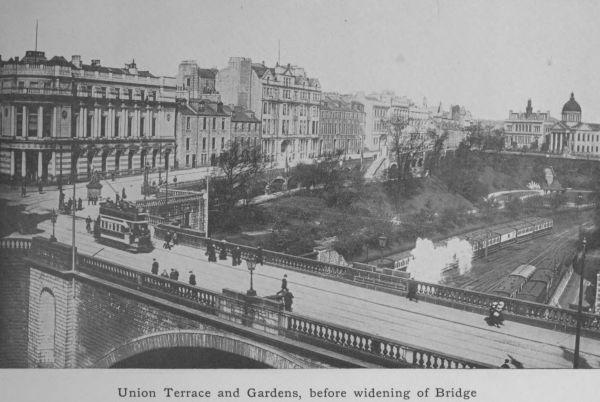
Union Terrace and Gardens, before widening of Bridge
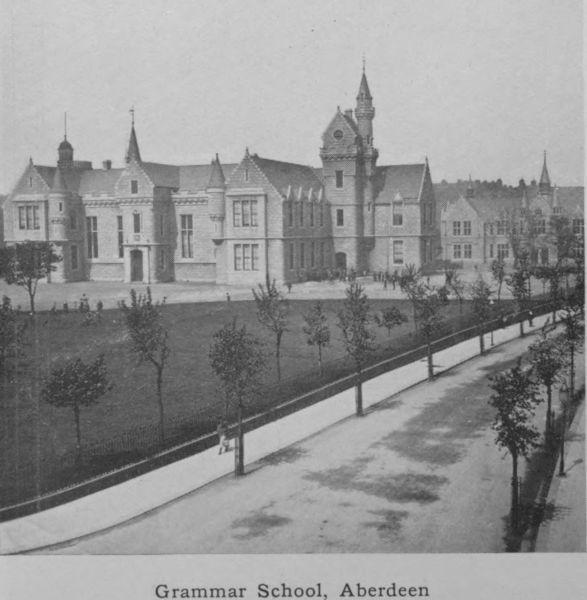
Grammar School, Aberdeen
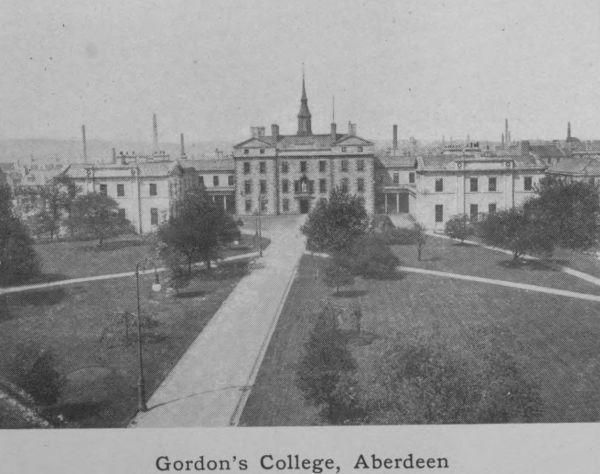
We can do no more than mention some of the other notable edifices in the city. The Grammar School, erected in 1863, is a successful application of castellated Gothic to a modern building—all the more effective that it is well set back from the street. The contiguous Art School and Art Gallery are modern buildings, each with an order of columns and a pediment which break the long low line of the façade. The elliptical arch that unites
Gordon’s College, Aberdeen
them gives access to Gordon’s College, the centre portion of which is a piece of sober eighteenth century work. The wings and colonnades were added subsequently. The Head Office of the North of Scotland and Town and County Bank at the top of King Street has its entrance porch at the angle with a colonnade of pillars. Near it is the Town Cross, a hexagonal erection with Ionic columns and a tapering shaft rising from the centre of the roof, with a heraldic unicorn as terminal. It dates from the end of the seventeenth century. In the panels of the balustrade are half-length portraits of Scottish and British Kings (including the seven Jameses). It is a fine example
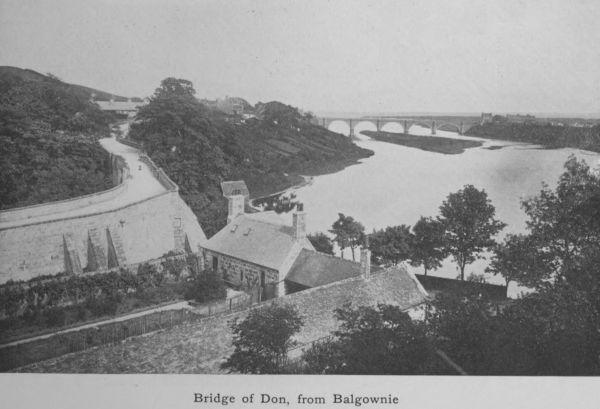
Bridge of Don, from Balgownie of its class and was the work of a local mason. The royal portraits are real and authentic. The Ionic screen or façade between Union Street and the city churches gives some idea of the severely classic architecture that was the vogue in Aberdeen nearly a century ago.
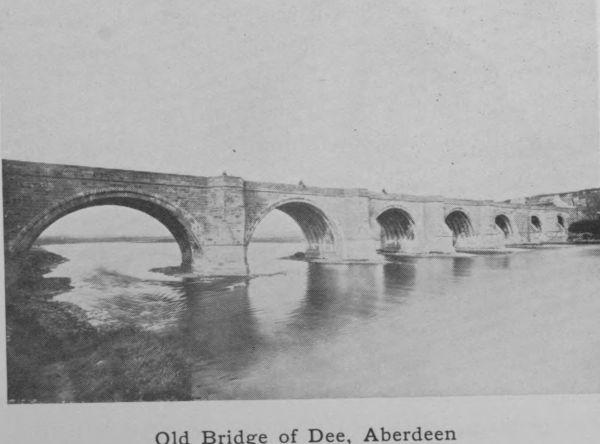
Old Bridge of Dee, Aberdeen
A word must be said about the chief bridges. Union Bridge has a span of 130 feet, and was built in 1802 to facilitate the making of Union Street. It was originally narrower than the street and has recently been widened to meet the requirements of increased traffic. The Bridge of Don (Balgownie), probably built early in the fourteenth century if not earlier, throws its one Gothic arch over the deep contracted stream of the river. A small bequest in the seventeenth century for its maintenance has been so well husbanded that out of its accumulations the cost of the new Bridge (£17,000), and other buildings has been defrayed, and the capital value of the fund— called the Bridge of Don fund—is to-day £26,500. The new bridge, much nearer the sea and with five arches, was designed by Telford and completed in 1830. The Old Bridge of Dee (with seven arches) was founded by Bishop Elphinstone and completed in 1527 by Bishop Gavin Dunbar. In 1842 it was widened 11-1/2 feet. The New
(Victoria) Bridge, a continuation of Market Street, was opened in 1882, since when quite a new and populous city has sprung up on the south side of the river, entirely eclipsing the old fishing village of Torry which formerly monopolised this side of the water.
21. Architecture—(_d_) Domestic.
The mansion-houses of the county, whether they are ancient fortalices modernised by later additions or entirely modern buildings erected within a century of the present time, deserve more space than can be allotted to them here. They are of all types of architecture, classical, renaissance, and composite, but there is no doubt that the castellated, Scotch baronial, the traditional type so common in the seventeenth century, still predominates.
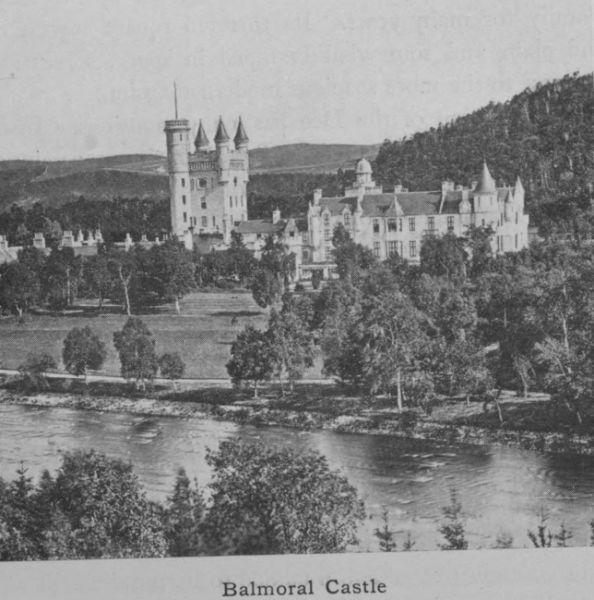
Balmoral Castle
Foremost among them must be mentioned Balmoral Castle far up the valley of the Dee. Built in 1853 of a light grey granite found in the neighbourhood, it is composed of two semi-detached squares with connecting wings, and displays the usual castellated towers, high-pitched gables and conical roofed turrets. The massive clocktower rising to a height of 100 feet from amongst the surrounding leafage and gleaming white in summer sunshine forms a pleasing picture. The late Queen Victoria purchased the estate in 1848, and
the Prince Consort took a great personal interest in the design the details of which are said to be modelled on a close study of Castle Fraser, already referred to. For more than half a century it has been a royal residence and though many additions and alterations have been made in that time, the general picture of the edifice remains the same to the traveller on the Deeside road. Two miles below is Abergeldie Castle, which has been leased by the Royal Family for many years. Its turreted square tower, old and plain and somewhat cramped in space, serves as a contrast to the more spacious modern mansion.
This region of the Dee has many mansions. Invercauld House, reconstructed in 1875, is in the same manner, its chief feature being a battlemented tower seventy feet high. The situation of Invercauld at the foot of a high hill and backed by plantations of pine and with a beautiful green terrace stretching to the river Dee is probably unsurpassed in the district. As seen from the Lion’s Face Rock, a perpendicular cliff on the south side of the river, this house of the Farquharsons makes a striking picture not likely ever to be forgotten. Farther up is Mar Lodge, the residence of the Duke of Fife, in the horizontal and English domestic style. It was built so recently as 1898, and replaced a somewhat similar building destroyed by fire. Glenmuick House, built in 1873, is in the Tudor style, strongly treated and modified to harmonise with the rugged surroundings. The only other Deeside mansion we can refer to is Kincardine Lodge, recently built, a very fine building, based to a large extent on the plan of Fyvie Castle, which we have already referred to as the grandest castellated mansion-house in the north.
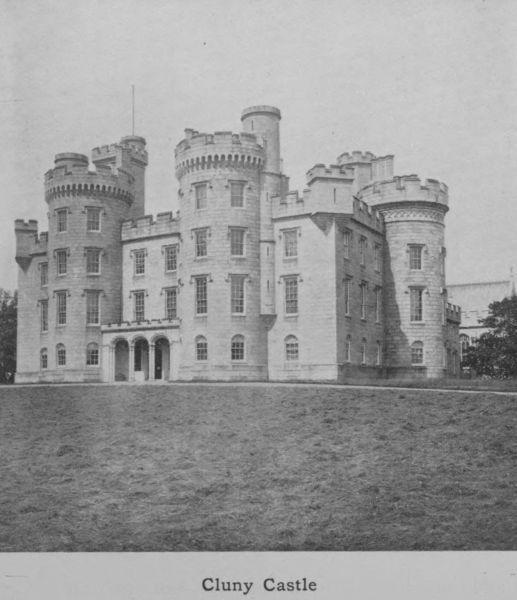
Cluny Castle
Donside is not so well furnished with stately and luxurious manorhouses, but it has Castle Newe and Cluny Castle, the antiquemodern Place of Tilliefoure, Fintray House in the Tudor style, Pitmathen in French Renaissance, each in its own way a work of art. Midway between the two valleys is Dunecht House, which was built for Lord Lindsay, a great authority on Christian art, and of which the most striking feature is the great campanile in the Italian manner.
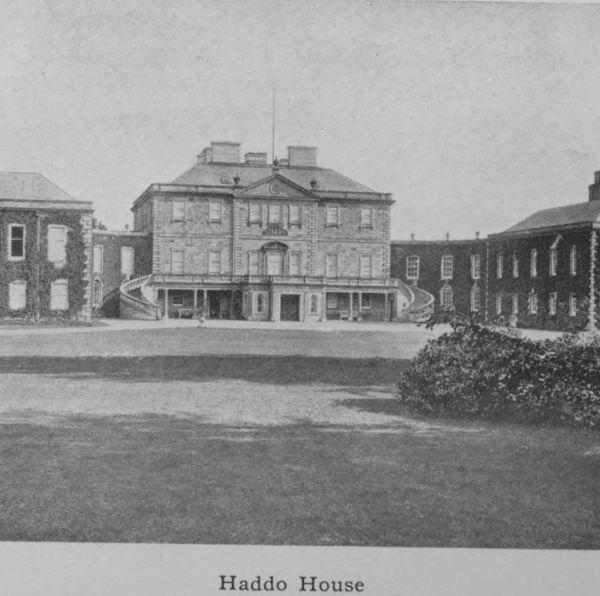
Haddo House
In the Ythan valley, Haddo House, the residence of the Earl of Aberdeen, Lord Lieutenant of the County, belongs to the period of the late English Renaissance, but additions have been made from time to time. Crimonmogate, Strichen, and Philorth are classic. It is a curious fact, worthy of mention, that the local masons have almost developed a school of craftsmanship, by the thorough conscientiousness and downright honesty
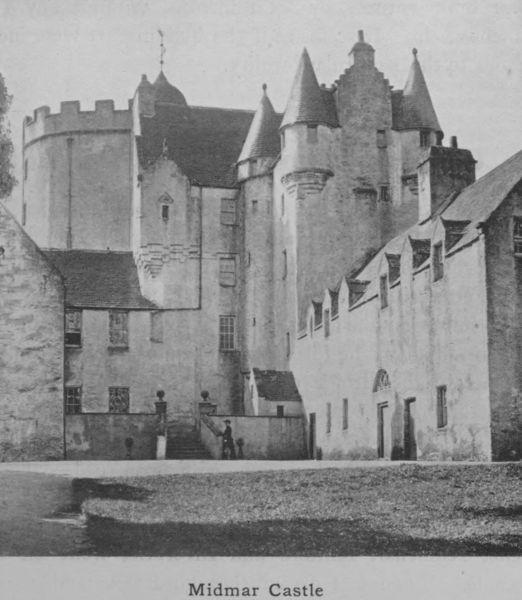
Midmar Castle
of their work. We have already remarked that Kintore and Inverurie seemed to be the centre from which the sculptured stones radiated. In the same region are the group of castles, Castle Fraser, Craigievar, Midmar and Cluny (now destroyed), all within an easy radius of the centre. Castle Fraser and Midmar were built by a mason called John Bell, whose work was characterised by sterling qualities. The art would almost seem to have been handed down through several generations of craftsmen, for the modern Cluny Castle and Dunecht
House, as well as their chapels, besides other palatial and extensive fabrics, were built entirely by local masons, without any extraneous help. It seems as if the building art were indigenous to this particular locality.
22. Communications—Roads, Railways.
In ancient times the chief means of communication between Aberdeenshire and the south was the old South and North Drove Road, which crosses the Cairn-o-Mounth from Fettercairn in Kincardine, and, passing the Dye and Whitestones on the Feugh, reaches the Dee at Potarch. It then ran along the hill to Lumphanan and on through Leochel to the Bridge of Alford, thence to Clatt and Kennethmont and along the valley of the Bogie to Huntly.
There was another a supposed Roman road—which, coming up from the direction of Stonehaven, crossed the Dee at Peterculter, and, proceeding northward through Skene, Kinnellar, Kintore and Inverurie, went on to Pitcaple. Thence it passed through Rayne and across the east shoulder of Tillymorgan to what has been regarded as a Roman camp at Glenmailen, and by the Corse of Monellie, Lessendrum and Cobairdy, to the fords of the Deveron below Avochie.
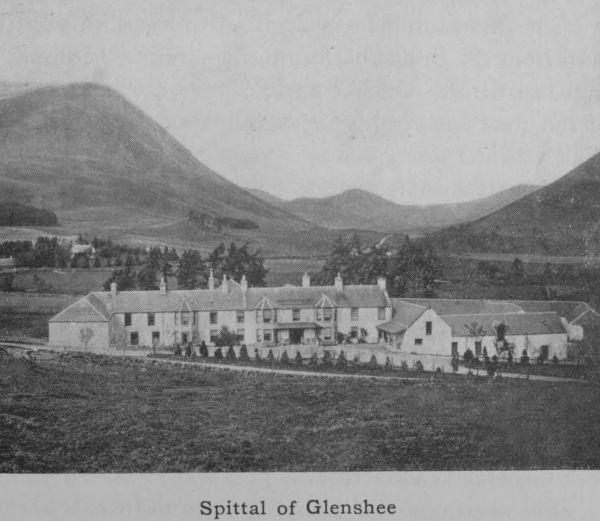
Another ancient road crossed the mountains from Blairgowrie by the Spittal of Glenshee, over the Cairnwell, Castleton of Braemar, and the upper waters of the Gairn to the valley of the Avon at Inchrory and thence by Tomintoul to Speyside.
Spittal of Glenshee
After the ’45 General Wade adopted the southern part of this road as the line of his great military route from Blairgowrie to Fort George, but from Castleton he turned to the east, went down the Dee valley to Crathie, and thence across the hills to Corgarff in Upper Strathdon from which he reached Tomintoul by the “Lecht.” This route he completed in 1750.
These roads had naturally to lead to fords in the rivers, and, when bridges came to be built, it was just as natural that they should be placed in the line of established routes. When the Bridge of Alford was built over the Don in 1810-11 and the Bridge of Potarch over the Dee in 1812-13, a new line of road was made across country to
connect them. It went from Dess through Lumphanan and Leochel to the Don valley.
The first turnpike made in Aberdeenshire was the road from the Bridge of Dee to the city of Aberdeen _viâ_ Holborn Street, which completed the northern section of the great post-road between Edinburgh and Aberdeen. This was in 1796.
About the same time was made the North Deeside Road reaching from Aberdeen to Aboyne and thence to Ballater, Crathie, and Braemar, where it met the Cairnwell Road. Another was the Aberdeen and Tarland route, which went by Skene and Echt with branches joining on to those already in existence. One of these struck off at Skene, and, crossing the hill of Tilliefourie, proceeded to Alford. It was afterwards extended up the Strath by Mossat, and Glenkindie to Corgarff, where it met General Wade’s road.
The great post-road from Aberdeen to Inverness went by Woodside, Bucksburn, Kintore, Inverurie, the Glens of Foudland to Huntly and Cairnie on the boundary of Banffshire. It had branches from Huntly to Portsoy through Rothiemay and to Banff through Forgue by the Bridge of Marnoch.
The Strathbogie Road from Huntly to Donside by way of Gartly, Rhynie, and Lumsden joined the Strathdon Road at Mossat. Though by no means the most convenient, it is still used as the route along which the mails are conveyed to Strathdon.
The Aberdeen and Banff Road left the post-road at Bucksburn and passing through Dyce, New Machar, Old Meldrum, Fyvie, Turriff, and King Edward made for the Bridge of Banff.
In the eastern district the most important route was that to Peterhead. It crossed the new Bridge of Don, and, passing through Belhelvie, Ellon, and Cruden, came to Peterhead by the coast. From there it went straight across country to Banff by Longside, Mintlaw, New Pitsligo, and Byth, thence over the Longmanhill to Macduff. Later a coast route was made connecting Peterhead and Fraserburgh, by way of St Fergus, Crimond and Lonmay. Another
continuation of it was along the coast past Rosehearty, Pennan, Gardenstown and Troup Head into Banffshire.
It was only during the nineteenth century that proper and serviceable highways were constructed. Prior to that time a few main roads had been made but side connections were few and badly kept, so that wheeled vehicles, if they had existed, would have been a useless luxury. Early in the eighteenth century wheeled vehicles were absolutely unknown. In 1765 the judges of the Circuit Court of Justiciary first travelled to Aberdeen in chaises instead of on horseback. The first mail coach did not arrive till 1798. It took 21 hours between Edinburgh and Aberdeen. Not till 1811 did passenger coaches begin to ply between Aberdeen and Huntly. Then only was it possible for the farmer to convey his products by cart, which superseded the pack-horse as a means of transport. The upkeep of the roads was secured by a system of tolls. Traces of the system still survive in the renovated toll-bar houses, which in some cases retain a window facing right and a window facing left to mark the approach of vehicles from either side. Aberdeenshire abolished tolls in 1865.
The Railway system reached Aberdeen in 1848. Prior to that time for fifty years the stage coach plying between Edinburgh and Aberdeen had been, apart from the sea-routes, the only bond between this part of the country and the south. A few years later, in 1854, what is now the Great North of Scotland Railway was opened from Aberdeen to Huntly, and two years thereafter was extended as far as Keith. This is still the main line of railway in the county. It touches in its course Dyce, Kintore, Inverurie, Insch, and Huntly. By and by branch lines were constructed forking off from it at various points; _first_ from Inveramsay, through Wartle, Fyvie, to Turriff and ultimately to Macduff; _second_ from Inverurie across country to Old Meldrum; _third_ from Kintore up Donside by Kemnay and Monymusk to Alford; and lastly from Dyce through New Machar, Udny, Ellon to New Maud, where it bifurcates, one fork going on to Peterhead the other to Fraserburgh. This is the Buchan and Formartine branch.
Recently a sub-branch was made from Ellon running to the coast and touching Cruden Bay, its terminus being at Boddam within half an hour’s distance of Peterhead. From Fraserburgh, a light railway runs to Cairnbulg, Inverallochy and St Combs. The only other line of railway in the county is the Deeside line, which runs up the Dee valley as far as Ballater. It was begun in 1853, and Banchory was the terminus till 1859, when an extension was made to Aboyne; then in 1866 it was extended to Ballater.
The lack of population and the paucity of goods apart from agricultural products have handicapped the local railways, which are far from prosperous. The chances of extension in other directions are very remote. Meantime outlying districts, such as Strathdon and Braemar, are served by motors. The holiday and tourist traffic during the summer months and the influx of sportsmen at the shooting season are contributory sources of revenue, but even these show no tendency to grow a state of affairs due to the prevalent use of private motor-cars.
Aberdeenshire has no canals and is never likely to have. Prior to the advent of railways a canal, designed by Telford, the great engineer, was constructed between Aberdeen and Port Elphinstone on the south side of Inverurie. It was opened for passenger and goods traffic in 1806, and continued to serve the district until the steamengine sounded its knell. For nearly half a century it was a bond between the chief city and the centre of the county and, although it never was remunerative to the promoters, and provided a very slow mode of conveyance, it was of great public service. The railway line to the north runs parallel at certain places to the track of this canal, whose superannuated embankments may still be recognised, after half a century, at various points between Aberdeen and Inverurie.
23. Administration and Divisions.
In the twelfth century Scotland was divided into Sheriffdoms, where the Sheriff was the minister of the Crown for trying civil and criminal cases. The office was hereditary until the rebellion of ’45, when its hereditary character was abolished. Aberdeenshire has a nonresident Sheriff-Principal (who is also Sheriff of Banff and Kincardine) besides two resident Sheriff-substitutes. These deal with ordinary civil cases such as debts, as well as with criminal cases involving fine or imprisonment, but not as a rule involving penal servitude, except forgery, robbery and fire-raising.
The head of the county is the Lord-Lieutenant. Next to him is the Vice-Lieutenant and a large number of Deputy-Lieutenants and Justices of the Peace, but the chief administrative body is the County Council, which consists of 65 members. These elect the chairman and vice-chairman, who are designated respectively convener and vice-convener. County Councils were first established in 1889. The county is divided into districts, and each district has so many divisions, or parishes, which elect one councillor. Aberdeenshire has 85 parishes, which are grouped in eight districts: (1) Deer with fifteen electoral divisions, (2) Ellon with seven, (3) Garioch with six, (4) Deeside with six, (5) Turriff with seven, (6) Aberdeen with nine, (7) Alford with four, and (8) Huntly with four, making fifty-eight electoral divisions in all. The powers of the Council are to maintain roads and bridges, to administer the Contagious Diseases (Animals) Acts, to appoint a medical officer of health and a sanitary inspector, to deal with the pollution of rivers and to see to the protection of wild birds. Previous to the passing of the Act of 1889 the Commissioners of Supply were the chief governing body. They are still retained but have no jurisdiction, except in so far as they elect members to the Standing Joint Committee. This committee includes representatives from the County Council appointed annually and from the Commissioners of Supply, together with the Sheriff _ex
officio_. The Standing Joint Committee has charge of the Police and controls all the capital expenditure in the county.
Each district has a district committee consisting of the county councillors for the divisions of the district and of parish councillors selected by each parish council of the district. Each parish has in this way two representatives on the district committee, one elected by the electors and the other appointed by the parish council. This district committee is the local authority for administering the Public Health Acts, but has no power to raise money—that being the function of the County Council as a whole.
By a later Act of 1894, a parish council was established in every parish. The number of councillors in landward parishes is fixed by the County Council and in burghal parishes by the Town Council. The parish council looks after the Poor Law and must provide for pauper lunatics, sees to the levying of the school rate, to the administration of the Vaccination Acts, and to the appointment of Registrars.
The affairs of the county are therefore divided amongst three bodies, the County Council, the District Committees and the Parish Councils. Prior to 1890 the powers of local administration lay with the Commissioners of Supply, the Road Trustees and the Parochial Boards, whose functions are now vested in these other bodies.
Each parish, besides having a Parish Council, has a School Board, which, since 1872, has administered the education of the parish. Education is free and compulsory for all children between the ages of 5 and 14. The schools are of three types—primary, intermediate, and secondary. The intermediate schools provide a three years’ course beyond the elementary stage, and the secondary schools a further course lasting for two years.
The County Council now takes a certain share in educational administration, having powers to allocate grants of money to schools and bursaries to pupils. The training of teachers, which until recently was in the hands of the Churches (Established and United Free), has
now passed to a Provincial Committee elected by various representative bodies.
Every burgh has a Town Council consisting of Provost, Magistrates and Councillors, who hold their seats for three years. The number of councillors varies with the size of the town. In Aberdeen, the councillors are elected by wards, of which there are eleven, each ward electing three representatives, one of whom retires annually. The Town Council of Aberdeen consists of 34 members, the Dean of Guild being an _ex officio_ member. The Town Council is the local authority for Public Health, and looks after the streets, buildings and sewers. It owns the gas works, water works, tramways, electric power station, and public parks. It regulates the lighting, cleansing, and sanitation. The Magistrates, who are elected annually by the Council, are the licensing authority, and form the police court for the trial of minor offences.
The city of Aberdeen is not like Peterhead and Fraserburgh included in the administration of the county, being itself constituted the county of a city, with a Lord-Lieutenant of its own, who is the LordProvost _ex officio_. It has its own Parish Council as well as its own School Board.
Aberdeenshire is represented in Parliament by four members—two for the county, east and west, and two for the city, north and south. Some of the smaller burghs, Kintore, Inverurie and Peterhead, are grouped with similar burghs in Banff and Moray (Banff, Elgin, Cullen) to form a constituency called the Elgin Burghs, which returns one member. In addition, the University of Aberdeen shares a member with the University of Glasgow.
There is still a certain amount of overlapping and confusion in the administrative divisions. For example, Torry, which is on the Kincardineshire side of the Dee, is really a suburb of Aberdeen, and as such elects members to the Town Council, the Parish Council, and the School Board, but it has no share in electing a member of Parliament for Aberdeen, being in that regard part of
Kincardineshire, and voting for a representative of that county. There are other similar anomalies.
24. The Roll of Honour.
It is an accepted fact that Aberdonians have intellectual characteristics somewhat different from those of their fellowcountrymen, the result partly of race, partly and chiefly, we believe, of environment. We have already alluded to the amalgamation of nationalities that went to form the people of this north-eastern corner of the kingdom. Doubtless the Spartan upbringing that was the rule in the county served to develop sturdy character and good physique. The result is that the Aberdonian has distinguished himself in all parts of the Empire and even beyond it. Not that he has often risen to the front rank of greatness, but he is frequently found well forward among the best of the second-class.
Their own county presenting no tempting openings for ability, Aberdonians have migrated from the narrow home-sphere in great numbers and have made their mark as administrators, medical officers, and even as soldiers of fortune. In the seventeenth and eighteenth centuries the cadets of the great houses, exiled by the pressure of the times, joined the service of continental kings and rose to high rank in the armies of Sweden, France, and Russia. Chief amongst these was James Keith, younger brother of the last Earl Marischal, and born at Inverugie Castle. After serving for nineteen years in Russia, he joined the service of Frederick the Great, under whom he attained to the highest military rank as Field-Marshal, contributing to victories gained during the Seven Years’ War and conducting the retreat from Olmütz. At the battle of Hochkirchen, when charging the enemy, he fell mortally wounded in 1758. Peterhead keeps his memory green by a statue presented to it by the Emperor William I. It is a replica in bronze of a similar effigy in Berlin. Field-Marshal Keith is probably the native of Aberdeenshire who has figured most largely in history. He was Frederick’s right hand, and his military genius has been fittingly acknowledged by Carlyle in his great work.
Another of the same type, though less eminent, was Patrick Gordon of Auchleuchries, who fought both on the Swedish and on the Polish side, but ultimately transferred his sword to Russia, where he rose to the highest rank, and on his death-bed was watched over and wept over by Peter the Great. He was born in 1635 at Auchleuchries near Ellon and died in 1699. He was a perfect example of the successful military adventurer, one of the type so skilfully depicted by Walter Scott in Dugald Dalgetty.
The county has been a prolific recruiting ground for the Army. After the ’45 Chatham’s device for breaking down the clan system and diverting the energies of the Highlanders into healthier channels by enlisting them in British regiments was an inspiration of genius. In 1794 the Duke of Gordon raised during a few weeks a regiment of Gordon Highlanders, which first distinguished itself with Sir Ralph Abercromby in Egypt, and did noble service also in the Peninsula and at Waterloo.
In the work of empire-making in India and elsewhere, the Aberdonian has borne a notable part. He has shown ability to exercise a singular mastery over inferior races. Conspicuous in this respect was Sir Harry B. Lumsden, who formed the Corps of Guides out of the most daring free-booters of the North-West frontier of India.
In statesmanship the county has been surpassed by other districts, and yet it has the distinction of having produced one Prime Minister —the fourth Earl of Aberdeen (1784-1860), who was responsible for the Crimean War, and whom Byron styled “the travelled Thane, Athenian Aberdeen.”
The ecclesiasts of distinction are too numerous to mention. Foremost amongst them was Bishop Elphinstone, who, though not a native of the county, identified himself with its interests when he became Bishop (1483), founded the University, King’s College, the light of the North (1494), and the church of St Machar (the Cathedral in Old Aberdeen) and was a pioneer in all that makes for educational enlightenment. He was instrumental in introducing the art of printing
into Scotland. His tomb is very appropriately in King’s College, the centre from which radiated the beneficent influence of his life. Henry Scougal (1650-1678), scholar and saint, son of Bishop Scougal and the inspirer of John Wesley, was a student of King’s College. He had not been long ordained in his charge at Auchterless before he was appointed to the Chair of Divinity in King’s College. He died at 28; but his _Life of God in the Soul of Man_ is still greatly prized by lovers of devotional literature. Dean Ramsay, whose _Reminiscences of Scottish Life and Character_ (1858) is a classic in humorous literature and one not likely soon to be forgotten, was born in Aberdeen.
In medical science the roll of eminent names is long and impressive, from Bannerman, who was physician to David II, down to Arthur Johnston, who after an academic career abroad, cultivated the muses at Aberdeen, gaining fame as a writer of Latin verse. He was for some time physician to Charles I. Born at Caskieben in 1587, he was rector of King’s College in 1637, and died in 1641. Dr John Arbuthnot, though a native of Kincardineshire, was a student at Marischal College; as the friend of Pope and Swift, and the wit and physician at the Court of Queen Anne, he is likely to be remembered. Another celebrated physician was Dr John Abercrombie, who, born in Aberdeen, went to Edinburgh, and became head of the profession and first physician to the king in 1824. Others no less noted were Sir James Clark; Sir Andrew Clark; Neil Arnott, a contemporary with Byron at the Grammar School, and more famous as natural philosopher than as physician, devising skilful inventions in healing and ventilation; Sir James Macgrigor, to whose memory a lofty obelisk in polished red granite was erected in Marischal College quadrangle. After standing there for years it was recently removed to the Duthie Park. Macgrigor was a pioneer in the humanitarian treatment of the sick and wounded in war, and was chief of the Medical Staff in the Peninsular campaigns.
In natural science William Macgillivray is known by his careful and authoritative work on the _History of British Birds_. James Clerk Maxwell, who did so much for the advancement of modern Physics,