Oxford University Press is a department of the University of Oxford. It furthers the University’s objective of excellence in research, scholarship, and education by publishing worldwide. Oxford is a registered trade mark of Oxford University Press in the UK and certain other countries.
Published in the United States of America by Oxford University Press 198 Madison Avenue, New York, NY 10016, United States of America.
All rights reserved. No part of this publication may be reproduced, stored in a retrieval system, or transmitted, in any form or by any means, without the prior permission in writing of Oxford University Press, or as expressly permitted by law, by license, or under terms agreed with the appropriate reproduction rights organization. Inquiries concerning reproduction outside the scope of the above should be sent to the Rights Department, Oxford University Press, at the address above.
You must not circulate this work in any other form and you must impose this same condition on any acquirer.
CIP data is on file at the Library of Congress
ISBN 978–0–19–007270–4
1 3 5 7 9 8 6 4 2
Printed by Sheridan Books, Inc., United States of America
To Lara, Ethan, and Maia
List of Illustrations
Glossary of Japanese Musical, Theatrical, and Aesthetic Terms
Introductions and Acknowledgments
1. “Beyond Description”: Nineteenth-Century Americans Hearing Japan 18
“Hail Columbia!”: Hearing America in Japonisme and in Japan
2. Strains of Japonisme in Tin Pan Alley, on Broadway, and in the Parlor 54
“On Many a Screen and Fan”: Popularizing Japonisme Musically 57
“Sing a-high sing a-lee sing a-low”: Sounding and Looking Japanese 65
“Your Tiny Face of Tan”: Racial Positioning
“Poor Butterfly” and Poor Pinkertons 81
“The Yankees of the Far East”: Representations of the Russo-Japanese War 90 “Founded upon Genuine Themes”: Aspirations of Exotic Authenticity
3. Japonisme and the Forging of American Musical Modernism
Nightmare Coming True
Eichheim and Japan: Gleanings from Buddha Fields
4. Two Paradigmatic Tales, between Genres and Genders
Cinematic Realism, Reflexivity, and the American “Madame Butterfly”
“Proto-cinematic” Butterflies?
“La Ghesha canterà”?: Avoiding Opera
“What do your excellencies desire?”: Avoiding Exotic Possibilities 162
“An unpleasant hangover on the picture”: Avoiding Miscegenation
Filming the Filming of the Film-Opera: Framing Puccini
The “True Geisha”?: Framing Exotic Realism
“No one before you, my husband, not even I”: Framing the American Woman
“Not just an opera, but real!”
A Tale of Musical Orientalism, in Four Genres and Two Nations
The Source of an Exotic Lineage
The Metamorphoses of the Exotic Man
Giving the Exotic Cinematic Male an Operatic Voice
5. An Exotic Enemy: Musical
6. Singing Sayonara: Musical
7.
8.
Illustrations
Boxes
3.1 Chronology: Henry Eichheim (1870–1942) and Japan
3.2 Chronology: Henry Cowell (1897–1965) and Japan
4.1 Selected Works Related to “Madame Butterfly”
7.1 Chronology: Tak Shindo (1922–2002)
7.2 Chronology: Claude Lapham (1890–1957)
Figures
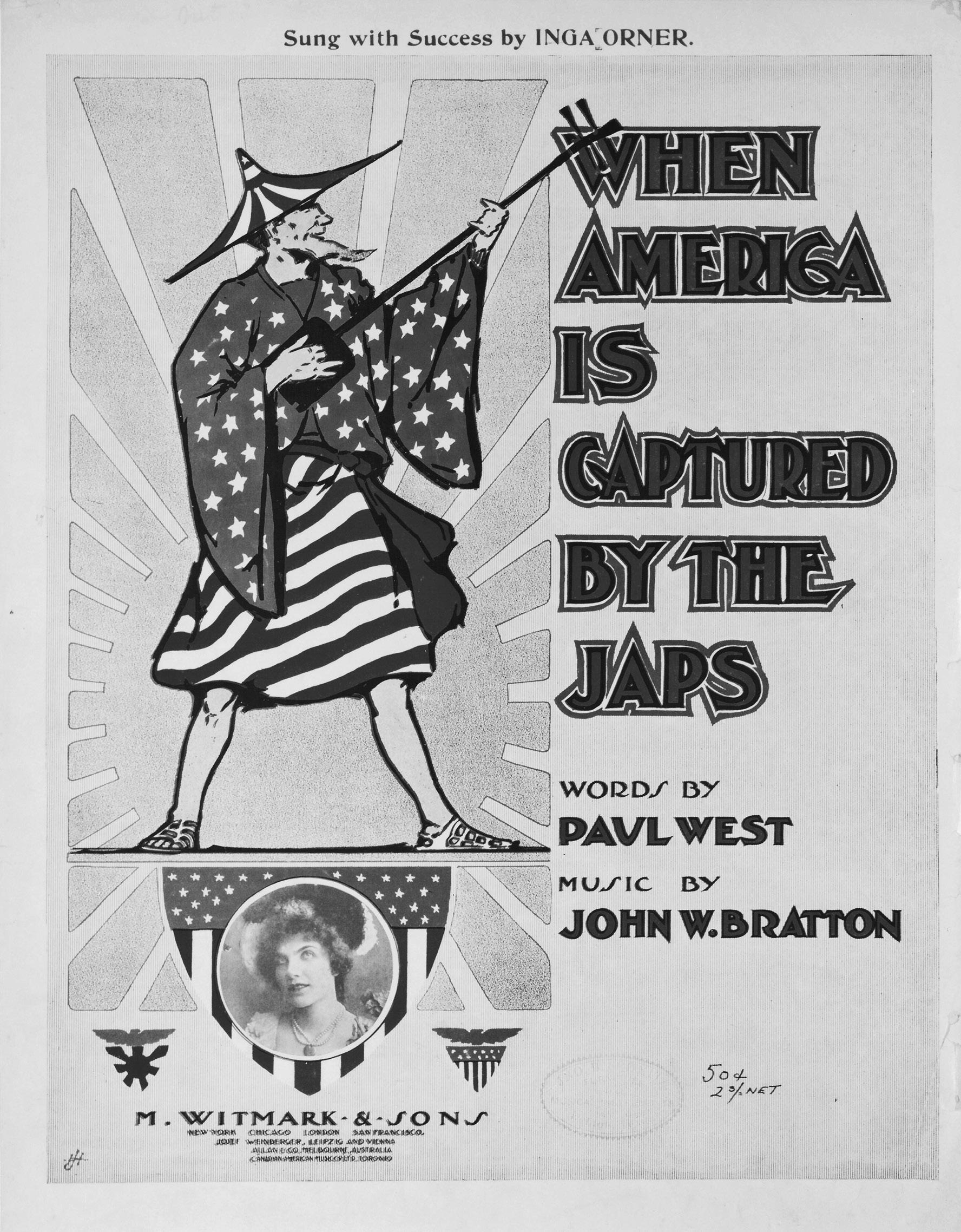
0.1 “When America Is Captured by the Japs” (1905)
1.1 Edward Sylvester Morse’s depiction of his 1883 noh lessons
1.2 Albert Gale’s program for “Music and Myth of Old Japan”
2.1 Sheet music published on Japanese topics, 1890–1930
2.2 “Tommy Polka” (1860)
2.3 “Lotus San” (1908)
2.4 “Little Sally-San (Of Old Japan)” (1918)
2.5 “Sing Song Man” (1922)
2.6 “Happy Jappy Soldier Man” (1904)
3.1 Henry Eichheim demonstrating a Javanese gong for Martha Graham 122
3.2 Kitaro Tamada playing the shakuhachi at Cowell’s home in 1962 129
3.3 Henry Cowell demonstrating the shakuhachi for Edgard Varèse, ca. 1944 130
3.4 Album cover for Kimio Eto, Art of the Koto (1963) 143
3.5 Cowell, Stokowski, and Eto at the 1964 premiere of Cowell’s Concerto for Koto
4.1 Mary Pickford as the silent singing geisha (1915)
4.2 Sylvia Sydney and Cary Grant as Butterfly and Pinkerton (1932) 166
4.3 Shirley MacLaine lip-syncing “Un bel dì” in Japanese (1962)
4.4 Shirley MacLaine’s Japanese suicide (1962)
4.5 The Bargain, The Cheat (1915)
4.6 The Branding, The Cheat (1915)
4.7 A “Hindu” Performance, The Cheat (1923)
5.1 Propagandistic pastiche in Prelude to War (1943)
5.2 A Hollywood wartime fantasy, Behind the Rising Sun (1943)
5.3 The noble Chinese in yellowface, Dragon Seed (1944)
6.1 One of multiple interracial kisses in Sayonara (1957)
6.2 Sweet Katsumi, Sayonara (1957)
6.3 The Matsubayashi grand finale in Sayonara (1957)
6.4 Representing Kabuki in Sayonara (1957)
6.5 Brando in yellowface in The Teahouse of the August Moon (1956)
7.1 Tak Shindo and his band (c. 1949)
7.2 Publicity postcard of the miniature set for Sakura at the Hollywood Bowl (1930)
7.3 “The Sakae Ito Story,” Wagon Train (1958)
7.4 Album cover for Brass and Bamboo (1960)
7.5 Album cover for Accent on Bamboo (1960)
7.6 Album cover for Mganga (1958)
7.7 Tak Shindo, June 2000
8.1 Hovhaness with a sho and Elizabeth Whittington Hovhaness (“Naru”) with a ryuteki
8.2 John Cage and David Tudor in the Tokeiji Temple Garden (1962)
8.3 Teitelbaum’s graphic score for Blends (1977)
8.4 Reynolds, Takemitsu, and Yuasa, Del Mar, CA (1976)
8.5 Roger Reynolds, Symphony[Myths] (1990), sketch 1
8.6 Roger Reynolds, Symphony[Myths] (1990), sketch 2
9.1 Haruki Fujimoto as Commodore Perry in the 1976 production of Pacific Overtures
9.2 Screenshots of Katy Perry performing as a geisha (2013)
9.3 John Oglevee as Elvis in Blue Moon over Memphis (2018)
Music Examples
2.1 The standard musical sign for East Asia
2.2 Variations of the standard musical sign for East Asia
a. 1880, “Japanese Love Song,” Cotsford Dick
b. 1881, “Japanese Tone Picture,” Chas. J. Newman
c. 1888, “Lady Picking Mulberries,” Edward Stillman Kelley 72 d. 1903, “My Little Japaneesee,” Max Hoffman
e. 1904, “Yokohama Intermezzo,” Ralph E. Kenny 72 f. 1905, “The Geisha Girl,” Fred T. Ashton 72
g. 1907, “Jappy Johnny,” Theodore Morse 73 h. 1910, “Chinatown, My Chinatown,” Jean Schwartz 73 i. 1916, “When He Comes Back to Me,” Dave Stamper 73 j. 1919, “Lantern Time in Tokio,” F. Henri Klickmann 73 k. 1920, “Yo San,” R. L. Harlow 73 l. 1929, “Japanese Toyland,” Raymond Klages, Jesse Greer, and Harry Carroll 73
2.3 “I Want to Go to Tokio,” Fred Fischer, 1914 73
4.9 Introduction to the Second Episode, Camille Erlanger, Forfaiture (Max Eschig, Paris, 1920) 194
5.1 Walter Scharf, The Fighting Seabees (Republic, 1944) 213
5.2 Hugo Friedhofer, Three Came Home (20th Century–Fox, 1950) 214
5.3 Max Steiner, Operation Pacific (Warner Bros., 1951) 214
5.4 Roy Webb, Behind the Rising Sun (RKO, 1943) 214
5.5 Victor Young, Sands of Iwo Jima (Republic, 1950) 216
5.6 Victor Young, Flying Tigers (Republic, 1942) 219
5.7 Alfred Newman, The Purple Heart (20th Century–Fox, 1944) 230
6.1 Waxman, Sayonara, Main Title Opening (Warner Bros., 1957) 253
6.2 Waxman’s cluster chords and sho clusters 255
a. Main Title, chord held measures 1–5 255
b. sho “otsu” cluster 255
c. Main Title, chord at measure 11 255
d. sho “takai-ju” cluster 255
7.1 Claude Lapham, Japanese Concerto in C Minor for Piano and Orchestra (1935) 289
7.2 Tak Shindo, “Debarkation,” A Majority of One (Warner Bros., 1962) 291
9.1 Weezer, “Across the Sea” (E.O. Smith Music, 1996), opening of verse 1 386
9.2 Weezer, “El Scorcho” (E.O. Smith Music, 1996), excerpt from verse 1 387
4.1 Versions of The Cheat 182
Glossary of Japanese Musical, Theatrical, and Aesthetic Terms
(Note: Japanese names will appear in the form of given name followed by family name throughout this text.)
benshi live narrator who performed at silent film screenings
biwa pear-shaped plucked fretted lute of four or five strings
bon-odori folk dance performed at obon festivals
bugaku ancient court dance genre accompanied by gagaku ensemble
bunraku puppet theater accompanied by solo vocalist (gidayu) and shamisen
butoh postwar avant-garde dance genre
charumera double-reed street instrument played by noodle sellers
enka mid-twentieth-century popular genre of sentimental lyrical ballads
fue/fuye bamboo flutes
gagaku court and Buddhist temple ensemble imported from China in seventh century
gidayu the narrative vocal and shamisen music in bunraku
gunka Western-influenced military songs from the Meiji period through World War II
hanamichi bridge/pathway extending through audience in kabuki, used for exits/entrances
hashigakari the covered walkway from backstage to the mainstage in noh
hayashi ensemble consisting of flute and drums in noh and kabuki
hichiriki oboe-like double reed melodic instrument in gagaku, piercing timbre
honkyoku classic genre of Zen Buddhist meditative shakuhachi music
hyoshigi wooden clappers used in kabuki and bunraku in pentatonic scale with larger and smaller intervals, considered distinctly Japanese
issei first-generation/immigrant Japanese American
joruri narrative shamisen music as in bunraku puppet theater
kabuki all-male, popular theatrical genre since the seventeenth century
kakegoe the explosive vocal calls emitted by the drummers in noh
kakko hourglass-shaped drum played with sticks in gagaku
kawaisa/kawaii aesthetic of cuteness in fashion/entertainment since late twentieth century
keisu an inverted, bowl-shaped bell
kibigaku ritual ensemble music and dance derived from gagaku in late nineteenth century
kokoro aesthetic term meaning “heart” or “mind”
kokyu/kokiu bowed lute
xiv Glossary of Japanese Musical, Theatrical, & Aesthetic Terms
koto plucked rectangular zither of thirteen strings
ko-tsuzumi smaller of two hourglass-shaped drums played in noh, held at the shoulder
kouta “little songs,” central to geisha performance
kyogen comic theater typically performed as interludes in noh
ma aesthetic term signifying the powerful impact of space, silence, stillness
matsuri bayashi Shinto festival music
mei dramatic poses struck by actors at climactic moments in kabuki
mokugyo fish-head-shaped gong used in Buddhist ritual music
nagauta the vocal and shamisen music of kabuki, “long song”
nisei second-generation Japanese American noh all-male, refined theatrical genre originating in the fourteenth century
obon/bon festival honoring ancestors
o-daiko large drum in kabuki
ondo folk songs and dances
onnagata female role performed by male actors in kabuki
otokoyaku male lead role performed by female actress in Takarazuka
o-tsuzumi larger of two hourglass-shaped drums played in noh, held at hip
rin small metal bowls played in Buddhist temple music
roppo dramatic exit by a male character on the hanamichi in kabuki
ryuteki transverse flute played in gagaku
sankyoku genre of chamber music, trio typically featuring koto, shamisen, and shakuhachi
sansei third-generation Japanese American
shakuhachi end-blown bamboo flute, employed both in Zen meditation and sankyoku
shamisen three stringed long-necked lute, central to geisha music, kabuki, bunraku
shinobue transverse bamboo flute
sho mouth reed organ, plays cluster chords in gagaku ensemble music
shomyo Buddhist chant
taiko barrel-shaped drum played with sticks, as in noh and kabuki
Takarazuka all-female form of popular theater originating in the early twentieth century
tayu the narrator/vocalist in bunraku puppet theater
tsugaru style of shamisen music characterized by rhythmic intensity
uchiwa-daiko fan drums used in Buddhist music
yo pentatonic scale consisting of roughly equal intervals (anhemitonic pentatonic)
Extreme Exoticism
Introductions and Acknowledgments
Over the course of the past century and a half, numerous composers, musicians, and audiences in the United States have imagined Japan through works created and experienced in every musical genre and medium. Some of these popular songs, film scores, and Broadway musicals reached large audiences over an extended period. The vast majority of these works proved more ephemeral, but nevertheless were culturally significant through their collective impact. This book investigates the reciprocal relationships among this diverse body of musical works, the ever protean political dynamic between the United States and Japan, and the evolving American social climate in which this music was created and experienced. To what extent was music employed to shape American perceptions of the Japanese, and to what extent was American music itself shaped in the process?
In the American imagination, Japan has represented the most exotic nation for well over 150 years. This perceived difference has inspired fantasies of both desire and repulsion. In addition, Japanese culture has had a profound impact on the arts and industry of the United States. The influence of Japan on American and European painting, architecture, design, theater, literature, and entertainment technology has been celebrated in numerous books and exhibitions. The impact of European and American music on Japan has also been studied by both Western and Japanese scholars. However, in the numerous studies of japonisme and Japan-US relations, the role of music has been virtually ignored.1 Similarly, in musical studies of Orientalism and cross-cultural influence, rarely have scholars pursued in depth a longitudinal study of the musical interactions between two nations.2 Extreme Exoticism offers a detailed and wide-ranging documentation and interpretation of the role of musical representation in shaping American perceptions of the Japanese, the reception of Japanese music encountered both in the United States and in Japan by American audiences, the influence of Japanese music and aesthetics on American composers, and the position of specific Japanese and Japanese American musicians in American musical life.
American interest in Japanese music and in representing Japan through music has directly paralleled Japanese and American actions on the global stage, resulting in specific periods of intense musical activity as well as periods of relative silence as Japan temporarily disappeared from the American culture radar. One can hear the development of Japan-US political relations in the silences and in the soundings of Japan-US musical encounters, from the 1853–1854 American “opening” of Japan, to Japan’s victory in the 1904–1905 Russo-Japanese War and the US-led peace
process, to the US Immigration Act of 1924 barring Japanese entry, to the 1941 bombing of Pearl Harbor, 1945 atomic bombing of Hiroshima and Nagasaki, and the subsequent US occupation of Japan, and on to the trade wars of the 1980s and the near ubiquity of Japanese computer games and cuisine in America by the end of the century. In the late nineteenth and early twentieth centuries, the passing of exotic “Old Japan” was lamented by many American aesthetes. Traditional Japanese culture was subsequently demonized leading up to and during World War II only to be met by American calls for its preservation in the postwar period. Similarly, the ultramodern “techno Japan” of the later twentieth century was simultaneously celebrated for bringing new forms of media technology and entertainment to American youth, and feared for its seeming inhuman technological dominance, unstoppable mass production, and mesmerizing entrapment. The appearance of specific Japanese cultural images, such as a shamisen-playing geisha in films from the early 1940s and then again in the late 1950s, has proven particularly polysemous.
Although American views of Japanese culture have vacillated dramatically, I have identified certain representational techniques and attitudes that have reappeared numerous times in different guises and in multiple musical genres. Composers, filmmakers, and theatrical producers have repeatedly sought to manufacture and manipulate “exotic authenticity” in their representations of Japan and in framing their audiences’ encounters with Japanese music. The reception, representation, and influence of Japanese music have always been bound up with and impacted prevailing American artistic and social concerns. In the past 150 years Japanese music has served as material for modernist experimentation, as a sounding board allowing Americans to define their own music, as a tool for representing Japan either positively or negatively, and even therapeutically, as background relaxation music for massage. Specific features of Japanese traditional music were embraced as mid-twentieth-century composers sought to break with timbral, temporal, and harmonic norms of the European musical past. Japanese music has repeatedly played a significant role in shaping American perceptions of gender, as it helped to define Japanese women as embodying a feminine ideal to be emulated by white American women—many of whom themselves participated in creating works of japonisme as performers and composers. Music has also assisted in defining the Japanese and Japanese Americans racially over time and in counterpoint with other groups, particularly with African Americans, Native Americans, and Chinese Americans. Japonisme has inspired some of the most beautiful and engaging American works of architecture, literature, painting, dance, and music. It has also inspired some of the most trite and blatant expressions of racist Orientalism. From Tin Pan Alley songs during the Russo-Japanese War to Hollywood films of the 1980s trade wars, from the encounters with Japanese music of nineteenth-century Boston Brahmins to the shakuhachi recordings in today’s day spas, from early cinematic versions of Madame Butterfly to Weezer’s Pinkerton album, and from Perry’s “opening” of Japan to the US Bicentennial opening of Sondheim’s Pacific Overtures on Broadway, music has consistently reinscribed Japan as the land of extreme exoticism.
Two particularly illustrative contemporaneous works from a century ago will introduce many of the themes of this book—the first, a 1905 mass-marketed song in a comic vein that imagines a Japanese future for America; the second, a 1919 highbrow symphonic work that attempts through music to recover a lost, noble Old Japan. “When America Is Captured by the Japs,” with lyrics by Paul West and music by John W. Bratton, was published in 1905 by the major New York company M. Witmark and Sons. Better known as the composer of “The Teddy Bears’ Picnic,” Bratton published multiple other Japanese-inspired songs and novelty piano pieces in the late nineteenth and early twentieth centuries, including “Japanese Lantern Dance” (1897), “My Little Belle of Japan: A Fan Tastic Episode” with words by Arthur L. Robb (1901), “In a Lotus Field” (1903), “Happy Jappy Soldier Man: Japanese War Song” with words by Paul West (1904), and (as lyricist) “In Cherry Blossom Time” (1914) with music by Eugene Salzer. “When America Is Captured by the Japs” stands out in this collection as it asks its audience and performers to imagine what would happen to American culture if the Japanese, fresh from their 1905 victory over Russia, were to push onward across the globe. The sheet music cover provides the answer, as may be seen in Figure 0.1. We see Uncle Sam dressed in a stars and stripes kimono, Japanese rice farmer’s hat, and sandals, standing in front of a subtle silhouette of the Japanese flag’s rising sun. Most strikingly, he plays a shamisen (with tuning pegs depicted upside down) and his lips are slightly parted as though in song. Such cultural cross-dressing had occurred in the reverse direction in latenineteenth-century Meiji Era Japan as the Japanese attempted to modernize by copying many aspects of Western culture, including music. For example, to honor former president General Ulysses S. Grant during his 1879 visit to Japan, geishas clad in American-flag patterned kimonos danced and sang in praise of “the glory of America.”3 On this 1905 sheet music cover, however, the recent political and military ascendency of Japan has clearly turned this white American Japanese, both in his outer appearance and through his musical performance. Awkwardly placed below this male musician’s spread legs is a photo of the Norwegian operatic soprano Inga Orner who, we are told, has sung this song “with Success,” presumably in her recitals rather than in her Metropolitan Opera appearances. Orner’s presence on this cover is but one of countless indications from this period that the boundary between high and low art was exceedingly porous. Her headshot is framed within an American shield and flanked by Japanese and American flag escutcheons. The placement of the photo suggests that her eyes are gazing upward to check on this culturally cross-dressed American male’s masculinity. In response to the new power and global prominence of Japan, the lyrics express both admiration and apprehension. The song predicts that America will be “captured,” rather than “conquered,” as Japanese culture will invade every aspect of American life. We learn that “when the yellow fellows own us,” enthralled Americans will carry fans, wear kimonos, eat rice, and drink sake instead of whiskey and that the trains will run on time and political corruption will be a thing of the past. In typical Tin Pan Alley–era fashion, ethnic and racial representation becomes
Figure 0.1 “When America Is Captured by the Japs,” sheet music cover (M. Witmark and Sons, 1905).
confused and interwoven in these verses and the term “Americans” refers solely to whites of Anglo-Saxon heritage. Besmirching African Americans as gamblers and referring to a Chinese card game, we are told that “coons will play fan tan instead of craps.” In addition, the Japanese will displace Irish cooks and Americans will come to smoke opium—a stereotypical Chinese, rather than Japanese, vice in American popular culture of this period. As signaled on the cover by the shamisenstrumming Uncle Sam, American music, both high and low, will also be captured by the efficient exotic invaders, who will “write new comic operas, perhaps,/They’ll import new prima donnas/To achieve our coin and honors,/And our tenors all will
be wiped off the maps.” Even “the show girls, goodness gracious, Will be driven out by geishas.” Thus this song from 1905 predicted an anxiety expressed by many white American audiences and critics at the end of the century that “Western classical music” had been overtaken by East Asian musicians.4 Bratton, however, clearly had not yet been “captured” by Japanese music. Instead, he efficiently signals a Japanese future musically by turning to a work of musical japonisme from the past, Gilbert and Sullivan’s The Mikado, and quoting “Miya sama”—Sullivan’s version of a Japanese gunka (military song) tune—in triple octaves and staccato articulation in the four opening bars. (The long-short-short rocking perfect fifth ostinato in the left hand accompaniment to the verses has more in common with representations of Native American drumming than with Japan.) Neither a fear of nor desire for musical miscegenation with Japanese music is evident in the score of this song, even though the cover art and lyrics suggest that Japanese exoticness could prove both dangerously contagious or temporarily and selectively assumed with pleasure.
Emerson Whithorne, a fairly conservative and successful composer of orchestral and piano music in the first decades of the twentieth century, did make an attempt to incorporate Japanese music more extensively in his 1919 orchestral suite Adventures of a Samurai. 5 Whithorne was known for his interest in East Asian music and professed to have studied Chinese music in particular. He composed numerous Japanese-inspired works including the 1911 set of songs From Japan and the 1916 piano pieces Hototogisu: The Cuckoo and The Rain, in addition to multiple Chinese-related works such as Four Chinese Poems (1912) and “Pell Street” from the suite New York Days and Nights (piano 1922; orchestral 1923). Adventures of a Samurai is a programmatic piece, subtitled “Just before the Battle” and in four movements titled “In the Temple,” “Consecration of the Bells,” “Serenade,” and “Bushido.” Like “When America Is Captured by the Japs,” Whithorne’s suite—the first version of which had been completed by 1914—was inspired by Japan’s recent military prowess, though this work offers a far more reverential representation of the Japanese and is based on claims of exotic authenticity.6 Announcements and reviews of Whithorne’s piece emphasized that he had employed “a remarkable collection of genuine Japanese melodies,” some of which had been offered to him by a friend who had spent time in Japan and others he had encountered through research at the British Museum, and that he had “allowed himself considerable freedom in their development.”7 Research and fieldwork appear to have been unnecessary as Whithorne employed the three most well-known and overused Japanese melodies in Western representations of Japan: “Miyasan”/“Tonyare-bushi” (Gilbert and Sullivan’s “Miya sama”), “Sakura Sakura,” and the anthem “Kimigayo.” These melodies gradually emerge in fragmented form before receiving a more complete statement in Whithorne’s score. For example, in the first movement the second half of the “Sakura Sakura” melody appears on page 4 of the score and the first half of the melody on page 20. In the fourth movement Whithorne expresses “Bushido,” the samurai code of honor, through fragmented appearances of both “Kimigayo” and “Miya sama” before eventually superimposing the two melodies (p. 72) and
climaxing with an orchestral apotheosis of “Kimigayo” (p. 85). Adventures of a Samurai also features the parallel fourths and fifths, staccato articulation, and general pentatonicism typical of Western musical representations of East Asia as well as some motives based on the in scale (a distinctively Japanese pentatonic scale featuring semitones). Though Whithorne attempted to capture this exotic music by drawing on Japanese melodies, his general musical style was clearly not “captured” by Japanese traditional music given that his score exhibits no traces of Japanese timbral or temporal sensibility. In short, he incorporated Japanese melodic material without altering his musical language very much to accommodate it. Exotic representation nearly always spurs some form of cross-cultural influence, however imaginatively and indirectly experienced it might be for the composer, and crosscultural influence nearly always results in some degree of exotic representation, however dependent it might be on the audience’s imagination.
In several chapters, I juxtapose examples separated by multiple decades and often created in strikingly different genres. In doing so, I reveal the profound continuities evident in exotic musical representation and influence throughout American music history and across the “high/low” cultural divide. A common assumption has been that “Romanticism,” “modernism” and “postmodernism,” “experimental” and “commercial,” “cross-cultural influence” and “Orientalist representation” exist as files into which we can organize music of the past century and a half. In my historical research and analysis, I do not find evidence in support of this scholarly hardening of the categories and attempts at strict periodization. Rather than attempting to debunk such terms as “modernism” and “postmodernism” or “appropriation” and “influence”—indeed, I continue to rely on these terminological crutches—I argue that none of these categories has proven mutually exclusive in practice, and that these and other false binaries have warped the way we think about and hear twentieth- and twenty-first-century musics, even deafening us to otherwise audible similarities across time and across aesthetic and cultural boundaries. The terminological skepticism expressed here demands that we now turn to scrutinize the words employed in this book’s title.
The title, Extreme Exoticism: Japan in the American Musical Imagination, contains terms and phrases denoting things that, strictly speaking, do not exist. After joining me in some titular deconstruction, I hope the reader will sense the presence of phantom scare quotes hovering around several of these words as they appear throughout this book. In addition, several of these terms should be understood as referring to a multiplicity and wide range of examples. For example, by “musical” I aim to signal all forms of music created in the United States, for I have not identified a single musical genre, style, medium, or format that has not at some point been harnessed to represent Japan or that lacks at least one example of a work shaped by Japanese cultural influences. I also intend to reveal the extensive imaginative work music has achieved throughout this history, how music has been harnessed to express individual composers’, performers’, and listeners’ imagination of this exotic culture. Actually, this imaginative work is carried out socially, between
individuals who assume multiple musical roles, both within and across cultures. As Arjun Appadurai explains: “The image, the imagined, the imaginary—these are all terms that direct us to something critical and new in global cultural processes: the imagination as a social practice. . . . the imagination has become an organized field of social practices, a form of work . . . and a form of negotiation between sites of agency (individuals) and globally defined fields of possibility.”8
As a description of widespread and persistent American perceptions, “extreme” is the easiest word to justify historically in this title. Though Japanese culture is, obviously, not inherently any more exotic than American culture—and, indeed, has constituted part of American culture since the late nineteenth century—it has been consistently declared to be extremely foreign by a range of American figures of all racial and ethnic groups. Most of these cultural figures have been white. However, we will find that younger Japanese Americans of successive generations also tended to view the culture of their parents and grandparents as exotic, choosing either to embrace or distance themselves from Japanese culture at specific moments in a frequently precarious history. Furthermore, throughout the long and continuing civil rights struggle in the United States, some Asian American and African American musicians have aimed for an Afro-Asian cultural fusion, with Japanese culture serving as a particularly useful exotic wellspring located in stark opposition to mainstream Euro-American cultural norms.
Japan had been perceived as the ne plus ultra exotic land by Europeans for centuries—it is no coincidence that Tamino, the fairytale foreign prince in Mozart and Schikaneder’s The Magic Flute, is identified as Japanese (though, as typical of exoticism, some sources indicate “Javanese”). It is clear that the sheer number and repetition of testimonials to Japan’s alterity reinforced these perceptions over the centuries. Given the geographical distance and Japan’s nearly 250 years of isolation prior to the arrival of Commodore Perry’s gunboats in Edo Bay in 1853, it is also not surprising that Americans in all fields have consistently referred to the Japanese as culturally opposite and even uniquely unique. For example, Percival Lowell—the astronomer who theorized life on Mars, authored multiple books on East Asia, and traveled three times to Japan in the late nineteenth century—explained in 1888 that even though the Japanese do not actually stand on their heads on the other side of the world as a child might imagine, “they still appear quite as antipodal, mentally considered. Intellectually, at least, their attitude sets gravity at defiance. For to the mind’s eye their world is one huge, comical antithesis of our own.”9 (Lowell did allow that “perhaps, could we once see ourselves as others see us, our surprise in the case of foreign peoples might be less pronounced.”)10 Writing as one of America’s most well-known pundits on all things Asian, Pearl S. Buck declared in 1966: “For if there is one single truth about Asia, it is that while each country there is totally different from every other, Japan is the most different of all.”11 A similar view had been expressed with less charitable intent in congressional testimony leading up to the passage of the 1924 Immigration Act, when the Japanese were referred to as the “least assimilable” and “most dangerous” race.12 A quarter century later, as the Cold
War was heating up, the eminent American Japanologist Edwin O. Reischauer took a broad view as he explained the particularity of the Japan-US relationship:
In the meeting of Japan and the United States, the two extremities of the world, the problems, the hazards, and, possibly, the benefits of this head-on convergence of races and cultures in a shrinking world stand out in a clearer, starker light than they do in other parts of the world, where the meeting has come about more slowly and has been between less spectacularly contrasting cultures.13
Commentators both in the United States and elsewhere have continued to describe American and Japanese cultures as diametrically opposed. In a 1992 study of globalization, the British sociologist Roland Robertson referred to the United States and Japan as “polar sociocultural opposites in the contemporary global field.”14
In quotations presented throughout this book it will become evident that, for many, Japanese music was a particularly clear indication of the ultimate otherness of the Japanese. During his tour of Japan, Albert Einstein confided in his travel diary on 3 November 1922: “It may be hard to understand them psychologically, I hesitate to try ever since the Japanese singing remained so entirely incomprehensible to me. Yesterday I heard another one singing away again to the point of making me dizzy.”15 When asked by me on 8 March 2006 at Williams College whether Japanese music and culture had impacted him and his film score for Mishima: A Life in Four Chapters (1985), Philip Glass professed that he found traveling to Japan “terrifying,” akin to being sent “to Venus,” and that he had “failed” at getting into the Japaneseness of Mishima in that score.
Coupled with the belief that Japanese music was extremely exotic, and the expressions of desire and loathing this inspired, was the recurring fear that this exoticism would be diminished through contact with the West. As early as 1903, Otto Abraham and Erich M. von Hornbostel concluded their study of Japanese music as follows:
Unfortunately, with the expansion of European cultural influences, the charming originality of exotic art vanishes, and with it disappears material of exceedingly great value to the musicologist, ethnologist, and psychologist. Though we cannot preserve musical creations in our museums as we can other cultural products, we should attempt to collect durable phonographic recordings for our laboratories, so long as this is still possible. It is true that practical music, unlike the fine arts and crafts, cannot learn much from East Asia; but knowledge may well be indebted to her in times to come for a widening of musical horizons.16
For these German comparative musicologists, the Westernization of music in Japan would primarily constitute a loss to musical science. We will hear numerous Americans lamenting somewhat more passionately the loss of Old Japan and of Japanese musical exoticism, from the turn-of-the-century writings of Lafcadio
Hearn to the pronouncements of American scholars and composers at the 1961 East-West Music Encounter conference in Tokyo. We will also encounter numerous American composers who enthusiastically turned to elements of Japanese traditional music in an effort to widen their musical horizons, drawing on the ancient exotic even as it seemed to fade, in a modernist attempt to “make it new.”
Repeated proclamations of Japan’s utter difference led many Americans, somewhat paradoxically, to declare on first encounter that Japanese culture was somehow insufficiently exotic after all, that it had already been contaminated through contact with the West and had lost some of its authenticity. Of course, consuming Western artistic representations of and writings on exotic Old Japan back home had likely raised their expectations for encountering extreme exoticism to unsatisfiable levels. In 1891 Oscar Wilde identified the problem faced by those who would seek exotic authenticity in Japan, famously declaring that the Japan of the Japanese (and Western) painters did not actually exist, that “the whole of Japan is a pure invention,” and that the Japanese people must actually be rather commonplace and not all that different from the English.17 The French novelist Pierre Loti had wryly written of his own experiences in Japan along these lines in his 1887 semi-autobiographical novel Madame Chrysanthème, a seminal work for literary, theatrical, and musical japonisme. After arriving in Japan, Loti’s protagonist explains how, pace Wilde, Japan proved just as artificial as its depictions in art: “At this moment, my impressions of Japan are charming enough; I feel myself fairly launched upon this tiny, artificial, fictitious world, which I felt I knew already from the paintings of lacquer and porcelains. It is so exact a representation!”18 His preconceptions of Japanese women were likewise met at the moment he was presented with a potential temporary bride: “Heavens! why, I know her already! Long before setting foot in Japan, I had met with her, on every fan, on every tea-cup—with her silly air, her puffy little visage, her tiny eyes, mere gimlet-holes above those expanses of impossible pink and white which are her cheeks.”19 However, this exotic woman, along with numerous other aspects of Japanese culture, proves disappointing for this Frenchman, rather than exotically stimulating.
Repeatedly, European and American creative artists have claimed a desire to recreate an authentic representation of Japan in their works. With Madama Butterfly, Puccini stated that he hoped to create a “true Japan, not Iris,”20 and many who have followed him have aspired to present a “true Japan, not Madama Butterfly.” However, we will find that in works of exotic representation, Japanese and Japanese American performers have been repeatedly rejected as not being “Japanese” enough. Indeed, Western composers, film directors, and choreographers have rarely hesitated to teach these performers how to appear and sound more “Japanese.” Conversely, actual Japanese music, dance, theatrical design, etc., was often rejected as being too foreign or incomprehensible when available for inclusion and, instead, was replaced by artistic translations and substitutions intended to make Japanese style and aesthetics more palatable for Western audiences. Aiming for exotic “authenticity” is an entirely quixotic project, in any case, given that cross-cultural presentation/