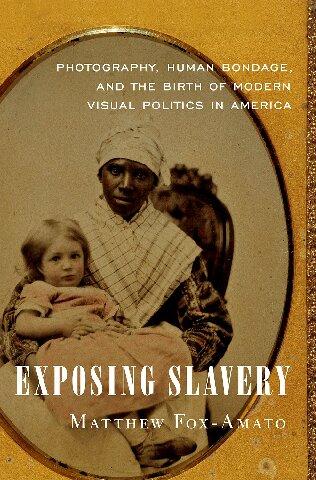
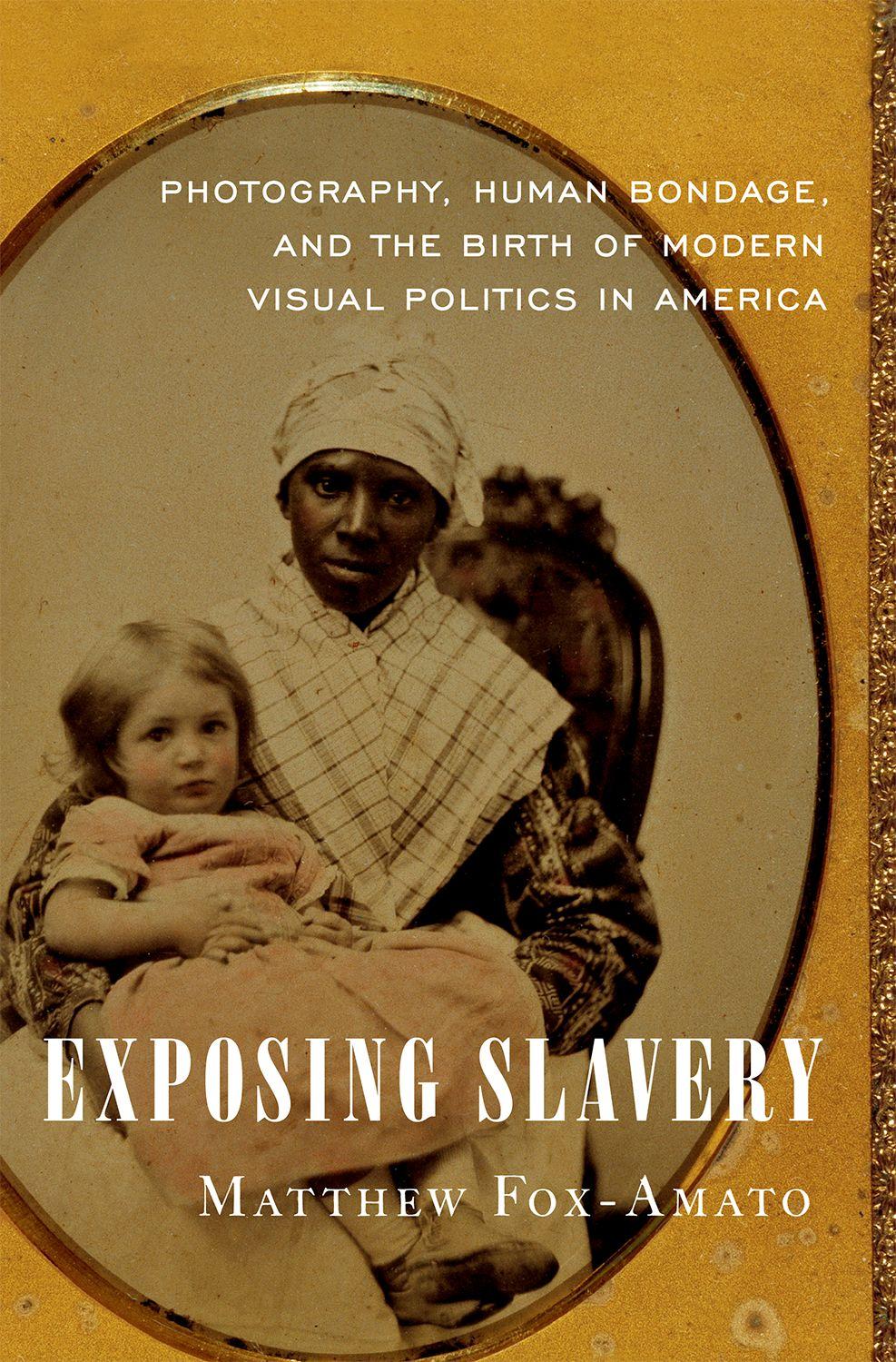
EXPOSING SLAVERY
Photography, Human Bondage, and the Birth of Modern Visual
Politics in America
Matthew Fox-Amato
1Oxford University Press is a department of the University of Oxford. It furthers the University’s objective of excellence in research, scholarship, and education by publishing worldwide. Oxford is a registered trade mark of Oxford University Press in the UK and certain other countries.
Published in the United States of America by Oxford University Press 198 Madison Avenue, New York, NY 10016, United States of America.
© Oxford University Press 2019
All rights reserved. No part of this publication may be reproduced, stored in a retrieval system, or transmitted, in any form or by any means, without the prior permission in writing of Oxford University Press, or as expressly permitted by law, by license, or under terms agreed with the appropriate reproduction rights organization. Inquiries concerning reproduction outside the scope of the above should be sent to the Rights Department, Oxford University Press, at the address above.
You must not circulate this work in any other form and you must impose this same condition on any acquirer.
Library of Congress Cataloging-in-Publication Data
Names: Fox-Amato, Matthew, author.
Title: Exposing slavery : photography, human bondage, and the birth of modern visual politics in America / Matthew Fox-Amato. Description: New York, NY : Oxford University Press, [2019] | Includes bibliographical references and index.
Identifiers: LCCN 2018024380 (print) | LCCN 2018042200 (ebook) | ISBN 9780190663940 (Updf) | ISBN 9780190663957 (Epub) | ISBN 9780190663933 (hardcover : alk. paper)
Subjects: LCSH: Slaves—United States—Social conditions—19th century. | Slaves—United States—Portraits. | Portrait photography—United States—History—19th century. | Photography—Social aspects—United States—History—19th century.
Classification: LCC E449 (ebook) | LCC E449 .F768 2019 (print) | DDC 306.3/6200222—dc23
LC record available at https://lccn.loc.gov/2018024380
1 3 5 7 9 8 6 4 2
Printed by Sheridan Books, Inc., United States of America
For my mom
Acknowledgments ix
Introduction 1
1. PolicingPersonhood 18
2. EnduringImages 69
3. RealizingAbolition 103
4. DomesticatingFreedom 160
Epilogue: The Photographic Legacy of American Slavery 215 Notes 237
Bibliography 297 Index 325
ACKNOWLEDGMENTS
This book has its roots in the generosity and support of so many people. I am thrilled to be able to thank them, beginning with my early mentors. To Mark Jerng, Tim McCarthy, and Werner Sollors: thank you for inspiring me as thinkers and teachers and setting me on a path to study the past.
In the Department of History at the University of Southern California, I wrote the dissertation that became this book, and I had the good fortune of an excellent committee. I am especially grateful to my advisor, Richard Fox. It was a joy to work with Richard, whose imaginative approach to history and unwavering support were instrumental in advancing this project. His passion for the vitality of ideas is a model for what a historian can be. For her intellectual generosity and persistently keen insights about this project, I am thankful to Karen Halttunen. Vanessa Schwartz’s intellectual spark and creativity continue to astonish me, and I have benefitted greatly from conversations with her about visual culture and from her support. I also benefitted from Leo Braudy’s expansive knowledge of American culture.The Visual Studies Graduate Certificate and Visual Studies Research Institute created a vibrant community to study all things visual and aided my work with a summer fellowship and the Anne Friedberg Memorial Grant. I thank Dornsife College for a graduate fellowship and the college doctoral fellowship. At USC, I owe a debt of gratitude to many more: Elinor Accampo, Sarah Banet-Weiser, Jen Black, Catherine Clark, Justin Clark,
Bill Deverell, Phil Ethington, Max Felker-Kantor, Sarah Keyes, Jason Glenn, Nick Glisserman, Jason Hill, David Levitus, Ryan Linkof, Peter Mancall, Richard Meyer, Steve Ross, George Sanchez, Carole Shammas, and Diana Williams. Lori Rogers, Laverne Hughes, Sandra Hopwood, and Joe Styles provided essential support. Friends in LA— especially Amy, Glenn, Matilda, Laura, Jer, Lauren, and Tony—made this a golden age. Mark Braude gave smart feedback on drafts of more things than I can count; I never thought I would leave graduate school having met such a close friend.
Much of my manuscript revisions took place at Washington University in St. Louis, where I spent two delightful years as a Mellon postdoc in the Modeling Interdisciplinary Inquiry program. I thank Joe Loewenstein for welcoming me into the fold, Amy Lehman for keeping things running smoothly, and Katy Hardy, Jess Paga, and Maggie Taft for their camaraderie on our hall in Umrath. Conversations with Michael Allen,Adrienne Davis,Andrea Friedman, Maggie Garb, Heidi Kolk, Dale Kretz, Long Le-Khac, and Rachel Lindsay pushed my ideas forward. My sincere thanks go to Rebecca Wanzo for discussing my project and inviting me to present material from it in one of her classes. I owe a special debt of gratitude to Iver Bernstein, for sharing his deep knowledge of the Civil War era and inviting me into the AMCS community, and to Peter Kastor, who became a go-to source for professional advice. I met Douglass Flowe in my first month at Wash U and have learned a lot from conversations with him ever since. My greatest thanks at Wash U go to Angela Miller, whose expertise, generosity, and verve made her the ideal mentor.
The University of Idaho has been a wonderful place to land. I am grateful to many colleagues within—and beyond—the history department, including Kathy Aiken,Ashley Kerr, Ellen Kittell, Dale Graden, Tara MacDonald, Aman McLeod, Sean Quinlan, Becca Scofield, Adam Sowards, Rick Spence, and Pingchao Zhu. I thank Debbie Husa, too, for her support.
Archivists and photograph collectors have been indispensable to my research. In particular, I would like to thank Anne Peterson at the Degolyer Library at Southern Methodist University;Randall K. Burkett and Kathy Shoemaker at Emory’s Manuscript,Archives, and Rare Book Library; Mary Jo Fairchild at the South Carolina Historical Society; Gigi Barnhill, Paul Erickson, Lauren Hewes, Marie Lamoureux, Jackie
Penny, and Elizabeth Pope at the American Antiquarian Society; Jennifer McCormick and Jennifer Scheetz at the Charleston Museum; Sara C. Arnold at the Gibbes Museum; Lynette Stoudt at the Georgia Historical Society; Beth Bilderback at the South Caroliniana Library; Matthew Turi at the Wilson Library; Heather Beattie, Frances Pollard, and Katherine Wilkins at the Virginia Historical Society; Autumn Reinhardt Simpson at the Valentine; Clayton Lewis at the William L. Clements Library; Pamela Powell at the Chester County Historical Society; Lish Thompson at the Charleston County Public Library; Patricia Dockman Anderson at the Maryland Historical Society; Kate Viens and Conrad Wright at the Massachusetts Historical Society; Bob Zeller, president of the Center for Civil War Photography; Robin Stanford; and Lawrence Jones III.
Many organizations generously supported my work on this book. A Mellon Fellowship for Dissertation Research in Original Sources from the Council on Library and Information Resources as well as a Mellon/ACLS Dissertation Completion Fellowship were instrumental in assisting my research and writing. So, too, were various archivespecific grants, including the Jay and Deborah Last Fellowship at the American Antiquarian Society, Mellon fellowships from the Virginia Historical Society and the Massachusetts Historical Society, and research awards from the Frances S. Summersell Center for the Study of the South at the University of Alabama and the Clements CenterDeGolyer Library at Southern Methodist University.The Social Science Research Council’s Dissertation Proposal Development Fellowship helped me to explore potential projects early on; years later, the Andrew W. Mellon Postdoctoral Fellowship in the Modeling Interdisciplinary Inquiry Program at Wash U offered incredible support.
This book has been shaped through conversations with, and suggestions from, many scholars beyond my home institutions: Margaret Abruzzo, Ed Ayers, Lisa Barbash, Robin Bernstein, Makeda Best, Richard Blackett, Josh Brown, Matt Clavin, Chris Dingwall, Carolyn Eastman, Matt Gallman, Lorri Glover, Aston Gonzalez, Ken Greenberg, Mazie Harris, Scott Heerman, Nathan Jeremie-Brink, Jessica Johnson, Cathy Kelly, Bonnie Martin, Tim McCarthy, Maurie McInnis, Yvette Piggush, Bradley Proctor, Martha Sandweiss, Manisha Sinha, Shawn Michelle Smith, John Stauffer, Zoe Trodd, Jennifer Tucker, Sarah Weicksel, A. B. Wilkinson, and Mike Zuckerman.
I am grateful to Francesca Ammon, Erica Ball, David Blight,Angela Miller,Mary Niall Mitchell,John Stauffer,JenniferTucker,and Deborah Willis for commenting on parts of this book at conferences and symposia. Ed Ayers, Mark Braude, and Manisha Sinha generously commented on portions of the manuscript, and Mike Zuckerman read an early iteration. I owe a special thanks to Iver Bernstein and Andrea Friedman for commenting on the whole thing, and to Ann Fabian and one anonymous scholar who reviewed the manuscript for Oxford University Press. At Oxford, I am especially grateful to Susan Ferber for her enthusiasm, sharp editorial pen, and guidance in bringing this book to fruition.
None of this would have been possible without the support of family. The Foxes welcomed me into theirs with joy, and their encouragement over the years has meant so much. I thank Dan and Joanna for their love and support. My dad made it a priority to take family trips to historical sites, and I am grateful for his unremitting encouragement. My mom enthusiastically read the first draft of the first chapter of what became this book. Though it has been bittersweet to complete it after she passed, her words continue to guide me and give me strength.
Above all else, I thank Kate. Her never-ending support and thoughtfulness have made this book better; her creative way of seeing the world makes my life rich. My best friend, she has been a loving partner every step of the way. I cannot wait for our next chapter together.
EXPOSING SLAVERY
INTRODUCTION
On august 24, 1839, the Great Western set sail from Bristol, England, carrying copies of the London Globe that described the much-anticipated technical details of the daguerreotype process, a French invention that many said would demolish old ways of picturing and seeing the world. One commentator typified the enthusiasm when he exclaimed, “What would you say to looking in a mirror and having the image fastened!!”1 By the end of September, the London Globe had reached all corners of the United States, from Boston to New Orleans, and Americans had read about Louis Jacques Mandé Daguerre’s imagemaking technique.2 The invention that seemed to break so forcefully from the past gave rise to many visions of its future. Certain artists bristled at the increasingly common idea that daguerreotypy would render painting obsolete. “If you believe everything the newspapers say,” artist Thomas Cole noted,“you would be led to suppose that the poor craft of painting was knocked in the head by this new machinery for making Nature take her own likeness, and we nothing to do but to give up the ghost.”3 Others were more optimistic. Inventor Samuel Morse saw the medium as a boon to science.“The naturalist is to have a new kingdom to explore,” Morse proclaimed after viewing a daguerreotype of a spider.4 In this still crude process, one man even imagined the makings of surveillance cameras: “What will become of
the poor thieves, when they shall see handed in as evidence against them their own portraits, taken by the room in which they stole, and in the very act of stealing!”5
In 1839, however, no one foresaw that the daguerreotype would alter the institution of American slavery. But new technologies spark unintended consequences. By the mid-1840s, American slaveholders had already begun commissioning photographic portraits of their slaves. Ex-slaves-turned-abolitionists, such as Frederick Douglass, had come to see how sitting for a portrait could help them confirm and project humanity and dignity amidst northern racism. In the first decade of the medium, enslaved people had begun entering southern daguerreotype saloons of their own volition, posing for cameras, and leaving with visual treasures they could keep in their pockets. Years later, as the Civil War raged, Union soldiers would orchestrate pictures with fugitive slaves that envisioned racial hierarchy as slavery fell. In these ways and others, from the earliest days of the medium to the first moments of emancipation, photography powerfully influenced how bondage and freedom were documented, imagined, and contested. By 1865 it would be difficult for many Americans to look back upon slavery and its fall without thinking of a photograph.
The historical relationship between slavery and photography is the subject of this book. Despite enormous scholarly attention paid to the history of antebellum bondage over the past half century, its intertwined development with photography has gone largely unstudied. This oversight can be chalked up to the long-standing preference for written over visual sources in the discipline of history, to the limited consideration of the photographic business in the antebellum South, or to the scattered nature of the photographic archive. Perhaps the subject fell through the porous disciplinary cracks between history, the history of photography, and art history. Whatever the case may be, pressing questions remain unanswered about the historical collision between a particular social structure and a new visual technology that took the United States by storm. How did photography shape the culture and politics of American slavery? And how, in turn, did slavery shape the development of photography—as an aesthetic form and as a set of cultural practices?
It will not surprise scholars that antislavery activists sought out photography, for they had long drawn upon the media technologies at
hand—from broadsides to illustrated magazines—to sway northern sentiment. But too often the slave South has been seen only as a place represented from afar, by artists in Boston and by northern and British travelers. Such a view has helped promote the notion that the Old South stood outside the historical transformations of the nineteenth century.6 Recent work on the economy of nineteenth-century American bondage, however, has set the stage for a richer understanding of slavery’s culture and cultural influence. Identifying slavery as a key engine of capitalism, historians have illuminated the dense financial and trade connections between the slave South, the North, and western Europe.7 Their studies have underscored that antebellum slavery was not a closed system. To make good on that insight, however, means also grappling with the relation between slavery and the new types of market-driven consumer and communicative culture that spread across the nation and infiltrated the South, especially from the 1820s onward.
Part of a revolution in print and visual culture that included the rise of illustrated presses, popular prints, and cheap pamphlets, photography proves a particularly compelling site to grasp the ties between commercial media and slavery because of its geographical scope and production conditions. Although the illustrated journalism of Frank Leslie’s Illustrated Newspaper and Harper’s Weekly undoubtedly defined and deepened sectional animosity through coverage of such events as John Brown’s trial, these publications were produced only in the North and did not arrive on the scene until the mid-1850s.Photography, in contrast, entered America more than a decade earlier and turned both North and South into producers of visual culture. In the 1850s Charleston could not boast of an illustrated newspaper to match Leslie’s, nor was it home to a print shop to rival Nathaniel Currier’s operation in New York.8 But Charleston did have a nationally recognized photographer in George Smith Cook, and during the 1850s Charlestonians could stop by one of many daguerreotype galleries operating on King Street and Meeting Street to purchase personal portraits.9 Photography quickly became a common cultural ground between North and South.
The intersection of photography and slavery also proves particularly rich because the first generation of photographers ushered in a new, immensely popular form of self-representation and self-definition.10
“’Tis certain that the Daguerreotype is the true Republican style of painting,” Ralph Waldo Emerson declared in 1841. “The Artist stands aside & lets you paint yourself.”11 Emerson obviously exaggerated the power of the sitter, but he was hardly alone in marveling at this new form of mechanical image consumption. In the 1840s and 1850s, American photography broadened the market for portraiture, opening up an elite practice to the masses.12 Portrait-taking quickly became an everyday pastime in cities and towns, and the community of photographers grew alongside this impulse to purchase likenesses—surging from 938 artists in 1850 to 3,154 in 1860.13 An emergent discourse characterized the photograph as a document of the self.As Philadelphia artist Marcus Root declared, a portrait was “worse than worthless if the pictured face does not show the soul of the original,—that individuality or selfhood, which differences him from all beings, past, present, or future.”14 Photographers and photographic commentators fashioned the portrait as a vehicle for capturing the inner essence of the sitter in external form.They made a particular mode of visibility commonplace as a means of shaping and understanding identity.
Understanding photographic self-representation as a historical force demands moving beyond approaches that focus solely or even largely on the photographers. It means treating image-making as a serious human activity for non-artists—one with important social, cultural, and political effects. The new social history of the 1970s fundamentally altered who counted as a significant historical actor, opening up the study of the working class, women, and racial minorities, but neither that intellectual shift nor the subsequent “cultural turn” transformed basic assumptions about what counts as communication, documentation, and expression in everyday life. That historical actors are not simply speakers, writers, and gesturers but also picture-makers is confirmed by cave paintings made thirty-four thousand years ago and camera-phone photos taken today, but history books consistently ignore this dimension of experience.15 One sliver of a millennia-long history of vernacular image-making, this study casts slaveholders, slaves, abolitionists, and Civil War soldiers not only as visual subjects but also as “photographic practitioners.” While visual-culture scholars Shawn Michelle Smith and Maurice O. Wallace have coined this term to describe a select group of African American political leaders, this book applies the concept more broadly, describing how many historical
actors, even though they did not operate the cameras, used personal and mass-produced photographs toward various ends.16 Fusing the methods of history and visual-culture studies means, in this case, illuminating images and image-making as important aspects of lived experience and informal politics. It means reconceiving the past as a world of picture-makers.
Enslavers, enslaved people, abolitionists, and Civil War soldiers form the backbone of this study because of their deep investment in two vital social and political problems of the Civil War era—problems they addressed, to a striking degree, through photography. The first concerned the character and destiny of enslaved African Americans: who, precisely, were enslaved people, and who might they be? These questions were rendered increasingly pressing by the sectional crisis of the 1850s (over the potential spread of slavery) and the eventual demise of bondage during the Civil War. At the center of the debate was the commodification of human beings and the worldview that propelled it. As many ex-slaves would testify in their narratives and lectures, American slavery was defined by the paradoxical legal and cultural status of slaves as both people and property. For Frederick Douglass, the determining quality of bondage was not “the relation in which a great mass of the people are compelled to labour and toil almost beyond their endurance,” though he surely stressed that slavery entailed a brutal labor regime. It was, instead, “that relation by which one man claims and enforces the right of property in the body and soul of another man.”17 Or as ex-slave James W. C. Pennington hauntingly put it, “The being of slavery, its soul and body, lives and moves in the chattel principle.”18
This person/property contradiction has, of course, long been central to American historians’ views of slavery, ever since David Brion Davis famously articulated it in The Problem of Slavery in Western Culture. For Davis, the “inherent contradiction of slavery lay not in its cruelty or economic exploitation, but in the underlying conception of man as a conveyable possession with no more autonomy of will and consciousness than a domestic animal.”19 Later scholars have shown how this contradiction played out on the ground, in the southern courtrooms where slaves were “human subjects and the objects of property relations,” and inside the many bustling slave markets of the antebellum South, where slaves were turned into people with
prices.20 Historians have shown, in short, that a racial ideology positioning African Americans as people and commodities undergirded the particular legal and economic mechanisms of the “peculiar institution.” The advent of photographic consumer culture raises new questions about how enslavers and bondspeople sustained and subverted this ideology within the South, how ex-slaves and abolitionists protested it beyond slavery’s borders, and how Confederate and Union soldiers perpetuated it as slavery fell. What would happen in the 1840s as floating daguerreotype boats began pulling up at southern docks and urban galleries opened their doors to southern cities, selling cheap portraits widely cast as vehicles for conveying social identity and even, for some, the unique qualities that constituted the visual subject? How would a southern regime (that increasingly felt the heat of the abolitionist movement) employ a novel visual technology that seemed to capture the social world with sparkling visual detail? And how would slaves and ex-slaves engage photography? What would a popular new form widely known for depicting bodies mean to those who painfully experienced the policing and possession of their bodies?
Part of photography’s uniquely powerful and unsettling role in the Civil War era was to open up a new cultural space—a new realm of visual symbols and symbol-rich social practices—through which Americans defined the boundaries of personhood and debated the social potential of enslaved African Americans.21 Of course, black and white Americans often held very different stakes in the photographic claims they made. Castigated as inhumane by antislavery proponents, enslavers projected their treatment of slaves as people, not commodities, by picturing and displaying well-dressed bondspeople in studio portraits. In the process, owners made sure to conscript the possibilities of those portraits by limiting slaves to certain poses and postures, cordoning off the broader range of social identities enslaved sitters might achieve in visual form. Slaves and ex-slaves, too, wanted photographs, for they offered a powerful means of remembering loved ones sold away in the domestic slave trade and of highlighting, at least in their eyes, their status as full people. “Man is the only picture making animal in the world,” Frederick Douglass asserted. “He alone of all the inhabitants of earth has the capacity and passion for pictures.”22 For Douglass and other black Americans, the very act of photographic
image-making served as a crucial sign of their humanity, as it enabled the expression of that humanity. That African Americans and other social groups embraced photography so quickly is a testament to the commercial dominance and emergent cultural associations of the medium: its availability and affordability, its reputation as an unusually effective means of conveying character, and its seemingly unparalleled capacity to picture the body, head, and face—features central to defining racial identity and difference in the antebellum era. Ironically, photography brought opposing forces into the same cultural sphere precisely because it proved an especially useful tool to address the urgent political and social problem of who enslaved people were and who they could be.
This photographic clash over enslaved people’s status and character was tangled up with a conflict over racial order. For slaveholders, slaves, abolitionists, and soldiers, photography proved a vital new tool to address an increasingly urgent predicament in the Civil War era: what was the ideal social relationship between blacks and whites? Although many Americans began taking group pictures with daguerreotypy, these four groups were distinctive in their use of photography to address this national dilemma by pictorially asserting the societies they sought to perpetuate or create. Abolitionists, for example, envisioned and enacted a miniature version of the national, interracial community they hoped to build. They did so by photographing interracial events and exchanging images amongst black and white activists. Likewise, northern soldiers responded to the flight of fugitives during the Civil War and the uncertainty of an interracial nation without slavery with images of white superiority and black servility, as seen in the many pictures of African Americans serving white army men in Union camps. Certain material qualities made photography an exceptionally good means for evoking interracial socialities. Even though the camera proved a poor instrument for distinguishing among gradations of skin color, the portability and eventual reproducibility of photographs enabled Americans to socially enact themselves as groups—to knit themselves together through practices of circulation, display, and preservation.23 As photography proved a privileged vehicle to debate enslaved people’s status and social potential, it simultaneously formed a contested terrain to portray and enact interracial futures.
To be sure, Americans had debated the social potential of African Americans, the nature of slavery, and the prospects of a nation without bondage well before 1839, and they would continue to do so in many non-photographic ways after photography arrived—through such forms as oratory, pamphlets, newspapers, and novels.24 But reconceptualizing this era as a world of photo-makers unlocks new ways of thinking about who debated racial identity and order as it reframes how these debates unfolded. It divulges messier everyday struggles, fought by rich masters and poor slaves, prim southern mistresses and underground radicals, who waged ideological battles through social practices and pictures.The most common daguerreotype measured only 2¾" by 3¼", but the import of such images far outweighed their size. In these small images, enslaved and free Americans often felt they gripped the many consequential abstractions of the day— notions of superiority and subservience, benevolence and righteousness, cruelty and courage, and beauty and freedom—in the very palms of their hands.And these pictures in hands also sparked raw emotions. “It is evident,” Frederick Douglass noted in a lecture on photography, “that the great cheapness, and universality of pictures, must exert a powerful though silent influence, upon the ideas and sentiment of present [and] future generations.”25 In photography, Douglass saw nothing less than a potent new marriage of the visual, visceral, and political.
Grasping this “silent influence” reveals the place of photography as a largely unrecognized catalyst in the coming of the Civil War. Historians of the causes of disunion have long taken interest in the question of modernization, and in recent decades many scholars have rejected an older view of the sectional crisis as a battle between a modernizing North and an anti-modern South. They have shown, instead, how antebellum slavery set itself on an uneven path toward modernization—one that included the construction of railroads in the Upper South, the use of steamboats along the Mississippi River, and the hybridization of cotton in many slave states.26 Slavery was undeniably central to the eruption of war, and though scholars no longer explain disunion by stressing how the slave states failed to keep pace with or turned their backs to modernity, there is still much to learn about how modern elements shared by North and South—including modern visual culture—exacerbated sectional animosity.27
Initially a scientific curiosity, photography was quickly turned into a cultural weapon on both sides of the sectional divide, a phenomenon that helps explain why the 1850s proved such a contentious and emotional powder keg. Slaveholders launched the use of photography as a tool for maintaining a racialized social order in America, deploying studio images of nursemaids, butlers, and boatmen as well as outdoor pictures of the plantation household to project a benevolent form of white rule. Across the Mason-Dixon line, abolitionists initiated the use of photography for reform, though in surprising ways. Rather than embarking on a campaign of photographic moral suasion, one meant to convert moderate northerners to their cause, northern radicals primarily used the medium to build solidarity amongst committed activists, by making and exchanging images of abolitionists and fugitive slaves. What bound these antagonistic sides, though, was the “silent influence” of photography on political sentiment. When fugitive slaves passed along the Underground Railroad, for instance, they paused to take photographs that never circulated widely yet aroused intense feelings of admiration and outrage in the abolitionists who kept and exchanged them.28 In these ways and others, photography injected the cultures of proslavery and abolitionism with a stronger sense of legitimacy, animosity, and urgency that heightened the sectional crisis and made compromise all the more unthinkable. Efforts to define racial identity and order were shaped by, and in turn hardened, the political divide over slavery.
Image-making produces conflict, but conflict also elicits imagemaking. It stokes desires for public images to reveal political events and social conditions. It animates aspirations for personal images to stake claims to particular identities, often precisely because it renders those identities unstable.29 Political struggles, especially wars, have played a crucial role in the development of photography as a central currency of modern communication. From Roger Fenton’s pictures of the Crimean War (1855) to Joe Rosenthal’s iconic Old Glory Goes Up on Mount Suribachi, Iwo Jima (1945) to images of America’s twentyfirst-century war in Afghanistan, artists and viewing audiences have engaged in a reciprocal exchange that has privileged the capacity of
the photograph to serve as eyewitness evidence of distant strife. Though Fenton represents the first major wartime photographer, scholars all point to the Civil War as the first systematically documented conflict. An estimated three thousand photographers produced tens of thousands of photographs, including gruesome scenes of battle aftermaths at Antietam and Gettysburg as well as portraits of generals and views of military fortifications. Further, they turned the Civil War into the first “living room war,” connecting the home front to the battlefront by selling mass-produced photographs and by turning photographs into engravings published in magazines.30 But during the 1840s and 1850s, well before the first battle at Fort Sumter, photography shaped the proslavery defense, as the medium helped bolster and define the movement that fought against the “peculiar institution.” Conflicts over slavery decisively shaped the cultural associations, social practices, and visual aesthetics of photography as it emerged in the United States. As photography sparked and shaped debates over racial identity and community, slavery generated a modern form of social struggle with photography at the center: it gave rise to a modern visual politics.
Modern visual politics describes a historically specific mode of informal political engagement with photographic images as its currency. While the history of American political imagery obviously predates photography, the rise of the daguerreotype rendered an entirely new political infrastructure because it democratized portraiture. It opened up the possibility that all invested parties could, in the context of commercial image-making, debate through the same visual language. Elites had, of course, long commissioned paintings (including regular and miniature portraits) to convey stature, solidify familial and romantic bonds, and memorialize loved ones, yet photography created the conditions for all non-artists to help produce and use commercial images.31 Rather than the world of formal politics—the arena of policymaking, election cycles, and political institutions—modern visual politics took shape in the domain of informal politics, defined as the power struggles of daily life. Its emergence has only been glimpsed by recent studies of race and early American photography, which have broken new ground in their own right by illuminating instances of black self-representation, antislavery propaganda, and racial pseudoscientific image-making.32 Only by conceptualizing all historical actors
as image-makers, by taking the millions of enslaved and free Americans most deeply invested in the potential futures of slavery as the object of inquiry, does the broad transformation in political culture that took place in the Civil War era come into view.
Abolitionists were at the center of this transformation. By recasting the first twenty-five years of American photography as a story of social and political conflict over bondage, this book reveals abolitionists’ signal role in turning mechanically reproducible image-making into a vital means of waging social justice struggles. Scholars have shown how artists of the Progressive and New Deal eras—including Jacob Riis, Lewis Hine, Dorothea Lange, and Walker Evans—highlighted urban and rural poverty for distant audiences as they promoted the notion of the photographer as intrepid social documentarian in search of truthful views.33 Other scholars have illuminated how photography was powerfully used by humanitarian organizations such as the British Congo Reform Association, which protested the violence committed by the regime of King Leopold II of Belgium in the Congo Free State, as well as by black activists in twentieth-century America, including the Student Nonviolent Coordinating Committee.34 Yet antebellum abolitionists actually established photography as a key instrument of reform.In their display of photographs of slaves on the lecture podium, they anticipated the lantern slide shows of the late nineteenth century. By initiating the subgenre of “atrocity” photography, with pictures such as Branded Hand and The Scourged Back, abolitionists gave rise to the capacity of the photograph to publicize violations of the body and to serve as a social witness.35 And in their circulation of private and mass-produced photographs, abolitionists launched a new means of forging an oppositional community; they pioneered the idea that the internal and external visibility of a social movement was essential to its effectiveness. Indeed, it was not inevitable that the twentieth century would witness the widespread use of photography as a means of documenting social conditions, of visualizing abstract claims about justice and exploitation, and of building politicized communities through images. The origins of this distinctly modern disposition lie in heated battles over late American slavery.
In the South, meanwhile, masters and slaves remade photography into a central means of bolstering and weathering racism and racial exploitation. Scholars’ emphasis on photojournalism and viewer response