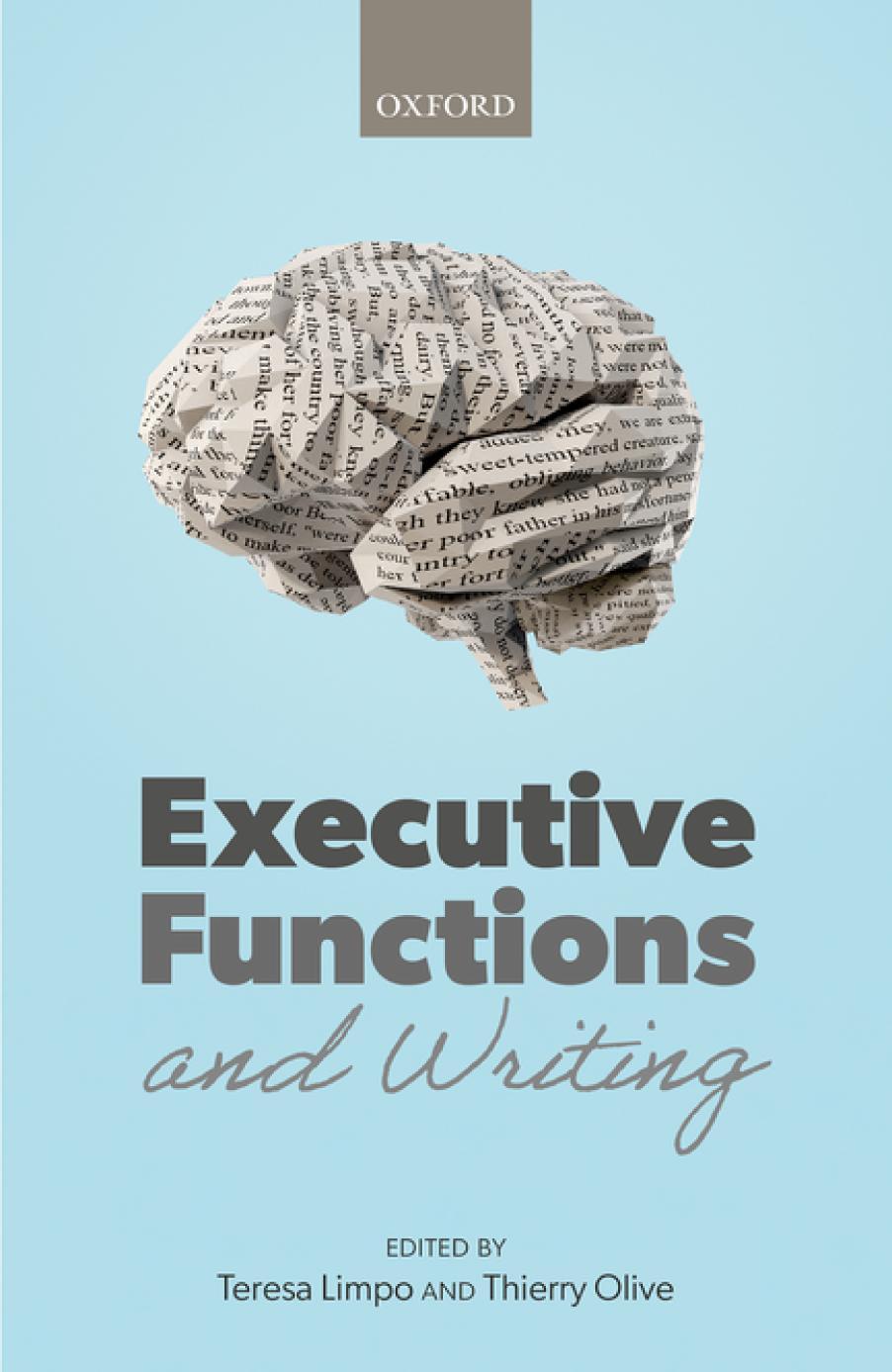
Executive Functions and Writing
Edited by
Teresa Limpo
Assistant Professor, Faculty of Psychology and Educational Sciences, University of Porto, Portugal
Thierry Olive
Senior Researcher at the Centre National de la Recherche Scientifique (CNRS) and Université de Poitiers, France
3
Great Clarendon Street, Oxford, OX2 6DP, United Kingdom
Oxford University Press is a department of the University of Oxford. It furthers the University’s objective of excellence in research, scholarship, and education by publishing worldwide. Oxford is a registered trade mark of Oxford University Press in the UK and in certain other countries
© Oxford University Press 2021
The moral rights of the authors have been asserted
First Edition published in 2021
Impression: 1
All rights reserved. No part of this publication may be reproduced, stored in a retrieval system, or transmitted, in any form or by any means, without the prior permission in writing of Oxford University Press, or as expressly permitted by law, by licence or under terms agreed with the appropriate reprographics rights organization. Enquiries concerning reproduction outside the scope of the above should be sent to the Rights Department, Oxford University Press, at the address above
You must not circulate this work in any other form and you must impose this same condition on any acquirer
Published in the United States of America by Oxford University Press 198 Madison Avenue, New York, NY 10016, United States of America
British Library Cataloguing in Publication Data
Data available
Library of Congress Control Number: 2020952978
ISBN 978–0–19–886356–4
DOI: 10.1093/oso/9780198863564.001.0001
Printed and bound in the UK by TJ Books Limited
Oxford University Press makes no representation, express or implied, that the drug dosages in this book are correct. Readers must therefore always check the product information and clinical procedures with the most up-to-date published product information and data sheets provided by the manufacturers and the most recent codes of conduct and safety regulations. The authors and the publishers do not accept responsibility or legal liability for any errors in the text or for the misuse or misapplication of material in this work. Except where otherwise stated, drug dosages and recommendations are for the non-pregnant adult who is not breast-feeding
Links to third party websites are provided by Oxford in good faith and for information only. Oxford disclaims any responsibility for the materials contained in any third party website referenced in this work.
Abbreviations vii
Contributors ix
I. INTRODUCTION
1. Why Should We Be Looking at the Relationship Between Executive Functions and Writing? 3
Teresa Limpo and Thierry Olive
II. MODELS OF EXECUTIVE FUNCTIONS AND WRITING
2. Current Issues in the Conceptualization and Measurement of Executive Function Skills 17
Michael Willoughby and Kesha Hudson
3. Executive Control and the Writer(s)-Within-Community Model 38
Steve Graham
III. METHODS FOR ASSESSING EXECUTIVE FUNCTIONS AND WRITING
4. Assessment of Executive Functions in Children 79
Helen St Clair-Thompson and Yunhong Wen
5. Capturing the Challenges in Assessing Writing: Development and Writing Dimensions 103
Julie E. Dockrell and Vincent Connelly
IV. EXECUTIVE FUNCTIONS AND WRITING ACROSS THE LIFESPAN
6. Executive Functions and Writing Skills in Children and Adolescents: Developmental Associations and Dissociations 139
Stephen R. Hooper, Lara Costa, Edmund Fernandez, Alexandra Barker, Courtney Valdes, Stephanie Catlett, and Melissa Green
7. How Do Executive Functions Issues Affect Writing in Students with Neurodevelopmental Disorders? 160 Marisa Filipe
Abbreviations
CBGO computer-based graphic organizers
CCC Cognitive Complexity and Control
CD conduct disorder
COPS Capitalization, Organization, Punctuation, Spelling
CPA cascading production analysis
DIEW direct and indirect effects model of writing
EC executive control
EF executive function
FPCEUP Faculty of Psychology and Education Sciences at University of Porto
HMEC Holarchical Model of Executive Control
LTM long-term memory
MCI mild cognitive impairment
MEFS McCloskey Executive Functions Scale
PENS Picks, Explores, Noted, and Subject
PND percentage of non-overlapping data
SALT Systematic Analysis of Language Transcripts
SIM Strategy Instruction Model
SPAG Spelling, Punctuation and Grammar
SRSD self-regulated strategy development
SST Stop Signal Task
SWF Sentence Writing Fluency
TAACO the automatic analysis of text cohesion
TAALES the automatic analysis of lexical sophistication
TTR Type Token Ratios
WAM Writing Assessment Measure
WCST Wisconsin Card Sorting Task
WM working memory
WOLD Wechsler Objective Language Dimensions
WWC Writing within Communities
Contributors
Regina Abreu
Research Associate, Centre for Psychology at University of Porto, Portugal
Alexandra Barker
Research Associate, Department of Allied Health Sciences, CB# 7120, School of Medicine, University of North CarolinaChapel Hill, USA
Stacie Brady
Doctoral Student, Special Education, George Mason University, USA
São Luís Castro
Full Professor, Faculty of Psychology and Educational Sciences, University of Porto, Portugal
Stephanie Catlett
Research Associate, Department of Allied Health Sciences, CB# 7120, School of Medicine, University of North Carolina-Chapel Hill, USA
Vincent Connelly
Professor of Psychology, Department of Psychology, Health and Professional Development, Faculty of Health and Life Sciences, Oxford Brookes University, UK
Lara Costa
Research Project Director, Department of Allied Health Sciences, CB# 7120, School of Medicine, University of North Carolina-Chapel Hill, USA
Julie E. Dockrell
Professor of Psychology and Special Needs, Psychology and Human Development, UCL Institute of Education, UK
Edmund Fernandez
Research Associate, Department of Allied Health Sciences, CB# 7120, School of Medicine, University of North Carolina-Chapel Hill, USA
Marisa Filipe
Assistant Professor, Digital HumanEnvironment Interaction Lab—HEI-Lab, Lusófona University, Portugal
George Georgiou
Professor, Director of the J.P. Das Centre on Developmental and Learning Disabilities, Department of Educational Psychology, University of Alberta, Canada
Sam Goldstein
Adjunct Assistant Professor, Department of Psychiatry, University of Utah School of Medicine; Clinical Director, Neurology, Learning and Behavior Center, USA
Steve Graham
Warner Professor of Educational Innovation and Leadership, Mary Lou Fulton Teachers College, Arizona State University, USA
Melissa Green
Research Associate, Department of Allied Health Sciences, CB# 7120, School of Medicine, University of North Carolina-Chapel Hill, USA
Stephen R. Hooper
Associate Dean of Medicine; Chair, Department of Allied Health Sciences, CB# 7120, School of Medicine, University of North Carolina-Chapel Hill, USA
Contributors
Kesha Hudson
Post-Doctoral Fellow, Education and Workforce Development, RTI International, Research Triangle Park, NC, USA
Teresa Limpo
Assistant Professor, Faculty of Psychology and Educational Sciences, University of Porto, Portugal
Linda H. Mason
Professor and Endowed Director of the Helen A. Kellar Institute for Human disAbility, College of Education and Human Development, George Mason University, USA
George McCloskey
Professor, School of Professional and Applied Psychology, Director of School Psychology Research, Philadelphia College of Osteopathic Medicine, USA
Keith D. McGoldrick
Neuropsychologist, Beehive Neuropsychology, USA
Thierry Olive
Senior Researcher at the Centre National de la Recherche Scientifique (CNRS) and Université de Poitiers, France
Helen St Clair-Thompson
Senior Lecturer in Psychology, School of Psychology, Newcastle University, UK
Courtney Valdes
Research Associate, Department of Allied Health Sciences, CB# 7120, School of Medicine, University of North Carolina-Chapel Hill, USA
Yunhong Wen
PhD Student in Psychology, School of Psychology, Newcastle University, UK
Michael Willoughby Fellow, Education, Education and Workforce Development, RTI International, Research Triangle Park, NC, USA
1 Why Should We Be Looking at the Relationship Between Executive Functions and Writing?
Teresa Limpo and Thierry Olive
Introduction
In 1980, John Hayes and Linda Flower introduced the first cognitive model of written composition (Hayes & Flower, 1980). This model was inspired by mainstream concepts of cognition at the time: writing was conceived as an ill-defined, goal-oriented problem, with cognitive operations working at several levels of mental representations under the supervision of a monitor. Still today, the influence of this model in shaping the development of writing research is extremely visible. The skeleton of this seminal model can be found at the root of the many cognitive models currently available to explain the process of producing writing (Berninger & Winn, 2006; Graham, 2018a; Kellogg, 1996; Kim & Schatschneider, 2017). One of the reasons for its remarkable and long-standing impact was the identification of the major cognitive processes involved in writing a text. From thinking-aloud protocols analysis, Hayes and Flower (1980) inferred three writing processes, namely, planning, translating, and revising. More important for the present volume, authors claimed that these processes recursively interacted during skilled writing under the control of a ‘monitor’ responsible for deciding which process to use and at which moment of composition as well as how to enact that process. Though not recognized explicitly, the functions ascribed to this ‘monitor’ match some of those currently gather under the umbrella term ‘executive functions’.
Sixteen years later, John Hayes provided the research community with an updated version of the original model, in which he incorporated several key modifications (Hayes, 1996). Among them was the exchange of the term ‘monitor’ by ‘working memory’. Later in 2012, Hayes abandoned the idea that planning and revising are specific writing processes and conceived them as specialized writing activities that engage other writing processes (Hayes, 2012). He posits that ‘creating a written plan not only involves setting goals, generating ideas, and evaluating them but also necessarily involves translation and transcription to produce a written product’, and
Teresa Limpo and Thierry Olive, Why Should We Be Looking at the Relationship Between Executive Functions and Writing? In: Executive Functions and Writing. Edited by: Teresa Limpo and Thierry Olive, Oxford University Press. © Oxford University Press 2021. DOI: 10.1093/oso/9780198863564.003.0001
that ‘revising . . . involves planning a solution to the problem (in written form or not), translating that solution into language, and transcribing that language into new text to replace the old text’ (p. 376). As Hayes underlined, this change was aimed at further understanding writing as the result of interactions among writing subprocesses. Like in the 1996 model, working memory was assumed a central role, as it was responsible for coordinating all the cognitive and motivational processes involved in writing. Since then, the inclusion of top-down mental processes responsible for managing the writer’s cognition, affects, and/or behaviours during writing has become the norm in cognitive writing models, despite the lack of agreement on how to label those executive processes (Berninger & Winn, 2006; Graham, 2018a; Kellogg, 1996; Kim & Schatschneider, 2017). This lack of agreement is not surprising, as it mimics the absence of a consensual definition of executive functions (see Chapter 2 of this volume). There is however an overall agreement that executive functions involve a group of cognitive processes that allow individuals to successfully engage in independent, purposeful, and self-directed behaviours (Lezac, Howieson, Bieglerr, & Tranel, 2012). These executive processes are called for in tasks where success depends upon an individual being capable to sustain attention, manipulate ideas, resist to temptations, think before acting, and/or deal with unanticipated challenges (Diamond, 2013). Though executive functions may not always be needed to succeed or achieve optimal performance (e.g. in close-skilled sports, where turning the ‘automatic pilot’ on may be advisable), this does not seem to be the case of such a complex and cognitively demanding activity as writing.
Since the 1980s, sound theoretical claims and empirical demonstrations supporting the complexity of writing have been provided. In part, this complexity is ascribed to the numerous processes involved in the act of producing written text that have to be orchestrated (see Chapters 3 and 9 of this volume), from the need to proficiently use a writing tool (e.g. a pen or a keyboard) or correctly spell words (Abbott & Berninger, 1993) to the importance of generating adequate ideas coherently organized to fulfil rhetorical goals (Hayes & Nash, 1996) and translated into an adapted language, while simultaneously dealing with external demands (e.g. audience) and internal beliefs (e.g. self-efficacy). Because of this complexity, it is well-established in the writing research field that, regardless of the term used, executive functions are a fundamental ingredient to produce good writing throughout the lifespan (Graham, 2018a; Harris et al., 2018; Kellogg & Whiteford, 2009; Olive, 2014), as discussed in Section IV of this volume.
Despite being widely accepted, one can neither say that the relationship between executive functions and writing is grounded on a large body of empirical research nor that it is a core research topic in the field of writing research. The limited efforts to explore the nature of the connection between executive functions and writing is even more evident when we look at recent compilations of works deepening our knowledge about the role of executive functions in education (Huizinga, Baeyens, & Burack, 2018; Meltzer, 2018). Notwithstanding their relevance, writing is only cursorily addressed. There is no question that during the last decade executive functions
became mainstream in neurocognition and educational research fields. Nevertheless, few attempts have been made to deeply investigate the role of executive functions in the production of written language in children and adolescents, and mainly in adults and elders.
Born within the M2S Project,1 the current volume was devised with a twofold purpose: to provide a comprehensive portrait of the state-of-the-art on the link between executive functions and writing, from theoretical, methodological, and developmental viewpoints; and to identify gaps in the literature that can inspire and stimulate researchers to deepen our knowledge in the topic through well-designed empirical research. To that end, we gathered a diverse group of internationally recognized scholars—coming from complementary areas in Psychology (e.g. Cognitive, Educational, Neuropsychology, Developmental, Experimental, School, Health) as well as from equally relevant research fields (such as Neuroscience or Medicine)— and to whom we are deeply grateful for making this volume possible. According to their area of expertise, authors were invited to produce specific chapters organized into four sections (besides the current, introductory one), which are further detailed in what follows.
Overview of the Current Volume
Section II. Models of Executive Functions and Writing
This section comprises two chapters addressing theoretical issues related to the conceptualization of executive functions and written language. In Chapter 2, Willoughby and Hudson provide an overview on the concept of executive functions. They start by presenting the neurobiological grounding of executive functions, with an eye on the precursors and correlates of these skills. This is followed by methodological considerations concerning performance- vs. questionnaire-based measurements of executive functions (see Chapter 4 of this volume for a thorough discussion on this). Willoughby and Hudson then provide a review of relevant theoretical models of executive functions, with the goal of showing the variation in scope and breadth of executive processes considered. After discussing the seminal models from Lezac (1995), Anderson (2002) and Zelazo, Carter, Reznick, and Frye (1997), they discuss the dimensionality of executive functions, grounded on empirical, factor-analytic approaches. Afterwards, they put forward a set of considerations regarding the development of executive functions, which are particularly useful to prepare readers for the chapters included in Section IV of this volume. The chapter ends with reflections
1 The M2S Project, ‘Mindfulness to students’ success (M2S): relating executive functions and writing through a mindfulness app to promote children’s cognitive, social, and health-related outcomes’, was funded through the Operational Programme for Competitiveness and Internationalization, supported by FEDER and national funds allocated to the Portuguese National Foundation for Science and Technology (NORTE-01-0145-FEDER-028404). More information on the project can be consulted at m2s.up.pt and its activities can be followed at https://www.facebook.com/M2S.project/
on the characterization of executive functions as a joint function of trait and state influence and a discussion on the conceptual similarity between concepts such as executive functions, error monitoring, metacognition, and uncertainty monitoring (all assumed to contribute to self-regulation). As intended by Willoughby and Hudson, the many inconsistencies and discrepancies in the field brought to light in the chapter provide a comprehensive framework for readers to adopt a critical position while going through subsequent chapters in the volume.
In Chapter 3, Graham presents the Writer(s)-within-Community model of writing (WWC; Graham, 2018a; Graham, 2018b), which merges the sociocultural and cognitive perspectives prevalent in the field of writing research. The WWC model includes two main components: the writing community where writing occurs, and the cognitive resources and capabilities of its members, which involve a set of control mechanisms to regulate the mental and physical processes used to produce text that draw on long-term memory resources. Adopting the term executive control (instead of executive functions), the author describes contextual and individual factors in writing and exemplify how these interact to shape and constrain the use of executive control in writing. Specifically, grounded on the WWC model, Graham describes common features of writing communities (e.g. purposes, members, tools) and discusses how these may shape and bind executive control. Subsequently, he delves into the cognitive architecture of the members of the community, namely writers, their collaborators (including mentors and teachers), and the intended audience (readers). Supported by illustrative examples depicting varying writing situations, the author describes the role of executive control in writing, viewed by the WWC as a multidimensional set of control mechanisms, including executive processes, working memory, and attention. In the second part of the chapter, Graham presents four tenets underlying the operation of the WWC model: (a) interactive effects between a writing community and its members; (b) simultaneous effects of community and individual capacity; (c) simultaneous effects of variability in a writing community and its members; and (d) simultaneous effects of community and member development. Illustrative examples of how these four tenets can potentially influence executive control are provided. The chapter ends with a summary of eight assumptions about executive control and writing within the WWC and future indications to empirically test them.
Section III. Methods for Assessing Executive Functions and Writing
The third section of the volume includes two chapters that discuss methodological matters concerning the measurement of executive functions and writing. In Chapter 4, St. Clair-Thompson and Wen provide an overview on two broad approaches to measure executive functions mainly in children (viz, cognitive measures and behavioural rating scales), with the ultimate goal of helping readers in choosing executive measures in an informed and justified way. They start with a brief description of several cognitive tasks typically used to measure each of the three core dimensions of executive functions, namely, inhibition, shifting, and updating working memory (Miyake et al., 2000). Subsequently, St. Clair-Thompson and Wen discuss a
set of four factors that should be considered when selecting a task to assess executive functions: (a) degree to which the task is developmentally appropriate for children, including those with disabilities (e.g. in terms of task difficulty, complexity of instructions, type of stimuli); (b) extent to which there are indicators that the measure is reliable (including alternate forms); (c) whether the task actually measures the cognitive processes that it is intended to assess; and (d) degree to which the task measures more than one executive function (also known as the ‘task impurity problem’). A useful table discussing these considerations in reference to the measures described earlier is also presented. In the second part of the chapter, St. Clair-Thompson and Wen discuss another approach to the measurement of executive function, that of using behavioural rating scales. They specifically focus on the Behavior Rating Inventory of Executive Function (Gioia, Isquith, Guy, & Kenworthy, 2000), one of the most commonly measures used, and discuss indicators of validity and reliability of the instrument. The chapter ends with a valuable reflection on the similarities and differences between using cognitive measures or rating scales to measure executive functions, followed by a flowchart intended to guide the decision-making processes when choosing a suitable measure of executive function.
In Chapter 5, Dockrell and Connelly discuss the measurement of writing, recognizing that one of the challenges in assessing writing is the lack of consensus on the meaning of writing proficiency at different developmental points. The chapter is organized around the measurement of two complementary aspects of writing: the outcome achieved (product) and the process that led to it (process). Concerning the assessment of the writing product, authors discuss the use of holistic and analytic scores as well as of the focus on specific dimensions of the written product (e.g. writing at the word, sentence, and text levels vs. productivity, complexity, and quality of writing). Turning to assessment of the writing process, Dockrell and Connelly present and discuss the measurement of key processes underlying text production, including planning, translating (in which they include the use online measures of writing to gauge bursts of written language), and revising, along with other dimensions, such as metacognitive control and communication. The subsequent discussion delves into three aspects worthy of considering when choosing a writing measure: (a) the number of samples to be collected and the duration of the writing task; (b) the degree to which genre influences the process and the product to be assessed; and (c) the possibility of using automated writing evaluation systems. Dockrell and Connelly also acknowledge the importance of adopting a framework that considers not only proximal factors (e.g. spelling) but also distal factors (e.g. oral language) that support writing. These latter underpin the production of writing and should be considered in a broader conceptualization of the assessment of writing. They additionally provide an illustration on how the previous remarks concerning the measurement of writing can be put into practice in empirical research. The conclusion of this chapter provides a thorough discussion on the challenges involved in the measurement of writing, including less targeted ones, as the language in which the text is produced.
Section IV. Executive Functions and Writing Across the Lifespan
This section gathers five chapters focusing on the relationship between executive functions and writing throughout lifespan development. In Chapter 6, Hooper et al. delve into the link (or lack of) between executive functions and writing in child and adolescent writers, from a developmental point of view. The authors start by describing several key models (i.e. Psychological Models, Problem-Solving Models, Working Memory Models) with potential applications to writing. They then provide a brief overview on the development of executive functions and writing skills, with the acknowledgement that the degree to which the development of those skills is related (inclusively in a bidirectional way) is still unclear. In what follows, Hooper et al. address the link between key components of executive functions and writing in novice writers. Studies providing empirical evidence on the association between inhibitory control, cognitive flexibility, working memory, and planning are reviewed. This first part of the chapter sets the basis for its second part, in which they discuss the associations and dissociations of executive functions and written expression. The discussion is grounded on an interesting viewpoint, concerning the situations in which intact executive functions are coupled with intact writing skills, or when impaired executive functions are coupled with impaired writing skills (associations); and when intact executive functions coexist with impaired writing skills, or vice versa (dissociations). Hooper et al.’s considerations become more intricate when they consider the issue of associations and dissociations between executive functions and writing over the course of development. The chapter ends recognizing the lack of research into these associations and dissociations, mainly through longitudinal methodologies. Hooper et al. provide relevant avenues for future research aimed to deepen our knowledge not only about the contribution of executive functions to writing, but also about the influence of written composition on executive functions.
In Chapter 7, Filipe raises the question of how executive functions may influence writing in individuals with neurodevelopment disorders. As she noted, writing can be especially difficult for those people. In part, that can be related to the importance of executive functions in writing associated with the executive impairments frequently observed in neurodevelopment disorders. Three clinical conditions are addressed: autism spectrum disorder, attention-deficit/hyperactivity disorder, and specific learning disorder (e.g. dyslexia). For each of these neurodevelopmental disorders, Filipe provides a definition of the condition and presents its fundamental characteristics, with a focus on the executive functions mostly impaired, which is then associated with the specific writing profile of these individuals. Overall, she proposes that the writing difficulties observed in autism spectrum disorders may be mainly associated with problems in cognitive flexibility, whereas the problems in writing observed in attention-deficit/hyperactivity disorders may be mostly related to working memory deficits, which may also underlie a great part of the difficulties faced by writers with specific learning disorders. Throughout the chapter, Filipe provides several examples aimed at illustrating how the impaired executive functions may constrain key aspects of text production, from handwriting to revising in response to
feedback. The chapter ends with useful implications for practitioners and educators, including indications for writing assessment, which should be tailored to the specific needs of individuals with neurodevelopmental disorders; as well as recommendations for developing and implementing writing interventions capable of helping them to overcome their executive impairments and diminish their difficulties in writing.
In Chapter 8, Mason and Brady provide a thorough discussion concerning how and why the teaching of writing should target executive functions, mainly through the inclusion of instructional components targeting self-regulation. They start by addressing the promotion of executive functions in the context of writing sentences, including compound and complex sentences, via the evidence-based methods of sentence combining. Afterwards, they focus on the promotion of writing processes (e.g. planning), through the well-known Self-Regulated Strategy Development (SRSD) model (Harris et al. 2018). This is a widely used and effective evidence-based approach that, among other key writing ingredients (such as knowledge or beliefs) targets several executive functions in the context of text production. Mason and Brady provide a description of the main steps of this model (i.e. develop and activate knowledge, discuss it, model it, memorize it, support it, and independent performance) and how each one can be implemented to support executive functions. They also present the SRSD for quick-writes (i.e. brief response to a prompt during a short time period), including additional tips to help the promotion of executive functions. Grounded on the effectiveness of strategy instruction, authors provide readers with a set of evidence-based writing strategies in the form of mnemonics that support several executive functions called for when producing a text (e.g. planning, working memory). In what follows, Mason and Brady discuss the power of technology (coupled with self-regulation) to support executive functions and improve writing. A set of studies describing technology-based writing interventions is briefly presented. Some of these studies showed the effectiveness of using technology to help students to plan via computer-based graphic organizers. The chapter ends by acknowledging the potential of joining strategies, self-regulation, and self-regulatory prompting with technology as a means to develop executive functioning in writing.
In Chapter 9, Olive focuses on the link between executive functions and writing in skilled writers, whose empirical grounds are admittedly scarce. Stemming from analytical or theoretical descriptions of the cognitive demands of writing along with indirect empirical findings, he presents a set of arguments to support the involvement of executive functions in skilled writers. He then critically presents the componential model of working memory in writing (Kellogg, 1996) and the capacity model of working memory in writing (McCutchen, 1996). Despite not fully specifying the role of executive functions in writing, these models have the advantage of addressing the role of a key executive function in skilled writers (working memory, which is likely the most researched executive function in this population). In what follows, Olive presents a set of empirical studies that indirectly addressed the role of executive functions in skilled writing, in particular, by measuring the cognitive effort involved in the highly demanding writing processes (viz., planning, translating, revising, transcription),
seen as an indicator of the engagement of executive functions. Next, he presents a set of initial proposals about the executive functions required by writing processes, either when enacted in sequence or concurrently. In general, Olive claims that the concurrent coordination of writing processes typically observed in skilled writers requires strong executive supervision particularly for monitoring process switching, information flow, and the related processing and short-term storage demands. Olive ends the chapter issuing a challenge to the research community targeting skilled writers, that of gathering empirical evidence on the role played by the multiple executive functions in the major cognitive processes of writing, and on how and to which extent does that role depends upon different writing tasks and situations, as well as skilled writers’ interindividual differences.
In Chapter 10, Castro and Abreu focus on the ageing writer in health and disease. They explore whether executive functions take part in the age-related changes observed in writing and whether writing can influence executive functioning in older people. Indeed, the chapter is grounded on the interesting claim that writing can be both an expression and an enhancer of cognitive functioning. Castro and Abreu began with a characterization of cognition in older ages, which is progressively narrowed to a characterization of writing aspects. They draw a thorough profile of the ageing writer, focused on the main age-related characteristics of writing in terms of contentrelated levels (i.e. lexical, syntactical, and discourse) as well as in terms of production processes (i.e. handwriting and typing). Recognizing the lack of empirical studies directly examining how executive functions impact writing in older years, they present a set of models to support their claim that executive functions can partly explain some age-related changes in writing. To continue substantiating the link between executive functions and writing in older ages, Castro and Abreu detail the many writing-related changes typically observed in dementia (relevant for screening and diagnosing purposes), which are however clearly distinguishable from those observed in healthy ageing. In the subsequent part of the chapter, they focus on the benefits of writingbased interventions in older people, mainly in socioemotional dimensions. Despite the scarce research evidence on this topic, they succeed in gathering evidence on the beneficial effects of autobiographical life review programmes (either in speaking or writing modalities), writing group interventions, learning a challenging calligraphy, and daily log of personal experiences. To conclude, Castro and Abreu present useful remarks concerning the still-open questions in the field (e.g. are the writing-related changes observed in healthy ageing progressive or sudden?), hoping for more research into the cognitive and socioemotional dimensions of the ageing writer.
Section V: Conclusions and Future Directions
The last section of the volume provides a set of three commentary chapters on the link between executive functions and writing, including insightful reflections on the topic and indications for future research. In Chapter 11, McCloskey comments on each section of the volume. To emphasize the importance of adopting a multidimensional perspective on executive functions, he presents the Holarchical Model of Executive
Control that includes multiple tiers of executive control (McCloskey, Gilmartin, & Stanco-Vitanza, 2014). Then, the author discusses issues related to the assessment of executive functions and writing, and describes the cascading production analysis methodology, illustrated with writing-related assessment tasks. Finally, McCloskey reflects on how to strengthen the use of executive functions in varying contexts and presents the executive control intervention continuum (McCloskey, Gilmartin, & Stanco-Vitanza, 2014).
In Chapter 12, Georgiou notes the reduced attention given to a higher-order executive function (at least in comparison to the three core functions of inhibition, shifting, and updating in working memory), that of cognitive planning. This process is labelled by the author as the ‘common denominator’ of both executive functions and writing. Georgiou also provides several empirically grounded considerations regarding the conceptualization of cognitive planning, which are then used to fit this process into existing models of writing and to present a writing task that operationalizes cognitive planning (cold executive functions), including an affective component (hot executive functions).
In Chapter 13, Goldstein and McGoldrick open their commentary with a series of questions concerning future challenges raised by globalization and technology development. The authors do not have answers for those challenges, but they claim that educational settings do certainly need to prepare children to deal with them. As they suggest, developing students’ executive functions can be a means not only to prepare them for the unknown time to come, but also to facilitate the current acquisition of key academic skills, such as writing. Given the central role that executive functions play inside and outside school and work contexts, promote them is contributing to develop citizens ready for new current and future challenges.
Conclusion
This volume itself provides a thorough answer to the question raised in the title of this chapter: Why should we be looking at the relationship between executive functions and writing? In this introductory chapter, we risk a clear-cut, perhaps simplistic, response to that query, which can be put as: because executive functions are essential to produce good writing and, if we want good writers, we need to know more about how this link operates in childhood, adulthood, and elderly years. As well illustrated through the volume, the relationship between executive functions and writing is more than a theoretical claim. There is now an emerging body of evidence showing the importance of those top-down mental processes to produce good writing at any age. Still, this volume showed that this evidence is neither consistent nor abundant. It is still not clear the conditions that determinate why one component of executive functions may be more important to writing than another. Moreover, the amount of studies aiming to deepen our knowledge about the contribution of executive functions to writing throughout the lifespan is reduced (the older the writer, the less evidence seems to
exist). Also, the methodologies used across available studies barely match, which impedes sound comparisons and productive synthesis to support strong theories. By providing a complete state-of-the-art on the theoretical and empirical bases relating executive functions and writing, while at the same time calling readers attention to the numerous gaps in these bases and giving them suggestions to overcome them, we believe this volume is an innovative and valuable contribution to the field of writing research and adjacent areas of inquiry.
Additionally, given the coverage of the topic—presenting theoretical viewpoints, discussing methodological considerations, and targeting developmental issues from childhood to old age, this volume can be seen as a reference and essential reading among researchers and graduate students interested in understanding the cognitive underpinnings of writing throughout the writer lifespan. The applied focus adopted in Section IV looking at executive functions and writing in children, adolescents, adults, and elders, also turns this volume into a useful tool for educators and practitioners interested in better understanding how to foster the mastery of writing throughout the lifespan.
Though many individuals struggle to master written language, its value in contemporary nations is irrefutable. The information generated by research is a catalyst for nurturing citizens’ capabilities to use that key skill. The body of knowledge here thoroughly presented and critically discussed can contribute to fulfil that goal. As editors, this was our intention when crafting the proposal of the current volume. Now that it is finished, we believe that the collection of works here gathered do represent a powerful knowledge asset for researchers and educators embarking the long and demanding journey of improving citizens writing skills.
References
Abbott, R.D., & Berninger, V.W. (1993). Structural equation modeling of relationships among developmental skills and writing skills in primary- and intermediate-grade writers. Journal of Educational Psychology, 85, 478–508.
Anderson, P. (2002). Assessment and development of executive function (EF) during childhood. Child Neuropsychology, 8, 71–82.
Berninger, V.W., & Winn, W. (2006). Implications of advancements in brain research and technology for writing development, writing instruction, and educational evolution. In C.A. MacArthur, S. Graham, & J. Fitzgerald (Eds.). Handbook of Writing Research (1st ed., pp. 96–114). New York, NY: Guilford Press.
Diamond, A. (2013). Executive functions. Annual Review of Psychology, 64, 135–68.
Gioia, G.A., Isquith, P.K., Guy, S.C., & Kenworthy, L. (2000). Test review behavior rating inventory of executive function. Child Neuropsychology, 6, 235–38.
Graham, S. (2018a). A revised writer(s)-within-community model of writing. Educational Psychologist, 11, 258–79.
Graham, S. (2018b). A writer(s) within community model of writing. In C. Bazerman, V. W. Berninger, D. Brandt, S. Graham, J. Langer, S. Murphy, P. Matsuda, D. Rowe, & M. Schleppegr (Eds.). The Lifespan Development of Writing (pp. 272–325). Urbana, IL: National Council of English.
Harris, K.R., Graham, S., Mason, L., McKeown, D., & Olinghouse, N.G. (2018). Self-regulated strategy development in writing: a classroom example of developing executive function processes and future directions. In L. Meltzer (Ed.). Executive Function in Education: From Theory to Practice (pp. 326–56). New York, NY: The Guilford Press.
Hayes, J.R. (1996). A new framework for understanding cognition and affect in writing. In C.M. Levy & S. Ransdell (Eds.). The Science of Writing: Theories, Methods, Individual Differences, and Applications (pp. 1–27). Mahwah, NJ: Lawrence Erlbaum Associates.
Hayes, J.R. (2012). Modeling and remodeling writing. Written Communication, 29(3), 369–88.
Hayes, J.R., & Flower, L. (1980). Identifying the organization of writing processes. In L.W. Gregg & E.R. Steinberg (Eds.). Cognitive Processes in Writing (pp. 3–29). Hillsdale, NJ: Lawrence Erlbaum Associates.
Hayes, J.R., & Nash, J.G. (1996). On the nature of planning in writing. In C.M. Levy & S. Ransdell (Eds.). The Science of Writing: Theories, Methods, Individual Differences, and Applications (pp. 29–55). Mahwah, NJ: Lawrence Erlbaum Associates.
Huizinga, M., Baeyens, D., & Burack, J.A. (2018). Editorial: executive function and education. Frontiers in Psychology, 9, 1357.
Kellogg, R.T. (1996). A model of working memory in writing. In C.M. Levy & S. Ransdell (Eds.). The Science of Writing (pp. 57–71). Mahwah, NJ: Lawrence Erlbaum Associates.
Kellogg, R.T., & Whiteford, A.P. (2009). Training advanced writing skills: the case for deliberate practice. Educational Psychologist, 44, 250–66.
Kim, Y.G., & Schatschneider, C. (2017). Expanding the developmental models of writing: a direct and indirect effects model of developmental writing (DIEW). Journal of Educational Psychology, 109, 35–50.
Lezac, M.D. (1995). Neuropsychological Assessment (3rd ed.). New York, NY: Oxford University Press.
Lezac, M.D., Howieson, D.B., Bieglerr, E.D., & Tranel, D. (2012). Neuropsychological Assessment New York, NY: Oxford University Press.
McCloskey, G., Gilmartin, C., & Stanco-Vitanza, B. (2014). Interventions for students with executive skills and executive functions difficulties. In J.T. Mascolo, V.C. Alfonso, D.P. Flanagan (Eds.). Essentials of Planning, Selecting, and Tailoring Interventions for Unique Learners (pp. 314–56). New York, NY: Wiley.
McCutchen, D. (1996). A capacity theory of writing: working memory in composition. Educational Psychology Review, 8, 299–325.
Meltzer, L. (2018). Executive Function in Education: From Theory to Practice. New York, NY: The Guilford Press.
Miyake, A., Friedman, N.P., Emerson, M.J., Witzki, A.H., Howerter, A., & Wager, T.D. (2000). The unity and diversity of executive functions and their contributions to complex ‘frontal lobe’ tasks: a latent variable analysis. Cognitive Psychology, 41, 49–100.
Olive, T. (2014). Toward a parallel and cascading model of the writing system: a review of research on writing processes coordination. Journal of Writing Research, 6, 173–94.
Zelazo, P.D., Carter, A., Reznick, J.S., & Frye, D. (1997). Early development of executive function: a problem-solving framework. Review of General Psychology, 1, 198–226.