Instant digital products (PDF, ePub, MOBI) ready for you
Download now and discover formats that fit your needs...
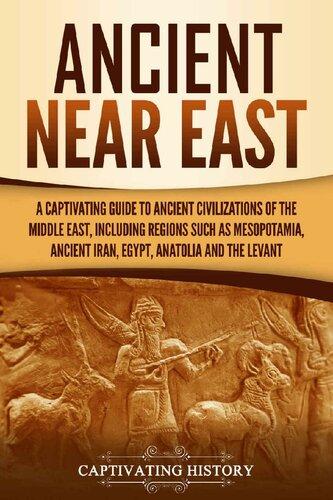
Ancient Near East: A Captivating Guide to Ancient Civilizations of the Middle East, Including Regions Such as Mesopotamia, Ancient Iran, Egypt, Anatolia, and the Levant Captivating History
Oxford University Press is a department of the University of Oxford. It furthers the University’s objective of excellence in research, scholarship, and education by publishing worldwide. Oxford is a registered trade mark of Oxford University Press in the UK and certain other countries.
Published in the United States of America by Oxford University Press 198 Madison Avenue, New York, NY 10016, United States of America.
All rights reserved. No part of this publication may be reproduced, stored in a retrieval system, or transmitted, in any form or by any means, without the prior permission in writing of Oxford University Press, or as expressly permitted by law, by license, or under terms agreed with the appropriate reproduction rights organization. Inquiries concerning reproduction outside the scope of the above should be sent to the Rights Department, Oxford University Press, at the address above.
You must not circulate this work in any other form and you must impose this same condition on any acquirer.
Library of Congress Cataloging-in-Publication Data
Names: Price, Max D., author.
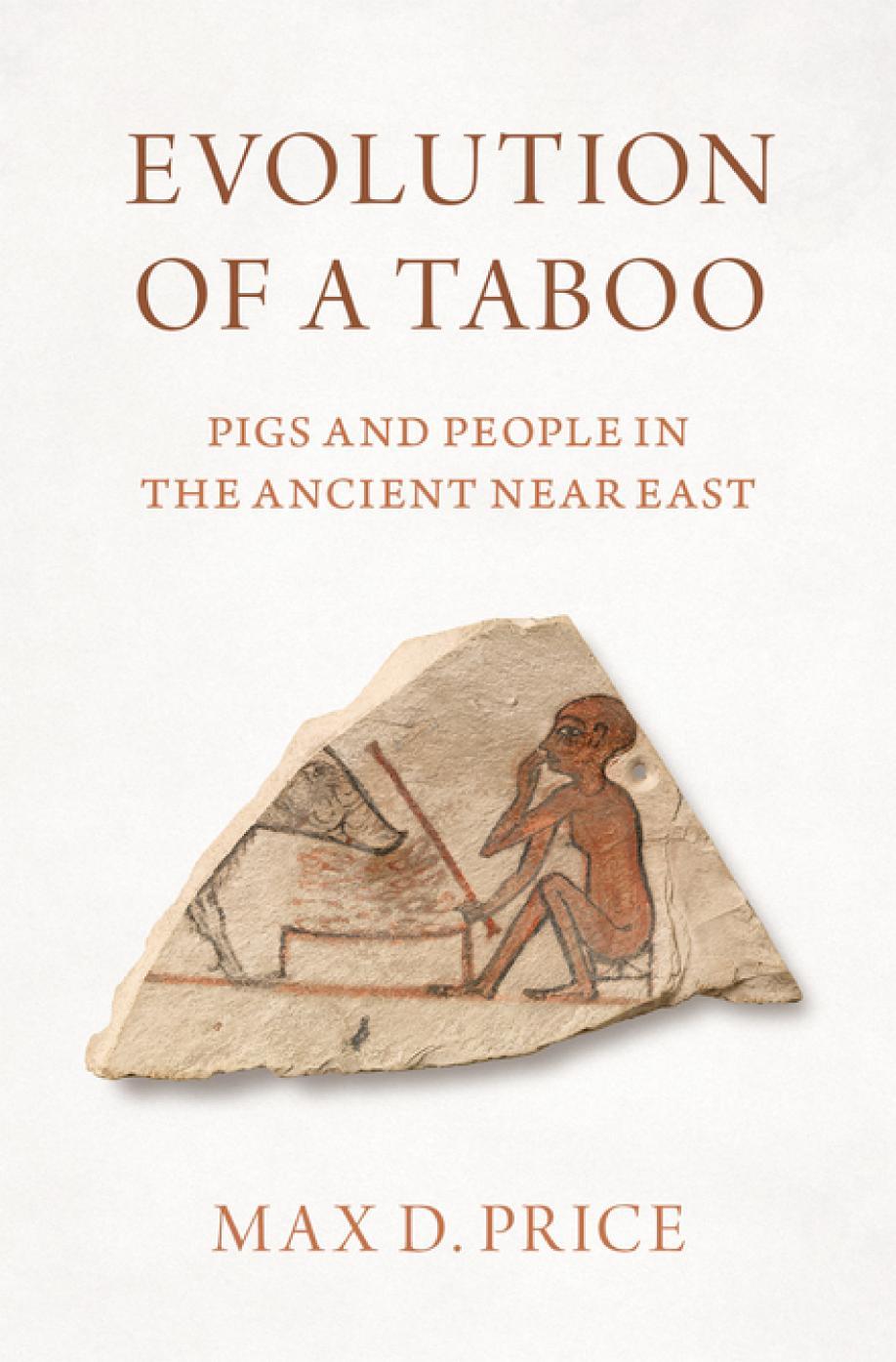
Title: Evolution of a taboo : pigs and people in the Ancient Near East / Max D. Price.
Other titles: Pigs and people in the Ancient Near East
Description: New York, NY : Oxford University Press, 2020. | Includes bibliographical references and index.
Identifiers: LCCN 2020023549 (print) | LCCN 2020023550 (ebook) | ISBN 9780197543276 (hardback) | ISBN 9780197543290 (epub) | ISBN 9780197543306
LC record available at https://lccn.loc.gov/2020023549
LC ebook record available at https://lccn.loc.gov/2020023550
1 3 5 7 9 8 6 4 2
Printed by Sheridan Books, Inc., United States of America
To my parents, for encouraging me even during my “pig phases.” And to Jess, for everything else.
Figures
2.1 Topographic map of Middle East. Modified from image downloaded from Wikipedia Commons, https://de.wikipedia.org/wiki/Datei:Middle_East_ topographic_map-blank.svg. 11
3.2 The gradual decline of pig dental size over time at Çayönü and nearby sites. Numbers inside boxplot squares indicate sample size. This figure uses the logsize index of molar breadth measurements. This method compares observed values against those of a standard, in this case the mean values of the modern wild boar presented in the figure. Data from Payne and Bull 1988 (modern wild boar reference); Monahan 2000; Price 2016; Price and Hongo, in press.
4.1 Steady and continual reduction in the size of pigs. This figure was drawn with log-size index values, using average modern wild boar as a standard. Data from Payne and Bull 1988 (modern wild boar reference); Price 2016; Price and Hongo, in press.
45
53
4.2 4th millennium BC cylinder seal impressions containing scenes of wild boar hunting. Images kindly provided by Robert Englund (see Englund 1995). 57
4.3 Proto-Elamite vessel of a pig. Southwestern Iran, ca. 3100–2900 BC. Purchase, Rogers Fund and Anonymous Gift, 1979. Accession number 1979.71. The Metropolitan Museum of Art. 58
5.1 Number of administrative texts mentioning pigs and other livestock species. Cuneiform terms for species in parentheses. Texts refer to live animals or animal products. Data from Cuneiform Digital Library Initiative, https://cdli.ucla.edu. 70
5.2 Relative abundances of pigs in southern Levant. Numbers inside pig silhouettes show percentage of pigs. Numbers below indicate site. Key to sites: 1, Pella; 2, Marj Rabba; 3, Tel Teo; 4, Meser; 5, Tel Aviv Jabotinsky St.; 6, Teleilat al Ghassul; 7, Abu Hamid; 8, Tel esh Shuna; 9, Tel Ali; 10, Bir es Safadi; 11, Horvat Beter; 12, Abu Hamid; 13, Shiqmim; 14, Gilat; 15, Grar; 16, Ai et Tell; 17, Tel Halif; 18, Megiddo; 19, Tell Abu al Kharaz; 20, Tel Yaqush; 21, Tel es Sakan; 22, Yiftahel; 23, Ashkelon; 24, Tel Hartuv; 25, Tel Bet Yerah; 26, Qiryat Ata I III; 27, Tel Dalit; 28, Tell Madaba; 29, Tel Lod; 30, Tel Yarmouth; 31, Tel Arad; 32, Tel Erani; 33,
Khirbet al Minsahlat; 34, Kh. ez Zeraqon; 35, Tel es Safi; 36, Tell Handaquq; 37, Tell al ‘Umayri; 38, Tell Abu en Niaj; 39, Tel Dan; 40, Refaim Valley; 41, Tell el Hayyat; 42, Shiloh; 43, Tel Aphek; 44, Tel Yoqne’am; 45, Tel Haror; 46, Tell Jemmeh; 47, Tel Kabri; 48, Tel Hazor; 49, Tel Nagila; 50, Jericho; 51, Tel Harasim; 52, Beth Shean; 53, Lachish; 54, Tel Dor; 55, Beth Shemesh; 56, Tel Rehov; 57, Tel Kinrot; 58, Miqne Ekron; 59, Nahariya. Data from Allentuck 2013; Allentuck and Rosen 2019; Fall et al. 1998; Hellwing and Gophna 1984; Horwitz 1997, 2003, 2009; Horwitz and Lernau 2005; Kansa 2004; Lev Tov 2010; Marom et al. 2014; Marom and Zuckerman 2012; Price et al. 2013, 2018; Sapir Hen et al. 2013, 2016; Van den Brink et al. 2015; Vila and Dalix 2004; Wapnish and Fulton 2018; Wapnish and Hesse 1988. 74
5.3 Pig sties in Building 400 at Amarna, Egypt. Photo courtesy of The Egypt Exploration Society and the University of Oxford Imaging Papyri Project. Plan courtesy of Barry Kemp. 81
5.4 Amulet or clay plaque from Nippur showing a boar mounting a nursing sow (probably Old Babylonian period, early 2nd millennium BC). 10.5 × 7 cm. Image courtesy of the Penn Museum, Image #296755. 85
5.5 Obsidian amulet of Lamashtu with dog and pig. Early 1st millennium BC. 5.7 × 4.7 × 0.9 cm. Purchase, James N. Spear Gift, 1984. Accession number 1984.348. The Metropolitan Museum of Art. 88
7.1 The genetic replacement of pig haplogroups across the Near East. Four regions compared: Anatolia, Levant, N. Mesopotamia/S. Anatolia, and Iran/Caucasus. Points indicate locations of sites. Data from Meiri et al. 2017; Ottoni et al. 2012. 138
8.1 Marble funerary stela for a pig killed in an accident en route to a Dionysia festival. Pella, Greece, 2nd–3rd century AD. The inscription reads: “I, the Pig, beloved of all, a four footed youngster, am buried here. I left the land of Dalmatia, when I was given as a gift. I stormed Dyrrachion and yearned for Apollonia, and I crossed every land on foot, alone and invincible. But now I have departed the light on account of the violence of the wheel, longing to see Emathia and the wagon of the phallic procession. Now here I am buried in this spot, without having reached the time to pay my tribute to death.” Translation by Onassis Cultural Center, New York, “A World of Emotions.” The credits on the depicted monument belong to the Ministry of Culture and Sports of the Hellenic Republic. The monument belongs to the Ephorate of Antiquities of Pella (object number AKA 1674). Ministry of Culture and Sports / Archaeological Resources Fund. 144
8.2 Terracotta statuette of Eros, god of love and sex, astride a pig. Southern Italy, 3rd century BC. Height 11.1 cm. Rogers Fund, 1919. Accession number 19.192.75. The Metropolitan Museum of Art. 149
8.3 Herakles delivering the Erymanthean Boar alive to Eurystheus. Athens, ca. 510 BC. 43 × 28.2 cm. Object number 86.AE.83. The J. Paul Getty Museum. 150
8.4 Intensification of pig husbandry in the Classical period at Gordion (central Anatolia). 153 Data reflect ages at death reconstructed from dental eruption and wear patterns in Roman and Hellenistic occupations. Lines represent the declining probabilities that a piglet born in either phase will reach successive age classes. Data from Çakırlar and Marston 2019.
8.5 St. Anthony, 1564. Engraving by Hieronymus (Jerome) Wierix (ca. 1553–1619). Bequest of Phyllis Massar, 2011. Accession number 2102.136.699, The Metropolitan Museum of Art. 170
9.1 Woodcut entitled Das grosse Judenschwein (The Jews’ Big Pig). Germany. 15th century. See Fuchs 1921. Image downloaded from Wikipedia Commons, https://commons.wikimedia.org/wiki/File:Judensau_Blockbuch.jpg. 187
Acknowledgments
What is it about the pig? An animal familiar and foreign, inhuman and eerily all too human. We use its name to offend those we dislike, while its fulsomest qualities encapsulate the deepest fears we harbor about ourselves. We rarely admit what we know to be true: swine are our uncanny reflections.
A sense of the uncanny has lingered around my work on pigs. My singular focus on their history in the ancient Near East has been an exercise in exploring an unusual animal within cultural contexts that seem recognizable but are ultimately unfamiliar. Rather than telling a good story, as so many others have done, my goal has been to develop a more accurate picture of the pig and the development of the taboo. I argue against single-theory explanations for pigs’ historical trajectory and instead explore the evolution of their cultural significance.
This book also represents a moment in a long and personal struggle with a Jewish identity that I have often held at arm’s length—not only because, from an early age, I embraced atheism, and later Marxism, but also because, as the product of a “mixed marriage,” I was often rejected by Judaism. Perhaps it is in an effort to understand this mutual estrangement that I have followed the rabbinic commandment and sought refuge in study—but a study of that which the rabbis have utterly rejected.
There are many people who helped this book along to publication. Some did so through their mentorship: Richard Meadow, Gil Stein, Kate Grossman, Cheryl Makarewicz, Heather Lechtman, Jason Ur, and Rowan Flad. Others contributed by reading drafts and exchanging ideas, or just chatting about pigs, Israelites, taboos, domestication, and animal husbandry: Josh Walton, Hitomi Hongo, Deirdre Fulton, Tate Paulette, Yorke Rowan, Morag Kersel, Lee Perry-Gal, Janling Fu, Canan Çakırlar, Nimrod Marom, Yitzchak Jaffe, Noa Corcoran-Tadd, Ari Caramanica, Bridget Alex, Bastien Varoutsikos, Jeff Dobereiner, Bridget Alex, Nat Erb-Satullo, Roz Gillis, Louise Bertini, Ben Arbuckle, Salima Ikram, Allowen Evin, Abra Spiciarich, Keith Dobney, Brian Lander, Mike Fisher, Thomas Cucchi, Ajita Patel, Mindy Zeder, Siavash Samei, Umberto Albarella, Lidar Sapir-Hen, Greger Larson, Laurent Frantz, Kathy Twiss, Jesse Wolfhagen, Naomi Sykes, Sadie Weber, Francesca Slim,
Taylor Hermes, Sarah Pleuger, and Kathryn O’Neil Weber. Thanks for your kindness and wisdom. Many thanks also to Stefan Vranka, my editor at Oxford University Press. I was fortunate to have two academic postings while writing this book—at MIT as a lecturer in the Department of Materials Science and Engineering and at the University of Kiel on a fellowship supported by the Alexander von Humboldt Stiftung.
And to my family, for all their patience with me throughout this project and their unwavering support, thank you.
Timeline of Middle Eastern Prehistory and History
MAP 1 Map of Middle East with Sites Mentioned in Text
Tel Dor
Caesarea
Qiryat Ata
Skhul Cave
Michal
Tel Aviv
Ain Mallaha (Eynan)
Hazor
Marj Rabba
Yi ahel
Sepphoris
Kibbutz Mizra
Megiddo
Dan
Anafa Bab el Hawa
Ohalo II Bet Yerah
Yarmouk R.
Umm Qais
Pella Beth Shean
Tsaf
Majdal Yaba
Ashdod es-Sa (Gath)
Ashkelon
Hesban
Ain Ghazal
Amman
Qumran
Miqne-Ekron
Maresha
Horvat Rimmon
Kibbutz Lahav
Lejjun
Dajaniya
MAP 2 Map of Southern Levant with Sites Mentioned in Text
Evolution of a Taboo
1 The Power of Pigs
Cairo’s Pig Problem
In the spring of 2009, the Near East stood poised on the threshold of a regionwide crisis. In the Levant, Israel had just finished a campaign against Gaza that had cost the lives of 1,500 Palestinians, mostly civilians, and Hamas was still launching rockets into southern Israel, explicitly targeting civilians. In Mesopotamia, as the American occupation of Iraq approached its seventh year and the insurgency against it faded, its most vicious opponents began reorganizing themselves into a group that would, four years later, declare itself the Islamic State in Iraq and Syria (ISIS). In Iran, anti-government demonstrations erupted across the country to protest the reelection of President Mahmoud Ahmadinejad. And in Syria, a country held together since 1971 by a brutal Baathist regime, a multi-year drought that was likely intensified by global warming had forced hundreds of thousands of Syrian farmers from their homes.1 They gathered in the cities, desperately searching for income in the shadows of a global economy shattered by Wall Street’s recklessness.
To add to the growing calamity, a major health crisis was developing. In what would become a dress rehearsal for the much more devastating COVID-19 pandemic a decade later, the H1N1 “swine flu” rapidly turned into a worldwide epidemic. Governments around the globe scrambled to prevent outbreaks. In Egypt, President Hosni Mubarak’s government placed medical personnel at airports and began a campaign to vaccinate anyone traveling for the Hajj, the annual pilgrimage to Mecca.
In April, the government also decided to slaughter all the pigs in Cairo and its suburbs.
The decision would come at a high price. A Christian minority, referred to as the Zabaleen, had raised pigs in Cairo and its outskirts for generations. Their livelihood leaned heavily on collecting refuse from the city’s streets and feeding its organic components to their pigs, the meat of which they would sell to supplement their often meager incomes.2 But the Zabaleen and
their pigs played a much larger role in the Egyptian economy than simply subsisting off its urban waste. They stood at the heart of an informal waste management and recycling system on which the 20 million residents of metropolitan Cairo depended to keep their city clean.
Many, including international health experts, saw the Cairo pig cull for what it was: an attack on a way of life that had long triggered discomfort among the majority. Pigs are haram, forbidden by Muslim dietary laws.3 The very thought of pigs can elicit disgust and disdain among Muslim Egyptians. For that reason, despite their role in waste management, there was considerable pressure to keep swine out of Cairo. The H1N1 outbreak provided a convenient opportunity to rid the city of an animal to which was attached one of the most powerful taboos in the world.
The slaughter met swift resistance in the form of a citywide strike; the Zabaleen refused to pick up the trash. Reporting for the New York Times, Michael Slackman interviewed local Zabaleen:
“They killed the pigs, let them clean the city,” said Moussa Rateb, a former garbage collector and pig owner who lives in the community of the Zabaleen. “Everything used to go to the pigs, now there are no pigs, so it goes to the administration.”4
Within days, filth piled up in the streets, bringing parts of Cairo to a standstill and exposing the Mubarak government’s incompetence. But Moussa Rateb’s implication—that the government was the real swine—reflected broader disenchantment with the way that Egypt and other countries in the Near East were being run. People’s distrust of those in power and their frustration with their leaders’ inability to provide them opportunities for better lives would eventually erupt into a regionwide social movement. The Zabaleen strike itself offered a preview of the Arab Spring and Egypt’s revolution two years later, an example of how grassroots mobilization of discontented people could defy seemingly powerful governments.5
Although often forgotten in the tangled web of political events and violence that defined the Near East over the next decade—from the ousting of Mubarak, to the eruption of the Syrian civil war, to the rise and fall of the Islamic State, to the increasing tensions between Turkey, Iran, Saudi Arabia, the US, and Russia for influence over the region—Cairo’s pig problem reflected in microcosm the greater political, economic, and environmental challenges facing the Near East. In Cairo, pigs acted as a figurehead for
class and ethnic conflict. Their presence forced discussions about religious tolerance, respect for Islam’s tenets in a Muslim-majority country, and the strength of political liberty. Swine had crept into discussions of public health and the management of waste in the Near East’s largest city. And they raised questions in the West about what this taboo on pigs was all about and why it was so important.
The clash between the Egyptian government and the Zabaleen highlights the multifaceted and socially entangled roles that pigs play in the Near East. These 21st-century predicaments reflect a deep and recurring historical theme: although often left out of the popular imagination of daily life in the region, Near Eastern pigs have long been uniquely situated within greater social processes, trapped within the politics of different ethnic and religious groups. In that way, swine offer an underexplored perspective on human cultures in the region. By understanding the pig, we can begin to appreciate the complexities of culture and politics in the Near East.
This is no easy task. Historians, archaeologists, anthropologists, and theologians have long studied and speculated about swine’s role in Near Eastern cultures, largely with regard to the origins and significance of the taboo on pigs in Judaism and Islam. For the most part, these scholars have been badly mistaken—not because of a lack of intellectual rigor, but because they have not had solid data on which to ground their arguments. This situation has changed over the past three decades largely in thanks to the work of zooarchaeologists, or archaeologists who specialize in studying animal bones and understanding human-animal interactions in the past.
The Power of Zooarchaeology
Why is it that the pig, an otherwise uncomplicated animal in other cultures, is the focus of so much consternation for Near Eastern peoples? After all, archaeological research documents that pigs were domesticated within the Near East around 10,000 years ago and remained a part of agricultural life throughout the region for millennia. Pork was eaten in abundance by kings, soldiers, merchants, and the poor in the first cities of Sumer, Syria, Anatolia, and Egypt. Pigs and their progenitors, wild boar, were depicted in artwork and writing composed for imperial courts. They had roles in rituals of magic and religion and were part of the tableau of daily life in the Near East for most of recorded history. What changed? How did swine traverse the road from