Cleopatra’s Daughter and Other Royal Women of the Augustan Era
Duane W. Roller
Perpetua
Athlete of God
Barbara K. Gold
Zenobia
Shooting Star of Palmyra
Nathanael Andrade
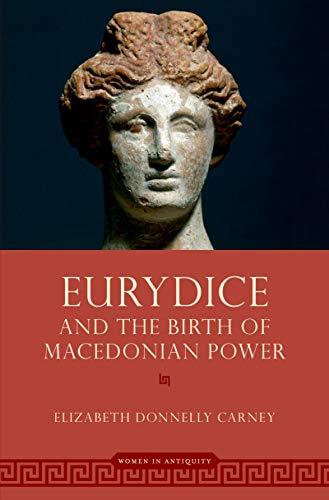
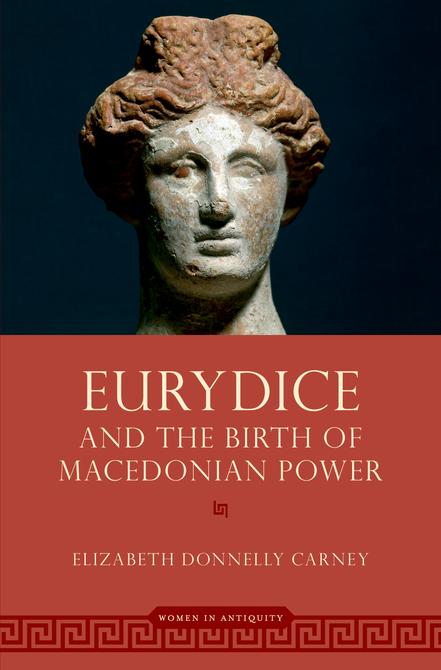
Eurydice and the Birth of the Macedonian Power
Elizabeth Donnelly Carney
EURYDICE AND THE BIRTH OF MACEDONIAN
POWER
Elizabeth Donnelly Carney
Oxford University Press is a department of the University of Oxford. It furthers the University’s objective of excellence in research, scholarship, and education by publishing worldwide. Oxford is a registered trade mark of Oxford University Press in the UK and certain other countries.
Published in the United States of America by Oxford University Press 198 Madison Avenue, New York, NY 10016, United States of America.
All rights reserved. No part of this publication may be reproduced, stored in a retrieval system, or transmitted, in any form or by any means, without the prior permission in writing of Oxford University Press, or as expressly permitted by law, by license, or under terms agreed with the appropriate reproduction rights organization. Inquiries concerning reproduction outside the scope of the above should be sent to the Rights Department, Oxford University Press, at the address above.
You must not circulate this work in any other form and you must impose this same condition on any acquirer.
CIP data is on file at the Library of Congress ISBN 978–0–19–028053–6
Printed by Sheridan Books, Inc., United States of America
For my brother, James T. Carney
Contents
Acknowledgments ix
Abbreviations xi
Chronology xiii
King List xv
The Agread Dynasty in the era of Eurydice xvii Map xix
1 Introduction 1
2 The Marriage of Eurydice and Her Husband’s Rule 14
3 The Rule of the Eurydice’s Sons: Alexander II, Perdiccas III, and Philip II 32
4 Eurydice and Her Sons 53
5 Eurydice’s Public Image during Her Lifetime 76
6 Eurydice’s Public Image after Her Death 96
Notes 119
Bibliography 155 Index 171
Acknowledgments
This book is a project I’ve been contemplating and yet avoiding (although I have carved off bits of it to discuss at one occasion or another) for a very long time because its subject, Eurydice of Macedon (who was born in the late fifth century and died in the 340s bce; all dates hereafter are BCE unless otherwise stated) is elusive and yet compelling. I owe Ronnie Ancona and Sarah Pomeroy, the editors of the Women in Antiquity series, and Stefan Vranka, Oxford University Press’s editor for Ancient History, Archaeology and Classical Studies, my thanks for their continued support and assistance, not to mention patience, in bringing this to completion.
The discoveries of Manolis Andronikos (the royal tombs under the Great Tumulus at Vergina in 1977 and 1978, the sanctuary of Eucleia in 1982, and the “Tomb of Eurydice” in 1987) changed the nature of doing ancient Macedonian history generally and made this particular project possible, not simply because they introduced new evidence about Eurydice but also because the discoveries provided greater context for longfamiliar literary evidence relevant to Eurydice. Critical to this project was the work of Chrysoula SaatsoglouPaliadeli on the Eucleia sanctuary, the site of at least two dedications of Eurydice. Recently, I have been fascinated by Athanasia Kyriakos’ and Alexandros Tourtas’ discussion of what amounts to the ancient memory history of the Eucleia site. I am grateful to Drs. SaatsoglouPaliadeli and Kyriakos for allowing me to use some images from the Eucleia site and for their asistance in acquiring them. Andronikos’ and Angeliki Kottaridi’s description of the intriguing tomb they attribute to Eurydice has illuminated this fascinating space. The scholarship and conversation of a number of scholars have helped me to think about Eurydice and her time. Bill Greenwalt
Acknowledgments x x and I have talked about Eurydice and disagreed about her, part of the time, for many years. Kate Mortensen stimulated my thoughts early on. Olga Palagia has helped me in innumerable ways, as have conversations with Sheila Ager and Sabine Müller and Daniel Ogden and Jeanne Reames and Peter Schultz. The analysis of two very different historians of ancient Macedonia, Eugene Borza and Militiades Hatzopoulos, has informed my own, though I have rarely agreed with either. As always, my husband and daughter have listened patiently to my latest scholarly worries and interests, even in the course of a Manhattan emergency room visit. I learned my first Latin when my brother began to study it and later listened to him practice his declamation of Cicero’s First Catlinarian. It might seem a long way from Cicero’s orations to the narrative of Justin (the subject of much discussion and condemnation in this study), but the distance from another of Cicero’s speeches, the Pro Caelio, to some of the more lurid points in Justin’s account of Eurydice is actually short.
I have spent my professional career in a history department and though I often wished that I were a member of a classics department, the fact that my academic anchor was, in fact, in the history department turned out to be stimulating. My colleagues, mostly historians of the last few centuries, were often bemused by my field and by the comparative paucity of evidence that is the normal situation for those who study antiquity. Nonetheless I learned a great deal from the questions they asked and the ways, blessed with more abundant evidence, they interrogated their sources. But, now that I no longer teach regularly, I am also newly aware of how much I learned from having to describe and explain the ancient world to students. Coincidentally, I taught a course on Alexander and ancient Macedonia for the first time in January 1978, a month or so after the first news of the finds at Vergina/Aegae appeared. For me, teaching about ancient Macedonia has always involved integrating the material and political history of the kingdom. The present work attempts to do the same.
Abbreviations
AA
ACD Acta Classica
AE Archaiologika Ephemeris
AEMTH
AHB Ancient History Bulletin
AJP American Journal of Philology
(Athens Annuals of Archaeology)
AM Ancient Macedonia (Archaia Makedonia)
AncSoc Ancient Society
AncW Ancient World
AnnPisa Annali della Scuola Normale Superiore di Pisa
BCH Bulletin de correspondance hellénique
BSA Annual of the British School at Athens
CA Classical Antiquity
CB The Classical Bulletin
CJ Classical Journal
CP Classical Philology
CQ Classical Quarterly
C&M Classica et Mediaevalia
FGrH Die Fragmente der griechischen Historiker
FlorIlib Florentia Iliberritana
GRBS Greek, Roman and Byzantine Studies
JHS Journal of Hellenic Studies
LCM Liverpool Classical Monthly
REG Revue des études grecques
RhM Rheinisches Museum für Philologie
RSA Rivista storica dell’Antichità
SEG Supplementum Epigraphicum Graecum
SIG W. Dittenberger, Sylloge Inscritioneum Graecarum, 3rd edition, Leipzig, 1915–24
ZPE Zeitschrift für Papyrologie und Epigraphik
Chronology
410–404 Eurydice born
394/3 Amyntas III takes the throne
393/2–390 Eurydice marries Amyntas III
388? Alexander II born
384–343? Perdiccas III born
383 or 382 Philip II born
370/69 Amyntas III dies and Alexander II (370/69–368/7) takes throne*
368/7 Despite attempt of Pelopidas to bring peace, Ptolemy kills Alexander II Perdiccas III may be king, or Ptolemy, or it may be disputed between them
July–autumn: Pausanias threatens to take the throne; Eurydice appeals to Iphicrates November?: Pelopidas returns, forces Ptolemy to be regent; Alexander II clearly king
365 Perdiccas III kills Ptolemy
360/59 Perdiccas III dies in battle against the Illyrians and Philip II takes over 350s Eucleia complex and Eurydice dedications
343 Aeschines, recounting a 346 speech to Philip, refers to the Iphicrates incident and says that he told Philip he could ask others present about it, but does not tell him to ask his mother
338 August: Philip’s victory at Chaeronea; decision to build Philippeum, including Eurydice statue
336 Philip II is killed and Alexander III takes the throne
*If Eurydice married Ptolemy, it may have happened after Amyntas III’s death or more likely after Alexander II’s death or after Pelopidas forced Ptolemy to be regent.
King List
Alexander I c. 498–54
Perdiccas II c. 454–414/13
Archelaus 414/13–399
Orestes? 399
Aeropus 399–396/5
Pausanias 396/5
Amyntas II 395/4
Pausanias 394/3
Amyntas III 394/3–370/69
Alexander II 370/69–368/67
Perdiccas III 368/7–360/59
Philip II 360/59–336
Alexander III (the Great) 336–323
Philip III (Arrhidaeus) 323–317
Alexander IV 323–c. 309
Arrhidaeus
The Agread Dynasty in the era of Eurydice
Gygaea 1 = Bubares Menelaus
Amyntas III (394/93–370/69) by Eurydice 1 by? by X by X Amyntas
Amyntas II (395–394)
Alexander I (498/7–ca. 454)
Amyntas (?–498/7) by X by X by ?
Philip Alcetas Stratonice 1 = Perdiccas II (ca. 454–413) by Xb y X Seuthes
Aeropus (398–395/4) by Cleopatra 1 by Simache
Archelaus (413–399)
by ? by Cleopatra 1 a son
by ? by X
Amyntas by Gygaea 2
Pausanias (394–393) a daughte rO restes (399–398/7)
sons sons
Perdiccas III (368/7–360/59)
Alexander II (370/69 –368/67)
Philip II (360/59–336) = Derdas Archelaus Arrhidaeus Menelaus
Eurynoe = Ptolemy
Amyntas by Cynnane Adea Eurydice
Map
EURYDICE AND THE BIRTH OF MACEDONIAN POWER
1
Introduction
Eurydice, the daughter of Sirras (c. 410–c. 340s bce), the wife of Amyntas III, king of Macedonia, and the mother of Philip II and grandmother of Alexander the Great, played a notable role in the public life of ancient Macedonia. She is the first royal Macedonian woman known to have done so, although she would hardly be the last. Her career marked a turning point in the role of royal women in Macedonian monarchy, one that coincided with the emergence of Macedonia as a great power in the Hellenic world. These two phenomena coincided but were not the result of coincidence: the same circumstance that led to Eurydice’s prominence also led to the growth of Macedonian power: dynastic crisis. This study examines the nature of Eurydice’s public role, the factors that contributed to the expansion of her role (and that of subsequent royal women), and how that expansion related to the growth of Macedonian power.
An element of the arbitrary always prevails in the survival of evidence from antiquity. The arbitrary element, however, is particularly strong in terms of material about the lives of individual women, given the degree of male dominance present in ancient societies, a dominance particularly powerful in relation to written records. Nonetheless, chance has occasionally preserved a considerable body of material about individual women. One thinks, for instance, of Enheduanna (2285–2250 bce), daughter of Sargon King of Akkad. She was the high priestess of the goddess Nanna in Ur. Enheduanna is one of the first poets whose name we know and, remarkably, a considerable body of her work has survived despite her apparent involvement in political controversy. There are also two seals with her name and a disk depicting her.1 Somewhat similarly, many traces of Plancia Magna, a woman who lived in the late first and
early second centuries ce in Perga in western Asia Minor, still exist: at least five portrait statues survive and many inscriptions.2 Both of these women were members of a ruling elite and both performed religious functions of great importance to their communities. Something similar can’t be said of Eurydice. In this sense, so much material about her and these other women did not survive entirely by chance; only women from elite groups with distinctive roles could possibly have produced or had created for them so many material and literary remembrances.
In fact, a surprising amount of evidence relevant to Eurydice’s life and actions has been preserved or discovered, some of it dating from her lifetime or very soon after her death. Aeschines (389–314 bce), an Athenian politician and orator, in a speech delivered to the Athenian assembly in 343, provides a vivid, if highly rhetorical account of her resourceful actions in support of her young sons at a critical moment in Macedonian affairs (Aeschin. 2.26–29). Aeschines delivered the speech a generation after the incident it describes (see Chapter 4). Three dedicatory inscriptions by Eurydice survive (two preserved on statue bases, the third included in an essay attributed to Plutarch). In addition, excavators have found the base of a portrait statue of Eurydice, as well as (at a slightly different location) another statue that some also consider a portrait of Eurydice (see Chapter 5). Philip II constructed an unusual building at Olympia that once housed gleaming images of some members of his immediate family (Philip himself, Alexander, Amyntas III, Olympias, and Eurydice). Pausanias’ description of this construct survives, as do the lower sections of the structure itself, including most of the statue bases. Finally, a splendid and eerie Macedoniantype tomb at Vergina (widely considered the site of the ancient Macedonian capital of Aegae) may have belonged to Eurydice (see Chapter 6).
Narrative sources of a much later date also recount her supposed actions and crimes and those of her close kin (see Chapters 3 and 4). We should approach these narratives with caution and skepticism. Upon what, for instance, do these later, largely Romanera, writers depend? Even if we (optimistically) conclude that their ultimate sources were fourth century and that the extant authors do not create events out of whole cloth but rather select material for their own purposes (often the teaching of moral lessons), we must recall that the original fourthcentury narratives themselves (e.g., Theopompus or Ephorus) had marked political perspectives, often Athenocentric or focused on Theban concerns, not Macedonian.3
Presumably, all of these depended, in turn, either on Macedonian court sources (thus people themselves likely involved in court factions; see Chapter 4) or on foreign visitors to the court, often members of embassies visiting Macedonia. These foreigners might have misunderstood customs and actions reported to them and also failed to recognize partisan opinion when they heard it. A court source, by definition, involves participants in the politics of Macedonia, but, so far as we know, none of the extant written sources depend on eyewitness accounts. For instance, neither Theopompus nor Marsyas (who was an elite Macedonian, but of a later generation), though each was familiar with the court, was personally present for the major events of Eurydice’s life.4 Antipater wrote a history of Perdiccas III’s Illyrian campaigns, but we have none of it.5
Moreover, since the narrative sources were written mainly by nonMacedonian authors either never or rarely present in Macedonia, and since Macedonia was not, during most of the period covered by this work, a great power, we should not assume that these sources knew exactly when certain events happened or exactly how long they took to happen. If a man died and his son succeeded him without any known dispute, then we can probably take our sources at their word about who was king, but if a king died unexpectedly or without an obvious adult heir, or if a rival claimant appeared, it may have taken awhile before widespread agreement developed about who was indeed king, and somewhat longer before such recognition spread abroad.
Macedonian monarchy and history were anything but stable, particularly in the era under consideration: conspiracies, assassinations, multiple claimants to the throne, and assorted foreign threats were commonplace. The court was faction ridden, but we cannot always identify to which group an individual belonged or assume that this was an unchanging allegiance or presume, at any given time, that we really understand the basis for that allegiance. Did, for instance, supporters of the mysterious Ptolemy (see, particularly, Chapter 4) always support him, or did they simply join him in reaction against the policy of Alexander II (Philip II’s older brother)? Having once supported Ptolemy, did they remain faithful and, if they did not, did Perdiccas III (the next of Eurydice’s sons to rule) and his brother Philip accept them back into the group of their philoi (friends)? Some may have belonged to the same “faction” for different reasons: personal loyalty or ambition, family loyalty, or connection to families or governments outside of Macedonia proper.