Library of Congress Cataloging-in-Publication Data
Names: Larson, Erica M., author.
Title: Ethics of belonging : education, religion, and politics in Manado, Indonesia / Erica M. Larson.
Other titles: New Southeast Asia.
Description: Honolulu : University of Hawai‘i Press, [2023] | Series: New Southeast Asia: politics, meaning, and memory | Includes bibliographical references and index.
Identifiers: LCCN 2023023171 | ISBN 9780824894436 (hardback) | ISBN 9780824896256 (epub) | ISBN 9780824896263 (kindle edition) | ISBN 9780824896249 (pdf)
Subjects: LCSH: Religion and civil society—Indonesia—Manado. | Religious pluralism—Indonesia—Manado. | Belonging (Social psychology)—Indonesia—Manado. | Religion in the public schools—Indonesia—Manado. | Manado (Indonesia)—Religion—21st century.
LC record available at https://lccn.loc.gov/2023023171
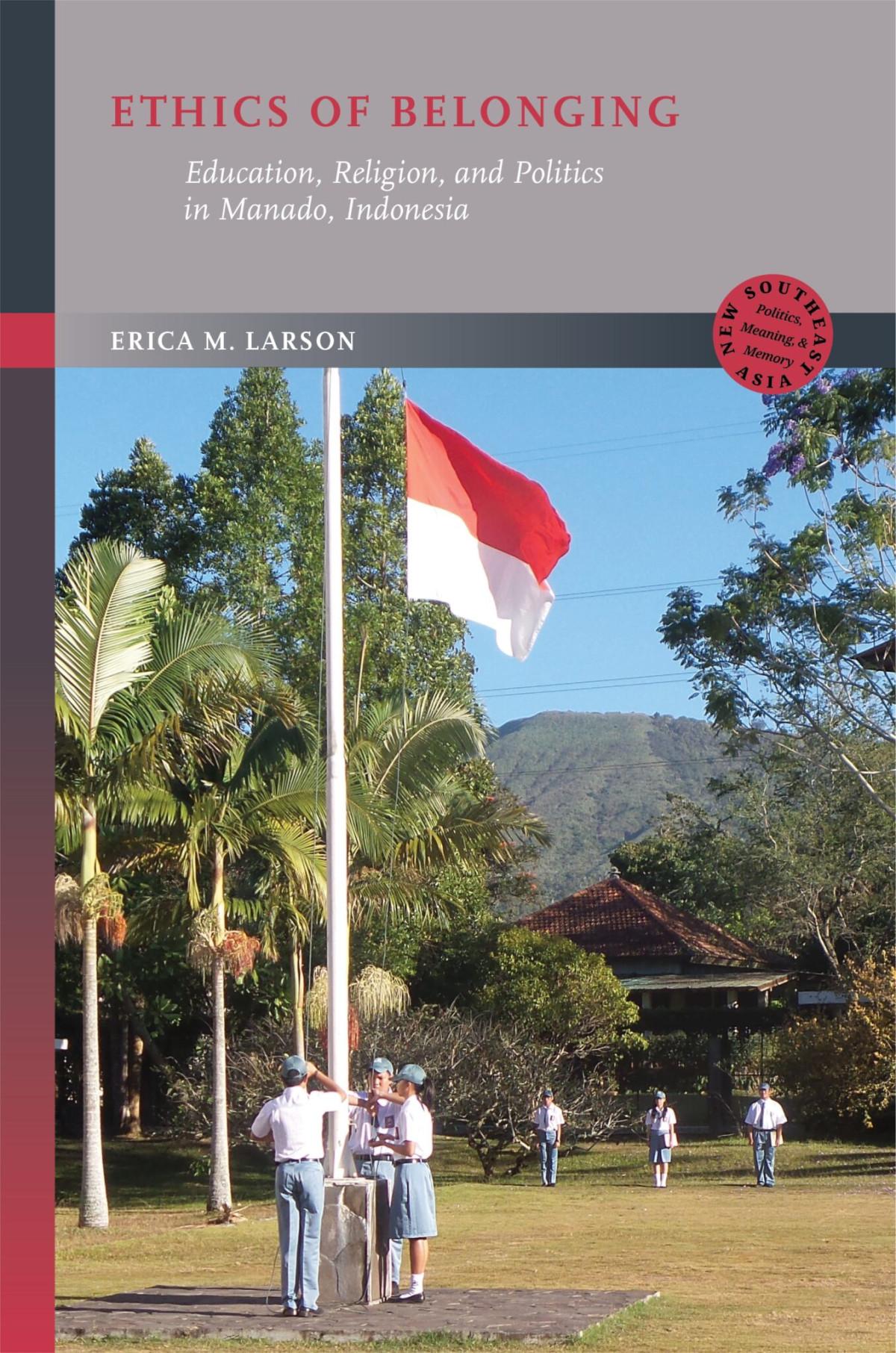
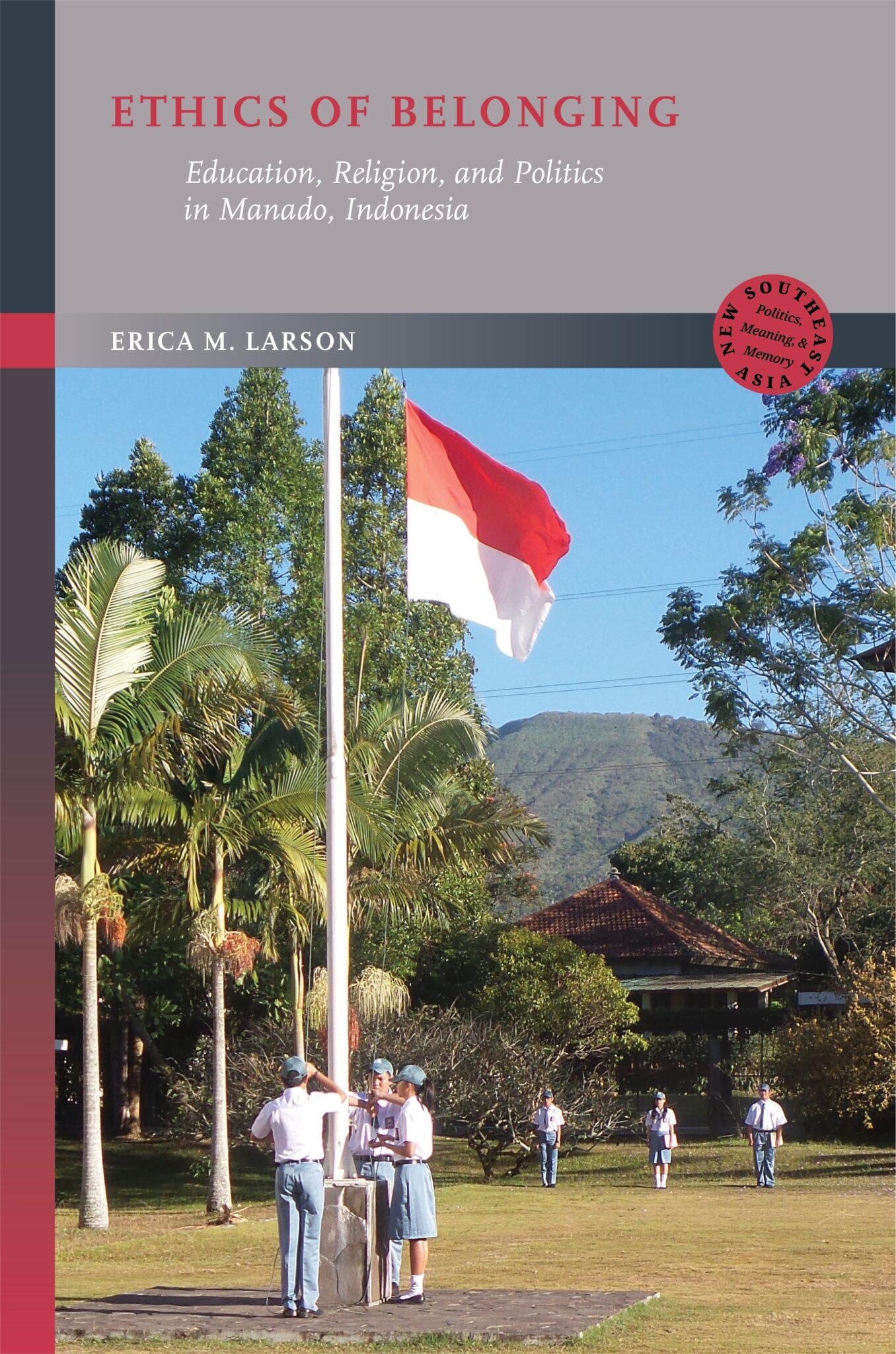
Cover photo: Students at Lokon School raise the Indonesian flag during the Flag Ceremony (Upacara Bendera)
University of Hawai‘i Press books are printed on acid-free paper and meet the guidelines for permanence and durability of the Council on Library Resources.
Acknowledgments vii
Note on Language ix
Figures xi
Abbreviations xiii
1 Introduction: Deliberating the Ethics of Belonging 1
2 Religion, Nation, and Politics of Difference through the Lens of Education 30
3 Public High School: Influence of the Protestant Majority 65
4 Private Catholic High School: Developing Faith and Character to Develop the Nation 95
5 Public Madrasah: Islamic Discipline as the Foundation of Civic Deliberation 125
6 Interreligious Exchange: A Pedagogical Project of Ethics across Borders 155
7 Going Public: Scaling Deliberation about Belonging 179
8 Conclusion: Pluralized Ethics for a Plural Society 200
Notes 213
Works Cited 217
Index 231
This research project and the resulting book would not have been possible without the students, teachers, administrators, and friends in Manado and Tomohon who let me into their schools and into their lives. A special thanks is in order for Ibu Mary and Pak Ronald, and all of the teachers, staff, and students at Lokon St. Nikolaus Catholic School, which became my home for the duration of my fieldwork. I am also very appreciative of the teachers and students at MAN Model Manado and SMANSA Manado. In addition, I am grateful for the university students who were my coparticipants in the Pertukaran Mahasiswa Lintas Agama at the STF-SP and who were willing to openly share their experience with me during the program.
I am also sincerely indebted to the many scholars, activists, budayawan, religious leaders, and friends in North Sulawesi who have supported my research in various ways. My research was made possible through the sponsorship and support of my local research counterpart, Professor Sjamsi Pasandaran, and the Civic Education department at Universitas Negeri Manado. Fellow scholars at other area universities, including IAIN, UKIT, and UNSRAT, have also been important conversation partners. The Mawale Movement and its enthusiastic members have also given me semangat for understanding the cultural dynamism of Minahasa. While I am not able to name all of these colleagues and friends here, I would like to briefly mention Muhammad Iqbal Suma, Denni Pinontoan, Rahman Mantu, Almunauwar Bin Rusli, Nono Sumampouw, Rinto Taroreh, Ruth Wangkai, Fredy Wowor, and Sofyan Jimmy Yosadi.
Terima kasih banyak to my Indonesian-language teachers at SEASSI, especially Ibu Amelia Liwe, who piqued my interest in Manado and introduced me to contacts there. Grace Nelwan and Maria Walukow have been such important guides and friends as well. Also, I am very appreciative of John Soucy and Mary Heather White for providing quiet places for me to write and think, but most of all, for sharing their friendship.
This project began during my time at Boston University, and I am honored and grateful to have had Bob Hefner as my advisor and mentor throughout the process. I also appreciate the mentorship and comments
from Nancy Smith-Hefner, Kimberly Arkin, and Merav Shohet. This project has continued and evolved during my time at the Asia Research Institute, National University of Singapore. Here I have benefitted from the feedback of Kenneth Dean and my colleagues in the Religion and Globalisation Cluster on portions of the manuscript. Funding for my research was secured from multiple sources: a Wenner-Gren Foundation Dissertation Fieldwork Grant, a Boston University Graduate Research Abroad Fellowship, a Global Religion Research Initiative Fellowship, and a USINDO Society Travel Grant.
I am grateful to my series editors at the University of Hawai‘i Press, Justin McDaniel and Nancy J. Smith-Hefner, and to executive editor Masako Ikeda for their guidance throughout the publication process. In addition, comments provided by the reviewers at the peer-review stage proved extremely useful in improving the manuscript. It goes without saying, however, that any and all faults that remain are my own.
I am extremely thankful that my family and friends have continued to provide motivation and moral support. Finally, I could never have completed this book without the unwavering support of my partner and colleague Michel Chambon, who has seen the project evolve over time and has been an ongoing source of inspiration and encouragement.
note on language
Words in Indonesian (Bahasa Indonesia) are designated by italics, except for proper nouns. Words in Manadonese (referred to as Bahasa Manado or Melayu Manado), a local form of Malay, are also italicized with the qualifier “Manado” preceding the italicized words. All translations from these languages are my own, unless otherwise specified.
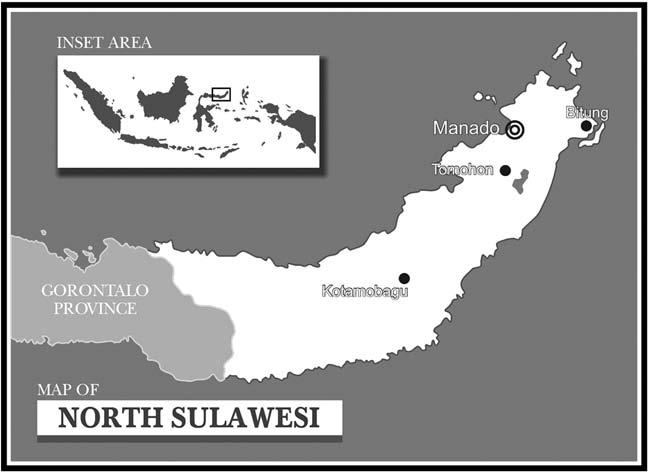
Figure 1.1 Map of North Sulawesi (excluding Sangihe and Talaud islands) 4
Figure 1.2 Jesus Bless Monument (Monumen Yesus Memberkati) in Manado 12
Figure 3.1 Protestant students from SMA sing praise songs under a tent at a weekend retreat 66
OSIS: Organisasi Siswa Intra Sekolah (Student Council Organization)
P4: Pedoman Penghayatan dan Pengalaman Pancasila (Training for the Application and Realization of Pancasila)
PKn: Pendidikan Kewarganegaraan (Citizenship Education)
PMP: Pendidikan Moral Pancasila (Pancasila Moral Education)
PPKn: Pendidikan Pancasila dan Kewarganegaraan (Pancasila and Citizenship Education)
Rohis: Rohani Islam (Muslim Students’ Club)
Rohkris: Rohani Kristen (Christian [Protestant] Students’ Club)
SARA: suku, agama, ras, dan antar-golongan (ethnicity, religion, race, and intergroup relations)
STAKN: Sekolah Tinggi Agama Kristen Negeri (State Christian [Protestant] School [of Higher Education])
Ethics of Belonging
Introduction
Deliberating the Ethics of Belonging
During their afternoon civic education lesson, tenth-grade Muslim students in the public madrasah1 of the Protestant-majority city of Manado, Indonesia, discussed the topic of diversity. The teacher, Ibu Aisyah,2 stood in front of her class, enthusiastically leading them through the material despite it being the last period of the school day. Students sitting at wooden desks fanned themselves with their notebooks in the afternoon heat as she proclaimed: “Diversity [keanekaragaman] is part of Indonesia. Indonesia is extremely plural [majemuk] in terms of religion, tradition, culture—but these are all together in one . . . Imagine if everything were just one color. Can you imagine if everything were just white? That’s boring! If there’s a little red, green, and white, that’s beautiful! Variation interests our eyes; it’s what makes a beautiful and interesting view. Inshallah, the rest of the world will also see this as interesting.” One student, Muhammad, had already voiced his conviction that Indonesia must value diversity, as the country’s standing in the international community hinges on its ability to do so. Others had nodded and echoed this sentiment, repeating the imperative that Indonesians must respect difference.
However, Ibu Aisyah’s follow-up question about how they can respect diversity and promote national unity as Indonesian citizens proved more difficult for the students to answer. Though intended to check their understanding of the material, her question has more significance than a simple textbook exercise with a predetermined answer. Indeed, the same question has become increasingly relevant in the public sphere as debates about religious and national belonging are waged in Indonesia. The problematic of maintaining national cohesion has surged to the fore with diverging visions of nation, each relying on a particular approach toward religious difference and a framework for coexistence. In the midst of these debates, one necessary measure to ensure the future integrity of the multireligious and multiethnic
nation emerges as unanimous: Indonesian youth must be taught the importance of respecting and appreciating difference.
As the relationship between religion and nation and the accompanying frameworks for accommodating religious pluralism remain unsettled, schools have faced increasing pressure to shape both religiously devout and inclusive citizens, stressing a discourse of unity and coherence in a society where religious belonging is imbued with increasing social and political significance. This book aims to elucidate how schools are central sites for deliberation about the ethics and politics of coexistence and belonging in the national project.
Back in the classroom as students struggled to respond to the question, a couple of hesitant suggestions were met with critical laughter from fellow students. “We can use technology to help us?” a student named Wahyu proposed, her transformation of a statement into a question belying her uncertainty. Another’s tentative remark that in order to respect difference, we must “pay attention to difference” (memperhatikan perbedaan) was equally sanctioned with muffled laughter. Finally, Ibu Aisyah praised Rifqi, who argued that in order to respect diversity, Indonesians must simultaneously protect the unity and integrity of the nation. As they quickly made the connection, several students spontaneously recited the national motto, “Unity in Diversity” (Bhinneka Tunggal Ika).
As the question of how to maintain cohesion is being raised with increasing vigor in modern plural societies, I contend that it is important to ask not only what schools teach about diversity, but how educational institutions become sites of deliberation about belonging. The question of how to approach difference and construct belonging on various levels scaling up to and including the national framework is an inherently ethical one, necessarily accompanied by ideologies and practices of inclusion and exclusion. Within the process of ethical socialization, schools are important institutions that aim to socialize citizens into particular national frameworks, encoding perspectives on difference and belonging through the negotiation and interpretation of the government-mandated curriculum. In addition, schools put forth understandings of difference through their own policies and attitudes toward dealing with diversity. However, this is not the end of the educational process—with knowledge and dispositions simply stamped onto student subjectivities—but only just the beginning.
Rather than locating schools as institutions within a faithful process of social reproduction, I emphasize the contingency of the educational process and the “deliberation” that occurs therein (Varenne 2007). Firstly,
education must be considered as a multicentered process in which schools, while clearly important sites of socialization, are only one of many spheres of influence. Secondly, education does not proceed unidirectionally, as discourses about belonging—and the ethical positioning that accompanies them—do not end at the school or with the individuals who encounter them. Viewed through the lens of ethical reflection and drawing on an understanding of “reflective freedom” as central to ethical life (Laidlaw 2014, 177), the process of education is instead understood in this case as deliberation about ethical frameworks for approaching religious coexistence in a plural society.
Considering education as an ongoing process of negotiation rather than one of teleological reproduction opens up the conceptual possibility for understanding its broader connection to public ethical culture beyond simply providing context or framing. This approach, broadening the typical view of educational institutions, highlights their importance in ethical socialization in conjunction with other institutions and interactions at multiple levels. With the understanding that there is no singular foundation for ethics and ethical reasoning, I take schools as a point of departure for locating the ethical frameworks of religious difference that are channeled through them, both connecting schools to their broader political context and considering how the frameworks they circulate become grounded in subjectivities. This connection ultimately allows for a consideration of how ethical streams channeled through institutions and negotiated by the individuals and groups who constitute them can contribute to the formation of a public ethical culture regarding the question of who belongs and how to coexist.
The Protestant-majority province of North Sulawesi and its capital city, Manado, claim to successfully model tolerance and interreligious relations for the rest of Indonesia. The particularities of the province as a Christian stronghold that simultaneously asserts the importance of religious harmony provide an important perspective on the mediation of religious identity in the public sphere and the deliberation about the contours of plural coexistence. Part of North Sulawesi’s unique position in Indonesia stems from its religious makeup when compared to the country as a whole. While 87 percent of Indonesians profess Islam and only 7 percent profess Protestant
Religion and Belonging in Manado, North Sulawesi
Christianity, the majority/minority dynamics are flipped in North Sulawesi. Protestants represent over 61 percent, Muslims account for 33 percent, and Catholics are 4 percent of the province’s population (Badan Pusat Statistik Sulawesi Utara 2021, 254). Hindus make up 1 percent of the provincial population, and Buddhists and Confucians together make up less than 1 percent.
North Sulawesi, with its popular motto “We Are All Brothers”3 (Manado: Torang Samua Basudara), is often praised by local leaders as a model of plural coexistence for Indonesia and projects this identity at the national level. In 2017, Manado was named the most tolerant city in Indonesia, a designation celebrated among its inhabitants (Setara Institute for Democracy and Peace 2017). Discourses and performances identifying North Sulawesi in terms of its proclaimed success in religious harmony (kerukunan beragama) continue to circulate, framing conversations about diversity in the public sphere (Swazey 2013). Today, this important designation of North Sulawesi as a region of religious harmony fosters a local sense of purpose and identity among individuals of various religious and ethnic backgrounds.
Nonetheless, there is a lack of consensus about what guarantees peace in the region and how to secure and maintain coexistence. Furthermore,
Figure 1.1 Map of North Sulawesi (excluding Sangihe and Talaud islands). Credit: Edhylius Sean.
ethnic identity is entangled with religious identity, as belonging to the Minahasan ethnic group (which comprises several subethnic groups) is synonymous with being Christian in the popular imagination. Yet, in reality, ethnic and religious identifications do not always overlap neatly. While many leaders and organizations praise coexistence in the province as a result of collaboration and cultural resources aimed at discouraging exclusivism, some argue that its identity as harmonious is guaranteed solely by its composition as a Christian-majority region, essentializing Christianity as a religion of love and, as a result, implicitly projecting Muslims as ethnic and religious outsiders to the region (Larson 2021).
As Indonesia ushered in a new democratic government and launched a massive decentralization campaign, ethno-religious conflicts broke out in several regions in Indonesia in the late 1990s and early 2000s, particularly in the neighboring provinces of Central Sulawesi, Maluku, and North Maluku (Sidel 2006; Wilson 2008). Significant numbers of Christian and Muslim refugees fled to Manado, and tensions ran high as many feared the region would also become embroiled in conflict (Duncan 2005). That the region was ultimately able to remain peaceful during such a turbulent time—with the help of the proactive attitude of the local government and their cooperation with community and religious leaders (Panggabean 2017)—was an important affirmation of coexistence across ethnic and religious lines. This has led to another popular local catchphrase, “Sulut sulit disulut” (North Sulawesi is difficult to ignite), typically indicating that Manadonese are not easily provoked into conflict, because of normative expectations of religious harmony and a tendency toward skepticism that prevents people from being drawn into divisive rumors without verification.
A network consisting of local religious leaders, intellectuals, activists, and journalists, called JAJAK (Jaringan Kerja Kasih, or Labor of Love Network), formed specifically with the goal of maintaining peaceful coexistence and resisting conflict during that time. They convinced the governor to declare both 2002 and 2003 the Year of Love, as an exhortation to maintain religious coexistence as much as to celebrate it. The monument Bukit Kasih, or the Hill of Love, was built in 2002 to enshrine religious harmony, materialized through miniature houses of worship for each of the officially recognized religions of Indonesia, set side by side against the stunning backdrop of a volcano (Thufail 2012, 365).
JAJAK produced a booklet in 2003 entitled “From North Sulawesi, We Save Indonesia,” which expressed an aspiration not only to maintain peaceful coexistence but to lead the way forward as an example for the rest
of the archipelago. The group praise God for maintaining peace while simultaneously admitting that the work is not done, and that the people of North Sulawesi must continue to “search for a socio-cultural mechanism with a religious foundation that is strongly rooted in the society of North Sulawesi, able to ward off violent conflicts and uphold harmony and peace” (Boroma and Alkartiri 2003).
In contemporary North Sulawesi, there remains a strong sense of pride in the province’s reputation for religious harmony. While there is agreement on the importance of maintaining religious coexistence, just as for the students in the madrasah from the story above, the answer for how to do so remains more elusive. Beyond the strong efforts toward interreligious dialogue and the presence of regional organizations to facilitate dialogue and cooperation, there is little agreement about what enabled the area to avoid violent conflict and how to continue to do that in the future.
As religious belonging has come to the foreground in Indonesia more generally, there has been a strong effort to maintain a Christian-inflected public sphere in North Sulawesi through demonstrations of religiosity and political influence. Fears about the religious future of the province and about the influence of Islam, which is perceived as encroaching, shape public discussions about religious tolerance, as there is a tension between efforts to promote religious harmony and efforts to leverage the majority-Christian population to secure a strong Christian environment and influence.4 Furthermore, many Minahasans assume causal linkages between the primarily Christian population and the history of religious harmony in the region, evoking an understanding of toleration dependent upon the goodwill of the majority, rather than the cultivation of a basis for plural belonging.
In the midst of this broad political and religious dynamic, my focus on educational institutions is intentional in its potential to demonstrate a mediation between multiple levels of analysis and societal spheres. The curriculum is developed on a national level, reflecting national concerns and normative political understandings—yet it is delivered in Manado, put into context by local teachers, and its potential resonance with students depends on their own experiences and perspectives. Furthermore, as described in chapter 2, education has the tendency to become an arena for debate about the religionstate relationship and the role of religion in public life. As various frameworks for coexistence circulate through national and local debates, they also impact the possibilities for and actual processes of ethical socialization in schools.
Observing a lack of consensus in public debates about how to respect and value difference, I began to investigate how these negotiations and
deliberations extend into schools and impact the way that youth may learn about and form understandings of difference. I use this approach to demonstrate the transformative potential of these deliberations in the context of education, as schools not only disseminate and reproduce existing understandings but “scale-up” (R. W. Hefner 2021, 12) normative understandings of diversity and pluralism. This book recenters educational institutions as important and dynamic sites for understanding the relationship between interpersonal ethical deliberation and the emergence of public ethical culture.
Indonesia’s Challenges for Unity in Diversity
The discussion of plural society and the possibilities for plural coexistence throughout this book focuses on the varied and divergent ethical streams in the public sphere and their ramifications for visions of nation in contemporary, democratic Indonesia. Historically, the extraordinary diversity of the Malay-Indonesian world has long attracted the attention of cultural and political observers. British civil servant and scholar J. S. Furnivall wrote of the Netherlands East Indies during the late colonial period as a prime example of a plural society, where “lack of a common will” among diverse social groups forebode instability and potential conflict (Furnivall 2010 [1939], 447). Of course, many of the social divisions noted by Furnivall materialized as a direct consequence of colonial intervention, and were subsequently leveraged to the advantage of colonial rule. Through the creation of a national project, the Indonesian archipelago has largely been able to overcome difference to maintain unity. Yet, even with a strong foundation for civic pluralism, a number of factors have posed challenges for national cohesion and religious coexistence, including more recent concerns over a climate of increasing Islamic conservatism (Van Bruinessen 2013), state repression, and democratic regression (Menchik 2019; Warburton and Aspinall 2019).
Indonesia, the world’s most populous Muslim-majority country, is a multiconfessional state that recognizes six official religions.5 Following more than three decades of authoritarian rule under President Suharto, Indonesia has since 1998 undergone a successful democratic transition and consolidation to become the third-largest democracy in the world (Künkler and Stepan 2013). Muslim intellectuals and organizations made major contributions to a public ethical culture able to support democracy, undergirded by a “civil
pluralist Islam” (R. W. Hefner 2000, 12). In addition, Christian leaders have continually played important roles in supporting a nationalist project defined by a multireligious citizenship based on the national ideology of Pancasila (R. W. Hefner 2017, 99).6 Despite the extraordinary ethnic and religious diversity across the archipelago, Indonesia managed to maintain national unity during the transition, which also entailed a massive project of decentralization to give increasing autonomy to regions outside the island of Java.
However, as mentioned above, outbreaks of sectarian and ethno-religious violence in various regions across Indonesia during the late 1990s and early 2000s have placed issues of national cohesion and management of diversity at the center of public debate, highlighting communal tensions and challenges for plural coexistence. Some analyses of these ethno-religious conflicts in Indonesia have tended to treat them as economic-resource and/or political-power grabs veiled in religious sentiments (Li 2007). Yet, others have importantly articulated that for many who experienced the violence, religion was central in how they understood and participated in or responded to the conflict (Duncan 2013, 3), and that anxieties about religious representation and threats to their religious identities impacted the evolution of violence over this period (Sidel 2006, 16). North Maluku (directly east of North Sulawesi) had previously articulated a collective identity around Christian-Muslim religious harmony, yet descended into communal violence that devastated the region (Wilson 2008). The memory of the conflict continues to organize and divide social, political, and economic life across religious lines today.
The way religion was mobilized and experienced in the communal conflicts in Indonesia indicates its important ramifications for identity, piety, and citizenship beyond the localized regions where they took place. Although the frequency and severity of large-scale conflicts have decreased, intolerance is shifting from the “radical fringe into the mainstream” (Jones 2013, 125), posing challenges for Indonesian democracy and cohesion. This book intervenes in the conversation, working to understand the ethical deliberation about religious coexistence taking place on a daily basis in a province that valorizes it as an ideal, yet simultaneously struggles to negotiate its relationship to its Christian-majority identity. In everyday practices at schools, which are viewed as important institutions in a multicentered process of socialization, how are ethical frames of religious difference circulated, deliberated, and enacted? Before turning more specifically to the theoretical concerns of the book regarding the question of education, I discuss the
observed trend of increasing Islamic conservatism in Indonesia and explain how the case of North Sulawesi can contribute to understanding the national dynamics of Indonesia as well as the topics of education and minority religious groups across Southeast Asia.
Concerns about increasing intolerance are linked to developments within Indonesian Islam since the transition to democracy, notably an increasing conservatism and pluralization of religious authority. Martin van Bruinessen has characterized this as a “conservative turn” in Indonesian Islam, marked most clearly by the 2005 fatwa issued by the MUI, the Indonesian Council of Ulama (a government-sponsored assembly of Islamic scholars), proclaiming secularism, pluralism, and religious liberalism as ideologies at odds with Islamic teachings (Van Bruinessen 2013, 3). While certainly vocal and influential, this more conservative brand of Islam must be contextualized within another major trend: the pluralization of religious authority in Indonesian Islam. In addition to the influence of Salafi movements and Islamist political parties, Indonesia has seen trends of celebrity religious gurus and self-help training programs popular among middle-class Muslims (Rudnyckyj 2010; Hoesterey 2012). The recent proliferation of Muslim schools also attests to the varied organizations and movements seeking to forward their own interpretations in the context of both the fragmentation of religious authority and the increasing influence of Islamic conservatism (R. W. Hefner 2009, 97).
This conservative turn within Indonesian Islam must also be analyzed in the context of broader debates about religious plurality and citizenship, and the perspective of a Christian-majority region is strategic in this regard. Christians are not simply responding to trends in Islam; they are also working to forge a way forward and negotiate their position within the plural Indonesian nation. At its most extreme, for Christians in North Sulawesi, this trend has entailed talks of secession if there is no longer a place guaranteed for Christians in the national project, though these discussions have remained largely out of the mainstream. The national protests that erupted in 2016–2017 against Jakarta’s Christian and ethnic Chinese governor Basuki Tjahaja Purnama (known as Ahok) demonstrated the continued, and even bolstered, strength of hard-line Islamic groups and their ability to mobilize followers. These protests centered on charges of blasphemy against Islam based on Ahok’s comments in an edited viral online video that surfaced during his reelection campaign, a political and religious dynamic that brought concerns about belonging to the fore for many Indonesian Christians.