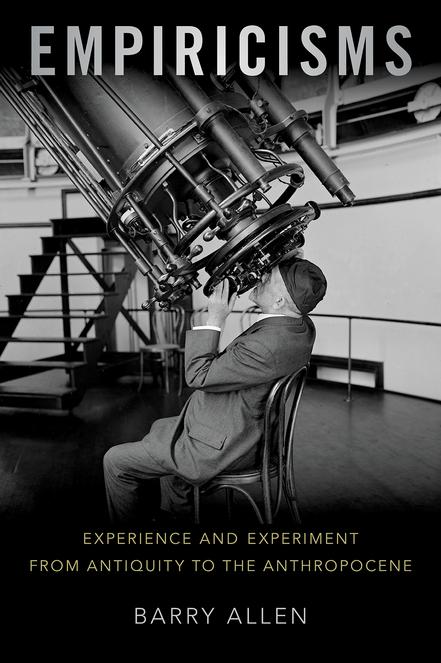
Experience and Experiment from Antiquity to the Anthropocene
BARRY ALLEN
Distinguished University Professor
McMaster University
3
Oxford University Press is a department of the University of Oxford. It furthers the University’s objective of excellence in research, scholarship, and education by publishing worldwide. Oxford is a registered trade mark of Oxford University Press in the UK and certain other countries.
Published in the United States of America by Oxford University Press 198 Madison Avenue, New York, NY 10016, United States of America.
All rights reserved. No part of this publication may be reproduced, stored in a retrieval system, or transmitted, in any form or by any means, without the prior permission in writing of Oxford University Press, or as expressly permitted by law, by license, or under terms agreed with the appropriate reproduction rights organization. Inquiries concerning reproduction outside the scope of the above should be sent to the Rights Department, Oxford University Press, at the address above.
You must not circulate this work in any other form and you must impose this same condition on any acquirer.
Library of Congress Cataloging-in-Publication Data
Names: Allen, Barry, 1957– author.
Title: Empiricisms : experience and experiment from antiquity to the anthropocene / Barry Allen.
Description: New York, NY, United States of America : Oxford University Press, 2021. | Includes bibliographical references and index.
Identifers: LCCN 2020024086 (print) | LCCN 2020024087 (ebook) | ISBN 9780197508930 (hb) | ISBN 9780197508954 (epub)
LC record available at https://lccn.loc.gov/2020024086
LC ebook record available at https://lccn.loc.gov/2020024087
1 3 5 7 9 8 6 4 2
Printed by Integrated Books International, United States of America
To McMaster University Its Libraries and Faculty of Humanities Friends of Humanities Research
I. HISTORY’S EMPIRICISMS
II. RADICAL EMPIRICISMS
4. The Beginning of Radical Empiricism: William
5. An Empiricism Worthy of the Name: Henri Bergson
7.
III. EMPIRICISMS
Preface
Empiricisms reassesses the values of experience and experiment in European philosophy and comparatively, from antiquity down to the global Anthropocene. I discuss the beginnings of empirical philosophy, the trials endured, and the modifcations accreted. I canvass medical empiricism, Epicurean empiricism, the empiricism of Gassendi and Locke, sensualism, the sense-data theory, logical empiricism, radical empiricism, transcendental empiricism, and varieties of anti-empiricism from Parmenides to Wilfrid Sellars.
Empiricism began in ancient medicine, when a self-consciously “empirical” medical philosophy arose in reaction to medical rationalism, itself a product of early interaction between medicine and philosophy. Chapter 1 follows the vicissitudes of the value of experience in antiquity from Democritus and Epicurus, who drew medical empiricism into natural philosophy, to Plato and Aristotle, who sought to throttle the birthing empiricism, with also a look at Babylonian empiricism, and empiricism under Islam.
Te empiricism of antiquity survived the scientifc revolution and became a philosophy of modern science owing to an alliance with the new value of experiments, which did not exist (much) in antiquity. An empiricism genealogically continuous with ancient medicine became entwined with the practice of experiments just when experiments were becoming the leading method of modern natural inquiry. Chapter 2 profles the rise of experimental natural philosophy, from the European recovery of Aristotle to Galileo and Newton. Chapter 3 continues the story of how empiricism subsequently became an epistemology, a psychology, and a theory of meaning. William James introduced the expression “radical empiricism,” and that was my original starting point. I wanted to explain James’s idea and believed it could be easily done. But the further I got into it the more I found, including his consistency with other thinkers, whom I study collectively as the radical empiricists, these being, besides James, Henri Bergson, John Dewey, and Gilles Deleuze, each the subject of a dedicated chapter in Part II. What makes them radical is to return empiricism from epistemology to the ontology and natural philosophy where it began.
In Part III I set European empiricisms in conversation with traditional China. I profle the values of experience and experiment, considering technological, scientifc, medical, artistic, and alchemical sources, as well as selected texts of Confucian, Daoist, and Mohist thought. We will see them eventually segregate the wide-ranging experiments of their technical culture from the evaluation of experience in their philosophy; neither is exposed to the other or allowed to learn from the other. What lets them slip past each other, instead of entwining as they did in Europe, is a diference between Chinese and European ideas on the value of knowledge.
Philosophers sometimes equate experience with present perception, and consider it an obvious example of knowing. I hope I can change minds here. Te experience of empirical philosophy is the experience from which we learn, and that is not merely sensation, perception, or present awareness, but requires memory, living through trials, a history of being changed by experience. To call experience knowledge is like calling a knife a cut. Better to say that experience can be organized and artfully used in inquiries that typically culminate in knowledge.
Empiricism is more multi-textured than philosophers tend to assume when we explain it to ourselves and to students. One purpose of Empiricisms is to recover the neglected context. A complementary purpose is to use historical and comparative arguments to elucidate the value of experience, and arrive at some idea of what is living and dead in philosophical empiricism. Te values of empiricism that remain relevant and tenable are values of experimentalism, even radical experimentalism, that is, experiments in experimentation. And while experimental values are many, and not limited to laboratory routine, “truth” is not one of these values, which instead favor aesthetic qualities like interesting, beautiful, surprising, and fecund. Te more consistently empiricism appreciates its own experience, the more must the values of empirical knowledge gravitate to the aesthetic, life-afrming, and beautiful, for in that way alone might thought direct what fnality it can on the tendency of the future.
Acknowledgments
I am grateful to colleagues and students at McMaster University with whom I have discussed many points from this work, especially Richard Arthur, Howard Jones, and Stefan Sciarafa. I am also grateful to two readers for Oxford University Press for many helpful comments and criticism, which I was glad to have had an opportunity to address.
I was able to present the Chinese material to several audiences in Shanghai, and I thank my hosts and conveners, Liu Liangjian 刘 梁剑, Chen Yajun 陈 亚军, and Roger Ames.
Tere is a lot more than just the glossary that I could not have presented here without the unfailing generosity of Weng Haizhen 翁 海 貞. To safeguard her kindness requires me to assume responsibility for any errors of Chinese usage that may have crept in despite her vigilance.
On a January morning in 1986, cold even in Florida, the launch of space shuttle Challenger ended abruptly seventy-three seconds afer lifof when a freball erupted and the shuttle disappeared in a plume of smoke nine miles above the Atlantic Ocean, killing all seven of the crew. A presidential commission was formed to investigate the accident. Most of the commissioners were associated with the space program and dutifully followed their chair, a former secretary of state. Te exception was physicist Richard Feynman, who went of on his own to talk to the engineers.
At NASA they told him that Challenger’s O-rings showed scorching. Apparently they had been concerned about these O-rings for some time. Orings are gaskets more than ten meters in circumference, sealing the seams between booster sections against escaping gas. Scorching suggests they failed.
Tis was not the frst or even an early shuttle launch. Tere had been many; it was almost routine. So why should O-rings fail on January 28? Feynman also learned that the contractor had been testing O-rings under conditions of cold, indicating concern. Te 1986 launch was the frst to occur when the temperature was below freezing. None of this information—scorching, contractor’s concern, diferent weather—was in the evidence before the commission.
Te New York Times heard what Feynman was hearing and published a story suggesting problems with cold O-rings. Te commission called a public meeting to review the evidence in the presence of reporters and television cameras. At dinner the night before, Feynman got the idea of taking a sample of the O-ring, clamping it tightly, and dunking it in ice water. Would it spring back to form? Te next day, before the meeting, he went to a hardware store to purchase tools and a C-clamp. Ten Feynman together with the head of NASA privately tried the experiment in his ofce. Te cold material remained deformed.
Feynman took his place when the meeting came to order, dripping pliers and C-clamp in his pocket. A NASA manager began explaining O-rings, passing a sample to the commissioners. It was when the sample got to him that Feynman produced his tools and performed his cool experiment. As he was preparing the material, he spoke to the NASA manager who had been testifying:
I took this stuf that I got out of your seal, and I put it in ice water, and I discovered that when you put some pressure on it for a while and then undo it, it maintains—it doesn’t stretch back. It stays the same dimension. In other words, for a few seconds at least—and more seconds than that—there’s no resilience in this particular material when it is at a temperature of thirtytwo degrees. I believe that has some signifcance for our problem.1
Tat evening, all the major television networks showed Feynman’s experiment. Te next day it was the front-page story in the New York Times and the Washington Post. Feynman became a national hero and public fgure.
Some years before, he had been asked to explain what science is. He answered, “Te separation of the true from the false by experiment or experience, that principle and the resultant body of knowledge which is consistent with that principle, that is science.” To students in his introductory physics course he explained that “the fundamental hypothesis of science, the fundamental philosophy,” is that “the sole test of validity of any idea is experiment.” He reiterates this elegant creed at the conclusion of lectures on the concept of physical law:
If it disagrees with experiment it is wrong. In that simple statement is the key to science. It does not make any diference how beautiful your guess is. It does not make any diference how smart you are, who made the guess, or what his name is—if it disagrees with experiment it is wrong. Tat is all there is to it.2
Yes, of course, one might say. Te trouble comes when we have to determine whether a conjecture disagrees with an experimental result. Is it really that obvious? We have to decide that the experiment was well done. Responsibility for the decision cannot be foisted on “inductive logic.” No observation can be stated without recourse to a language, and there is never one uniquely right choice. So what experiments show is always to some degree a
decision, the discretion logic leaves to experience. It is impossible to separate what the experiment shows from the interpretation of those who carried it out and claim the right to say what it means.3
Is what Feynman did even an experiment? He never squeezed warm Orings—is it an experiment at all without controls? Certainly everybody calls it an experiment. Every one of his obituaries describes the occasion, calls what Feynman did an experiment, and says it demonstrated something about why Challenger exploded. Feynman himself called it a “little experiment,” though he acknowledged that it was not strictly up to snuf. Examining a witness at the inquiry later the same day, he said, “I did a little experiment here, and this is not the way to do such experiments, indicating that the stuf looked as if it was less resilient at low temperatures.”4
Suppose it was an experiment—what did it show? Feynman said it indicated that the material lost resiliency at low temperature. No one remembers this modest conclusion. Instead, the experiment is depicted as the pivotal moment of the inquiry. Te New York Times obituary says that it “perfectly demonstrated” the vulnerability of the seal. An obituary in Scientifc American says it identifed “one of the proximate causes of the disaster.” Feynman did not himself mention the experiment or what conclusion he drew from it in the appendix he wrote to the fnal report expressing his dissenting opinion. Perhaps the most acute epitome came from Hans Bethe, another Nobel laureate, and Feynman’s erstwhile colleague at Los Alamos. He said Feynman “demonstrated the central problem simply by dropping a rubber O-ring into a glass of ice water.” He demonstrated a problem. Not a fact, not a truth, not a cause, not an answer at all, but a new problem, namely, what to make of the seal’s impaired resilience at low temperature.5
Feynman indicated irregularities with his “little experiment.” Tey become more or less glaring depending on what we understand the experiment to have accomplished. For instance, suppose we say the experiment demonstrated that cold seals were a proximate cause of the fatal explosion. To enroll the experiment in such a claim requires some assumptions worth making explicit. It was not raining on the morning of the launch; the seals were cold but not soaking wet, as Feynman’s sample was. Te metal in his clamp was probably not the same alloy as the boosters, and the pressure in the handtightened clamp was uncontrolled. It seems likely that the seals were subject to much greater pressure due to the massive booster rockets they joined. How do we know these things make no diference? And what about time? Te Challenger seals were exposed to the cold for hours, Feynman’s sample for a
few seconds. It may seem obvious that more time would only amplify the efect Feynman demonstrated, but how do we know? Obvious assumptions can turn out to be wrong.
Feynman tested a tiny portion of the sealant material. How do we know that a bigger piece responds the same way? Robert Boyle, prince of seventeenth-century experimentalists, observed, “Divers experiments succeed, when tried in small quantities of matter, which hold not in the great.” In his Experimental History of Cold (1665), Boyle recounts his investigation of reports that iron hoops surrounding water barrels break in very cold weather. Boyle wondered at the cause. Did cold change the iron, or was there some other agent? Te expansion of water on freezing was not then a fact and had even been refuted. One of the frst things Boyle had to do was confrm that a volume of water expands on freezing. Ten he could go on to show that it was this expansion and not some direct action of cold on metal that broke the hoops.6
Feynman believes in experiments, but he wants them carefully checked. He was notorious for checking students’ calculations, and found mistakes ofen enough to appreciate that little things need to be scrutinized. As he says, the experiment has to be rubbed back and forth.
When I say if it disagrees with experiment it is wrong, I mean afer the experiment has been checked, the calculations have been checked, and the thing has been rubbed back and forth a few times to make sure the consequences are logical consequences from the guess [the conjecture being tested], and that in fact it disagrees with a very carefully checked experiment.7
Feynman professed chagrin at having tried his experiment privately. “Although I knew it would be more dramatic and honest to do the experiment for the frst time in the public meeting, I did something that I’m a little bit ashamed of. I cheated. I couldn’t resist. I tried it. . . . I discovered that it worked before I did it in the open meeting.” How would it be more dramatic unrehearsed? Te audience is seeing it for the frst time in any case. It would be reckless to leave the experiment untried until he was live on television to the world. If nothing interesting happened, he would look like a bufoon.8
A diferent question is why, having done his experiment privately and knowing the result, Feynman gave his performance at all. He could have submitted a report to his chair, or recommended that engineers do a full test, but he chose instead to give his performance. I like to think he wanted others to
have the experience he did when he performed the test privately. Te value of the experiment is to alter the trajectory of inquiry, but to exercise that power it has to be experienced by those who stand to learn from it.
Experiments can be viewed in two ways: as probative proofs, or as instruments of discovery and invention. Philosophers have a tendency to emphasize the probative, holding that experiments prove, demonstrate, justify, confrm, support, evince, or verify. An alternative tradition in empirical philosophy values experiments as instruments. Used well, they can advance almost any problem of knowledge, and they do so not by the truth they prove, but by the new problems they create.
Freeman Dyson, Feynman’s colleague and friend, interprets Feynman’s experiment in the frst, probative way. Feynman gave the public the truth; he made truth present before them with his own hands. “Te public saw with their own eyes how science is done, how a great scientist thinks with his hands, how nature gives a clear answer when a scientist asks her a clear question.” Is that what Feynman did, ask a clear question? I’d like to know what it was! Dyson does not say, or even say what the answer was. Be that as it may, if we follow Dyson’s theorematic interpretation of the experiment, as proving a theorem, then the quibbles I mentioned become more serious, and the experiment looks rushed and shabby.9
Te mandate of the Challenger commission was to “establish the probable cause or causes of the accident.” In that form, the question is infnite. Cause or causes? Why does anything happen? But if we introduce a new question— did lost resilience in cold O-rings contribute to the disaster?—that is something people can look into. Feynman took a nebulous question with no answer in sight and enforced a detour. If you want to pursue that big question now, you have to pass through the little questions he successfully posed along the way. What do we know about the efect of cold on O-rings? How cold? How long? What other components may have been afected by the temperature, or by failing O-rings?10
His experiment did not answer a question, it invented one. Managers and engineers thought they understood the O-ring. “Now they were forced to agree that they had not. It was not just temperature efects that they did not understand. Te failure analysis showed that other factors, previously not taken into account, had contributed to the technical failure: the potential for ice in the joint, putty behavior, the efect of violent wind shear.” All of these were new questions, new problems, newly exigent thanks to Feynman’s little experiment.11
My suggestion that the value of experiments is their power to alter the trajectory of inquiry, especially with new problems, seems confrmed from another direction in the announcement of a Higgs boson fnding at CERN in July 2012. Te principal experimental apparatus, the Large Hadron Collider, was at the time the most ambitious piece of equipment in the history of experimental physics: a twenty-seven-kilometer ring of superconducting magnets chilled to within one degree of absolute zero. Design and construction required twenty years and cost US$10 billion.
Ofcial reactions to the confrmed discovery of a Higgs boson were couched in the probative idiom—the experiment proves, establishes, confrms, discovers. Among scientists, however, a diferent attitude sometimes prevailed. Some had hoped the experiment would cast light on dark matter, or produce evidence of postulated supersymmetry particles, or even that it would fail and drive physics “beyond the Standard Model.” Writing two years before the announcement, Steven Weinberg said, “Finding one neutral Higgs particle would not pull us out of the doldrums, it would put us into the doldrums. It would be just what we’re expecting and it would give us no clue to anything new. Finding several kinds of Higgs, or even no Higgs at all, would be better.”12
When confrmation was announced, on July 4, 2012, the event, for all the hoopla and good feeling, was ironically disappointing for many, especially those who understood the experiment best. Despite the impressive confrmation of the predictions of the Standard Model, “Nothing unexpected has leapt out from the data. Tere are no hints of supersymmetric particles; no dark matter candidates; no clues to guide the development of particle physics beyond the Standard Model.” No new problems, just old answers verifed.13
I mentioned two ways of looking at experiments. Teir diference corresponds to a duality in European empiricisms which I describe in terms from Euclid, who distinguished theorematic and problematic sciences. Teorematic sciences are bodies of theorems demonstrating something that exists independently of our knowledge. A theorem is grasped in an attitude of disinterested theorein, in Latin, contemplatio; for example, contemplating how the sum of a triangle’s internal angles must be the same as two right angles. Such theorems invent or construct nothing. Tey disclose timeless relations among eternal forms; all that is new is our knowledge of them. Problems and problematic science are diferent. Problems require the construction of something that did not previously exist. Given a straight
line, describe a square; inscribe an equilateral triangle in a circle; double the volume of a cube—the famous problem of the Delos altar.14
History’s empiricisms tend to one or the other, theorematic or problematic, in how they understand the relation between experience and knowledge. Is experience expected to make a theorem evident or confrm a hypothesis? Tose are theorematic empiricisms, and the value of experience is the evidence it extends to theory and theory’s truth—“Experience is ultimate evidence” is the slogan. Problematic empiricism discovers methodical experience as a power of invention and the solution of problems. It values experience for the questions it discovers, the techniques it invents, and the surprises it engenders.
Ancient empiricism was already split on these lines. Te empiricism of Hippocrates, Democritus, and Epicurus was problematically oriented; empirical knowledge was expected to produce something, for instance, health or tranquility. Aristotle’s sort of empiricism favored contemplative values, subordinating experience to a demonstration of theorematic truth. Problematic empiricism predominated in the seventeenth century; for instance, in the work of Galileo, Boyle, and Newton. A theorematic trend rises with positivism in the nineteenth century, while the radical empiricisms of the twentieth century reclaim experience for problematic thought.
Philosophers would do well to give up equating experience with present sense awareness, as in the expression “my current experience,” or “my present sensory experience.” Aristotle explains experience better when he says that it is not mere perception but perception remembered, a mnemic synthesis. Experience is “much memory,” in the pithy epitome of Tomas Hobbes. Te conscious present is perception, which becomes experience when it is recollected and allowed to enhance the efcacy of action. Experience is not just a moment of conscious perception; it is having learned from perception. Experience is not something had, it is something recalled, a deferred, belated perception, a quality of the remembered past that was never the quality of a conscious present. Te passage of time adds something to the present and its presence. It is called experience.
Empiricisms begins with a historical argument. I trace the tangled lines of what has been assumed, afrmed, and disputed concerning the values of experience and experiment from antiquity to the twentieth century. In antiquity, empiricism was a practice of inquiry and natural philosophy, from Alcmaeon in the sixth century bce to Galen in the second century ce, and including Hippocrates, Democritus, and Epicurus. Teir approach to natural
philosophy was the principal ancient alternative to the rationalism of Plato, Aristotle, and their schools. Tis empirical philosophy disappeared in late antiquity when inquiry disappeared as a practice, replaced by school commentaries on the “classics” that Plato and Aristotle had already become. A modernizing trend reprises empirical philosophy in an experimental key, from the recovery of Greek medicine and mathematics in the sixteenth century, to the consolidation of experiments as the principal method of natural philosophy by the eighteenth century.
“Experience” and “experiment” (or their Latin cognates) were interchangeable terms until the eighteenth century. Modern empiricism is concerned with experiments rather than sensory impressions. Galen in antiquity took a step toward experimental natural philosophy. Robert Grosseteste, Roger Bacon, William Ockham, Galileo Galilei, Francis Bacon, and Robert Boyle advanced the idea in modern empiricism, usually cognizant of medical tradition. A new trend emerges in the late nineteenth century, an efort to make empiricism more consistently empirical, eliminating assumptions inherited, by a tortuous route I will recount, from the nominalism inaugurated by Peter Abelard and William Ockham. We shall see that much of what makes this empiricism “radical” is antipathy to the legacy of nominalism, and a return to the problematic ontology of empiricism’s oldest sources.
PART I HISTORY’S EMPIRICISMS
1 Empiricisms of Antiquity
Epistemic virtues are many, including truth, objectivity, justifcation, and precision, each with its historical evolution and scientifc practice. Te “experience” family of epistemic virtues, beginning with experience itself, includes experiment, empiricism, induction, empirical evidence, probability, and fallibilism. Empiricism was born in reaction to rationalism, and its virtues tend to be antithetical, such as the virtue of not being rationalistic, not being deductive or speculative, not derived from tradition, books, or reasoning uncontrolled by experience.
“Concepts,” wrote Søren Kierkegaard, “just like individuals, have their history and are no more able than they to resist the dominion of time, but in and through it all they nevertheless harbor a kind of homesickness for the place of their birth.” Te birthplace of empiricism is ancient Greek medicine, and history’s empiricisms are not uncommonly homesick for the wisdom European civilization acquired from ancient medicine.1
Working on their own and not attracting the attention of elite philosophers, ancient physicians discovered how experience duly controlled can be evidence of unseen causes. Tey searched for methods that would make this experience an instrument of medical knowledge. Advances came slowly. Te philosophers mostly did not want to be empirical, and down to the eighteenth century the word “empiric” meant a quack. Experience (emperia), like perception (aisthesis), was comprehensively disqualifed by Greek rationalism, chiefy Plato and Aristotle. For these philosophers, experience is unfree, corporeal, passive, and passionate, in contrast to the contemplative tranquility of rational mind (nous). Experience commingles contemptibly with the contemptible body, serving its servile needs. Limited to superfcial appearances, it is incapable of scientifc cognition (episteme).
Physicians cannot take that view of their knowledge. Galen, prince of ancient doctors, also represents the acme of ancient thought on methods of inquiry, and no one except Aristotle is as infuential for later natural philosophy. Medical themes and the contribution of medical thought on the use of experience arise again and again in history’s empiricisms. I invite you to
watch for them, and I will introduce them whenever I can. Francis Bacon, Pierre Gassendi, Robert Boyle, and John Locke all draw from medical thought. Tere is probably nothing more decisive for Locke’s evaluation of knowledge than his experience as a physician. William James, philosopher of radical empiricism, is another physician. I make this point to justify the somewhat intricate refection on ancient medicine that follows. It is a needed step to make later connections cogent.
§2. Te Hippocratics
Te art of medicine in Greece was originally a traditional skill, especially in surgery and drugs, unwritten and unburdened by theory. However, from the ffh century bce a new medicine appears in the work of the so-called Hippocratics. Hippocrates is a historical fgure, a physician with a school on the island of Cos. He was not, however, the author of the treatises under his name. Tere are about seventy of these, which probably represent the remains of a library, possibly that of his school at Cos. Many of the treatises are compendia of medical treatments (surgical, pharmaceutical, or dietetic). Medical scholars regard the works on surgery as the best, and in fact the daily practice of a Greek physician (iatros) was mostly surgical. Terapeutics were a weak point. For internal disease usually nothing could be done but wait and watch, for which there is at least a dignifed name—“expectant medicine.”2
Some of the treatises explain the ethics and methods of physicians and their knowledge; others explain the causes of disease. On the Nature of the Child records developmental observations on chicken eggs. Airs, Waters, Places describes an experiment to prove that meltwater loses its lightest part, rendering it insalubrious. Measure an amount of water, let it freeze, then thaw and remeasure. Te author says it will be found to be less. Te Hippocratic approach to medicine emphasizes prognosis, detecting symptoms and foreseeing their development. Case histories detail the typical course of many diseases, and profer instructions on examination procedures and the interpretation of symptoms. Tese authors make no allowance for magic or supernatural causes. Nature acts uniformly, excluding intervention by the gods as a cause of either health or illness. Tey extol skillful prognosis both as a way to avoid blame for failure, since a physician is not responsible if he foretold the unfavorable outcome, and to bolster the reputation of the art. Te
physician who knows and can relate both the past and future of disease will “justly be an object of wonder.”3
Hippocratic physicians, meaning doctors who studied at least some of these works, trained in a school of medicine, and whose practice the treatises describe, were a movement that swept through Greece from the latter ffh century. Tey strove for professional regularity in medicine, establishing standards, and driving out charlatans. Tey cultivate a professional selfpresentation. A physician has to be accomplished, with a reputation for restoring and repairing the sick and wounded. He has to be competent, and the competence cannot be rhetorical. “It is disgraceful in any art and especially in medicine to make a parade of much trouble, display, and talk, and then do no good.” Te physician must be clear in expression and not use jargon. It is “of the greatest importance that anyone speaking about this art should be intelligible to laymen.” Here is the beginning of the demand for verbal clarity usually associated with Francis Bacon and English empiricism two thousand years in the future.4
Hippocratic doctors had a keen sense of their art’s difculty. Tey had to have faith in the healing power of nature because in many cases they had little else to ofer. Teir duty was to assist the body to heal itself. Tey knew theirs to be what Aristotle will call a stochastic art. Good carpenters build good tables, and the work is certain, but a good doctor can still lose a patient. If you crave certainty do not become a doctor. Te famous Hippocratic aphorism reads, “Life is short, art long, opportunity elusive, experience (peira) treacherous, judgment difcult.” Te sentiment is restated in their texts, where it merges with ideas from pre-Socratic philosophy: for instance in Ancient Medicine, which argues that medical knowledge is not easily won. Necessity compelled medicine into existence (probably a thesis from Democritus); gradually much has been learned, and with continued efort the knowledge can be expected to advance (Xenophanes and again Democritus).5
Te dedication to progress in medical knowledge was contrary to the rationalism prevailing in philosophy, and again foreshadows modern empiricism. Te distinguishing mark of technical medicine and what justifes its description as a techne is methodological accountability, which one does not fnd in the cult of Asclepius. Hippocratic authors and practitioners argue among themselves about why a therapy should or should not be adopted, and expect a doctor’s dedication to inquiry and the advance of the art. No less than healing, this medicine is an art of searching and discovery. Te same Ancient Medicine extolls research to enhance knowledge of human nature