1
Oxford University Press is a department of the University of Oxford. It furthers the University’s objective of excellence in research, scholarship, and education by publishing worldwide. Oxford is a registered trade mark of Oxford University Press in the UK and certain other countries.
Published in the United States of America by Oxford University Press 198 Madison Avenue, New York, NY 10016, United States of America.
© Oxford University Press 2019
All rights reserved. No part of this publication may be reproduced, stored in a retrieval system, or transmitted, in any form or by any means, without the prior permission in writing of Oxford University Press, or as expressly permitted by law, by license, or under terms agreed with the appropriate reproduction rights organization. Inquiries concerning reproduction outside the scope of the above should be sent to the Rights Department, Oxford University Press, at the address above.
You must not circulate this work in any other form and you must impose this same condition on any acquirer.
Library of Congress Cataloging-in-Publication Data
Names: Rotter, Andrew Jon, author.
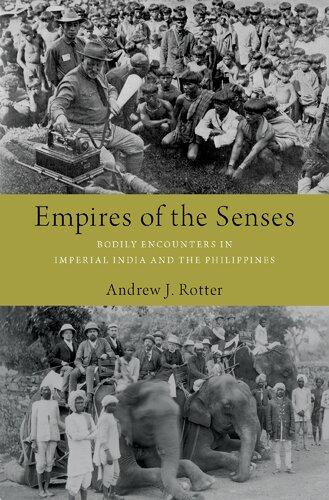
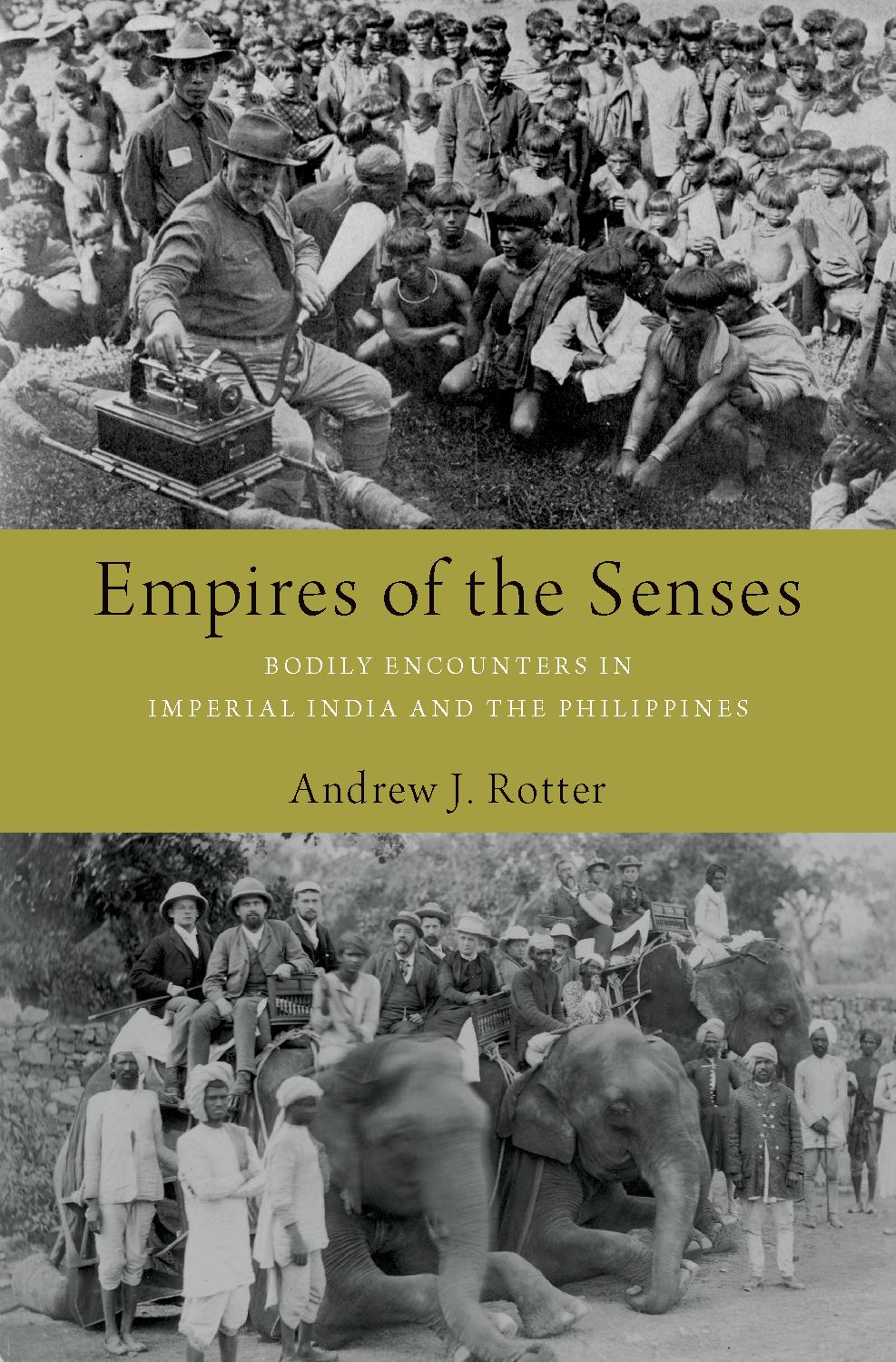
Title: Empires of the senses : bodily encounters in imperial India and the Philippines / Andrew J. Rotter.
Description: New York, NY : Oxford University Press, [2019] | Includes bibliographical references and index.
Identifiers: LCCN 2019002163 (print) | LCCN 2019005111 (ebook) | ISBN 9780190924713 (updf) | ISBN 9780190924720 (epub) | ISBN 9780190924706 (hardcover :alk. paper)
Subjects: LCSH: India—Civilization—1765–1947. | Philippines—Civilization—20th century. | Senses and sensation—India—History. | Senses and sensation—Philippines—History. Classification: LCC DS428 (ebook) | LCC DS428. R68 2019 (print) | DDC 954.03/5—dc23
LC record available at https://lccn.loc.gov/2019002163
1 3 5 7 9 8 6 4 2
Printed by Sheridan Books, Inc., United States of America
to Sam David Rotter Stevenson
CONTENTS
Acknowledgments ix
Introduction: Embodied Empires 1
1. The Senses and Civilization 14
2. Fighting: War and Empire’s Onset 47
3. Governing: Subjects and States Envisioned 86
4. Educating: New Soundscapes 131
5. Sanitizing: The Campaigns Against Odor 160
6. Touching, Feeling, and Healing: Hapticity and the Hazards of Contact 187
7. Nourishing: Imperial Foodways 233
Conclusion: The Senses at Empire’s End 264
Notes 289 Bibliography 335 Index 357
ACKNOWLEDGMENTS
I’ve been at this for a while, and in the course of reading and writing about two empires and five senses and more about sewers and leprosy than is healthy for most people, I have accumulated a great number of debts. I acknowledge too few of them here.
I was in the audience at Colgate University some years ago when Mark Smith gave a guest lecture about race and the senses in the American South. His talk was so arresting and provocative that it got me thinking about material I had run across even more years ago on how India smelled to the British when they arrived there in the nineteenth and twentieth centuries. Mark became a correspondent, and he has inspired and encouraged my work. Lizzie Collingham fed us in Duxbury and talked with me about Indian food. She writes like a dream about everything interesting. Chris Capozzola and Josh Gedacht gave me excellent advice about working in Manila, and Chris offered gentle and helpful criticism of a talk I gave at MIT. Trading notes with Mary Lui at the Rizal Library at Ataneo de Manila University was great fun. Paul Kramer has over the years read my work with a penetrating eye and commented on it with extraordinary grace. I’ve been encouraged in the project, through its ups and downs, by Jyoti Balachandran, Brooke Blower, Mark Philip Bradley, Susan Carruthers, Jay Cook, Nick Cullather, David Engerman, Lloyd Gardner, Kristin Hoganson, Aftab Jassal, Terri Keeley, Melanie Kiechle, Menachem Kogman, Prakash Kumar, Yanek Mieckowski, Michael Peletz, Andrew Preston, and Kelly Shannon, by Colgate and Cambridge University students at a joint seminar generously hosted by Andrew Preston at Cambridge in 2014, and by the stellar participants in the Society of Historians of American Foreign Relations Summer Institute in 2013. Audiences at Colgate, Ben-Gurion University (with thanks to Katrin Kogman-Appel and Ruth Ginio), the London School of Economics (Matthew Jones, twice), MIT (Jeff Ravel), and, by teleconference, the University of TexasAustin (Mark Lawrence), were good enough to listen to me talk about latrines,
cholera, and William Howard Taft’s underwear, and to offer sharp questions and comments.
Colgate, my home institution, has treated me with great generosity for many years. My colleagues in the history department have made it a joy to climb the hill to the office each day (though perhaps not so much in December); my thanks to Antonio Barrera, Dan Bouk, Alan Cooper, Ray Douglas, Faye Dudden, Xan Karn, Rob Nemes, David Robinson, and Heather Roller for their stimulating and supportive presence. Other Colgate faculty members have been wonderful interlocutors, especially Tim Byrnes and Georgia Frank. I am grateful to the Research Council, and its chairs Lynn Staley, Judith Oliver, and Rick Braaten, for a senior faculty leave, research support, and a book subvention. My dean-provosts, most recently Doug Hicks and Tracey Hucks, have always been enormously encouraging. And many thanks to my Colgate-supported student assistants: Hannah Fuchs, Max Johnson, Annie Morrow, Jack Schnettler, and Julia Smaldone.
Thanks, too, to the archivists and librarians who endured with the patience of Job my questions about their collections and my requests for material. Archives and libraries are not organized for the benefit of someone researching the senses, so helping me required even more than the usual degree of imagination. Much gratitude to the professionals at the Library of Congress Manuscript Division, National Archives II in College Park, Maryland; libraries at Harvard, Syracuse, Princeton, and Colgate Universities; the American Philosophical Society in Philadelphia; the Center for Advanced Study at Princeton (whose crack librarians treated a trailing spouse with great kindness); the Bancroft Library at the University of California, Berkeley; Cornell University and the University of Michigan Libraries (which generously loaned me microfilm from their collections); the US Military History Institute in Carlisle, Pennsylvania; the Center for South Asia at Cambridge University; the British Library; the National Archives of India in Delhi; and the American History Collection at the Rizal Library, Ateneo de Manila University.
Lesley Chapman, Visual Resources Curator at Colgate, worked brilliantly and patiently through my many questions concerning images for the book, tracking down high resolution versions of pictures I had found, finding other and better pictures, and tracing them all to their sources. When I started this project, I knew that I wanted to publish it with Oxford University Press. I got lucky. As so many historians know, one shouldn’t miss an opportunity to work with Susan Ferber. Susan still line edits (with a blue pencil, I think), and her care of the manuscript and its author have left me in awe. And her advice was always exactly right; for instance: “You don’t need this example—this paragraph is already revolting enough.” It has been a pleasure to work with her.
When I was starting out in the academy, I heard lots of talk about “intellectual community.” It took some time for me to realize what it was, and to understand that I had one. I learned that an intellectual community, or mine anyway, was not just about mutual advice and support for scholarly projects but also friendship that existed beyond arguments made in articles and books and, in some cases, in spite of disagreements with them. So my intellectual community—also known as “my friends”—includes Naoko Shibusawa, Petra Goedde, Andrew Preston, Rob Nemes, Liz Marlowe, Jerry and Kathy Eisman, Valerie Weller, Faye Dudden, and Marshall Blake, and four men who have for many years inspired me with their work: Frank Costigliola, Carl Guarneri, Richard Immerman, and Walt LaFeber.
As always, my greatest debt is to my family. My father, Roy, died before the book was finished, but I think he would have liked it, especially the parts about medicine and food. My mother, Muriel, is unlikely to read it, but if there is a bit of playfulness in it, that’s her bit. Lorraine and Chandran Kaimal, my inlaws, continue to astonish and inspire me with their energy; my son-in-law, Dan Stevenson, is a humane and intellectually curious mathematician and a delight to be around. Daughters Sophie and Phoebe . . . well. They are loving, hilarious, smart, accomplished, and warm young women who are deeply committed to social justice. Then there is Padma. Always. The book is dedicated to the youngest family member: Sam Stevenson, born in August 2017, charismatic minifauna and a pure joy.
Introduction
Embodied Empires
The forming of the five senses is a labor of the entire history of the world down to the present.
Karl Marx, Economic and Philosophic Manuscripts of 1844 (1932)
The senses, under the aegis and direction of the mind, give us a world.
Yi-Fan
Tuan, Passing Strange and Wonderful (1993)
Empire was many things. It involved economics, geopolitics, a desire for order and greatness, a craving for excitement and adventure. It also meant an encounter between authorities and subjects, an everyday process of social interaction, political negotiation, policing and schooling and healing. It meant violence, the imposition of control, and accommodation or resistance to it. All of these interactions were on some level intellectual, having to do with what people thought about each other. But they were also in significant ways mediated by the senses, by perceptions of others formed through seeing, hearing, touching, smelling, and tasting.
This book argues that all human relationships, including imperial ones, are shaped by all five senses; how we understand others, even more how we feel about them and thus how we act toward them, have a good deal to do with how we apprehend them through every sense. We have long assumed that how we see others, literally, and how we read the texts we generate about them, tell us all we need to know about our relations with them. Yet “the project of imperialism . . . could not be effected by sight alone,” as historian Mark M. Smith has written. The entire human sensorium was engaged in the acts of making and accommodating and resisting empire.1
This study—the sensory history of the British in India from the formal imposition of their rule to its end (1857–1947) and the Americans in the Philippines from annexation to independence (1898–1946)—is unapologetically interested in life on empire’s quotidian ground. It explores how the senses created
mutual impressions of the agents of imperialism and their subjects, and in so doing illuminates connections between apparently disparate items, including the otherwise unremarkable comments (and complaints) found in memoirs and reports, the appearance of lepers, the sound of bells, the odor of excrement, the feel of cloth against skin, the first taste of meat spiced with cumin or of a mango. Men and women in imperial India and the Philippines apprehended each other through their sense organs and their skins. Anglo-Americans and Asians did not necessarily agree on the relative importance of their senses. They had different ideas from the start about what looked, sounded, smelled, felt, and tasted good or bad.
Both the British and the Americans saw themselves as the civilizers of what they judged to be backward societies, and they believed that a vital part of the civilizing process was to put the senses in the right order of priority and to protect them against offense or affront. Those lacking respect for the senses lacked self-control; they were uncivilized and thus unfit for self-government. Societies that looked shabby, were noisy and smelly, felt wrong, and consumed unwholesome food in unmannerly ways were not prepared to form independent polities and stand on their own. It was the duty of allegedly more sensorily advanced westerners to put the senses right before withdrawing the most obvious manifestations of their power. Indians and Filipinos had different ideas of what constituted sensory civilization, and to some extent they resisted British and American efforts to impose their versions on them. In the end, a synthesis of sorts would emerge that involved compromises between these nations’ sensory regimes.
Empire was an embodied experience, for both its agents and subjects. People in imperial spaces not only think about each other; they meet each other hand to hand, face to face, body to body; they form through their senses impressions of others and have feelings about them. Their reactions are not always considered but may be instinctive, visceral, and above all emotional. People feel wonder at the seemingly different, mixed with fear—of bodily penetration, violation, pollution, or infection. Bodies are membranes, as scholar Laura Otis has argued, permitting osmosis that may be pleasurable or enlightening but also potentially distressing or threatening.2 In their encounter with what they perceive as new and strange, people feel delight and alarm, hope and danger, arousal and disgust, exhilaration and terror. Imperial policy was shaped by laws approved in metropoles, but it was enacted on the ground, and the relationship between policy and practice was at all times reciprocal. Men and women—Britons and Indians, Americans and Filipinos—encountered each other every day, through their senses. They watched each other warily, glanced at each other, or averted their eyes out of deference, revulsion, or defiance. Britons and Americans fixed their gaze on their subjects and cataloged them by counting them and taking their
pictures, while Indians and Filipinos might hope to fool or confound western eyes, hiding or deceiving with looks of feigned obedience or innocence. In India and the Philippines the Anglo-Americans heard what they regarded as discord, the jarring sounds of brass bands, shouting and spitting in the marketplace, the keening of mourners, and a babble of languages they could not understand. They hoped to impose new sonic regimes on their imperial outposts, trying first to get their subjects to quiet down, especially to lower the volume of the urban street, then to teach the most promising of them English, so they could be understood and thus better managed. Some Indians and Filipinos were willing to learn English and to make the language their own through a style of oratory they knew well, either to improve their positions or to confront the imperialists and demand their rights. Pungent smells entered western nostrils and signified to them Indians and Filipinos’ lack of refinement, for who but an uncivilized people would tolerate the acrid odors of lanes and waterways, the reek of garbage, domestic animals, and human excrement? Yet who but a westerner, thought Indians and Filipinos, would go for days without bathing or spurn the olfactory delights of rose attar or coconut oil? The touched or felt environment of the tropics seemed to demand revision by the agents of empire. The skins of their subjects were rough—how else to explain the coarseness of their clothing and their apparent imperviousness to discomfort or lack of feeling?—while their land was rutted and broken, and the air they breathed heavy with heat and moisture and alive with insects. Worse, they conveyed by their touch or through contact with their bodily discharges contagious diseases, making proximity to them a frightening risk. Indians and Filipinos resisted the skin-to-skin demands of the interlopers, refusing, for example, to handle their dead as efficiently as the westerners liked, or spurning the intrusive touch of British or American doctors who wished to examine or inoculate them. What foods their subjects/masters ate, appalling in their appearance and taste, and how disgustingly they ate them! And yet not every new sight, sound, touch, smell, and taste offended its recipient. The westerners’ most determined efforts to discipline Asian others by teaching them manners encountered not just resistance from those who preferred their own practices, but from Britons and Americans themselves, who found, often to their surprise, that there were delights to be had in opening their senses to their new environments and their people.
Empire was never a single project. It was instead an unwieldy cultural formation that included governance, and of which the senses constituted the most fundamental elements. To historian Jon Wilson, the British empire looks to have been “chaos”—there was, he says flatly, no “civilizing mission” in British India—but that is because he insists that such a mission could only have been characterized by consistency, unity, and single-mindedness by its rulers.3
Both the Indian and Philippines empires looked chaotic because they were
governed as federal structures, meaning that provincial or local control was by the twentieth century often conceded by central governments. India was too large and variegated for a small island to hold in its totality, and the Philippines was governed by Americans roughly as the United States was governed, with considerable local and state power. Still, there were in both places laws and requirements and sanctions laid down by central governments, in London and Calcutta then Delhi, in Washington and Manila. These concerned strategy, law and order, public works, public health, the creation of an education system, and other matters. And the empires were held together by everyday patterns: how rulers and subjects interacted, how they saw, heard, smelled, felt, and fed each other. The name of the cultural formation of empire was civilization.
The senses have been studied extensively by anthropologists and scholars of religion, but examinations of their history are vigorous and growing. Historians have adopted sense perception as a category of analysis, useful for the ways in which it allows us to apprehend differently (for example) the history of the body; social relations including understandings of race, class, and gender; and the history of the emotions. It enables the writing of history with more dimension and texture, giving it an instantiated, near-physical quality. Historians of the French Annales School have long argued that attention must be paid to senses other than vision, particularly in the study of European history prior to the eighteenth century. During the 1980s and 1990s, Alain Corbin published books on the social history of smell and sound. Constance Classen and David Howes, anthropologists by training, nevertheless ground their extensive scholarship on the senses in historical evidence. More than anyone else, Mark Smith has recast our understanding of the past in sensory terms, revealing how all the senses helped constitute US race relations, shaped the experience of the Civil War, and contributed broadly to the lived history of Europeans and Americans down the centuries. While sensory history has thus far touched only lightly on relations between people and nations, including the history of empire, the field seems a natural target for this kind of analysis.4
Several elements of sensory history seem especially worth noting. First, while the senses of course have a biological basis, they must be historicized. Take odor. Smells have chemical form: odor-producing molecules arrive and are recorded on the nerve endings inside the nostrils and produce reactions in all human brains. Yet smells have complicated meanings, which have shifted over time and depend on place. Humans have long distinguished between the civilized and the primitive on the basis of smell, the aesthetic and moral evaluation of which is learned through acculturation. None of the senses are stable or static. Because they cannot be fully explained by biology, the understanding of them varies from place to place.5 As Norbert Elias argued, the European judgment of what (for example) stank changed with the Enlightenment, with its new definition of
what was mannerly and therefore what it meant to be civilized.6 Second, those who have thought about the senses have tended to rank them in order of importance. In The Gutenberg Galaxy, Marshall McLuhan claimed that with the invention of moveable type and the advent of the Enlightenment, vision emerged as the sense without peer, the sole “authenticator of truth,” as hearing and especially the other three senses lost importance in text-based societies. Thus sight, McLuhan contends, carries a higher value than the other senses, and acuity of vision confers on those who have it civilization in its highest form.7
McLuhan’s binary distinction between sight and the four other senses, known as “the Great Divide” theory, has been challenged for various reasons. Far from abandoning hearing and the others in favor exclusively of sight, humans everywhere have in fact continued to rely on all their senses, working together, to understand their surroundings. Taste without smell is unimaginable; touch is often triggered vicariously by the sight of an object that is sharp or rough. There is no evidence, according to historian Mark S. R. Jenner, “that if one sense grows in significance others must decline correspondingly”—sensory history is not a “zero sum game.”8 In addition, to rank seeing over all other senses is implicitly to demean other ways of evaluating the world. It may be true that humans rely more fully on the proximate or so-called lower senses—smell, touch, and taste—than on sight and hearing, senses that work at a distance, when social boundaries become blurred, as they do in imperial settings. Where sight and sound are unreliable markers of difference, other senses appear to become more acute.9 In the end, it is better to attend to context, culture, and the balance of the senses through time and space.10
This book takes a comparative approach to the sensory experiences of the British Empire in India and those of the United States in the Philippines in order to de-provincialize exceptionalist national narratives. For many years, Americans regarded their experience with imperialism, in the Philippines and elsewhere, as a departure, an aberration, or not really imperial at all. Empire was something others did; if Americans expanded their territory it was the result of natural growth or a magnanimous desire to help others achieve similar freedom and virtues. Yet the British also told themselves throughout the nineteenth century that they were not imperialists, if the term was meant as a pejorative.11 And, as the scholar Julian Go has observed, Americans were “well aware of the larger imperial field,” especially the British presence in it, in which they undertook their efforts in the Philippines.12 These were empires with interesting differences but crucial similarities, and considering them together offers insights into each in turn. There was also a transimperial exchange of information between the British in India and Americans in the Philippines. These empires were parallel undertakings with lateral connections. By the early twentieth century imperial agents were visiting each other’s possessions and sharing ideas about how to
address common problems, among them how to combat diseases such as malaria, cholera, and tuberculosis, what to do about lepers, how to manage sewage, how best to educate Indians and Filipinos, and more generally what to do with their puzzling and refractory Asian subjects.13 European and American scientists, doctors, and sanitarians contributed to and read the same academic journals. In pursuit of their own comfort and welfare, Americans in the Philippines followed the British practice by creating a hill station to which to repair during the hottest season. Even critics of the US occupation found comparisons useful: in 1931, the anti-imperialist Senator Harry Hawes derided American officials in the islands as “imitators and champions of English satraps in India.”14
Finally, Britons and Americans imagined themselves as part of a combined effort to civilize, in their own terms, others whom they regarded as backward in nearly every way. The British and Americans were linked by their shared understanding of a racialized Anglo- Saxonism; its self-proclaimed virtues, according to historian Paul Kramer, included “extraordinary purity and continuity, raging outward movement, and transformative power over land and people.”15 Both read avidly the work of Rudyard Kipling, the poet laureate of empire praised by American critics “as the greatest living English writer of fiction” at the end of the nineteenth century.16 Soon after Admiral George Dewey defeated the Spanish fleet in Manila Bay in May 1898, Cecil Spring-Rice of the British Foreign Office wrote Theodore Roosevelt that the news of US annexation of the Philippines made him feel “as if a nightmare was over. It means possibly that our race and civilization is [sic] safe.”17 Roosevelt reciprocated the sentiment: the British, he said, had done “such marvelous things in India” that they could “gradually, as century succeeds century . . . transform the Indian population, not in blood, probably not in speech, but in government and culture, and thus leave [their] impress as Rome did hers on Western Europe.”18 A quarter century later, Lord Willingdon, formerly governor of the Madras and Bombay states, told the US GovernorGeneral in the Philippines Leonard Wood that he hoped the Americans would stay on in the islands: “He is strongly of the opinion,” Wood recorded, “that nothing could be more unfortunate for the English situation in India than for us to withdraw from here.” Wood reassured his guest “that we had no intention of withdrawing.”19 In myriad ways, the British and Americans shared experiences of life in the tropics. They met with similar resistance, saw what they called beauty and monstrosity, heard sublime music and shrill cacophony, ate new foods that delighted or disgusted them, endured the same illnesses, felt the prickle of heat and humidity on their skins. Their noses wrinkled with pleasure and revulsion as they took in strong smells. In the heat and the wet their watches stopped; even time stood still.20
There was one other important similarity between the British and American empires, especially during the first decades of the twentieth century. In both
cases, imperial policy was influenced by domestic changes, particularly the rise of social reform movements originating in Victorian Britain and emerging in the United States as Progressivism. Efforts to improve life in the metropoles—to change the habits of the poor and immigrants, to cleanse and beautify cities with parks, garbage collection, and the construction of modern sanitation systems, to reduce noise, to fight disease—were reflected in a variety of ways in India and the Philippines, and of course elsewhere in these empires. Even the reluctance to allow self-government by Asians was partly conditioned by fear of official corruption, of the kind progressives criticized in their own countries.21 The process of reform also worked in reverse: solutions to problems tried first overseas might be applied to the metropoles too. And the racism of these empires was homegrown too: while Britons encountered far fewer people of color at home than Americans did, Indians who came to the United Kingdom experienced the kind of mistreatment that would have been familiar to African Americans.22 These were empires formed from the inside out, and they were thus, for better or worse, sites of social experiment and innovation. The sensory stereotypes, preferences, and practices Britons and Americans brought with them to India and the Philippines had for years been rehearsed and refined at home; they were portable and powerful, well-sharpened instruments carried at times unthinkingly but always resolutely to imperial spaces.
The book—an extended essay really, but with a good number of footnotes— that follows is organized into chapters sense by sense, but also thematically and to some extent chronologically. It begins with a meditation on the senses and civilization, the concept that more than any other shaped thinking in imperial capitals about what empire meant and what it required. Self-government by their subjects was not the first thing on the minds of those who shaped empire. Yet the British eventually, and the Americans more quickly, came to understand that they could not formally control their colonies forever. Despairing of teaching the masses to behave properly, to learn English, to behave respectfully, and to lead clean lives, they focused on “civilizing” elite groups of Indians and Filipinos in order to prepare them for the responsibilities of eventual independence. Civilization meant rejecting the savage, the primitive, and the animal. It had gendered and class and religious meanings. It had emotional content. Above all, it was a racial concept, one that placed Anglo-Americans at the top of a naturalized hierarchy and men and women of color below. A crucial distinguishing feature of allegedly civilized whites was their respect for the five senses, something they claimed “uncivilized” people of color sadly lacked.
The next six chapters each take up a theme of empire in India and the Philippines by conveying an activity in process or an ongoing effort to achieve change. Chapter 2 concerns fighting. Both of these empires began with war. While the British East India Company had been in India since the late eighteenth
century, only after a revolt by Indians beginning in 1857 did the British government establish formal rule over India as a colony, inserting its own officials into positions of authority and increasing the size of its army. The Americans came to the Philippines as part of their war against Spain in 1898, and while the Philippine front in that conflict at first cost little American blood, President William McKinley’s announcement that the United States would annex the archipelago triggered three years of hard fighting with Filipinos determined to gain their independence. Britons and Americans tried to minimize the scope of these conflicts. To the British, the rising was the Sepoy Mutiny, a label that represented the struggle as undertaken only by a group of disgruntled Indian soldiers engaged in a convulsive but minor act. The Americans called the Philippines War an “insurrection,” suggesting that it was a revolt against an established (American) government, though there existed in the islands no such thing when the fighting began in February 1899. Both of these conflicts established patterns of rule and instruments of colonial control that carried on for decades following their conclusions. And, as wars do, both provoked the direct engagement of Anglo-American and Asian bodies in ways that awakened and heightened the senses on all sides, initiating British and American campaigns to put Indian and Filipino senses right—in short, to bring civilization to people the westerners judged belligerent, primitive, and unmannerly.
Chapters 3 through 7 treat in turn each one of the five senses. Considering the senses separately prevents the jumbling together of perceptions that functioned in some measure independently of each other: each sense had its own value and valence in the pursuit of empire and its part in the quest to “civilize” Others. As chapter 3 shows, by the early twentieth century Britons and Americans insisted that sight was pre-eminent among the senses, and thus made it their first priority to reveal their subjects and make legible their social, political, and economic organization. As James Scott has argued, the state must “see” its constituents before it can rule them effectively. British and American governance relied on finding, counting, photographing, and making visually respectable their Indian and Filipino subjects—or at least the ones who might someday assume the responsibilities of governance themselves. The British and the Americans thus initially created in these colonies administrative units that were visible to them as rulers.23
Chapter 4 explores hearing, specifically efforts by the Anglo-Americans to remake the sonic environments of their possessions. Unnerved by the noise of the street and the indecipherability of Indian and Filipino speech, imperial officials sought first to get their subjects to quiet down—to cease their bell-ringing, cartclattering, their high-pitched singing or discordant playing of instruments, the shouting of shopkeepers on market days—just as reformers back home were attempting to do with unruly lower classes and ethnic and racial minorities. If
silence was seldom attainable, noise might be replaced by sound—that is, noise tamed and civilized. The ultimate goal of the British and Americans, elusive as it often seemed, was to educate some number of their elite subjects, training them in job skills and manners, but most pointedly teaching them to speak English. One could not know what an Indian soldier or a Filipino farmer was up to if one could not understand his language. Even if it was too much to hope that all Indians and Filipinos would learn English, if there were enough around who could understand and converse with their rulers and translate for the rest of their fellow citizens, it would make far easier the task of managing them all. Subjects must be made audible as they were legible.
Chapter 5 is the first of three chapters concerned with the pursuit of public health in India and the Philippines. Its concern is smell, perceptions of the odors of others’ environments and bodies. When Britons and Americans arrived in India and the Philippines, they described themselves as under assault by odor. Some of the smells were pleasant, including flowers and the odors of the land at sunset in the Rajasthan desert or Manila’s Luneta Park. Many more were noxious, and westerners at first ascribed to them directly some of the illnesses they suffered in the tropics. The land, they said, released miasmas, some of which were foul-smelling, others insidiously odorless, all borne on breezes into undefended noses. Westerners regarded bad smells as pathogenic. The perils were everywhere: marsh gases and the odors of hemp production, the smell of garbage or human bodies burning, the stink of rotting food or dead animals. Most prevalent and dangerous was human urine and especially excrement, left exposed and untreated in the open air or flowing in uncovered ditches and deposited in fields, rivers, or cisterns. Even as European and American cities were initiating their own sewage projects that carried human wastes underground and away from civilized noses, the builders of empire undertook similar sanitation programs in their imperial possessions. They attributed resistance to these plans to the stubborn primitivism of the “natives.”
Touch—or rather, hapticity, the combination of touch (active) and feel (passive), through the fingertips and the skin—is the subject of chapter 6. The environments of the tropics felt wrong to the whites who entered them: the air was heavy on their skins, the land uneven underfoot, the allegedly coarse skins of the people who lived there rasped or oozed against their own on contact. “Native” bodies, claimed the foreigners, seethed with disease. The advent of the germ theory in the late nineteenth century came slowly. Yet over time, Britons and Americans who had been sure that the environments they had entered in Asia were pathological learned that mere inhalation of foul-smelling air would not kill them, though it likely indicated the presence of deadly substances. The pathogen itself was often a bacterium, and it could be absorbed only by direct contact, through an orifice or the open skin of an infected person or by ingestion