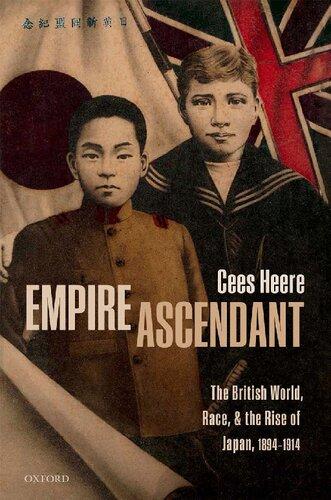
The British World, Race, and the Rise of Japan, 1894–1914
CEES HEERE
1
Great Clarendon Street, Oxford, OX2 6DP, United Kingdom
Oxford University Press is a department of the University of Oxford. It furthers the University’s objective of excellence in research, scholarship, and education by publishing worldwide. Oxford is a registered trade mark of Oxford University Press in the UK and in certain other countries
All rights reserved. No part of this publication may be reproduced, stored in a retrieval system, or transmitted, in any form or by any means, without the prior permission in writing of Oxford University Press, or as expressly permitted by law, by licence or under terms agreed with the appropriate reprographics rights organization. Enquiries concerning reproduction outside the scope of the above should be sent to the Rights Department, Oxford University Press, at the address above
You must not circulate this work in any other form and you must impose this same condition on any acquirer
Published in the United States of America by Oxford University Press 198 Madison Avenue, New York, NY 10016, United States of America
British Library Cataloguing in Publication Data Data available
Library of Congress Control Number: 2019945423
ISBN 978–0–19–883739–8
DOI: 10.1093/oso/9780198837398.001.0001
Printed and bound by CPI Group (UK) Ltd, Croydon, CR0 4YY
Acknowledgements
A great number of people and institutions contributed to the conception, preparation, and writing of this book. Much of the original research was made possible through the generous financial support of the British Association for Canadian Studies, the Dr Hendrik Muller Fund, the Fundatie Vrijvrouwe van Renswoude, the London School of Economics, the Royal Historical Society, the Japanese Studies programme at the Suntory and Toyota Centre for Economic Research and Development, and the Roosevelt Institute for American Studies, which also offset the costs of image reproductions. I have incurred debts of a different kind to the archivists and librarians without whom little historical research of any kind would be possible, least of all a project such as this, which builds on archival materials spread out across three continents. Full acknowledgements are given in the bibliography, but special thanks are due to Jennifer Toews at the Fisher Library in Toronto and to Paul Horsler, my subject librarian at the London School of Economics. I am also grateful to those institutions that have made historical materials freely accessible to distant researchers in digital format. Australia’s Trove and New Zealand’s Papers Past were indispensable resources, as were the various iterations of Hansard cited in the bibliography. I also made extensive use of the digital repositories of Cornell University Library, the Library and Archives of Canada, and the Australian National Archives. I am grateful to my fellow travellers, Benjamin Mountford, Jesse Tumblin, John Mitcham, and Graeme Thompson, whose insights sharpened my own throughout the writing of this book.
Many colleagues and friends offered advice on the book or commented on the manuscript in its various incarnations. The greatest thanks are due to my doctoral supervisor, Antony Best, who saw potential in this project and helped nurture it to fruition. I have benefited from his support and insight in more ways than I can acknowledge. I am especially grateful to Tom Doherty, Justin Hart, Joanna Lewis, Graeme Thompson, Naoko Shimazu, Takahiro Yamamoto, and the three anonymous reviewers for Oxford University Press for their comments and ideas. My doctoral examiners, Carl Bridge and John Darwin, brought a kind but discerning eye to the book in an earlier stage. Jesse Tumblin and John Mitcham advised on its completion. I remain, as ever, grateful to Chai Lieven for his wisdom and support. My colleagues at the Roosevelt Institute, Dario Fazzi, Leontien Joosse, Damian Pargas, Giles ScottSmith, Paul Brennan, Celia Nijdam, Nanka de Vries, Debby Esmée de Vlugt, and the interns who have presided over its magnificent library all provided moral and intellectual support during the final stages of writing.
Finally, I am indebted to the staff of Oxford University Press and its partners, and especially to Cathryn Steele for her patience and encouragement.
Writing can be a lonely process, and it would have been still more so but for the company and forbearance of friends in London, the Netherlands, and further afield. I am especially grateful to Ece Aygün, Bastiaan Bouwman, Alexandre Dab, Elif Durmus, Oliver Eliot, Marianna Ferro, Dominika Gamalczyk, Scott Gilfillan, Jonas Fossli Gjersø, Anne Irfan, Jin Lim, Tommaso Milani, Anika Mashru, Arne Muis, Eline van Ommen, Nilofar Sarwar and Morten Fausbøll, Simon Toner, Max Skjönsberg, Wesley Stuurman, Yu Suzuki, and Takahiro Yamamoto. Above all, I have relied on the love and support of my family, Thijs, Albert, and Sophia Heere. This book is dedicated to the memory of my grandmother, Elze HeereBijlsma, who fostered my love for history in more ways than she ever knew.
1. ‘The Englands of East and West’: Britain and Japan, Empire and Race, 1894–1904
2. A War for Civilization: The RussoJapanese War, 1904–5
3. ‘The Inalienable Right of the White Man’: Contact and Competition in China
4. Empire and Exclusion: The Japanese ‘Immigration Crisis’
5. The Pacific Problem: Race, Nationalism, and Imperial Defence
6. Alliance and Empire: British Policy and the ‘Japanese Question’, 1911–14
List of Figures
1.1. ‘Those Links of Kinship’, The Bulletin, 5 October 1901
1.2. ‘The Motherland’s Misalliance’, The Bulletin, 1 March 1902
2.1. ‘Regained!’, Punch, or the London Charivari, 11 January 1905
2.2. ‘Vote for the Conservatives, Who Gave You the Alliance’, 1905, BLPES, Coll Misc 051922
5.1. ‘The Audience on the Japanese Night at the Princess’ Theatre’, Punch [Melbourne], 24 May 1906
BLPES British Library of Political and Economic Science
CAPD Commonwealth of Australia Parliamentary Debates
CCAC Churchill College Archives Centre, Cambridge
CGEM The Correspondence of G. E. Morrison, Vol. I: 1895–1912, ed. Lo H.M. (Cambridge, 1976)
CID Committee of Imperial Defence
CL/WDS W. D. Straight Papers, Cornell University Library, Ithaca, NY
CPD Canadian Parliamentary Debates
CRL Cadbury Research Library, Birmingham
CUL Cambridge University Library
DUL/AG Albert Grey, 4th Earl Grey Papers, Durham University Library
FRBL/JOPB J. O. P. Bland Papers, Fisher Rare Book Library, Toronto
ICS Institute for Commonwealth Studies
LAC Library and Archives Canada, Ottawa
LAC/WL Wilfrid Laurier Papers, Library and Archives Canada
LAC/WLMK William Lyon Mackenzie King Papers, Library and Archives Canada
LHC Liddell Hart Centre for Military Archives, London
LTR The Letters of Theodore Roosevelt, 8 vols, ed. E. E. Morison (Cambridge, MA, 1951–4)
ML Mitchell Library, Sydney
NAA National Archives of Australia, Canberra
NCH North China Herald
NI News International Archive, London
NLA National Library of Australia, Canberra
NMM National Maritime Museum, Greenwich
NSWPD New South Wales Parliamentary Debates
NZH New Zealand Herald
NZPD New Zealand Parliamentary Debates
PA Parliamentary Archives
SOAS School of Oriental and African Studies
SMH Sydney Morning Herald
SPG Society for the Propagation of the Gospel
TNA The National Archives, Kew
Note on Names and Style
I have tried to render terms, names, and places from nonEuropean languages into English using the transliteration systems most commonly in use today. Chinese names are given in Pinyin throughout, with the exception of Manchurian place names that feature in the original sources, and whose modern rendering often differs significantly. Here I use the contemporary name, followed by the modern one in brackets, e.g. Mukden [Shenyang], Port Arthur [Lüshun], and Newchwang [Yinkou]. Japanese names and terms have been rendered with macrons (e.g. ō, ū) retained as a pronunciation aide, except in case of wellknown place names such as Tokyo (not Tōkyō). In keeping with regional custom, Japanese and Chinese names are given with the family name followed by the given name.
This book deals extensively with late nineteenth and early twentieth century perceptions of Japanese ‘race’, and thus it reproduces terminology from its source material that may strike modern audiences as coarse or offensive. A work such as this, which highlights the centrality of racial ideology to British perspectives on their imperial system and the world it inhabited, must use the terms in which these ideas were expressed. For this, I ask the reader’s understanding.
The late nineteenth century saw a shift in the mental geography of the British Empire, as India declined and the settler colonies rose to prominence in imperialist discourse. As the English radical J. A. Hobson famously observed in 1902, a ‘curious blindness’ had descended on ‘the average educated Briton when asked to picture to himself our colonial Empire. Almost instinctively he visualises Canada, Australia, and only quite recently South Africa—the rest he virtually ignores’.1 It is with this caveat in mind that the book often uses the terms ‘colonies’ and ‘colonial’ to refer to the larger settler colonies, until 1907, when the more appropriate term ‘dominions’ becomes available. Similarly, it should be noted that contemporary phrases such as ‘white Australia’, ‘the white colonies’, or even the ‘white empire’, denoted an aspirational selfidentification rather than a material reality: all five of the post1907 dominions (Canada, Australia, New Zealand, South Africa, and Newfoundland) contained large indigenous and immigrant populations that were to varying degrees excluded from membership of the colonial nation.
1 Hobson, Imperialism, p. 124.
KOREA
Shanghai
Taiwan
East Asia, 1895–1914
Tokyo Osaka
Sakhalin
JAPAN
Port Arthur
Peking
Vladivostok
CHINA
Harbin
Newchwang Mukden
RUSSIA
Introduction
Hurrah the day! hurrah the day!
The East and West stand side by side. The land where shines the rising sun, And the land that knows no setting sun, In alliance their hands have joined. The alliance this day we celebrate, ’Tis a flag of peace raised for the world.
‘The Students’ Song’, Japan Times, 16 February 1902
On the evening of 14 February 1902, the staff of the British legation in Tokyo witnessed a great movement of lights coming towards them through the winter darkness. There were over a thousand of them: small oil-lanterns, carried by students of the Keio Gijuku, the capital’s oldest and most prestigious school of ‘Western learning’, who held them aloft in celebration of the Anglo-Japanese alliance that had been announced two days before. The parade had started at dusk, and proceeded through the streets of Tokyo to the applause of a growing crowd of spectators. First came a man-sized lantern, emblazoned with large kanji proclaiming eternal Anglo-Japanese friendship. Then followed the headmaster, Fukuzawa Ichitarō, whose father, Fukuzawa Yukichi, had founded the school in 1858 as an incubator for a modern Japanese elite. He rode on horseback and in uniform, ‘as commander-in-chief of the procession’, leading the student band as it played ‘Rule Britannia’ and a specially composed ‘Song of the Anglo-Japanese alliance’. Then followed the school’s ‘rank and file’: fifteen hundred boys, each carrying a lantern on a stick, marching and singing. ‘As they passed along the streets, the sky was fairly illuminated’, noted a correspondent for the Japan Times ‘The effect was splendid.’1 At the entrance to the legation, the band launched into ‘God Save the King’, and the students let up a chorus of ‘banzai’ (or ‘ten thousand years’), while the British minister, Sir Claude Macdonald, looked down from the balcony with a look of ‘great satisfaction’. In the weeks that followed, further celebrations were staged all across the empire, from the southern port of Nagasaki (long Japan’s sole window on the West), to Shimonoseki, Osaka, Nagoya, and Kyoto, where thousands attended a ceremony in honour of the alliance at the
1 ‘Torchlight Procession of the Keio-Gijuku Students’, Japan Times, 16 February 1902.
Empire Ascendant: The British World, Race, and the Rise of Japan, 1894–1914. Cees Heere, Oxford University Press (2020).
Heian shrine. ‘The Japanese can hardly contain their delight at the new alliance’, one foreign observer noted. ‘It is unquestionably a triumph for them that the one power which on principle has abstained from alliances should now enter into an alliance, on terms of perfect equality, with the Japanese, who are of an utterly different race.’2
Japan could celebrate its alliance with Great Britain, the world’s leading imperial power, as a moment of initiation—a sign that four decades after the country’s forceful ‘opening’ to foreign trade it had at last been admitted to the society of ‘civilized’ states. But for the British, the formation of the alliance represented an altogether more ambiguous reckoning with the altered circumstances of their ‘world-system’.3 The British nineteenth century had been an era of optimism, bolstered by imperial expansion, economic growth, and a borderline utopian belief in the transformative power of industrial modernity. The twentieth, by contrast, seemed poised to bring with it rivalry, conflict, and decline. The war in South Africa (1899–1902) had shaken confidence in Britain’s ability to compete in a worldwide struggle for ‘efficiency’ against an expanding cast of imperial rivals.4 Economically, Britain had ceded its manufacturing edge to the United States and Germany. In the Middle East, India, and China, its strategic position was under pressure from an expanding Russia. The ‘imperial union’ with the settler colonies—Canada, Australia, New Zealand, and a unified South Africa— on which British imperialists had pinned their hopes for geopolitical survival, had failed to materialize. The Empire and the Century, a collection of essays published to mark the centenary of Trafalgar in 1905, struck a recessional note. ‘Will the empire last?’, one writer wondered. ‘Does it rest on permanent foundations, or is it only a political organism in a certain stage of decomposition?’5
Set against this gloomy picture, the rise of Japan offered a striking contrast. The speed and efficacy with which the Meiji state had adopted the hallmarks of modernity, ranging from telegraphs and railways to a centralized administration, a parliamentary constitution (1889), an industrializing economy, and a Westernstyle army, was without parallel in nineteenth-century Asia, though many sought to emulate its example.6 Following its successive military triumphs over China (1894–5) and Russia (1904–5), Japan became the first Asian state to re-join the society of ‘civilized nations’, whose membership had been practically confined to
2 Baelz, Awakening Japan, p. 154.
3 I borrow the term from John Darwin, The Empire Project, pp. 1–12; see also Howe, ‘British Worlds, Settler Worlds’, pp. 697–9.
4 For a contemporary example, see Anon., Decline and Fall of the British Empire; on the Edwardian ‘cult’ of ‘National Efficiency’, see Searle, The Quest for National Efficiency; Tonooka, ‘Reverse Emulation and the Cult of Japanese Efficiency’.
5 Moneypenny, ‘The Imperial Ideal’, p. 23; on ‘declinism’ see also Darwin, ‘The Fear of Falling’.
6 On Japan’s ‘Meiji revolution’, see Jansen, Making of Modern Japan; Ravina, To Stand with the Nations of the World; Tsuzuki, The Pursuit of Power in Modern Japan; for a global contextualization see Darwin, After Tamerlane, pp. 219–94.
white Europeans. Even after 1900, Japan’s racial identity made it an international outlier. Thus as one observer wrote of the Anglo-Japanese alliance, London had been bold ‘to disregard all social, political and religious prejudice to the point of allying themselves with the youngest nation, really only half-civilised, heathen, and of the Yellow race’.7 Across much of the empire, the conclusion of the AngloJapanese alliance ‘had come as an immense surprise’, noted the British governorgeneral in Australia, ‘as there has always been a feeling that the electors would look upon a “yellow alliance” as something unnatural and distasteful’.8 The implications for global race relations, first signalled by the alliance, would be further clarified with the outbreak of the Russo-Japanese War two years later. Japan’s ascendancy, as one British commentator put it in 1904, heralded the end of the ‘era of inequality of the races’, and the coming of a world where ‘white and yellow man must meet on an equal footing’.9 But there was the rub: would that world still accommodate British rule in India, the economic exploitation of China, or the exclusion of Asian immigrants from the self-declared ‘white men’s countries’ of the Pacific?
Empire Ascendant explores the British encounter with Meiji Japan from the Sino-Japanese War (1894–5) until the outbreak of the First World War. In particular, it attempts to understand how contemporary perceptions of Japan’s Asian identity structured and complicated its integration into an international order undergirded by cultural and racial hierarchies. It is thus, in part, a history of the role of race in international relations. But it is also an imperial history, which explores how Japan’s rapid rise to ‘great power’ status resonated across a British imperial system that was itself in a state of profound flux. Historians have typically treated the metropolitan and colonial dimensions of the Anglo-Japanese relationship in separate compartments. By contrast, this book brings both together to reveal an interconnected story, in which settler-colonial dynamics in Australasia, Canada, or the China coast, where racial visions of Japan were formed and mobilized in their sharpest form, could interact, challenge, and conflict with diplomatic and strategic decision-making processes in London. In the process, it portrays an imperial system struggling to redefine its organization and purpose as it negotiated the geopolitical upheavals of the late nineteenth and early twentieth centuries.
In this book, I explore the story of British engagement with Japan along the twinned arcs of race and empire to develop two distinct (though related) arguments. The first concerns the ambiguity of Japan’s international status as an Asian power in a world order dominated by white Europeans and their transatlantic progeny. Studies of Anglo-Japanese diplomacy have typically started from the assumption that both powers engaged one another on the basis of rational
7 Hippisley to Morrison, 9 March 1902, ML, Morrison Papers, 312/160.
8 Hopetoun to Barton, 14 February 1902, NLA, Barton Papers, MS 51/9/918.
9 Wilson, ‘Japan’s Trafalgar’, pp. 782–3.
geopolitical calculations, insulated from racial discourse: here, Japan and Britain are presented as equivalent strategic actors, enclosed within the universe of realpolitik. 10 Yet such an analysis sits uncomfortably alongside the work of historians of Japanese foreign relations, who have long drawn attention to the Meiji elite’s growing disillusionment with the racial standards of the supposedly universal ‘civilization’ it was attempting to join.11 Recent studies on transnational formation of ‘whiteness’, moreover, have placed the Japanese experience in a broader setting by demonstrating how American, Australian, and South African politicians employed the spectre of Asian nationalism to construct an alternative vision of global order, structured by the imperatives of white supremacy.12 This book, by contrast, seeks to integrate these apparently conflicting perspectives by drawing attention to the ways in which Japan’s inclusion in the diplomatic world of the early twentieth century was complicated by perceptions of racial difference. British officials and commentators were acutely aware that their partnership with Japan crossed the international ‘colour line’. They understood (and often shared) the concerns voiced in foreign, domestic, and colonial quarters over entering into what its detractors called a ‘yellow alliance’. But they also came to appreciate their Japanese diplomacy as a means to manage these tensions, and ultimately, to keep the world’s leading Asian power safely tethered to the colonial order.13
Second, I argue that these tensions need to be understood in an imperial as opposed to a strictly bilateral frame. Here, the present work draws on an expansive literature that has highlighted the cultural, economic, and political interconnectedness of the so-called ‘British world’ that united Britain with its imperial diaspora. After a long period of neglect, historians have now begun to reintegrate the histories of the British settler colonies (notably Canada, Australia, New Zealand, and South Africa) with the history of the British Empire.14 But what often remains missing from these accounts is an exploration of how these variegated connections could themselves act as independent channels for interaction
10 See here Nish’s two volume-study The Anglo-Japanese Alliance and Alliance in Decline; but also Lowe, Great Britain and Japan. Subsequent works have also highlighted the relationship’s cultural dynamics, see e.g. Best, ‘Race, Monarchy’; Iikura, ‘The Anglo-Japanese Alliance and the Question of Race’; Hotta-Lister, The Japan-British Exhibition of 1910; Otte, ‘ “A Very Great Gulf” ’.
11 See, for instance, Aydin, The Politics of Anti-Westernism in Asia; Hirobe, Japanese Pride, American Prejudice; Klotz, ‘Racial Inequality’; Shimazu, Japan, Race, and Equality; Suzuki, ‘Japan’s Socialization’.
12 A pivotal study here has been Lake and Reynolds, Drawing the Global Colour Line, but see also Atkinson, Burden of White Supremacy; Bright, Chinese Labour in South Africa; Schwarz, White Man’s World
13 I draw inspiration here from the extensive literature on race in American foreign relations: see, for instance, Borstelmann, The Cold War and the Color Line; Dower, War Without Mercy; Krenn, The Color of Empire; Vitalis, White World Order
14 For the original rallying cry, see Bridge and Fedorowich, ‘Mapping the British World’. Key studies in the ‘new’ imperial history include Belich, Replenishing the Earth; Bell, Greater Britain; Darwin, The Empire Project; Magee and Thompson, Empire and Globalisation; Mitcham, Race and Imperial Defence; Potter, News and the British World; Thompson, Imperial Britain
between the British imperial system and the world beyond it.15 Significantly, the scholarly field that explicitly devotes itself to the study of Britain in a global context—diplomatic history—has been notably reluctant to take the ‘new’ imperial history in its stride. And the need for a broader conceptualization of British international relations is especially pressing in the case of Japan. Britain’s new ally stood apart from the European arena of ‘great-power’ politics—the traditional focus for diplomatic historians of the pre-First World War era. But it enjoyed direct and dense connections to Canada, Australia, and New Zealand, for whom the expansion of Japanese trade, shipping, and emigration heightened awareness of Asia’s sudden proximity, while clarifying their own sense of themselves as international actors in ‘the main current of world politics’.16 The effects resonated throughout the imperial politics of the Edwardian era, as anxieties over a rising Japan inspired a surge of new demands for national self-assertion, from the creation of a ‘white Australia’ to the parallel debates over the future political and economic orientation of a Canadian nation.17
Historians have typically narrated this process as a clash between the demands of the imperial connection on the one hand, and of white colonial nationalism on the other. It was certainly true that colonial anxieties over ‘Asiatic’ encroachment could generate a great deal of friction with the imperial bureaucracy in Whitehall. But at the same time, the growth of Japanese power underlined the colonies’ need for external protection—their ‘position of dependence on the strong arm of Great Britain’, as a future Canadian prime minister put it in the aftermath of the anti-Asian riots that convulsed Vancouver in September 1907.18 This awareness decisively shaped the evolution of imperial politics during the long Edwardian decade that separated the South African War from the First World War. It heightened the urgency of dominion demands for a role in ‘imperial’ decision-making processes, particularly in the realms of immigration, defence, and foreign relations. More fundamentally, it moved colonial leaders to insist that their racial security be recognized as a legitimate imperial interest. Empire, they argued, had to be pressed into the service of whiteness. An analogous dynamic emerged among the British expatriate communities in China, where Japan’s rise similarly generated new claims on the deployment of imperial power. Taken together, these developments placed Japan at the centre of a set of wide-ranging debates on the prospects and purpose of an evolving imperial system.
15 An important exception is Mountford, Britain, China, and Colonial Australia, which posits Australia as a site of interaction between the British and Chinese empires.
16 Mahan, Interest of America in Sea Power, p. 162; ‘The Anglo-Japanese Alliance’, SMH, 14 February 1902.
17 On Australasia, see inter alia McGibbon, Path to Gallipoli; Meaney, Search for Security; Yarwood, Asian Migration to Australia; Walker, Anxious Nation. On Canada’s repeated ‘discoveries’ of the Pacific, see Chang, Pacific Connections; Price, Orienting Canada; Thompson, ‘Ontario’s Empire’.
18 King Diary, 18 March 1908, LAC/WLMK, MG26-J13, mf. 98.
The Sino-Japanese War (1894–5), which opens Chapter 1, redefined the Anglo-Japanese relationship in three key ways. First, victory over China decisively reframed contemporary British estimations of Japan’s ‘civilization’, and highlighted its growing importance as a geopolitical actor. Second, the political instability that the war left in its wake (and which Britain’s European rivals quickly moved to exploit) greatly amplified the significance of Japan’s position, and lent further urgency to its incorporation into ‘international society’ on terms favourable to London. Third, the war also witnessed Japan’s coming-of-age as a maritime power, exemplified by the growth of trade and emigration after 1895, generating new connections to Britain’s colonies in the Pacific. These more intensive interactions between the two ‘island empires’ framed the context in which Britons began to reassess Japan’s capacity for modernity, a process out of which several rival discursive strategies emerged. At their most optimistic, British commentators reinvented Japan as the ‘England of the East’: a conduit for the spread of Western-style modernity in Asia and a natural partner in the defence of the regional order. But others came to emphasize its racial difference, evoking the spectre of a ‘yellow peril’ looming over European rule in Asia. In the British Pacific, in particular, the rise of Japan came to lend new urgency to the formation of a federated ‘white Australia’.
The Russo-Japanese War (1904–5) threw these contrasts into sharper relief. Japan’s spectacular victory over a European great power catapulted it into the upper tiers of the international system. The war was celebrated in much of the British Empire as a blow against its Russian rival. But it also aroused reinforced anxieties over the future of Europe’s collective hegemony in Asia. Chapter 2 explores these complications along three main vectors. First, it conducts a close study into the war’s portrayal in British public opinion, focusing on the efforts of pro-Japanese journalists to manage Japan’s public image and contain the spread of ‘yellow peril’ rhetoric. Second, it considers the conflicted perspective of the British government: while London was keen to display its willingness to acknowledge Japan as an equal, officials were nonetheless anxious that the war was undermining Britain’s own racial prestige in Asia. Finally, the chapter again widens its scope to the wider British world, by showing how the war forced a recasting of the issue of Japanese immigration to Australia and Canada in light of Japan’s arrival on the main stage of global politics.
The chapters that follow trace out the political and ideological ramifications of Japan’s rise across three distinct imperial settings. Chapter 3 focuses on China, where the impact of Japan’s growing military and economic heft was most immediately felt. For the British residents of the treaty ports along the China coast, Japan came to represent both an existential challenge to Britain’s regional hegemony and, in a more intimate sense, to the privileges of their own position. But it was the question of immigration that brought out the most glaring contrasts between Japan’s international status and the racial identity projected onto it. Chapter 4
hones in on the nativist backlash against Japanese immigration on the Pacific coast of North America in 1906–8. Its central focus is on the Vancouver race riots of September 1907, when a white mob attempted to expel Japanese and Chinese residents from the city. These clamours for a ‘white Canada’ forced the Canadian government into a careful balancing act as it attempted to reconcile the demands of the exclusion movement with its diplomatic and imperial obligations to Tokyo and London. In a broader sense, the chapter explores how the ensuing ‘immigration crisis’ forced the British and Canadian governments to confront the implications of a world divided by race. Chapter 5 shows how these ideas in turn came to inflect thinking on imperial defence in Britain, Australia, and New Zealand. It explores how fears of a rising Japan were invoked and mobilized to reshape Australasian ideas of nationhood and empire. In particular, it examines several key episodes in which these efforts intersected with Britain’s own strategic priorities: the visit of the American ‘Great White Fleet’ to New Zealand and Australia; the ‘dreadnought scare’; and the subsequent Imperial Defence Conference of 1909. In the final chapter, these strands come together to form the imperial context for the renewal of the Anglo-Japanese alliance at the 1911 Imperial Conference. By this point, friction over China, immigration, and naval security had cast significant doubts over the future of Britain’s partnership with Japan, while also revealing the challenges of maintaining a unified foreign policy across a decentralizing imperial system. The result was a subtle but important shift in the alliance’s strategic rationale: in an effort to win over the dominions, London now presented the treaty as a diplomatic guarantee for their racial security. Yet hopes that this would settle the ‘Japanese question’ as an imperial issue quickly proved elusive. In the years that followed, Canada further tightened its restrictions on Japanese immigration, while Australia and New Zealand confronted London over the insufficiency of the imperial naval presence in the Pacific. Once again, British ties to Japan became the subject of a broader conflict between metropolitan and colonial perspectives on empire, race, and the future of global politics.
1
‘The Englands of East and West’
Britain and Japan, Empire and Race, 1894–1904
George Nathaniel Curzon began his Problems of the Far East (1894), the book that would establish him as an authority on foreign affairs, with a stern warning. ‘There will be found nothing in these pages’, he wrote, ‘of the Japan of temples, of tea-houses, and bric-à-brac—that infinitesimal segment of the national existence which the traveller is so prone to mistake for the whole.’ His would be a serious work of political analysis, undiluted by ‘aesthetic impressions’: a sober assessment of Japan’s industrial modernization, its constitutional development, its relations with foreign powers, ‘and the future that awaits her immense ambitions’.1 Already, Curzon noted, these were matters of vital concern to a British Empire whose prospects were intimately tied to the ‘prestige and wealth arising from her Asiatic position’.2 And they were bound to become more so in the century to come, as politics and technology drew ‘West’ and ‘East’ still closer together. Across the United States, Canada, and soon Russia, great transcontinental railways were reducing the travel distances between the Atlantic and the Pacific from weeks to days. The impending construction of an interoceanic canal across either Panama or Nicaragua would shrink the world still further. As the axis of world politics tilted towards the Pacific, Japan’s geopolitical role would expand accordingly. Its ‘supreme ambition’, Curzon informed his readers, was nothing less than to become ‘on a smaller scale, the Britain of the Far East’.3
Curzon was not the first commentator to pair Britain and Japan together: as early as 1851, the writer Henry Morley had described the country—at that point, still closed off to most Europeans—as an ‘England in the Pacific Ocean’.4 Geography invited the comparison. Looking to Japan, Britons saw another archipelagic state, similar in size and population, that sat at roughly the same latitude on the other end of the Eurasian landmass. But by the early 1900s, they had come to see something else as well: a fellow ‘island empire’, industrious and progressive, whose rivalry with Russia mirrored their own struggles against Europe’s Continental monarchies in the seventeenth and eighteenth centuries. While Curzon might not have taken the analogy quite so far, many others did. The Times effusively welcomed the conclusion of the Anglo-Japanese alliance in February 1902 as the
1 Curzon, Problems, p. ix.
2 Curzon, Problems, p. 387.
3 Curzon, Problems, pp. 396–7. 4 Yokoyama, Japan in the Victorian Mind, p. 15.
combination of ‘the two Island Empires of East and West’ in a common cause.5 The North China Herald, the principal voice of the British trading communities on the China coast, listed the traits that bound the new allies together:
Island empires both; born, bred, and nurtured within sound and sight of the ocean wave; blessed with a long and glorious history on each side; tenacious of right, and impatient of wrong; threatened by the same aggressor, and in many ways complementary to one another, was it not in the nature of things that these two should easily come to an understanding based on mutual need and mutual admiration?6
It was a remarkable reinvention. As Curzon’s own disavowal of ‘temples and teahouses’ attested, for much of the nineteenth century British images of Japan had tended towards the picturesque rather than the heroic.7 Visiting Japan at the height of the Meiji reforms in 1876, the Victorian writer-politician Charles Dilke had bracketed his approval for the spread of modern ‘English’ influences’ with an orientalist paean to the ‘elf-land’ that awaited him in the Japanese countryside.8 Dilke, at least, had taken an interest in Japan’s modernization—he already foresaw a day when the country would ‘be a useful ally. in the North Pacific’.9 But other visitors regarded Japan’s ‘imported’ civilization with barely veiled disdain. To the poet Rudyard Kipling, Japan was a ‘babu country’, ‘drunk on Western liquor’, that had ‘swapped its soul for a constitution’.10 It might be best, he half-jokingly proposed, to declare an ‘international suzerainty over Japan’, so as to remove the ‘fear of invasion’ and ensure that it ‘simply sat still and went on making beautiful things’.11 If modern Japan horrified Kipling, others (perhaps taking their cue from Gilbert and Sullivan’s 1882 operetta The Mikado) found it merely ridiculous. ‘The idea that Japan would ever be a factor in world politics was too absurd to contemplate’, one writer reflected in 1904. ‘Their role was to be absurd, and supply the suburbs with cheap decorations.’12
The outbreak of the Sino-Japanese War in July 1894 marked a sharp departure in British policy as well as attitudes. Japan’s successive victories over its larger Chinese neighbour decisively altered contemporary estimations of its capacity for modernity. ‘[A]s if by magic’, wrote the president of London’s Japan Society, the war had revealed ‘a nation no longer in leading-strings’, but a rising world power,
5 [Editorial], The Times, 12 February 1902.
6 ‘Sympathy as Political Power’, NCH, 13 January 1905.
7 On Western images of Japan in the nineteenth century, see Lehmann, The Image of Japan; Yokoyama, Japan in the Victorian Mind; Henning, Outposts of Civilization; Pham, ‘On the Edge of the Orient’.
8 Dilke, ‘English Influence in Japan’, p. 443. 9 Dilke, ‘English Influence in Japan’, p. 432.
10 Cortazzi and Webb (eds), Kipling’s Japan, p. 179.
11 Cortazzi and Webb (eds), Kipling’s Japan, p. 56.