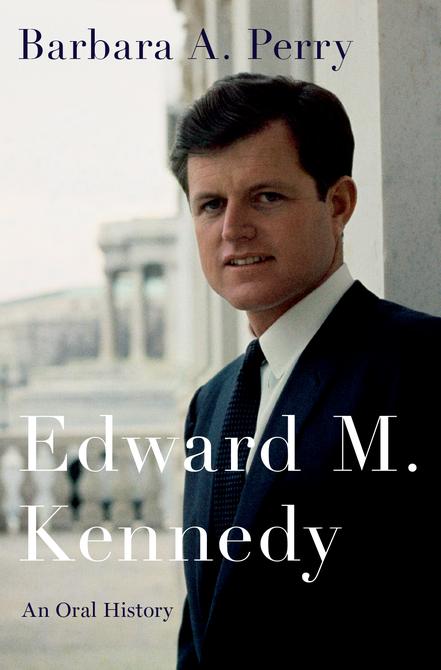
Edward M. Kennedy
An Oral History
BARBARA A. PERRY
Oxford University Press is a department of the University of Oxford. It furthers the University’s objective of excellence in research, scholarship, and education by publishing worldwide. Oxford is a registered trademark of Oxford University Press in the UK and certain other countries.
Published in the United States of America by Oxford University Press 198 Madison Avenue, New York, NY 10016, United States of America.
© Oxford University Press 2019
All rights reserved. No part of this publication may be reproduced, stored in a retrieval system, or transmitted, in any form or by any means, without the prior permission in writing of Oxford University Press, or as expressly permitted by law, by license, or under terms agreed with the appropriate reproduction rights organization. Inquiries concerning reproduction outside the scope of the above should be sent to the Rights Department, Oxford University Press, at the address above.
You must not circulate this work in any other form and you must impose this same condition on any acquirer.
Library of Congress Cataloging-in- Publication Data
Names: Perry, Barbara A. (Barbara Ann), 1956– compiler. | Kennedy, Edward M. (Edward Moore), 1932–2009, interviewee. Title: Edward M. Kennedy : an oral history / Barbara A. Perry. Description: New York, NY : Oxford University Press, 2019. | Series: Oxford oral history series | Includes bibliographical references and index. Identifiers: LCCN 2018027757 (print) | LCCN 2018029313 (ebook) | ISBN 9780190644857 (updf) | ISBN 9780190644864 (epub) | ISBN 9780190644840 (hardback)
Subjects: LCSH: Kennedy, Edward M. (Edward Moore), 1932–2009— Interviews. | Kennedy, Edward M. (Edward Moore), 1932–2009— Friends and associates— Interviews. | Kennedy, Edward M. (Edward Moore), 1932–2009. | Legislators— United States— Interviews. | United States. Congress. Senate—Interviews. | United States— Politics and government—1945–1989. | United States— Politics and government—1989– | Oral history. | BISAC: HISTORY / United States / 20th Century. | POLITICAL SCIENCE / History & Theory.Classification: LCC E840.8.K35 (ebook) | LCC E840.8.K35 P47 2019 (print) | DDC 973.92092 [B]— dc23 LC record available at https:// lccn.loc.gov/2018027757
9 8 7 6 5 4 3 2 1
Printed by Sheridan Books, Inc., United States of America
To Suzy Joy Brill, Debra Tabb DeCamillis, and Julia McDonough— my loyal friends and supporters
Preface
Marking the fortieth year of his US Senate tenure in 2002, Edward Kennedy met with a group of family and friends over dinner to discuss how he might begin to capture and solidify his legacy. Edwin Schlossberg, husband of the senator’s niece, Caroline Kennedy, suggested the idea for what would become the Edward M. Kennedy Institute for the United States Senate. Dedicated in March 2015 and located next to the John F. Kennedy Presidential Library and Museum in Boston, the institute features a full- scale model of the US Senate chamber, where visitors participate in congressional simulations. For generations to come, students of democracy will learn through interactive exercises the complex task of crafting and passing legislation, a process at which Senator Kennedy excelled.
But how would Ted Kennedy portray his remarkable life and the lessons he and his colleagues absorbed through their toil in the real Senate? At the 2002 dinner, Kennedy’s wife, Victoria (Vicki) Reggie Kennedy, raised the possibility of an oral history project to focus on the senator, his Senate colleagues, staffers, foreign leaders, journalists, and his family. The renowned historian and presidential advisor Arthur Schlesinger Jr., also present at the dinner, immediately seconded the idea. Schlesinger, a special assistant to Presidents Kennedy and Johnson, had organized and conducted interviews for the John F. Kennedy Library’s Oral History Project and had produced Jacqueline Kennedy’s oral history. A Pulitzer Prize winner for his book on JFK’s administration, A Thousand Days, Schlesinger was a staunch advocate for capturing unique historical insights through the art and science of oral interviews.
Senator Kennedy turned to his fellow University of Virginia Law School alumnus Lee Fentress to search for an appropriate institution to execute the Edward M. Kennedy Oral History Project. Although UVA’s Miller Center focused primarily on presidential oral histories, starting with the Gerald Ford administration in the late 1970s, Professor James Sterling Young, who headed the program, convinced the Kennedys that the Miller Center would be the logical institution to produce the spoken record of the senator’s biography and career. The Edward M. Kennedy Oral History Project would eventually comprise
more than twice as many interviews as the largest Miller Center presidential project.
Before his death from brain cancer in August 2009, Edward Kennedy recorded 29 conversations, with some 250 added by a host of colleagues, friends, and family members over a ten-year period. This book is based on the 23 Kennedy interviews cleared for release by the senator’s estate in 2015. They are generally arranged here in the chronological order of Kennedy’s life, starting with biographical conversations, followed by discussions of historical events involving the senator and his family, interspersed with key policies that Kennedy addressed over his long career. To augment Senator Kennedy’s own stories, each chapter contains “Perspectives,” with pertinent quotations from the rich interviews provided by those who knew him best professionally and personally. Because the biographies of the senator and his family are so well known, the reader may find insights from the supplementary interviews even more revelatory.
What distinguishes this vast interview archive from the voluminous secondary works published on Edward Kennedy and from his own memoir is the nuanced detail that emerges from the senator’s fulsome, never-beforepublished descriptions of his life and work, juxtaposed with the observations of his associates. Edward M. Kennedy: An Oral History weaves material from the more than seven hundred typescript pages of the senator’s interview transcripts, which his staff fact- checked and the Miller Center’s Oral History Program lightly edited for readability, into a compelling narrative of his remarkable life. Professor Stephen F. Knott initially directed the project before departing the Miller Center for the US Naval War College. He and Professor James Sterling Young, founder of the Miller Center’s Presidential Oral History Program, collaborated on several Kennedy interviews, but Young became the solo questioner for most of the senator’s interviews and directed the project until ill health intervened. Janet E. Heininger and Knott interviewed most of the other participants. No questions or topics were placed off limits in the project. The interviewers’ italicized queries, along with author’s notes and annotations, guide readers through the senator’s life, the cast of characters he encountered, and the political events, historic landmarks, and legislative processes that he shaped and that, in turn, molded him. Given the Kennedys’ well-known penchant for image creation, what the senator does not say or how he articulates what he chooses to include is often more enlightening than a simple declarative statement. Edward M. Kennedy: An Oral History reveals in the senator’s own voice his unexpurgated story about the epic Kennedy tragedies and how he attempted to play his part in the family’s commitment to public service on the domestic and world stages. Addressing his Irish Catholic immigrant roots, his political DNA, his work with ten presidents (JFK to Obama), his legislative accomplishments and failures, his unsuccessful run for the presidency, his impact on the Supreme Court, his observations on Washington gridlock, and his
epic personal weaknesses, Edward Kennedy spoke on the record, as did allies and adversaries alike, creating an unsurpassed and illuminating compendium for historians, political scientists, policymakers, journalists, teachers, students, and other readers of history. His thorough explanations and mastery of congressional intricacies serve as a user’s manual for prioritizing, crafting, and creating public policy. A man of complexity and paradox, Edward Kennedy could launch partisan salvos on the Senate floor but work across the aisle with the opposing party to find common ground. Testimonies abound of his care and concern for others, but his personal failings are also legendary. A master of compelling rhetoric, he could sometimes wander into puzzling syntactical cul- de- sacs or utter confounding malaprops. This oral history archive is replete with examples of his multifaceted personality—marked by an infectious joie de vivre, a profound humanity, and, sadly, feet of clay.
Senator Kennedy titled his 2009 memoir True Compass because, as he said in its opening pages, “Sailing, for me, has always been a metaphor for life.” With that historic life ebbing, the senator concluded, “[Y]ou might not reach your goal right away. But if you do your best and keep a true compass, you’ll get there.” He would not reach the distant shore of seeing his oral history project through to completion, nor would his trusted navigator, the late Jim Young. It was my honor and privilege to steer the project into port.
Launching this endeavor in December 2004, Senator Kennedy remarked, “I’ve always loved history, and I’ve long believed that scholars, politicians, and private citizens and the country as a whole, would benefit from a fuller examination of what we do as senators, and that’s the purpose of this oral history project.”
A cooperative endeavor of the Edward M. Kennedy Institute for the United States Senate in Boston and the Miller Center at the University of Virginia, the Edward M. Kennedy Oral History Project comprises nearly three hundred interviews, ranging from hour-long conversations to multi- day discussions.
Most of Senator Kennedy’s interviews, which ended with his cancer diagnosis in May 2008, along with nearly two hundred of his associates’ transcripts, are available online at the Miller Center (www.millercenter.org) and the Edward Kennedy Institute for the United States Senate (www.emkinstitute. org). Consistent with the Miller Center’s ongoing obligation to protect confidentiality, according to the protocols of oral history, some parts of these interviews remain closed until future dates, as requested by the interviewees in their deeds of gift.
While a PhD candidate at the University of Virginia in the 1980s, I occasionally spotted Senator Edward Kennedy at commencement exercises, which he would attend with his sister-in-law, Ethel Kennedy, when one of her eleven children graduated from the UVA Law School. Despite his hectic schedule in the US Senate, where he served for almost half a century, Senator Kennedy never ceased serving as a surrogate for his fallen brothers, Senator Robert
F. Kennedy and President John F. Kennedy. It was a homecoming of sorts for Teddy Kennedy, who had earned his law degree from Mr. Jefferson’s university. How appropriate, then, that he and his friend, fellow alumnus Lee Fentress, would choose their alma mater to produce this unprecedented archive of his oral history.
The Miller Center’s first foray into a comprehensive presidential oral history began in the early 1980s when Jim Young persuaded another native Georgian, President Jimmy Carter, and members of his administration to participate in a project of recorded conversations about the thirty-ninth presidency. Through the leadership of then–Miller Center director Philip Zelikow and Jim Young, a continuing oral history program emerged when the George H. W. Bush Foundation financially supported an oral history of his administration. The program subsequently conducted oral histories of Presidents Ronald Reagan and Bill Clinton, and it has since completed George W. Bush’s Presidential Oral History Project.
In addition to these “POTUS” projects and Senator Kennedy’s oral history, the Center has produced a project on Lloyd Cutler, White House counsel for Carter and Clinton, as well as recorded group sessions examining the Falklands War, White House congressional relations, presidential speechwriting, and the presidency and domestic policymaking.
Jim Young, Steve Knott, and Jan Heininger could not have conducted hundreds of interviews for the Edward Kennedy project without the support of first-rate Miller Center faculty and staff, including Jim’s successor Russell Riley, Marc Selverstone, Rob Martin, Jane Wilson, Beatriz Lee Swerdlow, Bonnie Burns, and Bryan Craig, along with our superb consultants.
The senator’s wife, Vicki, was crucial to the enterprise, and I have had the honor of knowing firsthand how meaningful this project is to her. Senator Paul G. Kirk (D- MA), Senator Kennedy’s special assistant, advisor, friend, executor, and replacement in the Senate, could not have been more gracious in facilitating the release of the senator’s interviews. As I have come to know Vicki and Paul, I can see why Edward Kennedy felt so fortunate to have them in his life.
Jean MacCormack and Nell Breyer, of the Edward Kennedy Institute, provided superlative assistance as the Miller Center processed interviews, through the tireless efforts of my colleagues Mike Greco, Sheila Blackford, and Amber Reichert. The Center’s director from 2006 to 2014, Governor Gerald L. Baliles, remained committed to the project throughout his tenure, and the chair of the Miller Center Governing Council, Eugene V. Fife, offered expert guidance to acquire and execute the project. William J. Antholis, the Miller Center’s current director, made one of his first goals the timely release of the Kennedy project, and he supported my need to disappear during a summer hiatus, as I devoted several months required to bring this compendium to fruition.
I am especially grateful to my colleague and friend Russell Riley, who set the gold standard for such volumes with his superb Oxford University Press publication Inside the Clinton White House: An Oral History. Oxford’s Vice President and Executive Editor Nancy Toff first suggested that we undertake these products of our oral histories several years ago, and we are most appreciative of her inspiration, guidance, and confidence in our work. OUP Assistant Editor Elizabeth Vaziri could not have been more helpful in facilitating the many details of the publishing process. The Miller Center’s Alfred Reaves IV provided expert research in tracking down photographs, and Rob Martin’s vast knowledge of the Edward Kennedy Oral History Project contributed to my drafting of introductions to chapters 4, 5, 11, 13, and 14.
I will always regret that I arrived at the Miller Center just after the Kennedy interviews were completed, so I had no opportunity to participate in them. But I will forever be grateful that Governor Baliles placed his faith in me to finalize the endeavor. Those who had assisted Jim Young so loyally and expertly, Rob Martin, Bonnie Burns, and Jane Wilson, generously lent their knowledge, experience, and talents to me. When Jane retired, Gail Hyder Wiley seamlessly continued the work of processing interviews and, along with Shirley Burke, updated and reviewed the list of Kennedy project transcripts, included in this book’s appendix.
The last two lines of what would be the final interview between Senator Kennedy and Professor Young, in March 2008, convey an accurate assessment of their journey together:
Kennedy: I think we got a lot of material down. Young: Yes, we did.
It was a “good sail,” gentlemen.
1 Growing Up Kennedy: Lessons from a Political Dynasty
The last of Joseph and Rose Kennedy’s nine children arrived on February 22, 1932, when his mother was forty- one years old. Well-meaning friends thought her foolish to have a ninth baby at her age. She was determined, however, to remain cheerful about her ongoing maternity, both for her own peace of mind and for the baby’s welfare. Because the child was born on George Washington’s birthday, Jack, his waggish fifteen-year- old brother, lobbied to name him for the first president, but his parents resisted and christened him Edward Moore Kennedy, after his father’s faithful secretary. The family dubbed the chubby tot “Teddy.” Although the Kennedys had moved to New York in 1926 to escape anti-Irish parochialism and to be closer to Joe’s Wall Street concerns, Rose returned to her beloved hometown for the birth, ensuring that Teddy would always be a Bostonian.
He was only six when the Kennedys pulled up stakes from their New York estate and sailed to London, settling into the American embassy for Joe Kennedy’s ambassadorship in 1938. There young Teddy reveled in the attention lavished on the charismatic clan. They were the toast of London, with Teddy pictured in newspaper and magazine stories about the American ambassador’s large and boisterous family. He learned at a tender age to smile and be gracious in public settings. When a baby elephant attempted to snatch a peanut from Teddy’s hand as he and his brother Bobby opened the Children’s Zoo in London, the youngster maintained his poise and giggled with delight. When the Kennedys attended the coronation of their friend Pope Pius XII at the Vatican in 1939, Teddy received his First Communion from the new head of the Roman Catholic Church at a private Mass.
Later that year, however, with World War II’s outbreak, the Kennedy adventure came to an abrupt end when Joe shipped the family home and out of harm’s way. Thus began a challenging period for the youngest Kennedy. His parents sold their New York home in 1941 and annually followed the sun from Cape Cod to Palm Beach, uprooting Teddy from a string of day schools. Ultimately, he became a boarder and faced bullying
and abuse from older students, an experience that imbued him with a lifelong empathy for the underdog.
Kennedy’s maternal grandfather, John F. (Honey Fitz) Fitzgerald, provided a respite from boarding school misery for young Teddy. Each Sunday he traveled from Fessenden School in the Boston suburbs to visit Grandpa Fitzgerald, absorbing the lessons in grassroots politics that Teddy carried with him throughout his career. Honey Fitz was a colorful, leprechaunish figure and former Boston mayor and congressman. His moniker derived from a sweet-talking patter and mellifluous voice that he revealed in warbling his theme song, “Sweet Adeline.” As they explored Boston’s historic sights and visited favorite restaurants, Teddy observed how his grandfather never met a stranger and spoke to diners, waiters, cooks, and busboys alike. Of the four Kennedy brothers, Teddy emerged as the most gregarious and effervescent. Whereas Joe Jr. and Jack thought their grandfather too corny, brother Teddy admired his genuine knack for connecting with the public. Years later he would keep a photo of Honey Fitz’s Ferry Street birthplace in Boston’s North End in his Senate office. It represented Kennedy’s humble roots, his concern for immigrant experiences, and how the characteristics of a traditional Irish pol can serve a legislator well in the modern polarized Congress.
After attending ten primary and secondary schools, Teddy followed his brothers and father to Harvard but was suspended after his freshman year for cheating on a final exam in Spanish by enlisting a friend to take the test for him. Harvard readmitted Kennedy upon completion of his two-year army enlistment, spent primarily on a NATO base near Paris. Teddy had wanted to volunteer for the Korean conflict, but his brothers begged him not to, out of deference to their parents’ grief suffered at the loss of Joe Kennedy Jr. in World War II. Despite the plum assignment in France, the army exposed young Kennedy to strata he had not known as a son of privilege. The experience would also make him a leading advocate for military veterans throughout his Senate career.
Following his Harvard graduation, Teddy enrolled in the University of Virginia Law School, as had his older brother Bobby, and served as Jack’s campaign chairman for his 1958 Senate re- election. Now Teddy could begin applying the informal tutorials in Massachusetts politics that master teacher Honey Fitz had led for his grandson. Just after Jack’s successful 1958 campaign, Teddy married Joan Bennett, whom he had met at his sister Jean’s alma mater, Manhattanville College. They would have three children, Kara (1960), Edward Jr. (1961), and Patrick (1967). Teddy graduated from UVA Law School in 1959, with mediocre grades but an impressive victory in the school’s moot court contest, where he partnered with future California senator John V. Tunney.
EMK: I think the one sort of overarching sense that we [the Kennedy family] all had is we were enormously happy together. Our best friends were our brothers and sisters. We enjoyed doing things together. There may have been times when my father and mother weren’t present, but we really were never
conscious of it. One thing that has struck me over the time that I’ve become older and realize the political activities of our whole family. I don’t remember ever, a single political event taking place in our home, either Cape Cod or in Florida. On rare occasions, my father would have people up to lunch when he was down in Florida, more often when we weren’t around, and very rare occasions when we were around. But I don’t ever remember a dinner, never remember a cocktail party, never a fundraiser. Home was always a place where we gathered and it was sort of our space and time. That was just the atmosphere and the climate that we grew up in. My brothers used to joke that my sisters would never get married, because they were having such a good time with my brothers, and I remember them talking about it. And of course, they went on in that period of time, they all got married somewhat older than most of their colleagues.
Even with the disruptions and the losses that took place in the course of the family, people had a great time together, they enjoyed each other, were very close to each other and close to our parents. And it was a house of activity. [T]he people who had read books would be talking at the table, the people who had gone on trips, went to interesting places, they would be able to talk and people would ask questions. It was a sort of continuing educational process, and a lively process. And there was always a good deal of sports activity wrapped into all of that, the games we played together, with a few close friends around the community, but there always seemed to be enough of us to make it interesting and fun. So that’s sort of a background.
And we took trips with our mother at very early ages, to visit historic places in Massachusetts: Plymouth, Walden Pond, the historic sites in Boston, Paul Revere’s home. This sort of fit in to what my grandfather [John F. “Honey Fitz” Fitzgerald] had done with me, I mean this was sort of a continuum.
I can look out my window next to my desk [in Boston] and see where my grandfather was born on Ferry Street and where my mother was born on Garden Court Street. My father was born on Meridian Street in East Boston; that’s fairly blocked. I can also see the Old North Church and St. Stephen’s Church, the Bunker Hill Monument, the Constitution. And if you lean out a little bit and look to the right, you can see Faneuil Hall.
This is the whole birthplace of America, and down the sweep of the harbor, I can see the building where eight of my forebears came in in 1848, out of one window, which is absolutely unique and special. That’s a very inspiring location.
Where all of the ships, all the immigrant ships, came in and passed to the docks. The docks are still there, where my great- grandparents came in, in 1848. Eight of them came in, and the steps are still there, where they walked on [to American soil]. They’re called the golden steps, because it was the golden steps into opportunity, into the United States.
The Constitution , the USS Constitution of course.1 Grandpa Fitzgerald had saved the Constitution in 1896. He went up to Portsmouth, New Hampshire, before he got elected to Congress and saw that it was sinking up there. His first appropriations effort was to get enough money to bring it to Boston and get it repaired. It was saved again in the ’30s by pennies. We’ve been very much involved in the development of the museum and a training program about the Constitution now.
EMK : As I think back on the times of politics . . . the presence of my grandfather emerges as a larger and larger figure, because I did spend a good deal of time at a very impressionable age, and I had a very close, warm personal relationship where he was sort of my father, a member of my family when I was first off at boarding school. I saw him and observed him and observed his relationship with people and the joy he had from relating to people, and how he related. He was outgoing and warm, and he was able to break through people’s barriers and reticence, and do it in an expansive, warm, lovely way. These were my first observations of what you really talk about in politics, and what is most important—how you’re going to relate to people.
Q: Was 1958 your first experience campaigning? It was for your brother for the Senate. Was that a relevant first introduction to campaigning in Massachusetts?
EMK: I would say yes. The ’58 campaign certainly was intense. I had dabbled. I’d hardly call it campaigning. I’d gone to appearances and events with my brother. I remember going to the old Copley Plaza and hearing [James Michael] Curley2 speak with my brother when I was very young. I wouldn’t call that campaigning, but he would take me along with him to different events. I remember even going to a few events with my grandfather and my brother, but those were sporadic—That was very early, forties, mid- and late-forties. But for all intents and purposes, ’58 was the first major involvement in a campaign. I . . . learned a lot, traveled all over Massachusetts. Enormously educational and very interesting and you learn so much. I traveled around at that time, with Larry O’Brien.3 It was very important that [JFK] do well, because that was sort of the launch of the ’60 [presidential bid]. It was both interesting and
1. Named by President George Washington and launched in 1797, the USS Constitution was among the first frigates in the new US Navy. It saw action in the Quasi-War with France, the First Barbary War, and the War of 1812. During the Civil War, it served as a training vessel for the US Naval Academy. The ship was retired from military service in 1881.
2. James Michael Curley was among the most colorful Democratic politicians in early twentieth- century Massachusetts, serving as Boston mayor, governor, congressman, and jail terms for corruption. He sabotaged John F. Fitzgerald’s career, and Honey Fitz’s namesake, JFK, happily succeeded Curley in Congress and refused to sign a petition to pardon his grandfather’s nemesis.
3. Lawrence F. O’Brien Jr., a Massachusetts political strategist, directed John F. Kennedy’s 1952 and 1958 US Senate campaigns, as well as his 1960 run for the presidency. JFK appointed him congressional liaison, and O’Brien served as part of the president’s most trusted inner circle in the White House.
a learning experience. You learned not only the state, but also that politics is about people, and you get a real feel for also, about whether this is something you wanted to do, or at least I certainly did from that kind of life experience.
The one time I campaigned with Bobby and Jack in Massachusetts was in 1958. Bobby was up towards the end of the campaign. It was a rather interesting phenomenon. My brother ran against a fellow named Vinny Celeste,4 who was not a very notorious figure. He [Jack] had gone abroad for ten days in the summer, and when he came back, it was just after the primary, and he had gotten more blanks than Foster Furcolo.5 More people in the Democratic primary had blanked him than Furcolo. This was a real concern to my father. It never really got reported, but my father was very concerned.
We went over and had a meeting in New York, just when my brother got back from Europe, with Bobby and my father and me. We were going to have to intensify the campaign because there was an apparent backlash out there. Either the Italians were upset or some other people were upset. Bobby took an interest. He didn’t campaign much himself, but he followed it more closely for the last few weeks. The primary was in mid- September. The night before the election, they used to have this famous rally at the G&G Delicatessen out on Blue Hill Avenue.
It was a hundred-year- old tradition. You’d speak from the top of the roof of the delicatessen. They’d have big speakers and lights and balloons and everything. They always got a very good turnout. That night my brother said he had made all the speeches in the campaign, but this night we were going to sing. So instead of making a speech, my brother, Bobby, and I, we all sang. We sang three songs for the crowd. And then my brother just talked—
Q: What were the songs?
EMK: “Heart of My Heart” and “That Old Gang of Mine.” “Wedding bells are breaking up that old gang of mine.” I’d sing it for you but, I’m—
Q: Sure. Do it! Do it!
EMK: Well, it’s (singing): “Heart of my heart, how I love that melody. Heart of my heart keeps that melody. When we were kids on the corner of the square, Boylston, Tremont Street, we were rough and ready guys, but oh how we could harmonize to heart of my heart, oh my friends were dearer then. You could borrow ten. Too bad we had to part. I know a tear would glisten, if once more I could listen, to that gang that sang heart of my heart.
“Now there’s no one on the corner. It’s a pretty certain sign, those wedding bells are breaking up that old gang of mine. Now don’t you get that lonesome feeling every time you hear those chimes? Those wedding bells are breaking up that old gang of mine. There goes Jack, there goes Jackie down through
4. Vincent J. Celeste, a Boston lawyer who, as the Republican candidate for the US House of Representatives in 1950 and the US Senate in 1958, lost to John F. Kennedy.
5. Foster Furcolo, Democratic governor of Massachusetts from 1957 to 1961.
lovers’ lane. Now and then we meet again, but it never seems the same. Now don’t you get that lonesome feeling every time you hear those chimes? Those wedding bells are breaking up that old gang of mine.”
And then there’s “Bill Bailey, won’t you please come home?” [Jack] didn’t know the words to it very well. I knew the words to it.
Q: Bill Bailey?
EMK: (singing): “Bill Bailey won’t you please come home?” Um, let’s see. “Knock, knock, knock. Who’s there? You’ve gone and I hear you, darlin’. I hear you down there”— something—“home for me. Oh, won’t you come home, Bill Bailey? Won’t you come home? I prayed the whole night long. I’ll do the cookin’, honey. I’ll pay the rent. I know I’ve done you wrong. Oh, no, there’s a rainy evening. I put you out with nothing but a fine tooth comb. I know I’m to blame. But ain’t it a shame, Bill Bailey won’t you please come home? Come on home, Bill Bailey. Bill Bailey won’t you please come home?”
I remembered the words a little better then. But that was a time that we all three had actually a lot of fun. It was one time we were all together [campaigning]. . . .
Kennedy recalls meeting Richard Nixon:
EMK: In the Russell [Senate Office] Building, on the fourth floor, way down this corridor, I had an office at one time, and I think my brother [Jack] was down on the second floor. [As a senator] I never [used] his office. But right opposite my brother’s office was Richard Nixon’s office. I remember coming down here [to Washington] to visit my brother one time when I was in law school. I took the overnight train, and I came on up [from Charlottesville]. The office was closed, and I was sitting on my suitcase reading, and this single figure came down. Who was it but Richard Nixon? He said, “Come on in my office.” I don’t think he had Secret Service or anything. It was just unbelievable. I went in there and talked to him for thirty minutes, waited until my brother’s office [opened] up. I thought he was the nicest person. He was interested in what I was doing in school and liked my brother, and it was just an amazing half-hour. This was before anything zoned in in terms of Richard Nixon.
Q: To back up again, what I’m trying to get at here is how you learned about Massachusetts politics and campaigning. It seems to me that your visits with your grandfather [John F. Fitzgerald] were your first exposure, even as a kid, to something about politics. And then you begin to hear Curley and so forth.
EMK: Oh, very definitely. As I think back on the times of politics, looking reflectively back, the presence of my grandfather emerges as a larger and larger figure, because I did spend a good deal of time [with him] at a very impressionable age, and I had a very close, warm personal relationship. . . . I saw him and observed him and observed his relationship with people and the joy he had from relating to people, and how he related. . . . I had a unique entry, or observation, into that. And I must say I saw that it was different in my brother [Jack], who was much more reserved. I saw his evolution and development
from his hesitancy in the beginning, his remarkable ability to be insightful and precise, but still have a hesitancy, which eventually in the buildup from ’56 to ’60 he overcame.
Q: You mentioned this was unique in your experience. You were the only child in the family who had this exposure in this way.
EMK: Really the only one.
Q: So that’s quite important as a first—
EMK: That’s true. I think my brother interacted with him, but in an entirely different kind of relationship. When my brother was running, Grandpa was a figure, and I think he didn’t know whether he did or didn’t want Grandpa there. But for me, he was an ideal, and extraordinarily unique. I had not seen those qualities in my own family, and the more I observed it, the more I learned about him, he was just an incredible phenomenon, a character. His inquisitiveness into life and people and events, and the joy he got out of knowing everything was enormously instructive. I think he had a similar impact in terms of my brother Jack, who spent more time; my brother Bob [Robert F. Kennedy], some. He was always inquisitive, but Grandpa’s inquisitiveness and thirst for knowledge were very contagious. My parents had that, but at a different pace. He had that, and the ultimate sense that there were interesting qualities and a sense of humor in people and a sense of joy and happiness if you just touched the nerve. He always was able to get there in a unique and special way. I don’t think any of us could ever get to the point that he did. It came naturally to him, and I think part of it was growing up at that time, and his own personal experience and evolution and development as well.
Q: Right. Somebody’s going to ask, “Was Grandpa your first role model?” I don’t like those terms, but it’s—
EMK: Oh, I always thought that Grandpa knew how to do it. If politics was going to be your game, he was the name. I was struck more by the personal association and contact and the joy he had in it. Obviously, to a child, the issues were somewhat blurred, but the idea that he would sing and get people aroused and interested and enthusiastic and be able to identify and attract people to him was the incredible ingredient. And my reading of the period tied into this. I can’t remember now whether it was my reading or whether Grandpa told me about how when he was first in public office, the Irish were too poor to buy newspapers. So they’d say to him, “How do you stand, Honey Fitz? How do you stand?” And he’d effectively tell them his position on whatever it was, and that was good enough for them. I think the people at that time made their judgments and decisions about politicians from the heart more than from the mind. And I think, looking back over history, it’s probably that they’ll continue to make some mistakes in doing it, but they’ll be more right than wrong, even today. But it was the way that people identified politics—
Q: Do you think it’s still true that people—
EMK: I think it is true.
Q: Do you find that in your own contemporary—
EMK: I still do. People have a sense of you and your inner qualities and strengths. They may differ with me, as frequently they do, but they have a sense that I’m standing up for things that I believe, which is most important. Stand for what you believe in is always a good indicator.
My grandfather used to take me around Boston. We’d always have lunch up at the Belleview Hotel, and then he’d take me for a walk in Boston and show me Milk Street, where the cows used to walk, or Water Street, where there used to be wells for the early settlers, and then over to the Old North Church and the Constitution. So it was a continuing sort of educational seminar on the one hand, and then there was also the religious seminar on another hand, that was never far behind. As I mentioned, my brothers were all altar boys, I was trained in that. That was a big force and factor. So that was sort of the climate and atmosphere everyone grew up in, which was very natural.
Some of my earliest impressions were about discrimination in our society, rather than just the issue as we think about it today, in terms of civil rights. And I believe those earliest impressions really started from my relationship with my grandfather. [I]n those walks that we’d have around Boston, he’d talk about the discrimination that took place against the Irish, and about the different sections of the city. In some sections, the Italians lived; in other sections, the Irish lived; and others lived in other communities. Jews lived in other parts of the city, Negroes lived in other communities, and some of these communities moved and shifted as the immigrations came on. He talked about how, in some places, the last people who came in, who would get the jobs, would be of a different party. He talked about the French up in Lowell and Lawrence. They came in and they got the jobs and replaced the Irish. The people who gave them the jobs were Republicans, and so they were much more inclined to be Republican.
Grandpa talked about the unfairness of the immigration rules—I remember that, long before everybody got into the immigration—how the immigration worked, discriminated against people about where they were born. He was very strongly against that. He was a mender, and he was looking for ways to try to mend the different kinds of groups together as a politician, and he saw that this was something that was very strongly held in terms of the different ethnic groups. I can remember him talking about that at a very early age. There had been a good deal of discrimination. I mean, Catholics in Massachusetts in 1780 couldn’t even vote, and you had discrimination in these schools—the Lord’s Prayer in the public schools, so the Catholics all wanted the private schools. They were sort of evident around in Boston, and the reasons you hear why is because the Protestant schools made Catholics say Protestant prayers and things like that. When I went to Protestant schools, I always had to have a separate time out to go to Catholic instructions with the other boys. It was always made possible, because my mother made such a deal out of it, but it
was always, you were very much aware that there was tension between the Protestant and the Catholic.
I think there are complicated ethical issues and questions that always need focus and attention, and we all need guidance in areas. But my sense is that on the one hand you have your basic moral and spiritual religious motivation, which helps to define your philosophy. You can go back and say, well, can you be agnostic and have values? A non-believer and have values? Many of them do. They say that that is part of the human gene— goodness and evil.
Others believe that the basic moral values comes from religious traditions, and great religions have common values of fairness and caring about the poor, others. My religion has the precepts which are laid out in its teachings, and which I find very powerful, and that motivated me—[St.] Matthew[’s Gospel], about the hungry and the thirsty and clothing the naked, welcoming the stranger and visiting the prisoner, and the provisions of [St.] John[’s Gospel]— when you have done it to the least of these, you have done it for me. The very powerful [scriptural] passages that exist, which are uplifting, inspiring, and pretty clear as to the purpose of life.
I grew up in a family where religion was very much a part of our own identity. I mean it was as much a part of our identity as the large family was, the Irish tradition was, the fact that brothers and sisters were members of the family. It was an inherent defining aspect of who we were. Now, I had parents who approached it in a somewhat different way. My mother was very accepting, rarely doubting, although she did doubt, particularly the loss of Bobby [Robert F. Kennedy]. She doubted, how could the Lord take away the father of ten children? That was a very powerful question that she had to live with.
My father questioned the hierarchal aspects of the church, although many of those that were in the hierarchy were his best friends. Father [John] Cavanaugh who was the president of Notre Dame, was one of his four or five best friends. Every time he stayed here he said Mass at seven in the morning, my father was there. Every single morning he did that. Or wherever we were, if we were down in Florida or someplace and [Father Cavanaugh] was saying [Mass], my father was there. Plus my father—in this house [at Hyannis Port] every person went to church on Sundays, even a candidate for president of the United States—he can’t get in very late. No one showed up for lunch if they hadn’t been to church, or dinner.
[My father] was very close to Cardinal Cushing,6 and he was very close to a fellow named Count Galeazzi, who was the architect of the Vatican and the personal advisor to the popes. Galeazzi used to come visit my father in France,
6. Richard Cardinal Cushing served as Boston’s archbishop from 1944 to 1970. The Kennedy family’s prelate, he presided over JFK’s wedding and funeral masses and gave the benediction at President Kennedy’s inauguration.