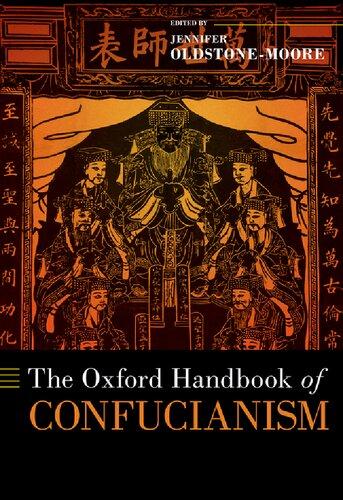
the Oxford Handbook of CONFUCIANISM
Edited by JENNIFER OLDSTONE- MOORE
Oxford University Press is a department of the University of Oxford. It furthers the University’s objective of excellence in research, scholarship, and education by publishing worldwide. Oxford is a registered trade mark of Oxford University Press in the UK and certain other countries.
Published in the United States of America by Oxford University Press 198 Madison Avenue, New York, NY 10016, United States of America.
© Oxford University Press 2023
All rights reserved. No part of this publication may be reproduced, stored in a retrieval system, or transmitted, in any form or by any means, without the prior permission in writing of Oxford University Press, or as expressly permitted by law, by license, or under terms agreed with the appropriate reproduction rights organization. Inquiries concerning reproduction outside the scope of the above should be sent to the Rights Department, Oxford University Press, at the address above.
You must not circulate this work in any other form and you must impose this same condition on any acquirer.
Library of Congress Control Number: 2022040745
ISBN 978–0–19–090618–4
DOI: 10.1093/oxfordhb/9780190906184.001.0001
Printed by Sheridan Books, Inc., United States of America
To Chris
List of Contributors xi Preface xvii
Jennifer Oldstone-Moore
Acknowledgments xxi
PART I INTRODUCTORY ESSAYS
1. Confucianism and “Confucianism”: Describing and Problematizing the Tradition 3
Jeffrey L. Richey
2. The Construction of Confucianism in East Asia 20
Nicolas Zufferey
3. The Construction of Confucianism in Europe and the Americas: Confucius and Confucian Sayings Across the Centuries 33
Lionel M. Jensen
PART II THE DEVELOPMENT OF CONFUCIANISM IN CHINA
4. The Confucian Legendary Past 57 Yuri Pines
5. Confucius and the Zhou Dynasty 70 Scott Cook
6. The Analects 84
Peimin Ni
7. Mencius 96
Jim Behuniak
8. Xunzi: The Quintessential Confucian 109
Lee Dian Rainey
9. The Confucian Classics 126
Newell Ann Van Auken
10. Early Imperial Confucianism 140 Keith N. Knapp
11. The Formation of Neo-Confucianism in the Song 153 Tze-ki Hon
12. Re-forming Confucianism: Zhu Xi’s Synthesis 164 Joseph A. Adler
13. Late Imperial Neo-Confucianism 177 Pauline C. Lee
14. Imperialism, Reform, and the End of Institutional Confucianism in the Late Qing 191 Kai-wing Chow
15. Confucianism in Republican China, 1911–1949 204 Jennifer Oldstone-Moore
16. Confucianism in Taiwan: The 20th and 21st Centuries 217 Chun-chieh Huang
17. Confucianism in Mainland China 230 Tongdong Bai
18. Images of Confucius Through the Ages 242 Deborah Sommer
PART III CONFUCIANISM BEYOND CHINA
19. Confucianism in Japan 255
Kiri Paramore
20. Confucianism in Japan: The Tokugawa Era 271 John A. Tucker
PART IV TOPICAL STUDIES OF CONFUCIANISM
34. Confucianism and Modern Culture
Christian Jochim
35. Confucianism and Ritual
Hagop Sarkissian
36. Confucius and Contemporary Ethics
Tim Connolly
37. Confucianism and Chinese Religion
Ronnie Littlejohn
38. Confucianism as a Religion
Yong Chen
List of Contributors
Joseph A. Adler is Professor Emeritus of Asian Studies and Religious Studies at Kenyon College. He is the author of Reconstructing the Confucian Dao: Zhu Xi’s Appropriation of Zhou Dunyi (SUNY, 2014) and The Yijing: A Guide (Oxford, forthcoming), and the translator of The Original Meaning of the Yijing: Commentary on the Scripture of Change, by Zhu Xi (Columbia, 2020).
Tongdong Bai is Professor of Philosophy and the director of an English-based MA program in Chinese philosophy at Fudan University in China. His publications in English include Against Political Equality: The Confucian Case (Princeton, 2019) and China: The Political Philosophy of the Middle Kingdom (Zed Books, 2012).
Jim Behuniak is Professor of Philosophy at Colby College in Waterville, ME. He is author of John Dewey and Daoist Thought: Experiments in Intra-Cultural Philosophy, Vol. 1, and John Dewey and Confucian Thought: Experiments in Intra-Cultural Philosophy, Vol. 2 (SUNY, 2019).
Sin Yee Chan is a Professor of Philosophy at the University of Vermont. Her research interests include Chinese philosophy, feminism, and philosophy of emotion. Her most recent publication is a book chapter “Why Does Confucianism Prefer Compassion to Empathy?” in New Life for Old Ideas.
Yong Chen is Research Professor at El Colegio de México. Publications include Confucianism as Religion: Controversies and Consequences (Brill, 2012), ¿Es el confucianismo una religion? (El Colegio de Mexico, 2012), Yinni kongjiao 28 tian xingji (My 28-day Visit to the Confucian Religion in Indonesia)(Chinese Heritage Center, Singapore, 2013), and Historia Minima del Confucianismo (co-authored, El Colegio de México, 2021).
Kai-wing Chow is Professor of History and East Asian Languages and Cultures and Medieval Studies at the University of Illinois, Urbana-Champaign. He specializes in Chinese intellectual and cultural history of the Ming-Qing periods. He is the author of The Rise of Confucian Ritualism in Late Imperial China: Ethics, Classics, and Lineage Discourse (Stanford, 1994) and Publishing, Culture, and Power in Early Modern China (Stanford, 2004). His edited books include Beyond the May-fourth Paradigm: In Search of Chinese Modernity, co-edited with Tze-ki Hon, Hung-yuk Ip, and Don C. Price (Lexington Books, 2008).
Tim Connolly is Professor of the Modern Languages, Philosophy, and Religion Department at East Stroudsburg University (East Stroudsburg, PA, USA). His books include Doing Philosophy Comparatively (Bloomsbury, 2015) and Foundations of Confucian Ethics: Virtues, Roles, and Exemplars (Rowman and Littlefield, forthcoming).
Scott Cook is Tan Chin Tuan Professor of Chinese Studies at Yale-NUS College in Singapore. His publications include The Bamboo Texts of Guodian: A Study and Complete Translation, Volumes I and II (Cornell East Asia Series, 2012), and three books on excavated manuscripts in Chinese, including A Study of Recorded Conversations of Confucius Texts among the Shanghai Museum Manuscripts 上博竹書孔子語錄文獻研究 (Shanghai: Zhongxi shuju, December 2021).
Michael A. Fuller is Professor Emeritus of Classical Chinese Literature and Thought at the University of California, Irvine. His two most recent books are An Introduction to Chinese Poetry (Harvard University Asian Center Press, 2017) and Drifting among Rivers and Lakes: Southern Song Dynasty Poetry and the Problem of Literary History (Harvard University Asian Center Press, 2013).
Tze-ki Hon is a Professor at the Research Centre for History and Culture, Beijing Normal University (Zhuhai campus). He is the Acting Dean of the Faculty of Humanities and Social Science at BNU-HKBU United International College. He is the author of The Yijing and Chinese Politics (2005), Revolution as Restoration (2013), Teaching the I Ching (Book of Changes) (2014, co-authored with Geoffrey Redmond), and The Allure of the Nation (2015). He edited and co-edited 6 volumes including Confucianism for the Contemporary World (2017), Cold War Cities (2022) and The Other Yijing (2022).
Chun-chieh Huang is a Distinguished Chair Professor of National Taiwan University (NTU) and a Member of Academia Europaea. His publications include East Asian Confucianisms: Texts in Contexts (NTU Press, 2015), Taiwan in Transformation: Retrospect and Prospect (Routledge, 2014), Humanism in East Asian Confucian Contexts (Columbia, 2010). His most recent books in Chinese include Discourses of Humanity in East Asian Confucianisms: A History (NTU Press, 2017), Confucianism and Chinese Historical Thinking (NTU Press, 2014).
Martin W. Huang is Professor of East Asian Studies in the School of Humanities at the University of California, Irvine. His specialty is literature and gender in late imperial China. His most recent book is Intimate Memory: Gender and Mourning in Late Imperial China (SUNY, 2018).
Lionel M. Jensen is Associate Professor of East Asian Languages and Cultures and Concurrent Professor of History at the University of Notre Dame. He is the author of Manufacturing Confucianism: Chinese Traditions and Universal Civilization (Duke, 1997). He has written on new Confucianisms, Chinese religion and thought, contemporary economy and politics, early culture contact, human rights, ancient and medievals popular cults, nationalism, mythology, and mythistory of Kongzi and Confucianism.
Christian Jochim is Professor Emeritus of Humanities, San Jose State University. His publications include Chinese Religions: A Cultural Perspective (Prentice-Hall, 1986) and “Carrying Confucianism into the Modern World: The Taiwan Case,” in Religion in Modern Taiwan: Tradition and Innovation in a Changing Society (Hawai‘i, 2003).
Sungmoon Kim is Professor of Public Policy at City University of Hong Kong, where he also serves as Associate Dean of the College of Liberal Arts and Social Sciences and Director of the Center for East Asian and Comparative Philosophy. His most recent publications include Theorizing Confucian Virtue Politics (Cambridge, 2020) and Democracy After Virtue (Oxford, 2018).
Youngmin Kim is Professor of Political Science at Seoul National University. His primary field of research is East Asian political thought. His publications include A History of Chinese Political Thought (Polity, 2017).
Youngyeon Kim is a PhD candidate at the Department of Korean Language and Literature, Seoul National University. Her primary research interests include the literary and intellectual history of Chosŏn Korea.
Keith N. Knapp is a Professor of History at The Citadel, The Military College of South Carolina. He is the author of Selfless Offspring: Filial Children and Social Order in Medieval China (Hawai’i, 2005), and co-editor of the Cambridge History of China: Volume 2, The Six Dynasties, 220–589 (Cambridge, 2019) and Early Medieval Chinese Texts: A Bibliographic Guide (coauthored; Institute of East Asian Studies University of California Berkeley, 2018).
Eddie C. Y. Kuo is Emeritus Professor of Nanyang Technological University and Academic Advisor of Singapore University of Social Sciences in Singapore. His most recent book is Language (with Brenda Chan, Singapore, 2016).
Pauline C. Lee is Associate Professor of Chinese Religions and Philosophy at Saint Louis University. Her publications include Li Zhi, Confucianism, and the Virtue of Desire (SUNY, 2012), and A Book to Burn and A Book to Keep (Hidden) (Columbia, 2016).
Ronnie Littlejohn is Chaney Distinguished Professor of Philosophy at Belmont University. He is the author of a number of works including Chinese Philosophy and Philosophers (Bloomsbury, 2022), Historical Dictionary of Daoism (Rowman & Littlefield, 2019), and 《儒学 儒学导论》(Introduction to Confucianism). Trans. Qian Jiancheng and Xiao Ya, Foreign Language and Teaching and Research Press of China (FLTR), 2019.
Robert L. Moore is Professor Emeritus of Anthropology at Rollins College where he served as Coordinator of Asian Studies. He is the coauthor, with William R. Jankowiak, of Family Life in China (Polity Press, 2017).
Julia K. Murray is Professor Emerita of Art History, East Asian Studies, and Religious Studies at the University of Wisconsin-Madison. Her books include The Aura of
Confucius: Relics and Representations of the Sage at the Kongzhai Shrine in Shanghai (Cambridge, 2021), Confucius: His Life and Legacy in Art (co-authored, Chinese Institute in America, 2010), Mirror of Morality: Chinese Narrative Illustration and Confucian Ideology (Hawai‘i, 2007; Chinese edition Sanlian shudian youxian gongsi, 2014), and Ma Hezhi and the Illustration of the Book of Odes (Cambridge, 1993).
Robert Cummings Neville is Professor Emeritus of Philosophy, Religion, and Theology and Dean Emeritus of the School of Theology and of Marsh Chapel at Boston University. He is the author of over 300 articles and 30 books, including The Tao and the Daimon (SUNY, 1982), Behind the Masks of God (SUNY, 1991), Boston Confucianism: Portable Tradition in the Late-Modern World (SUNY, 2000), Ritual and Deference (SUNY, 2008), and The Good Is One, Its Manifestations Many (SUNY, 2016).
Peimin Ni is Professor of Philosophy and East Asian Studies at Grand Valley State University in Michigan. His publications include Understanding the Analects of Confucius—A New Translation of Lunyu with Annotations (SUNY, 2017) and Confucius, the Man and the Way of Gongfu (Rowman & Littlefield, 2016).
Jennifer Oldstone-Moore is Professor Emerita of Religion and East Asian Studies at Wittenberg University in Springfield, Ohio. Her books include Confucianism (Oxford, 2002) and Understanding Taoism (Watkins, 2011).
Kiri Paramore is Professor of Asian Studies at University College Cork in the National University of Ireland. Publications include Japanese Confucianism (Cambridge University Press, 2016), Ideology and Christianity in Japan (Routledge, 2009), and Religion and Orientalism in Asian Studies (Bloomsbury, 2016).
Michael J. Pettid is Professor of Korean Studies at Binghamton University (SUNY). His publications include the co-edited volume Women and Confucianism in Chosŏn Korea (SUNY, 2011) and the forthcoming Encyclopedia of Daily Life: A Woman’s Guide to Living in Late-Chosŏn Korea (Hawai‘i, 2021).
Yuri Pines is Michael W. Lipson Professor of Chinese Studies, Hebrew University of Jerusalem. His books include Zhou History Unearthed, translation cum study of The Book of Lord Shang (Columbia, 2020 and 2017), The Everlasting Empire (Princeton, 2012), Envisioning Eternal Empire, and Foundations of Confucian Thought (Hawai‘i 2009 and 2002), in addition to four co-edited volumes.
Lee Dian Rainey was an Associate Professor in the Department of Religious Studies at Memorial University of Newfoundland. Her publications include “Confucianism and Its Texts” in Reading the Sacred Scriptures: From Oral Tradition to Written Documents and their Reception, Siobhan Dowling and Fiachra Long Eds., (Routledge, 2017), Confucius and Confucianism: The Essentials (Wiley-Blackwell, 2010) and Decoding Dao: Reading the Dao De Jing and the Zhuangzi (Wiley-Blackwell, 2013) as well as a number of scholarly articles.
Jeffrey L. Richey is Professor of Asian Studies at Berea College in Berea, Kentucky. His publications include Teaching Confucianism (Oxford, 2008), Confucius in East Asia (Association for Asian Studies, 2013), The Sage Returns (SUNY, 2015), and Daoism in Japan (Routledge, 2015).
Li-Hsiang Lisa Rosenlee is Professor of Philosophy at the University of Hawai‘i—West O’ahu. Her publications include Confucianism and Women (SUNY, 2006/2012), “A Revisionist History of Philosophy,” Journal of World Philosophies 5.1 (2020): 121–137, and A Feminist Re-imagination of Confucianism (forthcoming).
Hagop Sarkissian is Professor of Philosophy at the City University of New York, Graduate Center, and Baruch College, and Co-Director of the Columbia Society for Comparative Philosophy. His research spans various topics in the history of Chinese thought, as well as contemporary issues in moral psychology, metaethics, and the cognitive science of religion.
Qingjuan Sun is Associate Professor of Yuelu Academy at Hunan University in China. She received her doctorate in philosophy from Nanyang Technological University in 2017. Among her research interests are Chinese philosophy, comparative philosophy, and feminist philosophy.
Deborah Sommer is Professor of Religious Studies at Gettysburg College. Her recent research explores conceptualizations of the body in Chinese texts and their significance for visual representations of the body. She examines how the body and face of Confucius have been conceptualized and visualized in unusual ways over the centuries.
John A. Tucker is a Professor of History at East Carolina University in Greenville, NC. His publications include Kumazawa Banzan: Governing the Realm and Bringing Peace to All Below Heaven (Cambridge, 2021), The Forty-Seven Ronin: The Vendetta in History (Cambridge, 2018), Dao Companion to Japanese Confucian Philosophy, co-edited with Chun-chieh Huang (Springer, 2014), Critical Readings on Japanese Confucianism (Brill, 2012), Ogyū Sorai’s Philosophical Masterworks (Hawai‘i, 2006), and Itō Jinsai’s Gomō jigi and the Philosophical Definition of Early Modern Japan (Brill, 1998).
Newell Ann Van Auken is a Lecturer in the Division of World Languages, Literatures, and Cultures at the University of Iowa. Her research interests include early Chinese historiography and commentary, and her publications include The Commentarial Transformation of the Spring and Autumn (SUNY, 2016) and Spring and Autumn Historiography: Form and Hierarchy in Ancient Chinese Annals (Columbia, forthcoming 2023).
Linda Walton is Professor Emerita of History at Portland State University. Among her publications are Academies and Society in Southern Song China (Hawai‘i, 1999) and a conference volume, The Heritage Turn in China: The Reinvention, Dissemination, and Consumption of Heritage (Amsterdam University Press, 2020), co-edited with Carol Ludwig and Yi-wen Wang.
John K. Whitmore was Emeritus Researcher at the Center for Southeast Asian Studies at the University of Michigan. A specialist in precolonial Vietnam with mastery of Vietnamese and classical Chinese, he published two books and perhaps 100 articles on early Vietnamese political, cultural, diplomatic, and social history. Widely recognized around the world for his pathbreaking research, the late Professor Whitmore taught at the University of Michigan and Yale University.
Alan T. Wood is Professor Emeritus of History at the University of Washington Bothell, where he was a founding faculty of the new campus in 1990. His books include Limits to Autocracy: From Sung Neo-Confucianism to a Doctrine of Political Rights (Hawai‘i, 1995), World Civilizations, a co-authored textbook (Norton, 1997), What Does It Mean to be Human? (Peter Lang, 2001), and Asian Democracy in World History (Routledge, 2004).
Nicolas Zufferey is Professor of Sinology at the University of Geneva, Switzerland. His publications include various books and articles about ancient Chinese Confucianism, notably To the Origins of Confucianism: The Ru in Pre-Qin Times and during the Early Han Dynasty (Peter Lang, 2003).
Preface
Jennifer Oldstone- Moore
Confucianism is a multifaceted tradition that extends over thousands of years, permeating cultures that encompass more than one quarter of the world’s population. No one-volume work can provide an exhaustive study of so vast a subject. However, a selection of works by scholars from a variety of fields reveals the richness and variety of the Confucian tradition and of the range of approaches to its study. The Oxford Handbook of Confucianism draws upon the expertise of a wide range of scholars in the humanities and social sciences to provide a textured overview that engages emerging topics and innovative perspectives in contemporary Confucian studies.
Sophisticated and elitist, mundane and elemental, in many ways Confucianism is a paradox. On the one hand it has enjoyed an exalted official status in East Asian and some Southeast Asian societies. Governments have patronized it, fostering the development of an urbane and dedicated Confucian elite who built and curated a scholarly, erudite tradition of philosophy, literature, art, and government. On the other hand, Confucianism has had a broader, pervasive, and often more subtle influence in shaping the practices and values of common people and everyday life. Confucian ideas are so pervasive and interwoven in the habits, mores, and customs of the region that they can be difficult to differentiate or categorize apart from broader cultural and historical influences often denoted as simply “culture.” In this and many other ways Confucianism often defies Western intellectual and academic categorizations of religion, philosophy, and history.
Moreover, the term “Confucianism” itself is problematic, a historical oddity that in contrast to other such misnomers—for instance, Islam’s past designation as “Mohammedanism”—has stubbornly persisted into the twenty-first century. The musings, scolding, critiques, and hand-wringing by academics about both the name and the conceptual structures that have grown up around its study are as much a part of the landscape of Confucian studies as are exegesis of ancient texts and sociological study of families and filial piety. Whether this knot of nomenclature can be untangled remains to be seen; in the meantime, the term “Confucianism” is employed by scholars to designate a coherent if marvelously variable tradition. These concerns are represented and reconsidered throughout the essays in this volume.
The legacy of Confucianism has been shaped by its engagement in populations throughout East Asia and parts of Southeast Asia, and by a rich self-reflexive native tradition of commentary and study sustained through the centuries. Thus a primary
vantage point of Confucian studies draws on native categories and commentaries. Historical encounters between Asians and explorers, missionaries and imperialists over the last four-hundred-plus years was largely framed by Confucian expectations and structures of government, shaping the engagement of East Asian states in matters of diplomacy and foreign policy. The tradition has shaped the nature of interpersonal engagement between Asians and Westerners, greatly influencing the history of Asian modernization.
The Oxford Handbook of Confucianism is itself a testament to the history, breadth, reach and subtlety of Confucianism, and the vexing complexity of the term “Confucianism.” The essays here draw upon many material and theoretical resources: the reconstruction of texts and variants; philosophical strategies stemming from Western and Asian categories and approaches; historical narratives; sociological and anthropological investigations; analysis based on art historical and visual cultures; textual exegesis. Each of the thirty-eight original essays of this volume examines a key component of Confucianism using one or more of these approaches; as a volume they provide a panoramic view of the breadth and subtlety of Confucianism manifested in subject matter and hermeneutical approaches; the essays also offer new strategies for defining, understanding, and categorizing the tradition. Presenting Confucianism conceptually, chronologically, geographically, and topically, these essays are organized under four broad sections: Introductory Essays; The Development of Confucianism in China; Confucianism Beyond China; and Topical Studies of Confucianism.
Part I’s Introductory Essays consider the fundamental and perplexing methodological considerations specific to Confucianism that have become emblematic of the contours and boundaries of its academic study. Given the singularly important questions of creating and receiving this particular tradition, the first section introduces modes of study and conceptualizations in three essays, laying out the layered terrain of sources and impact, the porous and blurred boundaries, and shifting evidence and resulting conceptualizations that have shaped and sometimes transmogrified the study and understanding of Confucianism.
In the first essay, Jeffrey Richey delineates the primary points and categories of expressions of Confucianism, including education, ritual, text, and political tradition. Examining the challenges of historical and conceptual approaches from both within and outside the tradition, Richey suggests that we move away from asking the perennial yet consistently unanswerable question of “What is Confucianism?” to ask instead, “Who is a Confucian?” Rather than defining a tradition, the description of those who practice reveals the diversity and singularity of the tradition in repertoire, performer, place, and time.
Two other chapters in the Introductory Essays lay out the stakes and challenges of nomenclature. Names that denote the tradition tell their own story of tradition and received scholarship. Nicolas Zufferey explores the history, application, and significance of the native Chinese term for Confucianism—ru 儒 or literatus—noting that the indigenous associations made with this emic term are varied. Even as ru has come to indicate “Confucian” to most modern scholars outside of Asia, Zufferey notes that use of
the term is problematic in China virtually from the beginning of its usage. Moreover, the term had variant denotations in the other Confucian cultures of Korea, Japan, and Vietnam, posing a challenge even when using insider categories and nomenclature. The final essay in this section, Lionel Jensen’s, delineates the etic construction of the term, that is, the construction of Confucianism by Europeans and the emergence of European “Confucianism.” As is known from Jensen’s previous work, the manufacturing of both “Confucius” and “Confucianism” stems from Jesuit encounters with the Ming elite and subsequent encounters and conceptualizations with Western persons and powers. The term “Confucianism” itself has had a profound impact on the understanding of the tradition in the West. Jensen presents new vantage points on the Western constructions and their impact on the study of Confucianism.
The essays in the main body of the volume are organized from three vantage points. Part II, Confucianism in China, considers the development of the tradition from its earliest historical context in Chinese antiquity to the twenty-first century. Arranged in a roughly chronological format, methodologies and approaches in this this section are varied rather than monolithic. The variety of methods reflect both the indigenous and foreign modes, as well as varied “traditions” of Confucianism. Essays on the ancient heritage draw from ancient histories, philology, and archeology; essays on the foundational texts of classical Confucianism, such as the Analects and Mencius are regarded from the vantage point of philosophy; while the Confucian Classics are regarded both historically and as literary works. Other essays show important transitional periods, such as signature qualities and concerns of Neo-Confucianism in the early modern and late empire, and the reformulations of the tradition by luminaries such as Zhu Xi at the period of pivotal transformation in the Song dynasty. Using fresh approaches, this section establishes not only the historical panorama of Confucianism in China, but also the range of strategies for approaching the tradition in its diverse manifestations, and the impact of that diversity in the received tradition.
Part III, Confucianism Beyond China, reveals Confucianism both as a shared source of identity in the East Asian and Southeast Asian cultural and political world, and as a flexible and tenacious agent in varied cultural settings into which it has been absorbed and adopted. In premodern Asia, Confucianism enjoyed overt support and the systematic and institutional implementation in various states throughout the region and continues to wield influence in the present day. Confucianism is also evinced as an inchoate entity that is pervasive and identifiable in education, the etiquette of officials, family mores, and literary culture. Not only embedded in East Asian cultures and some Southeast Asian states, more recently Confucianism has taken root among Western academics in the singular manifestation of “Boston Confucianism.” Altogether, these essays reveal the expansive and diverse manifestations of Confucianism in Korea, Japan, Vietnam, Singapore, Malaysia, Indonesia, and the Western academy.
The final section, Part IV, Topical Studies of Confucianism, contains thirteen essays that show the malleability of Confucianism and the multitude of ways and arenas in which Confucianism has shaped Asian cultures. Confucianism has permeated every level of East Asian societies, shaping and nourishing many cherished cultural forms.
Essays in this section reflect Confucianism’s impact on shaping the quotidian and pedestrian structures and elements of society and culture, its integration in elite intellectual and artistic pursuits, and its imprint on standards of human relationships.
The paradoxes of the Confucian tradition are unmistakable. Confucius is a figure who claimed that he was not an innovator but a transmitter of a revered ancient tradition. Yet the aspirational outcome of the tradition is denoted by a term whose meaning Confucius dramatically changed so that junzi 君子 moved from a term of hereditary royalty to self-cultivated person, thus establishing an ideal that became fodder for social ethics and revolution. He is a man venerated as a sage and the First Teacher—and he has been reviled as Public Enemy #1 and the despised source of imperial weakness and decay. Confucianism was the basis for political culture, for strengthening government by holding officials and even the emperor accountable for immorality; governments identified as Confucian have also been regarded as irremediably conservative and dangerously tradition-bound and self-protective to the detriment of the state. Denigrated by Asians and non-Asians alike as the cause of moribund polity and social mores that endangered the very survival of East Asian states in the nineteenth and twentieth centuries, Confucianism has now revived and flourished in the twenty-first century in communist China and capitalist South Korea alike, and has been linked with the rapid growth and economic success of the region in the late twentieth and early twenty-first centuries. A highly textual tradition and a cornerstone to cultures that revere education, erudition, and the written word, the symbolic center of Confucianism has long been a figure who himself wrote nothing, his words coming to us as remembered fragments of conversations with students. Ultimately, the significance of this tradition of paradoxes is difficult to overstate. Perhaps it is in the very paradox that the vibrancy and longevity of the tradition has been nurtured. It is hoped that these essays will be a source for a concise presentation of the state of the field, fresh scholarship presenting a multitude of approaches, and a rich resource for comparative work both in terms of method and content.