Pax Economica
left- wing visions of a free trade world
marc- william palen
prince ton university press
& oxford
prince ton
Copyright © 2024 by Princeton University Press
Princeton University Press is committed to the protection of copyright and the intellectual property our authors entrust to us. Copyright promotes the progress and integrity of knowledge. Thank you for supporting free speech and the global exchange of ideas by purchasing an authorized edition of this book. If you wish to reproduce or distribute any part of it in any form, please obtain permission.
Requests for permission to reproduce material from this work should be sent to permissions@press princeton edu
Published by Princeton University Press
41 William Street, Princeton, New Jersey 08540
99 Banbury Road, Oxford OX2 6JX
press princeton edu
All Rights Reserved
Library of Congress Cataloging-in-Publication Data
Names: Palen, Marc-William, author.
Title: Pax economica: left-wing visions of a free trade world / Marc-William Palen.
Description: Princeton: Princeton University Press, 2024 | Includes bibliographical references and index.
Identifiers: LCCN 2023017887 (print) | LCCN 2023017888 (ebook) | ISBN 9780691199320 (hardback) | ISBN 9780691205137 (ebook)
Subjects: LCSH: Free trade—Political aspects—History. | Imperialism— Economic aspects—History. | Radicalism—Economic aspects—History. | International relations—History. | BISAC: BUSINESS & ECONOMICS / Economic History | HISTORY / Modern / 19th Century
Classification: LCC HF1711.P35 2024 (print) | LCC HF1711 (ebook) | DDC 382/.71—dc23/eng/20230705
LC record available at https://lccn.loc.gov/2023017887
LC ebook record available at https://lccn.loc.gov/2023017888
British Library Cataloging-in-Publication Data is available
Editorial: Hannah Paul and Josh Drake
Production Editorial: Theresa Liu
Jacket/Cover Design: Heather Hansen
Production: Erin Suydam
Publicity: James Schneider and Kate Farquhar-Thomson
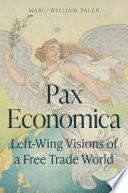
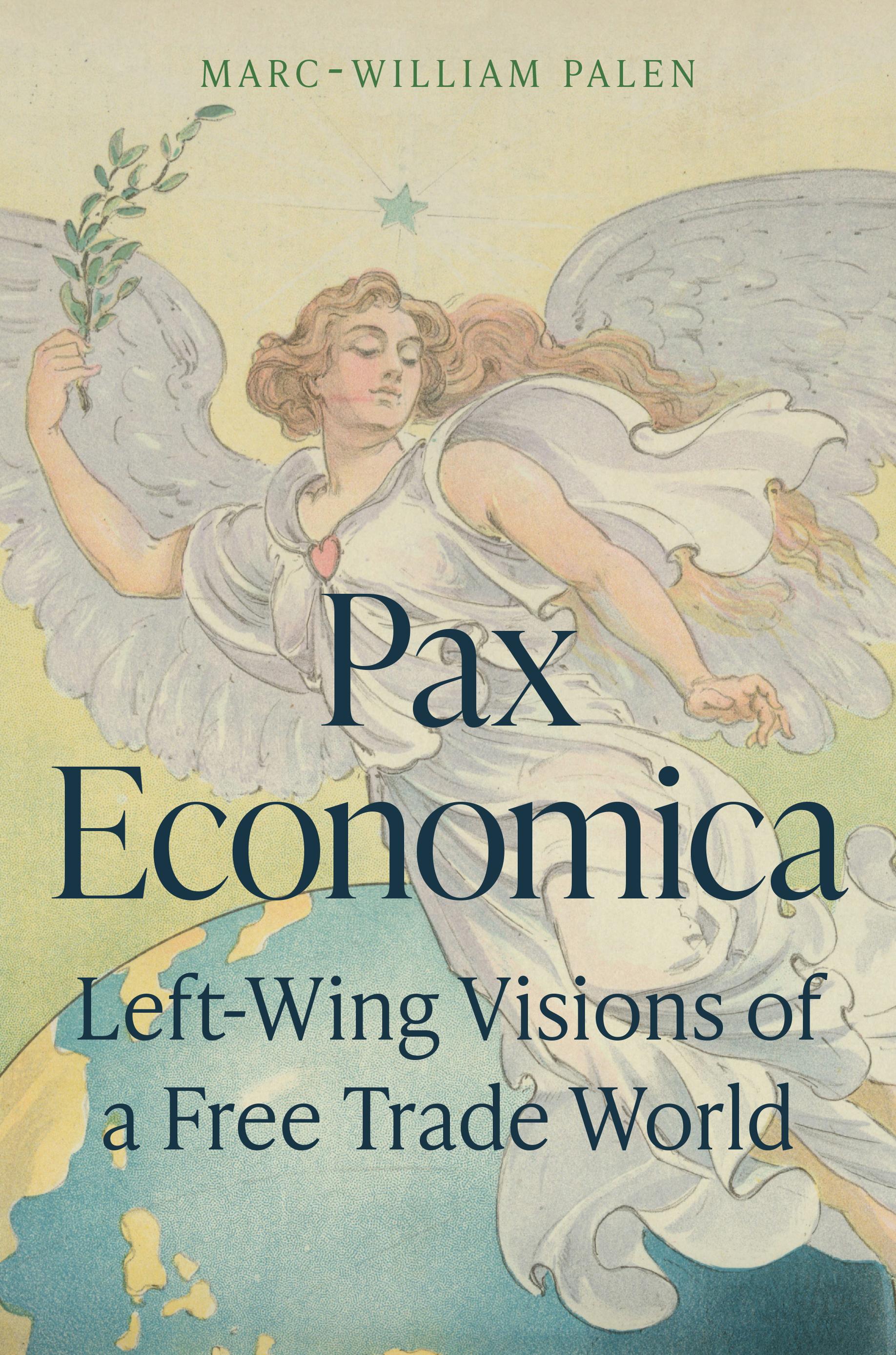
Jacket image: “—and peace shall rule,” Udo J. Keppler, 1872–1956. Published by Keppler & Schwarzmann, 1899 May 3. Library of Congress Prints and Photographs Division, Washington, DC.
This book has been composed in Classic Arno
Printed on acid-free paper. ∞
Printed in the United States of America
10 9 8 7 6 5 4 3 2 1
To Rachel
1 The Imperialism of Economic Nationalism: Globalizing the American System of Protectionism 13
2 The Anti-imperialism of Free Trade: The Liberal Radical Critique of Imperialism and War 51
3 Marx and Manchester: The Pacifistic Evolution of the Socialist Internationalist Free-Trade Tradition 93
4 Free-Trade Feminism: The International Feminist Fight for Free Trade, Anti-imperialism, and Peace 118
5 Free Trade, Fraternity, and Federation: The Economic Cosmopolitanism of Christian Pacifism 153
6 Pax Economica vs. Pax Americana: The Left-Wing Free-Trade Fight against Neocolonialism, Neomercantilism, and Neoliberalism, 1945–2022 188
1.1 ‘The Rapid Growth of Prosperity’. President McKinley pushes the massive imperial ‘Protection Snowball’, on its way to absorbing ‘Extension of Territory’.
American Economist, 23 February 1900, 89 27
1.2 ‘The White Light of Protection’. The American protectionist colonial empire shines with prosperous ‘white light’ at the dawning of the twentieth century.
American Economist, 28 December 1900, 305 28
1.3 ‘Oh Mother, May I Go Out to Swim?’ Uncle Sam, in maternal garb and carry ing a disciplinary birch rod, warns a childlike Philippines to stay away from the water labelled ‘free trade in tobacco in sugar’. Puck 58 (24 Jan. 1906) 29
1.4 C. R. Cleveland, ‘A Seditious Image’. London, British Library, India Office Records and Private Papers Mss.Eur.D.709/12. © British Library Board. All Rights Reserved/Bridgeman Images 47
2.1 Henry George pictured alongside Richard Cobden. The Daily News Land Songs for the People (1910), cover 75
4.1 Leaflet: Women’s Free Trade Demonstration (Manchester: Women’s Co-operative Guild, 1903). Jane Cobden Unwin Papers, Box 6, Folder DM 851, ‘Miscellaneous 1901–1911’. Courtesy of University of Bristol Library, Special Collections 128
4.2 WPS letterhead, 18 November 1920. Swarthmore College Peace Collection (McCabe Library, Swarthmore, PA), WPS Papers, Box 1, ‘Literature’ folder 133
4.3 ‘Tune in! The Women’s Peace Society’s Radio Time’, Newsletter Published by the Women’s Peace Society 2 (Aug. 1928), 3. Swarthmore College Peace Collection (McCabe Library, Swarthmore, PA), WPS Papers, Box 1, ‘Newsletters/Photography’ folder 135
4.4 Lizzie Magie’s original patent drawing for her board game, The Landlord’s Game, 5 January 1904 145
5.1 Les Murailles douainères de Jéricho (The tariff walls of Jericho), in Alois Derso and Emery Kelen, Le Testament de Genève (Paris, 1931), 30 168
this book owes a great debt to all those who graciously provided feedback along the way, be it by email exchanges, conversations over coffee, or close readings of draft chapters. After eight years, this has become quite a list: Duncan Bell, Bill Brands, Cathie Carmichael, Emily Conroy-Krutz, Thomas Conti, Mike Cullinane, Julio Decker, Chris Dietrich, Dexter Fergie, Katarina Friberg, Ben Gallaway, Bernard Gissibl, Sarah Hamilton, Ryan Hanley, Kristin Hoganson, Tony Hopkins, Tony Howe, Richard Huey, Jon Hunt, Julia Irwin, Josh Keidaish, Elisabeth Leake, James Mark, Steve Meardon, Jamie Miller, Jessica Moody, Simon Morgan, Jimmy Myers, Chris Nichols, Ned Richardson-Little, Natt Ringer, Aviel Roshwald, Tobias Rupprecht, Ilaria Scaglia, Cyrus Schayegh, Jay Sexton, David Thackeray, Martin Thomas, Andrew Thompson, Michael Thompson, Megan Threlkeld, Richard Toye, Heidi Tworek, James Vaughn, Daniel Whittall, Donald Winch, Krisna Wymore, the Press’s anonymous reviewers, and the brilliant students at Exeter who undertook my final-year course ‘Critics of Empire’ and joined me in investigating some of the book’s themes between Autumn 2016 and Spring 2022. And, of course, I will forever be indebted to my partner in life, Rachel Herrmann, for her keen edits, culinary sustenance, and intellectual inspiration along the way.
I am grateful to the editors and outlets that provided venues to test the book’s argument. An earlier version of chapter 1 appeared in The Cambridge History of Nationhood and Nationalism. A preliminary draft of chapter 3 appeared in the International History Review. An early condensed version of chapter 4 appeared in Imagining Britain’s Economic Future, c. 1800–1975. Ideas and themes explored in Diplomatic History and Crossing Empires have also been incorporated.1 On the editorial front, I also owe many thanks to my wonderful editors at Princeton University Press, Hannah Paul and Josh Drake, for their patience, guidance, and support throughout, as well as to Princeton’s marketing team, to my production editor Theresa Liu, and to Francis Eaves for his careful copyediting.
xi acknowledgements
I also want to thank those who supported the book’s archival research. Research support from the History Department and the College of Humanities at the University of Exeter was invaluable, as were short-term archival fellowships from the Sophia Smith Library at Smith College, the Historical Society of Pennsylvania, the Hoover Institution Library and Archives at Stanford, and UT Austin’s Harry Ransom Center. Geneva-based research was made possible thanks to the Global Humanitarianism Research Academy, which I was fortunate to contribute to during its run from 2015 to 2019. A long-term fellowship at the Massachusetts Historical Society in 2022 allowed me to finish my archival research and manuscript writing; a big shout-out to Kid Wongsrichanalai and the MHS’s amazing research team, archivists, and donors that made this possible.
abbreviations
aauw American Association of University Women
acll Anti–Corn Law League
aftl American Free Trade League
ail Anti-Imperialist League
aps American Peace Society
ccrwt Citizens’ Committee for Reciprocal World Trade
caip Catholic Association for International Peace
cecwt Consumer Education Council on World Trade
ceip Carnegie Endowment for International Peace
ceipr Carnegie Endowment for International Peace Records, Columbia University, New York
cpu Church Peace Union
cwu Church Women United
dar Daughters of the American Revolution
eec European Economic Community
eu European Union
fcc Federal Council of Churches for Fellowship of Reconciliation
gatt General Agreement on Tariffs and Trade
ghs German Historical School
hsp Historical Society of Philadelphia, PA
iapa International Arbitration and Peace Association
iaw International Alliance of Women for Suffrage and Equal Citizenship
List of Abbreviations
ica International Co-Operative Alliance
icdp International Confederation for Disarmament and Peace
icpuft International Committee to Promote Universal Free Trade
iftl International Free Trade League
iftu International Federation of Trade Unions
ilp Independent Labour Party
imf International Monetary Fund
inc Indian National Congress
ipc International Peace Campaign
isi Import Substitution Industrialization
ito International Trade Organization
lon League of Nations Archives, Geneva, Switzerland
lsi Labour and Socialist International
mecw Karl Marx/Frederick Engels Collected Works, 50 vols (New York: International Publishers, 1975–2004)
mhs Massachusetts Historical Society, Boston, MA
naacp National Association for the Advancement of Colored People
nafta North American Free Trade Agreement
ncccw National Committee on the Cause and Cure for War
ncjw National Council of Jewish Women
ncl National Consumers’ League
ncnw National Council of Negro Women
nieo New International Economic Order
nlwv National League of Women Voters
oecd Organization for Economic Co-operation and Development
oeec Organization for European Economic Co-operation
psa Argentine Socialist Party (Partido Socialista Argentino)
rtaa Reciprocal Trade Agreements Act
spa Socialist Party of America
spd [German] Social Democratic Party (Sozialdemokratische Partei Deutschlands)
List of Abbreviations xv
ssc Sophia Smith Collection, Smith College, Northampton, MA
tpp Trans-Pacific Partnership
uccw United Council of Church Women
un United Nations
unctad United Nations Conference on Trade and Development
usaid United States Agency for International Development
wap World Alliance for International Friendship through the Churches Papers, Swarthmore Peace Collection, Swarthmore, PA
wcc World Council of Churches
wcg Women’s Co-operative Guild
wilpf Women’s International League for Peace and Freedom
wpc World Peace Council
wpf World Peace Foundation
wpp Woman’s Peace Party
wps Women’s Peace Society
wtfa World Trade Foundation of America
wto World Trade Organization
ymca Young Men’s Christian Association
ywca Young Women’s Christian Association
Introduction
If you believe you are a citizen of the world, you are a citizen of nowhere.
British Conservative prime minister Theresa May, Birmingham, UK, 2016
The future does not belong to the globalists. The future belongs to patriots.
Republican US president Donald Trump, UN General Assembly, New York, 2019
in 1927, George and Ira Gershwin put on a musical satire about trade and war entitled Strike Up the Band. The plot centres around a middle-aged US cheesemaker, Horace J. Fletcher of Connecticut, who wants to corner the domestic dairy market. When Fletcher hears that the US government has just slapped a fifty per cent tariff on foreign-made cheese, he sees dollar signs. High tariffs mean his fellow citizens will have little choice but to ‘buy American’. What’s more, the tariff’s impact soon reaches beyond the national market to sour the country’s trade relationships. Swiss cheesemakers are particularly sharp in their demands for retaliation. Fletcher surmises that a prolonged Swiss–American military conflict would provide the necessary fiscal and nationalistic incentives to maintain the costly tariff on foreign cheese in perpetuity.
To make his monopolistic dream of market control a reality, Fletcher sees to it that the tariff spat between the two countries leads to all-out war. He first creates the Very Patriotic League to drum up support for the Alpine military adventure, as well as to weed out any ‘un-American’ agitation at home. The Very Patriotic League’s members, donning white hoods reminiscent of the Ku Klux Klan, go about excising all things Swiss from the nativist nation. Not even
the classic adventure tale The Swiss Family Robinson escapes notice: it gets rebranded The American Family Robinson. With domestic anti-war dissent quelled, Fletcher next orchestrates a military invasion of Switzerland. The farcical imperial intervention ends with a US victory. But just as the war with Switzerland winds down and a peaceful League of Cheese established, an ultimatum arrives from Russia objecting to a US tariff on caviar. And, it’s implied, the militant cycle repeats.
The Gershwins’ late-1920s lampoon was praised by theatre critics but panned by the public. ‘The masses in general still believe in patriotism,’ one theatre critic explained. ‘People are going to be hurt and resentful [. . .] to say nothing of the American Legion and patriotic societies.’1 He was right. The musical’s 1927 road tour was cancelled after just three weeks owing to the nationalistic blowback. A watered-down version of Strike Up the Band was churned out a couple years later. Apparently to make the story more palatable to the US sweet tooth, the tariff on cheese was switched for one on chocolate. Fletcher’s war with Switzerland, real in the original score, was downgraded to a dream sequence. Even with these ameliorative changes, however, critics once again warned that ‘the more aggressive American patriotic organizations’ might ‘threaten reprisals’.2
Strike Up the Band’s satirical association of US protectionism with nationalism, militarism, and imperialism may have gone too far for the average ‘patriotic’ American, but it would have struck a sympathetic chord with many left-wing peace workers. After all, during and after the First World War, the country’s peace activists—liberal radicals, socialists, feminists, Christians—had similarly witnessed with alarm the uptick of these very same ‘isms’ at home and abroad. And in seeking to curb these trends, left-wing peace workers often faced persecution, even imprisonment, at the hands of deputized ‘patriotic’ organizations and the US government. The peace movement’s common association of trade wars with geopolitical conflict, as in the Gershwin musical, is central to the story that follows. Leading peace activists envisioned instead a free trade world as promising a new prosperous economic order devoid of imperialism and war: what they increasingly referred to as their ‘Pax Economica’. Strike Up the Band’s libretto tongue-lashing of ‘patriotic’ protectionism can thus be recast as a musical accompaniment to what was, by the late 1920s, a long-standing international left-wing tradition that connected economic cosmopolitanism with anti-imperialism and peace—and economic nationalism with imperialism and war.
Writing this book amid a pandemic and mounting nationalist demands for economic self-sufficiency has been instructive. The COVID-19 pandemic itself
has heightened the tensions wrought from greater interdependence. Covid’s rapid spread illustrates a doomsday scenario that the Cassandras of globalization have long warned about. The ensuing stringent travel restrictions, broken supply chains, resurgent xenophobia, and further protectionist retrenchment that have followed demonstrate how the coronavirus has ratcheted up the political forces of anti-globalism that had been making headway in the years since the 2008 Great Recession.3 This economic nationalist revival has most strikingly transpired within the two nations most responsible for creating the more liberal and open economic order after the Second World War, the United States and Britain.4
In the years following the 2016 presidential election, US political leaders from both major parties have renounced the pro–free market ‘Washington Consensus’. Republican president Donald Trump kicked things off with the unveiling of his ‘America First’ foreign trade policy, replete with xenophobia, tariff wars against trading partners, and anti-immigration policies. Trump pulled the United States out of the massive Asia-Pacific trade agreement called the Trans-Pacific Partnership, scrapped the North American Free Trade Agreement, levied punitive tariffs against the country’s closest allies, and even attempted to build a giant wall along the US–Mexico border to deter migrants. Democratic president Joe Biden’s ‘Buy American’ programme and industrial policy echo Trump’s, and Biden has also continued the trade war with China. In some areas, Biden’s protectionist policies are even more extreme than his predecessor’s.
Brexit Britain’s bipartisan ‘Buy British’ campaign, in turn, has followed close on the heels of the UK’s chaotic and nationalistic dislocation from the European Union (EU), accompanied by severe immigration restrictions to ‘take back control’ of British sovereignty. Some Conservative Party Brexit champions have promised that former British colonies such as India will replace the EU single market; others have proffered a more selective racialized vision called CANZUK, an economic union between the UK and its former ‘white’ settler colonies Canada, Australia, and New Zealand. Both proposals drip with imperial nostalgia.5 The consequent creation of new trade barriers between the UK and the EU and between Northern Ireland and the rest of the UK, in turn, have upset the European peace project.
Nationalistic onlookers have been fast to follow the Anglo-American protectionist cue. Right-wing governments in Italy, Hungary, Poland, Turkey, Brazil, the Philippines, India, China, and Japan, among others, have taken inspiration from the burgeoning protectionist consensus. Then came Russia’s
brazen imperial incursion into Ukraine in 2022, accompanied by crippling Western economic sanctions in retaliation. The economic nationalist and imperial backdrop of the present volume no longer looks all that distant or alien.
Pax Economica’s spectrum of left-wingers broadly encompasses those whose politics were left of centre. Some sought reform, others revolution, but all shared the belief that economic interdependence could foster democratization, economic and social justice, and world harmony. For some left-wingers like Karl Marx writing in the 1840s, the envisaged interconnectivity wrought from free trade signalled the next progressive step in capitalism’s march towards proletarian revolution, and therefore deserved support. But for many other left-wing internationalists, universal free trade came to be seen as the economic bedrock of a more peaceful, prosperous, and democratic world order. Left-leaning liberal radical reformers such as Richard Cobden, Henry George, Mark Twain, Leo Tolstoy, Norman Angell, Abe Isoo, J. A. Hobson, Jane Addams, Rosika Schwimmer, and Fanny Garrison Villard connected free trade with democracy promotion, antislavery, universal suffrage, civil rights, prosperity, anti-imperialism, and peace. Socialist internationalist peace workers such as Florence Kelley, Eduard Bernstein, Karl Kautsky, Crystal Eastman, Toyohiko Kagawa, Norman Thomas, and Kirby Page leaned further left in their critiques of capitalism and economic inequality. But these same social democrats, demo cratic socialists, and communists nevertheless often found themselves working alongside their more moderate liberal radical contemporaries to realise their shared vision of a peaceful, free trade world.
Pax Economica’s motley crew of left- wing free traders were the leading globalists of their age, in contrast to the right-wing free-market advocacy more commonly associated with globalism’s champions today. The disjuncture between then and now offers an opportunity to correct a historical imbalance. The past couple of decades have witnessed a flurry of scholarship tracing the right-wing origins of today’s free-market ideas back to the interwar years.6 By recovering the shared world of left-wing radicalism and free trade, this book tells a very different story, with a much earlier starting point: the 1840s. Back then, the left-leaning free-trade ideology of anti-imperialism and peace was famously known as ‘Manchester liberalism’ or ‘the Manchester School’, owing to its roots in Manchester, England. It was also referred to as ‘Cobdenism’, after the school’s most prominent British spokesman, Richard Cobden. Cobdenism took on various left-wing guises and varieties, suffusing the international peace and anti-imperial movements from the mid-nineteenth century onward.
The terminology used to describe the book’s left-wingers accordingly reflect their intersectional fight for free trade, anti-imperialism, and peace. Their movement is referred to interchangeably throughout the book as ‘the freetrade-and-peace movement’, ‘the commercial peace movement’, and ‘the economic peace movement’. So too ‘internationalism’ is used interchangeably with ‘cosmopolitanism’, because of their shared intellectual property for much of the period between the mid-nineteenth and mid-twentieth centuries. During this time, even the most extreme cosmopolitans recognized the existence and staying power of the nation state; and even the staunchest internationalists, while recognizing that nationalism was an entrenched reality, also saw it as the most power ful stumbling block to a more peaceful, interdependent world order. Internationalism and cosmopolitanism back then were both also closely associated with ‘interdependence’: what we now more often refer to as ‘globalization’.7
‘Free trade’ and ‘protectionism’ also had meanings par ticular to the century preceding the Second World War. This was a time when governments relied largely on tariffs for generating revenue. Pax Economica’s cast of characters accordingly understood free trade to mean low tariffs for revenue purposes only, rather than their near absence as free trade is commonly thought of today. Left-wing free traders back then sought to lower government expenditures on imperial defence and militaries to keep revenue tariffs as low as possible for the consumer—with imperial devolution, peace, and prosperity a natural byproduct. Most protectionists, believing war and imperialism to be immutable, instead sought discriminatory or prohibitive tariffs on foreign products both to insulate domestic producers from unfettered international competition and to pay for expanding their nation’s militaries and empires. This form of economic nationalism, often accompanied by government subsidies for domestic businesses and internal improvements, became popularly known by the midnineteenth century as the ‘American System’ in the United States. The close late- nineteenth and twentieth- century association of protectionism and colonialism, in turn, is sometimes referred to as ‘neomercantilism’. As Eric Helleiner has argued, neomercantilism was an updated version of the older mercantilist system of imperial trading blocs and monopolies common among early modern empires.8
The left-wing economic cosmopolitan fight for anti-imperialism and peace begins with the mid-nineteenth-century transatlantic free-trade movement. At first glance, it might seem ironic that the leading peace and anti-imperial theories emanated outward from Britain, the dominant empire of the day. The
British Empire of the Victorian age likely brings to mind ambitions of worldwide market access and a British world system controlled through naval supremacy, pith helmets, and diplomatic persuasion. This depiction is in keeping with what is now a prodigious body of literature examining the complex relationship between British imperialism and modern liberalism.9 This volume adds further complexity by exploring how liberal ideas spurred transnational anti-imperial and peace activism; for many politically left-of-centre adherents, free-trade liberalism contained a hard-nosed critique of imperialism, militarism, and war.
And yet the radical left-wing free-trade fight to end imperialism and war, if recognized at all, is treated as a mere curiosity: what Stephen Howe describes as ‘a minority current, and a limited and conditional stance’.10 This marginalization stems in part from a long-standing tendency to misremember the halfcentury leading up to the First World War as ‘a golden era of globalization’, as Tara Zahra puts it.11 Pax Economica’s study of the commercial peace movement paints a very different political economic picture. Recovering the pacifistic efforts of left-wing free traders thus provides a new transnational history of peace activism and its complex relationship to global capitalism between the mid-nineteenth century and today. Excepting British peace historiography, most national histories of pre-1945 peace movements (and most are national histories) grant little more than a passing reference, if any, to free trade. They also exclude the numerous organizations for which peace through free trade was their main purpose.
Free trade’s marginalization and exclusion has a long lineage within peace studies. Helen Bosanquet, in her 1924 study of the relationship between free trade and peace in the nineteenth century, went so far as to state that peace societies had ‘lost even their mild interest in Free Trade’ after a brief flirtation in the 1840s and 1850s.12 The doyen of peace studies Merle Curti has argued that the ‘slow advance of peace’ over the late nineteenth and early twentieth centuries owed much to the fact that ‘peacemakers have not adequately fought the economic forces that make for war’. He goes on to argue that ‘most friends of peace [. .] have naturally accepted the existing economic order and have not seen the threats to peace inherent in it’. Others have held that peace activists didn’t think about economic matters at all. Gorham Munson, for instance, asserts that ‘as a movement pacifism has been notoriously innocent of economics’. These observations, John Nelson concludes, ‘hold true for the peace movement prior to the First World War’, and to a large extent after it.13 The disjuncture works both ways. Those histories of world governance and liberal
internationalism that have recognized the sizeable role played by free-trade ideas and their left-wing adherents have isolated them from their peace activism.14 This book turns these long-held assumptions, exclusions, and dissociations on their heads by showing how free trade remained a central tenet among left-wing internationalists working within the era’s anti-imperial and peace movements to overturn the neomercantilist order.
Free trade’s historiographical exclusion is more surprising still considering that commercial peace workers were well recognized in their day, not least by Nobel Peace Prize committees. The first ever Nobel Peace Prize, in 1901, was awarded to two individuals. Of the two names, Henri Dunant is the more familiar today, as the founder of the International Committee of the Red Cross in Geneva. The other, the leader of the turn- of-the- century French peace movement Frédéric Passy, is less remembered. Passy was a French disciple of Britain’s mid-nineteenth-century ‘apostle of free trade’ Richard Cobden. Like Cobden, Passy believed that universal free trade was an essential ingredient for a more peaceful world and accordingly helped create numerous European economic peace organizations. The Nobel committee’s interest in the economic cosmopolitan connection to peace only grew stronger after the First World War. In the summer of 1919 the Nobel Institute even ran an international competition to provide ‘An Account of the History of the Free Trade Movement in the Nineteenth Century and its Bearing on the International Peace Movement’.15 Other left-leaning leaders of the commercial peace movement to receive the prize thereafter included Chicago’s Jane Addams (1931), Britain’s Norman Angell (1933), former Democratic US secretary of state Cordell Hull (1945), and Boston’s Emily Green Balch (1946).
Along the way, Pax Economica traces how the global vision of left- wing economic cosmopolitans came to embrace supranational oversight as a prerequisite for their pacifistic free-trade order. As Glenda Sluga describes it, by the end of the First World War ‘steam, electricity, and trade had socialized a new kind of international man’ who put greater faith in supranational governance to maintain the peace.16 The book’s ‘cosmopolitan internationalists’ well understood that this meant weakening national borders and diminishing national sovereignty and allegiances. This globalist mindset and worldview paved the way for the likes of the League of Nations and, eventually, the United Nations, the EU, and the World Trade Organization, key institutions that would underpin subsequent post-1945 economic ordering.
The book’s thematic approach highlights the multifaceted growth and evolution of this left-wing free-trade tradition within transnational anti-imperial