Exploring the Variety of Random Documents with Different Content
The Project Gutenberg eBook of Old lamps for new
This ebook is for the use of anyone anywhere in the United States and most other parts of the world at no cost and with almost no restrictions whatsoever. You may copy it, give it away or re-use it under the terms of the Project Gutenberg License included with this ebook or online at www.gutenberg.org. If you are not located in the United States, you will have to check the laws of the country where you are located before using this eBook.
Title: Old lamps for new
Author: E. V. Lucas
Artist: Johannes Vermeer
Release date: March 16, 2024 [eBook #73174]
Language: English
Original publication: United States: The Macmillan Company, 1911
Credits: Charlene Taylor and the Online Distributed Proofreading Team at https://www.pgdp.net (This file was produced from images generously made available by The Internet Archive/American Libraries.) *** START OF THE PROJECT GUTENBERG EBOOK OLD LAMPS FOR NEW ***
Transcriber’s Note
New original cover art included with this eBook is granted to the public domain. It includes an illustration taken from the original book.
Additional notes will be found near the end of this ebook.
OLD LAMPS FOR NEW
THE MACMILLAN COMPANY
NEW YORK · BOSTON · CHICAGO
SAN FRANCISCO
MACMILLAN & CO., LIMITED
LONDON · BOMBAY · CALCUTTA
MELBOURNE
THE MACMILLAN CO. OF CANADA, LTD. TORONTO
(Larger)
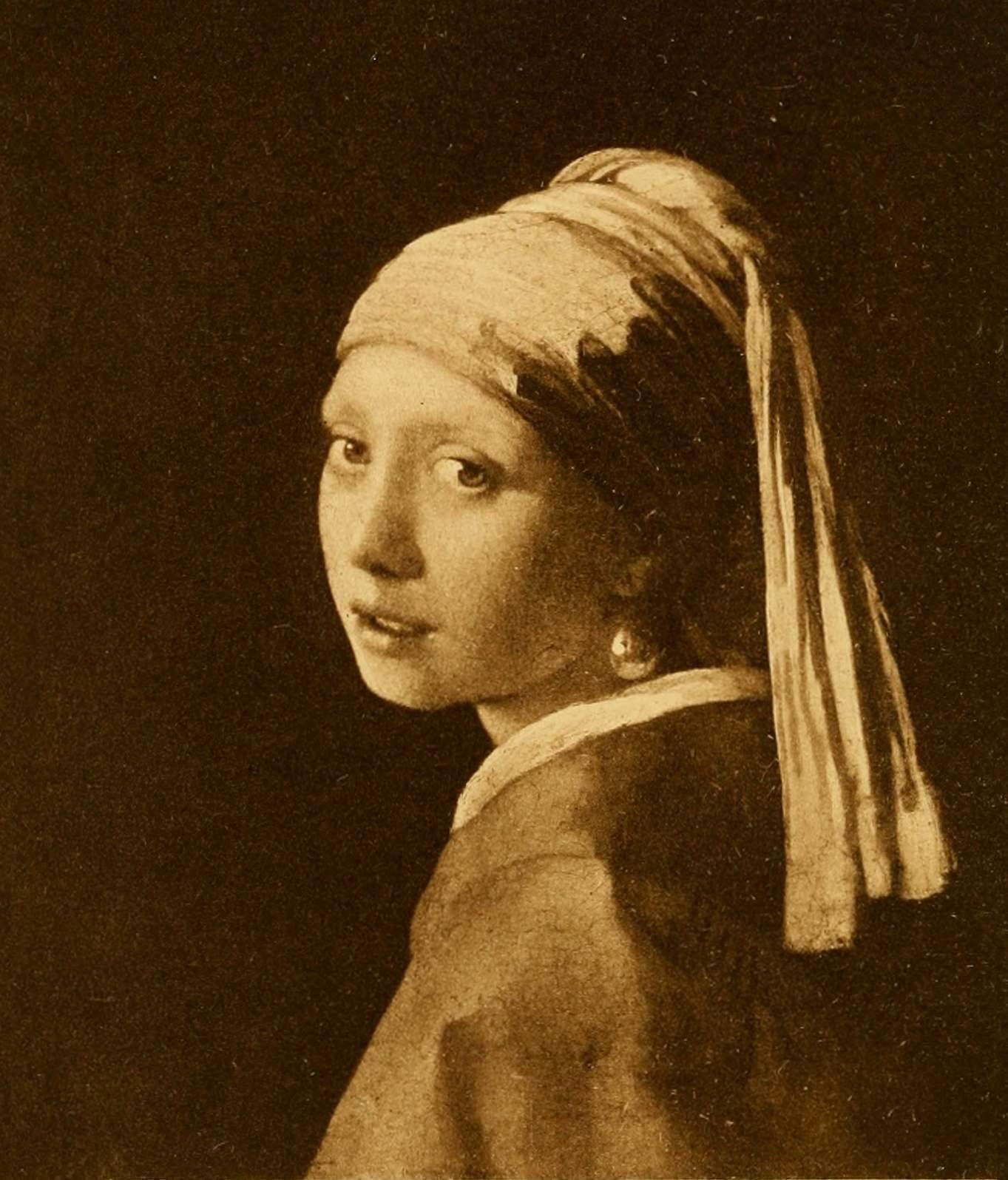
The Headofa Young Girl, byJanVermeerofDelft,
fromthePictureattheMauritshuis
attheHague.
OLD LAMPS FOR NEW
BY
E. V. LUCAS
AUTHOR OF “OVER BEMERTON’S” “MR. INGLESIDE,” ETC.
NEW YORK
THE MACMILLAN COMPANY
COPYRIGHT, 1911, BY THE MACMILLAN COMPANY.
Set up and electrotyped. Published September, 1911. Norwood Press
J. S. Cushing Co.—Berwick & Smith Co. Norwood, Mass., U.S.A.
OLD LAMPS FOR NEW
The School for Sympathy
I HAD heard a great deal about Miss Beam’s school, but not till last week did the chance come to visit it.
The cabman drew up at a gate in an old wall, about a mile out of the town. I noticed as I was waiting for him to give me change that the Cathedral spire was visible down the road. I rang the bell, the gate automatically opened, and I found myself in a pleasant garden facing a square red ample Georgian house, with the thick white window-frames that to my eyes always suggest warmth and welcome and stability. There was no one in sight but a girl of about twelve, with her eyes covered with a bandage, who was being led carefully between the flower-beds by a little boy of some four years her junior. She stopped, and evidently asked who it was that had come in, and he seemed to be describing me to her. Then they passed on, and I entered the door which a smiling parlour-maid—that pretty sight!—was holding open for me.
Miss Beam was all that I had expected—middle-aged, authoritative, kindly, and understanding. Her hair was beginning to turn grey, and her figure had a fulness likely to be comforting to a homesick child.
We talked idly for a little while, and then I asked her some questions as to her scholastic methods, which I had heard were simple.
“Well,” she said, “we don’t as a matter of fact do much teaching here. The children that come to me—small girls and smaller boys— have very few formal lessons: no more than is needful to get application into them, and those only of the simplest—spelling, adding, subtracting, multiplying, writing. The rest is done by reading to them
and by illustrated discourses, during which they have to sit still and keep their hands quiet. Practically there are no other lessons at all.”
“But I have heard so much,” I said, “about the originality of your system.”
Miss Beam smiled. “Ah, yes,” she said. “I am coming to that. The real aim of this school is not so much to instil thought as thoughtfulness—humanity, citizenship. That is the ideal I have always had, and happily there are parents good enough to trust me to try and put it into execution. Look out of the window a minute, will you?”
I went to the window, which commanded a large garden and playground at the back.
“What do you see?” Miss Beam asked.
“I see some very beautiful grounds,” I said, “and a lot of jolly children; but what perplexes me, and pains me too, is to notice that they are not all as healthy and active as I should wish. As I came in I saw one poor little thing being led about owing to some trouble with her eyes, and now I can see two more in the same plight; while there is a girl with a crutch just under the window watching the others at play. She seems to be a hopeless cripple.”
Miss Beam laughed. “Oh, no,” she said; “she’s not lame, really; this is only her lame day. Nor are those others blind; it is only their blind day.” I must have looked very much astonished, for she laughed again. “There you have an essential part of our system in a nutshell. In order to get a real appreciation and understanding of misfortune into these young minds we make them participants in misfortune too. In the course of the term every child has one blind day, one lame day, one deaf day, one maimed day, one dumb day. During the blind day their eyes are bandaged absolutely, and it is a point of honour not to peep. The bandage is put on overnight; they wake blind. This means that they need assistance in everything, and other children are told off to help them and lead them about. It is educative to both of them—the blind and the helpers.
“There is no privation about it,” Miss Beam continued. “Every one is very kind and it is really something of a joke, although, of course,
before the day is over the reality of the affliction must be apparent even to the least thoughtful. The blind day is, of course, really the worst,” she went on, “but some of the children tell me that the dumb day is the most dreaded. There, of course, the child must exercise willpower only, for the mouth is not bandaged.... But come down into the garden and see for yourself how the children like it.”
Miss Beam led me to one of the bandaged girls, a little merry thing, whose eyes under the folds were, I felt sure, as black as ashbuds. “Here’s a gentleman come to talk to you,” said Miss Beam, and left us.
“Don’t you ever peep?” I asked, by way of an opening.
“Oh, no,” she exclaimed; “that would be cheating. But I’d no idea it was so awful to be blind. You can’t see a thing. One feels one is going to be hit by something every moment. Sitting down’s such a relief.”
“Are your guides kind to you?” I asked.
“Pretty good. Not so careful as I shall be when it’s my turn. Those that have been blind already are the best. It’s perfectly ghastly not to see. I wish you’d try!”
“Shall I lead you anywhere?” I asked.
“Oh, yes,” she said; “let’s go for a little walk. Only you must tell me about things. I shall be so glad when to-day’s over. The other bad days can’t be half as bad as this. Having a leg tied up and hopping about on a crutch is almost fun, I guess. Having an arm tied up is a little more troublesome, because you have to get your food cut up for you, and so on; but it doesn’t really matter. And as for being deaf for a day, I shan’t mind that at least, not much. But being blind is so frightening. My head aches all the time, just from dodging things that probably aren’t there. Where are we now?”
“In the playground,” I said, “going towards the house. Miss Beam is walking up and down the terrace with a tall girl.”
“What has the girl got on?” my companion asked.
“A blue serge skirt and pink blouse.”
“I think it’s Millie,” she said. “What colour hair?”
“Very light,” I said.
“Yes, that’s Millie. She’s the head girl. She’s awfully decent.”
“There’s an old man tying up roses,” I said.
“Yes, that’s Peter. He’s the gardener. He’s hundreds of years old!”
“And here comes a dark girl in red, on crutches.”
“Yes,” she said; “that’s Beryl.”
And so we walked on, and in steering this little thing about I discovered that I was ten times more thoughtful already than I had any notion of, and also that the necessity of describing the surroundings to another makes them more interesting.
When Miss Beam came to release me, I was quite sorry to go, and said so.
“Ah!” she replied; “then there is something in my system after all!”
I walked back to the town murmuring (inaccurately as ever) the lines:
Can I see another’s woe
And not share their sorrow too?
O no, never can it be, Never, never, can it be.
On the Track of Vermeer
NOT long ago the papers contained a little paragraph stating that Herr Bredius, the curator of the Mauritshuis Gallery at the Hague, had just returned from a journey of exploration in Russia, bringing back with him over a hundred valuable pictures of the Dutch School which he had discovered there, in country and city mansions and even in farmhouses; for the Russian collectors of the seventeenth and eighteenth centuries, as is well known, greatly esteemed and desired (as who must not?) Dutch art. That was all that the paragraph said, and since that was all we may feel quite sure that among those hundred and more pictures there was nothing from the divinely gifted hand of Jan Vermeer of Delft; because the discovery of a new picture by Jan Vermeer of Delft is something not merely for mention in a paragraph but among the special news—something with which to agitate the cables of the world.
Can you conceive of a more delightful existence than that of Herr Bredius—to be when at home the conservator of such masterpieces as hang in the Mauritshuis on the banks of the Vyver, in the beautiful and bland Dutch capital (some of which are his own property, and only lent to the gallery), and when in mind to travel, to leave the Hague with a roving commission to hunt and acquire new treasures? I can’t. And that is why, when I am asked who I would choose to be were I not myself, I do not say the King, or Mr. Pierpont Morgan, but Herr Bredius of the Mauritshuis.
And yet if I had Mr. Pierpont Morgan’s wealth, I would.... But let us consider first the life and works of Jan Vermeer of Delft.
Jan Vermeer, or Van der Meer, was born in Delft and baptized there on 31 October, 1632. His father was Reymer Janszoon Vermeer, and his mother Dingnums Balthasars. In 1653 he married, also in Delft,
Catherina Bolnes or Bolenes. How many children they had I do not know, but eight survived him. It is generally believed that Karel Fabritius, himself a pupil of Rembrandt and a painter of extraordinary distinction, was Vermeer’s instructor; but the period of tuition must have been very short, for Fabritius became a member of the Delft Guild in 1652, before which he might not teach, and he was dead in 1654, killed by a powder explosion. A poem on the death of this great painter by a Delft writer has a stanza to the effect that from the ashes of that Phœnix rises Vermeer. There is very little of the work of Fabritius to be seen; but his exquisite “Siskin,” a small picture of the little musical shy bird, painted with the breadth that is commonly kept for auguster subjects, hangs next Vermeer’s “Head of a Young Girl” (my frontispiece) at the Hague, and would alone prove Fabritius to have possessed not only strength but sweetness.
Dr. Hofstede de Groot, the author of a magnificent monograph on Vermeer and Fabritius, published in 1907 and 1908, conjectures Vermeer to have had an Italian master as well as a Dutch, and it is easy to believe. I had, indeed, with none of Dr. de Groot’s knowledge, come to a similar conclusion; and in the huddle of pictures in one of the rooms of the Academy at Vienna I even found a copy of an Italian picture—a Correggio, I think—which Vermeer’s hand might easily have made, so luminous and liquid is it. That he visited Italy is more than unlikely—practically impossible; but to gain that something Italianate which his works occasionally discover there was no necessity for him to have done so, for Italian painters settled in Holland in some numbers. The “Diana and her Nymphs” at the Hague, and the “Christ in the House of Martha and Mary” (which I have seen only in reproduction) in Scotland, have each Italian characteristics; but I must add that in Vermeer’s authorship of these pictures Dr. de Groot does not absolutely believe.
The facts about Vermeer are singularly few, considering the high opinion in which he was held by contemporaries. Almost the only intimate thing told of him is the story of his unpaid bread bill, as recounted by De Monconys, the French traveller. De Monconys visited him in 1663 and wanted to buy a picture, but none could be found in the artist’s house. Vermeer’s baker consented, however, to sell one
which was hanging on his wall and for which he had allowed 300 florins. After Vermeer’s death, it is told, the baker’s debt of 3176 florins was liquidated by two pictures. Since Vermeer’s wife is known to have had rich relations and to have come into money from time to time, we may guess this gigantic account to have been the result rather of bad management than of poverty; for of all the painters of the world none less suggests necessity than Jan Vermeer of Delft: on the contrary, his work carries with it the idea of aristocracy and prosperity, certainly a fastidiousness rarely associated with the father of a large family’s struggle for existence in the seventeenth century. Moreover, we are told that his prices, even when he was alive, were higher than those of any painter save Gerard Dou, and such a guild as that of Delft would not be likely to elect a starving man as its chief four several times.
No, if Vermeer owed money to his baker it was because he was easy-going, placid, above such trifles, as other artists have been before and since: indeed, occasionally still are, I am told. You can see that Vermeer was placid: the fact shines in every picture. He was placid, and he liked others to be placid too. His wife was placid, his daughters (if, as I conjecture, certain of his models were his daughters) were placid, his sitters were placid. His one undisputed landscape shows that he wanted nature to be placid; his one street scene has the dove brooding upon it.
Yet when we put in one balance the debt for bread and in the other the very slender output of this famous artist, to whom a collector could come even from distant France with a heavy purse, we are face to face with a difficulty; because even placid men when they become chiefs of guilds do not much care for continual reminders that they owe money, and in such a small town as Delft Vermeer and his baker would have had some difficulty in not often meeting. Moreover what of the butcher? And the vintner? The inference therefore—especially when it is remembered that the baker occasionally agreed to be paid in kind and hang we know not which of the masterpieces on his wall—the inference therefore is that Vermeer painted, was forced by necessity to paint, many pictures in excess of the very small number at the present moment identifiable. Of this, more later; but I want to bring out the
point here, since it is of the highest importance and might indeed completely alter the life of Mr. Pierpont Morgan.
We may believe Vermeer to have been a home-keeping man from several circumstances. One is that he was not only born in Delft (in 1632), but he married in Delft (in 1653) and died in Delft (in 1675); another that the years in which he was a chief of the Delft Guild, and therefore a resident there, were 1662, 1663, 1670 and 1671; another that his only famous landscape and his only known street scene are both Delft subjects; and another that of his thirty odd known figure pictures, thirty-one are lighted from the left precisely in the same way, which leads one to suppose that most of them were painted in the same studio.
When I add that Vermeer died in December, 1675, at the early age of 43, and that his executor was Antony van Leeuwenhoek, the inventor of the microscope (and probably his model for several pictures), I have said all that is known for certain of his career.
To me it is not to Andrea del Sarto that the title of the “Perfect Painter” belongs, but to Jan Vermeer of Delft. Andrea with all his weakness was in a way greater than that: he had, one can see, finer thoughts, sweeter imaginings, a richer nature than a perfect painter needs; the phrase perfect painter limits him to the use of his brush, and one thinks of him (and not wholly because Browning was a man of genius) always as a human being too. But of Vermeer we know nothing save that he was a materialistic Dutchman who applied paint to canvas with a dexterity and charm that have never been equalled: in short, with perfection. His pictures tell us that he was not imaginative and not unhappy; they do not suggest any particular richness of personality; there is nothing in them or in his life to inspire a poet as Andrea and Lippo Lippi inspired Browning and Romney Tennyson. Vermeer was not like that. But when it comes to perfection in the use of paint, when it comes to the perfect painter—why, here he is. His contemporary Rembrandt of the Rhine is a giant beside him; but ruggedness was part of his strength. His contemporary, Frans Hals of Haarlem, could dip his brush in red and transform the pigment into pulsating blood with one flirt of his wrist, and yet think of his splendid
carelessnesses elsewhere. His contemporary, Jan Steen of Leyden, had a way of kindling with a touch an eye so that it danced with vivacity and dances still, after all these years; but what a sloven he could be in his backgrounds! His contemporary Peter de Hooch could flood canvas with the light of the sun, but how weakly drawn are some of his figures! And so one might go on with the other great painters—the Italians and the Spanish and the English and the French; naming one after another, all with more to them as personalities than Vermeer, all doing work of greater import; and all, even Michael Angelo and Leonardo, even Correggio, even Raphael, even Andrea, even Chardin, falling beneath Vermeer in the mere technical mastery of the brush and the palette—no one having with such accuracy and happiness adjusted the means to the desired end. He aimed low, but at his best —in, say, six pictures—he stands as near perfection as is possible.
It is this joyful mastery that fascinates me and made it so natural, when in the autumn of 1907 I was casting about for a motive for a holiday, to say, “Let us pursue this painter, let us see in twenty-one days all the Vermeers that we can.”
The farthest European city containing a Vermeer of which I then knew being Vienna (I afterwards found that Budapest has a putative example), we went there first; and there was a certain propriety in doing so, for in the Vienna picture the artist is supposed to have painted himself, and to begin with a concept of him was interesting and proper. The “Maler,” as it is there called, is at Count Czernin’s, a comfortable mansion at Number 9 Landes-gericht strasse, open to visitors only on Mondays and Thursdays. There are four rooms of pictures, and nothing in them matters very much save the Vermeer. An elderly butler is on duty; he shows you the best place to stand in, brings a chair, and murmurs such facts about the marvellous work as appeal most to his imagination—not so much that it is a miracle of painting as that it was acquired for a mere song, and that Americans constantly walk into this room with blank cheques in their hands and entreat the Count to fill them up at his pleasure. But no, the Count is too proud of his possession. Well, I admire him for it. The picture may not have such radiance as the “Pearl Necklace” at Berlin, or such charm as the “Woman Reading a Letter” at the Ryks, or such sheer
beauty as the Mauritshuis “Girl’s Head,” but it is brilliant and satisfying. It does not give me such pleasure as certain others, to be named later, but it is in some ways perhaps finer. Vermeer is seated at his easel with his back to the world—a largish man with long hair under a black velvet cap, and the careful costume of a man who can pay for his bread. Nor does the studio suggest poverty. The artist is at work on the head of a demure damsel whom he has posed near the window, with the light falling upon her, of course from the left. The little mousy thing has a wreath of leaves in her hair and a large book held to her breast; in her right hand is a long musical instrument. On the wall is the most fascinating of the many maps that the artist painted—with twenty little views of Dutch towns in the border. Vermeer was the first to see the decorative possibilities that lie in cartography; and he was also, one conjectures, a geographer by inclination.
The beautiful blue Danube had so little water in it just then that the voyage to Budapest would have taken almost twice as long as it should, and there was not time. To make the journey by train, just for one day, was an unbearable thought at that moment; although I now regret that we did not go. The Budapest Vermeer is a portrait, a Dutch Vrouw, standing, looking full at the world, without any accessories whatever. Not having seen it, I can express no opinion as to its authorship, but Dr. de Groot is doubtful, although he reproduces the picture in his book among the practical certainties. So also does M. Vanzype, the most recent of our painter’s critics, whose monograph, “Vermeer de Delft,” in the “Collection des Grands Artistes des PaysBas,” was published in 1908. M. Vanzype goes farther, for he also includes the portrait of a young man in the Brussels gallery for which the curator, M. A. J. Wauters, has made out so eloquent a case, but which Herr Bredius and Dr. de Groot both repudiate. For myself, all I can say of it is that one does not jump to the denial of it as one did to the putative example in our National Gallery, just completed by the addition of its lost half. The Budapest Vermeer is in reproduction a beautiful picture—a youngish Dutch woman with the inevitable placidity, but not so open and easy-going as the personalities whom the artist chose for his own pictures: she has folded hands and large white cape and cuffs. M. Vanzype admits that this portrait and that of