A Sketch of the World After the COVID-19 Crisis: Essays on Political Authority, The Future of Globalization, and the Rise of China 1st ed. Edition Jean-François Caron
The University of Pennsylvania With Graham Corrigan
Senior Sponsoring Editor: Katharine Glynn
Head of Learning Asset Acquisition, Global Edition: Laura Dent
Vice President, Marketing: Roxanne McCarley
Acquisitions Editor, Global Edition: Vrinda Mallik
Associate Project Editor, Global Edition: Uttaran Das Gupta
Project Manager: Rebecca Gilpin
Cover Designer: Lumina Datamatics
Cover Photo: IlyaMatushkin/Shutterstock
Senior Manufacturing Controller, Production, Global Edition: Trudy Kimber
Senior Manufacturing Buyer: Roy L. Pickering, Jr.
Credits and acknowledgments borrowed from other sources and reproduced, with permission, in this textbook appear on the appropriate page within text or on page 200.
Pearson Education Limited
Edinburgh Gate
Harlow
Essex CM 20 2JE
England and Associated Companies throughout the world
Visit us on the World Wide Web at: www.pearsonglobaleditions.com
The rights of Timothy Corrigan to be identified as the authors of this work have been asserted by them in accordance with the Copyright, Designs and Patents Act 1988.
All rights reserved. No part of this publication may be reproduced, stored in a retrieval system, or transmitted in any form or by any means, electronic, mechanical, photocopying, recording or otherwise, without either the prior written permission of the publisher or a license permitting restricted copying in the United Kingdom issued by the Copyright Licensing Agency Ltd, Saffron House, 6–10 Kirby Street, London EC1N 8TS.
All trademarks used herein are the property of their respective owners. The use of any trademark in this text does not vest in the author or publisher any trademark ownership rights in such trademarks, nor does the use of such trademarks imply any affiliation with or endorsement of this book by such owners.
ISBN 10: 1-292-07811-1
ISBN 13: 978-1-292-07811-3
British Library Cataloguing-in-Publication Data
A catalogue record for this book is available from the British Library
10 9 8 7 6 5 4 3 2 1
14 13 12 11
Typeset by Integra Software Services in New Caledonia LT Std 10pt. Printed and bound by Clays Digital in the United Kingdom.
Preface 9
1—IntroductIon to WrItIng about the MovIes 15
Why Write about the Movies? 15
Your audience and the aims of film criticism 22
The Screening Report 23
The Movie Review 24
The Theoretical Essay 25
The Critical Essay 27
Opinion and Evaluation 29 exercises 32
2—begInnIng to thInk, PreParIng to Watch, and startIng to WrIte 33 subject Matter and Meaning 38 silent dialogue: talking back to the Movies 38 taking notes 42
visual Memory and reflection 45 exercises 51
3—terMs and toPIcs for analYzIng and WrItIng about fIlMs 52 themes 53 film and the other arts 55 Narrative 56 Characters 61
Point of View 63
Comparative Essays and Adaptations 64
Mise-en-scène and realism 65
Realism 66
Elements of Mise-en-Scène 67 composition and the Image 74
The Shot 74
The Edited Image 81 sound 88 animation, 3d, and new Media 93 sample essay 95 exercises 99
4—aPProaches to WrItIng about fIlM 100 film history 101 national cinemas 103 genres 105 auteurs 107 kinds of formalism 108
Ideology 110 sample essays 113 exercises 125
5—effectIve WrItIng skIlls 126 the right Words 129
Concrete Language 129
Denotation and Connotation 130
Tone 130
Repetitions and Clichés 131 effective sentences 132
Introductory Paragraphs 138 concluding Paragraphs 140 revisions and Proofreading 141 checklist for Writing an effective essay 142 exercises 144
6—researchIng sources and InforMatIon 145 how to begin research 149 the Materials of research 151
Primary Sources 151
DVDs and Digital Downloads 151 Scripts 153
Secondary Sources: Books, Indexes, Journals, and Electronic Sources 153 film research on the Internet 161 taking notes on secondary sources 164 Writing the Paper 165 sample essays 167 exercises 174
7—ManuscrIPt forM 175 Manuscript copy 175 last-Minute corrections 177 Quotations 178 acknowledging sources 180 Common Knowledge 182 documenting sources 183
Notes for Documentation 183 Works Cited 185
Notes Supplying Additional Commentary 188 common conventions of usage 189 Names 189
Titles 190
Foreign Words and Quotation Marks 190
Bias-Free
Language 191
Spelling 191
last Words 191
suggestIons for further readIngs 192
aPPendIx 193
glossarY of fIlM terMs 194
Works cIted 198
credIts 200
Index 202
Preface
This book demonstrates—uniquely, I believe—how thinking about and writing about film are intricately bound together. Equally important, it draws on and develops the fact that students write better about a subject they know and like and that few subjects today are enjoyed and understood more universally than the movies. On the one hand, A Short Guide to Writing about Film walks students through the process of converting the fun and pleasure of watching a movie into the satisfaction of articulating ideas about that movie. With numerous student and professional examples along the way, it moves from note taking and first drafts to polished essays and research projects, demonstrating how an analysis of a film becomes more subtle and rigorous as part of a composition process. At the same time, the book assumes that we write better and more willingly about subjects with which we engage confidently and comfortably. For most students today, the movies are that subject, and A Short Guide to Writing about Film draws on that love and knowledge of films—ranging from movies that students easily recognize to ones they may only have read or heard about— as a way of encouraging and developing writing skills.
The aim of this book is threefold: to save time for instructors of film who, in presenting the complexities of the art and industry of film, are hard put to deal with the writing problems of students; to lessen students’ anxiety about writing, by clarifying points that many instructors mistakenly presume students already know; and, in doing this, to encourage more enjoyable and articulate communication between the two.
Updates and e nhancements for the n inth e dition
As with other editions, the aim of this latest edition has been to retain its size and focus so that the book remains practical for many kinds of film courses. Within those parameters, however, this edition features a number of important changes meant to keep the book up-to-date and to sharpen its pedagogical tools:
• The addition of a list of learning objectives at the beginning of each chapter. Each chapter is now introduced by a series of clearly and succinctly stated objectives that students should have
in mind while they read that chapter. Students will then be able to read these chapters with clear goals before them. After completing each chapter they can return to those bulleted points, carefully review them, and determine whether they have succeeded in understanding the chief aims of the chapter.
• The integration and highlighting of “writing cues” in each chapter. Another significant addition is the highlighted insertion of different cues in each chapter. Coordinated with the discussion at that point in the text, these writing cues, in effect, ask the student to pause and apply that discussion to a film they might know or be watching for class. These become critical checkpoints to remind the student that the lessons of the chapter presume an active dialogue with the student reader.
• Increasing coverage of digital media. As is well-known, digital technologies and digital media—from the Internet to Blueray DVDs— increasingly define movies and writing about movies today. This edition, therefore, continues to expand its discussion of the specific ways digital technologies impact not only how we view and understand films but also how we research and write about films.
• Updated examples and illustrations of recent films. An important adjustment in every edition of this book has been updating examples and integrating recent movies into the discussions and illustrations. While I am convinced that it’s crucial to introduce students to older films and foreign films as a way of piquing their curiosity and their interest in films they may not know, it is also paramount to provide examples of contemporary movies that students recognize and enjoy. Ideally, the updates in this edition will thus engage students more in the discussions of central points and thus lead to better writing.
t he n eed for t his Book
Those of us who teach film rarely have time to discuss writing about film. Most of us are busy presenting films and various books about those films, and the usual presumption we are forced to make is that students know how to put what they see and think into a comprehensible written form. As common and forgivable as that presumption may be, it is less reliable today than ever before. Instructors must increasingly puzzle over and bemoan those enthusiastic students who seem to know so much and are brimming with things to say about movies but who write confusing and disappointing papers.
One way to avoid this problem is to rely on examinations that elicit short answers. As useful and as necessary as this method is, especially in large lecture courses on film history, it sidesteps several beneficial demands of the critical essay, demands that make real differences in the quality of a student’s thinking. An essay forces a student to use special skills: to generate and focus original ideas; to organize, sustain, and support those ideas until they are fully developed; to fine-tune perceptions by revising the language used to describe them; to employ proper grammar and syntax as part of the convincing presentation of an argument; and to make use of the opinions of others through intelligent research.
Writing essays about films is, in short, one of the most sophisticated ways to respond to them. To elicit scope, originality, and rigor in a student’s thinking, an instructor, I believe, needs to guide that student through the mechanics of the essay form. Filling the gap between writing handbooks and film-studies textbooks by distilling writing lessons as they apply specifically to film criticism, this book hopes to be that guide.
Although the emphasis is on the analytical writing done in most film courses, the book can be used in many ways, with a variety of other textbooks, and by any professor who believes that writing about film is part of learning about film. This is a concise and flexible book that can be adapted to a wide variety of writing courses or film courses as a supplemental or central text. In all cases, its goal is to promote good thinking and good writing about film.
a cknowledgments
During the first stages of this book, Marcia Stubbs and Sylvan Barnet were consistently helpful and demanding in reading the manuscript and urging changes.
Since then, I am grateful to the many reviewers of the various editions, including Gus Amaya, Florida International University; Jeffrey Barlow, Pacific University; Betty Bettacchi, Collin College; Austin Briggs, Hamilton College; Kimberly Nichele Brown, Texas A&M University; Jim Collins, University of Notre Dame; David Cook, Emory University; Denise K. Cummings, University of Florida; Jill R. Deans, Kansas State University; Pamela Demery, University of California, Davis; Wheeler Winston Dixon, University Nebraska, Lincoln; Kyle Edwards, Oakland University; Cyndy Hendershot, Arkansas State University; Tammy Kinsey, University of Toledo; Alexis Krasilovsky, California State University, Northridge; Timothy Lyons, Emerson College; Kelli Marshall, Texas
Christian University; Richard McGhee, Arkansas State University; Toby Miller, New York University; Betty Jo Peters, Morehead State University; John McGowan-Hartmann, University of New Orleans; Clay Reynolds, The University of Texas at Dallas; Cynthia Riffe Hancock, University of North Carolina, Charlotte; Shelley Rodrigo, Mesa Community College; Deborah Rogers, University of Maine; Michael Rubinoff, Arizona State University; James Schwoch, Northwestern University; Lorraine K. Stock, University of Houston; Brad Strickland, Gainesville State College; Chuck Wasserburg, Northwestern University; Barbara Weitz, Florida International University; Emmett Winn, Auburn University; and Tom Zaniello, Northern Kentucky University; and in addition, the suggestions and advice of Lyn Tribble and Jeremy Butler have been indispensable in considering Internet research.
For the ninth edition, comments from the following reviewers have been of great help: Rocky Colavito, Butler University; Kyle Edwards, Oakland University; Cynthia Riffe Hancock, University of North Carolina, Charlotte; Marina Hassapopoulou, University of South Florida; Don R. Leet, California State University, Fresno; Rosemary Mink, Mohawk Valley Community College; Tony Prichard, Western Washington University; Michael W. Rubinoff, Arizona State University; and Wendy Smith, San Diego Mesa College.
I wish especially to thank—for their patience, assistance, and encouragement through our rich lives together since the inception of this book—Cecilia, Graham, and Anna Corrigan and, most of all, Marcia Ferguson.
Pearson would like to thank the following persons for their work on the Global Edition:
Contributor:
Subhajit Chatterjee, Jadavpur University.
Reviewers:
Bedatri Datta Choudhury; Tina Kendall, Angelia Ruskin University; Ananya Parikh, Symbiosis School of Liberal Arts and Jawaharlal Nehru University.
Timothy Corrigan
A Short Guide to Writing about Film
1 IntroductIon to WrItIng about the MovIes
After studying this chapter, you should be able to:
• Recognize and appreciate the pleasures and rewards of film analysis.
• Trace the movement from discussions about movies to writing about movies.
• Describe some of the different aims of film analysis and how they can be determined by determining your audience.
• Distinguish between a screening report, a movie review, a theoretical essay, and an analytical essay.
• Describe how to balance personal opinion and critical evaluation in your writing.
Why Write About the Movies?
Commenting some years ago on his experience at the movies, the French writer Christian Metz described a challenge that still faces the student of movies today: We all understand the movies, but how do we explain them?
As a measure of that common understanding, notice the extent to which movies are a part of a cultural life that we generally take for granted. We all treasure and identify with certain movies—for their laughs, their thrills, or their haunting images of terror—and movies and their stars regularly become part of our daily lives and conversations. The 2013 release of British filmmaker Steve McQueen’s 12 Years a Slave became a cultural forum in the United States about the horrifying brutality of slavery and its US legacy. In 2012, Academy Award® winner Zero Dark Thirty reignited public debates about the use of torture in Afghanistan and the extent to which it asisted in the killing of Osama bin Laden, and three years previously Avatar brought home a war on an alien planet with a three-dimensional (3D) technology that purportedly would
revolutionize how we watch movies. Blue Is the Warmest Color became one of the many recent films that opened up new perspectives on and conversations about gender and sexuality, and in the same year The Fifth Estate (2013) recounted the trials of Wikileaks founder Julian Assange while Assange was still on the run. In a sense, Erwin Panofsky’s 1934 words are probably truer today than ever before:
If all the serious lyrical poets, composers, painters and sculptors were forced by law to stop their activities, a rather small fraction of the general public would become aware of the fact and a still smaller fraction would seriously regret it. If the same thing were to happen with the movies, the social consequences would be catastrophic (234).
Publicly and privately, our lives have become so permeated by the movies that we rarely bother to think carefully about them—and less often, if at all, do we think of writing about them.
Normally, we might argue that there is little reason to struggle to explain—and certainly not in writing—what we understand primarily as entertainment. Whether in a movie theater or on late-night television, we usually watch films because we expect the kind of pleasure seldom associated with an inclination to pick up pen and paper. After seeing Gravity (2013), we might chat briefly about certain characters or scenes we particularly enjoyed or disliked, but we rarely want to offer a lengthy analysis of how the sets, the construction of the story, and the characters worked together. There is often an unspoken assumption that any kind of analysis might interfere with our enjoyment of the movies.
We are less reluctant to think analytically about other forms of entertainment. If, for instance, we watch a dance performance or a basketball game, we may easily and happily discuss some of their intricacies and complexities, realizing that our commentary adds to rather than subtracts from our enjoyment of them. At these times, our understanding of and pleasure in experiencing the event are products of the critical awareness that our discussion refines and elaborates on. The person who has no inclination or ability to reflect on or analyze basketball or dance may be entertained on some level, but the person who is able to activate a critical intelligence about the rules and possibilities involved experiences a richer kind of pleasure.
In fact, in these cases our ability to respond with some analytical awareness adds to our enjoyment. And not surprisingly, the same is true of our enjoyment of the movies. Informed audiences often turn to read a review of a show they have seen the night before; many of us enjoy reading about movies we have not even seen. Analytical thinking and reading about an “entertainment” invigorate and enrich it, and analytical
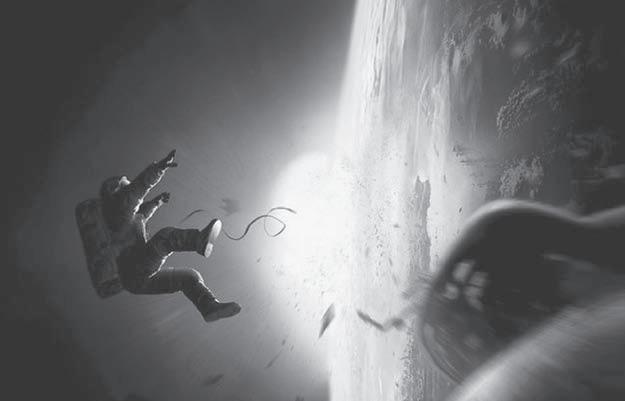
writing about film offers the same promises and rewards. For example, when pressured to explain carefully why she liked Gravity, one student discovered that her understanding of and appreciation for the film were more complex and subtle than she had initially realized (Figure 1.01). Acknowledging that there was no missing the spectacular special effects of the film, she began to think more about not only what makes the film so enjoyable, but also about how it communicates important ideas about humanity. She began her expanded response:
While most discussions of the 2013 Gravity will undoubtedly focus on the way its 3D technology transports us into outer space as few films ever have, we should not overlook the heart of the film: its ability to skillfully tell a gripping and suspenseful tale about the grit and determination of a woman struggling to survive under enormous pressure. Even severe critics would probably acknowledge the mesmerizing cinematography which not only immerses us in deep space but also, more subtlely, involves us in a meditative story about the power of emotional relationships. The story itself is relatively straightforward. On a routine space walk, medical engineer Ryan Stone and astronaut Matt Kowalsky are catastrophically separated from their shuttle, tethered only to each other. Later, after Kowalsky sacrifices himself so that she can make her
Figure 1.01 Writing about Gravity (2013) can become an opportunity to clarify and develop initial impressions into more developed ideas and thoughts about that film.
way to an abandoned space station, Ryan finds a way to navigate a crippled space capsule back to earth. Amidst this tense drama of loss and survival is the bond that develops between the two characters, the emergence of a mother’s memories of the tragic death of her daughter, and the excruciating drama of a woman’s astonishing skill and power within the beautiful but horrifying vacuum of space. This is not so much a sci-fi adventure film but a film about a woman overcoming a traumatic past and a terrifying present to become a miraculously tall figure, rising triumphantly from the gravity of the earth.
If the movies inform many parts of our lives, we should be able to enjoy them in many ways, including the challenging pleasure of trying to think about, explain, and write about our experience watching them. We go to the movies for many reasons: to think or not to think, to stare at them, or to write about them. We may go to a movie to consume it like cotton candy; we may go to a film where that candy becomes food for the mind. As the fan of Gravity found out, analyzing a response to a movie does not ruin the enjoyment of it. Writing about a film can allow viewers to enjoy it (and other films) in ways they were incapable of before. If watching and understanding is one of the pleasures of the movies, writing and explaining can be another exciting pleasure.
Let us keep in mind that writing about the movies is not so far from what most of us do already: When we leave a movie theater after two hours of enforced silence, most of us discuss or argue about the film. Although the difference between talking and writing about a subject is a crucial one, writing about a film is, in one sense, simply a more refined and measured kind of communication, but with a reader. Our comments can be about the performance of an actor, the excitement elicited by specific scenes, or just common questions about what happened, why it happened, or why the film made the answers to these questions unclear.
Frequently, these conversations evolve from searching for the right word or finding a satisfactory description of how a sequence develops: “I prefer Keaton to Chaplin because Keaton’s funnier. Well, I mean, he tells funnier, more complicated stories”; “I hated—no, I found much too predictable—the ending of Flight (2012).” While talking about movies, even casually, we search for words to match what we saw and how we reacted to it. Writing about film is a careful and more calculated step beyond this first impulse to discuss what we have seen. Given this normal impulse, we can even enjoy talking and writing about a movie that we did
not like. A friend of the writer who praised Gravity thus begins his essay more negatively than the student quoted previously:
While the 3D technology of Gravity (2013) creates a dreamy and often fascinating experience of outer space, it also demonstrates—once again—how that technology has usurped the complexity usually found in good stories with good characters. Sandra Bullock and George Clooney portray the only two characters in the film, medical engineer Ryan Stone and astronaut Matt Kowalsky, but despite this potentially rich and dynamic encounter between two megastars, the film lets them literally drift in and out of lame conversations and silly quips. Early in the film Clooney/Kowalski is cut loose to drift away into the void of space (reappearing later in Bullock/Stone’s brief hallucination), but the majority of the film concentrates on Stone’s weightless struggles with equipment and a broken space craft. There is, in fact, little story or plot in this movie other than the mechanical drama of returning to earth, and even adding the memory of Stone’s child and her tragic death cannot redeem the superficiality of characters who seem to be there mainly to enhance the visual acrobatics of the film. Gravity offers beautiful other-worldly images and sometimes suspenseful movements, but without nuanced characters and a fully developed story, it remains only a pleasant ride through the dark.
As these two friends discovered, when we perceive the same movie differently, trying to explain that understanding can be charged with all the energy of a good conversation.
Perhaps more than most other arts and entertainments, the movies frequently elicit a strong emotional or intellectual reaction. Often, however, the reason for our particular reaction to a movie remains unclear until we have had the opportunity to think carefully about and articulate what stimulated it. Meet John Doe (1941) might elicit a giddy nostalgia ridiculously out of step with today’s political complexities; some viewers of I Love You Phillip Morris (2009) may find themselves attracted by the honest depiction of a gay relationship with depth and passion but be put off by Jim Carrey’s typically exaggerated antics; most audiences of Fellini’s 8 1/2 (1963) will probably recognize the importance of the opening sequence, in which a man floats from his car above a traffic jam, but they may be hard-pressed to explain quickly what it means in terms of the story that follows. Analyzing our reactions to themes, characters, or images like these can be a way not only of understanding a movie
better, but also of understanding better how we view the world and the cultures we live in. In the following three paragraphs, we can see how Geoffrey Nowell-Smith turned his initial excitement about a scene in a Michelangelo Antonioni film into an exploration of that particular scene and, implicitly, into a discussion of his admiration of the human complexity in Antonioni’s films:
There is one brief scene in L’Avventura, not on the face of it a very important one, which seems to me to epitomize perfectly everything that is most valid and original about Antonioni’s form of cinema. It is the scene where Sandro and Claudia arrive by chance at a small village somewhere in the interior of Sicily. The village is strangely quiet. They walk around for a bit, call out. No reply, nothing. Gradually it dawns on them that the village is utterly deserted, uninhabited, perhaps never was inhabited. There is no one in the whole village but themselves, together and alone. Disturbed, they start to move away. For a moment the film hovers: the world is, so to speak, suspended for two seconds, perhaps more. Then suddenly the film plunges, and we cut to a closeup of Sandro and Claudia making love in a field—one of the most ecstatic moments in the history of the cinema, and one for which there has been apparently no formal preparation whatever. What exactly has happened?
It is not the case that Sandro and Claudia have suddenly fallen in love, or suddenly discovered at that moment that they have been in love all along. Nor, at the other extreme, is theirs a panic reaction to a sudden fear of desolation and loneliness. Nor again is it a question of the man profiting from a moment of helplessness on the part of the woman in order to seduce her. Each of these explanations contains an aspect of the truth, but the whole truth is more complicated and ultimately escapes analysis. What precisely happened in that moment the spectator will never know, and it is doubtful if the characters really know for themselves. Claudia knows that Sandro is interested in her. By coming with him to the village she has already more or less committed herself, but the actual fatal decision is neither hers nor his. It comes, when it comes, impulsively: and its immediate cause, the stimulus which provokes the response, is the feeling of emptiness and need created by the sight of the deserted village. Just as her feelings (and his too for that matter) are neither purely romantic nor purely physical, so her choice, Antonioni is saying, is neither purely determined nor purely free. She chooses, certainly, but the significance of her choice escapes her, and in a sense also she could hardly have acted otherwise.
Where in this oppressive physical and social environment do the characters find any escape? How can they break out of the labyrinth which nature and other men and their own sensibilities have built up around them? Properly speaking there is no escape, nor should there be. Man is doomed to living in the world—this is to say no more than that he is doomed to exist. But the situation is not hopeless. There are moments of happiness in the films, which come, when they come, from being at peace with the physical environment, or with others, not in withdrawing from them. Claudia in L’Avventura , on the yacht and then on the island, is cut off, mentally, from the other people there, and gives herself over to undiluted enjoyment of her physical surroundings, until with Anna’s disappearance even these surroundings seem to turn against her and aggravate rather than alleviate her pain. In The Eclipse Vittoria’s happiest moment is during that miraculous scene at Verona when her sudden contentment seems to be distilled out of the simple sights and sounds of the airport: sun, the wind in the grass, the drone of an aeroplane, a juke-box. At such moments other people are only a drag—and yet the need for them exists. The desire to get away from oneself, away from other people, and the satisfaction this gives, arise only from the practical necessity for most of the time of being aware of oneself and of forming casual or durable relationships with other people. And the relationships too can be a source of fulfillment. No single trite or abstract formulation can catch the living essence of Antonioni’s version of the human comedy (355, 363).
In this example, a single scene becomes the stimulus for the essay. The author probes and questions this scene: What exactly has happened, and what does it mean? His obvious satisfaction as a writer comes from analyzing this scene as if it were a mystery to be solved. In the process of his analysis, his original curiosity leads to broader readings of other Antonioni movies and, finally, to his discovery of a consolation in the disturbing predicament that first caught his eye. For this writer, the pleasure of following his curiosity leads to the larger pleasure of understanding more about life and happiness in modern times.
Writing Cue
Identify a scene in a film you’ve recently seen that most affected you or most confused you. In one or two paragraphs try to explain why. Be sure to use specific evidence from the film to support your answer.
y our Audien C e A nd the Ai M s of f il M Criti
C is M
Writing about film can serve one of several functions. It can help you do the following:
• Understand your own response to a movie better.
• Convince others why you like or dislike a film.
• Explain or introduce something about a movie, a filmmaker, or a group of movies that your readers may not know.
• Make comparisons and contrasts between one movie and others as a way of understanding them better.
• Make connections between a movie and other areas of culture to illuminate both the culture and the movies it produces.
The purposes that become part of or central to your writing will sometimes depend entirely on your audience: An essay introducing a new movie, for example, is usually written for an audience that has not seen the film. However, even when that purpose is decided on independently—perhaps out of a personal interest in the relation between Spanish films and Spanish culture—what you say will always be shaped by your notion of your audience and especially by what you presume those readers know or want to know.
If you think of writing as, in some ways, resembling conversation, you will see how the notion of an audience helps shape what you say. If, for example, you are discussing a US movie, such as The Blind Side (2009), with a non-American, both the way you make your point about the film and, perhaps, the point itself will be determined by what you believe that individual knows and wants to know about US culture and about the movie. (A non-American, for example, may need more information about US football and college recruitment of high-school players, whereas an American will need very little information.) Similarly, in discussing a film with someone who may not have seen it, I would probably first describe that film with a general overview, summarizing the plot and themes as a way to convince that person to see the film or not to see it. If, on the other hand, I am talking about a movie that a friend and I have both seen several times, such as Zero Dark Thirty , I do not have to remind that person of the plot or of the main characters. Just as our conversations about movies differ according to the individuals we are speaking with, the way we write about film and even the critical position we choose vary depending on the audience we are writing for.
One schematic and traditional way to indicate the different audiences a writer might envision is to distinguish among the following:
• A screening report.
• A movie review.
• A theoretical essay.
• A critical essay.
A great deal of writing about film today now appears on the Internet, and this kind of open forum does tend to blur these distinctions, just as it blurs a clear sense of the intended audience for different kinds of writing. Although these four modes of writing are hardly exhaustive or completely distinct, they should indicate the importance of keeping your audience in mind as a way of determining your style and goals.
the screening report
A screening report is a short piece of writing that acts as a preparation for class discussions and examinations. Primarily a descriptive assignment that organizes notes on a film (see pp. 38–45) , the report should contain about three or four paragraphs (about one to two pages) focused on two to four points related to the topics of the course or to specific questions provided by the instructor (your target audience for this kind of writing). Unlike a review or critical essay, a screening report avoids strong opinions or a particular argument. Instead, it aims to be as objective and concrete as possible, including audio and visual detail wherever possible. For a class on the road movie, one student begins his screening report of Terrence Malick’s Badlands (1973) this way:
1. Badlands as Road Movie: Narrative. Characteristic of this genre is the journey away from home and onto an open road. Like other road movies, here there are no apparent goals, except flight, and the plot develops as a series of episodic events and encounters. After the murder of Holly’s father, she and Kit almost randomly kill people they encounter on the road, as a kind of parody of the violence found in other road movies.
2. Badlands and the Road Movie: Compositions. The most obvious emblem of a road movie is the moving perspective of the car that carries Kit and Holly along the open roads of the West. The framing of numerous shots in this film call attention to the vast and empty spaces that surround the characters, but unlike more realistic road movies, the luminous images of Badlands often create surreal landscapes. The
sound track is an unusual variation on the genre: Holly’s voice-over narration makes the story seem like a cheap romantic novel, and the music ranges from the operatic to honky-tonk.
Because this is a first sketch of the report, more specific details must be added later. Precise description of several shots and scenes will then provide compelling support for discussions in class and for preparation for examinations.
the Movie review
The movie review is the type of film analysis with which most of us are chiefly familiar because it appears in almost every newspaper. Normally, a review aims at the broadest possible audience, the general public with no special knowledge of film. Accordingly, its function is to introduce unknown films and to recommend or not recommend them. Because it presumes that an audience has not seen the movie it discusses, much of the essay is devoted to summarizing the plot or placing the film in another context (the director’s other work, films of the same genre, and so on) that might help the reader understand it. Here, Vincent Canby’s review introduces the readers of the New York Times to Malick’s Badlands:
In Terrence Malick’s cool, sometimes brilliant, always ferociously American film, “Badlands,” which marks Malick’s debut as a director, Kit and Holly take an all-American joyride across the upper Middle West, at the end of which more than half a dozen people have been shot to death by Kit, usually at point blank range. “Badlands” is the first feature by Mr. Malick, a 29-year-old former Rhodes Scholar and philosophy student whose only other film credit is as the author of the screenplay for the nicely idiosyncratic “Pocket Money.” “Badlands” was inspired by the short, bloody saga of Charles Starkweather who, at age 19, in January, 1958, with the apparent cooperation of his 14-year-old girlfriend, Carol Fugate, went off on a murder spree that resulted in 10 victims. Starkweather was later executed in the electric chair and Miss Fugate given life imprisonment.
“Badlands” inevitably invites comparisons with three other important American films—Arthur Penn’s “Bonnie and Clyde” and Fritz Lang’s “Fury” and “You Only Live Once”—but it has a very different vision of violence and death. Mr. Malick spends no great amount of time invoking Freud to explain the behavior of Kit and Holly, nor is there any Depression to be held ultimately responsible. Society is, if anything, benign.
“Badlands” is narrated by Holly in the flat, nasal accents of the Middle West and in the syntax of a story in True Romances. “Little did
I realize,” she tells us at the beginning of the film, “that what began in the alleys and by-ways of this small town would end in the Badlands of Montana.” At the end, after half a dozen murders, she resolves never again to “tag around with the hell-bent type.”
Kit and Holly share with Bonnie and Clyde a fascination with their own press coverage, with their overnight fame (“The whole world was looking for us,” says Holly, “for who knew where Kit would strike next?”), but a lack of passion differentiates them from the gaudy desperados of the thirties. Toward the end of their joyride, the bored Holly tells us she passed the time, as she sat in the front seat beside Kit, spelling out complete sentences with her tongue on the roof of her mouth.
Mr. Malick tries not to romanticize his killers, and he is successful except for one sequence in which Kit and Holly hide out in a tree house as elaborate as anything the MGM art department ever designed for Tarzan and Jane. Mr. Sheen and Miss Spacek are splendid as the self-absorbed, cruel, possibly psychotic children of our time, as are the members of the supporting cast, including Warren Oates as Holly’s father.
One may legitimately debate the validity of Mr. Malick’s vision, but not, I think, his immense talent. “Badlands” is a most important and exciting film (40).
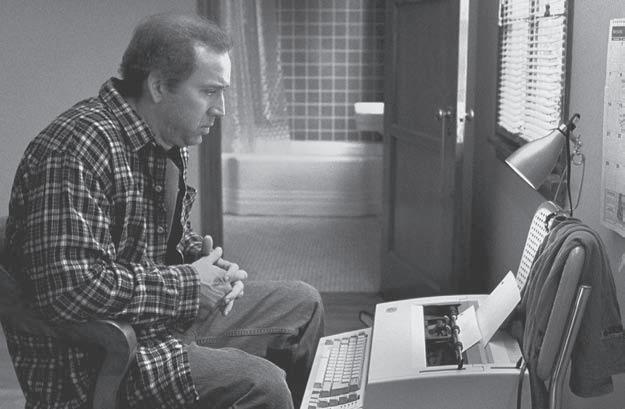
We can identify more than one function in this essay. Canby aims to convince his reader that Badlands is an important movie that is worth seeing, and he does this by introducing Malick and his credentials, by describing the plot and the historical background of that plot, by evaluating the acting, and by placing Malick’s movie in the context of other films like it (specifically, Bonnie and Clyde [1967] and the two Fritz Lang movies). Equally important, however, is his clear sense of his audience: readers who probably know the popular Bonnie and Clyde but little about Malick and the background of Badlands. These are readers who have not yet seen the film and would like to know the outline of the story and a little about the characters and actors (Figure 1.02).
the theoretical essay
The more theoretical essay—for instance, an essay on the relation of film and reality, on the political or ideological foundations of the movie industry, or on how film narrative is unlike literary narrative—is at the other end of the spectrum. Such an essay often supposes that the reader possesses a great deal of knowledge about specific films, film history, and other writings about film. Its target audience, often advanced students or people who teach film studies, is usually knowledgeable about the