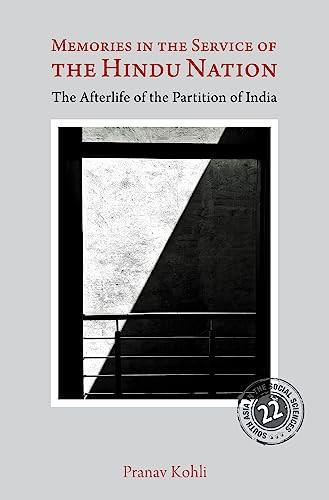
Memories in the Service of the Hindu Nation
Memories in the Service of the Hindu Nation is based on 14 months of ethnographic fieldwork in Delhi and its surroundings between 2017 and 2018 with Partition survivors from west Punjab and the North-West Frontier Province. It locates the global rise of far-right nationalism within globalisation and memories of victimhood. Focusing on Hindu nationalism in India, this book is an important and timely contribution to the literature on South Asian Partition Studies that shows how tragedy begets tragedy. It tries to answer an urgent, provocative but nevertheless necessary question: What does it mean to remember the Partition in the time of fascism?
The author shows what makes up cycles of violence by connecting the reinscription of trauma in Partition memories to the self-serving justifications of the contemporary violence of Hindu nationalism. It analyses how the hegemony of Hindu nationalism has structured the narratives of Hindu Partition survivors and recruited them in the service of a putative Hindu nation.
Pranav Kohli teaches sociology at Maynooth University, Ireland. He is a political anthropologist specialising in race, gender, conflict, authoritarianism and memory with an abiding interest in their intersections with the politics of health.
SOUTH ASIA IN THE SOCIAL SCIENCES
South Asia has become a laboratory for devising new institutions and practices of modern social life. Forms of capitalist enterprise, providing welfare and social services, the public role of religion, the management of ethnic conflict, popular culture and mass democracy in the countries of the region have shown a marked divergence from known patterns in other parts of the world. South Asia is now being studied for its relevance to the general theoretical understanding of modernity itself.
South Asia in the Social Sciences will feature books that offer innovative research on contemporary South Asia. It will focus on the place of the region in the various global disciplines of the social sciences and highlight research that uses unconventional sources of information and novel research methods. While recognising that most current research is focused on the larger countries, the series will attempt to showcase research on the smaller countries of the region.
General Editor
Partha Chatterjee
Columbia University
Editorial Board
Pranab Bardhan
University of California at Berkeley
Stuart Corbridge
Durham University
Satish Deshpande
University of Delhi
Christophe Jaffrelot
Centre d’etudes et de recherches internationales, Paris
Nivedita Menon
Jawaharlal Nehru University
Other books in the series:
Government as Practice: Democratic Left in a Transforming India
Dwaipayan Bhattacharyya
Courting the People: Public Interest Litigation in Post-Emergency India
Anuj Bhuwania
Development after Statism: Industrial Firms and the Political Economy of South Asia
Adnan Naseemullah
Politics of the Poor: Negotiating Democracy in Contemporary India
Indrajit Roy
Nationalism, Development and Ethnic Conflict in Sri Lanka
Rajesh Venugopal
South Asian Governmentalities: Michel Foucault and the Question of Postcolonial Orderings
Stephen Legg and Deana Heath (eds.)
Adivasis and the State: Subalternity and Citizenship in India’s Bhil Heartland
Alf Gunvald Nilsen
Maoist People’s War and the Revolution of Everyday Life in Nepal
Ina Zharkevich
New Perspectives on Pakistan’s Political Economy: State, Class and Social Change
Matthew McCartney and S. Akbar Zaidi (eds.)
Crafty Oligarchs, Savvy Voters: Democracy under Inequality in Rural Pakistan
Shandana Khan Mohmand
Dynamics of Caste and Law: Dalits, Oppression and Constitutional Democracy in India
Dag-Erik Berg
Simultaneous Identities: Language, Education and the Nepali Nation
Uma Pradhan
Deceptive Majority: Dalits, Hinduism, and Underground Religion
Joel Lee
Colossus: The Anatomy of Delhi
Sanjoy Chakravorty and Neelanjan Sircar (eds.)
When Ideas Matter: Democracy and Corruption in India
Bilal A. Baloch
In Search of Home: Citizenship, Law and the Politics of the Poor
Kaveri Haritas
Bureaucratic Archaeology: State, Science, and Past in Postcolonial India
Ashish Avikunthak
Political Economy of the Development of Bangladesh
K. A. S. Murshid
An Uneasy Hegemony: Politics of State-building and Struggles for Justice in Sri Lanka
Shyamika Jayasundara-Smits
Founding Mothers of the Indian Republic: Gender Politics of the Framing of the Constitution
Achyut Chetan
Freedom in Captivity: Negotiations of Belonging along Kashmir’s Frontier
Radhika Gupta
Memories in the Service of the Hindu Nation
The Afterlife of the Partition of India
Pranav Kohli
Shaftesbury Road, Cambridge CB2 8EA, United Kingdom
One Liberty Plaza, 20th Floor, New York, NY 10006, USA
477 Williamstown Road, Port Melbourne, VIC 3207, Australia
314–321, 3rd Floor, Plot No. 3, Splendor Forum, Jasola District Centre, New Delhi 110025, India
103 Penang Road, #05–06/07, Visioncrest Commercial, Singapore 238467
Cambridge University Press is part of Cambridge University Press & Assessment, a department of the University of Cambridge.
We share the University’s mission to contribute to society through the pursuit of education, learning and research at the highest international levels of excellence.
www.cambridge.org
Information on this title: www.cambridge.org/9781009318686
© Pranav Kohli 2023
This publication is in copyright. Subject to statutory exception and to the provisions of relevant collective licensing agreements, no reproduction of any part may take place without the written permission of Cambridge University Press & Assessment.
First published 2023
Printed in India
A catalogue record for this publication is available from the British Library ISBN 978-1-009-31868-6 Hardback
Cambridge University Press & Assessment has no responsibility for the persistence or accuracy of URLs for external or third-party internet websites referred to in this publication, and does not guarantee that any content on such websites is, or will remain, accurate or appropriate.
For my Nani, who carried the burden of a difficult past.
For my godson Anbu in the hope of an unburdened future.
1.1 Teen Murti Bhavan 73
1.2a The Gurdwara Shahidane Gujrat Train in Sector 5, NIT, Faridabad 83
1.2b The Gurdwara Shahidane Gujrat Train in Sector 5, NIT, Faridabad 83
5.1 The Usha-make sewing machine my grandaunt Anjali’s family friends still possessed 162
5.2 My grandaunt’s sewing machine 165
5.3 The embossed panel on the machine that reads, ‘Tolaram Ramdass & Co., Post Box No. 130, Karachi’ 165
5.4 My mother’s photograph with the then prime minister Indira Gandhi 182
6.1 The 1947 Partition Archive’s exhibition in Delhi’s Kamladevi Complex, September 2017 196
6.2 Members of the public watch a montage of interview snippets, at the exhibition 196
6.3 An excerpt from Promod Mehra’s oral testimony on display at the exhibition 197
6.4 An excerpt from Thakar Daas Batheja’s oral testimony at the 1947 Partition Archive’s exhibition 201
8.1 Screenshots of Hindu Right propaganda texts forwarded by Gangaram 252
8.2 Screenshots of a forwarded text message from Gangaram 254
Acknowledgements
There are a number of people to whom thanks are due. First and foremost, to my mom: thank you for being the best sociological mom ever! You are the best!
To Choti Nani and my family in Faridabad – Nani Masi, Tony mamu, Poonam mami and Sagar bhaiya – thank you for taking care of me during my fieldwork. None of this would have been possible without your kindness, hospitality, care and generosity. Thanks are also due to my extended family who helped me in various ways, including my search for informants.
To my informants, thank you for opening up your homes and hearts to me. You are my kin and ancestors, and I will always love and respect you. I will keep you alive in writing and memory. Thanks are also due to Mr and Mrs Adlakha for assisting me in my search for informants.
To my PhD supervisor, Thomas Strong, thank you for everything. You have been an inspiring mentor and role model, an exemplar of the kind of engaged anthropologist I aspire to be.
Thanks are also due to Chandana Mathur, Steve Coleman and Andrew Finlay for having been my supervisors at different stages of my academic journey. Your spirit animates this monograph. Thanks also to Peter van der Veer for his invaluable feedback as the external examiner of my PhD thesis. I bear the memory of passing my viva with zero corrections, with honour. Thanks are also due to my academic colleagues Eamonn Slater, John Brown and Barry Cannon for their advice and timely pep-talks at various stages of the publication process.
Acknowledgements
Thanks are also due to my whimsical Irish foster parents Ela and Michael Kennedy; to my friends Adeen Solaiman, Mahvish Khan, Miriam Teehan, Sara O’Rourke, Danielle Ng, Maire Ni Mhordha, and to my fellow Reading Room Rats (especially Gabriella for the lifetime free Dropbox space). A special thanks to Sherin and Nitin Williams – my family in Helsinki – for their feedback on the final draft of this manuscript.
Thanks also to Romila Thapar, Tanika Sarkar, Urvashi Butalia and Nonica Datta for taking the time to talk to me during my fieldwork. Thank you for inspiring me with your work and words.
Thanks are due to Maynooth University, whose John and Pat Hume Doctoral Studentship supported my PhD studies.
Last but not least, thanks to my editors Anwesha Rana and Qudsiya Ahmed, to series editor Partha Chatterjee, the members of the series editorial board and the three anonymous peer reviewers for believing in this project.
The Linguistic Setting
The Partition of India remains the largest episode of retributive genocide and mass displacement in history (Aiyar 1995). It is estimated that between 200,000 and 2 million people were killed in the retributive violence that ensued, while between 10 and 17 million people were displaced in a haphazard transfer of population. In the process, approximately 3.4 million refugees went missing (Brass 2003b; Khwaja, Bharadwaj and Mian 2009). What began as a haphazard migration for safety – as people found themselves on the ‘wrong’ side of the border – was later formalised between India and Pakistan as a transfer of population (Bharadwaj and Mirza 2019).
This book is an ethnography of the memory of this historical rupture – its afterlife. It is based on 14 months of intensive fieldwork in Delhi and its surrounding National Capital Region where I located and worked with over 50 first-hand survivors of the 1947 Partition of India. My research specifically focuses on Hindu refugees from the northwestern Pakistani districts of Mianwali, Dera Ghazi Khan, Dera Ismail Khan, Bannu, Quetta (Balochistan), Multan and Mianwali. Barring a brief trip to Dehradun, the overwhelming majority of Partition survivors I spoke to live in Delhi and its surroundings.
For the most part my fieldwork involved drinking copious amounts of tea with my informants as we discussed politics, history and their everyday lives. As a project that combines oral history with participant observation, this book relies heavily on the recording, transcription, interpretation and translation of the words of my informants. It is for
Memories in the Service of the Hindu Nation
this reason that detailing the ethnic and linguistic setting of my research gains added relevance.
Being a third-generation Partition migrant, my connection to the Partition is deeply intimate. Delhi was the obvious site for my fieldwork because my family’s Partition survivors and their friends are settled there. This personal connection is visible throughout my research, shaping my search for informants as well as my engagement with theory. Due to the snowballing nature of my search for informants – that branched out into the kith and kin networks of my family’s elders – all of my informants hail from the Derajat region and the North-West Frontier Province. All my informants were aged 80 and above at the time of interviews (2017–2018). Most of the people who find a mention in this book were close to 85 years of age. Roughly two-thirds of my informants happened to be men, an accident of social relations. All of my informants were upper-caste, middle-class and Hindu. They belonged to a mix of castes such as Khatri, Arora, Bhatia, Malik and Brahmin.1 All of them came from well-off zamindar families. Quite a few even owned businesses in addition to hereditary land titles.
The stories I have documented here tell the story of the Partition as it unfolded in this north-western region of Pakistan. The Derajat region is located in the area where the Pakistani provinces of Punjab, Balochistan and Khyber-Pakhtunkhawa (formerly North-West Frontier Province) meet. The Derajat region is identified as a culturally distinct region, partly due to the fact that it is home to the Saraiki language. The historical districts of Dera Ghazi Khan, Dera Ismail Khan, Quetta, Mianwali and Multan are most closely associated with the Derajat region and the Saraiki language (Hashmi and Majeed 2014). However, as my informants continuously reminded me, Saraiki is something of an umbrella term for the closely related dialects of Derawali, Mianwali-boli (or Mianwali dialect) and Multani. These dialects also bear a close resemblance to Punjabi. Today, Saraiki is the major language of this region (in Pakistan) and is spoken by approximately 25–40 million people (Hashmi and Majeed 2014).
North-west of the Derajat region, in the North-West Frontier Province, the main languages spoken were Pashto, Persian and Urdu. My informants from Bannu and other remote parts of this province saw themselves as neither Saraiki nor Punjabi, but as Pashtuns and/or
Pathans. As my key informant Pooran Chand told me, in the years immediately following the Partition, the Frontier refugees asserted their ethnic identity partly through their refusal to marry into Punjabi families.
However, much has changed in the post-Independence, postPartition context. Although remembered by the survivors of the Partition and some of their children, these regional identities have been subsumed within a larger Punjabi and Indian cultural identity. The grandchildren of Partition survivors, that is, the people of my generation, identify as Punjabi or Delhiites or whatever other local Indian identity they consider relevant. None of the people of my generation speak Saraiki or any of its dialects. Among the families of my informants, Hindi appeared to have replaced these dialects as the mother tongue. This is in contrast to Pakistan, where Saraiki has emerged as a slowburning ethnic question, complete with the demand for a Saraiki province (Butt and Ahmed 2016).
The only settings where I observed an explicit emphasis on these (legacy) regional identities was in the activities of the organisations formed by Partition refugees, namely the All-India Mianwali District Association and the All-India Derawal Sahayak Sabha (‘Volunteer Assembly’). These volunteer-based organisations were founded by Mianwali and Derawal Partition refugees in the 1950s with the explicit purpose of resettling their respective communities. However, by 2017 these organisations had become a mere shadow of their former selves. Almost all of their active members were aged 60 and above, with little to no involvement of young and middle-aged people. Although these organisations still organised annual meet-ups for their members, the general tone of these events can be best described by what Michael Herzfeld (2005) once referred to as a nostalgia for real community. Nevertheless, these organisations and their events were instrumental in my search for informants.
As a result of these transformations in culture and identity over the last 75 years since the Partition, my interviews and fieldwork interactions were almost entirely conducted in Hindi. However, given the diversity of the linguistic context of my research, other languages too often made an appearance in the speech of my informants. At times, either for dramatic effect or subconsciously, my informants spoke the occasional
sentence or phrase in English, Urdu, Saraiki or Punjabi. Notwithstanding such instances, Hindi was predominantly the language in which my fieldwork was conducted.
Having been fluently bilingual in Hindi and English from an early age, I was able to transcribe and translate my informants’ words with ease. My larger concern around translation in this context was not regarding my ability to convert words from one language into another. Rather, the challenge lay in confronting translation as an added layer of interpretation.
I have endeavoured to preserve the emic vocabulary of my informants as far as possible. Readers will observe numerous instances in this book where I have preserved the Hindi/Punjabi/Urdu words of my informants and explained their meanings in accompanying commentary. I have done this for words and phrases that do not have a direct English translation and to convey something of the literariness or emotive context of my informants’ speech.
Paying attention to the literariness of my informants’ speech has also informed my engagement with theory. This is most visible in Part II, where my analysis of the theodicical discourse of sacrifice partly hinges on the deconstruction of the gendered connotations of my informants’ use of the word purusharth. The translation and interpretation of this word is part of a larger dialogue with my informants and their memories of the Partition.
In my transliterations of these vernacular words and phrases, I have strived for phonetic accuracy. Dispensing with the use of diacritics, I have written these words phonetically using the Roman alphabet. There is nothing novel or controversial about this. Almost every Englishspeaking Indian netizen would have encountered such transliterations in the form of mass-forwarded vernacular jokes. Wherever I was in doubt regarding the ‘correct’ transliteration of a word, I merely turned to the vast literature on South Asia for guidance. In this way, my transliteration of vernacular words follows colloquial linguistic practices and former scholarly transliterations. Occasionally, I also sought my mother and my grandaunt Anjali’s advice on the translation and transliteration of particular words.
Ultimately, by preserving some of the literariness of the speech of my informants, I have tried to convey the individualised and personalised
tone of these narratives. There is no master narrative of the Partition. What one finds instead is a constellation of independent voices that contextualise, organise, localise and mobilise their memory in relation to certain common frames of reference. As an ethnography of the last generation of Partition survivors, I consider the documentation of this polyphonous voicing an important scholarly objective. I hope that my work will sustain our ongoing dialogue with the suffering and violence in our past and present.
Note
1 I have not mentioned the specific castes of specific informants in their introductions as part of persistent efforts to preserve their anonymity. Some of my informants shared their last name with the name of their caste (for example, Arora and Bhatia). I have therefore used the somewhat generalising gloss of ‘upper-caste’ with a twofold objective: to make the caste dynamics at play intelligible to a larger non-South Asian non-specialist audience and to obscure biographical details.
Part I
The Past and the Present
Death and the Problem of Theodicy
This book is primarily about death and suffering. It is an ethnography of the memory of the 1947 Partition of India and how its survivors make sense of the Partition’s death and suffering decades after the fact. Although I worked with close to 50 informants while compiling this book, there was one person who was instrumental in the conceptualisation of this overarching theme: my late grandaunt Sneh.
My grandaunt Sneh died on the night of 7 June 2018. Her death came as a complete shock. Earlier that night, we had spoken on the phone and made plans for the following day. But it was not to be. She had a heart attack later that night and by the time her children drove her to the hospital, it was already too late. It was all over in a little less than an hour.
Through the course of my fieldwork, she and I had become quite close. She was the last surviving sibling of my late maternal grandmother. But growing up, I had not had the chance to spend much time with her. That year that I spent living in Delhi, she affectionately imposed a grandmotherly relationship on me. She would call me frequently to check up on me and would get annoyed if we went a week without talking on the phone. It was almost always my fault!
Sneh, or Nani Masi as I used to call her, was born in 1946 in Rajanpur, a small town in the district of Dera Ghazi Khan (now in Punjab, Pakistan). She was only an infant during the Partition. The youngest of four siblings (by quite a distance), she was relatively shielded from the chaos of the time. She remembered growing up in Kingsway Camp (Delhi) and later in the resettlement colony of Palwal, a satellite town 60 kilometres from Delhi. Her father – my greatgrandfather – Chaudhry Pooran Chand1 was a renowned lawyer in his
time. He was even appointed the resettlement commissioner of this area. Until as late as 2018, a certain generation of people in Palwal still remembered how he had spearheaded the resettlement process in this area. As his last surviving child, Nani Masi quietly embodied his legacy.
In her youth, she had been something of a rebel. In contrast to the sheltered upbringing my grandmother had received, Nani Masi had enjoyed a degree of freedom and independence that was quite unusual in the context of its time. She was 11 years younger than my grandmother. This meant that Nani Masi was in school when my grandmother got married. Although only a teenager at the time, she would travel alone on public transport, from Palwal to Delhi, to visit them. As she described it, she had been fairly chust (street-smart) all through her life. Even after marriage, she often made her way on her own, sometimes even with a child or two on her hip. She and her husband had taken entire road trips on their motorcycle, often with their children balanced finely between them. She loved remembering the spontaneity and freespiritedness of her younger days.
Ultimately, it was her failing health that changed everything. The last 10 years of her life were marked by a steady decline. The slide had begun soon after my grandmother’s passing in 2006 and intensified after her husband’s death in 2010. By 2017 her health was dire. Her stomach and face had swollen up alarmingly. She could barely walk now. And even with a stick for support, just hobbling around her home left her breathless. While she was still quite sharp, her near-complete bed rest had impacted her mental health.
Yet she did not let her failing health stop her from becoming a part of my fieldwork. She used her vast network of friends and family to find me a number of informants. And, whenever she put me in touch with a new informant, she insisted on accompanying me to our first meeting. So, as I made numerous trips to Delhi and Palwal, she came with me. She would not have it any other way.
Those long drives are some of the fondest memories I have of her. Away from the rest of the family, she spoke her mind, unfiltered. Nani Masi and I rarely saw eye to eye on anything, but it was through these conversations that we truly bonded. She told me about her quarrels with her children, and we gossiped ad infinitum about the petty politics of her household. She also shared her memories of my grandparents
and of my mother’s childhood. It was during one of those conversations that she told me that she saw a lot of my mother in me – that like her, I am self-reliant and independent. This was important to her.
Another time, she shared one of her best-kept secrets: she had a fondness for drinking. She told me that often after she and uncle (her husband) had put the kids to bed, they would have a glass of Scotch together. She had never touched alcohol outside the home or in anyone else’s presence. Her ‘transgressions’ had remained safely ensconced within the four walls of her household. She still had a half bottle of Scotch hidden safely in her TV cabinet. After we got home that day, we had half a peg together, for old time’s sake.
Looking back, I feel these trips were like the second coming of her younger days. They gave her an excuse to get out of the house and back on the road, to rekindle old friendships and acquaintances, to meet people one last time. They were a partial return to the restless rhythms of her youth. A final hurrah!
During my fieldwork in Faridabad I fell into a routine where, after having spent an evening talking to a group of informants in Rose Garden, I would drop by her house for a chat. Her house was a short drive from the park. True to form, she always had a box of sweets and lemonade ready for me. We would sit together, have a chat and I would make fun of whatever melodramatic soap opera she happened to be watching at the time. For her part, she would tease me about my receding hairline and warn me that no one would want to marry a bald man like me. Sometimes she would call on me for lifts to the market. But for the most part, we would just sit together, catch up, gossip, and then I would return to my aunt and uncle’s house just in time for dinner.
Her sudden death was a profoundly dislocating experience. While her presence had had a great impact on my fieldwork, in death, she came to fundamentally structure my engagement with theory. On a basic level, her death reminded me of the fragility of life, especially that of my informants, the elderly – the last generation of Partition survivors. But on a deeper level, her death marked the beginning of my engagement with the philosophy of death and suffering: theodicy.
It was during her funerary rituals that I first observed theodicy at work. Everyone in my family had their own story about her death. Some of my relatives framed her death as the result of long-time neglect.